

ISO 7928-1:2026
(Main)Savory — Specification — Part 1: Winter savory (Satureja montana Linnaeus)
- Abstract
This document specifies the requirements of winter savory (Satureja montana Linnaeus) in the form of sprigs, and whole or broken leaves. It does not apply to summer savory (Satureja horfensis Linnaeus), which forms the subject of ISO 7928-2. Recommendations relating to storage and transport conditions are given in Annex A.
- Status
- Published
- Publication Date
- 26-Apr-2026
- Technical Committee
- ISO/TC 34/SC 7 - Spices, culinary herbs and condiments
- Drafting Committee
- ISO/TC 34/SC 7 - Spices, culinary herbs and condiments
- Current Stage
- 6060 - International Standard published
- Start Date
- 27-Apr-2026
- Due Date
- 15-Apr-2026
- Completion Date
- 27-Apr-2026

Overview
ISO 7928-1:2026 sets forth the international specifications for winter savory (Satureja montana Linnaeus) in the form of sprigs and whole or broken leaves. This standard establishes the requirements for quality, purity, packaging, and labelling, focusing exclusively on winter savory. It intentionally excludes summer savory (Satureja hortensis), which is addressed in ISO 7928-2. The document is designed to support consistent quality in the global trade and use of winter savory in food products and herbal applications. Recommendations for appropriate storage and transport conditions are provided in Annex A.
Key Topics
- Product Scope: Applies specifically to winter savory in sprig or leaf (whole or broken) forms.
- Definitions and Terminology: Establishes clear definitions for terms such as foreign matter and extraneous matter relevant to food safety and product integrity.
- Quality Requirements:
- Odour and flavour: Must be characteristic, strong, aromatic, and free from off-odours or taints.
- Physical requirements: Limits on foreign and extraneous matter to ensure purity.
- Chemical requirements: Specifies acceptable levels for moisture, ash, and volatile oil content.
- Chromatographic profile: Outlines expected main constituents of essential oils for product verification.
- Sampling and Testing: Describes appropriate reference methods for sampling, analysis, and conformity testing, referencing established ISO methods.
- Packaging and Marking: Includes guidelines for safe packaging to preserve quality, and essential label information for traceability and compliance.
- Storage and Transport Recommendations: Provides best practices for maintaining product integrity during storage and shipping.
Applications
- Food Industry: Enables consistent sourcing and quality assurance for winter savory as a culinary herb or spice, supporting manufacturers of processed foods, spice blends, and herb products.
- Herbal Products: Facilitates quality control in the production of herbal teas, extracts, and traditional remedies using winter savory leaves.
- Global Trade: Provides a standardized reference for buyers and suppliers in international markets, reducing disputes and ensuring supplier compliance.
- Regulatory Compliance: Serves as a benchmark for food inspectors, regulatory agencies, and certification bodies assessing herb and spice quality.
- Storage & Logistics: Assists logistics providers and storage facilities in adhering to best practices for maintaining the freshness and safety of dried herbs during distribution.
Related Standards
To ensure thorough quality control and consistency, ISO 7928-1:2026 references several related standards, including:
- ISO 7928-2: Savory - Specification - Part 2: Summer savory (Satureja hortensis Linnaeus)
- ISO 565: Test sieves - Sizes of openings
- ISO 927: Determination of extraneous and foreign matter content in spices and condiments
- ISO 928: Determination of total ash in spices and condiments
- ISO 930: Determination of acid-insoluble ash
- ISO 939: Determination of moisture content
- ISO 948: Sampling methods for spices and condiments
- ISO 2825: Preparation of ground samples for analysis
- ISO 6571: Determination of volatile oil content (hydrodistillation method)
Practical Value
Implementing ISO 7928-1:2026 helps producers, traders, and buyers ensure that winter savory meets internationally recognized quality and safety benchmarks. This fosters transparency, reduces risks related to contaminants, and assures end-users of consistent aromatic and culinary characteristics. It also supports compliance with global regulations and facilitates smoother movement of goods across borders, benefiting the entire savory supply chain.
For more information, visit the ISO website.
Relations
- Effective Date
- 19-Oct-2024
Get Certified
Connect with accredited certification bodies for this standard

BSI Group
BSI (British Standards Institution) is the business standards company that helps organizations make excellence a habit.

Bureau Veritas
Bureau Veritas is a world leader in laboratory testing, inspection and certification services.

DNV
DNV is an independent assurance and risk management provider.
Sponsored listings
Frequently Asked Questions
ISO 7928-1:2026 is a standard published by the International Organization for Standardization (ISO). Its full title is "Savory — Specification — Part 1: Winter savory (Satureja montana Linnaeus)". This standard covers: This document specifies the requirements of winter savory (Satureja montana Linnaeus) in the form of sprigs, and whole or broken leaves. It does not apply to summer savory (Satureja horfensis Linnaeus), which forms the subject of ISO 7928-2. Recommendations relating to storage and transport conditions are given in Annex A.
This document specifies the requirements of winter savory (Satureja montana Linnaeus) in the form of sprigs, and whole or broken leaves. It does not apply to summer savory (Satureja horfensis Linnaeus), which forms the subject of ISO 7928-2. Recommendations relating to storage and transport conditions are given in Annex A.
ISO 7928-1:2026 is classified under the following ICS (International Classification for Standards) categories: 67.220.10 - Spices and condiments. The ICS classification helps identify the subject area and facilitates finding related standards.
ISO 7928-1:2026 has the following relationships with other standards: It is inter standard links to ISO 7928-1:1991. Understanding these relationships helps ensure you are using the most current and applicable version of the standard.
ISO 7928-1:2026 is available in PDF format for immediate download after purchase. The document can be added to your cart and obtained through the secure checkout process. Digital delivery ensures instant access to the complete standard document.
Standards Content (Sample)
SLOVENSKI STANDARD
01-november-2026
Nadomešča:
SIST ISO 7928-1:1997
Šetraj - Specifikacija - 1. del: Kraški šetraj (Satureja montana Linnaeus) (ISO 7928-
1:2026)
Savory — Specification — Part 1: Winter savory (Satureja montana Linnaeus) (ISO 7928
-1:2026)
Sarriette — Spécifications — Partie 1: Sarriette des montagnes (Satureja montana
Linnaeus) (ISO 7928-1:2026)
Ta slovenski standard je istoveten z: ISO 7928-1:2026
ICS:
67.220.10 Začimbe Spices and condiments
2003-01.Slovenski inštitut za standardizacijo. Razmnoževanje celote ali delov tega standarda ni dovoljeno.
International
Standard
ISO 7928-1
Second edition
Savory — Specification —
2026-04
Part 1:
Winter savory (Satureja montana
Linnaeus)
Sarriette — Spécifications —
Partie 1: Sarriette des montagnes (Satureja montana Linnaeus)
Reference number
ISO 7928-1:2026(en)
© ISO 2026
All rights reserved. Unless otherwise specified, or required in the context of its implementation, no part of this publication may
be reproduced or utilized otherwise in any form or by any means, electronic or mechanical, including photocopying, or posting on
the internet or an intranet, without prior written permission. Permission can be requested from either ISO at the address below
or ISO’s member body in the country of the requester.
ISO copyright office
CP 401 • Ch. de Blandonnet 8
CH-1214 Vernier, Geneva
Phone: +41 22 749 01 11
Email: copyright@iso.org
Website: www.iso.org
Published in Switzerland
ii
ISO 7928-1:2026(en)
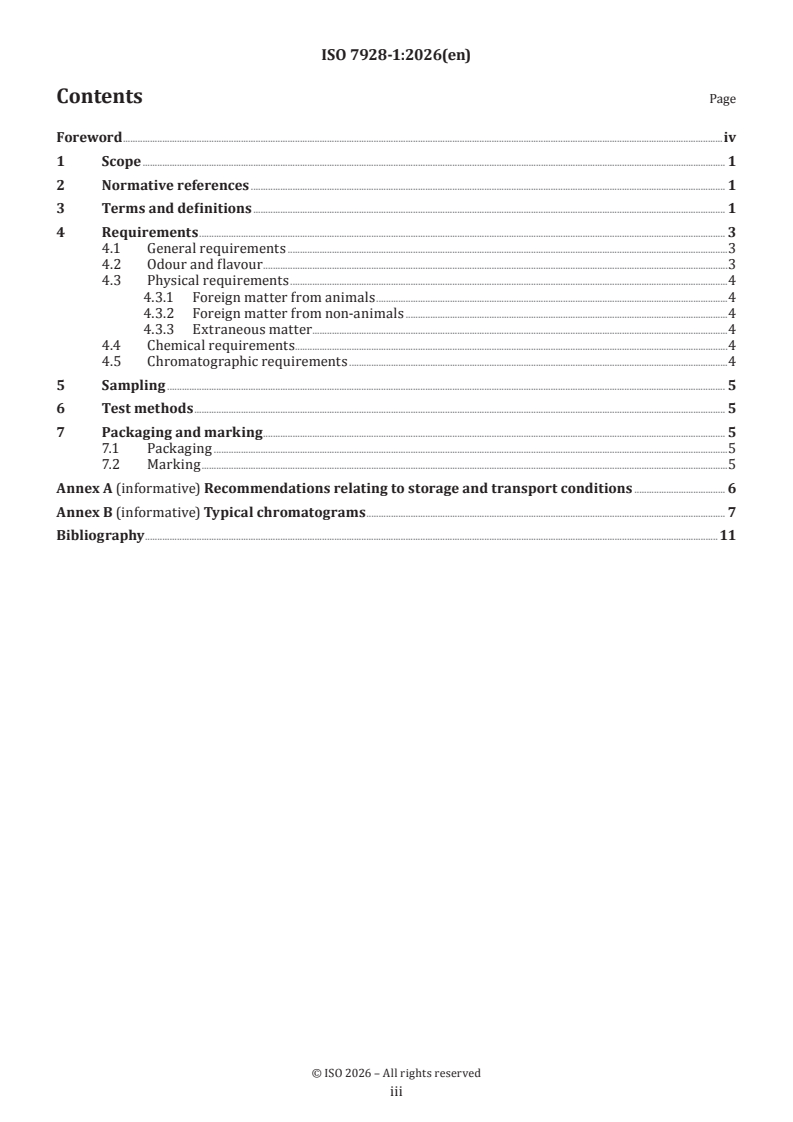
Contents Page
Foreword .iv
1 Scope . 1
2 Normative references . 1
3 Terms and definitions . 1
4 Requirements . 3
4.1 General requirements .3
4.2 Odour and flavour .3
4.3 Physical requirements .4
4.3.1 Foreign matter from animals .4
4.3.2 Foreign matter from non-animals .4
4.3.3 Extraneous matter . .4
4.4 Chemical requirements . .4
4.5 Chromatographic requirements .4
5 Sampling . 5
6 Test methods . 5
7 Packaging and marking . 5
7.1 Packaging .5
7.2 Marking .5
Annex A (informative) Recommendations relating to storage and transport conditions . 6
Annex B (informative) Typical chromatograms . 7
Bibliography .11
iii
ISO 7928-1:2026(en)
Foreword
ISO (the International Organization for Standardization) is a worldwide federation of national standards
bodies (ISO member bodies). The work of preparing International Standards is normally carried out through
ISO technical committees. Each member body interested in a subject for which a technical committee
has been established has the right to be represented on that committee. International organizations,
governmental and non-governmental, in liaison with ISO, also take part in the work. ISO collaborates closely
with the International Electrotechnical Commission (IEC) on all matters of electrotechnical standardization.
The procedures used to develop this document and those intended for its further maintenance are described
in the ISO/IEC Directives, Part 1. In particular, the different approval criteria needed for the different types
of ISO document should be noted. This document was drafted in accordance with the editorial rules of the
ISO/IEC Directives, Part 2 (see www.iso.org/directives).
ISO draws attention to the possibility that the implementation of this document may involve the use of (a)
patent(s). ISO takes no position concerning the evidence, validity or applicability of any claimed patent
rights in respect thereof. As of the date of publication of this document, ISO had not received notice of (a)
patent(s) which may be required to implement this document. However, implementers are cautioned that
this may not represent the latest information, which may be obtained from the patent database available at
www.iso.org/patents. ISO shall not be held responsible for identifying any or all such patent rights.
Any trade name used in this document is information given for the convenience of users and does not
constitute an endorsement.
For an explanation of the voluntary nature of standards, the meaning of ISO specific terms and expressions
related to conformity assessment, as well as information about ISO’s adherence to the World Trade
Organization (WTO) principles in the Technical Barriers to Trade (TBT), see www.iso.org/iso/foreword.html.
This document was prepared by Technical Committee ISO/TC 34, Food products, Subcommittee SC 7, Spices,
culinary herbs and condiments.
This second edition cancels and replaces the first edition (ISO 7928-1:1991), which has been technically
revised.
The main changes are as follows:
— the normative references have been undated;
— the definitions of extraneous matter and foreign matter have been modified in accordance with ISO 927.
Any feedback or questions on this document should be directed to the user’s national standards body. A
complete listing of these bodies can be found at www.iso.org/members.html.
iv
International Standard ISO 7928-1:2026(en)
Savory — Specification —
Part 1:
Winter savory (Satureja montana Linnaeus)
1 Scope
This document specifies the requirements of winter savory (Satureja montana Linnaeus) in the form of
sprigs, and whole or broken leaves.
It does not apply to summer savory (Satureja horfensis Linnaeus), which forms the subject of ISO 7928-2.
Recommendations relating to storage and transport conditions are given in Annex A.
2 Normative references
The following documents are referred to in the text in such a way that some or all of their content constitu
...
International
Standard
ISO 7928-1
Second edition
Savory — Specification —
2026-04
Part 1:
Winter savory (Satureja montana
Linnaeus)
Sarriette — Spécifications —
Partie 1: Sarriette des montagnes (Satureja montana Linnaeus)
Reference number
ISO 7928-1:2026(en)
© ISO 2026
All rights reserved. Unless otherwise specified, or required in the context of its implementation, no part of this publication may
be reproduced or utilized otherwise in any form or by any means, electronic or mechanical, including photocopying, or posting on
the internet or an intranet, without prior written permission. Permission can be requested from either ISO at the address below
or ISO’s member body in the country of the requester.
ISO copyright office
CP 401 • Ch. de Blandonnet 8
CH-1214 Vernier, Geneva
Phone: +41 22 749 01 11
Email: copyright@iso.org
Website: www.iso.org
Published in Switzerland
ii
ISO 7928-1:2026(en)
Contents Page
Foreword .iv
1 Scope . 1
2 Normative references . 1
3 Terms and definitions . 1
4 Requirements . 3
4.1 General requirements .3
4.2 Odour and flavour .3
4.3 Physical requirements .4
4.3.1 Foreign matter from animals .4
4.3.2 Foreign matter from non-animals .4
4.3.3 Extraneous matter . .4
4.4 Chemical requirements . .4
4.5 Chromatographic requirements .4
5 Sampling . 5
6 Test methods . 5
7 Packaging and marking . 5
7.1 Packaging .5
7.2 Marking .5
Annex A (informative) Recommendations relating to storage and transport conditions . 6
Annex B (informative) Typical chromatograms . 7
Bibliography .11
iii
ISO 7928-1:2026(en)
Foreword
ISO (the International Organization for Standardization) is a worldwide federation of national standards
bodies (ISO member bodies). The work of preparing International Standards is normally carried out through
ISO technical committees. Each member body interested in a subject for which a technical committee
has been established has the right to be represented on that committee. International organizations,
governmental and non-governmental, in liaison with ISO, also take part in the work. ISO collaborates closely
with the International Electrotechnical Commission (IEC) on all matters of electrotechnical standardization.
The procedures used to develop this document and those intended for its further maintenance are described
in the ISO/IEC Directives, Part 1. In particular, the different approval criteria needed for the different types
of ISO document should be noted. This document was drafted in accordance with the editorial rules of the
ISO/IEC Directives, Part 2 (see www.iso.org/directives).
ISO draws attention to the possibility that the implementation of this document may involve the use of (a)
patent(s). ISO takes no position concerning the evidence, validity or applicability of any claimed patent
rights in respect thereof. As of the date of publication of this document, ISO had not received notice of (a)
patent(s) which may be required to implement this document. However, implementers are cautioned that
this may not represent the latest information, which may be obtained from the patent database available at
www.iso.org/patents. ISO shall not be held responsible for identifying any or all such patent rights.
Any trade name used in this document is information given for the convenience of users and does not
constitute an endorsement.
For an explanation of the voluntary nature of standards, the meaning of ISO specific terms and expressions
related to conformity assessment, as well as information about ISO’s adherence to the World Trade
Organization (WTO) principles in the Technical Barriers to Trade (TBT), see www.iso.org/iso/foreword.html.
This document was prepared by Technical Committee ISO/TC 34, Food products, Subcommittee SC 7, Spices,
culinary herbs and condiments.
This second edition cancels and replaces the first edition (ISO 7928-1:1991), which has been technically
revised.
The main changes are as follows:
— the normative references have been undated;
— the definitions of extraneous matter and foreign matter have been modified in accordance with ISO 927.
Any feedback or questions on this document should be directed to the user’s national standards body. A
complete listing of these bodies can be found at www.iso.org/members.html.
iv
International Standard ISO 7928-1:2026(en)
Savory — Specification —
Part 1:
Winter savory (Satureja montana Linnaeus)
1 Scope
This document specifies the requirements of winter savory (Satureja montana Linnaeus) in the form of
sprigs, and whole or broken leaves.
It does not apply to summer savory (Satureja horfensis Linnaeus), which forms the subject of ISO 7928-2.
Recommendations relating to storage and transport conditions are given in Annex A.
2 Normative references
The following documents are referred to in the text in such a way that some or all of their content constitutes
requirements of this document. For dated references, only the edition cited applies. For undated references,
the latest edition of the referenced document (including any amendments) applies.
ISO 565, Test sieves — Metal wire cloth, perforated metal plate and electroformed sheet — Nominal sizes of
openings
ISO 927, Spices and condiments — Determination of extraneous matter and foreign ma
...