


ISO 13832:2013
(Main)Aerospace - Wire, aluminium alloy and copper-clad aluminium conductors - General performance requirements
Aerospace - Wire, aluminium alloy and copper-clad aluminium conductors - General performance requirements
ISO 13832:2013 specifies the dimensions, electrical characteristics and mechanical characteristics of aluminium-based and copper-clad aluminium (CCA) conductors, for lightweight aircraft electrical cables and aerospace applications. It applies to stranded conductors over the nominal cross-sectional area range 0,22 mm2 to 107 mm2 inclusive. It is not applicable to conductors for conventional copper-based cables, fire-resistant cables or for thermocouple extension cables. Conductors for copper-based cables are specified in ISO 2635, for fire-resistant cables are specified in ISO 1967 and for thermocouple extension cables are specified in ISO 8056 1.
Aéronautique et espace — Conducteurs en alliage d'aluminium chemisé cuivre pour câbles électriques — Exigences générales de performance
General Information
Overview
ISO 13832:2013 specifies general performance requirements for aluminium-based and copper-clad aluminium (CCA) conductors used in lightweight aircraft electrical cables and other aerospace applications. The standard covers stranded conductors with nominal cross-sectional areas from 0.22 mm² to 107 mm² and defines dimensions, electrical characteristics, mechanical properties, construction and testing requirements for aluminium conductors and CCA conductors. It is not applicable to conventional copper conductors, fire‑resistant cables or thermocouple extension cables.
Key topics and technical requirements
- Scope and materials
- Applies to stranded aluminium, aluminium‑alloy and CCA (ASTM B566 class 15A) conductors.
- Strand material codes: A (uncoated CCA), B (CCA + tin), C (CCA + silver), D (CCA + nickel), E (pure aluminium), F (aluminium alloy + nickel).
- Electrical characteristics
- Maximum resistivity at 20 °C: CCA 2.78 × 10⁻⁸ Ω·m, aluminium/alloy 3.0 × 10⁻⁸ Ω·m.
- Resistance tests must be corrected to 20 °C using the standard correction formula.
- Mechanical properties
- Minimum elongation at rupture: ≥ 6%.
- Minimum tensile strength: CCA ≥ 138 MPa, aluminium/alloy ≥ 105 MPa.
- CCA elastic limit (0.2%): ≥ 90 MPa.
- Construction & lay
- Conductor constructions: concentric, bunched or rope lay; outer layer lay to be left‑hand.
- Typical lay length: 8–16× conductor diameter; certain larger constructions limited to a maximum of 30× diameter.
- Joints in finished conductors are not permitted (individual strand joints allowed with spacing > 3 m).
- Strand plating requirements
- Plating continuity, adherence and minimum thickness checks (e.g., silver plating ≥ 1.0 µm; nickel per standard tables).
- Tests
- Tensile/elongation, mass per unit length, electrical resistance, plating continuity/adherence/thickness - tested per methods in the standard.
- Packaging & labelling
- Delivered on reels/spools/coils protected from moisture; labels must include standard reference, material code and conductor size code.
Applications and who uses ISO 13832
- Aerospace OEMs and cable manufacturers specifying lightweight aircraft wiring using aluminium or CCA conductors.
- Electrical harness designers selecting conductors for weight-sensitive platforms (commercial, military and space vehicles).
- Test laboratories and quality engineers performing compliance tests (tensile, resistance, plating).
- Maintenance, repair organizations and certification authorities (CAA, FAA, EASA) ensuring interoperable, standardized interconnection systems.
- Suppliers standardizing conductor sizes, crimp tooling and termination processes to reduce maintenance errors and achieve global compatibility.
Related standards
- ISO 2635 - copper conductors for aircraft
- ISO 1967 - fire‑resistant cables
- ISO 8056-1 - thermocouple extension cables
- ASTM B566 - specification for copper‑clad aluminium wire
- ISO 8815 - aerospace electrical cable vocabulary
Keywords: ISO 13832, aerospace wire, aluminium conductors, copper-clad aluminium, CCA conductors, lightweight aircraft electrical cables, conductor resistivity, tensile strength, strand plating, conductor lay length.
Frequently Asked Questions
ISO 13832:2013 is a standard published by the International Organization for Standardization (ISO). Its full title is "Aerospace - Wire, aluminium alloy and copper-clad aluminium conductors - General performance requirements". This standard covers: ISO 13832:2013 specifies the dimensions, electrical characteristics and mechanical characteristics of aluminium-based and copper-clad aluminium (CCA) conductors, for lightweight aircraft electrical cables and aerospace applications. It applies to stranded conductors over the nominal cross-sectional area range 0,22 mm2 to 107 mm2 inclusive. It is not applicable to conductors for conventional copper-based cables, fire-resistant cables or for thermocouple extension cables. Conductors for copper-based cables are specified in ISO 2635, for fire-resistant cables are specified in ISO 1967 and for thermocouple extension cables are specified in ISO 8056 1.
ISO 13832:2013 specifies the dimensions, electrical characteristics and mechanical characteristics of aluminium-based and copper-clad aluminium (CCA) conductors, for lightweight aircraft electrical cables and aerospace applications. It applies to stranded conductors over the nominal cross-sectional area range 0,22 mm2 to 107 mm2 inclusive. It is not applicable to conductors for conventional copper-based cables, fire-resistant cables or for thermocouple extension cables. Conductors for copper-based cables are specified in ISO 2635, for fire-resistant cables are specified in ISO 1967 and for thermocouple extension cables are specified in ISO 8056 1.
ISO 13832:2013 is classified under the following ICS (International Classification for Standards) categories: 49.060 - Aerospace electric equipment and systems. The ICS classification helps identify the subject area and facilitates finding related standards.
You can purchase ISO 13832:2013 directly from iTeh Standards. The document is available in PDF format and is delivered instantly after payment. Add the standard to your cart and complete the secure checkout process. iTeh Standards is an authorized distributor of ISO standards.
Standards Content (Sample)
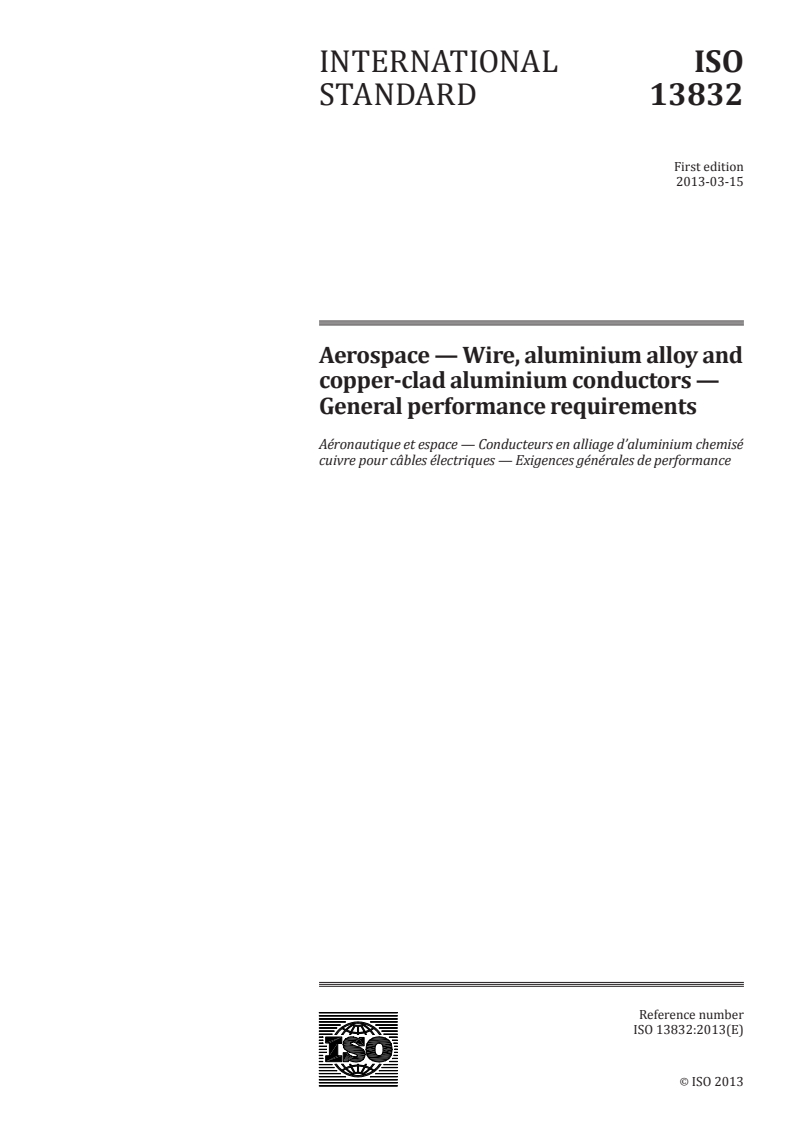
INTERNATIONAL ISO
STANDARD 13832
First edition
2013-03-15
Aerospace — Wire, aluminium alloy and
copper-clad aluminium conductors —
General performance requirements
Aéronautique et espace — Conducteurs en alliage d’aluminium chemisé
cuivre pour câbles électriques — Exigences générales de performance
Reference number
©
ISO 2013
© ISO 2013
All rights reserved. Unless otherwise specified, no part of this publication may be reproduced or utilized otherwise in any form
or by any means, electronic or mechanical, including photocopying, or posting on the internet or an intranet, without prior
written permission. Permission can be requested from either ISO at the address below or ISO’s member body in the country of
the requester.
ISO copyright office
Case postale 56 • CH-1211 Geneva 20
Tel. + 41 22 749 01 11
Fax + 41 22 749 09 47
E-mail copyright@iso.org
Web www.iso.org
Published in Switzerland
ii © ISO 2013 – All rights reserved
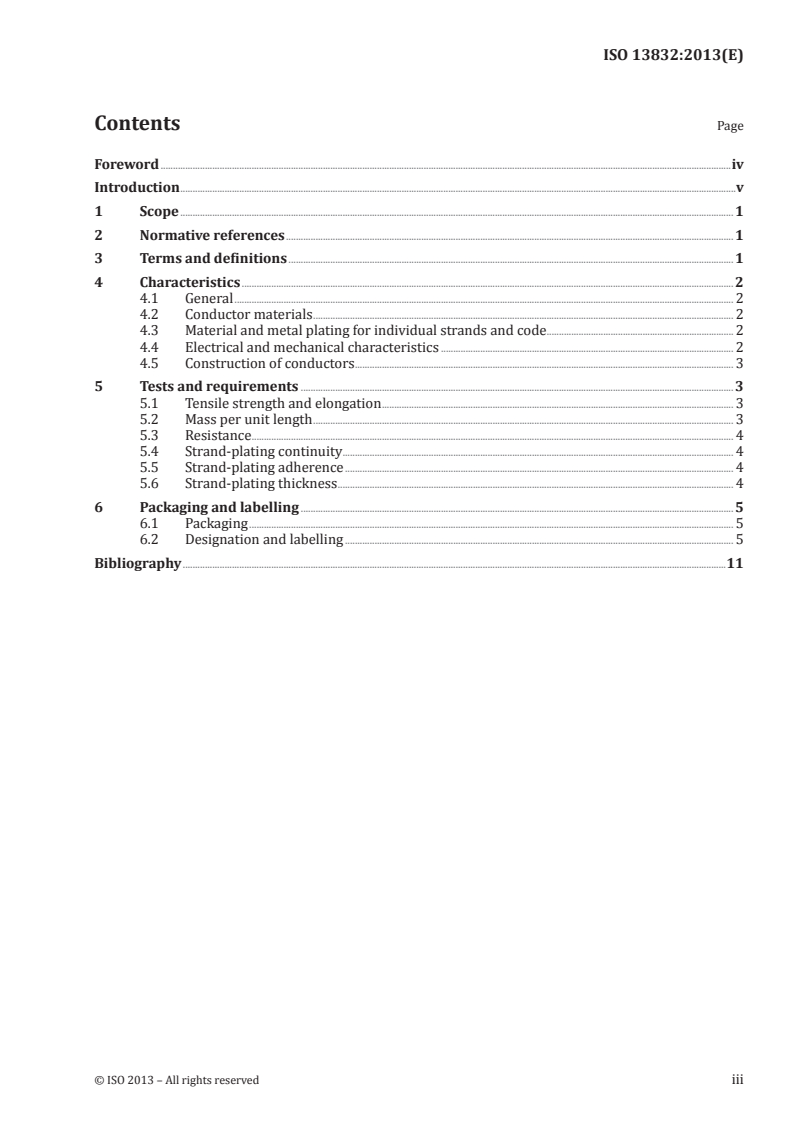
Contents Page
Foreword .iv
Introduction .v
1 Scope . 1
2 Normative references . 1
3 Terms and definitions . 1
4 Characteristics . 2
4.1 General . 2
4.2 Conductor materials . 2
4.3 Material and metal plating for individual strands and code . 2
4.4 Electrical and mechanical characteristics . 2
4.5 Construction of conductors . 3
5 Tests and requirements . 3
5.1 Tensile strength and elongation . 3
5.2 Mass per unit length . 3
5.3 Resistance . 4
5.4 Strand-plating continuity . 4
5.5 Strand-plating adherence . 4
5.6 Strand-plating thickness . 4
6 Packaging and labelling . 5
6.1 Packaging . 5
6.2 Designation and labelling . 5
Bibliography .11
Foreword
ISO (the International Organization for Standardization) is a worldwide federation of national standards
bodies (ISO member bodies). The work of preparing International Standards is normally carried out
through ISO technical committees. Each member body interested in a subject for which a technical
committee has been established has the right to be represented on that committee. International
organizations, governmental and non-governmental, in liaison with ISO, also take part in the work.
ISO collaborates closely with the International Electrotechnical Commission (IEC) on all matters of
electrotechnical standardization.
The procedures used to develop this document and those intended for its further maintenance are
described in the ISO/IEC Directives, Part 1. In particular the different approval criteria needed for the
different types of ISO documents should be noted. This document was drafted in accordance with the
editorial rules of the ISO/IEC Directives, Part 2. www.iso.org/directives
Attention is drawn to the possibility that some of the elements of this document may be the subject of
patent rights. ISO shall not be held responsible for identifying any or all such patent rights. Details of
any patent rights identified during the development of the document will be in the Introduction and/or
on the ISO list of patent declarations received. www.iso.org/patents
Any trade name used in this document is information given for the convenience of users and does not
constitute an endorsement.
The committee responsible for this document is ISO/TC 20, Aircraft and space vehicles, Subcommittee
SC 1, Aerospace electrical requirements.
iv © ISO 2013 – All rights reserved
Introduction
This International Standard is the general performance requirements of the wires with aluminium and
copper-clad aluminium conductors for aerospace.
The need for International Standardization in the Aerospace industry cannot be overemphasized.
Multinational projects abound in the construction industry and all major airlines use equipment produced
in different continents. The mixture of specifications and standards combine to increase the chances
of maintenance errors, no more so than in the interconnection system. Power plant manufacturers
in France may use conductors and terminations manufactured in Europe mating at the firewall with
terminations and conductors manufactured in North America. This can result in different contacts,
crimp tools and settings, and insulating stripping tools being required to work on mating connectors.
The same would apply to many types of equipment.
The requirement for close or “clipped” tolerance, lightweight conductors can provide the opportunity
to address many of these problems by overcoming the long-standing issue of AWG versus metric sizes.
This International Standard introduces a list of aluminium-based lightweight conductors for aerospace
cables. This list supplements the existing list of standard metric conductors which has not received
worldwide acceptance. The list is derived from EN 3719, prEN 4651 and MIL-W-7072(MS25191).
The constructions presented are those which are considered to be standards within the emerging
rules governing aircraft cables, e.g. seven strands minimum, copper-clad aluminium for size 22 and
smaller. However, it does take advantage of the lightest weight for each size. The resultant standard is
therefore a mixture of conductors with metric and imperial origins which gives the greatest advantage
to constructors and users for the future.
This International Standard:
— obeys existing rules regarding conductors for aircraft;
— gives the lightest weight for each size/rating currently used;
— standardizes the conductor cross-sectional area throughout the world aerospace industry;
— enables the standardization of terminations and the crimp tools used to produce the joints;
— reduces the number of insulation stripping tools required to service aircraft;
— enables the world industry to concentrate its efforts on improving interconnection technology
knowing that a world market exists;
— enables regulatory authorities (CAA, FAA, JAA, etc.) to make rules regarding the interconnection
system which applies internationally.
All these will, by reducing complexity, reduce servicing errors and contribute to aircraft safety.
INTERNATIONAL STANDARD ISO 13832:2013(E)
Aerospace — Wire, aluminium alloy and copper-
clad aluminium conductors — General performance
requirements
1 Scope
This International Standard specifies the dimensions, electrical characteristics and mechanical
characteristics of aluminium-based and copper-clad aluminium (CCA) conductors, for lightweight
aircraft electrical cables and aerospace applications. It applies to stranded conductors over the nominal
2 2
cross-sectional area range 0,22 mm to 107 mm inclusive.
It is not applicable to conductors for conventional copper-based cables, fire-resistant cables or for
thermocouple extension cables. Conductors for copper-based cables are specified in ISO 2635, for fire-
resistant cables are specified in ISO 1967 and for thermocouple extension cables are specified in ISO 8056-1.
2 Normative references
The following documents, in whole or in part, are normatively referenced in this document and are
indispensable for its application. For dated references, only the edition cited applies. For undated
references, the latest edition of the referenced document (including any amendments) applies.
ASTM B 566, Standard Specification for Copper-Clad Aluminum Wire
ISO 8815, Aircraft — Electrical cables and cable harnesses — Vocabulary
3 Terms and definitions
For the purposes of this document, the terms and definitions given in ISO 8815 and the following apply.
3.1
conductor code
numeric or alphanumeric code which designates conductor size and properties
[SOURCE: ISO 2635:2003, 3.1]
3.2
worldwide wire gauge
WWG
identification system, similar to the American wire gauge (AWG) system from which it has been derived,
for an international designation of wire cable sizes
[SOURCE: ISO 2635:2003, 3.2]
3.3
copper-clad aluminium
CCA
wire per ASTM B 566 class 15A which consists of an aluminium core with a continuous cladding of
copper thoroughly bonded to the core throughout
Note 1 to entry: See Figure 2.
4 Characteristics
4.1 General
The dimensions, electrical resistance, mechanical properties and mass of the conductors shall conform
to the values given in Table 5 for CCA wires and Table 6 for aluminium or aluminium alloy wires. The
shapes of conductors stranded in concentric lay, bunch or rope lay are illustrated in Figure 1. The wires
shall consist of stranded CCA, aluminium or aluminium alloy strands shown in Figure 2.
4.2 Conductor materials
The conductors in accordance wi
...
article title: ISO 13832:2013 - 항공우주 - 알루미늄 합금 및 동립 알루미늄 전선 - 일반적인 성능 요구 사항 article content: ISO 13832:2013는 가벼운 항공기 전기 케이블과 항공우주 응용 분야에 사용되는 알루미늄 기반 및 동립 알루미늄 (CCA) 전도체의 치수, 전기적 특성 및 기계적 특성을 규정합니다. 이는 명목 단면적 범위가 0.22 mm2에서 107 mm2로 이루어진 꼬임된 전도체에 적용됩니다. 이는 전통적인 구리 기반 케이블, 방화성 케이블 또는 써모커플 연장 케이블을 위한 전도체에는 적용되지 않습니다. 구리 기반 케이블용 전도체는 ISO 2635에서, 방화성 케이블용 전도체는 ISO 1967에서, 써모커플 연장 케이블용 전도체는 ISO 8056 1에서 규정되어 있습니다.
ISO 13832:2013 is a standard that outlines the specifications for aluminium-based and copper-clad aluminium (CCA) conductors used in lightweight aircraft electrical cables and aerospace applications. The standard covers stranded conductors within a specific range of cross-sectional areas. It does not apply to conductors used in traditional copper-based cables, fire-resistant cables, or thermocouple extension cables. Specifications for these other types of conductors can be found in other ISO standards.
article title: ISO 13832:2013 - 航空宇宙 - アルミニウム合金および銅被覆アルミニウム導体 - 一般的な性能要件 article content: ISO 13832:2013は、軽量航空機の電気ケーブルや航空宇宙アプリケーションで使用されるアルミニウムベースおよび銅被覆アルミニウム(CCA)導体の寸法、電気特性、機械特性を規定しています。この規格は、線の断面積が0.22 mm2から107 mm2までの範囲内のねじれた導体に適用されます。従来の銅ベースのケーブル、防火ケーブル、および熱電対延長ケーブルには適用されません。銅ベースのケーブル用の導体はISO 2635で、防火ケーブル用の導体はISO 1967で、熱電対延長ケーブル用の導体はISO 8056 1で規定されています。
Questions, Comments and Discussion
Ask us and Technical Secretary will try to provide an answer. You can facilitate discussion about the standard in here.
Loading comments...