

ISO 8056-2:1988/Amd 1:2016
(Amendment)Aircraft — Nickel-chromium and nickel-aluminium thermocouple extension cables — Part 2: Terminations — General requirements and tests — Amendment 1
General Information
- Abstract
- Status
- Published
- Publication Date
- 20-Jul-2016
- Technical Committee
- ISO/TC 20/SC 1 - Aerospace electrical requirements
- Drafting Committee
- ISO/TC 20/SC 1 - Aerospace electrical requirements
- Current Stage
- 6060 - International Standard published
- Start Date
- 21-Jul-2016
- Due Date
- 09-Oct-2016
- Completion Date
- 09-Oct-2016

Overview
ISO 8056-2:1988/Amd 1:2016 is an international standard amendment published by the International Organization for Standardization (ISO). It updates the requirements for aircraft nickel-chromium and nickel-aluminium thermocouple extension cables, specifically focusing on part 2: terminations – general requirements and tests. The standard ensures technical accuracy and consistency in the performance and testing of terminations for these essential aerospace components.
As revised under Amendment 1, this standard plays a critical role in supporting the safety, reliability, and performance of electrical systems in aircraft, where high-quality thermocouple extension cables and their terminations are essential for accurate temperature measurement.
Key Topics
- Thermocouple Extension Cables: Focuses on nickel-chromium (Ni-Cr) and nickel-aluminium (Ni-Al) alloy cables used in aircraft applications.
- Terminations: Details the general requirements for the termination methods of these cables, which are vital for maintaining measurement reliability.
- Testing Conditions: Specifies standardized test environmental conditions (temperature and air pressure) to ensure reproducible and trustworthy results.
- Amendment Updates: Corrects material labeling (changing “Ni-Ai” to “Ni-Al” for nickel-aluminium), ensuring clarity and reducing ambiguity in technical documentation.
- Quality and Reliability: Reinforces stringent requirements to help ensure electrical safety and operational consistency in aerospace systems.
Applications
This amendment and the underlying standard are crucial for a variety of stakeholders in the aerospace industry:
- Aircraft Manufacturers: Facilitates the selection and application of compliant thermocouple extension cables and terminations during the design and assembly of aircraft electrical systems.
- Maintenance and Repair Organizations: Provides a reference for evaluating and verifying the integrity of existing thermocouple terminations in operational aircraft.
- Component Suppliers and Subcontractors: Establishes uniform requirements for supplying standardized cable terminations, reducing the risk of incompatibility.
- Quality Assurance Teams: Enhances inspection and compliance protocols by clarifying testing conditions and terminological accuracy.
By adhering to ISO 8056-2:1988/Amd 1:2016, aerospace companies ensure they meet global expectations for product safety and technical performance, positively impacting reliability and regulatory approval.
Related Standards
To fully address the requirements for thermocouple extension cables and terminations in aerospace applications, consider referencing these associated standards:
- ISO 8056-1: General requirements for nickel-chromium and nickel-aluminium thermocouple extension cables - Part 1 covers cable construction and performance.
- IEC Standards: International Electrotechnical Commission standards on thermocouples and related measurement systems.
- EN and AS Standards: Regional standards may also complement ISO 8056-2, particularly for defense or regional aerospace projects.
- ISO/IEC Directives: Outlines the processes for the development and maintenance of international standards, ensuring procedural transparency.
Practical Value
Implementing ISO 8056-2:1988/Amd 1:2016 assists organizations in maintaining high-quality aircraft electrical systems by:
- Enhancing safety through precise and reliable temperature sensing
- Improving efficiency in system design, testing, and maintenance
- Ensuring compatibility and interchangeability between components from different suppliers
- Supporting global compliance and market access
Compliance with ISO 8056-2:1988/Amd 1:2016 underlines a commitment to aerospace quality, safety, and technical excellence.
Relations
- Effective Date
- 08-May-2020
Get Certified
Connect with accredited certification bodies for this standard

BUREAU VERITAS Certification Germany
Bureau Veritas certification in Germany.

Element Materials Technology
Materials testing and product certification.

AQMS Ltd.
AQMS provides ISO certification to SMEs across the UK.
Sponsored listings
Frequently Asked Questions
ISO 8056-2:1988/Amd 1:2016 is a standard published by the International Organization for Standardization (ISO). Its full title is "Aircraft — Nickel-chromium and nickel-aluminium thermocouple extension cables — Part 2: Terminations — General requirements and tests — Amendment 1". This standard covers: Aircraft — Nickel-chromium and nickel-aluminium thermocouple extension cables — Part 2: Terminations — General requirements and tests — Amendment 1
Aircraft — Nickel-chromium and nickel-aluminium thermocouple extension cables — Part 2: Terminations — General requirements and tests — Amendment 1
ISO 8056-2:1988/Amd 1:2016 is classified under the following ICS (International Classification for Standards) categories: 49.060 - Aerospace electric equipment and systems. The ICS classification helps identify the subject area and facilitates finding related standards.
ISO 8056-2:1988/Amd 1:2016 has the following relationships with other standards: It is inter standard links to ISO 8056-2:1988. Understanding these relationships helps ensure you are using the most current and applicable version of the standard.
ISO 8056-2:1988/Amd 1:2016 is available in PDF format for immediate download after purchase. The document can be added to your cart and obtained through the secure checkout process. Digital delivery ensures instant access to the complete standard document.
Standards Content (Sample)
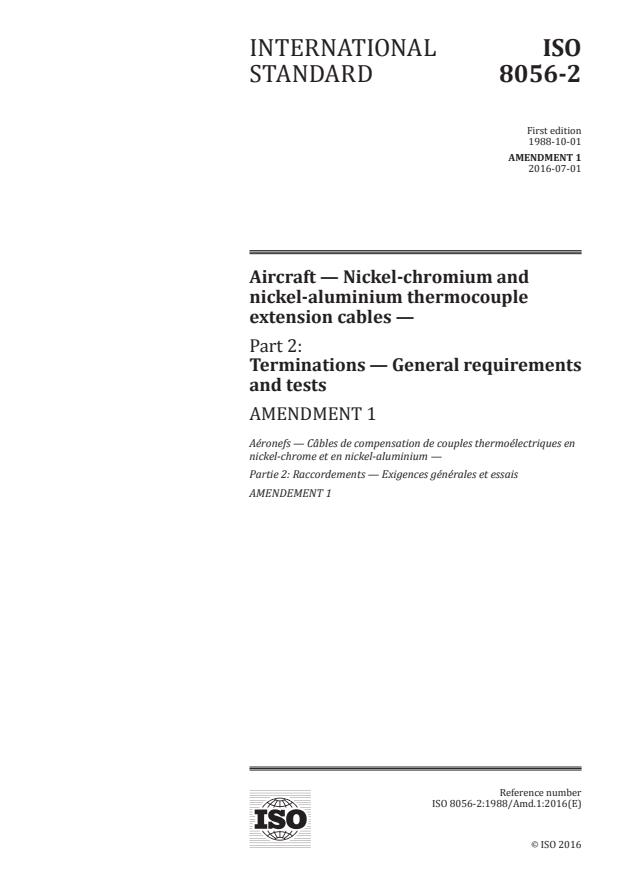
INTERNATIONAL ISO
STANDARD 8056-2
First edition
1988-10-01
AMENDMENT 1
2016-07-01
Aircraft — Nickel-chromium and
nickel-aluminium thermocouple
extension cables —
Part 2:
Terminations — General requirements
and tests
AMENDMENT 1
Aéronefs — Câbles de compensation de couples thermoélectriques en
nickel-chrome et en nickel-aluminium —
Partie 2: Raccordements — Exigences générales et essais
AMENDEMENT 1
Reference number
ISO 8056-2:1988/Amd.1:2016(E)
©
ISO 2016
ISO 8056-2:1988/Amd.1:2016(E)
© ISO 2016, Published in Switzerland
All rights reserved. Unless otherwise specified, no part of this publication may be reproduced or utilized otherwise in any form
or by any means, electronic or mechanical, including photocopying, or posting on the internet or an intranet, without prior
written permission. Permission can be requested from either ISO at the address below or ISO’s member body in the country of
the requester.
ISO copyright office
Ch. de Blandonnet 8 • CP 401
CH-1214 Vernier, Geneva, Switzerland
Tel. +41 22 749 01 11
Fax +41 22 749 09 47
copyright@iso.org
www.iso.org
ii © ISO 2016 – All rights reserved
ISO 8056-2:1988/Amd.1:2016(E)
Foreword
ISO (the International Organization for Standardization) is a worldwide federation of national standards
bodies (ISO member bodies). The work of preparing International Standards is normally carried out
through ISO technical committees. Each member body interested in a subject for which a technical
committee has been established has the right to be represented on that committee. International
organizations, governmental and non-governmental, in liaison with ISO, also take part in the work.
ISO collaborates closely with the International Electrotechnical Commission (IEC) on all matters of
electrotechnical standardization.
The procedures used to develop this document and those intended for its further maintenance are
described in t
...