

ISO 20691:2022
(Main)Biotechnology — Requirements for data formatting and description in the life sciences
General Information
- Abstract
This document specifies requirements for the consistent formatting and documentation of data and corresponding metadata (i.e. data describing the data and its context) in the life sciences, including biotechnology, and biomedical, as well as non-human biological research and development. It provides guidance on rendering data in the life sciences findable, accessible, interoperable and reusable (F-A-I-R). This document is applicable to manual or computational workflows that systematically capture, record or integrate data and corresponding metadata in the life sciences for other purposes. This document provides formatting requirements for both primary experimental or procedural data obtained manually and machine derived data. This document also describes requirements for storing, sharing, accessing, interoperability and reuse of data and corresponding metadata in the life sciences. This document specifies requirements for large quantities of data systematically obtained from automated high throughput workflows in the life sciences, as well as requirements for large-scale and small-scale data sets obtained by other life science technologies and manual data capture. This document is applicable to many domains in biotechnology and the life sciences including, but not limited to: basic/applied research in all domains of the life sciences, and industrial, medical, agricultural, or environmental biotechnology (excluding for diagnostic or therapeutic purposes), as well as methodology-driven domains, such as genomics (including massive parallel sequencing, metagenomics, epigenomics and functional genomics), transcriptomics, translatomics, proteomics, metabolomics, lipidomics, glycomics, enzymology, immunochemistry, synthetic biology, systems biology, systems medicine and related fields.
- Status
- Published
- Publication Date
- 03-Nov-2022
- Technical Committee
- ISO/TC 276 - Biotechnology
- Drafting Committee
- ISO/TC 276/WG 5 - Data processing and integration
- Current Stage
- 6060 - International Standard published
- Start Date
- 04-Nov-2022
- Due Date
- 13-Feb-2022
- Completion Date
- 04-Nov-2022

Overview
ISO 20691:2022 - Biotechnology: Requirements for data formatting and description in the life sciences defines a framework for consistent formatting, documentation and metadata for life‑science data. The standard supports making biological data Findable, Accessible, Interoperable and Reusable (FAIR) across manual and automated workflows, covering both primary experimental/procedural records and machine‑derived high‑throughput outputs. It applies across biotechnology and life‑science domains including genomics, transcriptomics, proteomics, metabolomics, synthetic biology, systems biology and related fields.
Key Topics
- Data and metadata formatting requirements: rules for consistent representation of primary and derived data to support reuse and automated processing.
- Identifiers and naming: recommended ubiquitous identifier schemes (URI/IRI provisions) for biological and conceptual entities to ensure stable referencing.
- Data types and encoding: guidance on encoding numerical values, character strings, sequence data, time values, boolean fields and imaging data.
- Versioning and provenance: requirements for version control, change logs and provenance to track data lineage and ensure integrity.
- Validation and integrity: format validation, compression, structural/control elements and data integrity checks for reliable exchange.
- Semantic annotation: minimum consensus information for annotating species, sex, age, organ, tissue, cell type, processes and technologies to enable interoperability.
- Terminologies and ontologies: criteria for ontologies and controlled vocabularies (maintenance, syntax, stable URIs, linking, licensing and community governance).
- Domain‑specific standards & repositories: requirements for maintainers of data standards and repositories, including stability, linking, visibility and governance (see Annexes for examples and minimum reporting standards).
Applications and Who Should Use It
ISO 20691:2022 is designed for practical use by:
- Researchers and laboratory teams capturing experimental metadata and high‑throughput outputs.
- Bioinformaticians and data engineers implementing data models, parsers and pipelines that require consistent encoding and validation.
- Repository managers and data stewards developing submission guidelines, persistent identifiers and discoverability features.
- Standards developers and ontology curators ensuring vocabularies meet interoperability requirements.
- Industry and regulatory bodies seeking reproducible, FAIR‑aligned data management across biotechnology, environmental and agricultural contexts (excluding diagnostic/therapeutic clinical use).
Practical benefits include improved data interoperability, reproducible analyses, easier data sharing, and reduced integration costs across life‑science projects and platforms.
Related Standards
- Aligns with FAIR principles and ISO/IEC directives for standards development.
- Includes informative annexes listing common life‑science formats and minimum reporting standards to support implementation.
Keywords: ISO 20691:2022, data formatting, life sciences, FAIR, metadata, ontologies, repositories, data interoperability, biotechnology.
Frequently Asked Questions
ISO 20691:2022 is a standard published by the International Organization for Standardization (ISO). Its full title is "Biotechnology — Requirements for data formatting and description in the life sciences". This standard covers: This document specifies requirements for the consistent formatting and documentation of data and corresponding metadata (i.e. data describing the data and its context) in the life sciences, including biotechnology, and biomedical, as well as non-human biological research and development. It provides guidance on rendering data in the life sciences findable, accessible, interoperable and reusable (F-A-I-R). This document is applicable to manual or computational workflows that systematically capture, record or integrate data and corresponding metadata in the life sciences for other purposes. This document provides formatting requirements for both primary experimental or procedural data obtained manually and machine derived data. This document also describes requirements for storing, sharing, accessing, interoperability and reuse of data and corresponding metadata in the life sciences. This document specifies requirements for large quantities of data systematically obtained from automated high throughput workflows in the life sciences, as well as requirements for large-scale and small-scale data sets obtained by other life science technologies and manual data capture. This document is applicable to many domains in biotechnology and the life sciences including, but not limited to: basic/applied research in all domains of the life sciences, and industrial, medical, agricultural, or environmental biotechnology (excluding for diagnostic or therapeutic purposes), as well as methodology-driven domains, such as genomics (including massive parallel sequencing, metagenomics, epigenomics and functional genomics), transcriptomics, translatomics, proteomics, metabolomics, lipidomics, glycomics, enzymology, immunochemistry, synthetic biology, systems biology, systems medicine and related fields.
This document specifies requirements for the consistent formatting and documentation of data and corresponding metadata (i.e. data describing the data and its context) in the life sciences, including biotechnology, and biomedical, as well as non-human biological research and development. It provides guidance on rendering data in the life sciences findable, accessible, interoperable and reusable (F-A-I-R). This document is applicable to manual or computational workflows that systematically capture, record or integrate data and corresponding metadata in the life sciences for other purposes. This document provides formatting requirements for both primary experimental or procedural data obtained manually and machine derived data. This document also describes requirements for storing, sharing, accessing, interoperability and reuse of data and corresponding metadata in the life sciences. This document specifies requirements for large quantities of data systematically obtained from automated high throughput workflows in the life sciences, as well as requirements for large-scale and small-scale data sets obtained by other life science technologies and manual data capture. This document is applicable to many domains in biotechnology and the life sciences including, but not limited to: basic/applied research in all domains of the life sciences, and industrial, medical, agricultural, or environmental biotechnology (excluding for diagnostic or therapeutic purposes), as well as methodology-driven domains, such as genomics (including massive parallel sequencing, metagenomics, epigenomics and functional genomics), transcriptomics, translatomics, proteomics, metabolomics, lipidomics, glycomics, enzymology, immunochemistry, synthetic biology, systems biology, systems medicine and related fields.
ISO 20691:2022 is classified under the following ICS (International Classification for Standards) categories: 07.080 - Biology. Botany. Zoology. The ICS classification helps identify the subject area and facilitates finding related standards.
ISO 20691:2022 is available in PDF format for immediate download after purchase. The document can be added to your cart and obtained through the secure checkout process. Digital delivery ensures instant access to the complete standard document.
Standards Content (Sample)
INTERNATIONAL ISO
STANDARD 20691
First edition
2022-11
Biotechnology — Requirements for
data formatting and description in the
life sciences
Biotechnologie — Exigences relatives au formatage et à la description
des données dans les sciences de la vie
Reference number
© ISO 2022
All rights reserved. Unless otherwise specified, or required in the context of its implementation, no part of this publication may
be reproduced or utilized otherwise in any form or by any means, electronic or mechanical, including photocopying, or posting on
the internet or an intranet, without prior written permission. Permission can be requested from either ISO at the address below
or ISO’s member body in the country of the requester.
ISO copyright office
CP 401 • Ch. de Blandonnet 8
CH-1214 Vernier, Geneva
Phone: +41 22 749 01 11
Email: copyright@iso.org
Website: www.iso.org
Published in Switzerland
ii
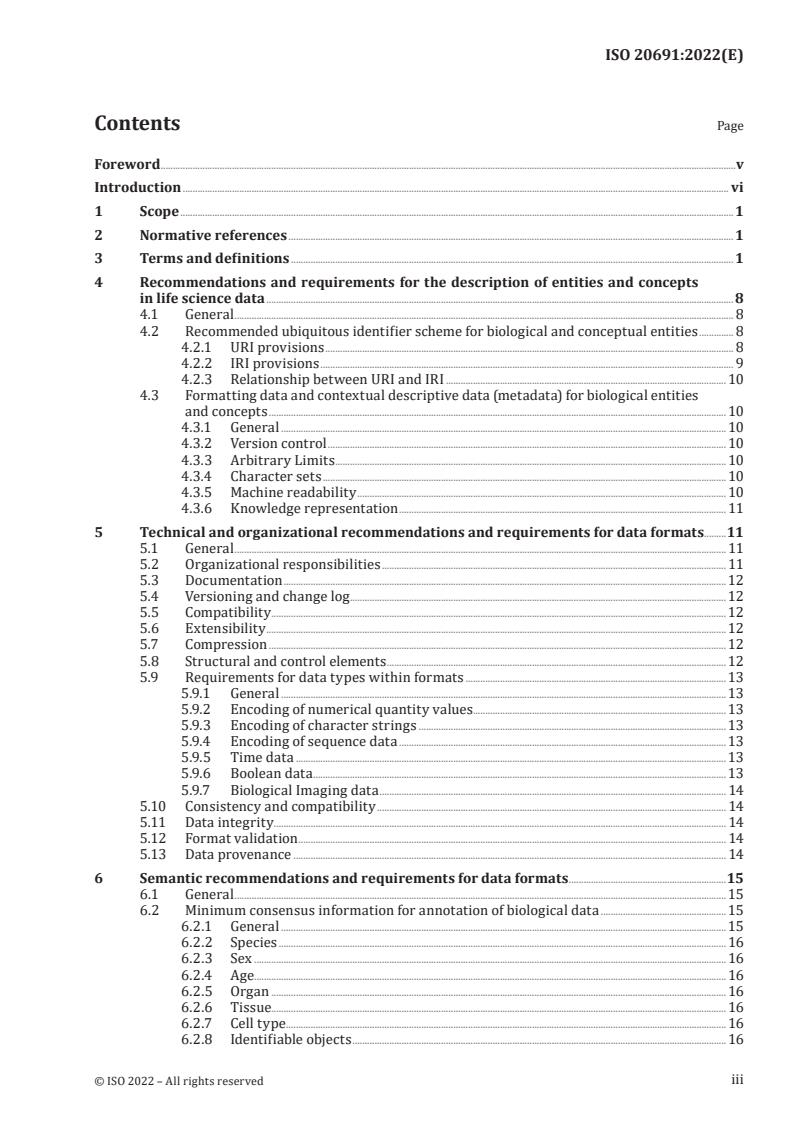
Contents Page
Foreword .v
Introduction . vi
1 Scope . 1
2 Normative references . 1
3 Terms and definitions . 1
4 Recommendations and requirements for the description of entities and concepts
in life science data . 8
4.1 General . 8
4.2 Recommended ubiquitous identifier scheme for biological and conceptual entities . 8
4.2.1 URI provisions . 8
4.2.2 IRI provisions . 9
4.2.3 Relationship between URI and IRI . 10
4.3 Formatting data and contextual descriptive data (metadata) for biological entities
and concepts . 10
4.3.1 General . 10
4.3.2 Version control . 10
4.3.3 Arbitrary Limits . 10
4.3.4 Character sets . 10
4.3.5 Machine readability . 10
4.3.6 Knowledge representation . 11
5 Technical and organizational recommendations and requirements for data formats.11
5.1 General . 11
5.2 Organizational responsibilities . 11
5.3 Documentation .12
5.4 Versioning and change log . 12
5.5 Compatibility .12
5.6 Extensibility .12
5.7 Compression . 12
5.8 Structural and control elements .12
5.9 Requirements for data types within formats . 13
5.9.1 General .13
5.9.2 Encoding of numerical quantity values.13
5.9.3 Encoding of character strings . 13
5.9.4 Encoding of sequence data . 13
5.9.5 Time data . 13
5.9.6 Boolean data . 13
5.9.7 Biological Imaging data . 14
5.10 Consistency and compatibility . 14
5.11 Data integrity . 14
5.12 Format validation . 14
5.13 Data provenance . 14
6 Semantic recommendations and requirements for data formats .15
6.1 General . 15
6.2 Minimum consensus information for annotation of biological data .15
6.2.1 General .15
6.2.2 Species . 16
6.2.3 Sex . 16
6.2.4 Age . . . 16
6.2.5 Organ . 16
6.2.6 Tissue. 16
6.2.7 Cell type . . . 16
6.2.8 Identifiable objects . 16
iii
6.2.9 Identifiable processes . 17
6.2.10 Manipulated entities . 17
6.2.11 Analytical, experimental and computational technology . 17
6.2.12 Biological or analytical question. 17
6.2.13 Technology-specific data. 17
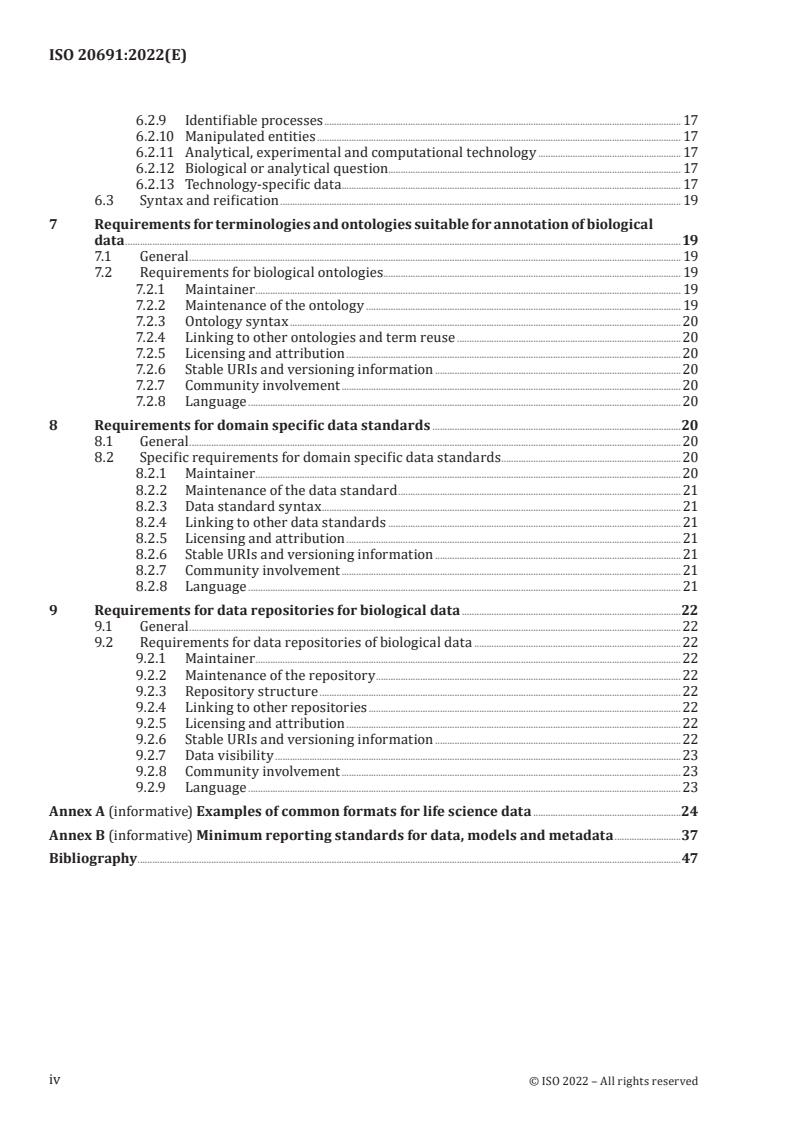
6.3 Syntax and reification . 19
7 Requirements for terminologies and ontologies suitable for annotation of biological
data .19
7.1 General . 19
7.2 Requirements for biological ontologies . 19
7.2.1 Maintainer . 19
7.2.2 Maintenance of the ontology . 19
7.2.3 Ontology syntax .20
7.2.4 Linking to other ontologies and term reuse . 20
7.2.5 Licensing and attribution . 20
7.2.6 Stable URIs and versioning information . 20
7.2.7 Community involvement . 20
7.2.8 Language . 20
8 Requirements for domain specific data standards .20
8.1 General . 20
8.2 Specific requirements for domain specific data standards . 20
8.2.1 Maintainer . 20
8.2.2 Maintenance of the data standard . 21
8.2.3 Data standard syntax . 21
8.2.4 Linking to other data standards . 21
8.2.5 Licensing and attribution . 21
8.2.6 Stable URIs and versioning information . 21
8.2.7 Community involvement . 21
8.2.8 Language . 21
9 Requirements for data repositories for biological data .22
9.1 General .22
9.2 Requirements for data repositories of biological data . 22
9.2.1 Maintainer . 22
9.2.2 Maintenance of the repository . 22
9.2.3 Repository structure . 22
9.2.4 Linking to other repositories . 22
9.2.5 Licensing and attribution . 22
9.2.6 Stable URIs and versioning information . 22
9.2.7 Data visibility .23
9.2.8 Community involvement . 23
9.2.9 Language . 23
Annex A (informative) Examples of common formats for life science data .24
Annex B (informative) Minimum reporting standards for data, models and metadata .37
Bibliography .47
iv
Foreword
ISO (the International Organization for Standardization) is a worldwide federation of national standards
bodies (ISO member bodies). The work of preparing International Standards is normally carried out
through ISO technical committees. Each member body interested in a subject for which a technical
committee has been established has the right to be represented on that committee. International
organizations, governmental and non-governmental, in liaison with ISO, also take part in the work.
ISO collaborates closely with the International Electrotechnical Commission (IEC) on all matters of
electrotechnical standardization.
The procedures used to develop this document and those intended for its further maintenance are
described in the ISO/IEC Directives, Part 1. In particular, the different approval criteria needed for the
different types of ISO documents should be noted. This document was drafted in accordance with the
editorial rules of the ISO/IEC Directives, Part 2 (see www.iso.org/directives).
Attention is drawn to the possibility that some of the elements of this document may be the subject of
patent rights. ISO shall not be held responsible for identifying any or all such patent rights. Details of
any patent rights identified during the development of the document will be in the Introduction and/or
on the ISO list of patent declarations received (see www.iso.org/patents).
Any trade name used in this document is information given for the convenience of users and does not
constitute an endorsement.
For an explanation of the voluntary nature of standards, the meaning of ISO specific terms and
expressions related to conformity assessment, as well as information about ISO's adherence to
the World Trade Organization (WTO) principles in the Technical Barriers to Trade (TBT), see
www.iso.org/iso/foreword.html.
This document was prepared by Technical Committee ISO/TC 276, Biotechnology.
Any feedback or questions on this document should be directed to the user’s national standards body. A
complete listing of these bodies can be found at www.iso.org/members.html.
v
Introduction
Life science research and the application of the obtained results in the biotechnology, diagnostics and
pharmaceutical industries depend on complex data obtained from a wide range of assays, biological
and functional studies, as well as process descriptions, laboratory and field measurements. This
includes the use of the derived data for computational reconstruction, modelling and simulation of
biological, biotechnological and physiological processes, as well as their applications in biotechnological
workflows. Data enabled life sciences and biotechnology research span across a wide range of biological
and biotechnological domains and applications (e.g. human health, genetically engineered organisms,
environmental sciences, agriculture, bioremediation, DNA sequencing, chromatography, microscopy).
Data driven, data intensive and big data analytical approaches in the life sciences are possible only with
the use of computational methods and through consistent description, structuring and integration of
[1]
data. Data storage, representation, meaning, interpretation, exchange and re-use are all affected
by format design. This document satisfies a critical need to set a framework for interoperable and
unambiguous data recording, description and transfer by setting fundamental requirements for data
recorded, processed, re-used and exchanged in the life sciences enabling the maximum data value and
utilization.
These life science data from different sources and recorded at different times must be findable,
[2]
accessible, interoperable and reusable (F-A-I-R). Data sets are valuable and useful only if they are
accessible and stored in well structured, consistent formats. Data versioning, data archiving and tracing
data provenance are ensured by timeless and platform independent formats. Complete and updatable
metadata (i.e. data describing the data) facilitates locating, use and analysis of data.
This document provides requirements and recommendations for standardized interoperable life
science data formats. It provides a conceptual framework for, as well as references to, many different
subdomain-specific data formatting and description standards defined by the biotechnological and
biological domain communities. A technology-independent framework of minimal requirements
and rules for the coherent utilization of the referenced domain-specific formatting and description
standards and their concerted interplay is described. This document, therefore, provides rules and
guidelines for coherent, subdomain overarching data formatting and description, as a foundation
for data integration across domains. Moreover, rules and guidelines for the creation of (sub-)domain
specific standards, their interoperability and their implementations are provided.
vi
INTERNATIONAL STANDARD ISO 20691:2022(E)
Biotechnology — Requirements for data formatting and
description in the life sciences
1 Scope
This document specifies requirements for the consistent formatting and documentation of data and
corresponding metadata (i.e. data describing the data and its context) in the life sciences, including
biotechnology, and biomedical, as well as non-human biological research and development. It provides
guidance on rendering data in the life sciences findable, accessible, interoperable and reusable (F-A-I-R).
This document is applicable to manual or computational workflows that systematically capture, record
or integrate data and corresponding metadata in the life sciences for other purposes.
This document provides formatting requirements for both primary experimental or procedural data
obtained manually and machine derived data. This document also describes requirements for storing,
sharing, accessing, interoperability and reuse of data and corresponding metadata in the life sciences.
This document specifies requirements for large quantities of data systematically obtained from
automated high throughput workflows in the life sciences, as well as requirements for large-scale and
small-scale data sets obtained by other life science technologies and manual data capture.
This document is applicable to many domains in biotechnology and the life sciences including, but
not limited to: basic/applied research in all domains of the life sciences, and industrial, medical,
agricultural, or environmental biotechnology (excluding for diagnostic or therapeutic purposes),
as well as methodology-driven domains, such as genomics (including massive parallel sequencing,
metagenomics, epigenomics and functional genomics), transcriptomics, translatomics, proteomics,
metabolomics, lipidomics, glycomics, enzymology, immunochemistry, synthetic biology, systems
biology, systems medicine and related fields.
2 Normative references
The following documents are referred to in the text in such a way that some or all of their content
constitutes requirements of this document. For dated references, only the edition cited applies. For
undated references, the latest edition of the referenced document (including any amendments) applies.
ISO 8601-1, Date and time — Representations for information interchange — Part 1: Basic rules
ISO 8601-2, Date and time — Representations for information interchange — Part 2: Extensions
3 Terms and definitions
For the purposes of this document, the following terms and definitions apply.
ISO and IEC maintain terminology databases for use in standardization at the following addresses:
— ISO Online browsing platform: available at https:// www .iso .org/ obp
— IEC Electropedia: available at https:// www .electropedia .org/
3.1
ASCII
American Standard Code for Information Interchange
character encoding standard for electronic communication
Note 1 to entry: ASCII codes represent text in computers, telecommunications equipment and other devices.
Note 2 to entry: Most modern character-encoding schemes are based on ASCII, although they support many
additional characters. In an ASCII file, each alphabetic, numeric or special character is represented with a 7-bit
binary number (a string of seven 0s or 1s). 128 possible characters are defined.
Note 3 to entry: The 7-bit ASCII is documented in ISO/IEC 646.
3.2
backward compatibility
compatibility of a newer coding standard with an older coding standard where the decoders designed to
operate with the older coding standard can continue to operate by decoding all or parts of a bitstream
produced according to the newer coding standard
3.3
character
printable symbol having phonetic or pictographic meaning and usually forming part of a word of text,
depicting a numeral or expressing grammatical punctuation
3.4
characteristic
abstraction that qualifies a property (3.37) of an object (3.31) or of a set of objects
[SOURCE: ISO 1087:2019, 3.2.1, modified — “that qualifies a property of an object or of a set of objects”
has replaced “of a property”, and the example and note to entry have been deleted.]
3.5
class
description of a set of objects (3.31) that share the same properties, operations, methods, relationships
and semantics
3.6
code
system of rule(s) to convert information such as text, images, sounds or electric, photonic or magnetic
signals into another form or representation to facilitate analysis, communication or storage in a storage
medium
3.7
concept
unit of knowledge created by a unique combination of characteristics (3.4)
[SOURCE: ISO 1087:2019, 3.2.7, modified — Notes 1 and 2 to entry have been deleted.]
3.8
context
circumstance, purpose and perspective under which an object (3.31) is defined or used
[SOURCE: ISO/IEC 11179-1:2015, 3.3.7, modified — Note 1 to entry had been deleted.]
3.9
data
reinterpretable representation of information in a formalized manner suitable for communication,
interpretation or processing
[SOURCE: ISO/IEC 2382:2015, 2121272, modified — Note 1, 2, and 3 to entry have been deleted.]
3.10
data element
unit of data (3.9) that is considered in context (3.8) to be indivisible
Note 1 to entry: This term is meant for the organization of data.
Note 2 to entry: The definition states that a data element is “indivisible” in some context. This means it is possible
that a data element considered indivisible in one context (e.g. telephone number) can be divisible in another
context (e.g. country code, area code, local number).
[SOURCE: ISO/IEC 15944-1:2011, 3.16, modified — “(in organization of data)” was deleted from the
term, the example and Note 1 to entry were deleted, and new Notes 1 and 2 to entry were added.]
3.11
data format
arrangement of data (3.9) in a file or stream
[SOURCE: ISO/TS 27790:2009, 3.18]
3.12
data integrity
property (3.37) that data (3.9) have not been altered or destroyed in an unauthorized manner
[SOURCE: ISO/TS 27790:2009, 3.19]
3.13
data model
graphical and/or lexical representation of data (3.9), specifying their properties, structure and
interrelationships
[SOURCE: ISO/IEC 11179-1:2015, 3.2.7]
3.14
data provider
individual or organization that is a source of data (3.9)
[SOURCE: ISO/IEC/IEEE 15939:2017, 3.5]
3.15
data set
dataset
identifiable collection of data (3.9) available for access or download in one or more data formats (3.11)
Note 1 to entry: A data set can be a smaller grouping of data, which, though limited by some constraint such as
spatial extent or feature type, is located physically within a larger data set. Theoretically, a data set can be as
small as a single feature or feature attribute contained within a larger data set.
Note 2 to entry: A data set may be presented in a tabular form and stored and distributed in tables in word
processed documents, spread sheets or databases. It could also be presented in any one of a number of alternative
formats, including AVRO, JSON, RDF and XML.
[SOURCE: ISO/IEC 11179-7:2019, 3.1.4]
3.16
data type
classification of data (3.9) indicating how it can be used
Note 1 to entry: Data type provides a set of values from which an expression can take its values.
Note 2 to entry: It characterizes both the content and the structure of an element.
Note 3 to entry: It characterizes properties of those values and operations on those values.
Note 4 to entry: Data types can be categorized in many ways, e.g. as master data or reference data.
3.17
data representation paradigm
tool for data (3.9) representation providing a well-defined syntax that is devoid of any application-level
semantics
3.18
entity
any concrete or abstract thing that exists, did exist or can exist, including its properties and interactions
with other things
3.19
extensibility
provisions in an early version of a data format (3.11) that are designed to maximize the interworking of
implementations of that early version with the expected implementations of a later version of that data
format
3.20
forward compatibility
compatibility of an older coding standard with a newer coding standard where the decoders designed
to operate with the newer coding standard can decode bitstreams of the older coding standard
[SOURCE: ISO/IEC 13818-3:1998, 2.1.108, modified — “compatibility of an older coding standard with a
newer coding standard where the” has replaced “A newer coding standard is forward compatible with
an older coding standard if”.]
3.21
identifier
sequence of characters (3.3), capable of uniquely identifying that with which it is associated, within a
specified context (3.8)
[SOURCE: ISO/IEC 11179-1:2015, 3.1.3, modified — Notes 1 and 2 to entry have been deleted.]
3.22
interoperability
ability of two or more systems or components to exchange information and to use the information that
has been exchanged
[SOURCE: ISO/TS 27790:2009, 3.39]
3.23
IRI
internationalized resource identifier
sequence of characters (3.3) from the universal coded character set (3.51), capable of uniquely identifying
that with which it is associated, within a specified context (3.8)
Note 1 to entry: IRI is an internet protocol element standard that builds on the uniform resource identifier (3.49)
[3]
by greatly expanding the set of permitted characters.
3.24
JSON
JavaScript Object Notation
open and text-based exchange format
Note 1 to entry: Data transmitted in JSON formats make it easy to read and write (for humans), parse and
generate (for computers).
[SOURCE: ISO/TS 23029:2020, 3.3]
3.25
long-term storage
storage, for a period of undefined length, of data (3.9) kept for permanent retention
[SOURCE: ISO 11799:2015, 2.3, modified — “data” has replaced “material” in the definition.]
3.26
maintainer
maintenance organization
individual or organization that maintains the data format (3.11)
3.27
metadata
data (3.9) that defines and describes other data (3.9)
[SOURCE: ISO/IEC 11179-1:2015, 3.2.16]
3.28
metadata object
object (3.31) type defined by a metamodel
[SOURCE: ISO/IEC 11179-1:2015, 3.2.18]
3.29
metadata attribute
attribute of an instance of a metadata object (3.28) commonly needed in its specification
3.30
namespace
class (3.5) of elements that are used to identify and refer to objects (3.31) of various kinds that can be
instantiated as uniform resource identifiers (3.49)
Note 1 to entry: A namespace ensures that all of a given set of objects have unique names so that they can be
easily identified.
Note 2 to entry: Namespaces are commonly structured as hierarchies to allow reuse of names in different
contexts.
3.31
object
anything perceivable or conceivable
Note 1 to entry: Objects can be material (e.g. “engine”, “sheet of paper”, “diamond”), immaterial (e.g. “conversion
ratio”, “project plan”) or imagined (e.g. “unicorn”, “scientific hypothesis”).
[SOURCE: ISO 1087:2019, 3.1.1]
3.32
ontology
collection of terms (3.47), relational expressions and associated natural-language definitions together
with one or more formal theories designed to capture the intended interpretations of these definitions
Note 1 to entry: An ontology defines a set of representational primitives with which to model a domain of
knowledge or discourse. The representational primitives are typically classes (or sets), attributes (or properties),
and relationships (or relations among class members). The definitions of the representational primitives include
information about their meaning and constraints on their logically consistent application.
[SOURCE: ISO 23903:2021, 3.18]
3.33
OWL
web ontology language
web-based language designed for use in applications that need to process the content of information
[SOURCE: ISO 14199:2015, 3.6]
3.34
permissible value
designation of a value meaning
[SOURCE: ISO/IEC 11179-1:2015, 3.3.20, modified — Notes 1 and 2 to entry have been deleted.]
3.35
persistent identifier
PID
unique identifier (3.21) that ensures permanent access for a digital object (3.31) by providing access to
it independently of its physical location or current ownership
[SOURCE: ISO 24619:2011, 3.2.4, modified — Note 1 to entry has been deleted.]
3.36
predicate
qualifier
relationship between a data set (3.15), or a data element (3.10), and a specific subject of a referenced
resource
3.37
property
characteristic (3.4) common to all members of a class (3.5)
3.38
proprietary software
non-free computer software for which the software's publisher or another person retains intellectual
property rights, usually copyright of the source code (3.6) and sometimes also patent rights
3.39
provenance
information on the place and time of origin, derivation or generation of a resource or a record or proof
of authenticity or of past ownership
[SOURCE: ISO/IEC 11179-7:2019, 3.1.10]
3.40
publisher
individual or organization that has published a data format (3.11)
3.41
quantity
quantitative value
property (3.37) of a phenomenon, body, or substance where the property has a magnitude that can be
expressed as a number and a reference
[SOURCE: ISO/IEC Guide 99:2007, 1.1, modified — “quantitative value” has been added as the admitted
term, and the notes to entry and the example have been deleted.]
3.42
RDF
Resource Description Framework
XML (3.53) syntax for describing metadata
[SOURCE: ISO 16684-1:2019, 3.6]
3.43
reification
making a topic represent the subject of another topic map construct in the same topic map
[SOURCE: ISO/IEC 13250-2:2006, 3.11]
3.44
repository
data repository
implementation of a collection of data (3.9) along with data access and control mechanisms, such as
search, indexing, storage, retrieval and security
Note 1 to entry: A repository can cover aspects of data governance, data stewardship and data ownership.
[SOURCE: ISO/IEC 20944-1:2013, 3.21.12.19, modified — “repository” has been added as the preferred
term and the example has been deleted. Note 1 has been added.]
3.45
semantic interoperability
ability for data (3.9) shared by systems to be understood at the level of formally defined domain
concepts (3.7)
[SOURCE: ISO/TS 27790:2009, 3.67]
3.46
stable format
stable data format
data format (3.11) specification not subject to constant or major changes over time
3.47
term
designation that represents a general concept (3.7) by linguistic means
[SOURCE: ISO 1087:2019, 3.4.2, modified — The example and note to entry have been deleted.]
3.48
terminology
set of terms (3.47) representing a system of concepts (3.7) within a specified domain
Note 1 to entry: This implies a published purpose and scope from which one can determine the degree to which
this representation adequately covers the domain specified.
[SOURCE: ISO 1087:2019, 3.1.11, modified — “terms representing a system of concepts within a
specified domain” has replaced “designations and concepts belonging to one domain or subject”, and
Note 1 to entry has been added.]
3.49
URI
uniform resource identifier
compact sequence of characters (3.3) that uniquely identifies an abstract or physical resource
Note 1 to entry: See IETF RFC 3986:2005.
[SOURCE: ISO/IEC 12785-1:2009, 3.23, modified — “uniquely” was added to the definition.]
3.50
unit of measure
actual units in which the associated values are measured
Note 1 to entry: The dimensionality of the associated conceptual domain must be appropriate for the specified
unit of measure.
[SOURCE: ISO/IEC 11179-1:2015, 3.3.29]
3.51
UCS
universal coded character set
character (3.3) set encoding standard for international electronic communication
3.52
verification
confirmation, through the provision of objective evidence, that specified requirements have been
fulfilled
Note 1 to entry: The objective evidence needed for a verification can be the result of an inspection or of other
forms of determination such as performing alternative calculations or reviewing documents.
[SOURCE: ISO 9000:2015, 3.8.12, modified — Notes 2 and 3 to entry have been deleted.]
3.53
XML
extensible markup language
markup language that encodes information in a way that is machine-processable as well as human-
readable
[SOURCE: ISO 5127:2017, 3.1.9.19]
4 Recommendations and requirements for the description of entities and
concepts in life science data
4.1 General
This clause is focused on recommendations and requirements for the consistent description of
biological or conceptual entities in life science data and data types (see ISO/IEC 11404) and the usage of
ubiquitous persistent identifiers (PIDs) to unambiguously refer to them.
Any biological or conceptual entity or defined process comprised in a data set, corresponding metadata
set or data collection shall be made unambiguously identifiable. To this end, persistent entity identifiers
[4]
in the form of uniform resource identifiers (URIs) or internationalized resource identifiers (IRIs)
should be applied for the attribution of a biological or conceptual entity or defined process to the
corresponding unambiguous definition or reference of the entity or process. This should be achieved
by annotating an entity or process in the data set by using a corresponding URI or IRI to an entry in
a database, registry, terminology resource, ontology or other appropriate resource carrying the
respective definition or data entry for disambiguation of the entity or process.
4.2 Recommended ubiquitous identifier scheme for biological and conceptual entities
4.2.1 URI provisions
4.2.1.1 General
A biological or conceptual entity or a defined process in a data set, corresponding metadata set or data
[4]
collection can be represented as or annotated by a URI. A biological or conceptual entity identifier
is qualified if it possesses a specific namespace and context, e.g. if it resides in a database, or if it is
[5]
included in a specific reference. A URI for a biological or conceptual entity can be represented in
any appropriate compatible scheme, e.g. http, https, urn or similar. The used URI scheme should be
[6]
registered with the Internet Assigned Numbers Authority (IANA), although non-registered schemes
are also valid. A URI shall be a string of ASCII characters with its format as follows:
scheme:// authority/ path/ name
where “authority” and “path” define the type of data (namespace), i.e. the collection of all “names” of the
same type, and “name” refers to the respective biological or conceptual entity within this namespace.
“Authority” shall at least comprise the host, consisting of either a registered name or an IP address the
namespace refers to (e.g. the database or web resource that carries the namespace or points to it), and
“path” comprises at least one or more, hierarchically structured namespace qualifier(s) pointing to a
collection of names of the same type. Hierarchical levels within the path shall be defined by forward
slashes (“/”). Of the ASCII character set, the characters: / ? # [ ] @ are reserved for use as delimiters of
the generic URI components and shall be percent-encoded (“escaped”), e.g. “%3F” for a question mark.
[114]
Dereferencing a URI shall lead to a representation of the distinct biological entity or concept identified
by the URI. Two URIs are the same if the escaped version of both URIs are the same, character for
character. URIs that are different can be equivalent, but have to be canonicalized by a software agent.
4.2.1.2 Persistence of URIs
Any URI used to describe the data or any of its contained entities or both shall be persistent and shall
not change. Provenance and versioning shall be maintained for changes to the data represented by the
URI.
4.2.1.3 Metadata for a URI
Any metadata connected to a URI shall be capturable and shall be kept over the whole lifetime of the
data.
A URI shall be persistent and remain independent of its mapping on a server, and its notation (including
upper versus lower case letters). Although schemes are case-insensitive, the canonical form is lower case
for documents that specify schemes. Implementations can accept upper case letters as equivalent to
lower case in scheme names (e.g. allow “HTTP” as well as “http”) for the sake of robustness.
A URI should not attempt to infer the properties of the biological entity or concept.
A URI shall identify only one biological entity or concept. Using the same URI to identify more than
one biological entity or concept, causes URI collision. URI collision shall be avoided. Communities of
databases are responsible for avoiding the assignmen
...