

ISO 20070:2025
(Main)Biotechnology — Biobanking — Requirements for primary containers for storing biological materials in biobanks
General Information
- Abstract
This document specifies requirements for primary containers intended for the storage of biological materials in biobanks. In addition to general requirements, this document also specifies special requirements depending on the storage conditions, the biological material and the intended use, as well as requirements for documentation and quality control. These requirements establish the framework for ensuring that primary containers meet the necessary quality criteria. This document specifies test criteria and test methods that enable proof of conformity with the requirements. This document is primarily aimed at manufacturers that produce primary containers for the storage of biological materials. Biobanks, submitters and users of biological material, and organizations that monitor or control the work of biobanks can also use this document. NOTE For primary containers intended for biological material for therapeutic use, other requirements can apply.
- Status
- Published
- Publication Date
- 04-Dec-2025
- Technical Committee
- ISO/TC 276 - Biotechnology
- Drafting Committee
- ISO/TC 276 - Biotechnology
- Current Stage
- 6060 - International Standard published
- Start Date
- 05-Dec-2025
- Due Date
- 14-Feb-2026
- Completion Date
- 05-Dec-2025
Overview
ISO 20070:2025 - "Biotechnology - Biobanking - Requirements for primary containers for storing biological materials in biobanks" defines minimum requirements and test methods for primary containers that directly contact and store biological material in biobanks. The standard sets a framework for manufacturer responsibilities, product specifications, documentation, quality control, and conformity testing to ensure containers do not compromise the integrity, stability or traceability of stored biological materials. It is primarily aimed at manufacturers but is also intended for biobanks, material submitters, users and regulatory/oversight organizations. (Note: containers for therapeutic-use biological material may be subject to additional requirements.)
Key Topics
- Scope and definitions: Clear definitions (e.g., primary container, nominal/working volume, extractable, leachable, minimum durability date) to harmonize terminology across biobanking operations.
- Manufacturer requirements: Design and production validation, including validation of leak-resistance, extractables/leachables, and dimensional stability under temperature/pressure.
- Container requirements:
- Suitability for storage conditions and duration (cold, cryogenic, ambient)
- Transport suitability and mechanical stability
- Compatibility with technical methods (automation, microplates, racks)
- Compatibility with biological material to avoid adsorption/absorption or contamination
- Leak-resistance and aging behaviour
- Test methods and criteria: Defined test methods for stability, leak-resistance, release of substances, adsorption/absorption, and mechanical changes, plus guidance on test reporting and sampling.
- Labelling and traceability: Requirements for identifiability, traceability and labelling verification (including bar code quality considerations).
- Quality control and documentation: Product specifications, batch control, minimum durability date and risk assessment requirements.
Applications
- Ensures reliable storage of specimens (DNA, tissues, biofluids, cell suspensions) in research, diagnostics and biobanking networks.
- Enables manufacturers to demonstrate conformity for product claims (leak-proof, low extractables/leachables, cryo-stable).
- Supports biobanks in selecting validated primary containers to preserve sample integrity for long-term storage, sample exchange and high-throughput/automated workflows.
- Assists conformity assessment bodies, auditors and quality managers in evaluating container performance and supplier documentation.
Related standards
- ISO 20387 - Biotechnology - Biobanking - General requirements for biobanking
- ISO/IEC 15416 - Bar code print quality test specification
- ISO 2859-1 / ISO 2859-2 - Sampling procedures for inspection by attributes
- ISO 8601-1 - Date and time representations
- ISO 10993 series (for extractables/leachables definitions)
- Relevant microplate format guidance (ANSI/SLAS dimensions, SBS layouts)
Keywords: ISO 20070, biobanking, primary containers, storage of biological materials, leak-resistance, extractables, leachables, test methods, labelling, container validation, biobank quality.
Frequently Asked Questions
ISO 20070:2025 is a standard published by the International Organization for Standardization (ISO). Its full title is "Biotechnology — Biobanking — Requirements for primary containers for storing biological materials in biobanks". This standard covers: This document specifies requirements for primary containers intended for the storage of biological materials in biobanks. In addition to general requirements, this document also specifies special requirements depending on the storage conditions, the biological material and the intended use, as well as requirements for documentation and quality control. These requirements establish the framework for ensuring that primary containers meet the necessary quality criteria. This document specifies test criteria and test methods that enable proof of conformity with the requirements. This document is primarily aimed at manufacturers that produce primary containers for the storage of biological materials. Biobanks, submitters and users of biological material, and organizations that monitor or control the work of biobanks can also use this document. NOTE For primary containers intended for biological material for therapeutic use, other requirements can apply.
This document specifies requirements for primary containers intended for the storage of biological materials in biobanks. In addition to general requirements, this document also specifies special requirements depending on the storage conditions, the biological material and the intended use, as well as requirements for documentation and quality control. These requirements establish the framework for ensuring that primary containers meet the necessary quality criteria. This document specifies test criteria and test methods that enable proof of conformity with the requirements. This document is primarily aimed at manufacturers that produce primary containers for the storage of biological materials. Biobanks, submitters and users of biological material, and organizations that monitor or control the work of biobanks can also use this document. NOTE For primary containers intended for biological material for therapeutic use, other requirements can apply.
ISO 20070:2025 is classified under the following ICS (International Classification for Standards) categories: 07.080 - Biology. Botany. Zoology. The ICS classification helps identify the subject area and facilitates finding related standards.
ISO 20070:2025 is available in PDF format for immediate download after purchase. The document can be added to your cart and obtained through the secure checkout process. Digital delivery ensures instant access to the complete standard document.
Standards Content (Sample)
International
Standard
ISO 20070
First edition
Biotechnology — Biobanking
2025-12
— Requirements for primary
containers for storing biological
materials in biobanks
Biotechnologie — Biobanking — Exigences relatives aux
contenants primaires pour le stockage des matériaux biologiques
dans les biobanques
Reference number
© ISO 2025
All rights reserved. Unless otherwise specified, or required in the context of its implementation, no part of this publication may
be reproduced or utilized otherwise in any form or by any means, electronic or mechanical, including photocopying, or posting on
the internet or an intranet, without prior written permission. Permission can be requested from either ISO at the address below
or ISO’s member body in the country of the requester.
ISO copyright office
CP 401 • Ch. de Blandonnet 8
CH-1214 Vernier, Geneva
Phone: +41 22 749 01 11
Email: copyright@iso.org
Website: www.iso.org
Published in Switzerland
ii
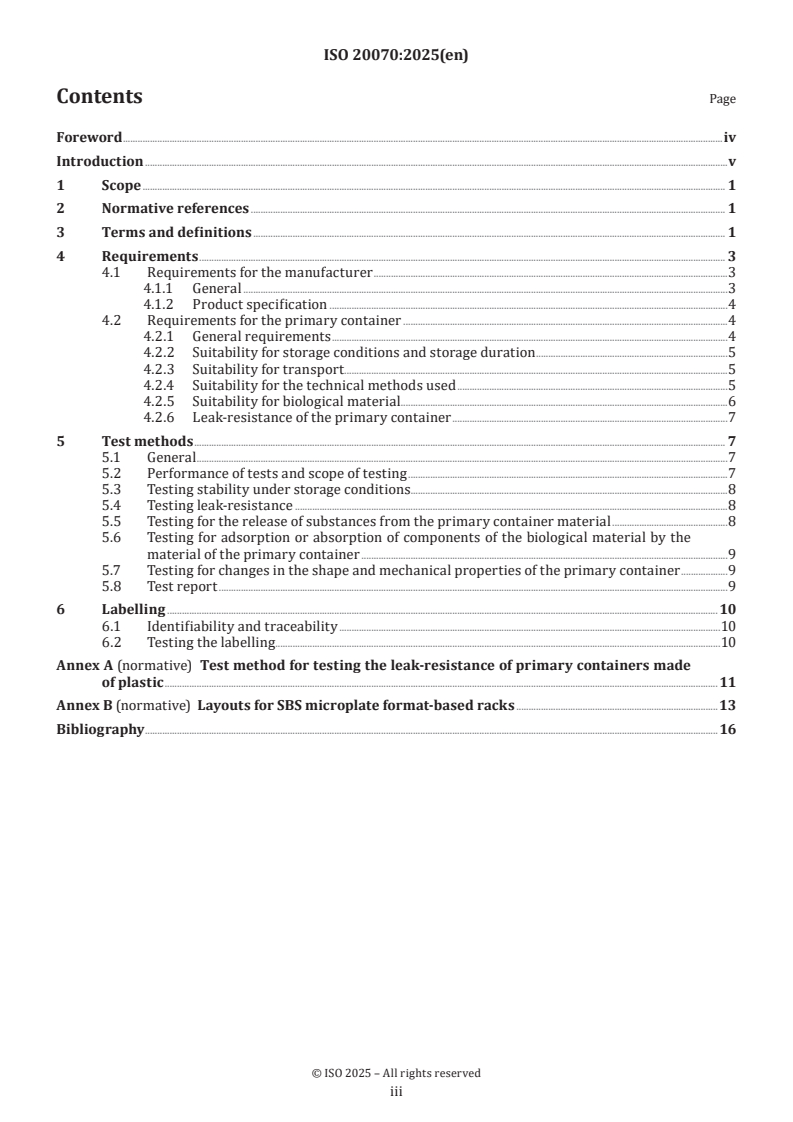
Contents Page
Foreword .iv
Introduction .v
1 Scope . 1
2 Normative references . 1
3 Terms and definitions . 1
4 Requirements . 3
4.1 Requirements for the manufacturer .3
4.1.1 General .3
4.1.2 Product specification .4
4.2 Requirements for the primary container .4
4.2.1 General requirements .4
4.2.2 Suitability for storage conditions and storage duration .5
4.2.3 Suitability for transport .5
4.2.4 Suitability for the technical methods used .5
4.2.5 Suitability for biological material.6
4.2.6 Leak-resistance of the primary container .7
5 Test methods . 7
5.1 General .7
5.2 Performance of tests and scope of testing .7
5.3 Testing stability under storage conditions.8
5.4 Testing leak-resistance .8
5.5 Testing for the release of substances from the primary container material .8
5.6 Testing for adsorption or absorption of components of the biological material by the
material of the primary container .9
5.7 Testing for changes in the shape and mechanical properties of the primary container .9
5.8 Test report .9
6 Labelling . 10
6.1 Identifiability and traceability .10
6.2 Testing the labelling . .10
Annex A (normative) Test method for testing the leak-resistance of primary containers made
of plastic .11
Annex B (normative) Layouts for SBS microplate format-based racks .13
Bibliography .16
iii
Foreword
ISO (the International Organization for Standardization) is a worldwide federation of national standards
bodies (ISO member bodies). The work of preparing International Standards is normally carried out through
ISO technical committees. Each member body interested in a subject for which a technical committee
has been established has the right to be represented on that committee. International organizations,
governmental and non-governmental, in liaison with ISO, also take part in the work. ISO collaborates closely
with the International Electrotechnical Commission (IEC) on all matters of electrotechnical standardization.
The procedures used to develop this document and those intended for its further maintenance are described
in the ISO/IEC Directives, Part 1. In particular, the different approval criteria needed for the different types
of ISO documents should be noted. This document was drafted in accordance with the editorial rules of the
ISO/IEC Directives, Part 2 (see www.iso.org/directives).
ISO draws attention to the possibility that the implementation of this document may involve the use of (a)
patent(s). ISO takes no position concerning the evidence, validity or applicability of any claimed patent
rights in respect thereof. As of the date of publication of this document, ISO had not received notice of (a)
patent(s) which may be required to implement this document. However, implementers are cautioned that
this may not represent the latest information, which may be obtained from the patent database available at
www.iso.org/patents. ISO shall not be held responsible for identifying any or all such patent rights.
Any trade name used in this document is information given for the convenience of users and does not
constitute an endorsement.
For an explanation of the voluntary nature of standards, the meaning of ISO specific terms and expressions
related to conformity assessment, as well as information about ISO’s adherence to the World Trade
Organization (WTO) principles in the Technical Barriers to Trade (TBT), see www.iso.org/iso/foreword.html.
This document was prepared by Technical Committee ISO/TC 276, Biotechnology.
Any feedback or questions on this document should be directed to the user’s national standards body. A
complete listing of these bodies can be found at www.iso.org/members.html.
iv
Introduction
Biobanks represent a central element of biological research and development. By providing biological
materials and their associated data of defined quality, they enable meaningful and reproducible research
results. Prerequisites for this are not only validated methods and qualified equipment, but also consumables
that ensure a defined quality of the biological material. Most of the consumables used come into contact
with the biological material only temporarily and can therefore influence the quality of the biological
material only to a limited extent. However, primary containers for storage, particularly when storage is over
a period of several years, can influence the properties of the biological material. This can occur, for example,
through adsorption or absorption of components of the biological material on the surface of the container,
contamination of the biological material through released contents of the container material, penetration of
foreign substances, or loss of components of the biological material through leaks in the primary container.
Furthermore, the material properties of the primary container can change during longer storage periods
(ageing). The properties of these primary containers can have a crucial effect on the quality of the biological
material.
This document specifies minimum requirements for primary containers that serve the purpose of storing
biological materials in biobanks. The requirements described in this document form the basis for verification
of the usability of primary containers for the storage of biological materials to ensure that there are no
adverse effects on the intrinsic quality of the biological material. In addition, test criteria and test methods
are specified to enable proof of conformity with the minimum requirements.
The requirements included are intended to enable biobanks to provide biological materials of suitable
quality for research and development. The specification of requirements for primary containers and
methods for verifying conformity with these requirements enables manufacturers of primary containers
to demonstrate the suitability of their products for their intended purpose. The standardization of primary
containers facilitates the exchange and gathering of biological materials from different biobanks for large-
scale research projects and use in automated processes.
This document supports biobanks in achieving defined quality targets, collaborating with researchers,
and in harmonizing the quality of biological materials for the benefit of research and development. This
document is primarily aimed at manufacturers that produce primary containers for the storage of biological
materials. Biobanks, submitters and users of biological material, and organizations that monitor or control
the work of biobanks can also use this document.
The following verbal forms are used in this document:
— “shall” indicates a requirement;
— “should” indicates a recommendation;
— “may” indicates a permission;
— “can” indicates a possibility or a capability.
v
International Standard ISO 20070:2025(en)
Biotechnology — Biobanking — Requirements for primary
containers for storing biological materials in biobanks
1 Scope
This document specifies requirements for primary containers intended for the storage of biological materials
in biobanks. In addition to general requirements, this document also specifies special requirements
depending on the storage conditions, the biological material and the intended use, as well as requirements
for documentation and quality control. These requirements establish the framework for ensuring that
primary containers meet the necessary quality criteria.
This document specifies test criteria and test methods that enable proof of conformity with the requirements.
This document is primarily aimed at manufacturers that produce primary containers for the storage of
biological materials. Biobanks, submitters and users of biological material, and organizations that monitor
or control the work of biobanks can also use this document.
NOTE For primary containers intended for biological material for therapeutic use, other requirements can apply.
2 Normative references
The following documents are referred to in the text in such a way that some or all of their content constitutes
requirements of this document. For dated references, only the edition cited applies. For undated references,
the latest edition of the referenced document (including any amendments) applies.
ISO/IEC 15416, Information technology — Automatic identification and data capture techniques — Bar code
print quality test specification — Linear symbols
ISO 20387, Biotechnology — Biobanking — General requirements for biobanking
ISO 2859-1, Sampling procedures for inspection by attributes — Part 1: Sampling schemes indexed by acceptance
quality limit (AQL) for lot-by-lot inspection
ISO 2859-2, Sampling procedures for inspection by attributes — Part 2: Sampling plans indexed by limiting
quality (LQ) for isolated lot inspection
ISO 8601-1, Date and time — Representations for information interchange — Part 1: Basic rules
3 Terms and definitions
For the purposes of this document, the terms and definitions given in ISO 20387 and the following apply.
ISO and IEC maintain terminology databases for use in standardization at the following addresses:
— ISO Online browsing platform: available at https:// www .iso .org/ obp
— IEC Electropedia: available at https:// www .electropedia .org/
3.1
extractable
substance that is released from a primary container (3.6) or material of construction when the primary
container or material is extracted using laboratory extraction conditions and vehicles
[SOURCE: ISO 10993-18:2020, 3.16, modified — Note 1 to entry has been removed, “medical device” has been
replaced by “primary container”.]
3.2
leachable
substance that is released from a primary container (3.6) or material during its use
[SOURCE: ISO 10993-18:2020, 3.22, modified — Note 1 to entry has been removed, “medical device” has
been replaced by “primary container”, and “clinical use” has been replaced by “use”.]
3.3
microplate
flat plate with an array of wells
[13-17]
Note 1 to entry: Some dimensions of microplates are defined in ANSI/SLAS standards .
[SOURCE: ISO 23783-1:2022, 3.29]
3.4
minimum durability date
validated minimum time interval during which a primary container (3.6) can be used under recommended
conditions while retaining appropriate quality
3.5
nominal volume
actual volume of the primary container (3.6) in closed condition
Note 1 to entry: Particularly in the case of primary containers with internal threads, the closure of the primary
container can significantly reduce the volume.
[SOURCE: DIN 13279:2022, 3.10]
3.6
primary container
receptacle that is in direct contact with the biological material for storage and/or transportation of a
biological material, and adapted to the type of biological material and to the kind of subsequent examination
or analysis
Note 1 to entry: Adapted from ISO 11609:2017, 3.4 and ISO 11074:2025, 4.4.19.
3.7
risk analysis
systematic use of available information to identify hazards and to estimate the risk
[SOURCE: ISO/IEC Guide 51:2014, 3.10]
3.8
risk assessment
overall process comprising a risk analysis (3.7) and a risk evaluation (3.9)
[SOURCE: ISO/IEC Guide 51:2014, 3.11]
3.9
risk evaluation
procedure based on the risk analysis (3.7) to determine whether tolerable risk has been exceeded
[SOURCE: ISO/IEC Guide 51:2014, 3.12]
3.10
sample
representative unit taken from a lot
3.11
sample size
number of items in the sample (3.10)
[SOURCE: ISO 2859-1:1999, 3.1.16]
3.12
stability
ability of a biological material, when stored under specified conditions, to maintain a specified property
value within specified limits for a specified period of time
[SOURCE: ISO Guide 30:2015, 2.1.15, modified — “characteristic of a reference material” has been replaced
by “ability of a biological material”; Note 1 to entry has been deleted.]
3.13
measurement uncertainty
uncertainty (of measurement)
parameter, associated with the result of a measurement, that characterizes the dispersion of the values that
could reasonably be attributed to the measurand
Note 1 to entry: The parameter can be, for example, a standard deviation (or a given multiple of it), or the half-width of
an interval having a stated level of confidence.
Note 2 to entry: Uncertainty of measurement comprises, in general, many components. Some of these components can
be evaluated from the statistical distribution of the results of series of measurements and can be characterized by
experimental standard deviations. The other components, which also can be characterized by standard deviations,
are evaluated from assumed probability distributions based on experience or other information.
[SOURCE: ISO/IEC Guide 98-3:2008, 2.2.3, modified — Note 3 to entry has been removed; “may” has been
replaced by “can”.]
3.14
working volume
actual usable proportion of the nominal volume (3.5) of the primary container (3.6)
[SOURCE: DIN 13279:2022, 3.1]
4 Requirements
4.1 Requirements for the manufacturer
4.1.1 General
The product design shall be validated according to the following:
a) leak-resistance;
b) extractables;
c) leachables;
d) dimensional stability with regard to temperature and pressure.
The production process of the material shall be validated.
Revalidation of the production process or the product design on the basis of the product properties shall
be carried out, if the manufacturing process, the conditions of manufacturing or the tools used have been
changed or replaced, or if the specifications of the starting materials or auxiliary materials have changed
and if these changes can be expected to impact the properties validated for the container. Product properties
to be verified in the revalidation shall be selected after a risk assessment.
NOTE 1 Risk assessment can be carried out according to ISO 14971.
The manufacturer should inform the users about changes in the product properties that can be expected to
impact the intended use of the container.
NOTE 2 The information can be provided by mailings, email, on the manufacturer’s website or passed on to
customers by the manufacturer via vendors.
The manufacturer shall verify and document the suitability of the primary containers for specified
requirements by means of suitable test methods (5.4 to 5.7).
The proof of suitability and, if applicable, the test results shall be made available by the manufacturer to the
user upon request.
In case of custom-made primary containers, the user’s specifications shall be provided to and followed by
the manufacturer.
4.1.2 Product specification
The manufacturer shall provide information on the properties and usability of the primary containers; this
includes information on:
a) the suitability for defined storage conditions (temperature and coolant);
b) the applicable characteristics of the biological material (e.g. aggregate condition, composition) to be stored;
c) the sterilization (e.g. free of viable microorganisms);
d) relevant biological contaminants (e.g. endotoxins, genetic material, DNAses and RNAses);
e) relevant chemical contaminants (e.g. leachables, extractables).
Additional information can be provided by the manufacturer to support a user risk assessment.
The manufacturer should provide information on the major components of the primary container material(s)
and relevant known incompatibilities.
The manufacturer shall specify the working volume of the primary container, if applicable. For this purpose,
the change in volume of the contained biological material under different environmental conditions shall
be taken into account. The working volume shall be selected in a way which ensures that the primary
container is not deformed or damaged by changes in the volume of the biological material (e.g. in the case of
temperature changes) and that no biological material can enter the closure of the primary container.
NOTE Detailed information on suitability can be, for example: “Not suitable for storage in liquid nitrogen”, “Only
for storage to −85 °C” or “Not suitable for transport on dry ice”.
4.2 Requirements for the primary container
4.2.1 General requirements
The primary container shall be suitable for storage of the biological material, i.e. the physical and chemical
properties of the material(s) of the primary container used shall meet the minimum requirements defined in
4.2.2 to 4.2.6.
The primary container should be designed so that the biological material can be inserted and removed with
no damage and, if handled properly, no biological material remains in the closure or is otherwise lost.
The specifications and associated tolerances for the primary container shall be documented in the data sheet.
Depending on the intended use, the primary container shall be able to withstand the environmental
influences that occur (e.g. temperature, pressure, media).
4.2.2 Suitability for storage conditions and storage duration
The manufacturer shall define and make available the minimum durability date until which, the primary
container retains its physical and chemical properties unchanged within specified tolerances under the
storage conditions specified. The minimum durability date shall be based on testing and review data
prepared by the manufacturer. The testing and review data should be made available upon request.
For containers intended for cold storage, the manufacturer should provide information on the number
of freezing and thawing cycles the container can withstand without altering its chemical and physical
properties. In addition, the manufacturer should specify, when applicable, conditions or biological materials
for which the primary container is unsuitable. This can be statements such as “not to be exposed to
temperatures below -30 °C” or “not suitable for nucleic acid storage”.
4.2.3 Suitability for transport
If a primary container is intended for the transport of biological materials, it shall meet the transport-
specific requirements. The primary container shall be suitable to withstand the mechanical and physical
loads during transport.
The suitability for transport under the respective conditions shall be included in the data sheet. The
corresponding detection method to verify this shall be specified. It shall be stated under which transport
conditions no significant damage, alteration or loss of the biological material is detected.
The primary container shall be suitable for transporting biological materials according to the classification
of the biological material in a hazard class. The manufacturer shall document the transport suitability of the
primary container conformity within relevant legislation. The manufacturer shall declare and specify for
which types of transport the primary container is suitable and according to which applicable guidelines the
proof has been provided.
4.2.4 Suitability for the technical methods used
The primary container shall be suitable for the technical methods used for processing, storage, relocation or
removal of the biological material and container.
The minimum requirements for the primary container are:
— guaranteed form stability; and
— the resistance to mechanical stress by defined processes
...