

ISO 17072-2:2022
(Main)Leather — Chemical determination of metal content — Part 2: Total metal content
General Information
- Abstract
This document specifies a method for the determination of the total metal content in leather using digestion of the leather and subsequent determination with inductively coupled plasma optical emission spectrometry (ICP-OES), inductively coupled plasma mass spectrometry (ICP-MS), atomic absorption spectrometry (AAS) or spectrometry of atomic fluorescence (SFA). This method determines the total metal content in leather. It is not compound-specific or specific to the oxidation state of the metals.
- Status
- Published
- Publication Date
- 01-Aug-2022
- Technical Committee
- IULTCS - International Union of Leather Technologists and Chemists Societies
- Current Stage
- 6060 - International Standard published
- Start Date
- 02-Aug-2022
- Due Date
- 12-Jan-2023
- Completion Date
- 02-Aug-2022
Buy Documents
ISO 17072-2:2022 - Leather — Chemical determination of metal content — Part 2: Total metal content Released:2. 08. 2022
ISO 17072-2:2022 - Leather — Chemical determination of metal content — Part 2: Total metal content Released:2. 08. 2022
Overview
ISO 17072-2:2022 - Leather - Chemical determination of metal content - Part 2: Total metal content defines a laboratory method to determine the total metal content in leather. The standard covers sample digestion (acid or microwave-assisted), followed by instrumental measurement using ICP-OES, ICP-MS, AAS or atomic fluorescence spectrometry (SFA) for mercury. The method reports total metal amounts on a dry-matter basis and is not compound- or oxidation-state specific.
Key topics and requirements
- Scope of metals: Applicable to Al, Sb, As, Ba, Cd, Ca, Cr (except chromium‑tanned leathers), Co, Cu, Fe, K, Mg, Mn, Mo, Na, Ni, Pb, Se, Si, Sn, Ti, V, Zn, Zr and also suitable for Boron (B).
- Digestion techniques:
- Open acid digestion using a ternary mixture (nitric, sulfuric, perchloric acids) with precautions for perchloric acid hazards.
- Microwave-assisted digestion (MAD) or other validated digestion procedures for complete mineralization.
- Annex B provides a specific digestion procedure for complete determination of aluminium (Al) and titanium (Ti).
- Instrumental analysis:
- ICP-OES (ISO 11885) and ICP-MS (ISO 17294-2) for multi-element quantification.
- Atomic absorption spectrometry (AAS) (ISO 15586) including graphite furnace and hydride-generation options.
- Atomic fluorescence (SFA) (ISO 17852) recommended for mercury.
- Sampling and sample prep:
- Sampling in accordance with ISO 2418; test-piece preparation per ISO 4044; dry matter determination per ISO 4684.
- Use procedural blanks to control acid and lab contamination; select trace-metal‑clean glassware or inert materials for Al-sensitive analyses.
- Reporting:
- Results expressed on a dry‑matter basis; include method, digestion type, instrumentation, calibration and detection/quantification limits. Annex A summarizes interlaboratory results and achievable quantification limits (ICP‑OES).
Applications and users
ISO 17072-2:2022 is used by:
- Leather testing laboratories and quality control departments in tanneries.
- Manufacturers of leather goods, footwear and apparel for regulatory compliance and product safety.
- Environmental and consumer safety analysts assessing metal contamination in finished leather.
- Research labs developing leather chemistry, tanning process controls or material safety data.
Practical benefits include standardized, comparable metal analysis across laboratories, support for compliance with chemical safety limits, and guidance for selecting appropriate digestion and instrumental techniques.
Related standards
- ISO 17072 series (other parts for specific determinations)
- ISO 2418 (sampling location), ISO 4044 (sample preparation), ISO 4684 (dry matter)
- ISO 11885 (ICP‑OES), ISO 17294‑2 (ICP‑MS), ISO 15586 (AAS), ISO 17852 (SFA)
- For chromium in chromium‑tanned leathers, consult the ISO 5398 series.
Relations
- Effective Date
- 12-Feb-2026
- Effective Date
- 06-Jun-2022
- Revises
ISO 17072-2:2019 - Leather — Chemical determination of metal content — Part 2: Total metal content - Effective Date
- 31-Jul-2021
Buy Documents
ISO 17072-2:2022 - Leather — Chemical determination of metal content — Part 2: Total metal content Released:2. 08. 2022
ISO 17072-2:2022 - Leather — Chemical determination of metal content — Part 2: Total metal content Released:2. 08. 2022
Get Certified
Connect with accredited certification bodies for this standard

Control Union Certifications
Global certification for agriculture and sustainability.

Hohenstein Institut
Textile testing and certification.

Bureau Veritas Bangladesh
Bureau Veritas certification services in Bangladesh.
Sponsored listings
Frequently Asked Questions
ISO 17072-2:2022 is a standard published by the International Organization for Standardization (ISO). Its full title is "Leather — Chemical determination of metal content — Part 2: Total metal content". This standard covers: This document specifies a method for the determination of the total metal content in leather using digestion of the leather and subsequent determination with inductively coupled plasma optical emission spectrometry (ICP-OES), inductively coupled plasma mass spectrometry (ICP-MS), atomic absorption spectrometry (AAS) or spectrometry of atomic fluorescence (SFA). This method determines the total metal content in leather. It is not compound-specific or specific to the oxidation state of the metals.
This document specifies a method for the determination of the total metal content in leather using digestion of the leather and subsequent determination with inductively coupled plasma optical emission spectrometry (ICP-OES), inductively coupled plasma mass spectrometry (ICP-MS), atomic absorption spectrometry (AAS) or spectrometry of atomic fluorescence (SFA). This method determines the total metal content in leather. It is not compound-specific or specific to the oxidation state of the metals.
ISO 17072-2:2022 is classified under the following ICS (International Classification for Standards) categories: 59.140.30 - Leather and furs. The ICS classification helps identify the subject area and facilitates finding related standards.
ISO 17072-2:2022 has the following relationships with other standards: It is inter standard links to EN ISO 17072-2:2022, ISO/IEC TR 23091-4:2019, ISO 17072-2:2019. Understanding these relationships helps ensure you are using the most current and applicable version of the standard.
ISO 17072-2:2022 is available in PDF format for immediate download after purchase. The document can be added to your cart and obtained through the secure checkout process. Digital delivery ensures instant access to the complete standard document.
Standards Content (Sample)
INTERNATIONAL ISO
STANDARD 17072-2
IULTCS
IUC 27-2
Third edition
2022-07
Leather — Chemical determination of
metal content —
Part 2:
Total metal content
Cuir — Dosage chimique des métaux —
Partie 2: Teneur totale en métaux
Reference numbers
IULTCS/IUC 27-2:2022(E)
IULTCS/IUC 27-2:2022(E)
© ISO 2022
All rights reserved. Unless otherwise specified, or required in the context of its implementation, no part of this publication may
be reproduced or utilized otherwise in any form or by any means, electronic or mechanical, including photocopying, or posting on
the internet or an intranet, without prior written permission. Permission can be requested from either ISO at the address below
or ISO’s member body in the country of the requester.
ISO copyright office
CP 401 • Ch. de Blandonnet 8
CH-1214 Vernier, Geneva
Phone: +41 22 749 01 11
Email: copyright@iso.org
Website: www.iso.org
Published in Switzerland
ii
IULTCS/IUC 27-2:2022(E)
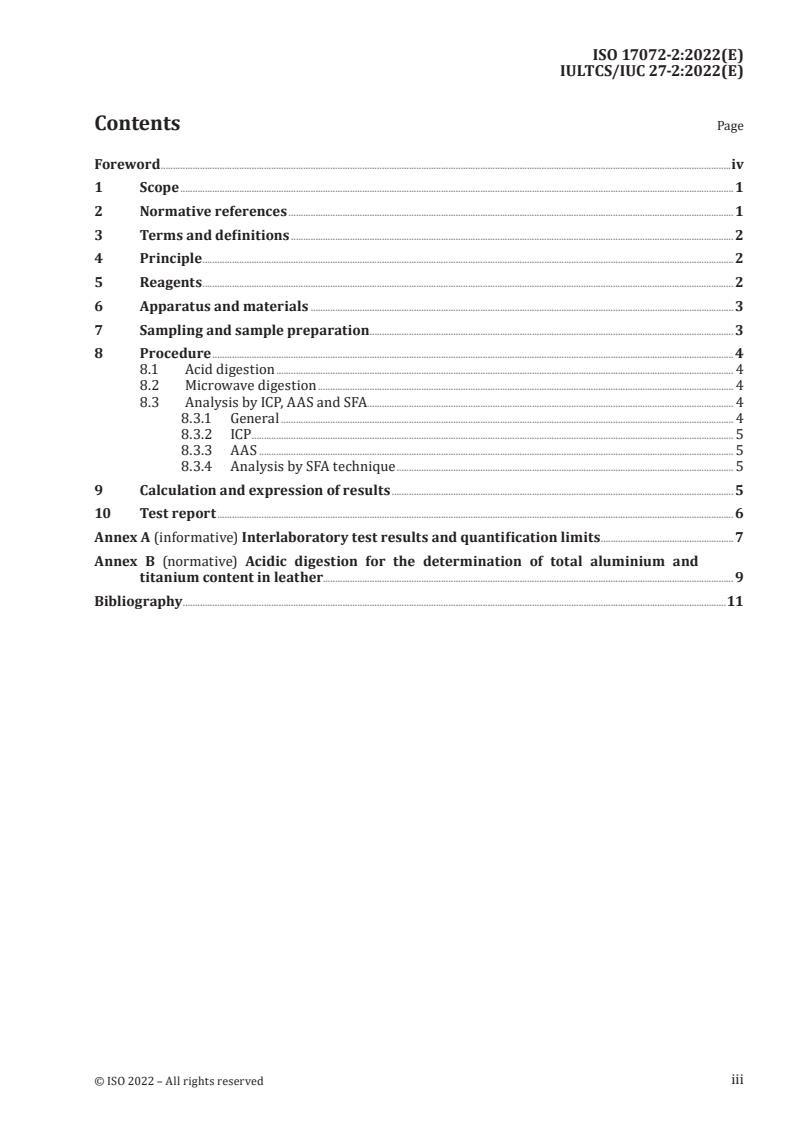
Contents Page
Foreword .iv
1 S c op e . 1
2 Nor m at i ve r ef er enc e s . 1
3 Terms and definitions . 2
4 P r i nc iple . 2
5 R e a g ent s . 2
6 Apparatus and materials .3
7 Sampling and sample preparation . 3
8 P r o c e du re .4
8 .1 Ac id d i g e s t ion . 4
8 . 2 M ic r ow ave d i g e s t ion . 4
8.3 A nalysis by ICP, AAS and SFA. 4
8.3.1 G eneral . 4
8 . 3 . 2 IC P . . 5
8 .3 .3 A A S . 5
8.3.4 Analysis by SFA technique . 5
9 C alculation and expression of results . 5
10 Te s t r ep or t . 6
Annex A (informative) Interlaboratory test results and quantification limits .7
Annex B (normative) Acidic digestion for the determination of total aluminium and
titanium content in leather. 9
Bibliography .11
iii
IULTCS/IUC 27-2:2022(E)
Foreword
ISO (the International Organization for Standardization) is a worldwide federation of national standards
bodies (ISO member bodies). The work of preparing International Standards is normally carried out
through ISO technical committees. Each member body interested in a subject for which a technical
committee has been established has the right to be represented on that committee. International
organizations, governmental and non-governmental, in liaison with ISO, also take part in the work.
ISO collaborates closely with the International Electrotechnical Commission (IEC) on all matters of
electrotechnical standardization.
The procedures used to develop this document and those intended for its further maintenance are
described in the ISO/IEC Directives, Part 1. In particular, the different approval criteria needed for the
different types of ISO documents should be noted. This document was drafted in accordance with the
editorial rules of the ISO/IEC Directives, Part 2 (see www.iso.org/directives).
Attention is drawn to the possibility that some of the elements of this document may be the subject of
patent rights. ISO shall not be held responsible for identifying any or all such patent rights. Details of
any patent rights identified during the development of the document will be in the Introduction and/or
on the ISO list of patent declarations received (see www.iso.org/patents).
Any trade name used in this document is information given for the convenience of users and does not
constitute an endorsement.
For an explanation of the voluntary nature of standards, the meaning of ISO specific terms and
expressions related to conformity assessment, as well as information about ISO’s adherence to the
World Trade Organization (WTO) principles in the Technical Barriers to Trade (TBT), see www.iso.org/
iso/foreword.html.
IULTCS, originally formed in 1897, is a world-wide organization of professional leather societies to
further the advancement of leather science and technology. IULTCS has three Commissions, which
are responsible for establishing international methods for the sampling and testing of leather. ISO
recognizes IULTCS as an international standardizing body for the preparation of test methods for
leather.
This document was prepared by the Chemical Test Commission of the International Union of Leather
Technologists and Chemists Societies (IUC Commission, IULTCS) in collaboration with the European
Committee for Standardization (CEN) Technical Committee CEN/TC 289, Leather, the secretariat of
which is held by UNI, in accordance with the agreement on technical cooperation between ISO and CEN
(Vienna Agreement).
This third edition cancels and replaces the second edition (ISO 17072-2:2019), which has been
technically revised. The main changes are as follows:
— Clause 1, Clause 6 and 8.1 have been editorially and technically modified;
— a new Annex B has been added describing the digestion procedure for the determination of
aluminium and titanium.
A list of all parts in the ISO 17072 series can be found on the ISO website.
Any feedback or questions on this document should be directed to the user’s national standards body. A
complete listing of these bodies can be found at www.iso.org/members.html.
iv
INTERNATIONAL STANDARD
IULTCS/IUC 27-2:2022(E)
Leather — Chemical determination of metal content —
Part 2:
Total metal content
1 S cope
This document specifies a method for the determination of the total metal content in leather using
digestion of the leather and subsequent determination with inductively coupled plasma optical emission
spectrometry (ICP-OES), inductively coupled plasma mass spectrometry (ICP-MS), atomic absorption
spectrometry (AAS) or spectrometry of atomic fluorescence (SFA).
This method determines the total metal content in leather. It is not compound-specific or specific to the
oxidation state of the metals.
The method is applicable for determining the following metals:
Aluminium (Al) Copper (Cu) Potassium (K)
Antimony (Sb) Iron (Fe) Selenium (Se)
Arsenic (As) Lead (Pb) Silicon (Si)
Barium (Ba) Magnesium (Mg) Sodium (Na)
Cadmium (Cd) Manganese (Mn) Tin (Sn)
Calcium (Ca) Mercury (Hg) Titanium (Ti)
Chromium (Cr) (except chromium-tanned leathers) Molybdenum (Mo) Zinc (Zn)
Cobalt (Co) Nickel (Ni) Zirconium (Zr)
This method is also suitable for determining Boron (B) in leather.
In the case of chromium-tanned leathers, it is often more relevant to use ISO 5398-1, ISO 5398-2,
ISO 5398-3 or ISO 5398-4.
Interlaboratory test results and the quantification limits possible with ICP-OES are given in Tables A.1
and A.2.
For the determination of Al and Ti in leather, a digestion procedure is given in Annex B.
2 Normat ive references
The following documents are referred to in the text in such a way that some or all of their content
constitutes requirements of this document. For dated references, only the edition cited applies. For
undated references, the latest edition of the referenced document (including any amendments) applies.
ISO 2418, Leather — Chemical, physical and mechanical and fastness tests — Sampling location
ISO 3696, Water for analytical laboratory use — Specification and test methods
ISO 4044, Leather — Chemical tests — Preparation of chemical test samples
IULTCS/IUC 27-2:2022(E)
ISO 4684, Leather — Chemical tests — Determination of volatile matter
ISO 11885, Water quality — Determination of selected elements by inductively coupled plasma optical
emission spectrometry (ICP-OES)
ISO 15586, Water quality — Determination of trace elements using atomic absorption spectrometry with
graphite furnace
ISO 17294-2, Water quality — Application of inductively coupled plasma mass spectrometry (ICP-MS) —
Part 2: Determination of selected elements including uranium isotopes
ISO 17852, Water quality — Determination of mercury — Method using atomic fluorescence spectrometry
3 Terms and definitions
No terms and definitions are listed in this document.
ISO and IEC maintain terminology databases for use in standardization at the following addresses:
— ISO Online browsing platform: available at https:// www .iso .org/ obp
— IEC Electropedia: available at https:// www .electropedia .org/
4 Principle
Digestion of the sample of leather (see ISO 4044) is carried out using a ternary acid mixture or
microwave digestion until complete mineralization is achieved. The residue is redissolved with water
and analysed by AAS, ICP or SFA (for mercury).
The results are reported on the dry matter of the leather.
5 Reagents
WARNING — The concentrated acids used in this method are very corrosive and/or oxidizing
liquids, which can raise the possibility of fire in the event of contact with ignitable materials
and promote an existing fire considerably or can decompose explosively with warming. They
can also cause acute or chronic health dangers. Moreover, they are hazardous to water. Suitable
safety measures are therefore necessary.
Analytical grade chemicals shall be used for digestion with the Kjeldhal method. Ultrapure acid shall be
used for microwave digestion. All solutions are aqueous solutions.
1)
5.1 Nitric acid, 60 % to 70 % mass fraction, CAS Registry Number® (CAS RN®): 7697-37-2.
5.2 Sulfuric acid, 98 % mass fraction, CAS RN: 7664-93-9.
5.3 Perchloric acid, 60 % to 70 % mass fraction, CAS RN: 7601-90-3.
5.4 Element stock solutions, of the various metals with mass concentrations of 1 000 mg/l each.
5.5 Hydrochloric acid, 37 % mass fraction, CAS RN: 7647-01-0.
5.6 Water, grade 3 in accordance with ISO 3696.
1) CAS Registry Number® (CAS RN®) is a trademark of CAS corporation. This information is given for the
convenience of users of this document and does not constitute an endorsement by ISO of the product named.
Equivalent products may be used if they can be shown to lead to the same results.
IULTCS/IUC 27-2:2022(E)
5.7 Hydrofluoric acid, CAS RN: 7664-39-3.
6 A pparatus and materials
All glassware, analytical devices and the materials, including filters, shall be suitable for analysis of
trace metals. In particular, it is known that aluminium can be released from some types of glassware.
Do a blank test to select the most suitable glassware.
Normal laboratory apparatus and, in particular, the f
...
NORME ISO
INTERNATIONALE 17072-2
IULTCS
IUC 27-2
Troisième édition
2022-07
Cuir — Dosage chimique des
métaux —
Partie 2:
Teneur totale en métaux
Leather — Chemical determination of metal content —
Part 2: Total metal content
Numéros de référence
IULTCS/IUC 27-2:2022(F)
IULTCS/IUC 27-2:2022(F)
DOCUMENT PROTÉGÉ PAR COPYRIGHT
© ISO 2022
Tous droits réservés. Sauf prescription différente ou nécessité dans le contexte de sa mise en œuvre, aucune partie de cette
publication ne peut être reproduite ni utilisée sous quelque forme que ce soit et par aucun procédé, électronique ou mécanique,
y compris la photocopie, ou la diffusion sur l’internet ou sur un intranet, sans autorisation écrite préalable. Une autorisation peut
être demandée à l’ISO à l’adresse ci-après ou au comité membre de l’ISO dans le pays du demandeur.
ISO copyright office
Case postale 401 • Ch. de Blandonnet 8
CH-1214 Vernier, Genève
Tél.: +41 22 749 01 11
E-mail: copyright@iso.org
Web: www.iso.org
Publié en Suisse
ii
IULTCS/IUC 27-2:2022(F)
Sommaire Page
Avant-propos .iv
1 Domaine d'application .1
2 Références normatives .1
3 Termes et définitions . 2
4 Principe. 2
5 Réactifs . 2
6 Appareillage et matériel .3
7 Échantillonnage et préparation des échantillons . 4
8 Mode opératoire . 4
8.1 Digestion en milieu acide . 4
8.2 Digestion aux micro-ondes . 5
8.3 Analyse par ICP, AAS et AFS . 5
8.3.1 Généralités . 5
8.3.2 ICP . . 5
8.3.3 AAS . 5
8.3.4 Analyse par la technique AFS . 6
9 Calculs et expression des résultats .6
10 Rapport d'essai .6
Annexe A (informative) Résultats de l'essai interlaboratoires et limites de quantification .7
Annexe B (normative) Digestion en milieu acide pour le dosage de l'aluminium total et du
titane total dans le cuir . 8
Bibliographie .10
iii
IULTCS/IUC 27-2:2022(F)
Avant-propos
L'ISO (Organisation internationale de normalisation) est une fédération mondiale d'organismes
nationaux de normalisation (comités membres de l'ISO). L'élaboration des Normes internationales est
en général confiée aux comités techniques de l'ISO. Chaque comité membre intéressé par une étude
a le droit de faire partie du comité technique créé à cet effet. Les organisations internationales,
gouvernementales et non gouvernementales, en liaison avec l'ISO participent également aux travaux.
L'ISO collabore étroitement avec la Commission électrotechnique internationale (IEC) en ce qui
concerne la normalisation électrotechnique.
Les procédures utilisées pour élaborer le présent document et celles destinées à sa mise à jour sont
décrites dans les Directives ISO/IEC, Partie 1. Il convient, en particulier de prendre note des différents
critères d'approbation requis pour les différents types de documents ISO. Le présent document a été
rédigé conformément aux règles de rédaction données dans les Directives ISO/IEC, Partie 2 (voir www.
iso.org/directives).
L'attention est attirée sur le fait que certains des éléments du présent document peuvent faire l'objet de
droits de propriété intellectuelle ou de droits analogues. L'ISO ne saurait être tenue pour responsable
de ne pas avoir identifié de tels droits de propriété et averti de leur existence. Les détails concernant
les références aux droits de propriété intellectuelle ou autres droits analogues identifiés lors de
l'élaboration du document sont indiqués dans l'Introduction et/ou dans la liste des déclarations de
brevets reçues par l'ISO (voir www.iso.org/brevets).
Les appellations commerciales éventuellement mentionnées dans le présent document sont données
pour information, par souci de commodité, à l’intention des utilisateurs et ne sauraient constituer un
engagement.
Pour une explication de la nature volontaire des normes, la signification des termes et expressions
spécifiques de l'ISO liés à l'évaluation de la conformité, ou pour toute information au sujet de l'adhésion
de l'ISO aux principes de l’Organisation mondiale du commerce (OMC) concernant les obstacles
techniques au commerce (OTC), voir: www.iso.org/iso/fr/avant-propos.
L'IULTCS est une organisation mondiale de sociétés professionnelles des industries du cuir fondée en
1897 ayant pour mission de favoriser l'avancement des sciences et technologies du cuir. L'IULTCS a trois
commissions, qui sont responsables de l'établissement des méthodes internationales d'échantillonnage
et d'essai des cuirs. L'ISO reconnaît l'IULTCS en tant qu'organisme international à activités normatives
pour l'élaboration de méthodes d'essai relatives au cuir.
Le présent document a été élaboré par la Commission des essais chimiques de l'Union internationale des
sociétés de techniciens et chimistes du cuir (commission IUC, IULTCS), en collaboration avec le comité
technique CEN/TC 289, Cuir, du Comité européen de normalisation (CEN), dont le secrétariat est tenu
par UNI, conformément à l'Accord de coopération technique entre l'ISO et le CEN (Accord de Vienne).
Cette troisième édition annule et remplace la deuxième édition (ISO 17072-2:2019), qui a fait l'objet
d'une révision technique.
Les principales modifications sont les suivantes :
— modifications éditoriales et techniques de l’Article 1, de l’Article 6 et du paragraphe 8.1;
— ajout d’une nouvelle annexe, l'Annexe B, qui décrit le mode opératoire de digestion pour le dosage de
l'aluminium et du titane.
Une liste de toutes les parties de la série ISO 17072 se trouve sur le site web de l'ISO.
Il convient que l’utilisateur adresse tout retour d’information ou toute question concernant le présent
document à l’organisme national de normalisation de son pays. Une liste exhaustive desdits organismes
se trouve à l’adresse www.iso.org/fr/members.html.
iv
NORME INTERNATIONALE
IULTCS/IUC 27-2:2022(F)
Cuir — Dosage chimique des métaux —
Partie 2:
Teneur totale en métaux
1 Domaine d'application
Le présent document spécifie une méthode de détermination de la teneur totale en métaux présents
dans le cuir par digestion du cuir suivie d'une détermination par spectrométrie d'émission optique
avec plasma à couplage inductif (ICP-OES), par spectrométrie de masse avec plasma à couplage
inductif (ICP‑MS), par spectrométrie d'absorption atomique (AAS) ou par spectrométrie de fluorescence
atomique (AFS).
Cette méthode détermine la teneur totale en métaux présents dans le cuir. Elle n'est pas spécifique à un
composé ni à l'état d'oxydation des métaux.
La méthode s'applique au dosage des métaux suivants :
Aluminium (Al) Cuivre (Cu) Potassium (K)
Antimoine (Sb) Fer (Fe) Sélénium (Se)
Arsenic (As) Plomb (Pb) Silicium (Si)
Baryum (Ba) Magnésium (Mg) Sodium (Na)
Cadmium (Cd) Manganèse (Mn) Étain (Sn)
Calcium (Ca) Mercure (Hg) Titane (Ti)
Chrome (Cr) (sauf pour les cuirs tannés au chrome) Molybdène (Mo) Zinc (Zn)
Cobalt (Co) Nickel (Ni) Zirconium (Zr)
La présente méthode est également applicable au dosage du bore (B) dans le cuir.
Dans le cas des cuirs tannés au chrome, il est souvent plus pertinent d'utiliser l'ISO 5398-1, l'ISO 5398-2,
l'ISO 5398-3 ou l'ISO 5398-4.
Les résultats de l'essai interlaboratoires et les limites de quantification possibles avec l'ICP‑OES sont
indiqués dans les Tableaux A.1 et A.2.
Un mode opératoire de digestion est indiqué à l'Annexe B pour le dosage de l'aluminium et du titane
dans le cuir.
2 Références normatives
Les documents suivants sont cités dans le texte de sorte qu’ils constituent, pour tout ou partie de leur
contenu, des exigences du présent document. Pour les références datées, seule l’édition citée s’applique.
Pour les références non datées, la dernière édition du document de référence s'applique (y compris les
éventuels amendements).
ISO 2418, Cuir — Essais chimiques, physiques, mécaniques et de solidité — Emplacement de l’échantillonnage
ISO 3696, Eau pour laboratoire à usage analytique — Spécification et méthodes d'essai
IULTCS/IUC 27-2:2022(F)
ISO 4044, Cuir — Essais chimiques - Préparation des échantillons pour essais chimiques
ISO 4684, Cuir — Essais chimiques — Détermination des matières volatiles
ISO 11885, Qualité de l'eau — Dosage d'éléments choisis par spectroscopie d'émission optique avec plasma
induit par haute fréquence (ICP-OES)
ISO 15586, Qualité de l'eau — Dosage des éléments traces par spectrométrie d'absorption atomique en four
graphite
ISO 17294-2, Qualité de l’eau — Application de la spectrométrie de masse avec plasma à couplage
inductif (ICP-MS) — Partie 2 : Dosage des éléments sélectionnés y compris les isotopes d’uranium
ISO 17852, Qualité de l'eau — Dosage du mercure — Méthode par spectrométrie de fluorescence atomique
3 Termes et définitions
Aucun terme n’est défini dans le présent document.
L’ISO et l’IEC tiennent à jour des bases de données terminologiques destinées à être utilisées en
normalisation, consultables aux adresses suivantes:
— ISO Online browsing platform: disponible à l’adresse https:// www .iso .org/ obp
— IEC Electropedia: disponible à l’adresse https:// www .electropedia .org/
4 Principe
La digestion de l'échantillon de cuir (voir l’ISO 4044) est réalisée en utilisant un mélange acide ternaire
ou une digestion aux micro-ondes jusqu'à minéralisation complète. Le résidu est de nouveau dissous
avec de l'eau et analysé par AAS, ICP ou AFS (pour le mercure).
Les résultats sont donnés par rapport à la matière sèche du cuir.
5 Réactifs
AVERTISSEMENT — Les acides concentrés utilisés dans la présente méthode sont des liquides
très corrosifs et/ou oxydants qui peuvent augmenter la possibilité d'incendie en cas de contact
avec des matériaux inflammables et attiser fortement un incendie existant, ou qui peuvent se
décomposer de manière explosive en chauffant. Ils peuvent également entraîner des risques
graves ou chroniques pour la santé. En outre, ils sont dangereux pour l'eau. Des mesures de
sécurité appropriées sont par conséquent nécessaires.
Des produits chimiques de qualité analytique doivent être utilisés pour la digestion avec la méthode
Kjeldhal. De l'acide ultrapur doit être utilisé pour la digestion aux micro-ondes. Toutes les solutions
sont aqueuses.
5.1 Acide nitrique, de fraction massique comprise entre 60 % et 70 %, numéro de registre CAS®
1)
(CAS RN®) : 7697-37-2.
5.2 Acide sulfurique, de fraction massique égale à 98 %, CAS RN: 7664-93-9.
5.3 Acide perchlorique, de fraction massique comprise entre 60 % et 70 %, CAS RN: 7601-90-3.
1) Numéro de registre CAS® (CAS RN®) est une marque de commerce de CAS Corporation. Cette information est
donnée à l'intention des utilisateurs du présent document et ne signifie nulle ment que l'ISO approuve l'emploi du
produit ainsi désigné. Des produits équivalents peuvent être utilisés s'il est démontré qu'ils aboutissent aux mêmes
résultats.
IULTCS/IUC 27-2:2022(F)
5.4 Solutions mères des éléments des différents métaux, présentant des concentrations massiques
de 1 000 mg/l chacune.
5.5 Acide chlorhydrique, de fraction massique égale à 37 %, CAS RN: 7647-01-0.
5.6 Eau, de qualité 3 conformément à l'ISO 3696.
5.7 Acide fluorhydrique, CAS RN: 7664-39-3.
6 Appareillage et matériel
L'ensemble de la verrerie, des dispositifs d'analyse et du matériel de laboratoire, filtres compris,
doit être adapté à l'analyse des métaux à l'état de trace. Il est notamment connu que certains types
de verrerie peuvent libérer de l’aluminium. Effectuer un essai à blanc pour sélectionner la verrerie la
mieux adaptée.
L'appareillage de laboratoire courant et, en particulier, les éléments ci-après doivent être utilisés.
6.1 Étuve de laboratoire pouvant être maintenue à (102 ± 2) °C.
6.2 Balance analytique d'une précision de 0,1 mg.
6.3 Appareil de chauffage pour ballons de Kjeldahl,
...