

ISO 3951-6:2023
(Main)Sampling procedures for inspection by variables — Part 6: Specification for single sampling plans for isolated lot inspection indexed by limiting quality (LQ)
General Information
- Abstract
This document specifies an acceptance sampling system of single sampling plans for inspection by variables, primarily designed for use under the following conditions: a) where the inspection procedure is applied to an isolated lot of discrete products all supplied by one producer using one production process; b) where only a single quality characteristic, x, of this process is taken into consideration, which is measurable on a continuous scale; c) where the quality characteristic, x, is distributed according to a normal distribution or a close approximation to a normal distribution; d) where the quality characteristic can be measured without error or with moderate measurement error; e) where a contract or standard defines a lower specification limit, L, an upper specification limit, U, or both; an item is qualified as conforming if and only if its measured quality characteristic, x, satisfies the appropriate one of the following inequalities: 1) x ≥ L (i.e. the lower specification limit is not violated); 2) x ≤ U (i.e. the upper specification limit is not violated); 3) x ≥ L and x ≤ U (i.e. neither the lower nor the upper specification limit is violated). Inequalities 1) and 2) are cases with a single specification limit, whereas inequality 3) is a case with double specification limits. Where double specification limits apply, it is assumed in this document that conformance to both specification limits is equally important to the integrity of the product. In such cases, it is appropriate to apply a single LQ to the combined fraction of a product outside the two specification limits. This is referred to as combined control.
- Status
- Published
- Publication Date
- 30-Nov-2023
- Technical Committee
- ISO/TC 69/SC 5 - Acceptance sampling
- Current Stage
- 6060 - International Standard published
- Start Date
- 01-Dec-2023
- Due Date
- 17-Jun-2023
- Completion Date
- 30-Nov-2023


Overview - ISO 3951-6:2023 (Sampling procedures for inspection by variables)
ISO 3951-6:2023 specifies single sampling plans for inspection by variables indexed by limiting quality (LQ), intended for isolated lot inspection. It provides an acceptance sampling system where a single, continuous quality characteristic x is measured and assumed to follow a normal (or near-normal) distribution. The standard covers cases with a single specification limit (lower or upper) or double specification limits (combined control), and is designed for situations where the switching rules of ongoing inspection (ISO 3951-1) are not applicable - for example, isolated lots or short production runs.
Key topics and technical requirements
- Scope and assumptions
- One quality characteristic measurable on a continuous scale.
- Normality assumption (or close approximation).
- Measurement error negligible or moderate (Annex B addresses measurement uncertainty).
- Plan types
- s-method (unknown standard deviation estimated from sample).
- σ-method (presumed known process standard deviation).
- p-method* for approximations and specific operational needs.
- Indexing and objective
- Plans are indexed by Limiting Quality (LQ) - designed so lots at LQ have ~10% probability of acceptance.
- Acceptance is based on an estimate of the fraction nonconforming from the sample.
- Practical procedures and tools
- Tables for plan selection (Clause 12) and worked examples (Clause 13).
- Guidance on choice between variables vs attributes, data transformations, handling outliers, and constructing acceptance diagrams (Annex H).
- Operating characteristic (OC) curves and relations to attributes plans (ISO 2859-2).
- Software support: R package “ISO 3951” (Annex I) to implement plans and compute OC curves.
- Risk and quality analysis
- Annexes with operating characteristics, consumer’s risk, producer’s risk quality and strategies for sampling.
Applications and who uses it
- Quality engineers, statisticians, and inspectors performing acceptance sampling on isolated lots (e.g., one-off shipments, pilot batches).
- Procurement, suppliers, and conformity assessment bodies needing objective single-lot acceptance criteria indexed by LQ.
- Laboratories and manufacturers measuring a continuous quality attribute (dimension, strength, content) where normality holds.
- Useful when switching rules for ongoing inspection are not possible or not desired.
Related standards
- ISO 3951-1 (variables plans with switching rules)
- ISO 2859-2 (attributes plans indexed by LQ for isolated lots) - OC curve comparisons
- ISO 2859-1 and ISO 3534 (statistical vocabulary and symbols)
Keywords: ISO 3951-6:2023, sampling procedures, inspection by variables, limiting quality LQ, single sampling plans, isolated lot inspection, s-method, σ-method, p*-method, acceptance sampling, OC curves, measurement uncertainty.
Get Certified
Connect with accredited certification bodies for this standard

BSI Group
BSI (British Standards Institution) is the business standards company that helps organizations make excellence a habit.

Bureau Veritas
Bureau Veritas is a world leader in laboratory testing, inspection and certification services.

DNV
DNV is an independent assurance and risk management provider.
Sponsored listings
Frequently Asked Questions
ISO 3951-6:2023 is a standard published by the International Organization for Standardization (ISO). Its full title is "Sampling procedures for inspection by variables — Part 6: Specification for single sampling plans for isolated lot inspection indexed by limiting quality (LQ)". This standard covers: This document specifies an acceptance sampling system of single sampling plans for inspection by variables, primarily designed for use under the following conditions: a) where the inspection procedure is applied to an isolated lot of discrete products all supplied by one producer using one production process; b) where only a single quality characteristic, x, of this process is taken into consideration, which is measurable on a continuous scale; c) where the quality characteristic, x, is distributed according to a normal distribution or a close approximation to a normal distribution; d) where the quality characteristic can be measured without error or with moderate measurement error; e) where a contract or standard defines a lower specification limit, L, an upper specification limit, U, or both; an item is qualified as conforming if and only if its measured quality characteristic, x, satisfies the appropriate one of the following inequalities: 1) x ≥ L (i.e. the lower specification limit is not violated); 2) x ≤ U (i.e. the upper specification limit is not violated); 3) x ≥ L and x ≤ U (i.e. neither the lower nor the upper specification limit is violated). Inequalities 1) and 2) are cases with a single specification limit, whereas inequality 3) is a case with double specification limits. Where double specification limits apply, it is assumed in this document that conformance to both specification limits is equally important to the integrity of the product. In such cases, it is appropriate to apply a single LQ to the combined fraction of a product outside the two specification limits. This is referred to as combined control.
This document specifies an acceptance sampling system of single sampling plans for inspection by variables, primarily designed for use under the following conditions: a) where the inspection procedure is applied to an isolated lot of discrete products all supplied by one producer using one production process; b) where only a single quality characteristic, x, of this process is taken into consideration, which is measurable on a continuous scale; c) where the quality characteristic, x, is distributed according to a normal distribution or a close approximation to a normal distribution; d) where the quality characteristic can be measured without error or with moderate measurement error; e) where a contract or standard defines a lower specification limit, L, an upper specification limit, U, or both; an item is qualified as conforming if and only if its measured quality characteristic, x, satisfies the appropriate one of the following inequalities: 1) x ≥ L (i.e. the lower specification limit is not violated); 2) x ≤ U (i.e. the upper specification limit is not violated); 3) x ≥ L and x ≤ U (i.e. neither the lower nor the upper specification limit is violated). Inequalities 1) and 2) are cases with a single specification limit, whereas inequality 3) is a case with double specification limits. Where double specification limits apply, it is assumed in this document that conformance to both specification limits is equally important to the integrity of the product. In such cases, it is appropriate to apply a single LQ to the combined fraction of a product outside the two specification limits. This is referred to as combined control.
ISO 3951-6:2023 is classified under the following ICS (International Classification for Standards) categories: 03.120.30 - Application of statistical methods. The ICS classification helps identify the subject area and facilitates finding related standards.
ISO 3951-6:2023 is available in PDF format for immediate download after purchase. The document can be added to your cart and obtained through the secure checkout process. Digital delivery ensures instant access to the complete standard document.
Standards Content (Sample)
INTERNATIONAL ISO
STANDARD 3951-6
First edition
2023-11
Sampling procedures for inspection by
variables —
Part 6:
Specification for single sampling plans
for isolated lot inspection indexed by
limiting quality (LQ)
Règles d’échantillonnage pour les contrôles par mesures —
Partie 6: Spécification pour les plans d’échantillonnage simples pour
les contrôles de lots isolés, indexés d’après la qualité limite (QL)
Reference number
© ISO 2023
All rights reserved. Unless otherwise specified, or required in the context of its implementation, no part of this publication may
be reproduced or utilized otherwise in any form or by any means, electronic or mechanical, including photocopying, or posting on
the internet or an intranet, without prior written permission. Permission can be requested from either ISO at the address below
or ISO’s member body in the country of the requester.
ISO copyright office
CP 401 • Ch. de Blandonnet 8
CH-1214 Vernier, Geneva
Phone: +41 22 749 01 11
Email: copyright@iso.org
Website: www.iso.org
Published in Switzerland
ii
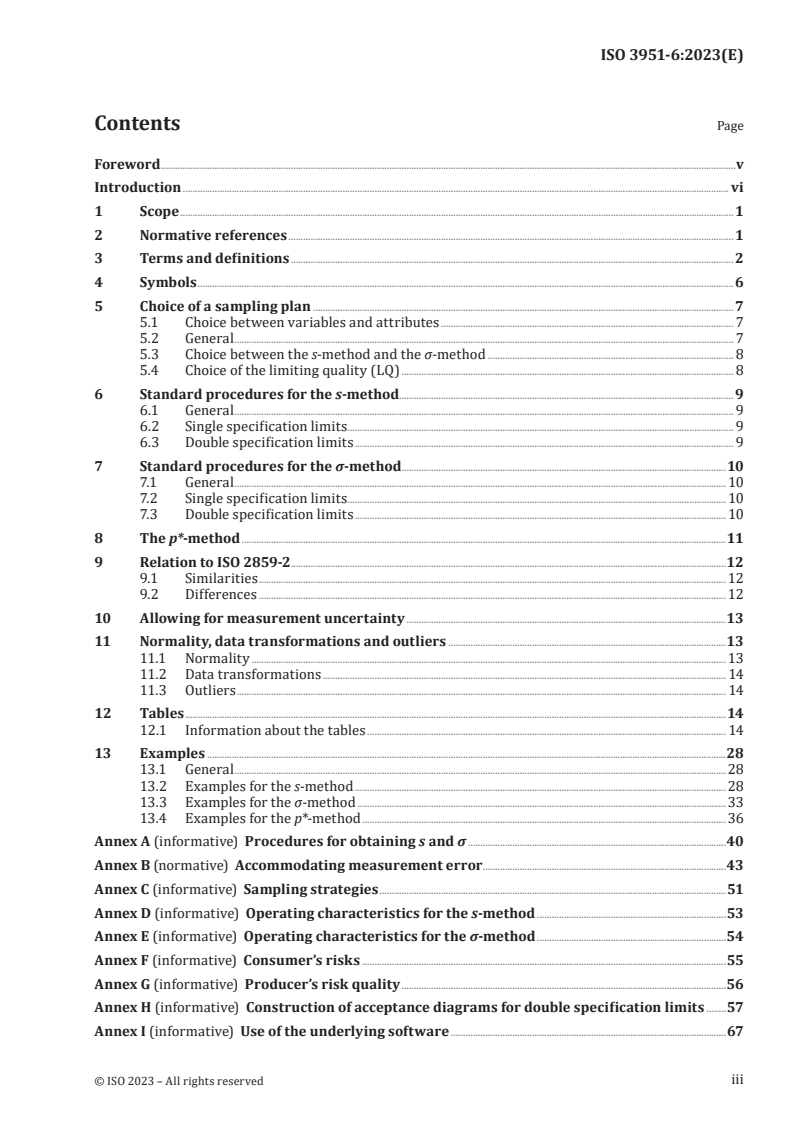
Contents Page
Foreword .v
Introduction . vi
1 Scope . 1
2 Normative references . 1
3 Terms and definitions . 2
4 Symbols . 6
5 Choice of a sampling plan . 7
5.1 Choice between variables and attributes . 7
5.2 General . 7
5.3 Choice between the s-method and the σ-method . 8
5.4 Choice of the limiting quality (LQ) . 8
6 Standard procedures for the s-method. 9
6.1 General . 9
6.2 Single specification limits . . 9
6.3 Double specification limits . 9
7 Standard procedures for the σ-method .10
7.1 General . 10
7.2 Single specification limits . . 10
7.3 Double specification limits . 10
8 The p*-method .11
9 Relation to ISO 2859-2 . .12
9.1 Similarities .12
9.2 Differences . 12
10 Allowing for measurement uncertainty .13
11 Normality, data transformations and outliers .13
11.1 Normality . 13
11.2 Data transformations . 14
11.3 Outliers . 14
12 Tables .14
12.1 Information about the tables . 14
13 Examples .28
13.1 General .28
13.2 Examples for the s-method .28
13.3 Examples for the σ-method .33
13.4 Examples for the p*-method . 36
Annex A (informative) Procedures for obtaining s and σ .40
Annex B (normative) Accommodating measurement error .43
Annex C (informative) Sampling strategies .51
Annex D (informative) Operating characteristics for the s-method .53
Annex E (informative) Operating characteristics for the σ-method .54
Annex F (informative) Consumer’s risks .55
Annex G (informative) Producer’s risk quality .56
Annex H (informative) Construction of acceptance diagrams for double specification limits .57
Annex I (informative) Use of the underlying software .67
iii
Bibliography .79
iv
Foreword
ISO (the International Organization for Standardization) is a worldwide federation of national standards
bodies (ISO member bodies). The work of preparing International Standards is normally carried out
through ISO technical committees. Each member body interested in a subject for which a technical
committee has been established has the right to be represented on that committee. International
organizations, governmental and non-governmental, in liaison with ISO, also take part in the work.
ISO collaborates closely with the International Electrotechnical Commission (IEC) on all matters of
electrotechnical standardization.
The procedures used to develop this document and those intended for its further maintenance are
described in the ISO/IEC Directives, Part 1. In particular, the different approval criteria needed for the
different types of ISO document should be noted. This document was drafted in accordance with the
editorial rules of the ISO/IEC Directives, Part 2 (see www.iso.org/directives).
ISO draws attention to the possibility that the implementation of this document may involve the use
of (a) patent(s). ISO takes no position concerning the evidence, validity or applicability of any claimed
patent rights in respect thereof. As of the date of publication of this document, ISO had not received
notice of (a) patent(s) which may be required to implement this document. However, implementers are
cautioned that this may not represent the latest information, which may be obtained from the patent
database available at www.iso.org/patents. ISO shall not be held responsible for identifying any or all
such patent rights.
Any trade name used in this document is information given for the convenience of users and does not
constitute an endorsement.
For an explanation of the voluntary nature of standards, the meaning of ISO specific terms and
expressions related to conformity assessment, as well as information about ISO's adherence to
the World Trade Organization (WTO) principles in the Technical Barriers to Trade (TBT), see
www.iso.org/iso/foreword.html.
This document was prepared by Technical Committee ISO/TC 69, Applications of statistical methods,
Subcommittee SC 5, Acceptance sampling.
A list of all parts in the ISO 3951 series can be found on the ISO website.
Any feedback or questions on this document should be directed to the user’s national standards body. A
complete listing of these bodies can be found at www.iso.org/members.html.
v
Introduction
This document specifies an acceptance sampling system of single sampling plans for inspection by
variables. It is indexed in terms of the limiting quality (LQ) for the inspection of lots where switching
rules as used in ISO 3951-1 are not applicable. These switching rules provide protection to the consumer
(by the prospect of switching to tightened inspection and discontinuation) and also provide an incentive
to the supplier to improve the quality level. However, there are various cases where the switching rules
of ISO 3951-1 are not applicable, such as isolated lots or a short series of lots.
This document is designed for the inspection of a single quality characteristic that is measurable on a
continuous scale and is normally distributed, under conditions where ISO 3951-1 is not applicable, and is
complementary to the attributes standard ISO 2859-2. The operating characteristic curves (OC curves)
of the variables plans in this document are similar but not identical to those of the corresponding
attributes plans in ISO 2859-2. The OC curves have been matched by minimizing the difference of the
OC curves on condition of getting a comprehensible sample size structure (see Clause 9).
In this document, the acceptance of a lot is implicitly determined from an estimate of the fraction of
nonconforming items in the process, based on a random sample of items from the lot. The objectives
of the methods laid down in this document are to ensure that lots of limiting quality have a probability
of acceptance about 10 % and that the probability of accepting lots with good quality is as high as
practicable.
It is assumed in the main body of this document that measurement error is negligible. For information
on accommodating measurement error, see Annex B, which was derived from References [24], [29]
and [30].
CAUTION — The procedures in this document are not suitable for application to lots that have
been screened for nonconforming items.
Inspection by variables for nonconforming items, as described in this document, includes several
possible modes, the combination of which leads to a presentation that can appear quite complex to the
user:
— unknown standard deviation, or known since the start of inspection;
— a single specification limit, or combined control of double specification limits.
The choice of the most suitable variables plan, if one exists, requires experience, judgement, and
some knowledge of both statistics and the product to be inspected. Clause 5 is intended to help those
responsible for specifying sampling plans in making this choice. It suggests the considerations that
should be borne in mind when deciding whether a variables plan would be suitable and the choices to
be made when selecting an appropriate standard plan.
The basic definitions and notations are provided by Clauses 3 and 4. The basic operational rules are
contained in Clauses 5 through 8. Clause 9 informs about the relations between this document and the
attributes sampling standard ISO 2859-2. Clauses 10 and 11 provide background on accounting for
measurement uncertainty and the underlying normality assumption. All tables needed for the sampling
procedure can be found in Clause 12, and examples for the s–method and the σ–method for both single
and double specification limits can be found in Clause 13.
Nine annexes are provided. Annex A indicates how the sample standard deviation, s, and the presumed
known value of the process standard deviation, σ, should be determined. Annex B provides procedures
for accommodating measurement uncertainty. Annex C shows five different sampling strategies.
Annex D gives the general formula for the operating characteristics of the s–method. Annex E gives the
general formula for the operating characteristics of the σ–method. Annex F gives the theory underlying
the calculation of consumer’s risks. Annex G gives the theory underlying the calculation of producer’s
risk quality. Annex H gives details of how acceptance diagrams for double specification limits are
constructed. Annex I gives a description of the use of the underlying software, R package ISO 3951, to
support implementation of this document.
vi
INTERNATIONAL STANDARD ISO 3951-6:2023(E)
Sampling procedures for inspection by variables —
Part 6:
Specification for single sampling plans for isolated lot
inspection indexed by limiting quality (LQ)
1 Scope
This document specifies an acceptance sampling system of single sampling plans for inspection by
variables, primarily designed for use under the following conditions:
a) where the inspection procedure is applied to an isolated lot of discrete products all supplied by one
producer using one production process;
b) where only a single quality characteristic, x, of this process is taken into consideration, which is
measurable on a continuous scale;
c) where the quality characteristic, x, is distributed according to a normal distribution or a close
approximation to a normal distribution;
d) where the quality characteristic can be measured without error or with moderate measurement
error;
e) where a contract or standard defines a lower specification limit, L, an upper specification limit,
U, or both; an item is qualified as conforming if and only if its measured quality characteristic, x,
satisfies the appropriate one of the following inequalities:
1) x ≥ L (i.e. the lower specification limit is not violated);
2) x ≤ U (i.e. the upper specification limit is not violated);
3) x ≥ L and x ≤ U (i.e. neither the lower nor the upper specification limit is violated).
Inequalities 1) and 2) are cases with a single specification limit, whereas inequality 3) is a case with
double specification limits.
Where double specification limits apply, it is assumed in this document that conformance to both
specification limits is equally important to the integrity of the product. In such cases, it is appropriate
to apply a single LQ to the combined fraction of a product outside the two specification limits. This is
referred to as combined control.
2 Normative references
The following documents are referred to in the text in such a way that some or all of their content
constitutes requirements of this document. For dated references, only the edition cited applies. For
undated references, the latest edition of the referenced document (including any amendments) applies.
ISO 2859-1, Sampling procedures for inspection by attributes — Part 1: Sampling schemes indexed by
acceptance quality limit (AQL) for lot-by-lot inspection
ISO 2859-2, Sampling procedures for inspection by attributes — Part 2: Sampling plans indexed by limiting
quality (LQ) for isolated lot inspection
ISO 3534-1, Statistics — Vocabulary and symbols — Part 1: General statistical terms and terms used in
probability
ISO 3534-2, Statistics — Vocabulary and symbols — Part 2: Applied statistics
3 Terms and definitions
For the purposes of this document, the terms and definitions given in ISO 2859-1, ISO 2859-2, ISO 3534-1,
and ISO 3534-2 and the following apply.
ISO and IEC maintain terminology databases for use in standardization at the following addresses:
— ISO Online browsing platform: available at https:// www .iso .org/ obp
— IEC Electropedia: available at https:// www .electropedia .org/
3.1
inspection by variables
inspection by measuring the magnitude of a characteristic of an item
[SOURCE: ISO 3534-2:2006, 4.1.4, modified — "the magnitude(s) of the characteristic(s)" replaced with
"the magnitude of a characteristic".]
3.2
sampling inspection
inspection of selected items in the group under consideration
[SOURCE: ISO 3534-2:2006, 4.1.6]
3.3
acceptance sampling inspection
acceptance sampling
sampling inspection (3.2) to determine whether or not to accept a lot or other amount of product,
material, or service
[SOURCE: ISO 3534-2:2006, 4.1.8, modified — "acceptance sampling" added as second preferred term;
original definition, "acceptance inspection where the acceptability is determined by means of sampling
inspection" replaced with the current one.]
3.4
acceptance sampling inspection by variables
acceptance sampling inspection (3.3) in which the acceptance of a lot is determined statistically from
measurements on specified quality characteristics of each item in a sample from a lot
[SOURCE: ISO 3534-2:2006, 4.2.11, modified — “the process” replaced by “a lot”, and “on specified
quality characteristics of each item in a sample from a lot” has been replaced by “from inspection by
variables”]
3.5
process fraction nonconforming
rate at which nonconforming items are generated by a process
Note 1 to entry: It is expressed as a proportion.
3.6
quality level
quality expressed as the fraction nonconforming
3.7
consumer's risk
CR
probability of acceptance when the quality level (3.6) has a value stated by the acceptance sampling
plan as unsatisfactory
Note 1 to entry: For the purposes of this document, the consumer's risk is approximately 10 %.
[SOURCE: ISO 3534-2:2006, 4.6.2, modified — Deleted symbol β; original Note 1 to entry replaced with
the current one.]
3.8
consumer's risk quality
CRQ
quality level (3.6) of a lot or process which, in the acceptance sampling plan, corresponds to a specified
consumer’s risk (3.7)
Note 1 to entry: For the purposes of this document, the consumer's risk quality is the limiting quality (3.9).
[SOURCE: ISO 3534-2:2006, 4.6.9, modified — Deleted symbol Q ; original Note 1 to entry replaced
CR
with the current one.]
3.9
limiting quality
LQ
quality level (3.6), when a lot is considered in isolation, which, for the purposes of acceptance sampling
inspection (3.3), is limited to a low probability of acceptance
[SOURCE: ISO 3534-2:2006, 4.6.13]
3.10
producer's risk
PR
probability of non-acceptance when the quality level (3.6) has a value stated by the plan as acceptable
Note 1 to entry: For the purposes of this document, the producer's risk is 5 %.
[SOURCE: ISO 3534-2:2006, 4.6.4, modified — Deleted symbol α; original Notes 1 and 2 to entry replaced
with the current one.]
3.11
producer's risk quality
PRQ
quality level (3.6) of a lot or process which, in the acceptance sampling plan, corresponds to a specified
producer's risk (3.10)
[SOURCE: ISO 3534-2:2006, 4.6.10, modified — Deleted symbol Q ; deleted Notes 1 and 2 to entry.]
PR
3.12
nonconformity
non-fulfilment of a requirement
[SOURCE: ISO 3534-2:2006, 3.1.11]
3.13
s–method acceptance sampling plan
s–method
acceptance sampling (3.3) plan by variables using the sample standard deviation.
Note 1 to entry: See Clause 6.
[SOURCE: ISO 3534-2:2006, 4.3.10, modified – “s method” has been replaced by “s-method”, “acceptance
sampling plan” has been added; “s-method” left as a second preferred term; in the definition, "acceptance
sampling inspection by variables" replaced with "acceptance sampling plan by variables"; added Note 1
to entry.]
3.14
σ–method acceptance sampling plan
σ–method
acceptance sampling (3.3) plan by variables using the presumed value of the process standard deviation
Note 1 to entry: See Clause 7.
[SOURCE: ISO 3534-2:2006, 4.3.9, modified — "sigma method" has been replaced with “σ-method”;
“acceptance sampling plan” has been added with “σ-method” left as a second preferred term; in the
definition, "acceptance sampling inspection by variables" replaced with "acceptance sampling plan by
variables"; added Note 1 to entry.]
3.15
specification limit
conformance boundary specified for a characteristic
[SOURCE: ISO 3534-2:2006, 3.1.3, modified — "limiting value stated" replaced with " conformance
boundary specified".]
3.16
lower specification limit
L
specification limit (3.15) that defines the lower conformance boundary
[SOURCE: ISO 3534-2:2006, 3.1.5, modified — " limiting value" replaced with " conformance boundary".]
3.17
upper specification limit
U
specification limit (3.15) that defines the upper conformance boundary
[SOURCE: ISO 3534-2:2006, 3.1.4, modified — " limiting value" replaced with " conformance boundary".]
3.18
combined control
requirement when both upper and lower limits are specified for the quality characteristic and an LQ
(3.9) that applies to the combined fraction nonconforming beyond the two limits is given
Note 1 to entry: The use of combined control implies that nonconformity (3.12) beyond either specification limit
(3.15) is believed to be of equal, or at least roughly equal, importance to the lack of integrity of the product.
3.19
form k acceptance constant
k
constant depending on the specified value of the limiting quality (3.9) and the sample size, used in the
criteria for accepting the lot in an acceptance sampling (3.3) plan by variables
Note 1 to entry: See Clauses 6 and 7.
[SOURCE: ISO 3534-2:2006, 4.4.4, modified – "acceptability constant" has been replaced with " form
k acceptance constant”; “value of the acceptance quality limit" replaced with "value of the limiting
quality"; added Note 1 to entry.]
3.20
form p* acceptance constant
p*
constant depending on the specified value of the limiting quality (3.9) and the sample size, used in the
criteria for accepting the lot in an acceptance (3.3) plan by variables
Note 1 to entry: See Clause 8.
[SOURCE: ISO 3534-2:2006, 4.4.4, modified — “acceptability constant” has been replaced with “form
p* acceptance constant”; “value of the acceptance quality limit" replaced with "value of the limiting
quality"; added Note 1 to entry.]
3.21
lower quality statistic
Q
L
function of the lower specification limit (3.15), the sample mean, and the sample or process standard
deviation
Note 1 to entry: For a single lower specification limit , the lot is sentenced on the result of comparing Q with the
L
form k acceptance constant (3.19) k.
Note 2 to entry: See Clauses 6 and 7.
[SOURCE: ISO 3534-2:2006, 4.4.11, modified — In the Note 1 to entry, "acceptability constant" has been
replaced with "form k acceptance constant"; Note 2 to entry added.]
3.22
upper quality statistic
Q
U
function of the upper specification limit (3.17), the sample mean, and the sample or process standard
deviation
Note 1 to entry: For a single upper specification limit , the lot is sentenced on the result of comparing Q with the
U
form k acceptance constant (3.19) k.
Note 2 to entry: See Clauses 6 and 7.
[SOURCE: ISO 3534-2:2006, 4.4.10, modified — In the Note 1 to entry, "acceptability constant" has been
replaced with "form k acceptance constant"; Note 2 to entry added.]
3.23
maximum process standard deviation
MPSD
σ
max
largest process standard deviation for a given sample size and LQ (3.9) for which it is possible to satisfy
the acceptance criterion for double specification limits (3.15) with a combined LQ (3.9) when the process
variability is known
[SOURCE: ISO 3534-2:2006, 4.4.8, modified — Added symbol σ ; "or a given sample size code letter
max
and AQL" replaced with "for a given sample size and LQ "; "for a double specification limit under all
inspection severities (i.e. normal, tightened and reduced) when the process variability is known"
replaced with "for double specification limits with a combined LQ when the process variability is
known"; Note 1 to entry deleted.]
3.24
measurement
set of operations to determine the value of some quantity
[SOURCE: ISO 3534-2:2006, 3.2.1, modified – "having the object of determining a value of a quantity"
replaced with "to determine the value of some quantity".]
4 Symbols
f factor that relates the maximum process standard deviation to the difference between
σ
U and L (see Table 3)
the distribution of the standard beta distribution with parameters α and β . In this
Fx()
BETA αβ,
()
document αβ== n 21− throughout.
Fx()
the distribution function of the non-central t-distribution with ν degrees of freedom
t()νδ,
and non-centrality parameter δ
the upper p-quantile of the standardized normal distribution, i.e. x such that 1−Φ xp=
K ()
p
, which corresponds to the process fraction nonconforming p
k form k acceptance constant for use with a single quality characteristic and a single
specification limit (see Table 2 for the s–method or Table 4 for the σ–method)
L lower specification limit (as a subscript to a variable, it denotes its value at L)
n sample size (number of items in a sample)
P probability of acceptance
a
p lot quality in fraction nonconforming
pˆ estimate of the process fraction nonconforming
estimate of the process fraction nonconforming below the lower specification limit
ˆ
p
L
estimate of the process fraction nonconforming above the upper specification limit
ˆ
p
U
*
form p* acceptance constant, i.e. the maximum acceptable value for the estimate of the
p
process fraction nonconforming (see Table 5)
Φ()x
the distribution function of the standardized normal distribution.
Q lower quality statistic
L
NOTE Q is defined as ()xL− s when the process standard deviation is unknown, and
L
as ()xL− σ when it is presumed to be known.
Q upper quality statistic
U
NOTE Q is defined as ()Ux− s when the process standard deviation is unknown, and
U
as ()Ux− σ when it is presumed to be known.
s sample standard deviation of the measured values of the quality characteristic (also
an estimate of the standard deviation of the process), i.e.
n 2
xx−
()
j
∑
j=1
s=
n−1
(see Annex A)
σ standard deviation of a process that is under statistical control
NOTE 1 σ , the square of the process standard deviation, is known as the process variance.
σ maximum process standard deviation (MPSD) (see Table 3)
max
U upper specification limit (as a subscript to a variable, it denotes its value at U)
th
x measured value of the quality characteristic for the j item of the sample
j
x
Sample arithmetic mean of the measured values of the quality characteristic in the
sample, i.e.
n
x
j
∑
j=1
x=
n
(see Annex A)
5 Choice of a sampling plan
5.1 Choice between variables and attributes
The first question to consider is whether it is desirable to inspect by variables rather than by attributes.
The following points should be taken into account.
a) In terms of economics, it is necessary to compare the total cost of the relatively simple inspection
of a larger number of items by means of an attributes scheme with the generally more elaborate
procedure required by a variables scheme, which is usually more time consuming and costly per
item.
b) In terms of the knowledge gained, the advantage lies with inspection by variables as the information
obtained indicates more precisely how good the product is.
c) An attributes scheme can be more readily understood and accepted; for example, it may at first be
difficult to accept that, when inspecting by variables, a lot can be rejected on measurements taken
of a sample that does not contain any nonconforming items and vice versa (see 13.2 Example 2 a
and Example 2 b).
d) From a comparison of the size of the samples required for the same LQ from standard plans
for inspection by attributes, such as from ISO 2959, and the standard plans in this document,
the smallest samples are generally required by the σ–method (used when the process standard
deviation is presumed to be known). The sample sizes for the s–method (used when the process
standard deviation is presumed to be unknown) are larger than for the σ-method but are, in
general, substantially smaller than for sampling by attributes.
e) Variables sampling has a substantial advantage when the inspection process is expensive, for
example, in the case of destructive testing.
f) For two or more quality characteristics, ISO 3951 series does not contain specifications for sampling
plans indexed by LQ.
5.2 General
The following procedures shall be followed in advance of the inspection by variables.
a) Specify the limiting quality (LQ) in accordance with 5.4.
b) Determine the lot size (N).
c) Determine the quality characteristic x and an upper limit U and/or a lower limit L for x.
d) For a quality characteristic with double specification limits, check that nonconformities beyond
each limit are of equal importance.
e) Check whether the s–method (Clause 6) should be used or whether the standard deviation is stable
and known, in which case the σ–method (Clause 7) should be used (see 5.3);
f) for the σ–method and a quality characteristic with double specification limits, a process capability
study in the following sense should be done:
1) enter Table 3 with the LQ to determine the value of the factor f ;
σ
2) calculate the maximum allowable value of the process standard deviation using the formula
σ =−()UL f ;
max σ
3) If σ exceeds σ , the process is not capable and sampling inspection is pointless until it is
max
demonstrated that the process variability has been adequately reduced.
With the specified lot size and the limiting quality as indexing values, the sample size n and the
acceptance constant k are given in Table 2 (s-method) or Table 4 (σ-method).
Although the primary index is the limiting quality, the producer/supplier needs guidance on the quality
level required if lots are to have a high probability of acceptance.
5.3 Choice between the s-method and the σ-method
If it is desired to apply inspection by variables as proposed in this document, the decision shall be
made whether to use the s–method or the σ–method. The σ–method is the more economical in terms of
sample size, but before this method can be applied, it is necessary to have a reliable value of σ, usually
obtained from previous process analyses.
In case no reliable assumptions on the value of σ can be made, it is necessary to use the s–method.
5.4 Choice of the limiting quality (LQ)
The purpose of this document is to guard against unsatisfactory quality. The determination of
unsatisfactory quality is generally a decision that should be made by quality management. The choice of
the LQ is governed by a number of factors, but is mainly a balance between the total cost of inspection
and the consequences of nonconforming items passing into service. In this document, the LQ is the
parameter used to protect against unsatisfactory quality. The sampling plans in this document have
a probability of accepting the lot at the LQ of about 10 %. In this document, the sampling tables are
indexed by a set of specified LQ values.
If the user’s chosen LQ value is not among those specified in Table 1, then an applicable LQ value shall
be the specified LQ corresponding to the range containing the user’s chosen LQ, which is the closest
specified LQ below the user’s chosen LQ (see Example).
Table 1 — Specified LQ values
Limiting quality (LQ) in percent nonconforming
range 00,,50≤
specified 0,05 0,08 0,125 0,2 0,315
range 0,50≤
specified 0,5 0,8 1,25 2 3,15
range 58≤
specified 5 8 12,5 20 31,5
Where both upper and lower specification limits are given, this document addresses only the case of an
overall LQ applying to the combined fraction nonconforming beyond both specification limits; this is
known as combined control.
EXAMPLE
For a product, the limiting quality has been set at 3,5 % nonconforming. This is not one of the specified values
and the applicable LQ shall be that for range 3,15 %5≤
is the closest specified LQ below 3,5 %.
6 Standard procedures for the s-method
6.1 General
The s-method shall be used if information about the standard deviation is missing or unreliable. Under
the s-method, the standard deviation is estimated directly from each sample. As soon as the conditions
for the use of the σ-method are warranted, one may switch from the s-method to the σ-method (see 5.3).
6.2 Single specification limits
Before starting the inspection by variables, see Clause 5.
The procedure for a single specification limit is as follows:
a) Enter Table 2 with the lot size, N, and the LQ to obtain the sample size, n, and the acceptance
constant, k.
b) Take a random sample of size n, measure the characteristic x in each item, and then calculate x , the
sample mean, and s, the sample standard deviation (see Annex A).
NOTE Some sampling strategies are provided in Annex C.
c) Determination of acceptance.
1) If xL< or xU> , reject the lot; or continue with the next step.
2) If s = 0 accept the lot; or continue with the next step.
NOTE It is possible to get s = 0 when measurement uncertainty is present (see Clause 10 and Annex B).
3) Calculate the quality statistic QU=−()xs/ or Qx=−()Ls/ and compare it with the
U L
acceptance constant k. The lot is accepted if Q ≥ k or Q ≥ k ; or rejected if Q < k or Q < k
U L U L
.
For examples of single lower and upper specification limits, see Example 1, Example 2 and Example 3)
in 13.2.
6.3 Double specification limits
Before starting the inspection by variables, see Clause 5.
The procedure for double specification limits for the s-method is as follows:
a) Enter Table 2 with the lot size, N, and the LQ to obtain the sample size, n, and the acceptance
constant, k.
b) Take a random sample of size n, measure the characteristic x in each item and then calculate x , the
sample mean, and s, the sample standard deviation (see Annex A).
NOTE Some sampling strategies are provided in Annex C.
c) Determination of acceptance.
1) If xL< or xU> , reject the lot; or continue with the next step.
2) Plot ()sx, on the acceptance diagram, which can be obtained using the acceptance_region
function in the underlying software (see I.5).
s xL−
NOTE The standardized values ()sx, where s = and x = may be used in which case
SS S S
UL− UL−
()sx, is plotted on the standardized acceptance diagram, which can be obtained using the
SS
acceptance_region function in the underlying software without providing the standardized lower and
upper specification limits L = 0, U = 1 (see I.5).
3) If the plotted point is outside the acceptance region the lot is rejected; otherwise, the lot is
accepted.
For examples of combined control of double specification limits see Example 4 and Example 5 in 13.2.
7 Standard procedures for the σ-method
7.1 General
The σ-method shall only be used when there is valid evidence that the standard deviation σ of the
process can be considered constant with a known value.
7.2 Single specification limits
Before starting the inspection by variables, see Clause 5.
The procedure for the σ-method for a single limit is as follows.
a) Enter Table 4 with the lot size, N, and the LQ to obtain the sample size, n, and the acceptance
constant, k.
b) Take a random sample of size n, measure the characteristic x in each item and then calculate x .
NOTE Some sampling strategies are provided in Annex C.
c) Calculate the quality statistic QU=−()x σ or Qx=−()L σ and compare it with the acceptance
U L
constant k. The lot is accepted if Qk≥ or Qk≥ ; or rejected if Qk< or Qk<
U L U L
For examples of single lower and upper specification limits using the σ–method, see Example 1 and
Example 2 in 13.3.
7.3 Double specification limits
Before starting the inspection by variables, see Clause 5.
a) For double specification limits, a process capability study in the following sense should be done:
1) Enter Table 3 with the Lot size, N, and the LQ to get f
σ
2) Calculate U – L and multiply this value by f to give σ the maximum process standard
σ max
deviation (MPSD)
3) If the known value of σ is less than or equal to σ then acceptance sampling using the σ–
max
method can begin.
4) Enter Table 4 with the lot size, N, and the LQ to obtain the sample size, n, and the acceptance
constant, k.
b) Determination of acceptance:
1) If xL< or xU> , reject the lot; or continue with the next step.
2) Calculate the quality statistics Qx=−L /σ and QU=−x /σ . If Qk< or Qk< , reject
() ()
L U L U
the lot; or continue with the next step.
3) If σσ≤07, 5 accept the lot; otherwise continue with the next step.
max
4) If neither Q or Q are close to k accept the lot; otherwise use the p*-method in Clause 8.
L U
For examples of combined control of double specification limits using the σ–method, see Example 3 in
13.3.
8 The p*-method
The p*-method is an alternative to the standard procedures in Clause 6 and Clause 7. For the application
of this method, distribution functions are calculated.
Before starting the inspection by variables, see Clause 5.
The procedure for the p*-method for a single specification limit and double specification limits is as
follows.
a) Enter Table 2 for unknown standard deviation or Table 4 for known standard deviation with the lot
size, N, and the LQ to obtain the sample size, n.
b) Enter Table 5 with the lot size, N, and the LQ to obtain the acceptance constant, i.e. the maximum
fraction nonconforming, p*.
c) Take a random sample of size n, measure the characteristic x in each item and then calculate x , the
sample mean. For unknown standard deviations, also calculate s, the sample standard deviation
(see Annex A).
NOTE 1 Some sampling strategies are provided in Annex C.
d) Estimated fraction nonconforming.
ˆ
1) Unknown standard deviation: For a lower specification limit, calculate p , for an upper limit,
L
ˆ
calculate p , and for double specification limits, calculate both.
U
1 1 xL− n 1 n
ˆ
pF=−max 0, =−FQmax 0, 1
L nn nn L
2 21s n − 2 n −1
BETA −−1, 1 BETA −−1, 1
2 2 2 2
1 1 Ux− n 1 n
pFˆ =−max 0, =−FQmax 0, 1
U nn nn U
2 21s n − 2 n −1
BETA −−1, 1 BETA −−1, 1
2 2 2 2
2) Known standard deviation: For a lower specification limit, calculate pˆ , for an upper limit,
L
calculate pˆ , and for double specification limits, calculate both.
U
Lx− n n
ˆ
p = ΦΦ =− Q
LL
σ n− 11n−
xU− n n
ˆ
p = ΦΦ =− Q
UU
σ n− 11n−
e) Determination of acceptance:
* *
1) single limit: A lot shall be accepted if ppˆ ≤ for a lower limit, and if ppˆ ≤ for an upper
L U
* *
ˆ ˆ
limit; if pp> or pp> respectively, the lot is rejected.
L U
* *
ˆˆ ˆˆ
2) double limits: A lot shall be accepted if pp+≤ p ; if pp+> p , the lot is rejected.
LU LU
For an example of single specification limits see Example 7 in 13.4. For examples of combined control of
double specification limits see Example 8 and Example 9 in 13.4.
9 Relation to ISO 2859-2
9.1 Similarities
a) This document is complementary to ISO 2859-2; the two documents share a common philosophy
and, as far as possible, their procedures and vocabulary are the same.
b) Both use the LQ to index the samp
...