

ISO/TS 21310:2020
(Main)Traditional Chinese medicine — Microscopic examination of medicinal herbs
General Information
- Abstract
This document specifies the methods for microscopic examination of medicinal herbs. It covers the equipment, sampling, preparation and observation methods. This document is applicable to medicinal herbs used in traditional Chinese medicine, including Chinese materia medica (whole medicinal materials) and decoction pieces derived from plants. It is not applicable to medicinal materials derived from animals or minerals.
- Status
- Withdrawn
- Publication Date
- 14-Jul-2020
- Technical Committee
- ISO/TC 249 - Traditional Chinese medicine
- Current Stage
- 9599 - Withdrawal of International Standard
- Start Date
- 18-Jun-2025
- Completion Date
- 29-Aug-2026
Buy Documents
ISO/TS 21310:2020 - Traditional Chinese medicine — Microscopic examination of medicinal herbs Released:15. 07. 2020
ISO/TS 21310:2020 - Traditional Chinese medicine — Microscopic examination of medicinal herbs/15/2020
Overview
ISO/TS 21310:2020 - Traditional Chinese medicine - Microscopic examination of medicinal herbs - specifies standardized methods for the microscopic analysis of plant-derived medicinal materials used in traditional Chinese medicine (TCM). The technical specification describes required equipment, sampling amounts, sample preparation (sections and powders), mounting/swelling agents, observation procedures and reporting. It applies to Chinese materia medica (whole medicinal materials) and decoction pieces derived from plants, but excludes animal- or mineral-derived materials.
Key topics and technical requirements
- Scope and definitions: Clarifies terms such as microscopic examination, slide, cover glass and micrometer; prepared in line with ISO/TC 249 terminology.
- Sampling: Guidance on representative sample sizes - small/powdered (50–250 g) and large/whole (250–500 g) - and preservation in airtight containers when needed.
- Apparatus: Use of optical microscopes or slide scanners, micrometers (optical or software), imaging devices (digital cameras), slides, cover glasses and botanical dissecting tools (tweezers, microtome, razor).
- Preparation methods:
- Cross-section and longitudinal-section slides (cutting to 10–20 µm; optional paraffin embedding).
- Powder slides (swelling in agents for ≥10 minutes and uniform smearing).
- Mounting and swelling agents (e.g., glycerine/water 1:1 or glycerine/95% ethanol/water 1:1:1).
- Annex A contains informative methods: moisturizing, fixation (ethanol, formalin, F.A.A., Craf III), maceration (KOH, chromic‑nitric, potassium chlorate), sectioning (free-hand, paraffin embedding, frozen/cryosection) and staining.
- Observation: Recommended observation order for whole and powdered samples (outer/inner portions, characteristic components, cell contents); includes histochemical detection procedures (e.g., phloroglucinol test for lignified walls).
- Test report requirements: Must include sample identification, sampling method, reference to ISO/TS 21310:2020, test methods and results, optional operating details, anomalies and test date.
Applications and intended users
- Quality control laboratories in herbal medicine manufacturers and suppliers
- Regulatory and pharmacopoeial testing bodies evaluating botanical identity and purity
- Research laboratories conducting anatomical and histochemical studies of medicinal herbs
- Educational institutions teaching pharmacognosy and TCM materia medica
ISO/TS 21310:2020 helps ensure consistent, reproducible microscopic identification of plant-based TCM materials, supporting authenticity checks, adulteration detection and quality assurance.
Related standards
- ISO/TC 249 (Traditional Chinese medicine) - responsible technical committee
- Cited terminology sources: ISO 17639:2003 and ISO 10934-1:2002 (for microscopy terms)
Keywords: ISO/TS 21310:2020, traditional Chinese medicine, microscopic examination, medicinal herbs, Chinese materia medica, decoction pieces, sample preparation, microscopy, microtome, paraffin embedding, powder slides, histochemical detection.
Relations
- Revised
ISO/TS 21310:2025 - Traditional Chinese medicine — Microscopic examination of medicinal herbs - Effective Date
- 15-Jun-2024
Buy Documents
ISO/TS 21310:2020 - Traditional Chinese medicine — Microscopic examination of medicinal herbs Released:15. 07. 2020
ISO/TS 21310:2020 - Traditional Chinese medicine — Microscopic examination of medicinal herbs/15/2020
Get Certified
Connect with accredited certification bodies for this standard

BSI Group
BSI (British Standards Institution) is the business standards company that helps organizations make excellence a habit.

TÜV Rheinland
TÜV Rheinland is a leading international provider of technical services.

TÜV SÜD
TÜV SÜD is a trusted partner of choice for safety, security and sustainability solutions.
Sponsored listings
Frequently Asked Questions
ISO/TS 21310:2020 is a technical specification published by the International Organization for Standardization (ISO). Its full title is "Traditional Chinese medicine — Microscopic examination of medicinal herbs". This standard covers: This document specifies the methods for microscopic examination of medicinal herbs. It covers the equipment, sampling, preparation and observation methods. This document is applicable to medicinal herbs used in traditional Chinese medicine, including Chinese materia medica (whole medicinal materials) and decoction pieces derived from plants. It is not applicable to medicinal materials derived from animals or minerals.
This document specifies the methods for microscopic examination of medicinal herbs. It covers the equipment, sampling, preparation and observation methods. This document is applicable to medicinal herbs used in traditional Chinese medicine, including Chinese materia medica (whole medicinal materials) and decoction pieces derived from plants. It is not applicable to medicinal materials derived from animals or minerals.
ISO/TS 21310:2020 is classified under the following ICS (International Classification for Standards) categories: 11.120.10 - Medicaments. The ICS classification helps identify the subject area and facilitates finding related standards.
ISO/TS 21310:2020 has the following relationships with other standards: It is inter standard links to ISO/TS 21310:2025. Understanding these relationships helps ensure you are using the most current and applicable version of the standard.
ISO/TS 21310:2020 is available in PDF format for immediate download after purchase. The document can be added to your cart and obtained through the secure checkout process. Digital delivery ensures instant access to the complete standard document.
Standards Content (Sample)
TECHNICAL ISO/TS
SPECIFICATION 21310
First edition
2020-07
Traditional Chinese medicine —
Microscopic examination of
medicinal herbs
Médecine traditionnelle chinoise — Examen microscopique des herbes
médicinales
Reference number
©
ISO 2020
© ISO 2020
All rights reserved. Unless otherwise specified, or required in the context of its implementation, no part of this publication may
be reproduced or utilized otherwise in any form or by any means, electronic or mechanical, including photocopying, or posting
on the internet or an intranet, without prior written permission. Permission can be requested from either ISO at the address
below or ISO’s member body in the country of the requester.
ISO copyright office
CP 401 • Ch. de Blandonnet 8
CH-1214 Vernier, Geneva
Phone: +41 22 749 01 11
Email: copyright@iso.org
Website: www.iso.org
Published in Switzerland
ii © ISO 2020 – All rights reserved
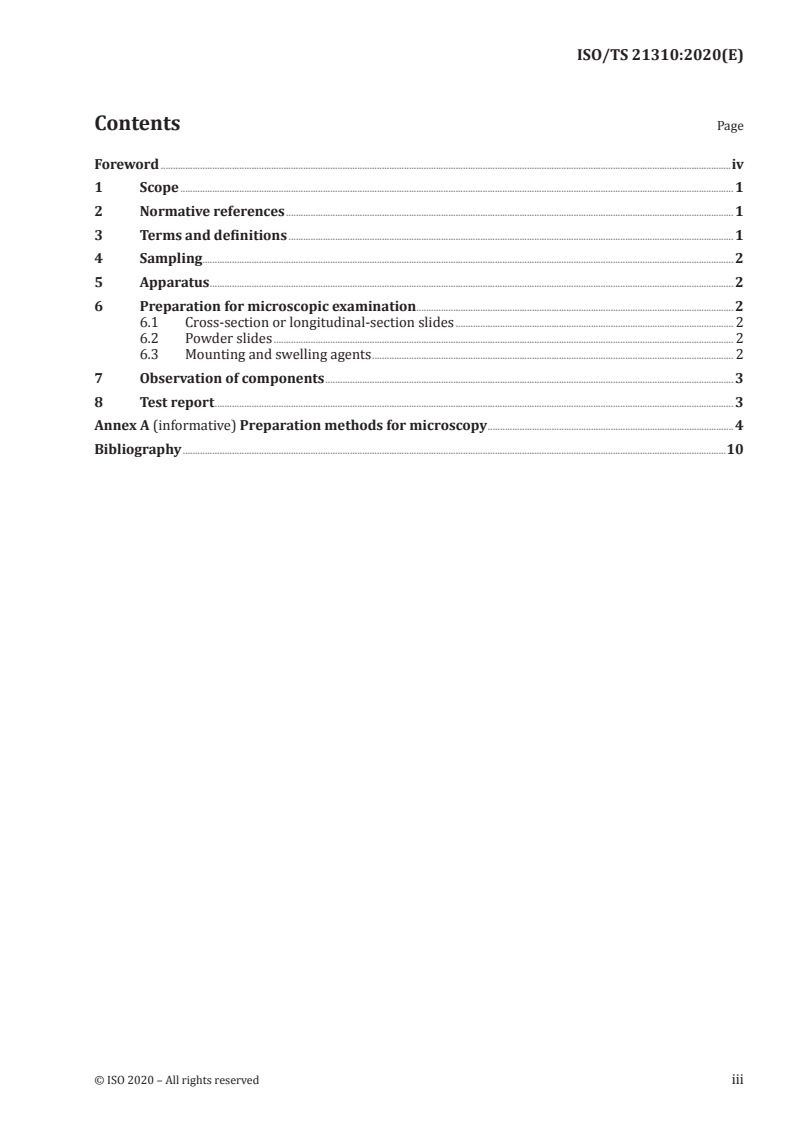
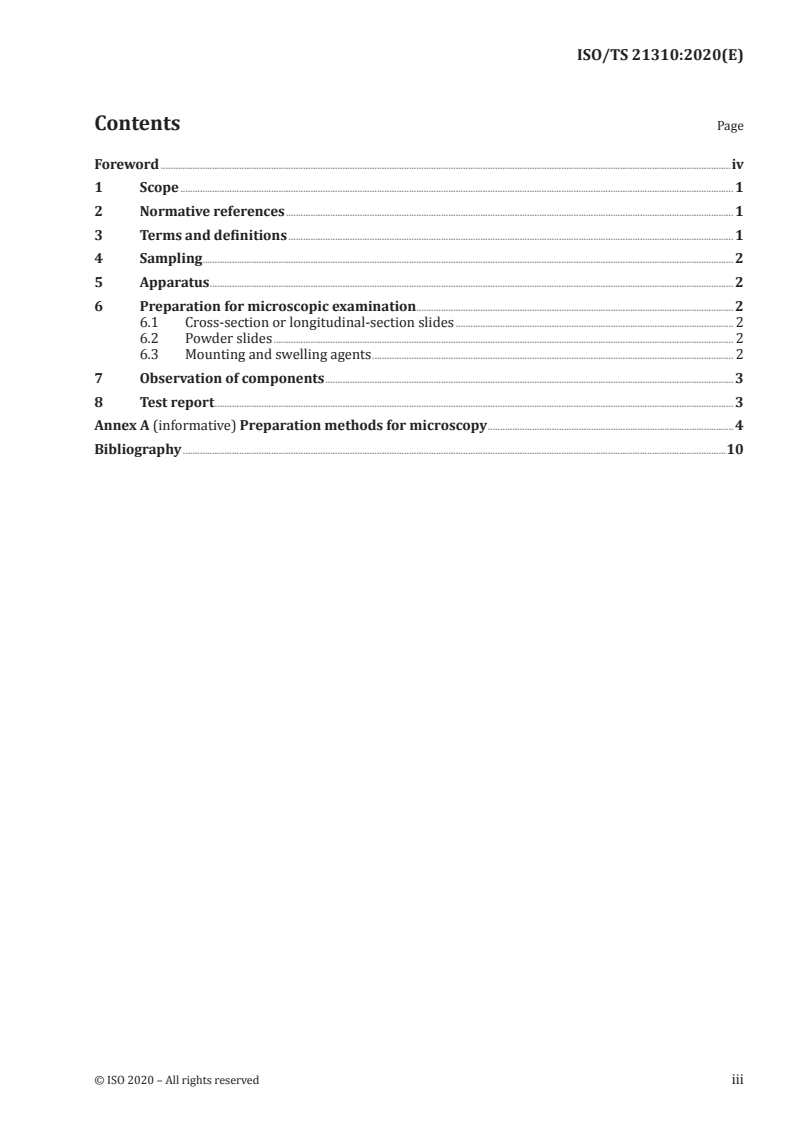
Contents Page
Foreword .iv
1 Scope . 1
2 Normative references . 1
3 Terms and definitions . 1
4 Sampling . 2
5 Apparatus . 2
6 Preparation for microscopic examination . 2
6.1 Cross-section or longitudinal-section slides . 2
6.2 Powder slides . 2
6.3 Mounting and swelling agents . 2
7 Observation of components . 3
8 Test report . 3
Annex A (informative) Preparation methods for microscopy . 4
Bibliography .10
Foreword
ISO (the International Organization for Standardization) is a worldwide federation of national standards
bodies (ISO member bodies). The work of preparing International Standards is normally carried out
through ISO technical committees. Each member body interested in a subject for which a technical
committee has been established has the right to be represented on that committee. International
organizations, governmental and non-governmental, in liaison with ISO, also take part in the work.
ISO collaborates closely with the International Electrotechnical Commission (IEC) on all matters of
electrotechnical standardization.
The procedures used to develop this document and those intended for its further maintenance are
described in the ISO/IEC Directives, Part 1. In particular, the different approval criteria needed for the
different types of ISO documents should be noted. This document was drafted in accordance with the
editorial rules of the ISO/IEC Directives, Part 2 (see www .iso .org/ directives).
Attention is drawn to the possibility that some of the elements of this document may be the subject of
patent rights. ISO shall not be held responsible for identifying any or all such patent rights. Details of
any patent rights identified during the development of the document will be in the Introduction and/or
on the ISO list of patent declarations received (see www .iso .org/ patents).
Any trade name used in this document is information given for the convenience of users and does not
constitute an endorsement.
For an explanation of the voluntary nature of standards, the meaning of ISO specific terms and
expressions related to conformity assessment, as well as information about ISO's adherence to the
World Trade Organization (WTO) principles in the Technical Barriers to Trade (TBT), see www .iso .org/
iso/ foreword .html.
This document was prepared by Technical Committee ISO/TC 249, Traditional Chinese medicine.
Any feedback or questions on this document should be directed to the user’s national standards body. A
complete listing of these bodies can be found at www .iso .org/ members .html.
iv © ISO 2020 – All rights reserved
TECHNICAL SPECIFICATION ISO/TS 21310:2020(E)
Traditional Chinese medicine — Microscopic examination
of medicinal herbs
1 Scope
This document specifies the methods for microscopic examination of medicinal herbs. It covers the
equipment, sampling, preparation and observation methods. This document is applicable to medicinal
herbs used in traditional Chinese medicine, including Chinese materia medica (whole medicinal
materials) and decoction pieces derived from plants. It is not applicable to medicinal materials derived
from animals or minerals.
2 Normative references
There are no normative references in this document.
3 Terms and definitions
For the purposes of this document, the following terms and definitions apply.
ISO and IEC maintain terminological databases for use in standardization at the following addresses:
— ISO Online browsing platform: available at https:// www .iso .org/ obp
— IEC Electropedia: available at http:// www .electropedia .org/
3.1
microscopic examination
examination of a test specimen by microscope with a magnification of generally × 50 to × 500
[SOURCE: ISO 17639:2003, 3.2, modified.]
3.2
medicinal herbs
raw materials derived from various parts of plants for drugs used in herbal medicine
Note 1 to entry: Herbal medicine includes traditional Chinese medicine, Korean medicine and Kampo.
3.3
slide
flat rectangular plate of glass on which an object is mounted for microscopic examination
[SOURCE: ISO 10934-1:2002, 2.133]
3.4
cover glass
rectangular or circular piece of thin glass used to cover a microscopical preparation
[SOURCE: ISO 10934-1:2002, 2.34, modified — Note 1 to entry removed.]
3.5
micrometer
device for measuring small lengths
[SOURCE: ISO 10934-1:2002, 2.96]
4 Sampling
Small-sized, cut or powdered material (50 g to 250 g) samples shall be taken after mixing thoroughly.
Large-sized or whole material (250 g to 500 g) samples shall be taken after mixing thoroughly. After
that, select a representative sample of the material. If necessary, the samples should be preserved in
airtight containers.
5 Apparatus
Use the usual laboratory apparatus and, in particular, the following:
5.1 Optical microscope or slide scanner.
5.2 Optical or in-software micrometer.
5.3 Imaging devices such as drawing attachments, embedded camera or digital imaging sensor for
the microscope.
5.4 Slides and cover glasses.
5.5 Botanical dissecting instruments such as tweezers, surgical knife, razor blade, microtome.
6 Preparation for microscopic examination
6.1 Cross-section or longitudinal-section slides
a) According to the sample condition, moisturizing, fixation or maceration process can be added. See
A.1 to A.3 for additional information.
b) Select representative pieces of the material being examined and cut into suitable lengths.
c) After softening, cut the material with a razor blade or a microtome to a thickness of 10 μm to 20 μm.
d) Place a section on a slide glass, add two or three drops of a mounting agent or chloral hydrate
solution and place a cover glass over it, taking precautions against the inclusion of bubbles.
e) Embed the material in hard paraffin for cutting, if necessary. See A.4.
6.2 Powder slides
a) Place about 0,1 g of powdered sample in a watch glass containing two or three drops of a swelling
agent or chloral hydrate solution, stir well with a small rod to prevent the inclusion of bubbles and
allow to stand for more than 10 min to swell the sample.
b) Using a small glass rod, smear the slide glass with a small amount of the swollen sample, add one
drop of the mounting agent and place a cover glass on it so that the tissue sections spread evenly
without overlap, taking precautions against the inclusion of bubbles.
6.3 Mounting and swelling agents
Mounting and swelling agents may be made of a mixture of glycerine and water (1:1) or a mixture of
glycerine, 95 % ethanol and water (1:1:1) as mounting and swelling agents. Other agents which have
characteristics of mounting and swelling agents can be used.
2 © ISO 2020 – All rights reserved
7 Observation of components
Observation can be conducted in the order of the outer portion, inner portion and cell contents. In
case of a powdered sample, observation can be made in the order of characteristic component, matter
present in large amounts, rarely existing matter and cell contents. For histochemical detection of the
sample, see A.6.
8 Test report
The test report shall include the following information:
a) all information necessary for the complete identification of the sample;
b) the sampling method used;
c) the test method used, with reference to this document, i.e. ISO/TS 21310:2020;
d) the test result(s) obtained;
e) all operating details not specified in this document, or regarded as optional, together with details
of any incidents which may have influenced the test result(s);
f) any unusual features (anomalies) observed during the test;
g) the date of the test.
Annex A
(informative)
Preparation methods for microscopy
A.1 Moisturizing
Dried parts of a plant may require softening before preparation for microscopy, preferably by soaking
in water. Use a desiccator for larger quantities of material, placing water into the lower part instead of
the drying agent.
Bark, wood and other dense and hard materials need to be soaked in water or in equal parts of water,
ethanol and glycerol for a few hours or overnight until they are soft enough to be cut. Boiling in water
for a few minutes can sometimes be necessary.
Any water-soluble contents can be removed from the cells by soaking in water. Starch grains can
be gelatinized by heating in water. In certain cases, material can be moistened with water for a few
minutes to soften the surfaces and allow sections to be cut.
A.2 Fixation
Fixation is the process of preserving the tissue by placing the tissue in fixatives. The permeation of
fixatives into the tissue can be dependent upon the size of the sample. Before fixation, it is recommended
that samples be cut smaller than 6 mm ⨯ 6 mm ⨯ 6 mm.
The following water solutions are used as fixatives:
— ethanol: 50 % to 70 %
—
...
TECHNICAL ISO/TS
SPECIFICATION 21310
First edition
2020-07
Traditional Chinese medicine —
Microscopic examination of
medicinal herbs
Médecine traditionnelle chinoise — Examen microscopique des herbes
médicinales
Reference number
©
ISO 2020
© ISO 2020
All rights reserved. Unless otherwise specified, or required in the context of its implementation, no part of this publication may
be reproduced or utilized otherwise in any form or by any means, electronic or mechanical, including photocopying, or posting
on the internet or an intranet, without prior written permission. Permission can be requested from either ISO at the address
below or ISO’s member body in the country of the requester.
ISO copyright office
CP 401 • Ch. de Blandonnet 8
CH-1214 Vernier, Geneva
Phone: +41 22 749 01 11
Email: copyright@iso.org
Website: www.iso.org
Published in Switzerland
ii © ISO 2020 – All rights reserved
Contents Page
Foreword .iv
1 Scope . 1
2 Normative references . 1
3 Terms and definitions . 1
4 Sampling . 2
5 Apparatus . 2
6 Preparation for microscopic examination . 2
6.1 Cross-section or longitudinal-section slides . 2
6.2 Powder slides . 2
6.3 Mounting and swelling agents . 2
7 Observation of components . 3
8 Test report . 3
Annex A (informative) Preparation methods for microscopy . 4
Bibliography .10
Foreword
ISO (the International Organization for Standardization) is a worldwide federation of national standards
bodies (ISO member bodies). The work of preparing International Standards is normally carried out
through ISO technical committees. Each member body interested in a subject for which a technical
committee has been established has the right to be represented on that committee. International
organizations, governmental and non-governmental, in liaison with ISO, also take part in the work.
ISO collaborates closely with the International Electrotechnical Commission (IEC) on all matters of
electrotechnical standardization.
The procedures used to develop this document and those intended for its further maintenance are
described in the ISO/IEC Directives, Part 1. In particular, the different approval criteria needed for the
different types of ISO documents should be noted. This document was drafted in accordance with the
editorial rules of the ISO/IEC Directives, Part 2 (see www .iso .org/ directives).
Attention is drawn to the possibility that some of the elements of this document may be the subject of
patent rights. ISO shall not be held responsible for identifying any or all such patent rights. Details of
any patent rights identified during the development of the document will be in the Introduction and/or
on the ISO list of patent declarations received (see www .iso .org/ patents).
Any trade name used in this document is information given for the convenience of users and does not
constitute an endorsement.
For an explanation of the voluntary nature of standards, the meaning of ISO specific terms and
expressions related to conformity assessment, as well as information about ISO's adherence to the
World Trade Organization (WTO) principles in the Technical Barriers to Trade (TBT), see www .iso .org/
iso/ foreword .html.
This document was prepared by Technical Committee ISO/TC 249, Traditional Chinese medicine.
Any feedback or questions on this document should be directed to the user’s national standards body. A
complete listing of these bodies can be found at www .iso .org/ members .html.
iv © ISO 2020 – All rights reserved
TECHNICAL SPECIFICATION ISO/TS 21310:2020(E)
Traditional Chinese medicine — Microscopic examination
of medicinal herbs
1 Scope
This document specifies the methods for microscopic examination of medicinal herbs. It covers the
equipment, sampling, preparation and observation methods. This document is applicable to medicinal
herbs used in traditional Chinese medicine, including Chinese materia medica (whole medicinal
materials) and decoction pieces derived from plants. It is not applicable to medicinal materials derived
from animals or minerals.
2 Normative references
There are no normative references in this document.
3 Terms and definitions
For the purposes of this document, the following terms and definitions apply.
ISO and IEC maintain terminological databases for use in standardization at the following addresses:
— ISO Online browsing platform: available at https:// www .iso .org/ obp
— IEC Electropedia: available at http:// www .electropedia .org/
3.1
microscopic examination
examination of a test specimen by microscope with a magnification of generally × 50 to × 500
[SOURCE: ISO 17639:2003, 3.2, modified.]
3.2
medicinal herbs
raw materials derived from various parts of plants for drugs used in herbal medicine
Note 1 to entry: Herbal medicine includes traditional Chinese medicine, Korean medicine and Kampo.
3.3
slide
flat rectangular plate of glass on which an object is mounted for microscopic examination
[SOURCE: ISO 10934-1:2002, 2.133]
3.4
cover glass
rectangular or circular piece of thin glass used to cover a microscopical preparation
[SOURCE: ISO 10934-1:2002, 2.34, modified — Note 1 to entry removed.]
3.5
micrometer
device for measuring small lengths
[SOURCE: ISO 10934-1:2002, 2.96]
4 Sampling
Small-sized, cut or powdered material (50 g to 250 g) samples shall be taken after mixing thoroughly.
Large-sized or whole material (250 g to 500 g) samples shall be taken after mixing thoroughly. After
that, select a representative sample of the material. If necessary, the samples should be preserved in
airtight containers.
5 Apparatus
Use the usual laboratory apparatus and, in particular, the following:
5.1 Optical microscope or slide scanner.
5.2 Optical or in-software micrometer.
5.3 Imaging devices such as drawing attachments, embedded camera or digital imaging sensor for
the microscope.
5.4 Slides and cover glasses.
5.5 Botanical dissecting instruments such as tweezers, surgical knife, razor blade, microtome.
6 Preparation for microscopic examination
6.1 Cross-section or longitudinal-section slides
a) According to the sample condition, moisturizing, fixation or maceration process can be added. See
A.1 to A.3 for additional information.
b) Select representative pieces of the material being examined and cut into suitable lengths.
c) After softening, cut the material with a razor blade or a microtome to a thickness of 10 μm to 20 μm.
d) Place a section on a slide glass, add two or three drops of a mounting agent or chloral hydrate
solution and place a cover glass over it, taking precautions against the inclusion of bubbles.
e) Embed the material in hard paraffin for cutting, if necessary. See A.4.
6.2 Powder slides
a) Place about 0,1 g of powdered sample in a watch glass containing two or three drops of a swelling
agent or chloral hydrate solution, stir well with a small rod to prevent the inclusion of bubbles and
allow to stand for more than 10 min to swell the sample.
b) Using a small glass rod, smear the slide glass with a small amount of the swollen sample, add one
drop of the mounting agent and place a cover glass on it so that the tissue sections spread evenly
without overlap, taking precautions against the inclusion of bubbles.
6.3 Mounting and swelling agents
Mounting and swelling agents may be made of a mixture of glycerine and water (1:1) or a mixture of
glycerine, 95 % ethanol and water (1:1:1) as mounting and swelling agents. Other agents which have
characteristics of mounting and swelling agents can be used.
2 © ISO 2020 – All rights reserved
7 Observation of components
Observation can be conducted in the order of the outer portion, inner portion and cell contents. In
case of a powdered sample, observation can be made in the order of characteristic component, matter
present in large amounts, rarely existing matter and cell contents. For histochemical detection of the
sample, see A.6.
8 Test report
The test report shall include the following information:
a) all information necessary for the complete identification of the sample;
b) the sampling method used;
c) the test method used, with reference to this document, i.e. ISO/TS 21310:2020;
d) the test result(s) obtained;
e) all operating details not specified in this document, or regarded as optional, together with details
of any incidents which may have influenced the test result(s);
f) any unusual features (anomalies) observed during the test;
g) the date of the test.
Annex A
(informative)
Preparation methods for microscopy
A.1 Moisturizing
Dried parts of a plant may require softening before preparation for microscopy, preferably by soaking
in water. Use a desiccator for larger quantities of material, placing water into the lower part instead of
the drying agent.
Bark, wood and other dense and hard materials need to be soaked in water or in equal parts of water,
ethanol and glycerol for a few hours or overnight until they are soft enough to be cut. Boiling in water
for a few minutes can sometimes be necessary.
Any water-soluble contents can be removed from the cells by soaking in water. Starch grains can
be gelatinized by heating in water. In certain cases, material can be moistened with water for a few
minutes to soften the surfaces and allow sections to be cut.
A.2 Fixation
Fixation is the process of preserving the tissue by placing the tissue in fixatives. The permeation of
fixatives into the tissue can be dependent upon the size of the sample. Before fixation, it is recommended
that samples be cut smaller than 6 mm ⨯ 6 mm ⨯ 6 mm.
The following water solutions are used as fixatives:
— ethanol: 50 % to 70 %
—
...