


ISO/FDIS 16810
(Main)Non-destructive testing — Ultrasonic testing — General principles
Non-destructive testing — Ultrasonic testing — General principles
ISO 16810:2012 defines the general principles required for the ultrasonic examination of industrial products that permit the transmission of ultrasound. The specific conditions of application and use of ultrasonic examination, which depend on the type of product examined, are described in documents which could include: a) product standards; b) specifications; c) codes; d) contractual documents; e) written procedures. Unless otherwise specified in the referencing documents the minimum requirements of ISO 16810:2012 are applicable. ISO 16810:2012 does not define: 1) extent of examination and scanning plans; 2) acceptance criteria.
Essais non destructifs — Contrôle par ultrasons — Principes généraux
L'ISO 16810:2012 définit les principes généraux du contrôle ultrasonore des produits industriels perméables aux ondes ultrasonores. Les conditions particulières d'application et d'utilisation des contrôles ultrasonores, qui dépendent du type de produit examiné, font l'objet de documents tels que normes de produit, spécifications, codes, documents contractuels et procédures écrites. Sauf indications contraires dans les documents de référence, les exigences minimales de l'ISO 16810:2012 sont applicables. L'ISO 16810:2012 ne définit pas l'étendue des essais et des plans de contrôle et les critères d'acceptation.
General Information
Relations
Buy Standard
Standards Content (Sample)
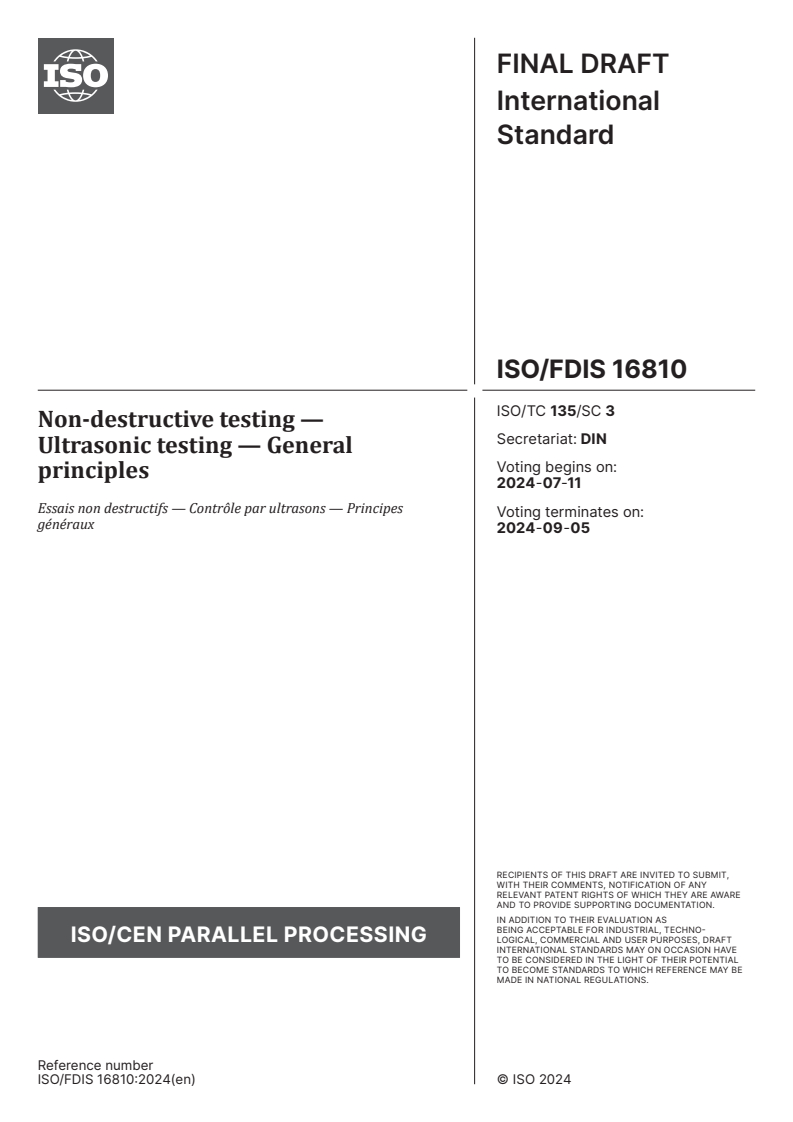
FINAL DRAFT
International
Standard
ISO/TC 135/SC 3
Non-destructive testing —
Secretariat: DIN
Ultrasonic testing — General
Voting begins on:
principles
2024-07-11
Essais non destructifs — Contrôle par ultrasons — Principes
Voting terminates on:
généraux
2024-09-05
RECIPIENTS OF THIS DRAFT ARE INVITED TO SUBMIT,
WITH THEIR COMMENTS, NOTIFICATION OF ANY
RELEVANT PATENT RIGHTS OF WHICH THEY ARE AWARE
AND TO PROVIDE SUPPOR TING DOCUMENTATION.
IN ADDITION TO THEIR EVALUATION AS
BEING ACCEPTABLE FOR INDUSTRIAL, TECHNO
ISO/CEN PARALLEL PROCESSING LOGICAL, COMMERCIAL AND USER PURPOSES, DRAFT
INTERNATIONAL STANDARDS MAY ON OCCASION HAVE
TO BE CONSIDERED IN THE LIGHT OF THEIR POTENTIAL
TO BECOME STAN DARDS TO WHICH REFERENCE MAY BE
MADE IN NATIONAL REGULATIONS.
Reference number
FINAL DRAFT
International
Standard
ISO/TC 135/SC 3
Non-destructive testing —
Secretariat: DIN
Ultrasonic testing — General
Voting begins on:
principles
Essais non destructifs — Contrôle par ultrasons — Principes
Voting terminates on:
généraux
RECIPIENTS OF THIS DRAFT ARE INVITED TO SUBMIT,
WITH THEIR COMMENTS, NOTIFICATION OF ANY
RELEVANT PATENT RIGHTS OF WHICH THEY ARE AWARE
AND TO PROVIDE SUPPOR TING DOCUMENTATION.
© ISO 2024
IN ADDITION TO THEIR EVALUATION AS
All rights reserved. Unless otherwise specified, or required in the context of its implementation, no part of this publication may
BEING ACCEPTABLE FOR INDUSTRIAL, TECHNO
ISO/CEN PARALLEL PROCESSING
LOGICAL, COMMERCIAL AND USER PURPOSES, DRAFT
be reproduced or utilized otherwise in any form or by any means, electronic or mechanical, including photocopying, or posting on
INTERNATIONAL STANDARDS MAY ON OCCASION HAVE
the internet or an intranet, without prior written permission. Permission can be requested from either ISO at the address below
TO BE CONSIDERED IN THE LIGHT OF THEIR POTENTIAL
or ISO’s member body in the country of the requester.
TO BECOME STAN DARDS TO WHICH REFERENCE MAY BE
MADE IN NATIONAL REGULATIONS.
ISO copyright office
CP 401 • Ch. de Blandonnet 8
CH-1214 Vernier, Geneva
Phone: +41 22 749 01 11
Email: copyright@iso.org
Website: www.iso.org
Published in Switzerland Reference number
ii
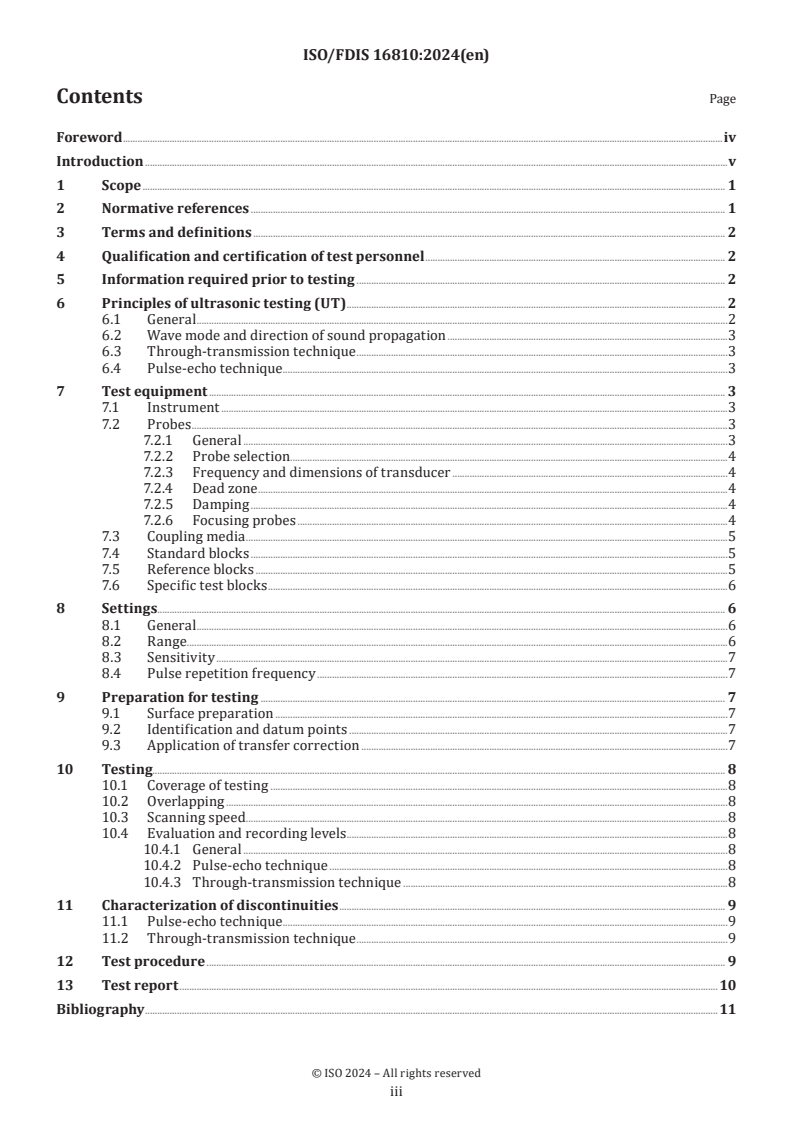
Contents Page
Foreword .iv
Introduction .v
1 Scope . 1
2 Normative references . 1
3 Terms and definitions . 2
4 Qualification and certification of test personnel . 2
5 Information required prior to testing . 2
6 Principles of ultrasonic testing (UT) . . 2
6.1 General .2
6.2 Wave mode and direction of sound propagation .3
6.3 Through-transmission technique .3
6.4 Pulse-echo technique . .3
7 Test equipment . 3
7.1 Instrument .3
7.2 Probes .3
7.2.1 General .3
7.2.2 Probe selection.4
7.2.3 Frequency and dimensions of transducer .4
7.2.4 Dead zone .4
7.2.5 Damping .4
7.2.6 Focusing probes .4
7.3 Coupling media .5
7.4 Standard blocks .5
7.5 Reference blocks .5
7.6 Specific test blocks .6
8 Settings. 6
8.1 General .6
8.2 Range . .6
8.3 Sensitivity .7
8.4 Pulse repetition frequency .7
9 Preparation for testing . 7
9.1 Surface preparation .7
9.2 Identification and datum points .7
9.3 Application of transfer correction .7
10 Testing. 8
10.1 Coverage of testing .8
10.2 Overlapping .8
10.3 Scanning speed.8
10.4 Evaluation and recording levels .8
10.4.1 General .8
10.4.2 Pulse-echo technique .8
10.4.3 Through-transmission technique .8
11 Characterization of discontinuities . 9
11.1 Pulse-echo technique . .9
11.2 Through-transmission technique .9
12 Test procedure . 9
13 Test report . 10
Bibliography .11
iii
Foreword
ISO (the International Organization for Standardization) is a worldwide federation of national standards
bodies (ISO member bodies). The work of preparing International Standards is normally carried out through
ISO technical committees. Each member body interested in a subject for which a technical committee
has been established has the right to be represented on that committee. International organizations,
governmental and non-governmental, in liaison with ISO, also take part in the work. ISO collaborates closely
with the International Electrotechnical Commission (IEC) on all matters of electrotechnical standardization.
The procedures used to develop this document and those intended for its further maintenance are described
in the ISO/IEC Directives, Part 1. In particular, the different approval criteria needed for the different types
of ISO document should be noted. This document was drafted in accordance with the editorial rules of the
ISO/IEC Directives, Part 2 (see www.iso.org/directives).
ISO draws attention to the possibility that the implementation of this document may involve the use of (a)
patent(s). ISO takes no position concerning the evidence, validity or applicability of any claimed patent
rights in respect thereof. As of the date of publication of this document, ISO had not received notice of (a)
patent(s) which may be required to implement this document. However, implementers are cautioned that
this may not represent the latest information, which may be obtained from the patent database available at
www.iso.org/patents. ISO shall not be held responsible for identifying any or all such patent rights.
Any trade name used in this document is information given for the convenience of users and does not
constitute an endorsement.
For an explanation of the voluntary nature of standards, the meaning of ISO specific terms and expressions
related to conformity assessment, as well as information about ISO's adherence to the World Trade
Organization (WTO) principles in the Technical Barriers to Trade (TBT), see www.iso.org/iso/foreword.html.
Th
...
ISO/FDIS 16810:2024(E)
ISO /TC 135/SC 3/WG 7
Secretariat: DIN
Date: 2024-07-06
Non-destructive testing — Ultrasonic testing — General principles
Essais non destructifs — Contrôle par ultrasons — Principes généraux
FDIS stage
ISO/FDIS 16810:2024(Een)
All rights reserved. Unless otherwise specified, or required in the context of its implementation, no part of this publication
may be reproduced or utilized otherwise in any form or by any means, electronic or mechanical, including photocopying,
or posting on the internet or an intranet, without prior written permission. Permission can be requested from either ISO
at the address below or ISO’s member body in the country of the requester.
ISO copyright office
CP 401 • Ch. de Blandonnet 8
CH-1214 Vernier, Geneva
Phone: + 41 22 749 01 11
EmailE-mail: copyright@iso.org
Website: www.iso.orgwww.iso.org
Published in Switzerland
ii © ISO 2024 – All rights reserved
ii
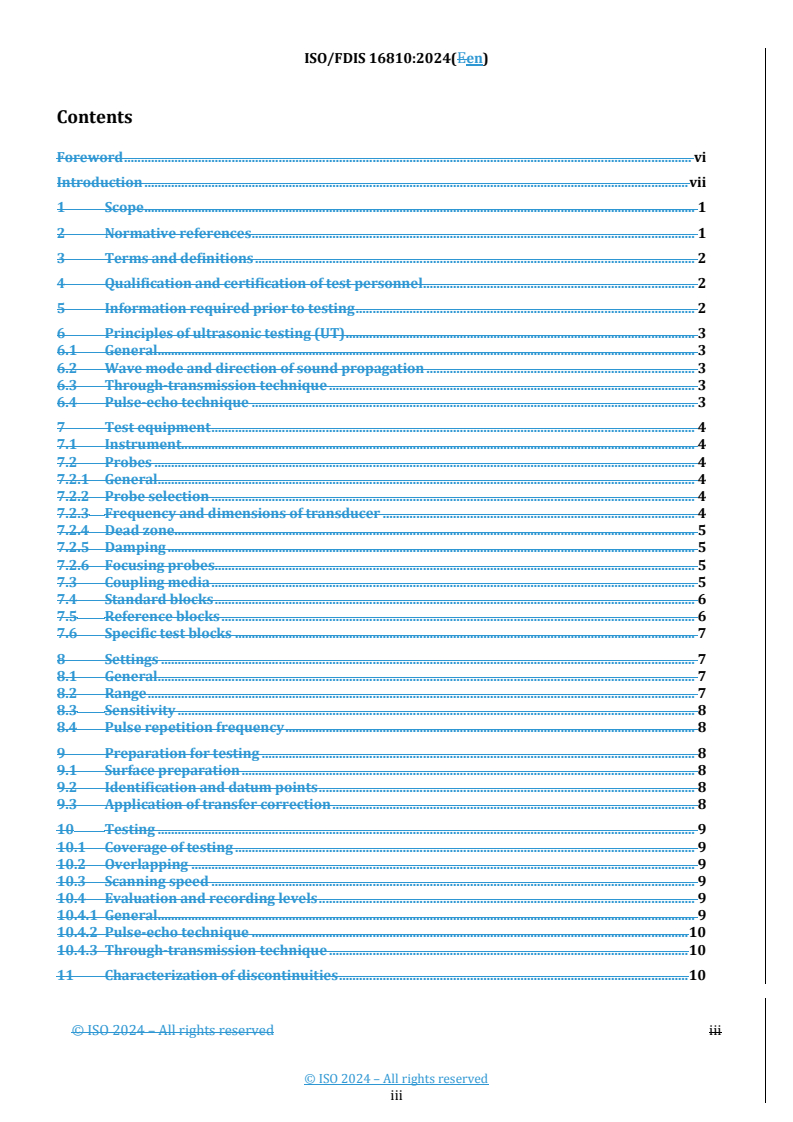
Contents
Foreword . vi
Introduction . vii
1 Scope . 1
2 Normative references . 1
3 Terms and definitions . 2
4 Qualification and certification of test personnel . 2
5 Information required prior to testing . 2
6 Principles of ultrasonic testing (UT) . 3
6.1 General. 3
6.2 Wave mode and direction of sound propagation . 3
6.3 Through-transmission technique . 3
6.4 Pulse-echo technique . 3
7 Test equipment . 4
7.1 Instrument. 4
7.2 Probes . 4
7.2.1 General. 4
7.2.2 Probe selection . 4
7.2.3 Frequency and dimensions of transducer . 4
7.2.4 Dead zone. 5
7.2.5 Damping . 5
7.2.6 Focusing probes. 5
7.3 Coupling media . 5
7.4 Standard blocks . 6
7.5 Reference blocks . 6
7.6 Specific test blocks . 7
8 Settings . 7
8.1 General. 7
8.2 Range . 7
8.3 Sensitivity . 8
8.4 Pulse repetition frequency . 8
9 Preparation for testing . 8
9.1 Surface preparation . 8
9.2 Identification and datum points . 8
9.3 Application of transfer correction . 8
10 Testing . 9
10.1 Coverage of testing . 9
10.2 Overlapping . 9
10.3 Scanning speed . 9
10.4 Evaluation and recording levels . 9
10.4.1 General. 9
10.4.2 Pulse-echo technique . 10
10.4.3 Through-transmission technique . 10
11 Characterization of discontinuities . 10
iii
ISO/FDIS 16810:2024(Een)
11.1 Pulse-echo technique . 10
11.2 Through-transmission technique . 10
12 Test procedure . 10
13 Test report . 11
Bibliography . 13
Foreword . vi
Introduction . vii
1 Scope . 1
2 Normative references . 1
3 Terms and definitions . 2
4 Qualification and certification of test personnel . 2
5 Information required prior to testing . 2
6 Principles of ultrasonic testing (UT) . 3
6.1 General. 3
6.2 Wave mode and direction of sound propagation . 3
6.3 Through-transmission technique . 3
6.4 Pulse-echo technique . 3
7 Test equipment . 4
7.1 Instrument. 4
7.2 Probes . 4
7.2.1 General. 4
7.2.2 Probe selection . 4
7.2.3 Frequency and dimensions of transducer . 4
7.2.4 Dead zone. 5
7.2.5 Damping . 5
7.2.6 Focusing probes. 5
7.3 Coupling media . 5
7.4 Standard blocks . 6
7.5 Reference blocks . 6
7.6 Specific test blocks . 7
8 Settings . 7
8.1 General. 7
8.2 Range . 7
8.3 Sensitivity . 8
8.4 Pulse repetition frequency . 8
9 Preparation for testing . 8
9.1 Surface preparation . 8
9.2 Identification and datum points . 8
9.3 Application of transfer correction . 8
10 Testing . 9
10.1 Coverage of testing .
...
Questions, Comments and Discussion
Ask us and Technical Secretary will try to provide an answer. You can facilitate discussion about the standard in here.