

ISO 22423:2019
(Main)Foil bearings — Performance testing of foil thrust bearings — Testing of static load capacity, bearing torque, friction coefficient and lifetime
General Information
- Abstract
This document specifies the method for comparing performance evaluation results for a foil thrust bearing that supports load with aerodynamic force generated by the rotation of a driving shaft and lubricates using air, not lubricating oil. The test procedure explained in this document measures and evaluates the static load capacity, bearing torque, friction coefficient and lifetime of the foil thrust bearing and compares the test results to those for different test conditions. The measured static load capacity can be varied depending on the capabilities of the test device used.
- Status
- Published
- Publication Date
- 06-Jan-2019
- Technical Committee
- ISO/TC 123/SC 7 - Special types of plain bearings
- Drafting Committee
- ISO/TC 123/SC 7 - Special types of plain bearings
- Current Stage
- 9092 - International Standard to be revised
- Start Date
- 03-Feb-2025
- Completion Date
- 29-Aug-2026
Buy Documents


ISO 22423:2019 - Foil bearings -- Performance testing of foil thrust bearings -- Testing of static load capacity, bearing torque, friction coefficient and lifetime
ISO 22423:2019 - Foil bearings — Performance testing of foil thrust bearings — Testing of static load capacity, bearing torque, friction coefficient and lifetime/7/2019
Overview
ISO 22423:2019 specifies a standardized method for performance testing of foil thrust bearings that operate with air (or gas) lubrication. The standard defines how to measure and compare static load capacity, bearing torque, friction coefficient, take-off speed and lifetime using controlled test apparatus and repeatable start–stop cycles. It addresses bearings that generate aerodynamic load by shaft rotation and removes the need for oil lubrication, making it relevant for high-speed, oil-free turbomachinery.
Key Topics and Requirements
- Scope and purpose: Procedures to measure and evaluate the primary performance metrics of foil thrust bearings and to compare results under different test conditions.
- Test environment: Tests are carried out after ambient pressure, temperature and humidity reach equilibrium; preheating and steady-state conditions are required.
- Test apparatus design: Emphasis on accurate alignment and controlled relative position of runner and bearing to avoid measurement errors caused by misalignment or disturbance.
- Sensors and instrumentation: Installation of torque measurement, load cells, rotational speed meters and thermocouples (air and top-foil surface) as detailed in the document.
- Start–stop cycles and take-off speed: Determination of the speed at which the runner lifts off the top foil (take-off) from measured torque vs. speed behavior.
- Reference and initial loads: Recommended thrust pressure for reference load is 0.5 bar (0.05 N/mm²); reference load Fr = thrust pressure × top-foil area. Initial load and increments typically set as percentages of Fr.
- Calculations and reporting: Procedures for calculating bearing torque, load, friction coefficient and evaluating static load capacity per unit area; format and essential items for the test report (Annex B).
- Durability and lifetime: Start–stop durability tests with lifetime defined by number of cycles until coating layer disappearance; methods outlined in Clause 9.
Applications and Users
ISO 22423 is practical for:
- Bearing manufacturers validating foil thrust bearing designs
- R&D and test laboratories performing comparative performance testing
- OEMs of turbines, compressors, pumps and other high-speed rotating machinery specifying oil-free bearing performance
- Maintenance engineers and quality control teams verifying lifetime, friction and load capacity for procurement and certification
Keywords: ISO 22423, foil bearings, foil thrust bearings, static load capacity, bearing torque, friction coefficient, lifetime testing, take-off speed, performance testing.
Related Standards
- Prepared by ISO/TC 123 (Plain bearings). Users commonly apply ISO 22423 alongside other ISO plain-bearing test and design documents and the ISO/IEC Directives for standardization practices. Refer to the standard text (Annex A/B) for typical bearing configuration and recommended test-report contents.
Relations
- Effective Date
- 06-Jun-2022
Buy Documents
ISO 22423:2019 - Foil bearings -- Performance testing of foil thrust bearings -- Testing of static load capacity, bearing torque, friction coefficient and lifetime
ISO 22423:2019 - Foil bearings — Performance testing of foil thrust bearings — Testing of static load capacity, bearing torque, friction coefficient and lifetime/7/2019
Frequently Asked Questions
ISO 22423:2019 is a standard published by the International Organization for Standardization (ISO). Its full title is "Foil bearings — Performance testing of foil thrust bearings — Testing of static load capacity, bearing torque, friction coefficient and lifetime". This standard covers: This document specifies the method for comparing performance evaluation results for a foil thrust bearing that supports load with aerodynamic force generated by the rotation of a driving shaft and lubricates using air, not lubricating oil. The test procedure explained in this document measures and evaluates the static load capacity, bearing torque, friction coefficient and lifetime of the foil thrust bearing and compares the test results to those for different test conditions. The measured static load capacity can be varied depending on the capabilities of the test device used.
This document specifies the method for comparing performance evaluation results for a foil thrust bearing that supports load with aerodynamic force generated by the rotation of a driving shaft and lubricates using air, not lubricating oil. The test procedure explained in this document measures and evaluates the static load capacity, bearing torque, friction coefficient and lifetime of the foil thrust bearing and compares the test results to those for different test conditions. The measured static load capacity can be varied depending on the capabilities of the test device used.
ISO 22423:2019 is classified under the following ICS (International Classification for Standards) categories: 21.100.10 - Plain bearings. The ICS classification helps identify the subject area and facilitates finding related standards.
ISO 22423:2019 has the following relationships with other standards: It is inter standard links to ISO 17294-2:2023. Understanding these relationships helps ensure you are using the most current and applicable version of the standard.
ISO 22423:2019 is available in PDF format for immediate download after purchase. The document can be added to your cart and obtained through the secure checkout process. Digital delivery ensures instant access to the complete standard document.
Standards Content (Sample)
INTERNATIONAL ISO
STANDARD 22423
First edition
2019-01
Foil bearings — Performance testing
of foil thrust bearings — Testing of
static load capacity, bearing torque,
friction coefficient and lifetime
Reference number
©
ISO 2019
© ISO 2019
All rights reserved. Unless otherwise specified, or required in the context of its implementation, no part of this publication may
be reproduced or utilized otherwise in any form or by any means, electronic or mechanical, including photocopying, or posting
on the internet or an intranet, without prior written permission. Permission can be requested from either ISO at the address
below or ISO’s member body in the country of the requester.
ISO copyright office
CP 401 • Ch. de Blandonnet 8
CH-1214 Vernier, Geneva
Phone: +41 22 749 01 11
Fax: +41 22 749 09 47
Email: copyright@iso.org
Website: www.iso.org
Published in Switzerland
ii © ISO 2019 – All rights reserved
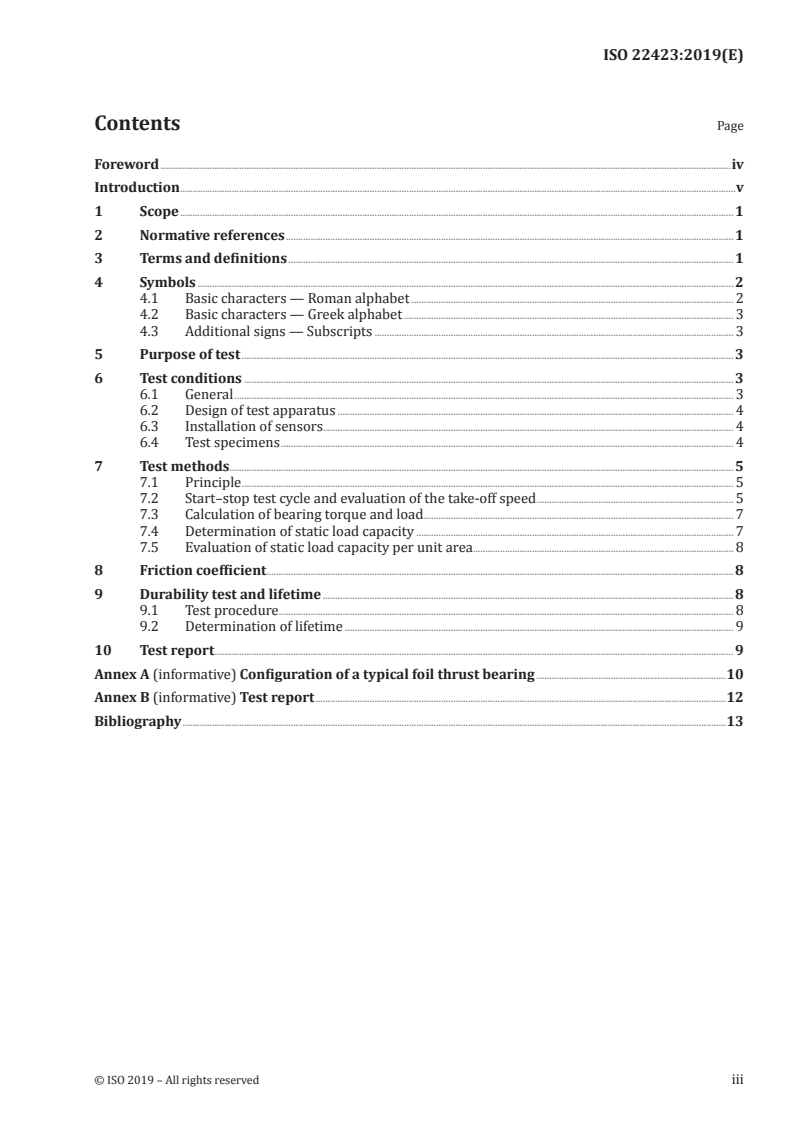
Contents Page
Foreword .iv
Introduction .v
1 Scope . 1
2 Normative references . 1
3 Terms and definitions . 1
4 Symbols . 2
4.1 Basic characters — Roman alphabet . 2
4.2 Basic characters — Greek alphabet . 3
4.3 Additional signs — Subscripts . 3
5 Purpose of test . 3
6 Test conditions . 3
6.1 General . 3
6.2 Design of test apparatus . 4
6.3 Installation of sensors. 4
6.4 Test specimens . 4
7 Test methods . 5
7.1 Principle . 5
7.2 Start–stop test cycle and evaluation of the take-off speed . 5
7.3 Calculation of bearing torque and load . 7
7.4 Determination of static load capacity . 7
7.5 Evaluation of static load capacity per unit area. 8
8 Friction coefficient. 8
9 Durability test and lifetime . 8
9.1 Test procedure . 8
9.2 Determination of lifetime . 9
10 Test report . 9
Annex A (informative) Configuration of a typical foil thrust bearing .10
Annex B (informative) Test report .12
Bibliography .13
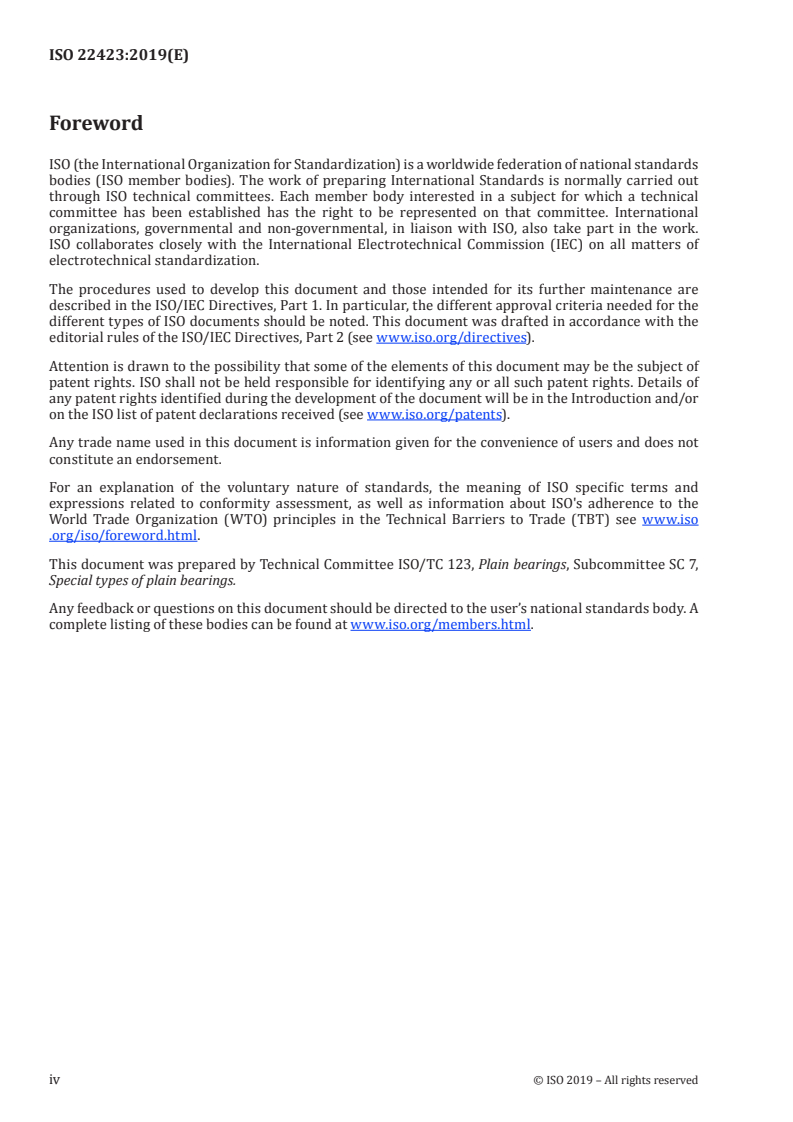
Foreword
ISO (the International Organization for Standardization) is a worldwide federation of national standards
bodies (ISO member bodies). The work of preparing International Standards is normally carried out
through ISO technical committees. Each member body interested in a subject for which a technical
committee has been established has the right to be represented on that committee. International
organizations, governmental and non-governmental, in liaison with ISO, also take part in the work.
ISO collaborates closely with the International Electrotechnical Commission (IEC) on all matters of
electrotechnical standardization.
The procedures used to develop this document and those intended for its further maintenance are
described in the ISO/IEC Directives, Part 1. In particular, the different approval criteria needed for the
different types of ISO documents should be noted. This document was drafted in accordance with the
editorial rules of the ISO/IEC Directives, Part 2 (see www .iso .org/directives).
Attention is drawn to the possibility that some of the elements of this document may be the subject of
patent rights. ISO shall not be held responsible for identifying any or all such patent rights. Details of
any patent rights identified during the development of the document will be in the Introduction and/or
on the ISO list of patent declarations received (see www .iso .org/patents).
Any trade name used in this document is information given for the convenience of users and does not
constitute an endorsement.
For an explanation of the voluntary nature of standards, the meaning of ISO specific terms and
expressions related to conformity assessment, as well as information about ISO's adherence to the
World Trade Organization (WTO) principles in the Technical Barriers to Trade (TBT) see www .iso
.org/iso/foreword .html.
This document was prepared by Technical Committee ISO/TC 123, Plain bearings, Subcommittee SC 7,
Special types of plain bearings.
Any feedback or questions on this document should be directed to the user’s national standards body. A
complete listing of these bodies can be found at www .iso .org/members .html.
iv © ISO 2019 – All rights reserved
Introduction
Design improvements commonly required for rotating machines such as turbines, generators,
compressors and pumps include increases in speed and decreases in size. Foil bearings in
turbomachinery operate by generating a self-acting air (or gas) film between surfaces in relative
motion. A gap between a rotating shaft or runner and a foil surface compresses a gaseous lubricant to
an elevated pressure, separating the relatively moving surfaces and providing a load-carrying capacity.
The use of the surrounding air (or gas) as the bearing lubricant eliminates the need for an auxiliary
lubrication system to deliver conventional oil lubricants. This permits drastic reductions in the weight,
complexity and maintenance costs of foil bearing-supported turbomachines, in comparison to their
rolling bearing-supported counterparts. It also permits higher shaft speeds by removing the n × d
m
speed limits (where d is the mean diameter of bearing and n is the rotation rate) on rolling bearings.
m
INTERNATIONAL STANDARD ISO 22423:2019(E)
Foil bearings — Performance testing of foil thrust bearings
— Testing of static load capacity, bearing torque, friction
coefficient and lifetime
1 Scope
This document specifies the method for comparing performance evaluation results for a foil thrust
bearing that supports load with aerodynamic force generated by the rotation of a driving shaft and
lubricates using air, not lubricating oil. The test procedure explained in this document measures and
evaluates the static load capacity, bearing torque, friction coefficient and lifetime of the foil thrust
bearing and compares the test results to those for different test conditions. The measured static load
capacity can be varied depending on the capabilities of the test device used.
2 Normative references
There are no normative references in this document.
3 Terms and definitions
For the purposes of this document, the following terms and definitions apply.
ISO and IEC maintain terminological databases for use in standardization at the following addresses:
— ISO Online browsing platform: available at https: //www .iso .org/obp
— IEC Electropedia: available at http: //www .electropedia .org/
3.1
thrust runner
runner
circular disc connected to the rotating shaft and facing the surface of the top foil
Note 1 to entry: The surfaces of the thrust runner should be machined smoothly enough to form the air film
between the runner and the top foil.
3.2
take-off
stage aimed to secure the distance between the thrust runner (3.1) and the top foil by developing an
aerodynamic pressure between them
3.3
clearance
shortest distance between the thrust runner (3.1) and the top foil
3.4
bearing torque
torque value developed by rotational friction between the thrust runner (3.1) and the top foil
Note 1 to entry: The measurement of the bearing torque is as described in 7.3.
3.5
load
load capacity
weight that can be delivered by a bearing under steady-state conditions
3.6
initial load
load (3.5) exerted on the rotating system in the beginning
Note 1 to entry: It should be lower than the static load capacity and the load at which the lifetime of the bearing is
determined, as explained in 7.4 and 9.2.
3.7
reference load
load (3.5) expected to be supported by a bearing
Note 1 to entry: The calculation of the reference load is given in 7.2.
3.8
static load capacity
maximum load (3.5) value of a bearing in static state
Note 1 to entry: The measurement of the static load capacity is explained in 7.4.
3.9
friction coefficient
flow resistance caused by rotational friction between the thrust runner (3.1) and the top foil
Note 1 to entry: The measurement of the friction coefficient is described in Clause 8.
3.10
lifetime of bearing
total number of start–stop test cycles of the foil thrust bearing at which the coating layer disappears
Note 1 to entry: The measurement of the lifetime of bearing follows Clause 9.
4 Symbols
For the purposes of this document, the following symbols apply.
4.1 Basic characters — Roman alphabet
Table 1 — Symbol — Basic characters — Roman alphabet
Symbol Description Units
A Area Square millimetre
F Force, load Newton
H Height Millimetre
h Humidity Percentage
L Lifetime Number of start-stop cycles
M Torque Newton-millimetre
R Surface roughness Millimetre
a
r Distance, radius Millimetre
T Temperature Degrees Celsius
t Thickness Millimetre
2 © ISO 2019 – All rights reserved
4.2 Basic characters — Greek alphabet
Table 2 — Symbol — Basic characters — Greek alphabet
Symbol Description Unit
a
µ Friction coefficient Non-dimensional
ω Rotational speed r/min
a
The symbol f is also commonly used and accepted.
4.3 Additional signs — Subscripts
Table 3 — Symbol — Additional signs — Subscripts
Subscription Description
a Air (surrounding), average, applied
b Bump foil, bearing
f Top foil, friction
fs Top foil surface
i Inner
inc Increment
max Maximum
n Net
o Outer
r Radial, radius, runner, reference
R Relative
to Take-off
s Steady-state, static
u Upper
ua Unit area
w Working
5 Purpose of test
The primary purpose of the test is to measure and evaluate the static load capacity, bearing torque,
friction coefficients and lifetime of a foil thrust bearing. These are the primary performance metrics of
a foil thrust bearing as a mechanical element with specific dimensions. They are closely related to the
performance of the mechanical systems in which foil thrust bearings are used.
6 Test conditions
6.1 General
The static load capacity of a foil thrust bearing should be tested, after the ambient pressure, temperature
and humidity of the environment in which the bearing operates have reached a state of equilibrium.
The bearing performance is determined by measuring the bearing torque and the rotational speed of
the shaft. The take-off speed, which is the speed at which the runner floats on the top foil without
making contact, should be determined. The bearing performance should be measured and compared at
a rotational speed that is higher than the take-off speed.
ISO 22423:
...
INTERNATIONAL ISO
STANDARD 22423
First edition
2019-01
Foil bearings — Performance testing
of foil thrust bearings — Testing of
static load capacity, bearing torque,
friction coefficient and lifetime
Reference number
©
ISO 2019
© ISO 2019
All rights reserved. Unless otherwise specified, or required in the context of its implementation, no part of this publication may
be reproduced or utilized otherwise in any form or by any means, electronic or mechanical, including photocopying, or posting
on the internet or an intranet, without prior written permission. Permission can be requested from either ISO at the address
below or ISO’s member body in the country of the requester.
ISO copyright office
CP 401 • Ch. de Blandonnet 8
CH-1214 Vernier, Geneva
Phone: +41 22 749 01 11
Fax: +41 22 749 09 47
Email: copyright@iso.org
Website: www.iso.org
Published in Switzerland
ii © ISO 2019 – All rights reserved
Contents Page
Foreword .iv
Introduction .v
1 Scope . 1
2 Normative references . 1
3 Terms and definitions . 1
4 Symbols . 2
4.1 Basic characters — Roman alphabet . 2
4.2 Basic characters — Greek alphabet . 3
4.3 Additional signs — Subscripts . 3
5 Purpose of test . 3
6 Test conditions . 3
6.1 General . 3
6.2 Design of test apparatus . 4
6.3 Installation of sensors. 4
6.4 Test specimens . 4
7 Test methods . 5
7.1 Principle . 5
7.2 Start–stop test cycle and evaluation of the take-off speed . 5
7.3 Calculation of bearing torque and load . 7
7.4 Determination of static load capacity . 7
7.5 Evaluation of static load capacity per unit area. 8
8 Friction coefficient. 8
9 Durability test and lifetime . 8
9.1 Test procedure . 8
9.2 Determination of lifetime . 9
10 Test report . 9
Annex A (informative) Configuration of a typical foil thrust bearing .10
Annex B (informative) Test report .12
Bibliography .13
Foreword
ISO (the International Organization for Standardization) is a worldwide federation of national standards
bodies (ISO member bodies). The work of preparing International Standards is normally carried out
through ISO technical committees. Each member body interested in a subject for which a technical
committee has been established has the right to be represented on that committee. International
organizations, governmental and non-governmental, in liaison with ISO, also take part in the work.
ISO collaborates closely with the International Electrotechnical Commission (IEC) on all matters of
electrotechnical standardization.
The procedures used to develop this document and those intended for its further maintenance are
described in the ISO/IEC Directives, Part 1. In particular, the different approval criteria needed for the
different types of ISO documents should be noted. This document was drafted in accordance with the
editorial rules of the ISO/IEC Directives, Part 2 (see www .iso .org/directives).
Attention is drawn to the possibility that some of the elements of this document may be the subject of
patent rights. ISO shall not be held responsible for identifying any or all such patent rights. Details of
any patent rights identified during the development of the document will be in the Introduction and/or
on the ISO list of patent declarations received (see www .iso .org/patents).
Any trade name used in this document is information given for the convenience of users and does not
constitute an endorsement.
For an explanation of the voluntary nature of standards, the meaning of ISO specific terms and
expressions related to conformity assessment, as well as information about ISO's adherence to the
World Trade Organization (WTO) principles in the Technical Barriers to Trade (TBT) see www .iso
.org/iso/foreword .html.
This document was prepared by Technical Committee ISO/TC 123, Plain bearings, Subcommittee SC 7,
Special types of plain bearings.
Any feedback or questions on this document should be directed to the user’s national standards body. A
complete listing of these bodies can be found at www .iso .org/members .html.
iv © ISO 2019 – All rights reserved
Introduction
Design improvements commonly required for rotating machines such as turbines, generators,
compressors and pumps include increases in speed and decreases in size. Foil bearings in
turbomachinery operate by generating a self-acting air (or gas) film between surfaces in relative
motion. A gap between a rotating shaft or runner and a foil surface compresses a gaseous lubricant to
an elevated pressure, separating the relatively moving surfaces and providing a load-carrying capacity.
The use of the surrounding air (or gas) as the bearing lubricant eliminates the need for an auxiliary
lubrication system to deliver conventional oil lubricants. This permits drastic reductions in the weight,
complexity and maintenance costs of foil bearing-supported turbomachines, in comparison to their
rolling bearing-supported counterparts. It also permits higher shaft speeds by removing the n × d
m
speed limits (where d is the mean diameter of bearing and n is the rotation rate) on rolling bearings.
m
INTERNATIONAL STANDARD ISO 22423:2019(E)
Foil bearings — Performance testing of foil thrust bearings
— Testing of static load capacity, bearing torque, friction
coefficient and lifetime
1 Scope
This document specifies the method for comparing performance evaluation results for a foil thrust
bearing that supports load with aerodynamic force generated by the rotation of a driving shaft and
lubricates using air, not lubricating oil. The test procedure explained in this document measures and
evaluates the static load capacity, bearing torque, friction coefficient and lifetime of the foil thrust
bearing and compares the test results to those for different test conditions. The measured static load
capacity can be varied depending on the capabilities of the test device used.
2 Normative references
There are no normative references in this document.
3 Terms and definitions
For the purposes of this document, the following terms and definitions apply.
ISO and IEC maintain terminological databases for use in standardization at the following addresses:
— ISO Online browsing platform: available at https: //www .iso .org/obp
— IEC Electropedia: available at http: //www .electropedia .org/
3.1
thrust runner
runner
circular disc connected to the rotating shaft and facing the surface of the top foil
Note 1 to entry: The surfaces of the thrust runner should be machined smoothly enough to form the air film
between the runner and the top foil.
3.2
take-off
stage aimed to secure the distance between the thrust runner (3.1) and the top foil by developing an
aerodynamic pressure between them
3.3
clearance
shortest distance between the thrust runner (3.1) and the top foil
3.4
bearing torque
torque value developed by rotational friction between the thrust runner (3.1) and the top foil
Note 1 to entry: The measurement of the bearing torque is as described in 7.3.
3.5
load
load capacity
weight that can be delivered by a bearing under steady-state conditions
3.6
initial load
load (3.5) exerted on the rotating system in the beginning
Note 1 to entry: It should be lower than the static load capacity and the load at which the lifetime of the bearing is
determined, as explained in 7.4 and 9.2.
3.7
reference load
load (3.5) expected to be supported by a bearing
Note 1 to entry: The calculation of the reference load is given in 7.2.
3.8
static load capacity
maximum load (3.5) value of a bearing in static state
Note 1 to entry: The measurement of the static load capacity is explained in 7.4.
3.9
friction coefficient
flow resistance caused by rotational friction between the thrust runner (3.1) and the top foil
Note 1 to entry: The measurement of the friction coefficient is described in Clause 8.
3.10
lifetime of bearing
total number of start–stop test cycles of the foil thrust bearing at which the coating layer disappears
Note 1 to entry: The measurement of the lifetime of bearing follows Clause 9.
4 Symbols
For the purposes of this document, the following symbols apply.
4.1 Basic characters — Roman alphabet
Table 1 — Symbol — Basic characters — Roman alphabet
Symbol Description Units
A Area Square millimetre
F Force, load Newton
H Height Millimetre
h Humidity Percentage
L Lifetime Number of start-stop cycles
M Torque Newton-millimetre
R Surface roughness Millimetre
a
r Distance, radius Millimetre
T Temperature Degrees Celsius
t Thickness Millimetre
2 © ISO 2019 – All rights reserved
4.2 Basic characters — Greek alphabet
Table 2 — Symbol — Basic characters — Greek alphabet
Symbol Description Unit
a
µ Friction coefficient Non-dimensional
ω Rotational speed r/min
a
The symbol f is also commonly used and accepted.
4.3 Additional signs — Subscripts
Table 3 — Symbol — Additional signs — Subscripts
Subscription Description
a Air (surrounding), average, applied
b Bump foil, bearing
f Top foil, friction
fs Top foil surface
i Inner
inc Increment
max Maximum
n Net
o Outer
r Radial, radius, runner, reference
R Relative
to Take-off
s Steady-state, static
u Upper
ua Unit area
w Working
5 Purpose of test
The primary purpose of the test is to measure and evaluate the static load capacity, bearing torque,
friction coefficients and lifetime of a foil thrust bearing. These are the primary performance metrics of
a foil thrust bearing as a mechanical element with specific dimensions. They are closely related to the
performance of the mechanical systems in which foil thrust bearings are used.
6 Test conditions
6.1 General
The static load capacity of a foil thrust bearing should be tested, after the ambient pressure, temperature
and humidity of the environment in which the bearing operates have reached a state of equilibrium.
The bearing performance is determined by measuring the bearing torque and the rotational speed of
the shaft. The take-off speed, which is the speed at which the runner floats on the top foil without
making contact, should be determined. The bearing performance should be measured and compared at
a rotational speed that is higher than the take-off speed.
ISO 22423:
...