

ISO/IEC 18745-1:2018
(Main)Test methods for machine readable travel documents (MRTD) and associated devices — Part 1: Physical test methods for passport books (durability)
General Information
- Abstract
This document provides a set of instructions for evaluation of MRPs which may incorporate contactless integrated circuits. This evaluation is an instrument to establish the ability in principle of a specific type of document to fulfil the requirements of use. It supplies a structured approach to evaluate MRPs by: — defining reproducible stress methods to submit the document(s) under evaluation to specific stress or environmental conditions; — defining reproducible evaluation methods to measure numerical values for specific document properties; — defining test sequences that specify the order in which stress methods and evaluation methods are to be performed; — defining test plans to link specific user requirements to test sequences and related parameters. It specifies the minimum criteria to be achieved in order to meet ICAO's expectations for durability of fully personalized MRPs.
- Status
- Published
- Publication Date
- 22-Jul-2018
- Technical Committee
- ISO/IEC JTC 1/SC 17 - Cards and security devices for personal identification
- Current Stage
- 9093 - International Standard confirmed
- Start Date
- 22-Oct-2024
- Completion Date
- 29-Aug-2026
Buy Documents

ISO/IEC 18745-1:2018 - Test methods for machine readable travel documents (MRTD) and associated devices
ISO/IEC 18745-1:2018 - Test methods for machine readable travel documents (MRTD) and associated devices — Part 1: Physical test methods for passport books (durability)/23/2018
Overview
ISO/IEC 18745-1:2018 - Test methods for machine readable travel documents (MRTD) and associated devices - Part 1 defines standardized physical test methods for passport books (durability). The standard provides a structured, reproducible approach to evaluate Machine Readable Passports (MRPs), including those that incorporate contactless integrated circuits (ICs). Its purpose is to establish, in principle, whether a given passport type can meet real‑world durability expectations set by ICAO and issuing authorities.
Key Topics and Technical Requirements
- Methodology and tester guidance: instructions on sample numbers, preparation, sampling and storage to ensure consistent test conditions.
- Common test information: default environment, climatic conditions, tolerances and MRP holder definitions.
- Reproducible stress methods: a comprehensive suite of physical stress tests including:
- Conditioning, thermal cycling and storage temperature
- Operational climate exposure
- Impact and book‑bend (back pocket) tests
- Dynamic bend and torsion tests
- Sheet turning, sheet pull and abrasion tests
- Pen‑stress and resistance to chemicals (short and long‑term contamination)
- Evaluation methods and output parameters: standardized procedures to measure numerical values for document properties after stress application.
- Test sequences and test plans: defined order of stress and evaluation methods and mapping of user requirements to specific test sequences and parameters.
- Minimum acceptance criteria: criteria that passport books should meet to align with ICAO durability expectations (as referenced in the standard).
Practical Applications and Who Uses It
ISO/IEC 18745-1 is essential for organizations involved in the lifecycle of travel documents:
- Passport and MRP manufacturers - to design and validate durable passport books and components.
- Government issuing authorities and identity bureaus - to specify durability requirements and accept vendor deliverables.
- Independent test laboratories and QA teams - to perform repeatable, accredited durability testing and certification.
- Suppliers of passport materials and embedded ICs - to assess how materials and contactless chips tolerate mechanical and environmental stresses.
- System integrators and procurement teams - to develop test plans that link operational requirements to acceptance testing.
Related Standards
- References to ICAO durability expectations are integral; consult ICAO MRTD guidance (e.g., ICAO Doc 9303) and other ISO/IEC MRTD standards when developing comprehensive test and compliance programmes.
ISO/IEC 18745-1:2018 is a practical, standards‑based framework to ensure passport books remain functional and secure through real‑world handling, environmental exposure and wear - supporting interoperability, reliability and traveler identity assurance.
Relations
- Effective Date
- 08-Nov-2014
Buy Documents
ISO/IEC 18745-1:2018 - Test methods for machine readable travel documents (MRTD) and associated devices
ISO/IEC 18745-1:2018 - Test methods for machine readable travel documents (MRTD) and associated devices — Part 1: Physical test methods for passport books (durability)/23/2018
Get Certified
Connect with accredited certification bodies for this standard

BSI Group
BSI (British Standards Institution) is the business standards company that helps organizations make excellence a habit.

NYCE
Mexican standards and certification body.
Sponsored listings
Frequently Asked Questions
ISO/IEC 18745-1:2018 is a standard published by the International Organization for Standardization (ISO). Its full title is "Test methods for machine readable travel documents (MRTD) and associated devices — Part 1: Physical test methods for passport books (durability)". This standard covers: This document provides a set of instructions for evaluation of MRPs which may incorporate contactless integrated circuits. This evaluation is an instrument to establish the ability in principle of a specific type of document to fulfil the requirements of use. It supplies a structured approach to evaluate MRPs by: — defining reproducible stress methods to submit the document(s) under evaluation to specific stress or environmental conditions; — defining reproducible evaluation methods to measure numerical values for specific document properties; — defining test sequences that specify the order in which stress methods and evaluation methods are to be performed; — defining test plans to link specific user requirements to test sequences and related parameters. It specifies the minimum criteria to be achieved in order to meet ICAO's expectations for durability of fully personalized MRPs.
This document provides a set of instructions for evaluation of MRPs which may incorporate contactless integrated circuits. This evaluation is an instrument to establish the ability in principle of a specific type of document to fulfil the requirements of use. It supplies a structured approach to evaluate MRPs by: — defining reproducible stress methods to submit the document(s) under evaluation to specific stress or environmental conditions; — defining reproducible evaluation methods to measure numerical values for specific document properties; — defining test sequences that specify the order in which stress methods and evaluation methods are to be performed; — defining test plans to link specific user requirements to test sequences and related parameters. It specifies the minimum criteria to be achieved in order to meet ICAO's expectations for durability of fully personalized MRPs.
ISO/IEC 18745-1:2018 is classified under the following ICS (International Classification for Standards) categories: 35.240.15 - Identification cards. Chip cards. Biometrics. The ICS classification helps identify the subject area and facilitates finding related standards.
ISO/IEC 18745-1:2018 has the following relationships with other standards: It is inter standard links to ISO/IEC 18745-1:2014. Understanding these relationships helps ensure you are using the most current and applicable version of the standard.
ISO/IEC 18745-1:2018 is available in PDF format for immediate download after purchase. The document can be added to your cart and obtained through the secure checkout process. Digital delivery ensures instant access to the complete standard document.
Standards Content (Sample)
INTERNATIONAL ISO/IEC
STANDARD 18745-1
Second edition
2018-07
Test methods for machine readable
travel documents (MRTD) and
associated devices —
Part 1:
Physical test methods for passport
books (durability)
Méthodes d'essais pour documents de voyage lisibles par machine et
dispositifs associés —
Partie 1: Méthodes d'essais physiques pour livrets de passeport
(durabilité)
Reference number
©
ISO/IEC 2018
© ISO/IEC 2018
All rights reserved. Unless otherwise specified, or required in the context of its implementation, no part of this publication may
be reproduced or utilized otherwise in any form or by any means, electronic or mechanical, including photocopying, or posting
on the internet or an intranet, without prior written permission. Permission can be requested from either ISO at the address
below or ISO’s member body in the country of the requester.
ISO copyright office
CP 401 • Ch. de Blandonnet 8
CH-1214 Vernier, Geneva
Phone: +41 22 749 01 11
Fax: +41 22 749 09 47
Email: copyright@iso.org
Website: www.iso.org
Published in Switzerland
ii © ISO/IEC 2018 – All rights reserved
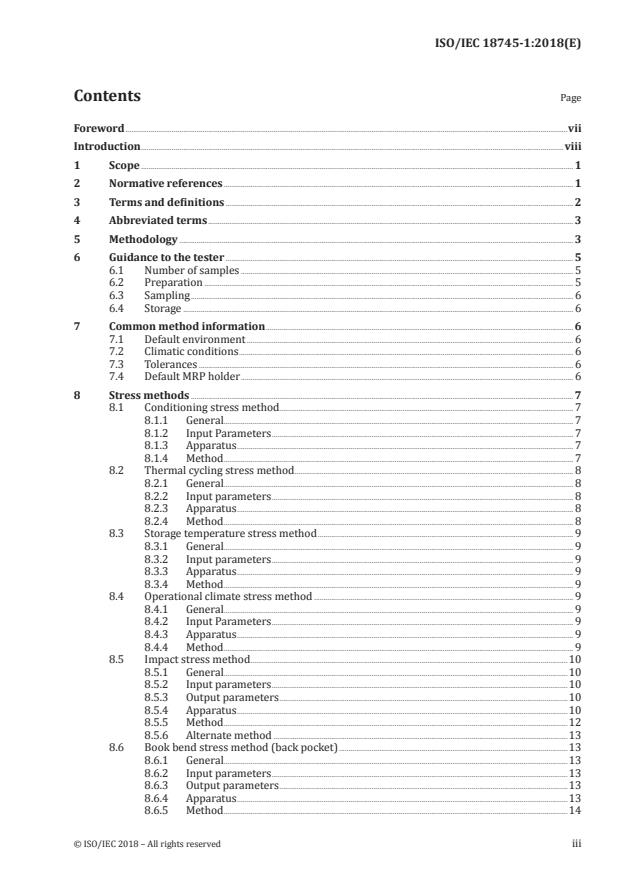
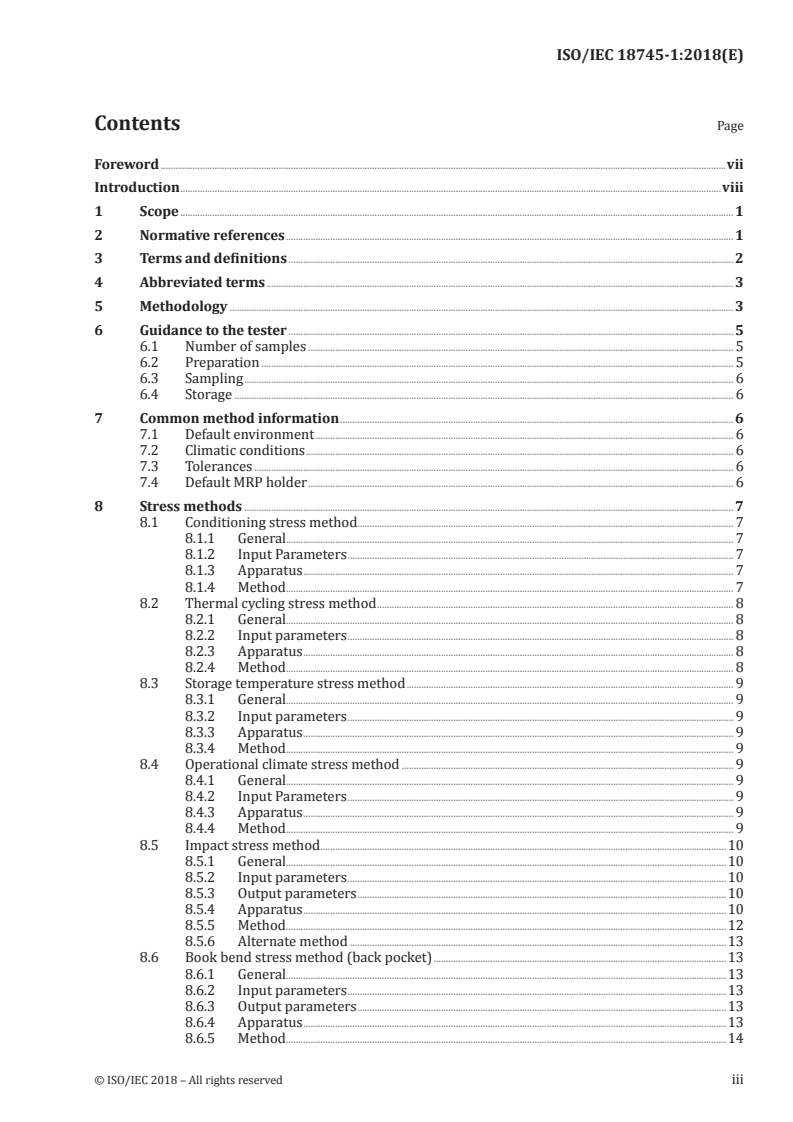
Contents Page
Foreword .vii
Introduction .viii
1 Scope . 1
2 Normative references . 1
3 Terms and definitions . 2
4 Abbreviated terms . 3
5 Methodology . 3
6 Guidance to the tester . 5
6.1 Number of samples . 5
6.2 Preparation . 5
6.3 Sampling . 6
6.4 Storage . 6
7 Common method information . 6
7.1 Default environment . 6
7.2 Climatic conditions . 6
7.3 Tolerances . 6
7.4 Default MRP holder . 6
8 Stress methods . 7
8.1 Conditioning stress method. 7
8.1.1 General. 7
8.1.2 Input Parameters . 7
8.1.3 Apparatus . 7
8.1.4 Method . 7
8.2 Thermal cycling stress method . 8
8.2.1 General. 8
8.2.2 Input parameters . 8
8.2.3 Apparatus . 8
8.2.4 Method . 8
8.3 Storage temperature stress method . 9
8.3.1 General. 9
8.3.2 Input parameters . 9
8.3.3 Apparatus . 9
8.3.4 Method . 9
8.4 Operational climate stress method . 9
8.4.1 General. 9
8.4.2 Input Parameters . 9
8.4.3 Apparatus . 9
8.4.4 Method . 9
8.5 Impact stress method .10
8.5.1 General.10
8.5.2 Input parameters .10
8.5.3 Output parameters .10
8.5.4 Apparatus .10
8.5.5 Method .12
8.5.6 Alternate method .13
8.6 Book bend stress method (back pocket) .13
8.6.1 General.13
8.6.2 Input parameters .13
8.6.3 Output parameters .13
8.6.4 Apparatus .13
8.6.5 Method .14
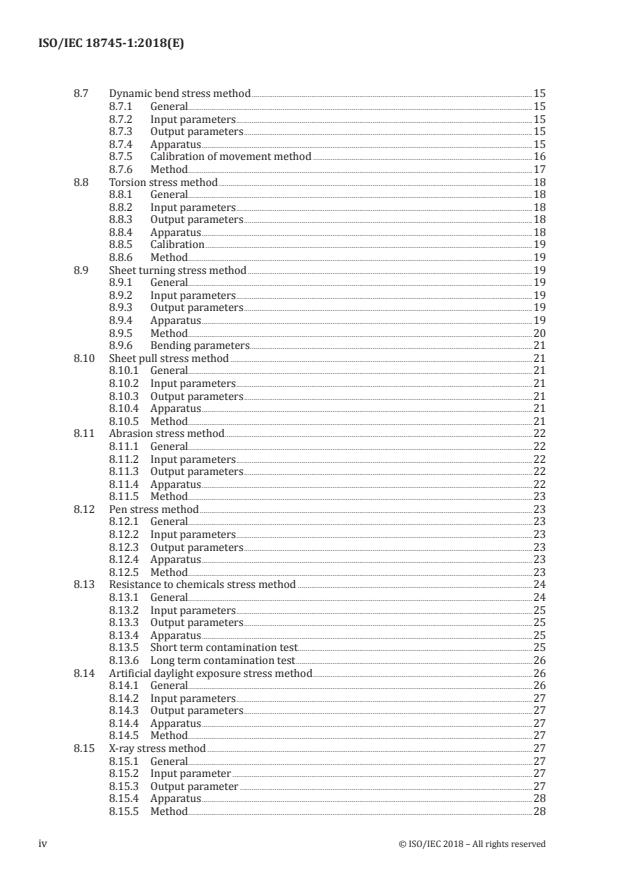
© ISO/IEC 2018 – All rights reserved iii
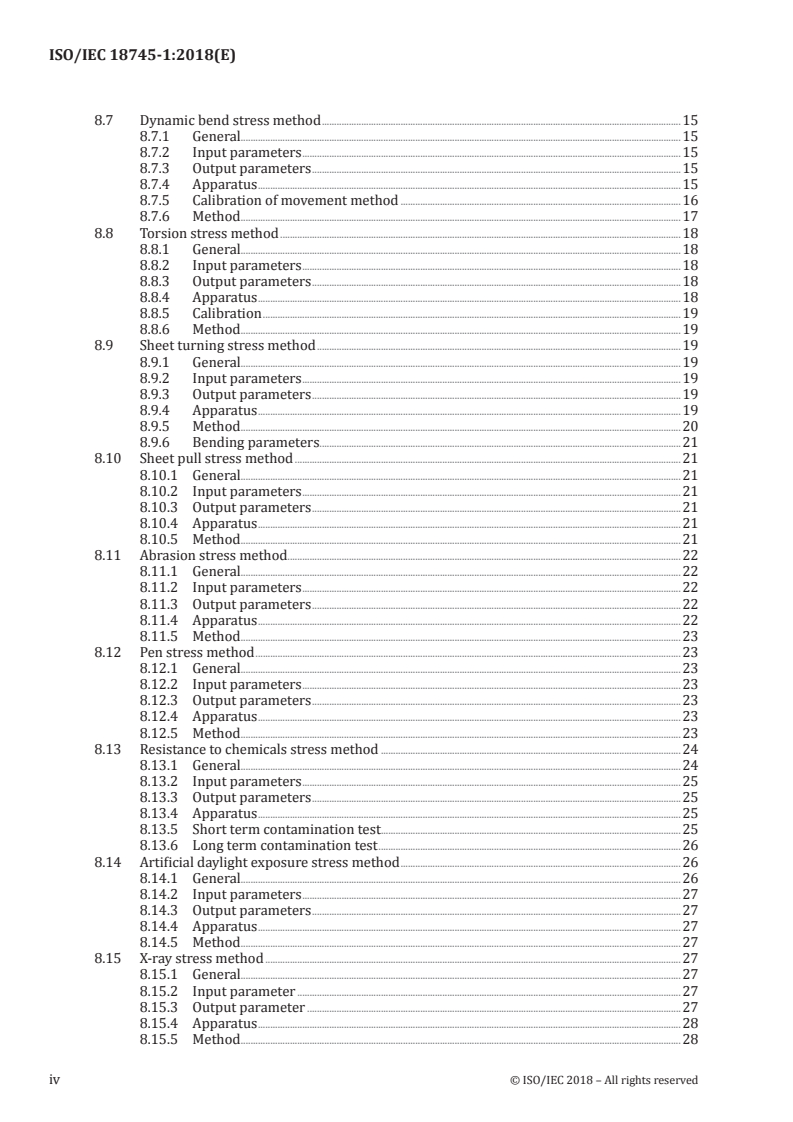
8.7 Dynamic bend stress method .15
8.7.1 General.15
8.7.2 Input parameters .15
8.7.3 Output parameters .15
8.7.4 Apparatus .15
8.7.5 Calibration of movement method .16
8.7.6 Method .17
8.8 Torsion stress method .18
8.8.1 General.18
8.8.2 Input parameters .18
8.8.3 Output parameters .18
8.8.4 Apparatus .18
8.8.5 Calibration .19
8.8.6 Method .19
8.9 Sheet turning stress method .19
8.9.1 General.19
8.9.2 Input parameters .19
8.9.3 Output parameters .19
8.9.4 Apparatus .19
8.9.5 Method .20
8.9.6 Bending parameters.21
8.10 Sheet pull stress method .21
8.10.1 General.21
8.10.2 Input parameters .21
8.10.3 Output parameters .21
8.10.4 Apparatus .21
8.10.5 Method .21
8.11 Abrasion stress method.22
8.11.1 General.22
8.11.2 Input parameters .22
8.11.3 Output parameters .22
8.11.4 Apparatus .22
8.11.5 Method .23
8.12 Pen stress method .23
8.12.1 General.23
8.12.2 Input parameters .23
8.12.3 Output parameters .23
8.12.4 Apparatus .23
8.12.5 Method .23
8.13 Resistance to chemicals stress method .24
8.13.1 General.24
8.13.2 Input parameters .25
8.13.3 Output parameters .25
8.13.4 Apparatus .25
8.13.5 Short term contamination test . .25
8.13.6 Long term contamination test .26
8.14 Artificial daylight exposure stress method .26
8.14.1 General.26
8.14.2 Input parameters .27
8.14.3 Output parameters .27
8.14.4 Apparatus .27
8.14.5 Method .27
8.15 X-ray stress method .27
8.15.1 General.27
8.15.2 Input parameter .27
8.15.3 Output parameter .27
8.15.4 Apparatus .28
8.15.5 Method .28
iv © ISO/IEC 2018 – All rights reserved
9 Evaluation methods .28
9.1 Functional PIC evaluation method .28
9.1.1 General.28
9.1.2 Input parameters .28
9.1.3 Output parameters .28
9.1.4 Apparatus .28
9.1.5 Method .28
9.2 Physical damage evaluation method .28
9.2.1 General.28
9.2.2 Input parameters .29
9.2.3 Output parameters .29
9.2.4 Apparatus .29
9.2.5 Method .29
9.3 Peel strength evaluation method .29
9.3.1 General.29
9.3.2 Input parameters .29
9.3.3 Output parameters .30
9.3.4 Apparatus .30
9.3.5 Method .30
9.4 Colour fastness evaluation method .30
9.4.1 General.30
9.4.2 Input parameters .30
9.4.3 Output parameters .31
9.4.4 Apparatus .31
9.4.5 Method .31
9.5 Datapage and cover warpage evaluation method . .31
9.5.1 General.31
9.5.2 Input parameters .31
9.5.3 Output parameters .31
9.5.4 Apparatus .31
9.5.5 Method .31
9.6 Book warpage evaluation method .33
9.6.1 General.33
9.6.2 Input parameters .33
9.6.3 Output parameters .34
9.6.4 Apparatus .34
9.6.5 Method .34
10 Test sequences .35
10.1 General .35
10.2 Instructions for using the sequence table .35
10.3 Sheet binding sequence .35
10.3.1 General.35
10.3.2 Input parameters .35
10.3.3 Output parameters .35
10.3.4 Sequence .36
10.4 Storage climate sequence .36
10.4.1 General.36
10.4.2 Input parameters .36
10.4.3 Output parameters .36
10.4.4 Sequence .36
10.5 Operational climate sequence .36
10.5.1 General.36
10.5.2 Input parameters .37
10.5.3 Output parameters .37
10.5.4 Sequence .37
10.6 Impact sequence .37
10.6.1 General.37
10.6.2 Input parameters .37
© ISO/IEC 2018 – All rights reserved v
10.6.3 Output parameters .37
10.6.4 Sequence .37
10.7 Back pocket sequence .38
10.7.1 General.38
10.7.2 Input parameters .38
10.7.3 Output parameters .38
10.7.4 Sequence .38
10.8 Torsion fatigue sequence .38
10.8.1 General.38
10.8.2 Input parameters .38
10.8.3 Output parameters .38
10.8.4 Sequence .39
10.9 Delamination sequence .39
10.9.1 General.39
10.9.2 Input parameters .39
10.9.3 Output parameters .39
10.9.4 Sequence .39
10.10 Bending fatigue sequence .39
10.10.1 General.39
10.10.2 Input parameters .39
10.10.3 Output parameters .40
10.10.4 Sequence .40
10.11 Thermal cycling sequence .40
10.11.1 General.40
10.11.2 Input parameters .40
10.11.3 Output parameters .40
10.11.4 Sequence .40
10.12 Colour fastness sequence .41
10.12.1 General.41
10.12.2 Input parameters .41
10.12.3 Output parameters .41
10.12.4 Sequence .41
10.13 Resistance to chemicals sequence .41
10.13.1 General.41
10.13.2 Input parameters .41
10.13.3 Output parameters .42
10.13.4 Sequence .42
10.14 Pen sequence .42
10.14.1 General.42
10.14.2 Input parameters .42
10.14.3 Output parameters .42
10.14.4 Sequence .42
10.15 Datapage abrasion sequence .42
10.15.1 General.42
10.15.2 Input parameters .43
10.15.3 Output parameters .43
10.15.4 Sequence .43
10.16 X-ray sequence .43
10.16.1 General.43
10.16.2 Input parameters .43
10.16.3 Output parameters .43
10.16.4 Sequence .43
11 Test plans.43
11.1 General .43
11.2 Minimum level test plan . .44
Bibliography .45
vi © ISO/IEC 2018 – All rights reserved
Foreword
ISO (the International Organization for Standardization) and IEC (the International Electrotechnical
Commission) form the specialized system for worldwide standardization. National bodies that are
members of ISO or IEC participate in the development of International Standards through technical
committees established by the respective organization to deal with particular fields of technical
activity. ISO and IEC technical committees collaborate in fields of mutual interest. Other international
organizations, governmental and non-governmental, in liaison with ISO and IEC, also take part in the
work. In the field of information technology, ISO and IEC have established a joint technical committee,
ISO/IEC JTC 1.
The procedures used to develop this document and those intended for its further
...
INTERNATIONAL ISO/IEC
STANDARD 18745-1
Second edition
2018-07
Test methods for machine readable
travel documents (MRTD) and
associated devices —
Part 1:
Physical test methods for passport
books (durability)
Méthodes d'essais pour documents de voyage lisibles par machine et
dispositifs associés —
Partie 1: Méthodes d'essais physiques pour livrets de passeport
(durabilité)
Reference number
©
ISO/IEC 2018
© ISO/IEC 2018
All rights reserved. Unless otherwise specified, or required in the context of its implementation, no part of this publication may
be reproduced or utilized otherwise in any form or by any means, electronic or mechanical, including photocopying, or posting
on the internet or an intranet, without prior written permission. Permission can be requested from either ISO at the address
below or ISO’s member body in the country of the requester.
ISO copyright office
CP 401 • Ch. de Blandonnet 8
CH-1214 Vernier, Geneva
Phone: +41 22 749 01 11
Fax: +41 22 749 09 47
Email: copyright@iso.org
Website: www.iso.org
Published in Switzerland
ii © ISO/IEC 2018 – All rights reserved
Contents Page
Foreword .vii
Introduction .viii
1 Scope . 1
2 Normative references . 1
3 Terms and definitions . 2
4 Abbreviated terms . 3
5 Methodology . 3
6 Guidance to the tester . 5
6.1 Number of samples . 5
6.2 Preparation . 5
6.3 Sampling . 6
6.4 Storage . 6
7 Common method information . 6
7.1 Default environment . 6
7.2 Climatic conditions . 6
7.3 Tolerances . 6
7.4 Default MRP holder . 6
8 Stress methods . 7
8.1 Conditioning stress method. 7
8.1.1 General. 7
8.1.2 Input Parameters . 7
8.1.3 Apparatus . 7
8.1.4 Method . 7
8.2 Thermal cycling stress method . 8
8.2.1 General. 8
8.2.2 Input parameters . 8
8.2.3 Apparatus . 8
8.2.4 Method . 8
8.3 Storage temperature stress method . 9
8.3.1 General. 9
8.3.2 Input parameters . 9
8.3.3 Apparatus . 9
8.3.4 Method . 9
8.4 Operational climate stress method . 9
8.4.1 General. 9
8.4.2 Input Parameters . 9
8.4.3 Apparatus . 9
8.4.4 Method . 9
8.5 Impact stress method .10
8.5.1 General.10
8.5.2 Input parameters .10
8.5.3 Output parameters .10
8.5.4 Apparatus .10
8.5.5 Method .12
8.5.6 Alternate method .13
8.6 Book bend stress method (back pocket) .13
8.6.1 General.13
8.6.2 Input parameters .13
8.6.3 Output parameters .13
8.6.4 Apparatus .13
8.6.5 Method .14
© ISO/IEC 2018 – All rights reserved iii
8.7 Dynamic bend stress method .15
8.7.1 General.15
8.7.2 Input parameters .15
8.7.3 Output parameters .15
8.7.4 Apparatus .15
8.7.5 Calibration of movement method .16
8.7.6 Method .17
8.8 Torsion stress method .18
8.8.1 General.18
8.8.2 Input parameters .18
8.8.3 Output parameters .18
8.8.4 Apparatus .18
8.8.5 Calibration .19
8.8.6 Method .19
8.9 Sheet turning stress method .19
8.9.1 General.19
8.9.2 Input parameters .19
8.9.3 Output parameters .19
8.9.4 Apparatus .19
8.9.5 Method .20
8.9.6 Bending parameters.21
8.10 Sheet pull stress method .21
8.10.1 General.21
8.10.2 Input parameters .21
8.10.3 Output parameters .21
8.10.4 Apparatus .21
8.10.5 Method .21
8.11 Abrasion stress method.22
8.11.1 General.22
8.11.2 Input parameters .22
8.11.3 Output parameters .22
8.11.4 Apparatus .22
8.11.5 Method .23
8.12 Pen stress method .23
8.12.1 General.23
8.12.2 Input parameters .23
8.12.3 Output parameters .23
8.12.4 Apparatus .23
8.12.5 Method .23
8.13 Resistance to chemicals stress method .24
8.13.1 General.24
8.13.2 Input parameters .25
8.13.3 Output parameters .25
8.13.4 Apparatus .25
8.13.5 Short term contamination test . .25
8.13.6 Long term contamination test .26
8.14 Artificial daylight exposure stress method .26
8.14.1 General.26
8.14.2 Input parameters .27
8.14.3 Output parameters .27
8.14.4 Apparatus .27
8.14.5 Method .27
8.15 X-ray stress method .27
8.15.1 General.27
8.15.2 Input parameter .27
8.15.3 Output parameter .27
8.15.4 Apparatus .28
8.15.5 Method .28
iv © ISO/IEC 2018 – All rights reserved
9 Evaluation methods .28
9.1 Functional PIC evaluation method .28
9.1.1 General.28
9.1.2 Input parameters .28
9.1.3 Output parameters .28
9.1.4 Apparatus .28
9.1.5 Method .28
9.2 Physical damage evaluation method .28
9.2.1 General.28
9.2.2 Input parameters .29
9.2.3 Output parameters .29
9.2.4 Apparatus .29
9.2.5 Method .29
9.3 Peel strength evaluation method .29
9.3.1 General.29
9.3.2 Input parameters .29
9.3.3 Output parameters .30
9.3.4 Apparatus .30
9.3.5 Method .30
9.4 Colour fastness evaluation method .30
9.4.1 General.30
9.4.2 Input parameters .30
9.4.3 Output parameters .31
9.4.4 Apparatus .31
9.4.5 Method .31
9.5 Datapage and cover warpage evaluation method . .31
9.5.1 General.31
9.5.2 Input parameters .31
9.5.3 Output parameters .31
9.5.4 Apparatus .31
9.5.5 Method .31
9.6 Book warpage evaluation method .33
9.6.1 General.33
9.6.2 Input parameters .33
9.6.3 Output parameters .34
9.6.4 Apparatus .34
9.6.5 Method .34
10 Test sequences .35
10.1 General .35
10.2 Instructions for using the sequence table .35
10.3 Sheet binding sequence .35
10.3.1 General.35
10.3.2 Input parameters .35
10.3.3 Output parameters .35
10.3.4 Sequence .36
10.4 Storage climate sequence .36
10.4.1 General.36
10.4.2 Input parameters .36
10.4.3 Output parameters .36
10.4.4 Sequence .36
10.5 Operational climate sequence .36
10.5.1 General.36
10.5.2 Input parameters .37
10.5.3 Output parameters .37
10.5.4 Sequence .37
10.6 Impact sequence .37
10.6.1 General.37
10.6.2 Input parameters .37
© ISO/IEC 2018 – All rights reserved v
10.6.3 Output parameters .37
10.6.4 Sequence .37
10.7 Back pocket sequence .38
10.7.1 General.38
10.7.2 Input parameters .38
10.7.3 Output parameters .38
10.7.4 Sequence .38
10.8 Torsion fatigue sequence .38
10.8.1 General.38
10.8.2 Input parameters .38
10.8.3 Output parameters .38
10.8.4 Sequence .39
10.9 Delamination sequence .39
10.9.1 General.39
10.9.2 Input parameters .39
10.9.3 Output parameters .39
10.9.4 Sequence .39
10.10 Bending fatigue sequence .39
10.10.1 General.39
10.10.2 Input parameters .39
10.10.3 Output parameters .40
10.10.4 Sequence .40
10.11 Thermal cycling sequence .40
10.11.1 General.40
10.11.2 Input parameters .40
10.11.3 Output parameters .40
10.11.4 Sequence .40
10.12 Colour fastness sequence .41
10.12.1 General.41
10.12.2 Input parameters .41
10.12.3 Output parameters .41
10.12.4 Sequence .41
10.13 Resistance to chemicals sequence .41
10.13.1 General.41
10.13.2 Input parameters .41
10.13.3 Output parameters .42
10.13.4 Sequence .42
10.14 Pen sequence .42
10.14.1 General.42
10.14.2 Input parameters .42
10.14.3 Output parameters .42
10.14.4 Sequence .42
10.15 Datapage abrasion sequence .42
10.15.1 General.42
10.15.2 Input parameters .43
10.15.3 Output parameters .43
10.15.4 Sequence .43
10.16 X-ray sequence .43
10.16.1 General.43
10.16.2 Input parameters .43
10.16.3 Output parameters .43
10.16.4 Sequence .43
11 Test plans.43
11.1 General .43
11.2 Minimum level test plan . .44
Bibliography .45
vi © ISO/IEC 2018 – All rights reserved
Foreword
ISO (the International Organization for Standardization) and IEC (the International Electrotechnical
Commission) form the specialized system for worldwide standardization. National bodies that are
members of ISO or IEC participate in the development of International Standards through technical
committees established by the respective organization to deal with particular fields of technical
activity. ISO and IEC technical committees collaborate in fields of mutual interest. Other international
organizations, governmental and non-governmental, in liaison with ISO and IEC, also take part in the
work. In the field of information technology, ISO and IEC have established a joint technical committee,
ISO/IEC JTC 1.
The procedures used to develop this document and those intended for its further
...