

ISO/TS 17536-2:2026
(Main)Road vehicles — Aerosol separator performance test for internal combustion engines — Part 2: Laboratory test method
General Information
- Abstract
This document defines standardized and repeatable test procedures for the evaluation of blowby oil aerosol separators and filtering devices and specifies laboratory gravimetric separation efficiency and system pressure tests in both open and closed crankcase ventilation systems. This document has a limitation of 0 % to 99 % for aerosol gravimetric efficiency. NOTE Gravimetric efficiencies > 99 % can be difficult to measure due to long test durations and absolute filter weight measurements. Filter life is not evaluated in this document. This test method only applies to devices that have a defined tubular inlet, outlet and drain that can be connected to the test equipment. For devices that lack such connections, for example, one that is built into a valve cover, see Annex A.
- Status
- Published
- Publication Date
- 15-Apr-2026
- Technical Committee
- ISO/TC 22/SC 34 - Propulsion, powertrain and powertrain fluids
- Current Stage
- 6060 - International Standard published
- Start Date
- 16-Apr-2026
- Due Date
- 01-May-2025
- Completion Date
- 16-Apr-2026
Overview
ISO/TS 17536-2:2026 specifies standardized laboratory test methods for evaluating the performance of aerosol separators in road vehicle internal combustion engines. This technical specification, published by the International Organization for Standardization (ISO), focuses on test procedures for measuring the gravimetric separation efficiency and system pressure characteristics of blowby oil aerosol separators and filtering devices. The methods ensure repeatable, accurate assessment in both open and closed crankcase ventilation systems, supporting effective engine emission control and oil management.
Key Topics
- Aerosol Separator Testing: The document details laboratory test methods for blowby oil aerosol separators and filtering devices, including gravimetric separation efficiency testing and system pressure measurement.
- Gravimetric Efficiency: Tests are defined to measure aerosol separation efficiency across a range from 0% to 99%. Efficiency levels above 99% are noted as difficult to verify due to the limitations of test duration and filter weight measurement precision.
- Applicable Devices: Only separators and filters with defined tubular inlets, outlets, and drains suited for test equipment connections are within the method’s scope. For devices integrated into engine parts without standard connections, Annex A provides additional guidance.
- Pressure and Flow Measurement: Procedures standardize airflow, pressure loss, and differential pressure tests, with corrections to standard laboratory conditions (20°C, 0% RH, 101.3 kPa).
- Test Conditions: Test oil, aerosol size distribution, and environmental conditions are standardized to ensure repeatability and comparability across devices.
- Equipment and Setup: Specifies required test equipment-such as piezometers, aerosol generators, manometers, and flow meters-and outlines exact laboratory configurations for pressure loss and efficiency assessments.
Applications
ISO/TS 17536-2:2026 is valuable for automotive engineers, laboratories, separator manufacturers, and emission compliance specialists who need to:
- Evaluate Separator Performance: Objectively measure the performance of blowby oil aerosol separators used in internal combustion engines to control oil mist emissions.
- Quality Assurance: Ensure separator devices meet industry-accepted levels of gravimetric efficiency and minimal pressure losses, supporting product consistency and regulatory compliance.
- Design Validation: Support R&D and product optimization by providing repeatable, comparative data on new or improved separator technologies before integration into production engines.
- Emission Control Compliance: Meet environmental and regulatory requirements through verified separator performance, contributing to reduced engine emissions and improved durability.
- System Integration: Aid in the proper selection, sizing, and installation of separators in both open and closed crankcase ventilation systems, accommodating a range of engine architectures.
Related Standards
- ISO 17536-1:2015: General requirements and definitions for road vehicle aerosol separator performance testing, providing foundational terminology and supporting methodologies referenced throughout Part 2.
- ISO/IEC Directives (various): Editorial and procedural guidelines for ISO standards development and maintenance.
- IEC Electropedia & ISO Online Browsing Platform: Authoritative references for terms, definitions, and ongoing updates to standardization vocabulary.
For effective laboratory testing, separator manufacturers and users should also familiarize themselves with related standards for component connection requirements, test oil properties, and gravimetric measurement techniques.
Keywords: ISO/TS 17536-2:2026, aerosol separator, blowby oil separator, internal combustion engine, crankcase ventilation, gravimetric efficiency, road vehicles, laboratory test method, separator performance, emission control.
Relations
- Effective Date
- 04-Nov-2023
Get Certified
Connect with accredited certification bodies for this standard

TÜV Rheinland
TÜV Rheinland is a leading international provider of technical services.

TÜV SÜD
TÜV SÜD is a trusted partner of choice for safety, security and sustainability solutions.

DEKRA Certification Inc.
DEKRA US certification services.
Sponsored listings
Frequently Asked Questions
ISO/TS 17536-2:2026 is a technical specification published by the International Organization for Standardization (ISO). Its full title is "Road vehicles — Aerosol separator performance test for internal combustion engines — Part 2: Laboratory test method". This standard covers: This document defines standardized and repeatable test procedures for the evaluation of blowby oil aerosol separators and filtering devices and specifies laboratory gravimetric separation efficiency and system pressure tests in both open and closed crankcase ventilation systems. This document has a limitation of 0 % to 99 % for aerosol gravimetric efficiency. NOTE Gravimetric efficiencies > 99 % can be difficult to measure due to long test durations and absolute filter weight measurements. Filter life is not evaluated in this document. This test method only applies to devices that have a defined tubular inlet, outlet and drain that can be connected to the test equipment. For devices that lack such connections, for example, one that is built into a valve cover, see Annex A.
This document defines standardized and repeatable test procedures for the evaluation of blowby oil aerosol separators and filtering devices and specifies laboratory gravimetric separation efficiency and system pressure tests in both open and closed crankcase ventilation systems. This document has a limitation of 0 % to 99 % for aerosol gravimetric efficiency. NOTE Gravimetric efficiencies > 99 % can be difficult to measure due to long test durations and absolute filter weight measurements. Filter life is not evaluated in this document. This test method only applies to devices that have a defined tubular inlet, outlet and drain that can be connected to the test equipment. For devices that lack such connections, for example, one that is built into a valve cover, see Annex A.
ISO/TS 17536-2:2026 is classified under the following ICS (International Classification for Standards) categories: 43.060.20 - Pressure charging and air/exhaust gas ducting systems. The ICS classification helps identify the subject area and facilitates finding related standards.
ISO/TS 17536-2:2026 has the following relationships with other standards: It is inter standard links to ISO/TS 17536-2:2017. Understanding these relationships helps ensure you are using the most current and applicable version of the standard.
ISO/TS 17536-2:2026 is available in PDF format for immediate download after purchase. The document can be added to your cart and obtained through the secure checkout process. Digital delivery ensures instant access to the complete standard document.
Standards Content (Sample)
Technical
Specification
ISO/TS 17536-2
Second edition
Road vehicles — Aerosol separator
2026-04
performance test for internal
combustion engines —
Part 2:
Laboratory test method
Véhicules routiers — Essai de performance du séparateur
d'aérosols pour les moteurs à combustion interne —
Partie 2: Méthode d'essai de laboratoire
Reference number
© ISO 2026
All rights reserved. Unless otherwise specified, or required in the context of its implementation, no part of this publication may
be reproduced or utilized otherwise in any form or by any means, electronic or mechanical, including photocopying, or posting on
the internet or an intranet, without prior written permission. Permission can be requested from either ISO at the address below
or ISO’s member body in the country of the requester.
ISO copyright office
CP 401 • Ch. de Blandonnet 8
CH-1214 Vernier, Geneva
Phone: +41 22 749 01 11
Email: copyright@iso.org
Website: www.iso.org
Published in Switzerland
ii
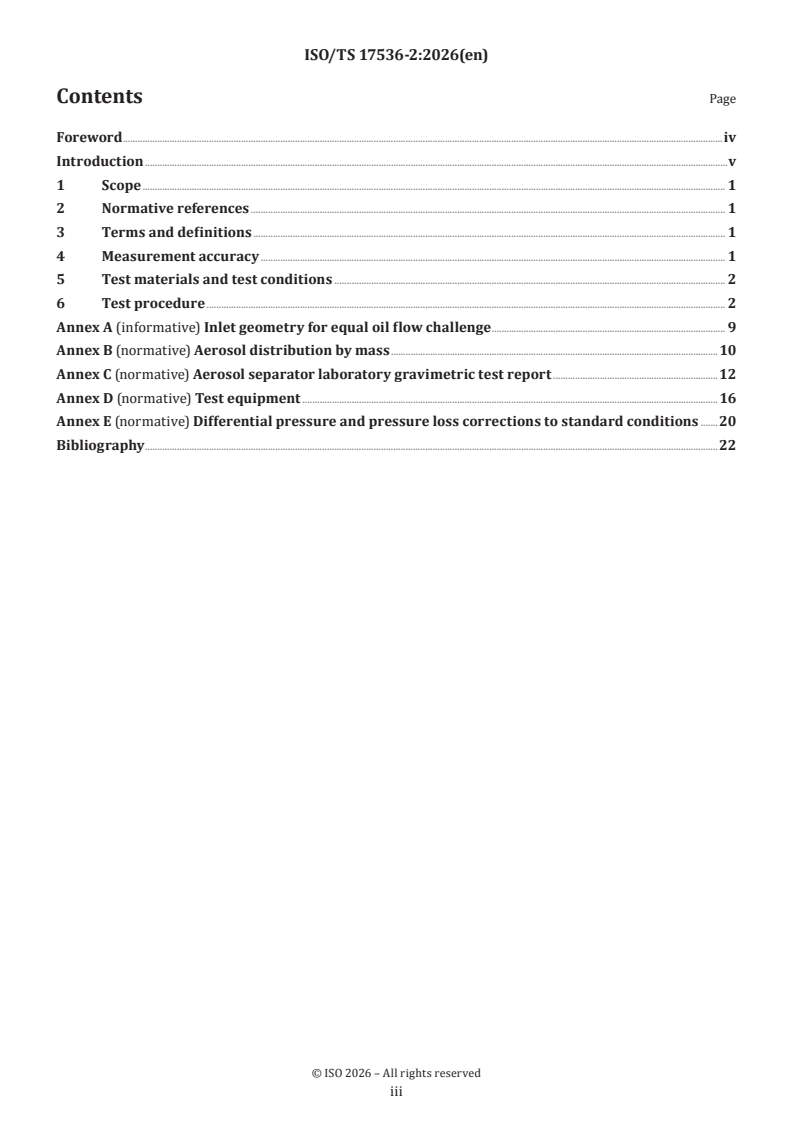
Contents Page
Foreword .iv
Introduction .v
1 Scope . 1
2 Normative references . 1
3 Terms and definitions . 1
4 Measurement accuracy . 1
5 Test materials and test conditions . 2
6 Test procedure . 2
Annex A (informative) Inlet geometry for equal oil flow challenge . 9
Annex B (normative) Aerosol distribution by mass . 10
Annex C (normative) Aerosol separator laboratory gravimetric test report .12
Annex D (normative) Test equipment .16
Annex E (normative) Differential pressure and pressure loss corrections to standard conditions .20
Bibliography .22
iii
Foreword
ISO (the International Organization for Standardization) is a worldwide federation of national standards
bodies (ISO member bodies). The work of preparing International Standards is normally carried out through
ISO technical committees. Each member body interested in a subject for which a technical committee
has been established has the right to be represented on that committee. International organizations,
governmental and non-governmental, in liaison with ISO, also take part in the work. ISO collaborates closely
with the International Electrotechnical Commission (IEC) on all matters of electrotechnical standardization.
The procedures used to develop this document and those intended for its further maintenance are described
in the ISO/IEC Directives, Part 1. In particular, the different approval criteria needed for the different types
of ISO document should be noted. This document was drafted in accordance with the editorial rules of the
ISO/IEC Directives, Part 2 (see www.iso.org/directives).
ISO draws attention to the possibility that the implementation of this document may involve the use of (a)
patent(s). ISO takes no position concerning the evidence, validity or applicability of any claimed patent
rights in respect thereof. As of the date of publication of this document, ISO had not received notice of (a)
patent(s) which may be required to implement this document. However, implementers are cautioned that
this may not represent the latest information, which may be obtained from the patent database available at
www.iso.org/patents. ISO shall not be held responsible for identifying any or all such patent rights.
Any trade name used in this document is information given for the convenience of users and does not
constitute an endorsement.
For an explanation of the voluntary nature of standards, the meaning of ISO specific terms and expressions
related to conformity assessment, as well as information about ISO's adherence to the World Trade
Organization (WTO) principles in the Technical Barriers to Trade (TBT), see www.iso.org/iso/foreword.html.
This document was prepared by Technical Committee ISO/TC 22, Road vehicles, Subcommittee SC 34,
Propulsion, powertrain and powertrain fluids.
This second edition cancels and replaces the first edition (ISO/TS 17536-2:2017), which has been technically
revised.
The main changes are as follows:
— update of Figure B.1, Table B.1 and Figure C.1.
A list of all parts in the ISO 17536 series can be found on the ISO website.
Any feedback or questions on this document should be directed to the user’s national standards body. A
complete listing of these bodies can be found at www.iso.org/members.html.
iv
Introduction
The engine crankcase blowby is composed of combustion exhaust gases which have escaped to the crankcase
via piston ring seals and lube oil aerosols generated by thermal and mechanical action within the engine.
These gases are vented from the crankcase to prevent a build-up of high pressure. The constituents of vented
engine blowby gases are recognized as an undesirable contaminant and technology for their containment is
therefore evolving.
The device, used to separate oil aerosols from the blowby, typically releases cleaned gases to the atmosphere
or alternatively returns the cleaned product to the combustion process by feeding into the engine air intake
prior to the turbo compressor if present. The latter has led to the requirement for a pressure control device
to isolate the engine crankcase from air intake pressure.
It is the purpose of this document to define standardized and repeatable test procedures for the evaluation
of blowby oil aerosol separators and filtering devices using this laboratory gravimetric test method.
v
Technical Specification ISO/TS 17536-2:2026(en)
Road vehicles — Aerosol separator performance test for
internal combustion engines —
Part 2:
Laboratory test method
1 Scope
This document defines standardized and repeatable test procedures for the evaluation of blowby oil aerosol
separators and filtering devices and specifies laboratory gravimetric separation efficiency and system
pressure tests in both open and closed crankcase ventilation systems. This document has a limitation of
0 % to 99 % for aerosol gravimetric efficiency.
NOTE Gravimetric efficiencies > 99 % can be difficult to measure due to long test durations and absolute filter
weight measurements.
Filter life is not evaluated in this document.
This test method only applies to devices that have a defined tubular inlet, outlet and drain that can be
connected to the test equipment. For devices that lack such connections, for example, one that is built into a
valve cover, see Annex A.
2 Normative references
The following documents are referred to in the text in such a way that some or all of their content constitutes
requirements of this document. For dated references, only the edition cited applies. For undated references,
the latest edition of the referenced document (including any amendments) applies.
ISO 17536-1:2015, Road vehicles — Aerosol separator performance test for internal combustion engines — Part
1: General
3 Terms and definitions
For the purposes of this document, the terms and definitions given in ISO 17536-1 and the following apply.
ISO and IEC maintain terminology databases for use in standardization at the following addresses:
— ISO Online browsing platform: available at https:// www .iso .org/ obp
— IEC Electropedia: available at https:// www .electropedia .org/
3.1
standard flow
flow rate corrected to standard conditions as specified in 5.3
4 Measurement accuracy
The measurement accuracy of this document shall be in accordance with ISO 17536-1:2015, Clause 3.
5 Test materials and test conditions
5.1 Test oil
The test oil shall be an oil of such appropriate viscosity and surface tension that the particle size of 50 %
cumulative mass of the generated aerosol exhibits more than 0,85 μm and less than 0,90 μm. The test oil
shall meet the aerosol distribution by mass given in Annex B. The challenge aerosol size distribution shall be
plotted in Figure C.1.
5.2 Absolute filter, wall flow trap and leakage
The provisions related to the absolute filter, the downstream wall flow trap and leakage shall be in
accordance with ISO 17536-1:2015, Clause 4.
5.3 Standard conditions
The standard condition for temperature, humidity, and pressure is 20 °C, 0 % RH, and 101,3 kPa (1 013 mbar).
Airflow differential pressure, inlet and outlet pressure, and pressure loss shall be corrected to that standard
condition.
5.4 Test temperature
5.4.1 Efficiency tests
The volume directly outside of the unit under test (UUT) and internal temperature of the efficiency test shall
be either:
— condition A: 80 °C ± 3 °C;
— condition B: 23 °C ± 5 °C.
The condition that is run shall be documented in the test report (see Table C.1).
5.4.2 Differential pressure, pressure loss, and crankcase pressure control tests
The flow rate for pressure loss and crankcase pressure control tests shall be corrected to standard flow.
The pressure loss and crankcase pressure control tests shall be conducted with air entering the aerosol
separator at a temperature of 23 °C ± 5 °C.
6 Test procedure
6.1 General
Performance tests shall be performed on a complete aerosol separator assembly. The tests shall consist
of a pressure loss test, a gravimetric efficiency test, conditioned gravimetric efficiency test, a crankcase
pressure control test (when pressure regulator is present), and a drain interval test (when applicable).
6.2 Test equipment
NOTE The definitions of the following terms related to the test equipment are defined in ISO 17536-1:2015,
Clause 2; upstream particle counter, particle counter calibration, maximum particle concentration and particle
counter flow.
6.2.1 Typical arrangements to determine the differential pressure or pressure loss to air flow, efficiency
and crankcase pressure control are shown in Annex D.
Use an aerosol generator which is capable of dosing oil mist over the range of delivery rates required
according to the customer's specification.
The aerosol generator shall be validated as follows:
— fill the aerosol generator to a pre-determined level;
— simultaneously start the aerosol generator and timer.
At a time interval relative to a mass oil flow of >1 g, determine the amount of aerosol dispersed and particle
size distribution. Continue mass oil flow determinations of the aerosol until the desired oil flow deviates
by < 5 % and shall be > 30 min. Continue feeding aerosol until the particle distribution does not meet the
Annex B specification (to understand time capability to deliver a distribution per Annex B).
Adjust the aerosol generator until the average delivery rate is within ±5 % of the desired rate and deviation
in the delivery rate from the average is not more than ±5 % for the entire designated test duration.
After verifying the delivery rate, verify the aerosol delivered from the aerosol generator for the entire test
duration is within the Annex B specifications.
6.2.2 An upstream wall flow trap should be used between the oil mist generator and the inlet tube to
eliminate any oil wall flow to the inlet tube. Use a wall flow trap conforming to ISO 17536-1:2015, Annex I.
6.2.3 Use an inlet piezometer tube conforming to ISO 17536-1:2015, Figure B.2. The cross-section shall be
the same as the aerosol separator inlet. In the case of non-uniform flow conditions caused by special inlet
tubes, special precautions may be required.
6.2.4 Use a manometer or other differential pressure measuring device with the specified accuracy
described in ISO 17536-1:2015, Clause 3.
6.2.5 Setup test with no UUT present (e.g. straight pipe).
6.2.6 A downstream wall flow trap should be used between the unit under test and the outlet piezometer
tube described in 6.2.3 to eliminate any oil wall flow. Use a wall flow trap conforming to ISO 17536-1:2015,
Annex I.
6.2.7 Use an outlet tube conforming to ISO 17536-1:2015, Figure B.2. The cross-section shall be the same
as the aerosol separator outlet. In the case of non-uniform flow conditions caused by special inlet tubes,
special precautions may be required.
6.2.8 Use an air flow rate measuring system having the accuracy described in ISO 17536-1:2015, Clause 3.
The flow rate for differential pressure and crankcase pressure control tests shall be standard flow, which is
the volume flow rate corrected to standard conditions, specified in 5.3.
6.2.9 Use an air flow rate control system with a refresh rate greater than 2 Hz capable of maintaining the
indicated flow rate to within 5 % of the selected value at a minimum data record frequency of 2 Hz during a
steady-state and variable air flow operation.
6.2.10 Use a compressed air/blower/exhauster for controlling the air flow through the system, which has
adequate flow rate and pressure characteristics for the oil separators to be tested.
6.2.11 If the unit under test has a pressure regulator or bypass, the use of a blower/exhauster on the
downstream of the system can be used to regulate the pressure on the outlet of the UUT. Devices with
pressure regulators shall have air pushed through the inlet because the pressure regulator device regulates
the amount of negative vacuum allowed on the system.
6.2.12 Grounding is required for all test apparatus to reduce the effects of static charges and to improve the
consistency of the test results. Grounding of metallic and non-metallic surfaces, housings, transport tubes,
injectors and associated hardware is recommended.
6.3 Pressure loss test
6.3.1 The purpose of this test is to determine the pressure loss across the UUT which will occur when air
passes through under predetermined conditions. The airflow differential pressure is measured with a clean
aerosol separator with at least four equally spaced air flows or as agreed upon between the customer and
supplier.
6.3.2 Set up the UUT as shown in ISO 17536-1:2015, Figure B.1, Figure D.1, or Figure D.3. Seal all joints to
prevent air leaks. Connect piezometer tubes to the inlet and outlet of the UUT. The piezometer tube shall be
sized to the size of the inlet and outlet of UUT.
6.3.3 Record the inlet temperature, barometric pressure and relative humidity.
6.3.4 Measure and record the differential pressure, and upstream absolute pressure of the UUT versus the
air flow rate at a minimum of four equally spaced air flows or flow rates agreed upon between the customer
and supplier.
6.3.5 Record the inlet temperature, barometric pressure, and relative humidity.
6.3.6 Recorded differential pressure readings shall be corrected to standard conditions in accordance
with Annex E.
6.3.7 For pressure loss determination, use the formula given in ISO 17536-1:2015, Annex A.
6.3.8 Plot the pressure loss as shown in Figure C.2 or equivalent.
6.4 Gravimetric efficiency test
6.4.1 The purpose of the gravimetric efficiency test is to determine the gravimetric separation efficiency
of a device in two conditions:
a) new state;
b) conditioned state as specified in 6.5.
The test duration for a gravimetric efficiency test shall be a minimum of 30 min and the minimum mass
gained on the absolute filter shall be 0,1 g. Additional time may be needed to achieve the absolute filter
weight gain requirement. The weight changes of the component parts and the absolute filter during the test
duration are used to calculate the new and conditioned state gravimetric efficiency.
High efficiency separators shall not exceed 3 h for 6.4.1, a) testing, as the new state is no longer maintained.
For such separators, 6.5 and 6.6 shall be performed to complete an efficiency evaluation on the product and
shall meet the above minimum requirements of 30 min and 0,1 g on the absolute filter.
NOTE The higher efficiency separators can require additional time to achieve the specified absolute filter weight
gain requirement.
6.4.2 The mass oil flow is agreed upon by the user and manufacturer.
6.4.3 Weigh and record the UUT.
6.4.4 Weigh and record the drainage vessel (if present).
6.4.5 Weigh the absolute filter as specified in ISO 17536-1:2015, 4.1.2 and record the mass before assembly
within the absolute filter housing.
6.4.6 Weigh the downstream wall flow trap of the UUT as specified in ISO 17536-1:2015, 4.2.1.
6.4.7 Setup the test stand as shown in Figure D.2 or Figure D.4 for all aerosol separators. Seal all joints to
prevent air leakage. The orientation of the UUT shall be as in application.
6.4.8 Record the UUT external air temperature, pressure, and relative humidity.
6.4.9 Start the air flow through the test stand as specified in 5.4.1 and stabilize at the test flow as specified
in 6.2.8. Record the differential pressure.
6.4.10 Set the feed rate to the pre-determined oil flow. Start the aerosol generator.
6.4.11 The differential pressure shall be compensated for the increased differential pressure that the tubing
and downstream wall flow trap between the UUT and the piezometer introduces, since the downstream
wall flow trap will be in this area. The downstream wall flow trap is present to protect the downstream
piezometer from contamination of liquid oil wall flow. The pressure loss of the downstream wall flow trap
shall be subtracted from the overall pressure loss.
6.4.12 Every 10 min, record the differential pressure at the air test flow and the elapsed test time.
6.4.13 Record the differential pressure at the end of test before interrupting either the air flow rate or mass
oil flow to remove the absolute filter.
6.4.14 Stop the aerosol generator and continue to run the air flow rate for 15 s – 30 s, this will evacuate the
test stand of aerosol.
6.4.15 Stop the air flow rate.
6.4.16 Record the UUT external air temperature, pressure and relative humidity.
6.4.17 Weigh the UUT. Note any evidence of seal leakage or unusual conditions. The increase in mass of the
UUT is the mass measured minus the mass recorded in 6.4.3.
NOTE All components are weighed carefully so as not to lose any oil or mass.
6.4.18 Remove the absolute filter. Repeat 6.4.5 and determine the difference in mass. The change is the
increase in mass of the absolute filter. The differen
...