

ISO/FDIS 25584
(Main)Traditional Chinese medicine — Phellodendron chinense and Phellodendron amurense bark
General Information
- Abstract
This document specifies the minimum requirements and test methods for Phellodendron bark, which is derived from the plant of Phellodendron chinense Schneid. or Phellodendron amurense Rupr. (Fam. Rutaceae). This document is applicable to Phellodendron bark that is sold and used as herbal raw materials in the international trade, including Chinese materia medica (whole medicinal materials) and decoction pieces derived from these plants.
- Status
- Not Published
- Technical Committee
- ISO/TC 249 - Traditional Chinese medicine
- Current Stage
- 5020 - FDIS ballot initiated: 2 months. Proof sent to secretariat
- Start Date
- 03-Aug-2026
- Completion Date
- 03-Aug-2026
Buy Documents
ISO/FDIS 25584 - Traditional Chinese medicine — Phellodendron chinense and Phellodendron amurense bark
REDLINE ISO/FDIS 25584 - Traditional Chinese medicine — Phellodendron chinense and Phellodendron amurense bark
Overview
ISO/FDIS 25584: Traditional Chinese medicine - Phellodendron chinense and Phellodendron amurense bark establishes internationally harmonized requirements and test methods for Phellodendron bark derived from Phellodendron chinense Schneid. or Phellodendron amurense Rupr. This standard is developed by ISO/TC 249, focusing on traditional Chinese medicine (TCM) products and aims to ensure the quality, safety, and consistency of Phellodendron bark used as herbal raw material in both whole form (Chinese materia medica) and as decoction pieces in the global marketplace.
Phellodendron bark is widely utilized in TCM, Japanese Kampo, and as a dietary supplement ingredient in various countries. Its quality regulation previously varied among national pharmacopoeias, making unified international guidelines essential for commerce and public health.
Key Topics
1. Product Definition and Scope
- Specifies Phellodendron bark as the dried bark of P. chinense or P. amurense.
- Applies to herbal raw materials traded or used as whole bark or decoction pieces.
2. Quality Requirements
- General: Must be clean, free from leaf, foreign matter, visible insects, mold, and external contaminants.
- Morphological features: Detailed descriptions provided for species identification and quality assessment.
- Microscopic characteristics: Defined to enable precise identification and differentiation.
3. Chemical and Physical Testing
- Thin-layer chromatogram (TLC): Identification method to confirm authenticity against reference compounds.
- Moisture, total ash, acid-insoluble ash, and ethanol-soluble extractives: Quantified to ensure product quality and stability.
- Marker compound content: Berberine content is evaluated as a quality marker.
- Heavy metals, sulfur dioxide, and pesticide residues: Determined to assure consumer safety.
4. Sampling and Test Methods
- Refers to internationally recognized ISO methods for sampling, chemical analysis, and reporting.
5. Packaging and Labelling
- Packaging must protect from light, moisture, pollution, and contamination.
- Product labels must include clear information on product name, origin, batch, expiration, quality characteristics, and handling instructions.
Applications
Phellodendron bark is a cornerstone in traditional Chinese medicine for its reputed anti-inflammatory, antibacterial, antiviral, and other therapeutic properties. Key practical uses and applications include:
- Herbal medicine production: Ensures that raw materials used in TCM and Kampo pharmaceutical preparations meet consistent standards.
- International trade: Facilitates cross-border commerce in herbal materials by harmonizing requirements and test methods.
- Safety monitoring: Enables regulatory authorities and manufacturers to verify product integrity, purity, and contaminant levels.
- Research and product development: Supports phytochemical research and innovation in herbal supplements and pharmaceutical products.
This standard promotes global best practices in handling, testing, and trading Phellodendron bark, crucial for maintaining efficacy and minimizing adverse events in herbal medicine consumers.
Related Standards
For comprehensive quality assurance of herbal raw materials and related testing, consider the following ISO standards:
- ISO 18664: Determination of heavy metals in traditional Chinese herbal medicines
- ISO/TS 21310: Microscopic examination of medicinal herbs
- ISO 21371: Labelling requirements for oral/topical TCM products
- ISO 22217: Storage requirements for raw materials and decoction pieces
- ISO 22258: Determination of pesticide residues in natural herbal products
- ISO 22590: Determination of sulfur dioxide in natural products
- ISO 23723: General requirements for herbal raw material and materia medica
These standards collectively provide a robust framework for ensuring the safety, quality, and transparency of Phellodendron bark in international markets, aligning with regulatory and industry expectations for traditional herbal medicines.
Buy Documents
ISO/FDIS 25584 - Traditional Chinese medicine — Phellodendron chinense and Phellodendron amurense bark
REDLINE ISO/FDIS 25584 - Traditional Chinese medicine — Phellodendron chinense and Phellodendron amurense bark
Get Certified
Connect with accredited certification bodies for this standard

BSI Group
BSI (British Standards Institution) is the business standards company that helps organizations make excellence a habit.

TÜV Rheinland
TÜV Rheinland is a leading international provider of technical services.

TÜV SÜD
TÜV SÜD is a trusted partner of choice for safety, security and sustainability solutions.
Sponsored listings
Frequently Asked Questions
ISO/FDIS 25584 is a draft published by the International Organization for Standardization (ISO). Its full title is "Traditional Chinese medicine — Phellodendron chinense and Phellodendron amurense bark". This standard covers: This document specifies the minimum requirements and test methods for Phellodendron bark, which is derived from the plant of Phellodendron chinense Schneid. or Phellodendron amurense Rupr. (Fam. Rutaceae). This document is applicable to Phellodendron bark that is sold and used as herbal raw materials in the international trade, including Chinese materia medica (whole medicinal materials) and decoction pieces derived from these plants.
This document specifies the minimum requirements and test methods for Phellodendron bark, which is derived from the plant of Phellodendron chinense Schneid. or Phellodendron amurense Rupr. (Fam. Rutaceae). This document is applicable to Phellodendron bark that is sold and used as herbal raw materials in the international trade, including Chinese materia medica (whole medicinal materials) and decoction pieces derived from these plants.
ISO/FDIS 25584 is classified under the following ICS (International Classification for Standards) categories: 11.120.10 - Medicaments. The ICS classification helps identify the subject area and facilitates finding related standards.
ISO/FDIS 25584 is available in PDF format for immediate download after purchase. The document can be added to your cart and obtained through the secure checkout process. Digital delivery ensures instant access to the complete standard document.
Standards Content (Sample)
FINAL DRAFT
International
Standard
ISO/TC 249/SC 1
Traditional Chinese medicine —
Secretariat: SAC
Phellodendron chinense and
Voting begins on:
Phellodendron amurense bark
2026-08-03
Voting terminates on:
2026-09-28
RECIPIENTS OF THIS DRAFT ARE INVITED TO SUBMIT,
WITH THEIR COMMENTS, NOTIFICATION OF ANY
RELEVANT PATENT RIGHTS OF WHICH THEY ARE AWARE
AND TO PROVIDE SUPPOR TING DOCUMENTATION.
IN ADDITION TO THEIR EVALUATION AS
BEING ACCEPTABLE FOR INDUSTRIAL, TECHNO
LOGICAL, COMMERCIAL AND USER PURPOSES, DRAFT
INTERNATIONAL STANDARDS MAY ON OCCASION HAVE
TO BE CONSIDERED IN THE LIGHT OF THEIR POTENTIAL
TO BECOME STAN DARDS TO WHICH REFERENCE MAY BE
MADE IN NATIONAL REGULATIONS.
Reference number
FINAL DRAFT
International
Standard
ISO/TC 249/SC 1
Traditional Chinese medicine —
Secretariat: SAC
Phellodendron chinense and
Voting begins on:
Phellodendron amurense bark
Voting terminates on:
RECIPIENTS OF THIS DRAFT ARE INVITED TO SUBMIT,
WITH THEIR COMMENTS, NOTIFICATION OF ANY
RELEVANT PATENT RIGHTS OF WHICH THEY ARE AWARE
AND TO PROVIDE SUPPOR TING DOCUMENTATION.
© ISO 2026
IN ADDITION TO THEIR EVALUATION AS
All rights reserved. Unless otherwise specified, or required in the context of its implementation, no part of this publication may
BEING ACCEPTABLE FOR INDUSTRIAL, TECHNO
LOGICAL, COMMERCIAL AND USER PURPOSES, DRAFT
be reproduced or utilized otherwise in any form or by any means, electronic or mechanical, including photocopying, or posting on
INTERNATIONAL STANDARDS MAY ON OCCASION HAVE
the internet or an intranet, without prior written permission. Permission can be requested from either ISO at the address below
TO BE CONSIDERED IN THE LIGHT OF THEIR POTENTIAL
or ISO’s member body in the country of the requester.
TO BECOME STAN DARDS TO WHICH REFERENCE MAY BE
MADE IN NATIONAL REGULATIONS.
ISO copyright office
CP 401 • Ch. de Blandonnet 8
CH-1214 Vernier, Geneva
Phone: +41 22 749 01 11
Email: copyright@iso.org
Website: www.iso.org
Published in Switzerland Reference number
ii
Contents Page
Foreword .iv
Introduction .v
1 Scope . 1
2 Normative references . 1
3 Terms and definitions . 1
4 Descriptions . 2
5 Requirements and recommendations . 3
5.1 General characteristics .3
5.2 Morphological features .4
5.3 Microscopic characteristics .4
5.4 Thin-layer chromatogram (TLC) identification .5
5.5 Foreign matter .5
5.6 Moisture .5
5.7 Total ash .5
5.8 Acid-insoluble ash .5
5.9 Ethanol-soluble extractives .5
5.10 Marker compound .5
5.11 Heavy metals .5
5.12 Sulfur dioxide . .5
5.13 Pesticide residues .5
6 Sampling . 5
7 Test methods . 5
7.1 Macroscopic identification .5
7.2 Microscopic examination .5
7.3 Thin-layer chromatogram (TLC) identification .6
7.4 Determination of foreign matters .6
7.5 Determination of moisture content .6
7.6 Determination of total ash content .6
7.7 Determination of acid-insoluble ash content .6
7.8 Determination of ethanol-soluble extractives .6
7.9 Determination of marker compound .6
7.10 Determination of heavy metals content .6
7.11 Determination of sulfur dioxide content .6
7.12 Determination of pesticide residues content .6
8 Test report . 6
9 Packaging, storage and transportation . 7
10 Marking and labelling . 7
Annex A (informative) Thin-layer chromatogram (TLC) identification . 8
Annex B (informative) Determination of marker compound content . 9
Annex C (informative) Reference information of national and regional requirements .11
Bibliography .13
iii
Foreword
ISO (the International Organization for Standardization) is a worldwide federation of national standards
bodies (ISO member bodies). The work of preparing International Standards is normally carried out through
ISO technical committees. Each member body interested in a subject for which a technical committee
has been established has the right to be represented on that committee. International organizations,
governmental and non-governmental, in liaison with ISO, also take part in the work. ISO collaborates closely
with the International Electrotechnical Commission (IEC) on all matters of electrotechnical standardization.
The procedures used to develop this document and those intended for its further maintenance are described
in the ISO/IEC Directives, Part 1. In particular, the different approval criteria needed for the different types
of ISO document should be noted. This document was drafted in accordance with the editorial rules of the
ISO/IEC Directives, Part 2 (see www.iso.org/directives).
ISO draws attention to the possibility that the implementation of this document may involve the use of (a)
patent(s). ISO takes no position concerning the evidence, validity or applicability of any claimed patent
rights in respect thereof. As of the date of publication of this document, ISO had not received notice of (a)
patent(s) which may be required to implement this document. However, implementers are cautioned that
this may not represent the latest information, which may be obtained from the patent database available at
www.iso.org/patents. ISO shall not be held responsible for identifying any or all such patent rights.
Any trade name used in this document is information given for the convenience of users and does not
constitute an endorsement.
For an explanation of the voluntary nature of standards, the meaning of ISO specific terms and expressions
related to conformity assessment, as well as information about ISO's adherence to the World Trade
Organization (WTO) principles in the Technical Barriers to Trade (TBT), see www.iso.org/iso/foreword.html.
This document was prepared by Technical Committee ISO/TC 249, Traditional medicine, Subcommittee SC 1,
Traditional Chinese medicine.
Any feedback or questions on this document should be directed to the user’s national standards body. A
complete listing of these bodies can be found at www.iso.org/members.html.
iv
Introduction
Phellodendron bark is the dried bark of Phellodendron chinense Schneid. or Phellodendron amurense Rupr.
(Fam. Rutaceae). The pinyin name is Huangbo or Guanhuangbo. It is a commonly used Chinese herbal
medicine with a long history, which is mainly produced in China, Japan, and Korea.
The main chemical constituents of Phellodendron bark include alkaloids, phenolic acids, limonoids,
phenylpropanoids and terpenoids. Modern pharmacological studies have shown that the alkaloids are the
main active components of Phellodendron bark, which have anti-inflammatory, antibacterial, antiviral,
antioxidant, anti-cancer, anti-tumor, hypoglycemic, reduction of uric acid, liver and kidney protection, and
other biological activities. It can be used to treat pneumonia, pulmonary tuberculosis, bacillary dysentery,
chronic osteomyelitis, impetigo, eczema, herpes zoster, trichomonal vaginitis, pruritus vulvae, acute
conjunctivitis and other diseases.
Phellodendron bark is one of the most frequently used herbal medicines in traditional Chinese medicine. For
example, among 1607 formulations in Chinese Pharmacopoeia (2020 edition), there are 85 formulations with
ingredient of Phellodendron bark (occupying 5,29%); among 294 formulations in the approval standards for
over-the-counter Kampo products (2012 edition) from the ministry of health, labor, and welfare (MHLW)
of Japan, there are 19 formulations with ingredient of Phellodendron bark (occupying 6,46%). In the United
States of America, Phellodendron bark is sold as a dietary supplement ingredient.
In terms of quality supervision of medicinal materials, the quality of Phellodendron bark is regulated in
Chinese Pharmacopoeia, Japanese Pharmacopoeia, Korean Pharmacopoeia and Hong Kong Chinese Materia
Medica Standards. However, these standards are not yet harmonized, and cannot safeguard the quality and
safety of Phellodendron bark on an international trade level.
In addition, Phellodendron bark is ranked the 77th in the priority list of single herbal medicines for developing
[1]
standards in ISO/TR 23975:2025 . This means it is necessary to establish standards to standardize the
quality and safety control of Phellodendron bark.
As national implementation may differ, national standards bodies are invited to modify the values given in
5.6, 5.7 and 5.10 in their national standards. Examples of national and regional values are given in Annex C.
v
FINAL DRAFT International Standard ISO/FDIS 25584:2026(en)
Traditional Chinese medicine — Phellodendron chinense and
Phellodendron amurense bark
1 Scope
This document specifies the minimum requirements and test methods for cultivated Phellodendron bark,
which is derived from the plant of Phellodendron chinense Schneid. or Phellodendron amurense Rupr. (Fam.
Rutaceae).
This document is applicable to cultivated Phellodendron bark that is sold and used as herbal raw materials
in international trade, including Chinese materia medica (whole medicinal materials) and decoction pieces
derived from these plants.
2 Normative references
The following documents are referred to in the text in such a way that some or all of their content constitutes
requirements of this document.
...
Style Definition: Heading 1: Indent: Left: 0 cm, First
ISO/DISFDIS 25584
line: 0 cm
ISO/TC 249/SC 1
Style Definition: Heading 2: Font: Bold, Indent: Left: 0
cm, First line: 0 cm
Secretariat: SAC
Style Definition: Heading 3: Font: Bold, Indent: Left: 0
cm, First line: 0 cm
Date: 2026-05-1307-20
Style Definition: Heading 4: Font: Bold, Indent: Left: 0
cm, First line: 0 cm
Style Definition: Heading 5: Font: Bold, Indent: Left: 0
cm, First line: 0 cm
Style Definition: Heading 6: Font: Bold
Style Definition: IntroHeading1: Font: Bold, Indent:
Traditional Chinese medicine — Phellodendron chinense and
Left: 0 cm, First line: 0 cm
Phellodendron amurense bark
Style Definition: IntroHeading2: Font: Bold, Indent:
Left: 0 cm, First line: 0 cm
Style Definition: IntroHeading3: Font: Bold, Indent:
Left: 0 cm, First line: 0 cm
Style Definition: IntroHeading4: Font: Bold, Indent:
Left: 0 cm, First line: 0 cm
Style Definition: IntroHeading5: Font: Bold, Indent:
Left: 0 cm, First line: 0 cm
Style Definition: IntroHeading6
Style Definition: IntroHeading7
DISFDIS stage
Style Definition: IntroHeading8
Style Definition: IntroHeading9
Style Definition: ANNEX
Style Definition: Key Text
Style Definition: Key Title
Style Definition: List Continue 1
Style Definition: TermNum2: Font: Bold, Indent: Left: 0
cm, First line: 0 cm
Style Definition: TermNum3: Font: Bold, Indent: Left: 0
cm, First line: 0 cm
Style Definition: TermNum4: Font: Bold, Indent: Left: 0
cm, First line: 0 cm
Style Definition: TermNum5: Font: Bold, Indent: Left: 0
cm, First line: 0 cm
Style Definition: TermNum6: Font: Bold
Style Definition: Body Text
Style Definition: boxedText
Style Definition: Boxed List Continue 1
Style Definition: boxedTitle
VVVVVoooootttttiiiiing bng bng bng bng beeeeegigigigiginsnsnsnsns o o o o on:n:n:n:n: 202 202 202 202 20255555-----1212121212-----2222222222
Style Definition: FooterCentered
VoVoVoVoVotintintintintinggggg t t t t terererererminminminminminatatatatateseseseses o o o o onnnnn::::: 22222000002222266666-----0000033333-----1616161616
Style Definition: FooterPageNumber
Style Definition: FooterPageRomanNumber
Style Definition: FooterCenteredContinued
Style Definition: TPS Markup Base
Formatted: French (France)
Formatted: French (France)
ISO/DISFDIS 25584:2026(en)
All rights reserved. Unless otherwise specified, or required in the context of its implementation, no part of this publication
may be reproduced or utilized otherwise in any form or by any means, electronic or mechanical, including photocopying,
or posting on the internet or an intranet, without prior written permission. Permission can be requested from either ISO
at the address below or ISO’s member body in the country of the requester.
ISO copyright office
CP 401 • Ch. de Blandonnet 8
CH-1214 Vernier, Geneva
Phone: + 41 22 749 01 11
Formatted: French (France)
E-mail: copyright@iso.org
Website: www.iso.org
Published in Switzerland
ii
ISO/DISFDIS 25584:2026(en)
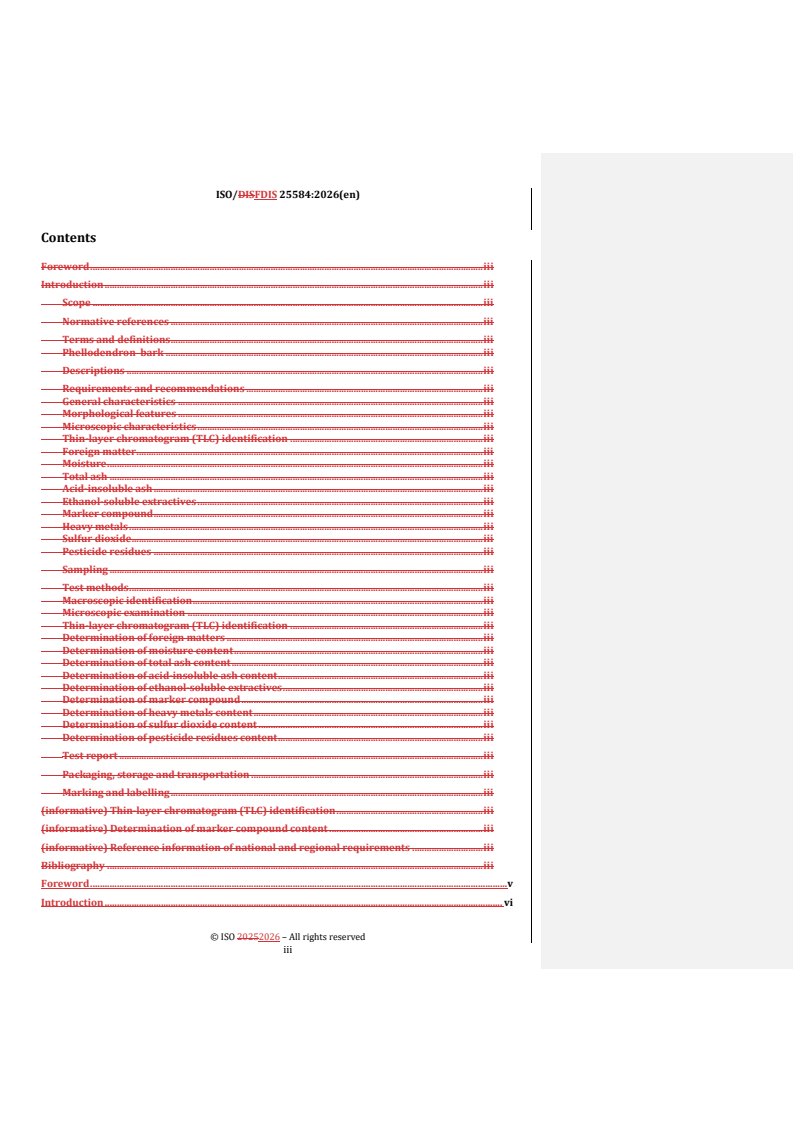
Contents
Foreword . iii
Introduction . iii
Scope . iii
Normative references . iii
Terms and definitions . iii
Phellodendron bark . iii
Descriptions . iii
Requirements and recommendations . iii
General characteristics . iii
Morphological features . iii
Microscopic characteristics . iii
Thin-layer chromatogram (TLC) identification . iii
Foreign matter . iii
Moisture . iii
Total ash . iii
Acid-insoluble ash . iii
Ethanol-soluble extractives . iii
Marker compound . iii
Heavy metals . iii
Sulfur dioxide . iii
Pesticide residues . iii
Sampling . iii
Test methods . iii
Macroscopic identification . iii
Microscopic examination . iii
Thin-layer chromatogram (TLC) identification . iii
Determination of foreign matters . iii
Determination of moisture content . iii
Determination of total ash content . iii
Determination of acid-insoluble ash content . iii
Determination of ethanol-soluble extractives . iii
Determination of marker compound . iii
Determination of heavy metals content . iii
Determination of sulfur dioxide content . iii
Determination of pesticide residues content . iii
Test report . iii
Packaging, storage and transportation . iii
Marking and labelling . iii
(informative) Thin-layer chromatogram (TLC) identification . iii
(informative) Determination of marker compound content . iii
(informative) Reference information of national and regional requirements . iii
Bibliography . iii
Foreword . v
Introduction . vi
iii
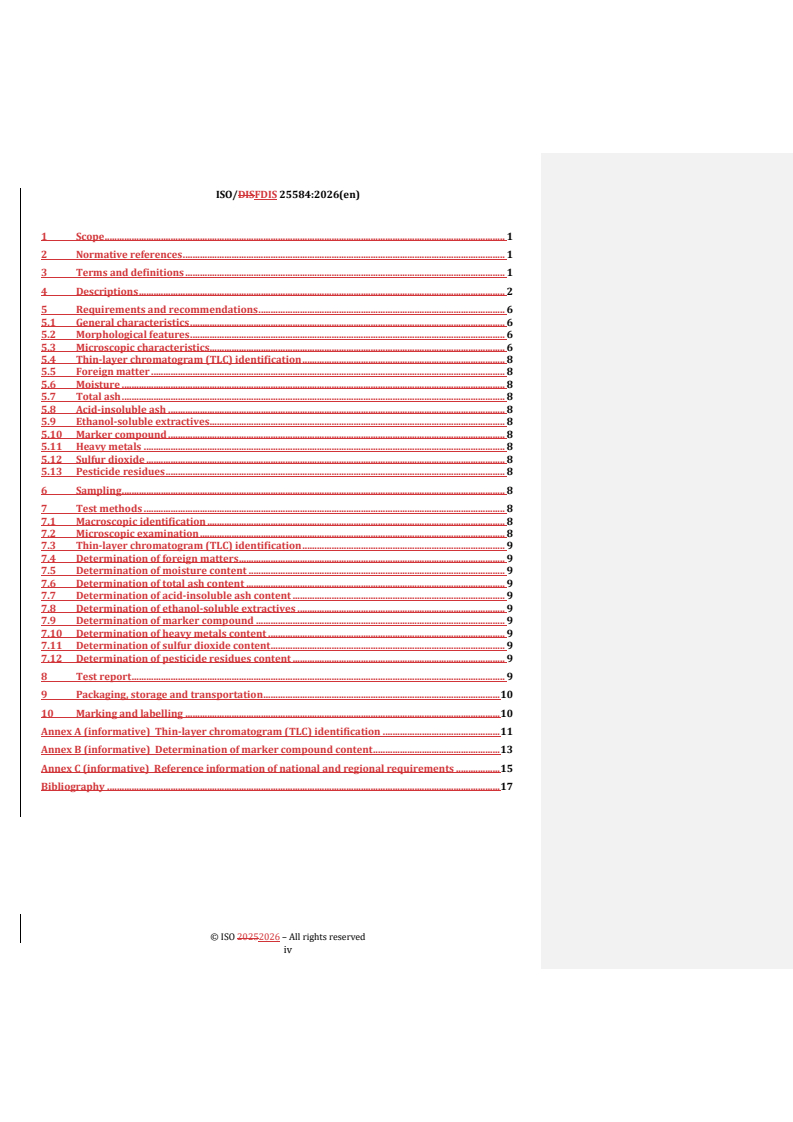
ISO/DISFDIS 25584:2026(en)
1 Scope . 1
2 Normative references . 1
3 Terms and definitions . 1
4 Descriptions . 2
5 Requirements and recommendations . 6
5.1 General characteristics . 6
5.2 Morphological features . 6
5.3 Microscopic characteristics. 6
5.4 Thin-layer chromatogram (TLC) identification . 8
5.5 Foreign matter . 8
5.6 Moisture . 8
5.7 Total ash . 8
5.8 Acid-insoluble ash . 8
5.9 Ethanol-soluble extractives. 8
5.10 Marker compound . 8
5.11 Heavy metals . 8
5.12 Sulfur dioxide . 8
5.13 Pesticide residues . 8
6 Sampling . 8
7 Test methods . 8
7.1 Macroscopic identification . 8
7.2 Microscopic examination . 8
7.3 Thin-layer chromatogram (TLC) identification . 9
7.4 Determination of foreign matters . 9
7.5 Determination of moisture content . 9
7.6 Determination of total ash content . 9
7.7 Determination of acid-insoluble ash content . 9
7.8 Determination of ethanol-soluble extractives . 9
7.9 Determination of marker compound . 9
7.10 Determination of heavy metals content . 9
7.11 Determination of sulfur dioxide content . 9
7.12 Determination of pesticide residues content . 9
8 Test report . 9
9 Packaging, storage and transportation . 10
10 Marking and labelling . 10
Annex A (informative) Thin-layer chromatogram (TLC) identification . 11
Annex B (informative) Determination of marker compound content . 13
Annex C (informative) Reference information of national and regional requirements . 15
Bibliography . 17
iv
ISO/DISFDIS 25584:2026(en)
Foreword
ISO (the International Organization for Standardization) is a worldwide federation of national standards
bodies (ISO member bodies). The work of preparing International Standards is normally carried out through
ISO technical committees. Each member body interested in a subject for which a technical committee has been
established has the right to be represented on that committee. International organizations, governmental and
non-governmental, in liaison with ISO, also take part in the work. ISO collaborates closely with the
International Electrotechnical Commission (IEC) on all matters of electrotechnical standardization.
The procedures used to develop this document and those intended for its further maintenance are described
in the ISO/IEC Directives, Part 1. In particular, the different approval criteria needed for the different types of
ISO document should be noted. This document was drafted in accordance with the editorial rules of the
ISO/IEC Directives, Part 2 (see www.iso.org/directives).
ISO draws attention to the possibility that the implementation of this document may involve the use of (a)
patent(s). ISO takes no position concerning the evidence, validity or applicability of any claimed patent rights
in respect thereof. As of the date of publication of this document, ISO had not received notice of (a) patent(s)
which may be required to implement this document. However, implementers are cautioned that this may not
represent the latest information, which may be obtained from the patent database available at
www.iso.org/patents. ISO shall not be held responsible for identifying any or all such patent rights.
Any trade name used in this document is information given for the convenience of users and does not
constitute an endorsement.
For an explanation of the voluntary nature of standards, the meaning of ISO specific terms and expressions
related to conformity assessment, as well as information about ISO's adherence to the World Trade
Organization (WTO) principles in the Technical Barriers to Trade (TBT), see www.iso.org/iso/foreword.html.
This document was prepared by Technical Committee ISO/TC 249/, Traditional medicine, Subcommittee SC 1,
Traditional Chinese medicine.
Any feedback or questions on this document should be directed to the user’s national standards body. A
complete listing of these bodies can be found at www.iso.org/members.html.
v
ISO/DISFDIS 25584:2026(en)
Introduction
Phellodendron bark is the dried bark of Phellodendron chinense Schneid. or Phellodendron amurense Rupr.
(Fam. Rutaceae). The pinyin name is Huangbo or Guanhuangbo. It is a commonly used Chinese herbal medicine
with a long history, which is mainly produced in China, Japan, and Korea.
The main chemical constituents of Phellodendron bark include alkaloids, phenolic acids, limonoids,
phenylpropanoids and terpenoids. Modern pharmacological studies have shown that the alkaloids are the
main active components of Phellodendron bark, which have anti-inflammatory, antibacterial, antiviral,
antioxidant, anti-cancer, anti-tumor, hypoglycemic, reduction of uric acid, liver and kidney protection, and
other biological activities. It can be used to treat pneumonia, pulmonary tuberculosis, bacillary dysentery,
chronic osteomyelitis, impetigo, eczema, herpes zoster, trichomonal vaginitis, pruritus vulvae, acute
conjunctivitis and other diseases.
Phellodendron bark is one of the most frequently used herbal medicines in traditional Chinese medicine. For
example, among 1607 formulations in Chinese Pharmacopoeia (2020 edition), there are 85 formulations with
ingredient of Phellodendron bark (occupying 5,29%); among 294 formulations in the approval standards for
over-the-counter Kampo products (2012 edition) from the ministry of health, labor, and welfare (MHLW) of
Japan, there are 19 formulations with ingredient of Phellodendron bark (occupying 6,46%). In the United
States of America, Phellodendron bark is sold as a dietary supplement ingredient.
In terms of quality supervision of medicinal materials, the quality of Phellodendron bark is regulated in Chinese
Pharmacopoeia, Japanese Pharmacopoeia, Korean Pharmacopoeia and Hong Kong Chinese Materia Medica
Standards. However, these standards are not yet harmonized, and cannot safeguard the quality and safety of
Phellodendron bark on an international trade level.
In addition, Phellodendron bark is ranked the 77th in the priority list of single herbal medicines for developing
standards in ISO/TR 23975:2025.ISO/TR 23975:2025. This means it is necessary to establish standards to
standardize the quality and safety control of Phellodendron bark.
As national implementation may differ, national standards bodies are invited to modify the values given in 5.6,
5.7 and 5.10 in their national standards. Examples of national and regional values are given in Annex C.
vi
ISO/DISFDIS 25584:2026(en)
Traditional Chinese medicine — Phellodendron chinense and
Phellodendron amurense bark
1 Scope
This document specifies the minimum requirements and test methods for cultivated Phellodendron bark,
whi
...