

ISO/IEC TS 19841:2015
(Main)Technical Specification for C++ Extensions for Transactional Memory
General Information
- Abstract
ISO/IEC TS 19841:2015 describes extensions to the C++ Programming Language (1.3) that enable the specification of Transactional Memory. These extensions include new syntactic forms and modifications to existing language and library. The International Standard, ISO/IEC 14882, provides important context and specification for this Technical Specification. This document is written as a set of changes against that specification. Instructions to modify or add paragraphs are written as explicit instructions. Modifications made directly to existing text from the International Standard use green to represent added text and strikethrough to represent deleted text. ISO/IEC TS 19841:2015 is non-normative. Some of the functionality described by this Technical Specification may be considered for standardization in a future version of C++, but it is not currently part any C++ standard. Some of the functionality in this Technical Specification may never be standardized, and other functionality may standardized in a substantially changed form. The goal of this Technical Specification is to build widespread existing practice for Transactional Memory. It gives advice on extensions to those vendors who wish to provide them
- Status
- Published
- Publication Date
- 15-Sep-2015
- Technical Committee
- ISO/IEC JTC 1/SC 22 - Programming languages, their environments and system software interfaces
- Drafting Committee
- ISO/IEC JTC 1/SC 22/WG 21 - C++
- Current Stage
- 9093 - International Standard confirmed
- Start Date
- 03-Sep-2024
- Completion Date
- 29-Aug-2026
Buy Documents

ISO/IEC TS 19841:2015 - Technical Specification for C++ Extensions for Transactional Memory Released:9/16/2015

ISO/IEC TS 19841:2015 - Technical Specification for C++ Extensions for Transactional Memory/16/2015
Overview
ISO/IEC TS 19841:2015 - Technical Specification for C++ Extensions for Transactional Memory is an informative (non‑normative) Technical Specification that describes proposed extensions to the C++ language and standard library to support Transactional Memory (TM). Written as a set of changes against the International Standard ISO/IEC 14882 (C++), the document specifies new syntactic forms and library modifications that enable programmers and implementers to express transactions, transaction-safety, and related runtime behavior. It is intended to document existing practice, provide guidance to vendors, and inform potential future standardization - not to introduce mandatory changes to the C++ standard.
Key topics and technical requirements
- Language extensions and syntax: The TS describes new syntactic constructs (presented as modifications to ISO/IEC 14882) to express transactional regions and related constructs.
- Statements and control: Entries in the table of contents reference constructs such as synchronized statement and atomic statement, showing the TS addresses transactional control flow and jump/exception interactions inside transactions.
- Transaction-safety and conversions: Sections like Transaction-safety conversion and transaction-safe function define how code and functions are categorized or converted with respect to transactional execution.
- Library support: The TS adds or modifies library components for transactional use, e.g. tx_exception (transaction exception type), and introduces requirements for transaction safety within the C++ library.
- Diagnostics and runtime: Coverage includes exception handling, diagnostics, and runtime support relevant to transactions (throwing/handling exceptions inside transactional contexts).
- Implementation guidance: Clauses on implementation compliance, feature testing, and conforming implementations guide compiler and library vendors on how to provide and test TM features.
- Informative nature: The document uses explicit edit instructions and highlights changes against ISO/IEC 14882; it is advisory and documents practices that may or may not become part of a future C++ standard.
Applications and who uses it
- Compiler and toolchain vendors - to prototype and implement TM language extensions and provide transaction-aware optimizations.
- Standard library implementers - to adapt containers, allocators, and exception types for transactional safety.
- Systems and concurrent software developers - to design lock‑free or optimistic concurrency using transactional constructs for performance and scalability.
- Research and performance engineering teams - to evaluate transactional memory semantics, performance trade‑offs, and language interactions.
- Library authors - to create transaction-aware libraries (memory, synchronization, utilities) consistent with proposed C++ TM guidance.
Related standards
- ISO/IEC 14882 (C++) - the International Standard that provides the base language rules and is the reference document against which TS 19841 is written.
Keywords: ISO/IEC TS 19841:2015, C++, Transactional Memory, transaction‑safety, synchronized statement, atomic statement, tx_exception, C++ language extensions, transactional library support.
Buy Documents
ISO/IEC TS 19841:2015 - Technical Specification for C++ Extensions for Transactional Memory Released:9/16/2015
ISO/IEC TS 19841:2015 - Technical Specification for C++ Extensions for Transactional Memory/16/2015
Get Certified
Connect with accredited certification bodies for this standard

BSI Group
BSI (British Standards Institution) is the business standards company that helps organizations make excellence a habit.

NYCE
Mexican standards and certification body.
Sponsored listings
Frequently Asked Questions
ISO/IEC TS 19841:2015 is a technical specification published by the International Organization for Standardization (ISO). Its full title is "Technical Specification for C++ Extensions for Transactional Memory". This standard covers: ISO/IEC TS 19841:2015 describes extensions to the C++ Programming Language (1.3) that enable the specification of Transactional Memory. These extensions include new syntactic forms and modifications to existing language and library. The International Standard, ISO/IEC 14882, provides important context and specification for this Technical Specification. This document is written as a set of changes against that specification. Instructions to modify or add paragraphs are written as explicit instructions. Modifications made directly to existing text from the International Standard use green to represent added text and strikethrough to represent deleted text. ISO/IEC TS 19841:2015 is non-normative. Some of the functionality described by this Technical Specification may be considered for standardization in a future version of C++, but it is not currently part any C++ standard. Some of the functionality in this Technical Specification may never be standardized, and other functionality may standardized in a substantially changed form. The goal of this Technical Specification is to build widespread existing practice for Transactional Memory. It gives advice on extensions to those vendors who wish to provide them
ISO/IEC TS 19841:2015 describes extensions to the C++ Programming Language (1.3) that enable the specification of Transactional Memory. These extensions include new syntactic forms and modifications to existing language and library. The International Standard, ISO/IEC 14882, provides important context and specification for this Technical Specification. This document is written as a set of changes against that specification. Instructions to modify or add paragraphs are written as explicit instructions. Modifications made directly to existing text from the International Standard use green to represent added text and strikethrough to represent deleted text. ISO/IEC TS 19841:2015 is non-normative. Some of the functionality described by this Technical Specification may be considered for standardization in a future version of C++, but it is not currently part any C++ standard. Some of the functionality in this Technical Specification may never be standardized, and other functionality may standardized in a substantially changed form. The goal of this Technical Specification is to build widespread existing practice for Transactional Memory. It gives advice on extensions to those vendors who wish to provide them
ISO/IEC TS 19841:2015 is classified under the following ICS (International Classification for Standards) categories: 35.060 - Languages used in information technology. The ICS classification helps identify the subject area and facilitates finding related standards.
ISO/IEC TS 19841:2015 is available in PDF format for immediate download after purchase. The document can be added to your cart and obtained through the secure checkout process. Digital delivery ensures instant access to the complete standard document.
Standards Content (Sample)
TECHNICAL ISO/IEC TS
SPECIFICATION 19841
First edition
2015-10-01
Technical Specification for C++
Extensions for Transactional Memory
Spécification technique pour les extensions C++ de la mémoire
transactionnelle
Reference number
©
ISO/IEC 2015
© ISO/IEC 2015, Published in Switzerland
�ll ���ht� �e�e��ed. �nle�� othe����e ��e����ed� no �a�t o� th�� ���l��at�on �a� �e �e��od��ed o� �t�l��ed othe����e �n an� �o��
o� �� an� �ean�� ele�t�on�� o� �e�han��al� �n�l�d�n� �hoto�o���n�� o� �o�t�n� on the �nte�net o� an �nt�anet� ��tho�t ���o�
���tten �e������on. Pe������on �an �e �e��e�ted ��o� e�the� ��� at the add�e�� �elo� o� ����� �e��e� �od� �n the �o�nt�� o�
the requester.
��� �o�����ht o����e
Ch. de Blandonnet 8 • CP 401
CH-1214 Vernier, Geneva, Switzerland
Tel. +41 22 749 01 11
Fax +41 22 749 09 47
�o�����ht���o.o��
www.iso.org
ii © ISO/IEC 2015 – All rights reserved
© ISO/IEC N4514
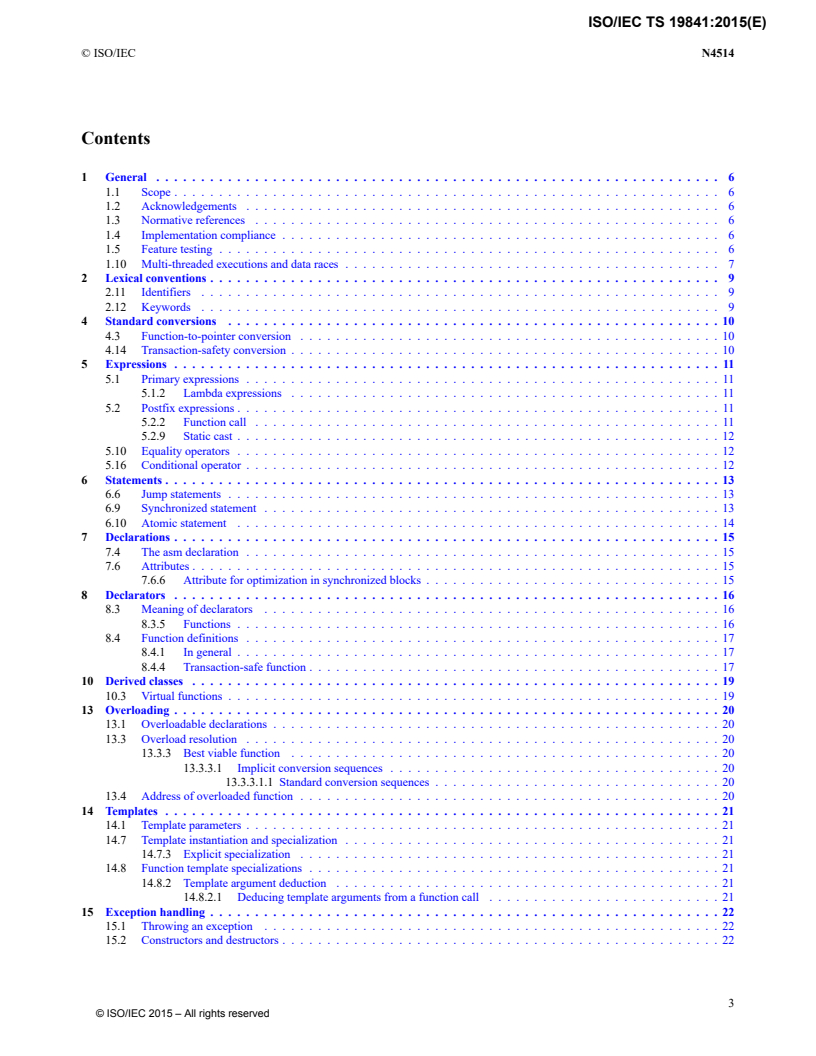
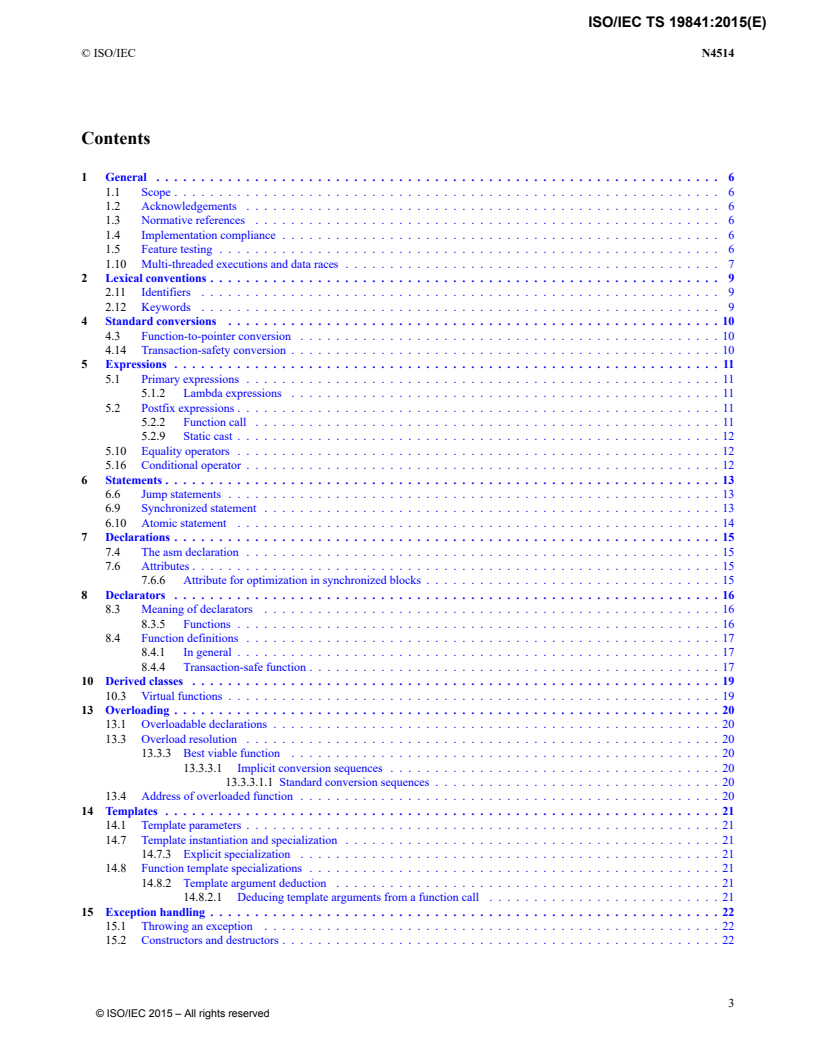
Contents
1 General . . . . . . . . . . . . . . . . . . . . . . . . . . . . . . . . . . . . . . . . . . . . . . . . . . . . . . . . . . . . . . . 6
1.1 Scope . . . . . . . . . . . . . . . . . . . . . . . . . . . . . . . . . . . . . . . . . . . . . . . . . . . . . . . . . . . . . 6
1.2 Acknowledgements . . . . . . . . . . . . . . . . . . . . . . . . . . . . . . . . . . . . . . . . . . . . . . . . . . . . . 6
1.3 Normative references . . . . . . . . . . . . . . . . . . . . . . . . . . . . . . . . . . . . . . . . . . . . . . . . . . . . 6
1.4 Implementation compliance . . . . . . . . . . . . . . . . . . . . . . . . . . . . . . . . . . . . . . . . . . . . . . . . . 6
1.5 Feature testing . . . . . . . . . . . . . . . . . . . . . . . . . . . . . . . . . . . . . . . . . . . . . . . . . . . . . . . . 6
1.10 Multi-threaded executions and data races . . . . . . . . . . . . . . . . . . . . . . . . . . . . . . . . . . . . . . . . . . 7
2 Lexical conventions . . . . . . . . . . . . . . . . . . . . . . . . . . . . . . . . . . . . . . . . . . . . . . . . . . . . . . . . . 9
2.11 Identifiers . . . . . . . . . . . . . . . . . . . . . . . . . . . . . . . . . . . . . . . . . . . . . . . . . . . . . . . . . . 9
2.12 Keywords . . . . . . . . . . . . . . . . . . . . . . . . . . . . . . . . . . . . . . . . . . . . . . . . . . . . . . . . . . 9
4 Standard conversions . . . . . . . . . . . . . . . . . . . . . . . . . . . . . . . . . . . . . . . . . . . . . . . . . . . . . . . 10
4.3 Function-to-pointer conversion . . . . . . . . . . . . . . . . . . . . . . . . . . . . . . . . . . . . . . . . . . . . . . . 10
4.14 Transaction-safety conversion . . . . . . . . . . . . . . . . . . . . . . . . . . . . . . . . . . . . . . . . . . . . . . . . 10
5 Expressions . . . . . . . . . . . . . . . . . . . . . . . . . . . . . . . . . . . . . . . . . . . . . . . . . . . . . . . . . . . . . 11
5.1 Primary expressions . . . . . . . . . . . . . . . . . . . . . . . . . . . . . . . . . . . . . . . . . . . . . . . . . . . . . 11
5.1.2 Lambda expressions . . . . . . . . . . . . . . . . . . . . . . . . . . . . . . . . . . . . . . . . . . . . . . . . 11
5.2 Postfix expressions . . . . . . . . . . . . . . . . . . . . . . . . . . . . . . . . . . . . . . . . . . . . . . . . . . . . . . 11
5.2.2 Function call . . . . . . . . . . . . . . . . . . . . . . . . . . . . . . . . . . . . . . . . . . . . . . . . . . . . 11
5.2.9 Static cast . . . . . . . . . . . . . . . . . . . . . . . . . . . . . . . . . . . . . . . . . . . . . . . . . . . . . . 12
5.10 Equality operators . . . . . . . . . . . . . . . . . . . . . . . . . . . . . . . . . . . . . . . . . . . . . . . . . . . . . . 12
5.16 Conditional operator . . . . . . . . . . . . . . . . . . . . . . . . . . . . . . . . . . . . . . . . . . . . . . . . . . . . . 12
6 Statements . . . . . . . . . . . . . . . . . . . . . . . . . . . . . . . . . . . . . . . . . . . . . . . . . . . . . . . . . . . . . . 13
6.6 Jump statements . . . . . . . . . . . . . . . . . . . . . . . . . . . . . . . . . . . . . . . . . . . . . . . . . . . . . . . 13
6.9 Synchronized statement . . . . . . . . . . . . . . . . . . . . . . . . . . . . . . . . . . . . . . . . . . . . . . . . . . . 13
6.10 Atomic statement . . . . . . . . . . . . . . . . . . . . . . . . . . . . . . . . . . . . . . . . . . . . . . . . . . . . . . 14
7 Declarations . . . . . . . . . . . . . . . . . . . . . . . . . . . . . . . . . . . . . . . . . . . . . . . . . . . . . . . . . . . . . 15
7.4 The asm declaration . . . . . . . . . . . . . . . . . . . . . . . . . . . . . . . . . . . . . . . . . . . . . . . . . . . . . 15
7.6 Attributes . . . . . . . . . . . . . . . . . . . . . . . . . . . . . . . . . . . . . . . . . . . . . . . . . . . . . . . . . . . 15
7.6.6 Attribute for optimization in synchronized blocks . . . . . . . . . . . . . . . . . . . . . . . . . . . . . . . . . 15
8 Declarators . . . . . . . . . . . . . . . . . . . . . . . . . . . . . . . . . . . . . . . . . . . . . . . . . . . . . . . . . . . . . 16
8.3 Meaning of declarators . . . . . . . . . . . . . . . . . . . . . . . . . . . . . . . . . . . . . . . . . . . . . . . . . . . 16
8.3.5 Functions . . . . . . . . . . . . . . . . . . . . . . . . . . . . . . . . . . . . . . . . . . . . . . . . . . . . . . 16
8.4 Function definitions . . . . . . . . . . . . . . . . . . . . . . . . . . . . . . . . . . . . . . . . . . . . . . . . . . . . . 17
8.4.1 In general . . . . . . . . . . . . . . . . . . . . . . . . . . . . . . . . . . . . . . . . . . . . . . . . . . . . . . 17
8.4.4 Transaction-safe function . . . . . . . . . . . . . . . . . . . . . . . . . . . . . . . . . . . . . . . . . . . . . . 17
10 Derived classes . . . . . . . . . . . . . . . . . . . . . . . . . . . . . . . . . . . . . . . . . . . . . . . . . . . . . . . . . . . 19
10.3 Virtual functions . . . . . . . . . . . . . . . . . . . . . . . . . . . . . . . . . . . . . . . . . . . . . . . . . . . . . . . 19
13 Overloading . . . . . . . . . . . . . . . . . . . . . . . . . . . . . . . . . . . . . . . . . . . . . . . . . . . . . . . . . . . . . 20
13.1 Overloadable declarations . . . . . . . . . . . . . . . . . . . . . . . . . . . . . . . . . . . . . . . . . . . . . . . . . . 20
13.3 Overload resolution . . . . . . . . . . . . . . . . . . . . . . . . . . . . . . . . . . . . . . . . . . . . . . . . . . . . . 20
13.3.3 Best viable function . . . . . . . . . . . . . . . . . . . . . . . . . . . . . . . . . . . . . . . . . . . . . . . . 20
13.3.3.1 Implicit conversion sequences . . . . . . . . . . . . . . . . . . . . . . . . . . . . . . . . . . . . . 20
13.3.3.1.1 Standard conversion sequences . . . . . . . . . . . . . . . . . . . . . . . . . . . . . . . . 20
13.4 Address of overloaded function . . . . . . . . . . . . . . . . . . . . . . . . . . . . . . . . . . . . . . . . . . . . . . . 20
14 Templates . . . . . . . . . . . . . . . . . . . . . . . . . . . . . . . . . . . . . . . . . . . . . . . . . . . . . . . . . . . . . . 21
14.1 Template parameters . . . . . . . . . . . . . . . . . . . . . . . . . . . . . . . . . . . . . . . . . . . . . . . . . . . . . 21
14.7 Template instantiation and specialization . . . . . . . . . . . . . . . . . . . . . . . . . . . . . . . . . . . . . . . . . . 21
14.7.3 Explicit specialization . . . . . . . . . . . . . . . . . . . . . . . . . . . . . . . . . . . . . . . . . . . . . . . 21
14.8 Function template specializations . . . . . . . . . . . . . . . . . . . . . . . . . . . . . . . . . . . . . . . . . . . . . . 21
14.8.2 Template argument deduction . . . . . . . . . . . . . . . . . . . . . . . . . . . . . . . . . . . . . . . . . . . 21
14.8.2.1 Deducing template arguments from a function call . . . . . . . . . . . . . . . . . . . . . . . . . . 21
15 Exception handling . . . . . . . . . . . . . . . . . . . . . . . . . . . . . . . . . . . . . . . . . . . . . . . . . . . . . . . . . 22
15.1 Throwing an exception . . . . . . . . . . . . . . . . . . . . . . . . . . . . . . . . . . . . . . . . . . . . . . . . . . . 22
15.2 Constructors and destructors . . . . . . . . . . . . . . . . . . . . . . . . . . . . . . . . . . . . . . . . . . . . . . . . . 22
© ISO/IEC 2015 – All rights reserved
© ISO/IEC N4514
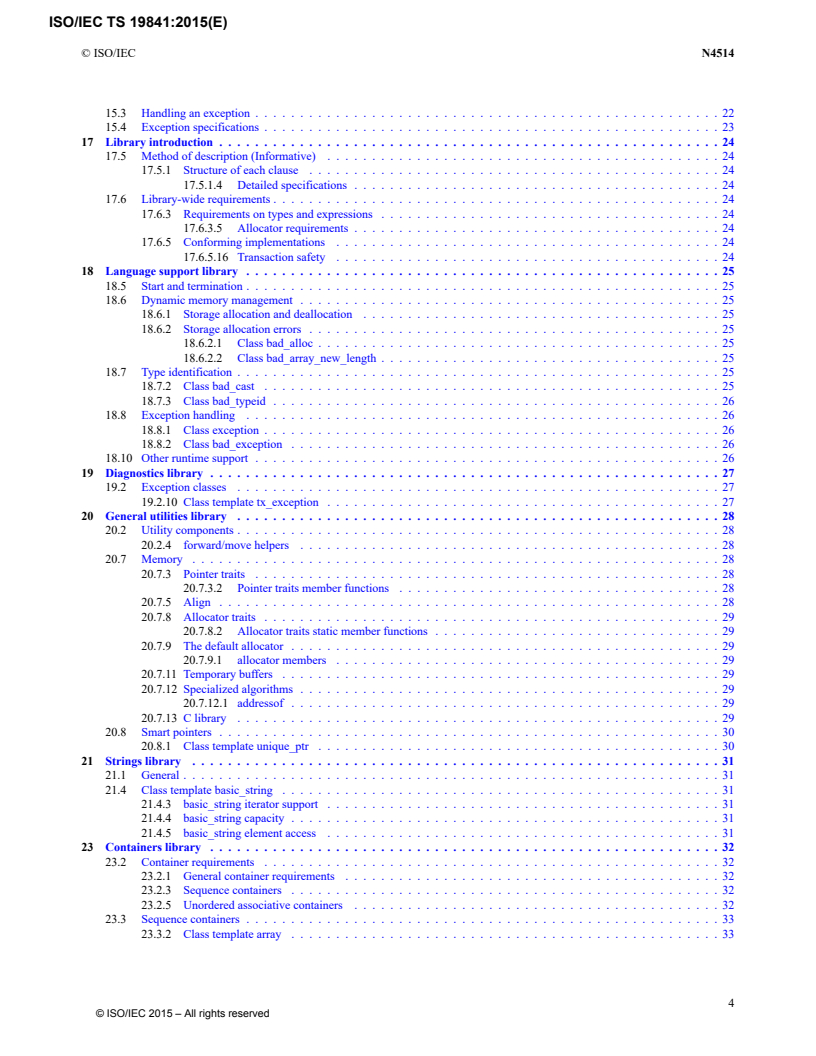
15.3 Handling an exception . . . . . . . . . . . . . . . . . . . . . . . . . . . . . . . . . . . . . . . . . . . . . . . . . . . . 22
15.4 Exception specifications . . . . . . . . . . . . . . . . . . . . . . . . . . . . . . . . . . . . . . . . . . . . . . . . . . . 23
17 Library introduction . . . . . . . . . . . . . . . . . . . . . . . . . . . . . . . . . . . . . . . . . . . . . . . . . . . . . . . . 24
17.5 Method of description (Informative) . . . . . . . . . . . . . . . . . . . . . . . . . . . . . . . . . . . . . . . . . . . . 24
17.5.1 Structure of each clause . . . . . . . . . . . . . . . . . . . . . . . . . . . . . . . . . . . . . . . . . . . . . . 24
17.5.1.4 Detailed specifications . . . . . . . . . . . . . . . . . . . . . . . . . . . . . . . . . . . . . . . . . 24
17.6 Library-wide requirements . . . . . . . . . . . . . . . . . . . . . . . . . . . . . . . . . . . . . . . . . . . . . . . . . . 24
17.6.3 Requirements on types and expressions . . . . . . . . . . . . . . . . . . . . . . . . . . . . . . . . . . . . . . 24
17.6.3.5 Allocator requirements . . . . . . . . . . . . . . . . . . . . . . . . . . . . . . . . . . . . . . . . . 24
17.6.5 Conforming implementations . . . . . . . . . . . . . . . . . . . . . . . . . . . . . . . . . . . . . . . . . . . 24
17.6.5.16 Transaction safety . . . . . . . . . . . . . . . . . . . . . . . . . . . . . . . . . . . . . . . . . . . 24
18 Language support library . . . . . . . . . . . . . . . . . . . . . . . . . . . . . . . . . . . . . . . . . . . . . . . . . . . . . 25
18.5 Start and termination . . . . . . . . . . . . . . . . . . . . . . . . . . . . . . . . . . . . . . . . . . . . . . . . . . . . . 25
18.6 Dynamic memory management . . . . . . . . . . . . . . . . . . . . . . . . . . . . . . . . . . . . . . . . . . . . . . . 25
18.6.1 Storage allocation and deallocation . . . . . . . . . . . . . . . . . . . . . . . . . . . . . . . . . . . . . . . . 25
18.6.2 Storage allocation errors . . . . . . . . . . . . . . . . . . . . . . . . . . . . . . . . . . . . . . . . . . . . . . 25
18.6.2.1 Class bad_alloc . . . . . . . . . . . . . . . . . . . . . . . . . . . . . . . . . . . . . . . . . . . . . 25
18.6.2.2 Class bad_array_new_length . . . . . . . . . . . . . . . . . . . . . . . . . . . . . . . . . . . . . . 25
18.7 Type identification . . . . . . . . . . . . . . . . . . . . . . . . . . . . . . . . . . . . . . . . . . . . . . . . . . . . . . 25
18.7.2 Class bad_cast . . . . . . . . . . . . . . . . . . . . . . . . . . . . . . . . . . . . . . . . . . . . . . . . . . . 25
18.7.3 Class bad_typeid . . . . . . . . . . . . . . . . . . . . . . . . . . . . . . . . . . . . . . . . . . . . . . . . . . 26
18.8 Exception handling . . . . . . . . . . . . . . . . . . . . . . . . . . . . . . . . . . . . . . . . . . . . . . . . . . . . . 26
18.8.1 Class exception . . . . . . . . . . . . . . . . . . . . . . . . . . . . . . . . . . . . . . . . . . . . . . . . . . . 26
18.8.2 Class bad_exception . . . . . . . . . . . . . . . . . . . . . . . . . . . . . . . . . . . . . . . . . . . . . . . . 26
18.10 Other runtime support . . . . . . . . . . . . . . . . . . . . . . . . . . . . . . . . . . . . . . . . . . . . . . . . . . . . 26
19 Diagnostics library . . . . . . . . . . . . . . . . . . . . . . . . . . . . . . . . . . . . . . . . . . . . . . . . . . . . . . . . . 27
19.2 Exception classes . . . . . . . . . . . . . . . . . . . . . . . . . . . . . . . . . . . . . . . . . . . . . . . . . . . . . . 27
19.2.10 Class template tx_exception . . . . . . . . . . . . . . . . . . . . . . . . . . . . . . . . . . . . . . . . . . . . 27
20 General utilities library . . . . . . . . . . . . . . . . . . . . . . . . . . . . . . . . . . . . . . . . . . . . . . . . . . . . . . 28
20.2 Utility components . . . . . . . . . . . . . . . . . . . . . . . . . . . . . . . . . . . . . . . . . . . . . . . . . . . . . . 28
20.2.4 forward/move helpers . . . . . . . . . . . . . . . . . . . . . . . . . . . . . . . . . . . . . . . . . . . . . . . 28
20.7 Memory . . . . . . . . . . . . . . . . . . . . . . . . . . . . . . . . . . . . . . . . . . . . . . . . . . . . . . . . . . . 28
20.7.3 Pointer traits . . . . . . . . . . . . . . . . . . . . . . . . . . . . . . . . . . . . . . . . . . . . . . . . . . . . 28
20.7.3.2 Pointer traits member functions . . . . . . . . . . . . . . . . . . . . . . . . . . . . . . . . . . . . 28
20.7.5 Align . . . . . . . . . . . . . . . . . . . . . . . . . . . . . . . . . . . . . . . . . . . . . . . . . . . . . . . . 28
20.7.8 Allocator traits . . . . . . . . . . . . . . . . . . . . . . . . . . . . . . . . . . . . . . . . . . . . . . . . . . . 29
20.7.8.2 Allocator traits static member functions . . . . . . . . . . . . . . . . . . . . . . . . . . . . . . . . 29
20.7.9 The default allocator . . . . . . . . . . . . . . . . . . . . . . . . . . . . . . . . . . . . . . . . . . . . . . . . 29
20.7.9.1 allocator members . . . . . . . . . . . . . . . . . . . . . . . . . . . . . . . . . . . . . . . . . . . 29
20.7.11 Temporary buffers . . . . . . . . . . . . . . . . . . . . . . . . . . . . . . . . . . . . . . . . . . . . . . . . . 29
20.7.12 Specialized algorithms . . . . . . . . . . . . . . . . . . . . . . . . . . . . . . . . . . . . . . . . . . . . . . . 29
20.7.12.1 addressof . . . . . . . . . . . . . . . . . . . . . . . . . . . . . . . . . . . . . . . . . . . . . . . . 29
20.7.13 C library . . . . . . . . . . . . . . . . . . . . . . . . . . . . . . . . . . . . . . . . . . . . . . . . . . . . . . 29
20.8 Smart pointers . . . . . . . . . . . . . . . . . . . . . . . . . . . . . . . . . . . . . . . . . . . . . . . . . . . . . . . . 30
20.8.1 Class template unique_ptr . . . . . . . . . . . . . . . . . . . . . . . . . . . . . . . . . . . . . . . . . . . . . 30
21 Strings library . . . . . . . . . . . . . . . . . . . . . . . . . . . . . . . . . . . . . . . . . . . . . . . . . . . . . . . . . . . 31
21.1 General . . . . . . . . . . . . . . . . . . . . . . . . . . . . . . . . . . . . . . . . . . . . . . . . . . . . . . . . . . . . 31
21.4 Class template basic_string . . . . . . . . . . . . . . . . . . . . . . . . . . . . . . . . . . . . . . . . . . . . . . . . . 31
21.4.3 basic_string iterator support . . . . . . . . . . . . . . . . . . . . . . . . . . . . . . . . . . . . . . . . . . . . 31
21.4.4 basic_string capacity . . . . . . . . . . . . . . . . . . . . . . . . . . . . . . . . . . . . . . . . . . . . . . . . 31
21.4.5 basic_string element access . . . . . . . . . . . . . . . . . . . . . . . . . . . . . . . . . . . . . . . . . . . . 31
23 Containers library . . . . . . . . . . . . . . . . . . . . . . . . . . . . . . . . . . . . . . . . . . . . . . . . . . . . . . . . . 32
23.2 Container requirements . . . . . . . . . . . . . . . . . . . . . . . . . . . . . . . . . . . . . . . . . . . . . . . . . . . 32
23.2.1 General container requirements . . . . . . . . . . . . . . . . . . . . . . . . . . . . . . . . . . . . . . . . . . 32
23.2.3 Sequence containers . . . . . . . . . . . . . . . . . . . . . . . . . . . . . . . . . . . . . . . . . . . . . . . . 32
23.2.5 Unordered associative containers . . . . . . . . . . . . . . . . . . . . . . . . . . . . . . . . . . . . . . . . . 32
23.3 Sequence containers . . . . . . . . . . . . . . . . . . . . . . . . . . . . . . . . . . . . . . . . . . . . . . . . . . . . . 33
23.3.2 Class template array . . . . . . . . . . . . . . . . . . . . . . . . . . . . . . . . . . . . . . . . . . . . . . . . 33
© ISO/IEC 2015 – All rights reserved
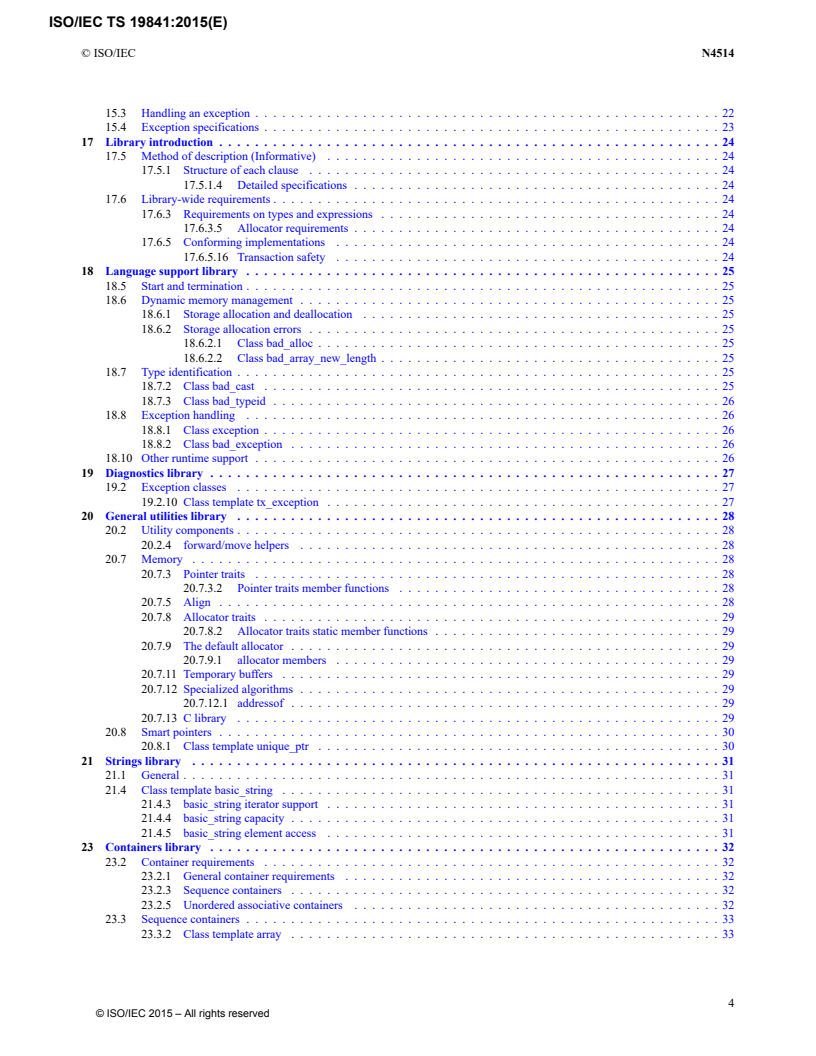
© ISO/IEC N4514
23.3.2.1 Class template array overview . . . . . . . . . . . . . . . . . . . . . . . . . . . . . . . . . . . . . 33
23.3.3 Class template deque . . . . . . . . . . . . . . . . . . . . . . . . . . . . . . . . . . . . . . . . . . . . . . . . 33
23.3.3.1 Class template deque overview . . . . . . . . . . . . . . . . . . . . . . . . . . . . . . . . . . . . . 33
23.3.4 Class template forward_list . . . . . . . . . . . . . . . . . . . . . . . . . . . . . . . . . . . . . . . . . . . . . 33
23.3.4.1 Class template forward_list overview . . . . . . . . . . . . . . . . . . . . . . . . . . . . . . . . . 33
23.3.4.6 forward_list operations . . . . . . . . . . . . . . . . . . . . . . . . . . . . . . . . . . . . . . . . . 33
23.3.5 Class template list . . . . . . . . . . . . . . . . . . . . . . . . . . . . . . . . . . . . . . . . . . . . . . . . . 33
23.3.5.1 Class template list overview . . . . . . . . . . . . . . . . . . . . . . . . . . . . . . . . . . . . . . 33
23.3.5.5 list operations . . . . . . . . . . . . . . . . . . . . . . . . . . . . . . . . . . . . . . . . . . . . . . 33
23.3.6 Class template vector . . . . . . . . . . . . . . . . . . . . . . . . . . . . . . . . . . . . . . . . . . . . . . . . 33
23.3.6.1 Class template vector overview . . . . . . . . . . . . . . . . . . . . . . . . . . . . . . . . . . . . 33
23.3.6.3 vector capacity . . . . . . . . . . . . . . . . . . . . . . . . . . . . . . . . . . . . . . . . . . . . . 34
23.3.6.4 vector data . . . . . . . . . . . . . . . . . . . . . . . . . . . . . . . . . . . . . . . . . . . . . . . 34
23.3.7 Class vector . . . . . . . . . . . . . . . . . . . . . . . . . . . . . . . . . . . . . . . . . . . . . . . . . 34
23.4 Associative containers . . . . . . . . . . . . . . . . . . . . . . . . . . . . . . . . . . . . . . . . . . . . . . . . . . . . 34
23.4.4 Class template map . . . . . . . . . . . . . . . . . . . . . . . . . . . . . . . . . . . . . . . . . . . . . . . . . 34
23.4.4.1 Class template map overview . . . . . . . . . . . . . . . . . . . . . . . . . . . . . . . . . . . . . 34
23.4.5 Class template multimap . . . . . . . . . . . . . . . . . . . . . . . . . . . . . . . . . . . . . . . . . . . . . . 34
23.4.5.1 Class template multimap overview . . . . . . . . . . . . . . . . . . . . . . . . . . . . . . . . . . . 34
23.4.6 Class template set . . . . . . . . . . . . . . . . . . . . . . . . . . . . . . . . . . . . . . . . . . . . . . . . . . 34
23.4.6.1 Class template set overview . . . . . . . . . . . . . . . . . . . . . . . . . . . . . . . . . . . . . . 34
23.4.7 Class template multiset . . . . . . . . . . . . . . . . . . . . . . . . . . . . . . . . . . . . . . . . . . . . . . . 34
23.4.7.1 Class template multiset overview . . . . . . . . . . . . . . . . . . . . . . . . . . . . . . . . . . . 34
23.5 Unordered associative containers . . . . . . . . . . . . . . . . . . . . . . . . . . . . . . . . . . . . . . . . . . . . . . 35
23.5.4 Class template unordered_map . . . . . . . . . . . . . . . . . . . . . . . . . . . . . . . . . . . . . . . . . . . 35
23.5.4.1 Class template unordered_map overview . . . . . . . . . . . . . . . . . . . . . . . . . . . . . . . 35
23.5.5 Class template unordered_multimap overview . . . . . . . . . . . . . . . . . . . . . . . . . . . . . . . . . . . 35
23.5.5.1 Class template unordered_multimap overview . . . . . . . . . . . . . . . . . . . . . . . . . . . . . 35
23.5.6 Class template unordered_set . . . . . . . . . . . . . . . . . . . . . . . . . . . . . . . . . . . . . . . . . . . 35
23.5.6.1 Class template unordered_set overview . . . . . . . . . . . . . . . . . . . . . . . . . . . . . . . . 35
23.5.7 Class template unordered_multiset . . . . . . . . . . . . . . . . . . . . . . . . . . . . . . . . . . . . . . . . . 35
23.5.7.1 Class template unordered_multiset overview . . . . . . . . . . . . . . . . . . . . . . . . . . . . . 35
23.6 Container adaptors . . . . . . . . . . . . . . . . . . . . . . . . . . . . . . . . . . . . . . . . . . . . . . . . . . . . . . 35
23.6.1 In general . . . . . . . . . . . . . . . . . . . . . . . . . . . . . . . . . . . . . . . . . . . . . . . . . . . . . . 35
24 Iterators library . . . . . . . . . . . . . . . . . . . . . . . . . . . . . . . . . . . . . . . . . . . . . . . . . . . . . . . . . . 36
24.4 Iterator primitives . . . . . . . . . . . . . . . . . . . . . . . . . . . . . . . . . . . . . . . . . . . . . . . . . . . . . . 36
24.4.4 Iterator operations . . . . . . . . . . . . . . . . . . . . . . . . . . . . . . . . . . . . . . . . . . . . . . . . . 36
24.5 Iterator adaptors . . . . . . . . . . . . . . . . . . . . . . . . . . . . . . . . . . . . . . . . . . . . . . . . . . . . . . . 36
24.5.1 Reverse iterators . . . . . . . . . . . . . . . . . . . . . . . . . . . . . . . . . . . . . . . . . . . . . . . . . . 36
24.5.2 Insert iterators . . . . . . . . . . . . . . . . . . . . . . . . . . . . . . . . . . . . . . . . . . . . . . . . . . . 36
24.5.3 Move iterators . . . . . . . . . . . . . . . . . . . . . . . . . . . . . . . . . . . . . . . . . . . . . . . . . . . 36
24.7 range access . . . . . . . . . . . . . . . . . . . . . . . . . . . . . . . . . . . . . . . . . . . . . . . . . . . . . . . . . 36
25 Algorithms library . . . . . . . . . . . . . . . . . . . . . . . . . . . . . . . . . . . . . . . . . . . . . . . . . . . . . . . . . 37
25.1 General . . . . . . . . . . . . . . . . . . . . . . . . . . . . . . . . . . . . . . . . . . . . . . . . . . . . . . . . . . . . 37
26 Numerics library . . . . . . . . . . . . . . . . . . . . . . . . . . . . . . . . . . . . . . . . . . . . . . . . . . . . . . . . . . 38
26.7 Generalized numeric operations . . . . . . . . . . . . . . . . . . . . . . . . . . . . . . . . . . . . . . . . . . . . . . . 38
26.7.1 Header synopsis . . . . . . . . . . . . . . . . . . . . . . . . . . . . . . . . . . . . . . . . . . . . 38
26.8 C library . . . . . . . . . . . . . . . . . . . . . . . . . . . . . . . . . . . . . . . . . . . . . . . . . . . . . . . . . . . 38
© ISO/IEC 2015 – All rights reserved
© ISO/IEC N4514
Technical Specification for C++
Extensions for Transactional Memory
1 General [intro]
1.1 Scope [general.scope]
This Technical Specification describes extensions to the C++ Programming Language (1.3) that enable the specification of Transactional
Memory. These extensions include new syntactic forms and modifications to existing language and library.
The International Standard, ISO/IEC 14882, provides important context and specification for this Technical Specification. This
document is written as a set of changes against that specification. Instructions to modify or add paragraphs are written as explicit
instructions. Modifications made directly to existing text from the International Standard use green to represent added text and
strikethrough to represent deleted text.
This Technical Specification is non-normative. Some of the functionality described by this Technical Specification may be considered for
standardization in a future version of C++, but it is not currently part of any C++ standard. Some of the functionality in this Technical
Specification may never be standardized, and other functionality may be standardized in a substantially changed form.
The goal of this Technical Specification is to build widespread existing practice for Transactional Memory. It gives advice on extensions
to those vendors who wish to provide them.
1.2 Acknowledgements [general.ack]
This work is the result of collaboration of researchers in industry and academia, including the Transactional Memory Specification
Drafting Group and the follow-on WG21 study group SG5. We wish to thank people who made valuable contributions within and outside
these groups, including Hans Boehm, Justin Gottschlich, Victor Luchangco, Jens Maurer, Paul McKenney, Maged Michael, Mark Moir,
Torvald Riegel, Michael Scott, Tatiana Shpeisman, Michael Spear, Michael Wong, and many others not named here who contributed to
the discussion.
1.3 Normative references [general.references]
The following referenced document is indispensable for the application of this document. For dated references, only the edition cited
applies. For undated references, the latest edition of the referenced document (including any amendments) applies.
— ISO/IEC 14882:2014, Programming Languages - C++
ISO/IEC 14882:2014 is hereinafter called the C++ Standard. Beginning with section 1.10 below, all clause and section numbers, titles,
and symbolic references in [brackets] refer to the corresponding elements of the C++ Standard. Sections 1.1 through 1.5 of this Technical
Specification are introductory material and are unrelated to the similarly-numbered sections of the C++ Standard.
1.4 Implementation compliance [intro.compliance]
Conformance requirements for this specification are the same as those defined in section 1.4 [intro.compliance] of the C++ Standard.
[ Note: Conformance is defined in terms of the behavior of programs. — end note ]
1.5 Feature testing [intro.features]
An implementation that provides support for this Technical Specification shall define the feature test macro in Table 1.
Table 1 -- Feature Test Macro
Name Value Header
__cpp_transactional_memory 201505 predeclared
§ 1.5 6
© ISO/IEC 2015 – All rights reserved
© ISO/IEC N4514
1.10 Multi-threaded executions and data races [intro.multithread]
Add a paragraph 9 to section 1.10 [intro.multithread] after paragraph 8:
The start and the end of each synchronized block or atomic block is a full-expression (1.9 [intro.execution]). A
synchronized block (6.9 [stmt.sync]) or atomic block (6.10 [stmt.tx]) that is not dynamically nested within another
synchronized block or atomic block is called an outer block. [ Note: Due to syntactic constraints, blocks cannot
overlap unless one is nested within the other. ] There is a global total order of execution for all outer blocks. If, in
that total order, T1 is ordered before T2,
— no evaluation in T2 happens before any evaluation in T1 and
— if T1 and T2 perform conflicting expression evaluations, then the end of T1 synchronizes with the start of
T2.
§ 1.10 7
© ISO/IEC 2015 – All rights reserved
© ISO/IEC N4514
Change in 1.10 [intro.multithread] paragraph 10:
Synchronized and atomic blocks as well as certain Certain library calls synchronize with other synchronized blocks,
atomic blocks, and library calls performed by another thread.
Change in 1.10 [intro.multithread] paragraph 21:
The execution of a program contains a data race if it contains two conflicting actions in different threads, at least one of
which is not atomic, and neither happens before the other. Any such data race results in undefined behavior. [ Note: It can be
shown that programs that correctly use mutexes, synchronized and atomic blocks, and memory_order_seq_cst operations
to prevent all data races and use no other synchronization operations behave as if the operations executed by their constituent
threads were simply interleaved, with each value computation of an object being taken from the last side effect on that object
in that interleaving. This is normally referred to as "sequential consistency". However, this applies only to data-race-free
programs, and data-race-free programs cannot observe most program transformations that do not change single-threaded
program semantics. In fact, most single-threaded program transformations continue to be allowed, since any program that
behaves differently as a result must perform an undefined operation. -- end note ]
Add a new paragraph 22 after 1.10 [intro.multithread] paragraph 21:
[ Note: Due to the constraints on transaction safety (8.4.4 [dcl.fct.def.tx]), the following holds for a data-race-free
program: If the start of an atomic block T is sequenced before an evaluation A, A is sequenced before the end of
T, and A inter-thread happens before some evaluation B, then the end of T inter-thread happens before B. If an
evaluation C inter-thread happens before that evaluation A, then C inter-thread happens before the start of T. These
properties in turn imply that in any simple interleaved (sequentially consistent) execution, the operations of each
atomic block appear to be contiguous in the interleaving. -- end note ]
§ 1.10 8
© ISO/IEC 2015 – All rights reserved
© ISO/IEC N4514
2 Lexical conventions [lex]
2.11 Identifiers [lex.name]
In section 2.11 [lex.name] paragraph 2, add transaction_safe and transaction_safe_dynamic to the table.
2.12 Keywords [lex.key]
In section 2.12 [lex.key] paragraph 1, add the keywords synchronized, atomic_noexcept, atomic_cancel, and atomic_commit to the
table.
§ 2.12 9
© ISO/IEC 2015 – All rights reserved
© ISO/IEC N4514
4 Standard conversions [conv]
4.3 Function-to-pointer conversion [conv.func]
Change in section 4.3 [conv.func] paragraph 1:
An lvalue of function type T can be converted to a prvalue of type "pointer to T." T". An lvalue of type "transaction-safe
function" can be converted to a prvalue of type "pointer to function". The result is a pointer to the function. [ Footnote:
... ]
4.14 Transaction-safety conversion [conv.tx]
Add a new section 4.14 [conv.tx] paragraph 1:
4.14 [conv.tx] Transaction-safety conversion
A prvalue of type "pointer to transaction_safe function" can be converted to a prvalue of type "pointer to
function". The result is a pointer to the function. A prvalue of type "pointer to member of type transaction_safe
function" can be converted to a prvalue of type "pointer to member of type function". The result points to the
member function.
§ 4.14 10
© ISO/IEC 2015 – All rights reserved
© ISO/IEC N4514
5 Expressions [expr]
Change in 5 [expr] paragraph 13:
[ Note: . ] The composite pointer type of two operands p1 and p2 having types T1 and T2, respectively, where at least one
is a pointer or pointer to member type or std::nullptr_t, is:
— .
— if T1 or T2 is "pointer to cv1 void" and the other type is "pointer to cv2 T", "pointer to cv12 void", where cv12
is the union of cv1 and cv2 ;
— if T1 is "pointer to transaction_safe function" and T2 is "pointer to function", where the function types
are otherwise the same, T2, and vice versa;
— .
5.1 Primary expressions [expr.prim]
5.1.2 Lambda expressions [expr.prim.lambda]
Change in 5.1.2 [expr.prim.lambda] paragraph 1:
lambda-declarator:
( parameter-declaration-clause ) mutable transaction_safe
opt opt
exception-specification attribute-specifier-seq trailing-return-type
opt opt opt
Change in 5.1.2 [expr.prim.lambda] paragraph 5:
This function call operator or operator template is declared const (9.3.1) if and only if the lambda-expression's parameter-
declaration-clause is not followed bymutable. It is neither virtual nor declared volatile. It is declaredtransaction_safe if
and only if the lambda-expression's parameter-declaration-clause is followed bytransaction_safe or, in a non-generic
lambda-expression, it has a transaction-safe function definition (8.4.4 [dcl.fct.def.tx]). Any exception-specification
specified on a lambda-expression applies to the corresponding function call operator or operator template. .
Change in 5.1.2 [expr.prim.lambda] paragraph 6:
The closure type for a non-generic lambda-expression with no lambda-capture has a public non-virtual non-explicit const
transaction_safe conversion function to pointer to function with C++ language linkage (7.5 [dcl.link]) having the same
parameter and return types as the closure type's function call operator. That pointer is a pointer to transaction-safe
function if the function call operator is transaction-safe.
5.2 Postfix expressions [expr.post]
5.2.2 Function call [expr.call]
Add at the end of 5.2.2 [expr.call] paragraph 1:
... [ Note: ... ] A call to a virtual function that is evaluated within an atomic block (6.10 [stmt.tx]) results in
undefined behavior if the virtual function is declared transaction_safe_dynamic and the final overrider is not
declared transaction_safe.
Add paragraph 10 after 5.2.2 [expr.call] paragraph 9:
Recursive calls are permitted, except to the function named main (3.6.1)
Calling a function that is not transaction-safe (8.4.4 [dcl.fct.def.tx]) through a pointer to or lvalue of type
"transaction-safe function" has undefined behavior.
§ 5.2.2 11
© ISO/IEC 2015 – All rights reserved
© ISO/IEC N4514
5.2.9 Static cast [expr.static.cast]
Change in 5.2.9 [expr.static.cast] paragraph 7:
The inverse of any standard conversion sequence (Clause 4 [conv]) not containing an lvalue-to-rvalue (4.1 [conv.lval]),
array-to-pointer (4.2 [conv.array]), function-to-pointer (4.3), null pointer (4.10), null member pointer (4.11), or boolean
(4.12), or transaction-safety (4.14 [conv.tx]) conversion, can be performed explicitly using static_cast. .
5.10 Equality operators [expr.eq]
Change in 5.10 [expr.eq] paragraph 2:
If at least one of the operands is a pointer, pointer conversions (4.10 [conv.ptr]), transaction-safety conversions (4.14
[conv.tx]), and qualification conversions (4.4 [conv.qual]) are performed on both operands to bring them to their composite
pointer type (clause 5 [expr]). Comparing pointers is defined as follows: Before transaction-safety conversions, if one
pointer is of type "pointer to function", the other is of type "pointer to transaction_safe function", and both point
to the same function, it is unspecified whether the pointers compare equal. Otherwise, Two two pointers compare equal
if they are both null, both point to the same function, or both represent the same address (3.9.2), otherwise they compare
unequal.
5.16 Conditional operator [expr.cond]
Change in 5.16 [expr.cond] paragraph 6:
— One or both of the second and third operands have pointer type; pointer conversions (4.10 [conv.ptr]),
transaction-safety conversions (4.14 [conv.tx]), and qualification conversions (4.4 [conv.qual]) are performed
to bring them to their composite pointer type (5 [expr]). .
— .
§ 5.16 12
© ISO/IEC 2015 – All rights reserved
© ISO/IEC N4514
6 Statements [stmt.stmt]
In 6 [stmt.stmt] paragraph 1, add two productions to the grammar:
statement:
labeled-statement
attribute-specifier-seq expression-statement
opt
attribute-specifier-seq compound-statement
opt
attribute-specifier-seq selection-statement
opt
attribute-specifier-seq iteration-statement
opt
attribute-specifier-seq jump-statement
opt
declaration-statement
attribute-specifier-seq try-block
opt
synchronized-statement
atomic-statement
6.6 Jump statements [stmt.jump]
Add a new paragraph 3 at the end of 6.6 [stmt.jump]:
Transfer out of an atomic block other than via an exception executes the end of the atomic block. [ Note: Colloquially,
this is known as committing the transaction. For exceptions, see 15.2 [except.ctor]. -- end note ] Transfer out of a
synchronized block (including via an exception) executes the end of the synchronized block.
6.9 Synchronized statement [stmt.sync]
Add a new section 6.9 [stmt.sync] paragraph 1:
6.9 [stmt.sync] Synchronized statement
synchronized-statement:
synchronized compound-statement
A synchronized statement is also called a synchronized block.
The start of the synchronized block is immediately before the opening { of the compound-statement. The end of the
synchronized block is immediately after the closing } of the compound-statement.
A goto or switch statement shall not be used to transfer control into a synchronized block.
[ Example:
int f()
{
static int i = 0;
synchronized {
printf("before %d\n", i);
++i;
printf("after %d\n", i);
return i;
}
}
Each invocation of f (even when called from several threads simultaneously) retrieves a unique value (ignoring
overflow). The output is guaranteed to comprise consistent before/after pairs. -- end example ]
§ 6.9 13
© ISO/IEC 2015 – All rights reserved
© ISO/IEC N4514
6.10 Atomic statement [stmt.tx]
Add a new section 6.10 [stmt.tx] paragraph 1:
6.10 [stmt.tx] Atomic statement
atomic-statement:
atomic_noexcept compound-statement
atomic_cancel compound-statement
atomic_commit compound-statement
An atomic statement is also called an atomic block. The program is ill-formed if the compound-statement is a
transaction-unsafe statement (8.4.4 [dcl.fct.def.tx]).
The start of the atomic block is immediately before the opening { of the compound-statement. The end of the atomic
block is immediately after the closing } of the compound-statement. [ Note: Thus, variables with automatic storage
duration declared in the compound-statement are destroyed prior to reaching the end of the atomic block; see 6.6
[stmt.jump]. -- end note ]
A goto or switch statement shall not be used to
...
TECHNICAL ISO/IEC TS
SPECIFICATION 19841
First edition
2015-10-01
Technical Specification for C++
Extensions for Transactional Memory
Spécification technique pour les extensions C++ de la mémoire
transactionnelle
Reference number
©
ISO/IEC 2015
© ISO/IEC 2015, Published in Switzerland
�ll ���ht� �e�e��ed. �nle�� othe����e ��e����ed� no �a�t o� th�� ���l��at�on �a� �e �e��od��ed o� �t�l��ed othe����e �n an� �o��
o� �� an� �ean�� ele�t�on�� o� �e�han��al� �n�l�d�n� �hoto�o���n�� o� �o�t�n� on the �nte�net o� an �nt�anet� ��tho�t ���o�
���tten �e������on. Pe������on �an �e �e��e�ted ��o� e�the� ��� at the add�e�� �elo� o� ����� �e��e� �od� �n the �o�nt�� o�
the requester.
��� �o�����ht o����e
Ch. de Blandonnet 8 • CP 401
CH-1214 Vernier, Geneva, Switzerland
Tel. +41 22 749 01 11
Fax +41 22 749 09 47
�o�����ht���o.o��
www.iso.org
ii © ISO/IEC 2015 – All rights reserved
© ISO/IEC N4514
Contents
1 General . . . . . . . . . . . . . . . . . . . . . . . . . . . . . . . . . . . . . . . . . . . . . . . . . . . . . . . . . . . . . . . 6
1.1 Scope . . . . . . . . . . . . . . . . . . . . . . . . . . . . . . . . . . . . . . . . . . . . . . . . . . . . . . . . . . . . . 6
1.2 Acknowledgements . . . . . . . . . . . . . . . . . . . . . . . . . . . . . . . . . . . . . . . . . . . . . . . . . . . . . 6
1.3 Normative references . . . . . . . . . . . . . . . . . . . . . . . . . . . . . . . . . . . . . . . . . . . . . . . . . . . . 6
1.4 Implementation compliance . . . . . . . . . . . . . . . . . . . . . . . . . . . . . . . . . . . . . . . . . . . . . . . . . 6
1.5 Feature testing . . . . . . . . . . . . . . . . . . . . . . . . . . . . . . . . . . . . . . . . . . . . . . . . . . . . . . . . 6
1.10 Multi-threaded executions and data races . . . . . . . . . . . . . . . . . . . . . . . . . . . . . . . . . . . . . . . . . . 7
2 Lexical conventions . . . . . . . . . . . . . . . . . . . . . . . . . . . . . . . . . . . . . . . . . . . . . . . . . . . . . . . . . 9
2.11 Identifiers . . . . . . . . . . . . . . . . . . . . . . . . . . . . . . . . . . . . . . . . . . . . . . . . . . . . . . . . . . 9
2.12 Keywords . . . . . . . . . . . . . . . . . . . . . . . . . . . . . . . . . . . . . . . . . . . . . . . . . . . . . . . . . . 9
4 Standard conversions . . . . . . . . . . . . . . . . . . . . . . . . . . . . . . . . . . . . . . . . . . . . . . . . . . . . . . . 10
4.3 Function-to-pointer conversion . . . . . . . . . . . . . . . . . . . . . . . . . . . . . . . . . . . . . . . . . . . . . . . 10
4.14 Transaction-safety conversion . . . . . . . . . . . . . . . . . . . . . . . . . . . . . . . . . . . . . . . . . . . . . . . . 10
5 Expressions . . . . . . . . . . . . . . . . . . . . . . . . . . . . . . . . . . . . . . . . . . . . . . . . . . . . . . . . . . . . . 11
5.1 Primary expressions . . . . . . . . . . . . . . . . . . . . . . . . . . . . . . . . . . . . . . . . . . . . . . . . . . . . . 11
5.1.2 Lambda expressions . . . . . . . . . . . . . . . . . . . . . . . . . . . . . . . . . . . . . . . . . . . . . . . . 11
5.2 Postfix expressions . . . . . . . . . . . . . . . . . . . . . . . . . . . . . . . . . . . . . . . . . . . . . . . . . . . . . . 11
5.2.2 Function call . . . . . . . . . . . . . . . . . . . . . . . . . . . . . . . . . . . . . . . . . . . . . . . . . . . . 11
5.2.9 Static cast . . . . . . . . . . . . . . . . . . . . . . . . . . . . . . . . . . . . . . . . . . . . . . . . . . . . . . 12
5.10 Equality operators . . . . . . . . . . . . . . . . . . . . . . . . . . . . . . . . . . . . . . . . . . . . . . . . . . . . . . 12
5.16 Conditional operator . . . . . . . . . . . . . . . . . . . . . . . . . . . . . . . . . . . . . . . . . . . . . . . . . . . . . 12
6 Statements . . . . . . . . . . . . . . . . . . . . . . . . . . . . . . . . . . . . . . . . . . . . . . . . . . . . . . . . . . . . . . 13
6.6 Jump statements . . . . . . . . . . . . . . . . . . . . . . . . . . . . . . . . . . . . . . . . . . . . . . . . . . . . . . . 13
6.9 Synchronized statement . . . . . . . . . . . . . . . . . . . . . . . . . . . . . . . . . . . . . . . . . . . . . . . . . . . 13
6.10 Atomic statement . . . . . . . . . . . . . . . . . . . . . . . . . . . . . . . . . . . . . . . . . . . . . . . . . . . . . . 14
7 Declarations . . . . . . . . . . . . . . . . . . . . . . . . . . . . . . . . . . . . . . . . . . . . . . . . . . . . . . . . . . . . . 15
7.4 The asm declaration . . . . . . . . . . . . . . . . . . . . . . . . . . . . . . . . . . . . . . . . . . . . . . . . . . . . . 15
7.6 Attributes . . . . . . . . . . . . . . . . . . . . . . . . . . . . . . . . . . . . . . . . . . . . . . . . . . . . . . . . . . . 15
7.6.6 Attribute for optimization in synchronized blocks . . . . . . . . . . . . . . . . . . . . . . . . . . . . . . . . . 15
8 Declarators . . . . . . . . . . . . . . . . . . . . . . . . . . . . . . . . . . . . . . . . . . . . . . . . . . . . . . . . . . . . . 16
8.3 Meaning of declarators . . . . . . . . . . . . . . . . . . . . . . . . . . . . . . . . . . . . . . . . . . . . . . . . . . . 16
8.3.5 Functions . . . . . . . . . . . . . . . . . . . . . . . . . . . . . . . . . . . . . . . . . . . . . . . . . . . . . . 16
8.4 Function definitions . . . . . . . . . . . . . . . . . . . . . . . . . . . . . . . . . . . . . . . . . . . . . . . . . . . . . 17
8.4.1 In general . . . . . . . . . . . . . . . . . . . . . . . . . . . . . . . . . . . . . . . . . . . . . . . . . . . . . . 17
8.4.4 Transaction-safe function . . . . . . . . . . . . . . . . . . . . . . . . . . . . . . . . . . . . . . . . . . . . . . 17
10 Derived classes . . . . . . . . . . . . . . . . . . . . . . . . . . . . . . . . . . . . . . . . . . . . . . . . . . . . . . . . . . . 19
10.3 Virtual functions . . . . . . . . . . . . . . . . . . . . . . . . . . . . . . . . . . . . . . . . . . . . . . . . . . . . . . . 19
13 Overloading . . . . . . . . . . . . . . . . . . . . . . . . . . . . . . . . . . . . . . . . . . . . . . . . . . . . . . . . . . . . . 20
13.1 Overloadable declarations . . . . . . . . . . . . . . . . . . . . . . . . . . . . . . . . . . . . . . . . . . . . . . . . . . 20
13.3 Overload resolution . . . . . . . . . . . . . . . . . . . . . . . . . . . . . . . . . . . . . . . . . . . . . . . . . . . . . 20
13.3.3 Best viable function . . . . . . . . . . . . . . . . . . . . . . . . . . . . . . . . . . . . . . . . . . . . . . . . 20
13.3.3.1 Implicit conversion sequences . . . . . . . . . . . . . . . . . . . . . . . . . . . . . . . . . . . . . 20
13.3.3.1.1 Standard conversion sequences . . . . . . . . . . . . . . . . . . . . . . . . . . . . . . . . 20
13.4 Address of overloaded function . . . . . . . . . . . . . . . . . . . . . . . . . . . . . . . . . . . . . . . . . . . . . . . 20
14 Templates . . . . . . . . . . . . . . . . . . . . . . . . . . . . . . . . . . . . . . . . . . . . . . . . . . . . . . . . . . . . . . 21
14.1 Template parameters . . . . . . . . . . . . . . . . . . . . . . . . . . . . . . . . . . . . . . . . . . . . . . . . . . . . . 21
14.7 Template instantiation and specialization . . . . . . . . . . . . . . . . . . . . . . . . . . . . . . . . . . . . . . . . . . 21
14.7.3 Explicit specialization . . . . . . . . . . . . . . . . . . . . . . . . . . . . . . . . . . . . . . . . . . . . . . . 21
14.8 Function template specializations . . . . . . . . . . . . . . . . . . . . . . . . . . . . . . . . . . . . . . . . . . . . . . 21
14.8.2 Template argument deduction . . . . . . . . . . . . . . . . . . . . . . . . . . . . . . . . . . . . . . . . . . . 21
14.8.2.1 Deducing template arguments from a function call . . . . . . . . . . . . . . . . . . . . . . . . . . 21
15 Exception handling . . . . . . . . . . . . . . . . . . . . . . . . . . . . . . . . . . . . . . . . . . . . . . . . . . . . . . . . . 22
15.1 Throwing an exception . . . . . . . . . . . . . . . . . . . . . . . . . . . . . . . . . . . . . . . . . . . . . . . . . . . 22
15.2 Constructors and destructors . . . . . . . . . . . . . . . . . . . . . . . . . . . . . . . . . . . . . . . . . . . . . . . . . 22
© ISO/IEC 2015 – All rights reserved
© ISO/IEC N4514
15.3 Handling an exception . . . . . . . . . . . . . . . . . . . . . . . . . . . . . . . . . . . . . . . . . . . . . . . . . . . . 22
15.4 Exception specifications . . . . . . . . . . . . . . . . . . . . . . . . . . . . . . . . . . . . . . . . . . . . . . . . . . . 23
17 Library introduction . . . . . . . . . . . . . . . . . . . . . . . . . . . . . . . . . . . . . . . . . . . . . . . . . . . . . . . . 24
17.5 Method of description (Informative) . . . . . . . . . . . . . . . . . . . . . . . . . . . . . . . . . . . . . . . . . . . . 24
17.5.1 Structure of each clause . . . . . . . . . . . . . . . . . . . . . . . . . . . . . . . . . . . . . . . . . . . . . . 24
17.5.1.4 Detailed specifications . . . . . . . . . . . . . . . . . . . . . . . . . . . . . . . . . . . . . . . . . 24
17.6 Library-wide requirements . . . . . . . . . . . . . . . . . . . . . . . . . . . . . . . . . . . . . . . . . . . . . . . . . . 24
17.6.3 Requirements on types and expressions . . . . . . . . . . . . . . . . . . . . . . . . . . . . . . . . . . . . . . 24
17.6.3.5 Allocator requirements . . . . . . . . . . . . . . . . . . . . . . . . . . . . . . . . . . . . . . . . . 24
17.6.5 Conforming implementations . . . . . . . . . . . . . . . . . . . . . . . . . . . . . . . . . . . . . . . . . . . 24
17.6.5.16 Transaction safety . . . . . . . . . . . . . . . . . . . . . . . . . . . . . . . . . . . . . . . . . . . 24
18 Language support library . . . . . . . . . . . . . . . . . . . . . . . . . . . . . . . . . . . . . . . . . . . . . . . . . . . . . 25
18.5 Start and termination . . . . . . . . . . . . . . . . . . . . . . . . . . . . . . . . . . . . . . . . . . . . . . . . . . . . . 25
18.6 Dynamic memory management . . . . . . . . . . . . . . . . . . . . . . . . . . . . . . . . . . . . . . . . . . . . . . . 25
18.6.1 Storage allocation and deallocation . . . . . . . . . . . . . . . . . . . . . . . . . . . . . . . . . . . . . . . . 25
18.6.2 Storage allocation errors . . . . . . . . . . . . . . . . . . . . . . . . . . . . . . . . . . . . . . . . . . . . . . 25
18.6.2.1 Class bad_alloc . . . . . . . . . . . . . . . . . . . . . . . . . . . . . . . . . . . . . . . . . . . . . 25
18.6.2.2 Class bad_array_new_length . . . . . . . . . . . . . . . . . . . . . . . . . . . . . . . . . . . . . . 25
18.7 Type identification . . . . . . . . . . . . . . . . . . . . . . . . . . . . . . . . . . . . . . . . . . . . . . . . . . . . . . 25
18.7.2 Class bad_cast . . . . . . . . . . . . . . . . . . . . . . . . . . . . . . . . . . . . . . . . . . . . . . . . . . . 25
18.7.3 Class bad_typeid . . . . . . . . . . . . . . . . . . . . . . . . . . . . . . . . . . . . . . . . . . . . . . . . . . 26
18.8 Exception handling . . . . . . . . . . . . . . . . . . . . . . . . . . . . . . . . . . . . . . . . . . . . . . . . . . . . . 26
18.8.1 Class exception . . . . . . . . . . . . . . . . . . . . . . . . . . . . . . . . . . . . . . . . . . . . . . . . . . . 26
18.8.2 Class bad_exception . . . . . . . . . . . . . . . . . . . . . . . . . . . . . . . . . . . . . . . . . . . . . . . . 26
18.10 Other runtime support . . . . . . . . . . . . . . . . . . . . . . . . . . . . . . . . . . . . . . . . . . . . . . . . . . . . 26
19 Diagnostics library . . . . . . . . . . . . . . . . . . . . . . . . . . . . . . . . . . . . . . . . . . . . . . . . . . . . . . . . . 27
19.2 Exception classes . . . . . . . . . . . . . . . . . . . . . . . . . . . . . . . . . . . . . . . . . . . . . . . . . . . . . . 27
19.2.10 Class template tx_exception . . . . . . . . . . . . . . . . . . . . . . . . . . . . . . . . . . . . . . . . . . . . 27
20 General utilities library . . . . . . . . . . . . . . . . . . . . . . . . . . . . . . . . . . . . . . . . . . . . . . . . . . . . . . 28
20.2 Utility components . . . . . . . . . . . . . . . . . . . . . . . . . . . . . . . . . . . . . . . . . . . . . . . . . . . . . . 28
20.2.4 forward/move helpers . . . . . . . . . . . . . . . . . . . . . . . . . . . . . . . . . . . . . . . . . . . . . . . 28
20.7 Memory . . . . . . . . . . . . . . . . . . . . . . . . . . . . . . . . . . . . . . . . . . . . . . . . . . . . . . . . . . . 28
20.7.3 Pointer traits . . . . . . . . . . . . . . . . . . . . . . . . . . . . . . . . . . . . . . . . . . . . . . . . . . . . 28
20.7.3.2 Pointer traits member functions . . . . . . . . . . . . . . . . . . . . . . . . . . . . . . . . . . . . 28
20.7.5 Align . . . . . . . . . . . . . . . . . . . . . . . . . . . . . . . . . . . . . . . . . . . . . . . . . . . . . . . . 28
20.7.8 Allocator traits . . . . . . . . . . . . . . . . . . . . . . . . . . . . . . . . . . . . . . . . . . . . . . . . . . . 29
20.7.8.2 Allocator traits static member functions . . . . . . . . . . . . . . . . . . . . . . . . . . . . . . . . 29
20.7.9 The default allocator . . . . . . . . . . . . . . . . . . . . . . . . . . . . . . . . . . . . . . . . . . . . . . . . 29
20.7.9.1 allocator members . . . . . . . . . . . . . . . . . . . . . . . . . . . . . . . . . . . . . . . . . . . 29
20.7.11 Temporary buffers . . . . . . . . . . . . . . . . . . . . . . . . . . . . . . . . . . . . . . . . . . . . . . . . . 29
20.7.12 Specialized algorithms . . . . . . . . . . . . . . . . . . . . . . . . . . . . . . . . . . . . . . . . . . . . . . . 29
20.7.12.1 addressof . . . . . . . . . . . . . . . . . . . . . . . . . . . . . . . . . . . . . . . . . . . . . . . . 29
20.7.13 C library . . . . . . . . . . . . . . . . . . . . . . . . . . . . . . . . . . . . . . . . . . . . . . . . . . . . . . 29
20.8 Smart pointers . . . . . . . . . . . . . . . . . . . . . . . . . . . . . . . . . . . . . . . . . . . . . . . . . . . . . . . . 30
20.8.1 Class template unique_ptr . . . . . . . . . . . . . . . . . . . . . . . . . . . . . . . . . . . . . . . . . . . . . 30
21 Strings library . . . . . . . . . . . . . . . . . . . . . . . . . . . . . . . . . . . . . . . . . . . . . . . . . . . . . . . . . . . 31
21.1 General . . . . . . . . . . . . . . . . . . . . . . . . . . . . . . . . . . . . . . . . . . . . . . . . . . . . . . . . . . . . 31
21.4 Class template basic_string . . . . . . . . . . . . . . . . . . . . . . . . . . . . . . . . . . . . . . . . . . . . . . . . . 31
21.4.3 basic_string iterator support . . . . . . . . . . . . . . . . . . . . . . . . . . . . . . . . . . . . . . . . . . . . 31
21.4.4 basic_string capacity . . . . . . . . . . . . . . . . . . . . . . . . . . . . . . . . . . . . . . . . . . . . . . . . 31
21.4.5 basic_string element access . . . . . . . . . . . . . . . . . . . . . . . . . . . . . . . . . . . . . . . . . . . . 31
23 Containers library . . . . . . . . . . . . . . . . . . . . . . . . . . . . . . . . . . . . . . . . . . . . . . . . . . . . . . . . . 32
23.2 Container requirements . . . . . . . . . . . . . . . . . . . . . . . . . . . . . . . . . . . . . . . . . . . . . . . . . . . 32
23.2.1 General container requirements . . . . . . . . . . . . . . . . . . . . . . . . . . . . . . . . . . . . . . . . . . 32
23.2.3 Sequence containers . . . . . . . . . . . . . . . . . . . . . . . . . . . . . . . . . . . . . . . . . . . . . . . . 32
23.2.5 Unordered associative containers . . . . . . . . . . . . . . . . . . . . . . . . . . . . . . . . . . . . . . . . . 32
23.3 Sequence containers . . . . . . . . . . . . . . . . . . . . . . . . . . . . . . . . . . . . . . . . . . . . . . . . . . . . . 33
23.3.2 Class template array . . . . . . . . . . . . . . . . . . . . . . . . . . . . . . . . . . . . . . . . . . . . . . . . 33
© ISO/IEC 2015 – All rights reserved
© ISO/IEC N4514
23.3.2.1 Class template array overview . . . . . . . . . . . . . . . . . . . . . . . . . . . . . . . . . . . . . 33
23.3.3 Class template deque . . . . . . . . . . . . . . . . . . . . . . . . . . . . . . . . . . . . . . . . . . . . . . . . 33
23.3.3.1 Class template deque overview . . . . . . . . . . . . . . . . . . . . . . . . . . . . . . . . . . . . . 33
23.3.4 Class template forward_list . . . . . . . . . . . . . . . . . . . . . . . . . . . . . . . . . . . . . . . . . . . . . 33
23.3.4.1 Class template forward_list overview . . . . . . . . . . . . . . . . . . . . . . . . . . . . . . . . . 33
23.3.4.6 forward_list operations . . . . . . . . . . . . . . . . . . . . . . . . . . . . . . . . . . . . . . . . . 33
23.3.5 Class template list . . . . . . . . . . . . . . . . . . . . . . . . . . . . . . . . . . . . . . . . . . . . . . . . . 33
23.3.5.1 Class template list overview . . . . . . . . . . . . . . . . . . . . . . . . . . . . . . . . . . . . . . 33
23.3.5.5 list operations . . . . . . . . . . . . . . . . . . . . . . . . . . . . . . . . . . . . . . . . . . . . . . 33
23.3.6 Class template vector . . . . . . . . . . . . . . . . . . . . . . . . . . . . . . . . . . . . . . . . . . . . . . . . 33
23.3.6.1 Class template vector overview . . . . . . . . . . . . . . . . . . . . . . . . . . . . . . . . . . . . 33
23.3.6.3 vector capacity . . . . . . . . . . . . . . . . . . . . . . . . . . . . . . . . . . . . . . . . . . . . . 34
23.3.6.4 vector data . . . . . . . . . . . . . . . . . . . . . . . . . . . . . . . . . . . . . . . . . . . . . . . 34
23.3.7 Class vector . . . . . . . . . . . . . . . . . . . . . . . . . . . . . . . . . . . . . . . . . . . . . . . . . 34
23.4 Associative containers . . . . . . . . . . . . . . . . . . . . . . . . . . . . . . . . . . . . . . . . . . . . . . . . . . . . 34
23.4.4 Class template map . . . . . . . . . . . . . . . . . . . . . . . . . . . . . . . . . . . . . . . . . . . . . . . . . 34
23.4.4.1 Class template map overview . . . . . . . . . . . . . . . . . . . . . . . . . . . . . . . . . . . . . 34
23.4.5 Class template multimap . . . . . . . . . . . . . . . . . . . . . . . . . . . . . . . . . . . . . . . . . . . . . . 34
23.4.5.1 Class template multimap overview . . . . . . . . . . . . . . . . . . . . . . . . . . . . . . . . . . . 34
23.4.6 Class template set . . . . . . . . . . . . . . . . . . . . . . . . . . . . . . . . . . . . . . . . . . . . . . . . . . 34
23.4.6.1 Class template set overview . . . . . . . . . . . . . . . . . . . . . . . . . . . . . . . . . . . . . . 34
23.4.7 Class template multiset . . . . . . . . . . . . . . . . . . . . . . . . . . . . . . . . . . . . . . . . . . . . . . . 34
23.4.7.1 Class template multiset overview . . . . . . . . . . . . . . . . . . . . . . . . . . . . . . . . . . . 34
23.5 Unordered associative containers . . . . . . . . . . . . . . . . . . . . . . . . . . . . . . . . . . . . . . . . . . . . . . 35
23.5.4 Class template unordered_map . . . . . . . . . . . . . . . . . . . . . . . . . . . . . . . . . . . . . . . . . . . 35
23.5.4.1 Class template unordered_map overview . . . . . . . . . . . . . . . . . . . . . . . . . . . . . . . 35
23.5.5 Class template unordered_multimap overview . . . . . . . . . . . . . . . . . . . . . . . . . . . . . . . . . . . 35
23.5.5.1 Class template unordered_multimap overview . . . . . . . . . . . . . . . . . . . . . . . . . . . . . 35
23.5.6 Class template unordered_set . . . . . . . . . . . . . . . . . . . . . . . . . . . . . . . . . . . . . . . . . . . 35
23.5.6.1 Class template unordered_set overview . . . . . . . . . . . . . . . . . . . . . . . . . . . . . . . . 35
23.5.7 Class template unordered_multiset . . . . . . . . . . . . . . . . . . . . . . . . . . . . . . . . . . . . . . . . . 35
23.5.7.1 Class template unordered_multiset overview . . . . . . . . . . . . . . . . . . . . . . . . . . . . . 35
23.6 Container adaptors . . . . . . . . . . . . . . . . . . . . . . . . . . . . . . . . . . . . . . . . . . . . . . . . . . . . . . 35
23.6.1 In general . . . . . . . . . . . . . . . . . . . . . . . . . . . . . . . . . . . . . . . . . . . . . . . . . . . . . . 35
24 Iterators library . . . . . . . . . . . . . . . . . . . . . . . . . . . . . . . . . . . . . . . . . . . . . . . . . . . . . . . . . . 36
24.4 Iterator primitives . . . . . . . . . . . . . . . . . . . . . . . . . . . . . . . . . . . . . . . . . . . . . . . . . . . . . . 36
24.4.4 Iterator operations . . . . . . . . . . . . . . . . . . . . . . . . . . . . . . . . . . . . . . . . . . . . . . . . . 36
24.5 Iterator adaptors . . . . . . . . . . . . . . . . . . . . . . . . . . . . . . . . . . . . . . . . . . . . . . . . . . . . . . . 36
24.5.1 Reverse iterators . . . . . . . . . . . . . . . . . . . . . . . . . . . . . . . . . . . . . . . . . . . . . . . . . . 36
24.5.2 Insert iterators . . . . . . . . . . . . . . . . . . . . . . . . . . . . . . . . . . . . . . . . . . . . . . . . . . . 36
24.5.3 Move iterators . . . . . . . . . . . . . . . . . . . . . . . . . . . . . . . . . . . . . . . . . . . . . . . . . . . 36
24.7 range access . . . . . . . . . . . . . . . . . . . . . . . . . . . . . . . . . . . . . . . . . . . . . . . . . . . . . . . . . 36
25 Algorithms library . . . . . . . . . . . . . . . . . . . . . . . . . . . . . . . . . . . . . . . . . . . . . . . . . . . . . . . . . 37
25.1 General . . . . . . . . . . . . . . . . . . . . . . . . . . . . . . . . . . . . . . . . . . . . . . . . . . . . . . . . . . . . 37
26 Numerics library . . . . . . . . . . . . . . . . . . . . . . . . . . . . . . . . . . . . . . . . . . . . . . . . . . . . . . . . . . 38
26.7 Generalized numeric operations . . . . . . . . . . . . . . . . . . . . . . . . . . . . . . . . . . . . . . . . . . . . . . . 38
26.7.1 Header synopsis . . . . . . . . . . . . . . . . . . . . . . . . . . . . . . . . . . . . . . . . . . . . 38
26.8 C library . . . . . . . . . . . . . . . . . . . . . . . . . . . . . . . . . . . . . . . . . . . . . . . . . . . . . . . . . . . 38
© ISO/IEC 2015 – All rights reserved
© ISO/IEC N4514
Technical Specification for C++
Extensions for Transactional Memory
1 General [intro]
1.1 Scope [general.scope]
This Technical Specification describes extensions to the C++ Programming Language (1.3) that enable the specification of Transactional
Memory. These extensions include new syntactic forms and modifications to existing language and library.
The International Standard, ISO/IEC 14882, provides important context and specification for this Technical Specification. This
document is written as a set of changes against that specification. Instructions to modify or add paragraphs are written as explicit
instructions. Modifications made directly to existing text from the International Standard use green to represent added text and
strikethrough to represent deleted text.
This Technical Specification is non-normative. Some of the functionality described by this Technical Specification may be considered for
standardization in a future version of C++, but it is not currently part of any C++ standard. Some of the functionality in this Technical
Specification may never be standardized, and other functionality may be standardized in a substantially changed form.
The goal of this Technical Specification is to build widespread existing practice for Transactional Memory. It gives advice on extensions
to those vendors who wish to provide them.
1.2 Acknowledgements [general.ack]
This work is the result of collaboration of researchers in industry and academia, including the Transactional Memory Specification
Drafting Group and the follow-on WG21 study group SG5. We wish to thank people who made valuable contributions within and outside
these groups, including Hans Boehm, Justin Gottschlich, Victor Luchangco, Jens Maurer, Paul McKenney, Maged Michael, Mark Moir,
Torvald Riegel, Michael Scott, Tatiana Shpeisman, Michael Spear, Michael Wong, and many others not named here who contributed to
the discussion.
1.3 Normative references [general.references]
The following referenced document is indispensable for the application of this document. For dated references, only the edition cited
applies. For undated references, the latest edition of the referenced document (including any amendments) applies.
— ISO/IEC 14882:2014, Programming Languages - C++
ISO/IEC 14882:2014 is hereinafter called the C++ Standard. Beginning with section 1.10 below, all clause and section numbers, titles,
and symbolic references in [brackets] refer to the corresponding elements of the C++ Standard. Sections 1.1 through 1.5 of this Technical
Specification are introductory material and are unrelated to the similarly-numbered sections of the C++ Standard.
1.4 Implementation compliance [intro.compliance]
Conformance requirements for this specification are the same as those defined in section 1.4 [intro.compliance] of the C++ Standard.
[ Note: Conformance is defined in terms of the behavior of programs. — end note ]
1.5 Feature testing [intro.features]
An implementation that provides support for this Technical Specification shall define the feature test macro in Table 1.
Table 1 -- Feature Test Macro
Name Value Header
__cpp_transactional_memory 201505 predeclared
§ 1.5 6
© ISO/IEC 2015 – All rights reserved
© ISO/IEC N4514
1.10 Multi-threaded executions and data races [intro.multithread]
Add a paragraph 9 to section 1.10 [intro.multithread] after paragraph 8:
The start and the end of each synchronized block or atomic block is a full-expression (1.9 [intro.execution]). A
synchronized block (6.9 [stmt.sync]) or atomic block (6.10 [stmt.tx]) that is not dynamically nested within another
synchronized block or atomic block is called an outer block. [ Note: Due to syntactic constraints, blocks cannot
overlap unless one is nested within the other. ] There is a global total order of execution for all outer blocks. If, in
that total order, T1 is ordered before T2,
— no evaluation in T2 happens before any evaluation in T1 and
— if T1 and T2 perform conflicting expression evaluations, then the end of T1 synchronizes with the start of
T2.
§ 1.10 7
© ISO/IEC 2015 – All rights reserved
© ISO/IEC N4514
Change in 1.10 [intro.multithread] paragraph 10:
Synchronized and atomic blocks as well as certain Certain library calls synchronize with other synchronized blocks,
atomic blocks, and library calls performed by another thread.
Change in 1.10 [intro.multithread] paragraph 21:
The execution of a program contains a data race if it contains two conflicting actions in different threads, at least one of
which is not atomic, and neither happens before the other. Any such data race results in undefined behavior. [ Note: It can be
shown that programs that correctly use mutexes, synchronized and atomic blocks, and memory_order_seq_cst operations
to prevent all data races and use no other synchronization operations behave as if the operations executed by their constituent
threads were simply interleaved, with each value computation of an object being taken from the last side effect on that object
in that interleaving. This is normally referred to as "sequential consistency". However, this applies only to data-race-free
programs, and data-race-free programs cannot observe most program transformations that do not change single-threaded
program semantics. In fact, most single-threaded program transformations continue to be allowed, since any program that
behaves differently as a result must perform an undefined operation. -- end note ]
Add a new paragraph 22 after 1.10 [intro.multithread] paragraph 21:
[ Note: Due to the constraints on transaction safety (8.4.4 [dcl.fct.def.tx]), the following holds for a data-race-free
program: If the start of an atomic block T is sequenced before an evaluation A, A is sequenced before the end of
T, and A inter-thread happens before some evaluation B, then the end of T inter-thread happens before B. If an
evaluation C inter-thread happens before that evaluation A, then C inter-thread happens before the start of T. These
properties in turn imply that in any simple interleaved (sequentially consistent) execution, the operations of each
atomic block appear to be contiguous in the interleaving. -- end note ]
§ 1.10 8
© ISO/IEC 2015 – All rights reserved
© ISO/IEC N4514
2 Lexical conventions [lex]
2.11 Identifiers [lex.name]
In section 2.11 [lex.name] paragraph 2, add transaction_safe and transaction_safe_dynamic to the table.
2.12 Keywords [lex.key]
In section 2.12 [lex.key] paragraph 1, add the keywords synchronized, atomic_noexcept, atomic_cancel, and atomic_commit to the
table.
§ 2.12 9
© ISO/IEC 2015 – All rights reserved
© ISO/IEC N4514
4 Standard conversions [conv]
4.3 Function-to-pointer conversion [conv.func]
Change in section 4.3 [conv.func] paragraph 1:
An lvalue of function type T can be converted to a prvalue of type "pointer to T." T". An lvalue of type "transaction-safe
function" can be converted to a prvalue of type "pointer to function". The result is a pointer to the function. [ Footnote:
... ]
4.14 Transaction-safety conversion [conv.tx]
Add a new section 4.14 [conv.tx] paragraph 1:
4.14 [conv.tx] Transaction-safety conversion
A prvalue of type "pointer to transaction_safe function" can be converted to a prvalue of type "pointer to
function". The result is a pointer to the function. A prvalue of type "pointer to member of type transaction_safe
function" can be converted to a prvalue of type "pointer to member of type function". The result points to the
member function.
§ 4.14 10
© ISO/IEC 2015 – All rights reserved
© ISO/IEC N4514
5 Expressions [expr]
Change in 5 [expr] paragraph 13:
[ Note: . ] The composite pointer type of two operands p1 and p2 having types T1 and T2, respectively, where at least one
is a pointer or pointer to member type or std::nullptr_t, is:
— .
— if T1 or T2 is "pointer to cv1 void" and the other type is "pointer to cv2 T", "pointer to cv12 void", where cv12
is the union of cv1 and cv2 ;
— if T1 is "pointer to transaction_safe function" and T2 is "pointer to function", where the function types
are otherwise the same, T2, and vice versa;
— .
5.1 Primary expressions [expr.prim]
5.1.2 Lambda expressions [expr.prim.lambda]
Change in 5.1.2 [expr.prim.lambda] paragraph 1:
lambda-declarator:
( parameter-declaration-clause ) mutable transaction_safe
opt opt
exception-specification attribute-specifier-seq trailing-return-type
opt opt opt
Change in 5.1.2 [expr.prim.lambda] paragraph 5:
This function call operator or operator template is declared const (9.3.1) if and only if the lambda-expression's parameter-
declaration-clause is not followed bymutable. It is neither virtual nor declared volatile. It is declaredtransaction_safe if
and only if the lambda-expression's parameter-declaration-clause is followed bytransaction_safe or, in a non-generic
lambda-expression, it has a transaction-safe function definition (8.4.4 [dcl.fct.def.tx]). Any exception-specification
specified on a lambda-expression applies to the corresponding function call operator or operator template. .
Change in 5.1.2 [expr.prim.lambda] paragraph 6:
The closure type for a non-generic lambda-expression with no lambda-capture has a public non-virtual non-explicit const
transaction_safe conversion function to pointer to function with C++ language linkage (7.5 [dcl.link]) having the same
parameter and return types as the closure type's function call operator. That pointer is a pointer to transaction-safe
function if the function call operator is transaction-safe.
5.2 Postfix expressions [expr.post]
5.2.2 Function call [expr.call]
Add at the end of 5.2.2 [expr.call] paragraph 1:
... [ Note: ... ] A call to a virtual function that is evaluated within an atomic block (6.10 [stmt.tx]) results in
undefined behavior if the virtual function is declared transaction_safe_dynamic and the final overrider is not
declared transaction_safe.
Add paragraph 10 after 5.2.2 [expr.call] paragraph 9:
Recursive calls are permitted, except to the function named main (3.6.1)
Calling a function that is not transaction-safe (8.4.4 [dcl.fct.def.tx]) through a pointer to or lvalue of type
"transaction-safe function" has undefined behavior.
§ 5.2.2 11
© ISO/IEC 2015 – All rights reserved
© ISO/IEC N4514
5.2.9 Static cast [expr.static.cast]
Change in 5.2.9 [expr.static.cast] paragraph 7:
The inverse of any standard conversion sequence (Clause 4 [conv]) not containing an lvalue-to-rvalue (4.1 [conv.lval]),
array-to-pointer (4.2 [conv.array]), function-to-pointer (4.3), null pointer (4.10), null member pointer (4.11), or boolean
(4.12), or transaction-safety (4.14 [conv.tx]) conversion, can be performed explicitly using static_cast. .
5.10 Equality operators [expr.eq]
Change in 5.10 [expr.eq] paragraph 2:
If at least one of the operands is a pointer, pointer conversions (4.10 [conv.ptr]), transaction-safety conversions (4.14
[conv.tx]), and qualification conversions (4.4 [conv.qual]) are performed on both operands to bring them to their composite
pointer type (clause 5 [expr]). Comparing pointers is defined as follows: Before transaction-safety conversions, if one
pointer is of type "pointer to function", the other is of type "pointer to transaction_safe function", and both point
to the same function, it is unspecified whether the pointers compare equal. Otherwise, Two two pointers compare equal
if they are both null, both point to the same function, or both represent the same address (3.9.2), otherwise they compare
unequal.
5.16 Conditional operator [expr.cond]
Change in 5.16 [expr.cond] paragraph 6:
— One or both of the second and third operands have pointer type; pointer conversions (4.10 [conv.ptr]),
transaction-safety conversions (4.14 [conv.tx]), and qualification conversions (4.4 [conv.qual]) are performed
to bring them to their composite pointer type (5 [expr]). .
— .
§ 5.16 12
© ISO/IEC 2015 – All rights reserved
© ISO/IEC N4514
6 Statements [stmt.stmt]
In 6 [stmt.stmt] paragraph 1, add two productions to the grammar:
statement:
labeled-statement
attribute-specifier-seq expression-statement
opt
attribute-specifier-seq compound-statement
opt
attribute-specifier-seq selection-statement
opt
attribute-specifier-seq iteration-statement
opt
attribute-specifier-seq jump-statement
opt
declaration-statement
attribute-specifier-seq try-block
opt
synchronized-statement
atomic-statement
6.6 Jump statements [stmt.jump]
Add a new paragraph 3 at the end of 6.6 [stmt.jump]:
Transfer out of an atomic block other than via an exception executes the end of the atomic block. [ Note: Colloquially,
this is known as committing the transaction. For exceptions, see 15.2 [except.ctor]. -- end note ] Transfer out of a
synchronized block (including via an exception) executes the end of the synchronized block.
6.9 Synchronized statement [stmt.sync]
Add a new section 6.9 [stmt.sync] paragraph 1:
6.9 [stmt.sync] Synchronized statement
synchronized-statement:
synchronized compound-statement
A synchronized statement is also called a synchronized block.
The start of the synchronized block is immediately before the opening { of the compound-statement. The end of the
synchronized block is immediately after the closing } of the compound-statement.
A goto or switch statement shall not be used to transfer control into a synchronized block.
[ Example:
int f()
{
static int i = 0;
synchronized {
printf("before %d\n", i);
++i;
printf("after %d\n", i);
return i;
}
}
Each invocation of f (even when called from several threads simultaneously) retrieves a unique value (ignoring
overflow). The output is guaranteed to comprise consistent before/after pairs. -- end example ]
§ 6.9 13
© ISO/IEC 2015 – All rights reserved
© ISO/IEC N4514
6.10 Atomic statement [stmt.tx]
Add a new section 6.10 [stmt.tx] paragraph 1:
6.10 [stmt.tx] Atomic statement
atomic-statement:
atomic_noexcept compound-statement
atomic_cancel compound-statement
atomic_commit compound-statement
An atomic statement is also called an atomic block. The program is ill-formed if the compound-statement is a
transaction-unsafe statement (8.4.4 [dcl.fct.def.tx]).
The start of the atomic block is immediately before the opening { of the compound-statement. The end of the atomic
block is immediately after the closing } of the compound-statement. [ Note: Thus, variables with automatic storage
duration declared in the compound-statement are destroyed prior to reaching the end of the atomic block; see 6.6
[stmt.jump]. -- end note ]
A goto or switch statement shall not be used to
...