


ISO 24065:2023
(Main)Aerospace — High-power solid-state power controller — General performance requirements
Aerospace — High-power solid-state power controller — General performance requirements
This document specifies the general performance requirements and test methods to determine the performance of the high-power solid-state power controller (HPSSPC) for use in the primary power distribution of aircrafts.
Titre manque
General Information
- Status
- Published
- Publication Date
- 01-Oct-2023
- Technical Committee
- ISO/TC 20/SC 1 - Aerospace electrical requirements
- Current Stage
- 6060 - International Standard published
- Start Date
- 02-Oct-2023
- Due Date
- 12-Jul-2023
- Completion Date
- 02-Oct-2023
Overview
ISO 24065:2023 - Aerospace - High‑power solid‑state power controller (HPSSPC) - General performance requirements defines the general performance requirements and test methods for HPSSPCs used in the primary power distribution of aircraft. Published October 2023, this first‑edition ISO standard addresses the needs of higher‑voltage, higher‑current aircraft electrical systems and complements existing SSPC guidance by providing requirements specific to high‑power applications.
Key topics and technical requirements
ISO 24065:2023 covers functional, electrical and test-oriented aspects of HPSSPCs, including:
- Control signals - definitions and required behavior for turn‑on and turn‑off commands (including command data packets via control buses).
- Timing characteristics - turn‑on and turn‑off time, load voltage rise and fall time (soft on/off), and distinctions for DC, non‑zero‑crossing AC, and zero‑crossing AC operation.
- Electrical characteristics - isolation, control signal levels, voltage drop, off‑state leakage current, off‑state output voltage and power dissipation.
- Protection and performance - overload characteristics, current limiting, trip‑free behavior and setting changes for rated current.
- AC‑specific functions - zero‑voltage turn‑on (ZVTO) and zero‑current turn‑off (ZCTO), reverse current handling, and exponential rate of voltage rise.
- Safety and fault handling - arc fault detection and response, including specified arc‑fault tests (guillotine, wet arc fault, intermittent connection) and compatibility checks with normal loads and other line faults.
- Diagnostics - built‑in test (BIT) functions and state indication outputs for health monitoring and status reporting.
- Quality assurance - test methods and verification procedures for electrical characteristics and performance.
Practical applications and who uses this standard
ISO 24065:2023 is intended for stakeholders involved in design, production, verification and certification of aircraft primary power systems:
- Aircraft manufacturers and power‑distribution system designers specifying HPSSPC performance.
- Avionics and electrical engineers developing HPSSPC hardware and control firmware.
- Component and subsystem suppliers validating compliance and performing type or acceptance testing.
- Test laboratories and certification authorities assessing conformity with aerospace performance and safety requirements.
- Systems integrators ensuring compatibility of HPSSPCs with aircraft electrical architectures.
Typical applications include high‑power circuit switching, load protection and fault isolation in primary aircraft distribution networks where solid‑state switching advantages (fast control, soft‑start/stop, fault detection) are required.
Related standards
- ISO 27027 - SSPC standard for lower electrical power supply (related background).
- ISO 1540 - Aerospace - Characteristics of aircraft electrical systems (normative reference).
- ISO 7137:1995 - Environmental conditions and test procedures for airborne equipment (normative reference).
Keywords: ISO 24065:2023, HPSSPC, high‑power solid‑state power controller, aerospace, primary power distribution, performance requirements, test methods, arc fault, zero‑voltage turn‑on, built‑in test.
Get Certified
Connect with accredited certification bodies for this standard

DEKRA North America
DEKRA certification services in North America.

Eagle Registrations Inc.
American certification body for aerospace and defense.

Element Materials Technology
Materials testing and product certification.
Sponsored listings
Frequently Asked Questions
ISO 24065:2023 is a standard published by the International Organization for Standardization (ISO). Its full title is "Aerospace — High-power solid-state power controller — General performance requirements". This standard covers: This document specifies the general performance requirements and test methods to determine the performance of the high-power solid-state power controller (HPSSPC) for use in the primary power distribution of aircrafts.
This document specifies the general performance requirements and test methods to determine the performance of the high-power solid-state power controller (HPSSPC) for use in the primary power distribution of aircrafts.
ISO 24065:2023 is classified under the following ICS (International Classification for Standards) categories: 49.060 - Aerospace electric equipment and systems. The ICS classification helps identify the subject area and facilitates finding related standards.
ISO 24065:2023 is available in PDF format for immediate download after purchase. The document can be added to your cart and obtained through the secure checkout process. Digital delivery ensures instant access to the complete standard document.
Standards Content (Sample)
INTERNATIONAL ISO
STANDARD 24065
First edition
2023-10
Aerospace — High-power solid-
state power controller — General
performance requirements
Reference number
© ISO 2023
All rights reserved. Unless otherwise specified, or required in the context of its implementation, no part of this publication may
be reproduced or utilized otherwise in any form or by any means, electronic or mechanical, including photocopying, or posting on
the internet or an intranet, without prior written permission. Permission can be requested from either ISO at the address below
or ISO’s member body in the country of the requester.
ISO copyright office
CP 401 • Ch. de Blandonnet 8
CH-1214 Vernier, Geneva
Phone: +41 22 749 01 11
Email: copyright@iso.org
Website: www.iso.org
Published in Switzerland
ii
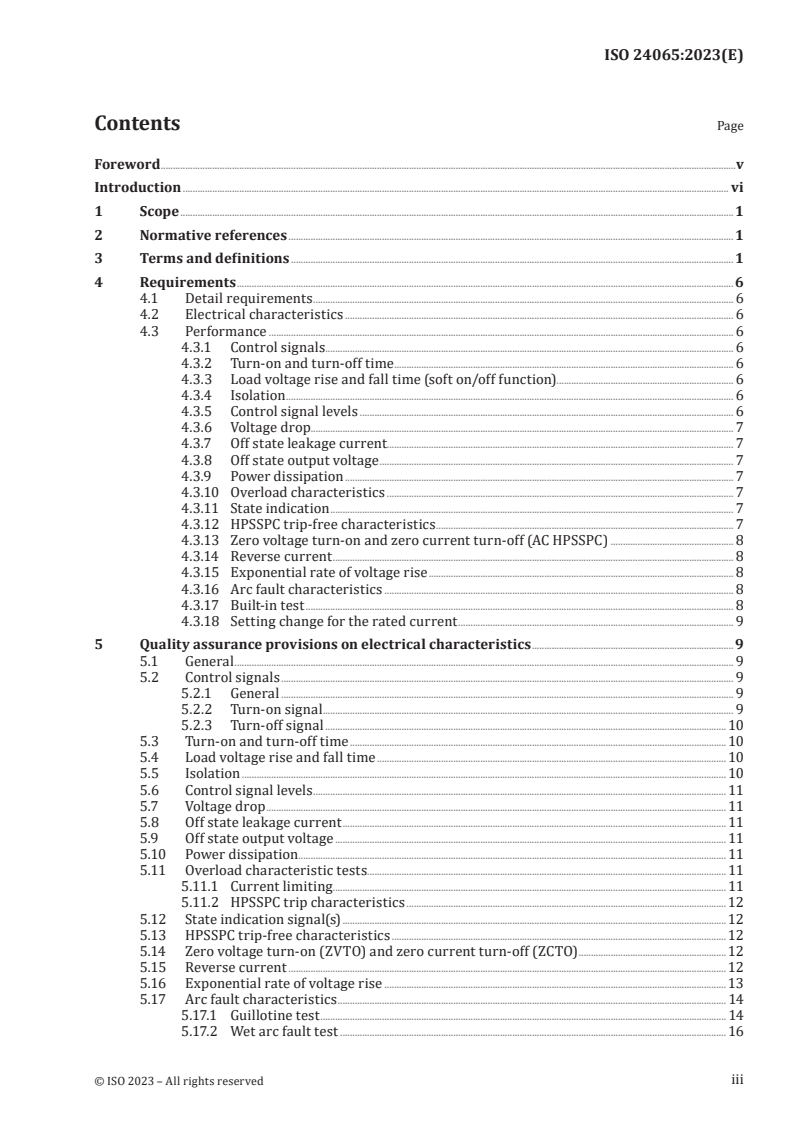
Contents Page
Foreword .v
Introduction . vi
1 Scope . 1
2 Normative references . 1
3 Terms and definitions . 1
4 Requirements . 6
4.1 Detail requirements . 6
4.2 Electrical characteristics . 6
4.3 Performance . 6
4.3.1 Control signals . . 6
4.3.2 Turn-on and turn-off time . 6
4.3.3 Load voltage rise and fall time (soft on/off function). 6
4.3.4 Isolation . 6
4.3.5 Control signal levels . 6
4.3.6 Voltage drop. 7
4.3.7 Off state leakage current. 7
4.3.8 Off state output voltage . 7
4.3.9 Power dissipation . 7
4.3.10 Overload characteristics . 7
4.3.11 State indication . 7
4.3.12 HPSSPC trip-free characteristics . 7
4.3.13 Zero voltage turn-on and zero current turn-off (AC HPSSPC) . 8
4.3.14 Reverse current . 8
4.3.15 Exponential rate of voltage rise . 8
4.3.16 Arc fault characteristics . 8
4.3.17 Built-in test . 8
4.3.18 Setting change for the rated current . 9
5 Quality assurance provisions on electrical characteristics . 9
5.1 General . 9
5.2 Control signals . 9
5.2.1 General . 9
5.2.2 Turn-on signal . 9
5.2.3 Turn-off signal . 10
5.3 Turn-on and turn-off time . 10
5.4 Load voltage rise and fall time . 10
5.5 Isolation . 10
5.6 Control signal levels . 11
5.7 Voltage drop . 11
5.8 Off state leakage current . 11
5.9 Off state output voltage . 11
5.10 Power dissipation . 11
5.11 Overload characteristic tests. 11
5.11.1 Current limiting . . 11
5.11.2 HPSSPC trip characteristics .12
5.12 State indication signal(s) .12
5.13 HPSSPC trip-free characteristics .12
5.14 Zero voltage turn-on (ZVTO) and zero current turn-off (ZCTO) .12
5.15 Reverse current .12
5.16 Exponential rate of voltage rise . 13
5.17 Arc fault characteristics . 14
5.17.1 Guillotine test . 14
5.17.2 Wet arc fault test . 16
iii
5.17.3 Intermittent connection test . 17
5.17.4 Compatibility with normal load . 20
5.17.5 Compatibility with arc fault of another line . 20
5.18 Built-in test. 21
5.19 Setting change for the rated current . 21
Bibliography .23
iv
Foreword
ISO (the International Organization for Standardization) is a worldwide federation of national standards
bodies (ISO member bodies). The work of preparing International Standards is normally carried out
through ISO technical committees. Each member body interested in a subject for which a technical
committee has been established has the right to be represented on that committee. International
organizations, governmental and non-governmental, in liaison with ISO, also take part in the work.
ISO collaborates closely with the International Electrotechnical Commission (IEC) on all matters of
electrotechnical standardization.
The procedures used to develop this document and those intended for its further maintenance are
described in the ISO/IEC Directives, Part 1. In particular, the different approval criteria needed for the
different types of ISO documents should be noted. This document was drafted in accordance with the
editorial rules of the ISO/IEC Directives, Part 2 (see www.iso.org/directives).
ISO draws attention to the possibility that the implementation of this document may involve the use
of (a) patent(s). ISO takes no position concerning the evidence, validity or applicability of any claimed
patent rights in respect thereof. As of the date of publication of this document, ISO had not received
notice of (a) patent(s) which may be required to implement this document. However, implementers are
cautioned that this may not represent the latest information, which may be obtained from the patent
database available at www.iso.org/patents. ISO shall not be held responsible for identifying any or all
such patent rights.
Any trade name used in this document is information given for the convenience of users and does not
constitute an endorsement.
For an explanation of the voluntary nature of standards, the meaning of ISO specific terms and
expressions related to conformity assessment, as well as information about ISO's adherence to
the World Trade Organization (WTO) principles in the Technical Barriers to Trade (TBT), see
www.iso.org/iso/foreword.html.
This document was prepared by Technical Committee ISO/TC 20, Aircraft and space vehicles,
Subcommittee SC 1, Aerospace electrical requirements.
Any feedback or questions on this document should be directed to the user’s national standards body. A
complete listing of these bodies can be found at www.iso.org/members.html.
v
Introduction
For aircrafts electrical power systems, there is a trend toward higher voltage and higher current
systems. There are several advantages in using a solid-state power controller (SSPC) for the distribution
system. A standard of the SSPC for lower electrical power supply has been established (ISO 27027); but
the standard for the SSPC for higher electrical power supply, which is intended for application in the
primary power distribution of aircrafts, has not been established. Therefore, it is necessary to develop
a standard for the high-power solid-state power controller (HPSSPC).
The purpose of this document is to standardize the requirements for HPSSPCs that are physically and
environmentally diversified.
The HPSSPC:
a) consists of a solid-state switching device and its driver circuit;
b) turns on or off the power output by receiving the control signal;
c) detects the over current in the load which results in limiting or shutting down this current, and/or
optionally detects the arc fault in the circuit which results in shutting down the fault;
d) has the built-in test function which can detect the health status of itself;
e) indicates the on or off status of the power output.
In order to satisfy this purpose, this document specifies requirements such as physical, environmental
and individual items in accordance with the detail requirements that are issued individually.
vi
INTERNATIONAL STANDARD ISO 24065:2023(E)
Aerospace — High-power solid-state power controller —
General performance requirements
1 Scope
This document specifies the general performance requirements and test methods to determine the
performance of the high-power solid-state power controller (HPSSPC) for use in the primary power
distribution of aircrafts.
2 Normative references
The following documents are referred to in the text in such a way that some or all of their content
constitutes requirements of this document. For dated references, only the edition cited applies. For
undated references, the latest edition of the referenced document (including any amendments) applies.
ISO 1540, Aerospace — Characteristics of aircraft electrical systems
ISO 7137:1995, Aircraft — Environmental conditions and test procedures for airborne equipment
3 Terms and definitions
For the purposes of this document, the following terms and definitions apply.
ISO and IEC maintain terminology databases for use in standardization at the following addresses:
— ISO Online browsing platform: available at https:// www .iso .org/ obp
— IEC Electropedia: available at https:// www .electropedia .org/
3.1
turn-on time
time interval between the initiation of the turn-
on signal (3.5) or the latest frame of the turn-on command data packet via the control signal bus and the
time when the output reaches 90 % of its steady-state on value
Note 1 to entry: Shown in Figure 1 a).
a) DC HPSSPC
b) AC HPSSPC
Key
Y load voltage
V voltage
t time
T turn-on time
ON
T turn-off time
OFF
T rise time
R
T fall time
F
1 rated control signal (which can optionally consist of control bus)
2 turn on (min)
3 turn off (max)
4 zero voltage turn-on
5 zero current turn-off
Figure 1 — Illustration of timing characteristics
3.2
turn-on time
time interval between the initiation of the turn-on signal (3.5)
or the latest frame of the turn-on command data packet via the control signal bus and the time when
the output switch is on at zero-crossing
Note 1 to entry: Shown in Figure 1 b).
3.3
turn-off time
time interval between the initiation of the turn-
off signal or the latest frame of the turn-off command data packet via the control signal bus and the
time when the output reaches 10 % of its steady-state on value
Note 1 to entry: Shown in Figure 1 a).
3.4
turn-off time
time interval between the initiation of the turn-off signal or
the latest frame of the turn-off command data packet via the control signal bus and the time when the
output switch is off at zero-crossing
Note 1 to entry: Shown in Figure 1 b).
3.5
turn-on signal
control signal level or turn-on command data packet via the control signal bus at which the power
controller is turned on
3.6
turn-off signal
control signal level or turn-off command data packet via the control signal bus at which the power
controller is turned off
3.7
load voltage rise and fall time
time interval between 10 % and 90 % of the steady state load voltage (3.10) value
Note 1 to entry: This definition applies to DC devices and non-zero-crossing turn-off AC devices.
Note 2 to entry: The load voltage rise and fall time for DC devices is shown in Figure 1 a).
[SOURCE: ISO 27027:2014, 3.4, modified — "(DC devices and non-zero-crossing turn-off AC devices)"
has been moved from the term to Note 1 to entry; the reference to Figure 1 a) has been moved from the
end of the definition to Note 2 to entry.]
3.8
soft on/off
function for the power output current to increase linearly with the turn-on signal (3.5) or the turn-on
command data packet via the control signal bus and to decrease linearly with the turn-off signal or the
turn-off command data packet via the control signal bus
3.9
supply voltage
voltage applied between the power input terminal of the HPSSPC (3.13) and the power ground
3.10
load voltage
voltage between the power output terminal of the HPSSPC (3.13) and the power ground
3.11
voltage drop
voltage across load and line terminals of the HPSSPC (3.13) in the on state (3.20) at the specified load
3.12
rated current
supplied maximum current that the HPSSPC (3.13) continuously outputs from the output terminal
without tripping
3.13
HPSSPC
high-power solid-state power controller
solid-state power controller (SSPC) which is applied on primary power distribution
3.14
power dissipation
power loss which includes all power dissipated in the power switching circuit, due to internal leakage
currents and power supplies
Note 1 to entry: When the HPSSPC (3.13) is off, the power dissipation includes only dissipation due to leakage
currents and internal power supplies.
3.15
HPSSPC trip
automatic reversion to the off state (3.21) of the HPSSPC (3.13) output caused by an overcurrent or a
short circuit (3.22) condition or detection of an arc fault (3.28)
3.16
HPSSPC trip-free
feature which prevents subsequent re-closing unless preceded by a reset (3.19) signal, when the HPSSPC
(3.13) has tripped due to an overcurrent or a short circuit (3.22) condition or detection of an arc fault
(3.28)
3.17
trip time
time interval between the application of an overcurrent or a short circuit (3.22) condition or detection
of an arc fault (3.28) and the 10 % value of rated output current
Note 1 to entry: In general, the higher the over current condition, the shorter the trip time.
3.18
trip curve
curve which sets the minimum and maximum trip points of the HPSSPC (3.13) and is plotted as current
versus time
3.19
reset
restoration of the tripped HPSSPC (3.13) to a state from which it can be turned on
3.20
on state
condition in which, with the turn-on signal (3.5) applied, the device allows power to be passed to the
load
[SOURCE: ISO 27027:2014, 3.6]
3.21
off state
condition in which, with the turn-off signal applied, the device prevents power from being passed to the
load
[SOURCE: ISO 27027:2014, 3.5]
3.22
short circuit
circuit with the impedance of less than 1 mΩ applied between the output terminal and ground
[SOURCE: ISO 27027:2014, 3.13]
3.23
current limiting
function to limit the power output current to the required level within required time from overload or
short circuit (3.22) conditions
Note 1 to entry: Shown in Figure 2.
[SOURCE: ISO 27027:2014, 3.2, modified — The reference to Figure 2 has been moved from the end of
the definition to Note 1 to entry.]
Key
I load current
t time
1 peak let-through current
2 specified current limit
3 ripple
Figure 2 — Overload let-through current
3.24
peak let-through current
peak value of the current at the maximum system voltage that the HPSSPC (3.13) conducts for a specified
time interval without damage
3.25
zero voltage turn-on
characteristic that requires the HPSSPC (3.13) to turn on only at the half-cycle zero-crossing point,
regardless of when the control signal is applied
Note 1 to entry: This characteristic applies only to AC devices.
3.26
zero current turn-off
characteristic that requires the HPSSPC (3.13) to turn off only at the half-cycle zero-crossing point,
regardless of when the control signal is removed
Note 1 to entry: This characteristic applies only to AC devices.
3.27
reverse current
current into the load terminal of the HPSSPC (3.13) from the load energy source
3.28
arc fault
sustained luminous discharge of electricity across a gap in a circuit or between conductors
Note 1 to entry: Arc impedance can reduce low-voltage fault current magnitudes appreciably.
[SOURCE: ISO 27027:2014, 3.1]
3.29
parallel arc fault
arc fault (3.28) condition in which arcing occurs in a circuit from line-to-line or line-to-ground and not
through any load(s)
Note 1 to entry: Only the arc impedance and the system current impedance limit the magnitude of the arc fault
current.
[SOURCE: ISO 27027:2014, 3.7]
3.30
series arc fault
arc fault (3.28) condition in which the current passes through the arc and each circuit load
Note 1 to entry: The load equipment limits the magnitude of the arc fault current.
[SOURCE: ISO 27027:2014, 3.12]
4 Requirements
4.1 Detail requirements
The individual item requirements shall be specified in accordance with the detail requirements that
are issued individually. ISO 7137 should be used for the s
...
Questions, Comments and Discussion
Ask us and Technical Secretary will try to provide an answer. You can facilitate discussion about the standard in here.
Loading comments...