


ISO/IEC 21481:2005
(Main)Information technology — Telecommunications and information exchange between systems — Near Field Communication Interface and Protocol -2 (NFCIP-2)
Information technology — Telecommunications and information exchange between systems — Near Field Communication Interface and Protocol -2 (NFCIP-2)
ISO/IEC 21481:2005 specifies the communication mode selection mechanism, designed not to disturb any ongoing communication at 13,56 MHz, for devices implementing ISO/IEC 18092 and the reader functionality for integrated circuit cards compliant with ISO/IEC 14443 or ISO/IEC 15693. ISO/IEC 21481:2005 requires implementations to enter the selected communication mode as specified in the respective International Standard. The communication mode specifications, however, are outside the scope of this NFCIP-2 International Standard.
Technologies de l'information — Télécommunications et échange d'information entre systèmes — Interface et protocole -2 en communication de champ proche (NFCIP-2)
General Information
- Status
- Withdrawn
- Publication Date
- 09-Jan-2005
- Withdrawal Date
- 09-Jan-2005
- Current Stage
- 9599 - Withdrawal of International Standard
- Start Date
- 25-Jun-2012
- Completion Date
- 12-Feb-2026
Relations
- Effective Date
- 03-Jul-2010


Get Certified
Connect with accredited certification bodies for this standard

BSI Group
BSI (British Standards Institution) is the business standards company that helps organizations make excellence a habit.

NYCE
Mexican standards and certification body.
Sponsored listings
Frequently Asked Questions
ISO/IEC 21481:2005 is a standard published by the International Organization for Standardization (ISO). Its full title is "Information technology — Telecommunications and information exchange between systems — Near Field Communication Interface and Protocol -2 (NFCIP-2)". This standard covers: ISO/IEC 21481:2005 specifies the communication mode selection mechanism, designed not to disturb any ongoing communication at 13,56 MHz, for devices implementing ISO/IEC 18092 and the reader functionality for integrated circuit cards compliant with ISO/IEC 14443 or ISO/IEC 15693. ISO/IEC 21481:2005 requires implementations to enter the selected communication mode as specified in the respective International Standard. The communication mode specifications, however, are outside the scope of this NFCIP-2 International Standard.
ISO/IEC 21481:2005 specifies the communication mode selection mechanism, designed not to disturb any ongoing communication at 13,56 MHz, for devices implementing ISO/IEC 18092 and the reader functionality for integrated circuit cards compliant with ISO/IEC 14443 or ISO/IEC 15693. ISO/IEC 21481:2005 requires implementations to enter the selected communication mode as specified in the respective International Standard. The communication mode specifications, however, are outside the scope of this NFCIP-2 International Standard.
ISO/IEC 21481:2005 is classified under the following ICS (International Classification for Standards) categories: 35.100.20 - Data link layer. The ICS classification helps identify the subject area and facilitates finding related standards.
ISO/IEC 21481:2005 has the following relationships with other standards: It is inter standard links to ISO/IEC 21481:2012. Understanding these relationships helps ensure you are using the most current and applicable version of the standard.
ISO/IEC 21481:2005 is available in PDF format for immediate download after purchase. The document can be added to your cart and obtained through the secure checkout process. Digital delivery ensures instant access to the complete standard document.
Standards Content (Sample)
INTERNATIONAL ISO/IEC
STANDARD 21481
First edition
2005-01-15
Information technology —
Telecommunications and information
exchange between systems — Near Field
Communication Interface and Protocol -2
(NFCIP-2)
Technologies de l'information — Télécommunications et échange
d'information entre systèmes — Interface et protocole -2 en
communication de champ proche (NFCIP-2)
Reference number
©
ISO/IEC 2005
PDF disclaimer
This PDF file may contain embedded typefaces. In accordance with Adobe's licensing policy, this file may be printed or viewed but
shall not be edited unless the typefaces which are embedded are licensed to and installed on the computer performing the editing. In
downloading this file, parties accept therein the responsibility of not infringing Adobe's licensing policy. The ISO Central Secretariat
accepts no liability in this area.
Adobe is a trademark of Adobe Systems Incorporated.
Details of the software products used to create this PDF file can be found in the General Info relative to the file; the PDF-creation
parameters were optimized for printing. Every care has been taken to ensure that the file is suitable for use by ISO member bodies. In
the unlikely event that a problem relating to it is found, please inform the Central Secretariat at the address given below.
© ISO/IEC 2005
All rights reserved. Unless otherwise specified, no part of this publication may be reproduced or utilized in any form or by any means,
electronic or mechanical, including photocopying and microfilm, without permission in writing from either ISO at the address below or
ISO's member body in the country of the requester.
ISO copyright office
Case postale 56 • CH-1211 Geneva 20
Tel. + 41 22 749 01 11
Fax + 41 22 749 09 47
E-mail copyright@iso.org
Web www.iso.org
Published in Switzerland
ii © ISO/IEC 2005 – All rights reserved
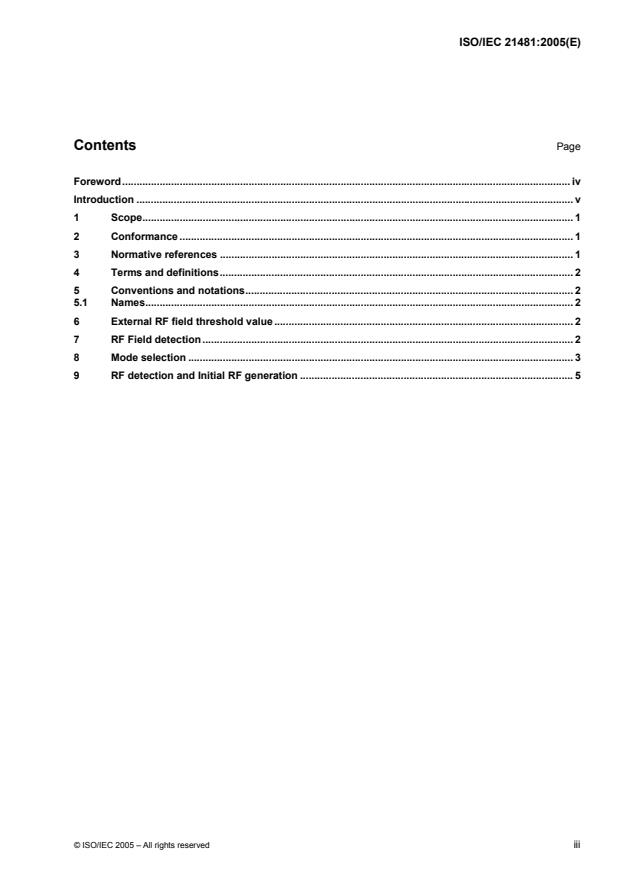
Contents Page
Foreword. iv
Introduction . v
1 Scope. 1
2 Conformance. 1
3 Normative references. 1
4 Terms and definitions. 2
5 Conventions and notations. 2
5.1 Names. 2
6 External RF field threshold value . 2
7 RF Field detection . 2
8 Mode selection. 3
9 RF detection and Initial RF generation . 5
© ISO/IEC 2005 – All rights reserved iii
Foreword
ISO (the International Organization for Standardization) and IEC (the International Electrotechnical
Commission) form the specialized system for worldwide standardization. National bodies that are members of
ISO or IEC participate in the development of International Standards through technical committees
established by the respective organization to deal with particular fields of technical activity. ISO and IEC
technical committees collaborate in fields of mutual interest. Other international organizations, governmental
and non-governmental, in liaison with ISO and IEC, also take part in the work. In the field of information
technology, ISO and IEC have established a joint technical committee, ISO/IEC JTC 1.
International Standards are drafted in accordance with the rules given in the ISO/IEC Directives, Part 2.
The main task of the joint technical committee is to prepare International Standards. Draft International
Standards adopted by the joint technical committee are circulated to national bodies for voting. Publication as
an International Standard requires approval by at least 75 % of the national bodies casting a vote.
Attention is drawn to the possibility that some of the elements of this document may be the subject of patent
rights. ISO and IEC shall not be held responsible for identifying any or all such patent rights.
ISO/IEC 21481 was prepared by Ecma International (as ECMA-352) and was adopted, under a special “fast-
track procedure”, by Joint Technical Committee ISO/IEC JTC 1, Information technology, in parallel with its
approval by national bodies of ISO and IEC.
iv © ISO/IEC 2005 – All rights reserved
Introduction
In 2002, Ecma International formed Task Group 19 of Technical Committee 32 to specify Near Field
Communication (NFC) signal interfaces and protocols. The NFC devices are wireless closely coupled devices
communicating at 13,56 MHz.
Although ISO/IEC 18092 (NFCIP-1), ISO/IEC 14443 and ISO/IEC 15693 standards all specify 13,56 MHz as
their working frequency, they specify distinct communication modes. These are defined as NFC, PCD, and
VCD communication modes respectively.
This NFCIP-2 Standard specifies the mechanism to detect and select one communication mode out of those
three possible communication modes. Furthermore, NFCIP-2 requires that subsequent behaviour be as
specified in the standard specifying the selected communication mode.
© ISO/IEC 2005 – All rights reserved v
INTERNATIONAL STANDARD ISO/IEC 21481:2005(E)
Information technology — Telecommunications and information
exchange between systems — Nea
...
Questions, Comments and Discussion
Ask us and Technical Secretary will try to provide an answer. You can facilitate discussion about the standard in here.
Loading comments...