


ISO/IEC 9075-9:2001
(Main)Information technology — Database languages — SQL — Part 9: Management of External Data (SQL/MED)
Information technology — Database languages — SQL — Part 9: Management of External Data (SQL/MED)
Technologies de l'information — Langages de base de données — SQL — Partie 9: Gestion des données externes (SQL/MED)
General Information
- Status
- Withdrawn
- Publication Date
- 06-Jun-2001
- Withdrawal Date
- 06-Jun-2001
- Technical Committee
- ISO/IEC JTC 1/SC 32 - Data management and interchange
- Drafting Committee
- ISO/IEC JTC 1/SC 32/WG 3 - Database language
- Current Stage
- 9599 - Withdrawal of International Standard
- Start Date
- 15-Dec-2003
- Completion Date
- 12-Feb-2026
Relations
- Effective Date
- 06-Jun-2022
- Effective Date
- 15-Apr-2008
Get Certified
Connect with accredited certification bodies for this standard

BSI Group
BSI (British Standards Institution) is the business standards company that helps organizations make excellence a habit.

NYCE
Mexican standards and certification body.
Sponsored listings
Frequently Asked Questions
ISO/IEC 9075-9:2001 is a standard published by the International Organization for Standardization (ISO). Its full title is "Information technology — Database languages — SQL — Part 9: Management of External Data (SQL/MED)". This standard covers: Information technology — Database languages — SQL — Part 9: Management of External Data (SQL/MED)
Information technology — Database languages — SQL — Part 9: Management of External Data (SQL/MED)
ISO/IEC 9075-9:2001 is classified under the following ICS (International Classification for Standards) categories: 35.060 - Languages used in information technology. The ICS classification helps identify the subject area and facilitates finding related standards.
ISO/IEC 9075-9:2001 has the following relationships with other standards: It is inter standard links to ISO/IEC 9075-9:2001/Cor 1:2003; is excused to ISO/IEC 9075-9:2001/Cor 1:2003. Understanding these relationships helps ensure you are using the most current and applicable version of the standard.
ISO/IEC 9075-9:2001 is available in PDF format for immediate download after purchase. The document can be added to your cart and obtained through the secure checkout process. Digital delivery ensures instant access to the complete standard document.
Standards Content (Sample)
INTERNATIONAL ISO/IEC
STANDARD 9075-9
First edition
2001-05-15
Information technology — Database
languages — SQL —
Part 9:
Management of External Data (SQL/MED)
Technologies de l'information — Langages de base de données — SQL —
Partie 9: Gestion des données externes (SQL/MED)
Reference number
©
ISO/IEC 2001
PDF disclaimer
This PDF file may contain embedded typefaces. In accordance with Adobe's licensing policy, this file may be printed or viewed but shall not
be edited unless the typefaces which are embedded are licensed to and installed on the computer performing the editing. In downloading this
file, parties accept therein the responsibility of not infringing Adobe's licensing policy. The ISO Central Secretariat accepts no liability in this
area.
Adobe is a trademark of Adobe Systems Incorporated.
Details of the software products used to create this PDF file can be found in the General Info relative to the file; the PDF-creation parameters
were optimized for printing. Every care has been taken to ensure that the file is suitable for use by ISO member bodies. In the unlikely event
that a problem relating to it is found, please inform the Central Secretariat at the address given below.
© ISO/IEC 2001
All rights reserved. Unless otherwise specified, no part of this publication may be reproduced or utilized in any form or by any means, electronic
or mechanical, including photocopying and microfilm, without permission in writing from either ISO at the address below or ISO's member body
in the country of the requester.
ISO copyright office
Case postale 56 � CH-1211 Geneva 20
Tel. + 41 22 749 01 11
Fax + 41 22 749 09 47
E-mail copyright@iso.ch
Web www.iso.ch
Printed in Switzerland
ii © ISO/IEC 2001 – All rights reserved
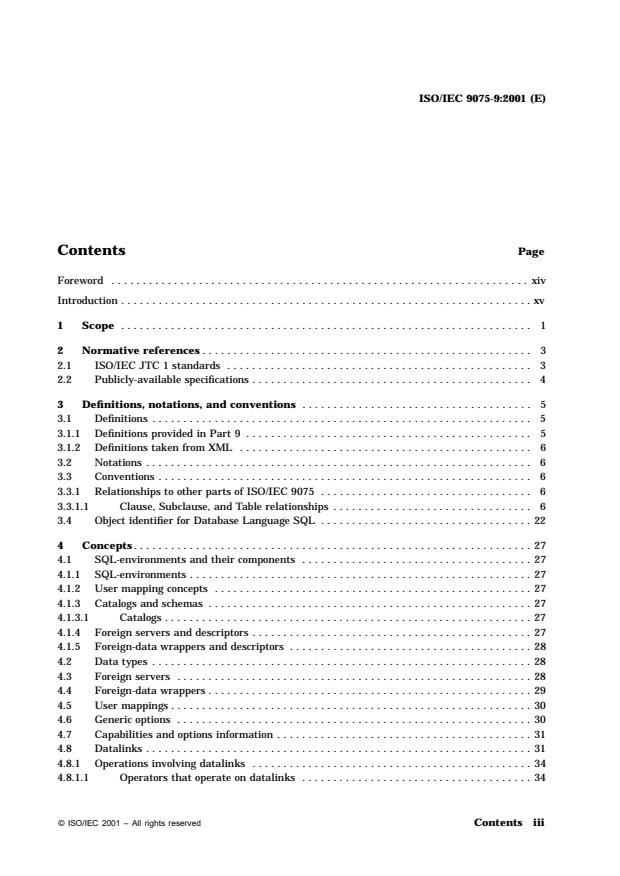
Contents Page
Foreword . . xiv
Introduction . . . . . . . . xv
1 Scope . 1
2 Normative references. 3
2.1 ISO/IEC JTC 1 standards . . . . 3
2.2 Publicly-available specifications . 4
3 Definitions, notations, and conventions . 5
3.1 Definitions . 5
3.1.1 Definitions provided in Part 9 . 5
3.1.2 Definitions taken from XML . . 6
3.2 Notations . 6
3.3 Conventions . 6
3.3.1 Relationships to other parts of ISO/IEC 9075 . 6
3.3.1.1 Clause, Subclause, and Table relationships . . . 6
3.4 Object identifier for Database Language SQL . 22
4 Concepts. 27
4.1 SQL-environments and their components . 27
4.1.1 SQL-environments . 27
4.1.2 User mapping concepts . 27
4.1.3 Catalogs and schemas . 27
4.1.3.1 Catalogs . 27
4.1.4 Foreign servers and descriptors . 27
4.1.5 Foreign-data wrappers and descriptors . . 28
4.2 Data types . 28
4.3 Foreign servers . . . 28
4.4 Foreign-data wrappers . 29
4.5 User mappings . . . . 30
4.6 Generic options . . . 30
4.7 Capabilities and options information . . . . 31
4.8 Datalinks . 31
4.8.1 Operations involving datalinks . 34
4.8.1.1 Operators that operate on datalinks . 34
© ISO/IEC 2001 – All rights reserved Contents iii
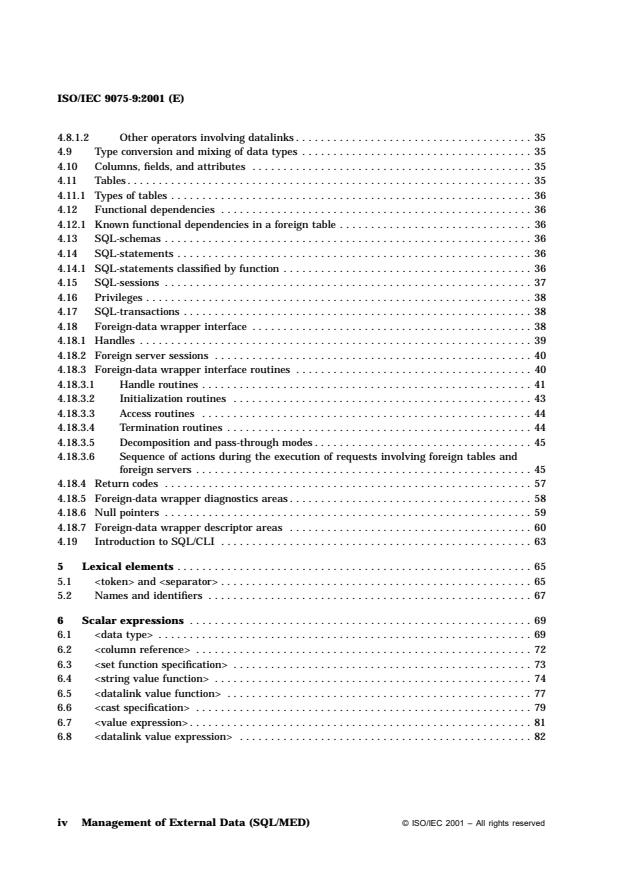
4.8.1.2 Other operators involving datalinks. 35
4.9 Type conversion and mixing of data types . 35
4.10 Columns, fields, and attributes . 35
4.11 Tables . . . 35
4.11.1 Types of tables . . . . 36
4.12 Functional dependencies . 36
4.12.1 Known functional dependencies in a foreign table . . 36
4.13 SQL-schemas . 36
4.14 SQL-statements . . . 36
4.14.1 SQL-statements classified by function . . . 36
4.15 SQL-sessions . 37
4.16 Privileges . 38
4.17 SQL-transactions . . 38
4.18 Foreign-data wrapper interface . 38
4.18.1 Handles . 39
4.18.2 Foreign server sessions . 40
4.18.3 Foreign-data wrapper interface routines . 40
4.18.3.1 Handle routines . 41
4.18.3.2 Initialization routines . . . 43
4.18.3.3 Access routines . 44
4.18.3.4 Termination routines . . . . 44
4.18.3.5 Decomposition and pass-through modes. 45
4.18.3.6 Sequence of actions during the execution of requests involving foreign tables and
foreign servers . 45
4.18.4 Return codes . 57
4.18.5 Foreign-data wrapper diagnostics areas . . 58
4.18.6 Null pointers . 59
4.18.7 Foreign-data wrapper descriptor areas . . 60
4.19 Introduction to SQL/CLI . 63
5 Lexical elements . 65
5.1 and . 65
5.2 Names and identifiers . 67
6 Scalar expressions . 69
6.1 . 69
6.2 . 72
6.3 . . . 73
6.4 . 74
6.5 . . . . 77
6.6 . 79
6.7 . 81
6.8 . . 82
iv Management of External Data (SQL/MED) © ISO/IEC 2001 – All rights reserved
7 Query expressions . 83
7.1 . . 83
7.2 . . . . 89
7.3 . 90
7.4 . 91
7.5 . 92
8 Predicates . 93
8.1 . 93
9 URLs. 95
9.1 URL format . 95
10 Data assignment rules and routine determination . 99
10.1 Retrieval assignment . 99
10.2 Store assignment . . 100
10.3 Data types of results of aggregations . . . . 101
10.4 Type precedence list determination . 102
10.5 Determination of identical values . 103
11 Additional common elements . 105
11.1 . 105
11.2 . . 106
11.3 . 107
12 Schema definition and manipulation. 109
12.1 . 109
12.2 . . . . 110
12.3
12.4 . 112
12.5 . 113
12.6 . 114
12.7 . 115
12.8 . 116
12.9 . 117
12.10 . 118
12.11 . 119
12.12 . 120
12.13 . 123
12.14 . 125
12.15 . 127
12.16 . 128
12.17 . 130
© ISO/IEC 2001 – All rights reserved Contents v
13 Catalog manipulation. 133
13.1 . . . . 133
13.2 . 135
13.3 . 136
13.4 . 137
13.5 . 139
13.6 . . 140
13.7 . 141
14 Access control . 143
14.1 . 143
14.2 . . . . 144
14.3 . 146
14.4 . 147
15 SQL-client modules . 149
15.1 . 149
15.2 . 150
15.3 Calls to an . 151
15.4 . . 153
15.5 Data type correspondences . . . . 154
16 Data manipulation . 157
16.1 . . . 157
16.2 Effect of deleting rows from base tables . . 158
16.3 Effect of inserting tables into base tables. 159
16.4 Effect of replacing rows in base tables . . . 160
17 Session management . 163
17.1 . . 163
18 Dynamic SQL. 165
18.1 Description of SQL descriptor areas. 165
18.2 . 166
18.3 . 168
18.4 . 169
18.5 . 171
18.6 . 175
18.7 . 178
18.8 . . . . 179
18.9 . . . 180
18.10 . . . 181
18.11 . . . 182
18.12 . . . 183
vi Management of External Data (SQL/MED) © ISO/IEC 2001 – All rights reserved
19 Embedded SQL . 185
19.1 . 185
19.2 . . 186
19.3 . 187
19.4 . 188
19.5 . . . . 189
19.6 . 190
19.7 . 191
20 Call-Level Interface specifications . 193
20.1 . . . . 193
20.2 Implicit DESCRIBE USING clause . 193
20.2.1 CLI-specific status codes . 194
20.2.2 Description of CLI item descriptor areas . 194
20.2.3 Other tables associated with CLI. 195
20.3 SQL/CLI data type correspondences. 197
21 SQL/CLI routines . 199
21.1 BuildDataLink . . . . 199
21.2 GetDataLinkAttr . . 200
21.3 GetInfo . . 202
22 SQL/MED common specifications . 203
22.1 Description of foreign-data wrapper item descriptor areas . . . . 203
22.2 Implicit cursor . . . . 207
22.3 Implicit DESCRIBE INPUT USING clause . 209
22.4 Implicit DESCRIBE OUTPUT USING clause . 212
22.5 Implicit EXECUTE USING and OPEN USING clauses. 216
22.6 Implicit FETCH USING clause . 219
22.7 Character string retrieval . . . . 223
22.8 Binary large object string retrieval . 224
22.9 Tables used with SQL/MED . . . 225
23 Foreign-data wrapper interface routines . 235
23.1 . 235
23.2 invocation . 239
23.3 Foreign-data wrapper interface wrapper routines . . 241
23.3.1 AllocWrapperEnv . . 241
23.3.2 Close . . . 243
23.3.3 ConnectServer . . . . 244
23.3.4 FreeExecutionHandle. 246
23.3.5 FreeFSConnection . 248
23.3.6 FreeReplyHandle . . 249
23.3.7 FreeWrapperEnv . . 250
23.3.8 GetNumReplySelectElems . . . . 251
23.3.9 GetNumReplyTableRefs . 252
23.3.10 GetOpts . 253
© ISO/IEC 2001 – All rights reserved Contents vii
23.3.11 GetReplySelectElem. 255
23.3.12 GetReplyTableRef . 256
23.3.13 GetSPDHandle . . . . 257
23.3.14 GetSRDHandle . . . . 258
23.3.15 GetStatistics . 259
23.3.16 GetWPDHandle . . . 261
23.3.17 GetWRDHandle . . . 262
23.3.18 InitRequest . 263
23.3.19 Iterate . . 267
23.3.20 Open . . . 269
23.3.21 ReOpen . 273
23.3.22 TransmitRequest . . 274
23.4 Foreign-data wrapper interface SQL-server routines . 277
23.4.1 AllocDescriptor . . . . 277
23.4.2 FreeDescriptor . . . . 278
23.4.3 GetAuthorizationId . 279
23.4.4 GetDescriptor. 280
23.4.5 GetNumSelectElems . 282
23.4.6 GetNumServerOpts . 283
23.4.7 GetNumTableColOpts . 284
23.4.8 GetNumTableOpts . 286
23.4.9 GetNumTableRefElems . 287
23.4.10 GetNumUserOpts . 288
23.4.11 GetNumWrapperOpts . 289
23.4.12 GetSelectElem . . . . 290
23.4.13 GetSelectElemType . 291
23.4.14 GetServerName . . . 292
23.4.15 GetServerOpt. 293
23.4.16 GetServerOptByName . 295
23.4.17 GetServerType . . . . 297
23.4.18 GetServerVersion . . 298
23.4.19 GetSQLString . . . . 299
23.4.20 GetTableColOpt . . . 300
23.4.21 GetTableColOptByName . 302
23.4.22 GetTableOpt. 304
23.4.23 GetTableOptByName . 306
23.4.24 GetTableRefElem . . 308
23.4.25 GetTableRefElemType . 309
23.4.26 GetTableRefTableName . 310
23.4.27 GetTableServerName . 310
23.4.28 GetTRDHandle . . . 312
23.4.29 GetUserOpt . 313
23.4.30 GetUserOptByName . 315
23.4.31 GetValExprColName . 317
23.4.32 GetWrapperLibraryName. 318
viii Management of External Data (SQL/MED) © ISO/IEC 2001 – All rights reserved
23.4.33 GetWrapperName . 319
23.4.34 GetWrapperOpt . . . 320
23.4.35 GetWrapperOptByName . 322
23.4.36 SetDescriptor . 324
23.5 Foreign-data wrapper interface general routines . . . 329
23.5.1 GetDiagnostics . . . . 329
24 Diagnostics management. 333
24.1 . . . 333
25 Information Schema. 335
25.1 ATTRIBUTES view . 335
25.2 COLUMN_OPTIONS view . . . . 337
25.3 COLUMNS view . . 338
25.4 FOREIGN_DATA_WRAPPER_OPTIONS view. 341
25.5 FOREIGN_DATA_WRAPPERS view . . . . 342
25.6 FOREIGN_SERVER_OPTIONS view . . . . 343
25.7 FOREIGN_SERVERS view . . . 344
25.8 FOREIGN_TABLE_OPTIONS view . 345
25.9 FOREIGN_TABLES view. 346
25.10 USER_MAP_OPTIONS view . . 347
25.11 USER_MAPPINGS view . 348
25.12 Short name views . . 349
26 Definition Schema . 353
26.1 COLUMN_OPTIONS base table . 353
26.2 DATA_TYPE_DESCRIPTOR base table . . 354
26.3 FOREIGN_DATA_WRAPPER_OPTIONS base table . 361
26.4 FOREIGN_DATA_WRAPPERS base table . 362
26.5 FOREIGN_SERVER_OPTIONS base table . 363
26.6 FOREIGN_SERVERS base table . 364
26.7 FOREIGN_TABLE_OPTIONS base table. 365
26.8 FOREIGN_TABLES base table . 366
26.9 SQL_SIZING base table. 367
26.10 TABLES base table . 368
26.11 USAGE_PRIVILEGES base table . 369
26.12 USER_MAPPING_OPTIONS base table . 370
26.13 USER_MAPPINGS base table . 371
27 Status codes. 373
27.1 SQLSTATE. 373
28 Conformance . 375
28.1 SQL-server conformance to SQL/MED . . . 375
28.2 Foreign-data-wrapper conformance to SQL/MED . . . 376
28.3 Claims of conformance by SQL-servers . . 376
28.4 Claims of conformance by foreign-data wrappers . . . 377
© ISO/IEC 2001 – All rights reserved Contents ix
28.5 Extensions and options . 377
Annex A SQL Conformance Summary . 379
Annex B Implementation-defined elements . 385
Annex C Implementation-dependent elements . 393
Annex D Deprecated features . 397
Annex E Incompatibilities with ISO/IEC 9075:1992 . 399
Annex F Typical header files . 401
F.1 C Header File SQLCLI.H. 401
F.2 COBOL Library Item SQLCLI . 402
Annex G SQL feature and package taxonomy. 403
Annex H SQL/MED model. 405
Index . 411
x Management of External Data (SQL/MED) © ISO/IEC 2001 – All rights reserved
FIGURES
Figure Page
1 SQL/MED interfaces . 405
2 SQL/MED information flow . . . 407
© ISO/IEC 2001 – All rights reserved Contents xi
TABLES
Tables Page
1 Clause, Subclause, and Table relationships . 6
2 Valid datalink file control options . 34
3 Sequence of actions during foreign server request executions . 46
4 Fields used in foreign-data wrapper diagnostics areas. 59
5 Fields in foreign-data wrapper descriptor areas . . . . 61
6 Data type correspondences for Ada . 154
7 Data type correspondences for C . 154
8 Data type correspondences for COBOL . . 154
9 Data type correspondences for Fortran . . 155
10 Data type correspondences for MUMPS . . 155
11 Data type correspondences for Pascal . . . 155
12 Data type correspondences for PL/I . 155
13 Codes used for SQL data types in Dynamic SQL . . . 165
14 Abbreviated SQL/CLI generic names . . . . 193
15 SQLSTATE class and subclass values for SQL/CLI-specific conditions . . . . 194
16 Codes used for implementation data types in SQL/CLI . 194
17 Codes used for application data types in SQL/CLI . . 195
18 Codes used to identify SQL/CLI routines . 195
19 Codes and data types for implementation information. 195
20 Codes used for datalink attributes . 195
21 Data types of attributes . 196
22 SQL/CLI data type correspondences for Ada . 197
23 SQL/CLI data type correspondences for C . 197
24 SQL/CLI data type correspondences for COBOL . . . 197
25 SQL/CLI data type correspondences for Fortran . . . 197
26 SQL/CLI data type correspondences for MUMPS . . . 197
27 SQL/CLI data type correspondences for Pascal . . . . 198
28 SQL/CLI data type correspondences for PL/I . 198
29 Codes used for
30 Codes used for types . 225
31 Codes used for foreign-data wrapper diagnostic fields . 225
32 Codes used for foreign-data wrapper descriptor fields . 225
33 Codes used for foreign-data wrapper handle types . . 227
34 Ability to retrieve foreign-data wrapper descriptor fields. 228
35 Ability to set foreign-data wrapper descriptor fields . 230
36 Foreign-data wrapper descriptor field default values . 231
37 Codes used for the format of the character string transmitted by GetSQLString( ) . . 233
38 SQL-statement codes . 333
xii Management of External Data (SQL/MED) © ISO/IEC 2001 – All rights reserved
39 SQLSTATE class and subclass values . . . 373
40 Implied feature relationships . . 375
41 SQL/MED feature taxonomy for features outside Core SQL . . 403
42 Legend for SQL/MED interfaces . 406
43 Legend for SQL/MED information flow . . 408
© ISO/IEC 2001 – All rights reserved Contents xiii
Foreword
ISO (the International Organization for Standardization) and IEC (the International Electrotechni-
cal Commission) form the specialized system for worldwide standardization. National bodies that
are members of ISO or IEC participate in the development of International Standards through
technical committees established by the respective organization to deal with particular fields of
technical activity. ISO and IEC technical committees collaborate in fields of mutual interest. Other
international organizations, governmental and non-governmental, in liaison with ISO and IEC, also
take part in the work.
International Standards are drafted in accordance with the rules given in the ISO/IEC Directives,
Part 3.
In the field of information technology, ISO and IEC have established a joint technical committee,
ISO/IEC JTC 1. Draft International Standards adopted by the joint technical committee are circu-
lated to national bodies for voting. Publication as an International Standard requires approval by
at least 75 % of the national bodies casting a vote.
Attention is drawn to the possibility that some of the elements of this part of ISO/IEC 9075 may
be the subject of patent rights. ISO and IEC shall not be held responsible for identifying any or all
such patent rights.
International Standard ISO/IEC 9075-9 was prepared by Joint Technical Committee ISO/IEC JTC 1,
Information technology, Subcommittee SC 32, Data management and interchange.
ISO/IEC 9075 consists of the following parts, under the general title Information technology —
Database languages — SQL:
— Part 1: Framework (SQL/Framework)
— Part 2: Foundation (SQL/Foundation)
— Part 3: Call-Level Interface (SQL/CLI)
— Part 4: Persistent Stored Modules (SQL/PSM)
— Part 5: Host Language Bindings (SQL/Bindings)
— Part 9: Management of External Data (SQL/MED)
— Part 10: Object Language Bindings (SQL/OLB)
Annexes A, B, C, D, E, F, G and H of this part of ISO/IEC 9075 are for information only.
xiv Foreword © ISO/IEC 2001 – All rights reserved
Introduction
The organization of this part of ISO/IEC 9075 is as follows:
1) Clause 1, ‘‘Scope’’, specifies the scope of this part of ISO/IEC 9075.
2) Clause 2, ‘‘Normative references’’, identifies additional standards that, through reference in this
part of ISO/IEC 9075, constitute provisions of this part of ISO/IEC 9075.
3) Clause 3, ‘‘Definitions, notations, and conventions’’, defines the notations and conventions used
in this part of ISO/IEC 9075.
4) Clause 4, ‘‘Concepts’’, presents concepts related to this part of ISO/IEC 9075.
5) Clause 5, ‘‘Lexical elements’’, defines the lexical elements of the language specified in this part
of ISO/IEC 9075.
6) Clause 6, ‘‘Scalar expressions’’, defines the elements of the language that produce scalar values.
7) Clause 7, ‘‘Query expressions’’, defines the elements of the language that produce rows and
tables of data.
8) Clause 8, ‘‘Predicates’’, defines the predicates of the language.
9) Clause 9, ‘‘URLs’’, specifies the format of URLs used in this part of ISO/IEC 9075.
10) Clause 10, ‘‘Data assignment rules and routine determination’’, specifies the rules for as-
signments that retrieves data from or store data into SQL-data, and formation rules for set
operations.
11) Clause 11, ‘‘Additional common elements’’, defines additional common elements used in the
definition of foreign tables, foreign servers, and foreign-data wrappers.
12) Clause 12, ‘‘Schema definition and manipulation’’, defines facilities related to foreign tables and
datalink type support for creating and managing a schema.
13) Clause 13, ‘‘Catalog manipulation’’, defines facilities for creating, altering, and dropping foreign
servers and foreign-data wrappers.
14) Clause 14, ‘‘Access control’’, defines facilities for controlling access to SQL-data.
15) Clause 15, ‘‘SQL-client modules’’, defines SQL-client modules and externally-invoked procedures.
16) Clause 16, ‘‘Data manipulation’’, defines the data manipulation statements.
17) Clause 17, ‘‘Session management’’, defines the SQL-session management statements.
18) Clause 18, ‘‘Dynamic SQL’’, defines the dynamic SQL statements.
19) Clause 19, ‘‘Embedded SQL’’, defines the embedded SQL statements.
© ISO/IEC 2001 – All rights reserved Introduction xv
20) Clause 20, ‘‘Call-Level Interface specifications’’, defines facilities for using SQL through a
Call-Level Interface.
21) Clause 21, ‘‘SQL/CLI routines’’, defines each of the routines that comprise the Call-Level Inter-
face.
22) Clause 22, ‘‘SQL/MED common specifications’’, specifies common facilities used by SQL/MED.
23) Clause 23, ‘‘Foreign-data wrapper interface routines’’, specifies the interaction between an
SQL-server and a foreign-data wrapper.
24) Clause 24, ‘‘Diagnostics management’’, defines the diagnostics management facilities.
25) Clause 25, ‘‘Information Schema’’, defines viewed tables that contain schema information.
26) Clause 26, ‘‘Definition Schema’’, defines base tables on which the viewed tables containing
schema information depend.
27) Clause 27, ‘‘Status codes’’, defines values that identify the status of the execution of SQL-
statements and the mechanisms by which those values are returned.
28) Clause 28, ‘‘Conformance’’, specifies the way in which conformance to this part of ISO/IEC 9075
may be claimed.
29) Annex A, ‘‘SQL Conformance Summary’’, is an informative Annex. It summarizes the confor-
mance requirements of the SQL language.
30) Annex B, ‘‘Implementation-defined elements’’, is an informative Annex. It lists those features for
which this part of ISO/IEC 9075 states that the syntax, the meaning, the returned results, the
effect on SQL-data and/or schemas, or any other behavior is partly or wholly implementation-
defined.
31) Annex C, ‘‘Implementation-dependent elements’’, is an informative Annex. It lists those fea-
tures for which this part of ISO/IEC 9075 states that the syntax, the meaning, the returned
results, the effect on SQL-data and/or schemas, or any other behavior is partly or wholly
implementation-dependent.
32) Annex D, ‘‘Deprecated features’’, is an informative Annex. It lists features that the responsible
Technical Committee intend will not appear in a future revised version of this part of ISO/IEC
9075.
33) Annex E, ‘‘Incompatibilities with ISO/IEC 9075:1992’’, is an informative Annex. It lists incom-
patibilities with the previous version of ISO/IEC 9075.
34) Annex F, ‘‘Typical header files’’, is an informative Annex. It provides examples of typical defini-
tion files for application programs using the SQL Call-Level Interface.
35) Annex G, ‘‘SQL feature and package taxonomy’’, is an informative Annex. It identifies features
and packages of the SQL language specified in this part of ISO/IEC 9075 by an identifier and a
short descriptive name. This taxonomy is used to specify conformance to the packages specified
in this part of ISO/IEC 9075. The feature taxonomy may be used to develop other profiles
involving the SQL language.
xvi Management of External Data (SQL/MED) © ISO/IEC 2001 – All rights reserved
36) Annex H, ‘‘SQL/MED model’’, is an informative Annex. It uses annotated diagrams to illustrate
the more important concepts of the model of SQL/MED, including the relationships between the
SQL-server, foreign-data wrappers, and foreign servers.
In the text of this part of ISO/IEC 9075, Clauses begin a new odd-numbered page, and in Clause 5,
‘‘Lexical elements’’, through Clause 28, ‘‘Conformance’’, Subclauses begin a new page. Any resulting
blank space is not significant.
© ISO/IEC 2001 – All rights reserved Introduction xvii
INTERNATIONAL STANDARD ISO/IEC 9075-9:2001 (E)
Information technology — Database languages — SQL —
Part 9: Management of External Data (SQL/MED)
1 Scope
This part of ISO/IEC 9075 defines extensions to Database Language SQL to support management of
external data through the use of foreign-data wrappers and datalink types.
© ISO/IEC 2001 – All rights reserved Scope 1
(Blank page)
2 Management of External Data (SQL/MED) © ISO/IEC 2001 – All rights reserved
2 Normative references
The following normative documents contain provisions which, through reference in this text,
constitute provisions of this part of ISO/IEC 9075. For dated references, subsequent amendments
to, or revisions of, any of these publications do not apply. However, parties to agreements based
on this part of ISO/IEC 9075 are encouraged to investigate the possibility of applying the most
recent editions of the normative documents indicated below. For undated references, the latest
edition of the normative document referred to applies. Members of ISO and IEC maintain registers
of currently valid International Standards.
2.1 ISO/IEC JTC 1 standards
— ISO/IEC 1539-1:1997, Information technology — Programming languages — Fortran — Part 1:
Base language.
— ISO 1989:1985, Programming languages — COBOL.
(Endorsement of ANSI X3.23-1985).
— ISO 6160:1979, Programming languages — PL/I.
(Endorsement of ANSI X3.53-1976).
— ISO/IEC 7185:1990, Information technology — Programming languages — Pascal.
— ISO/IEC 8652:1995, Information technology — Programming languages — Ada.
— ISO/IEC 9075-1:1999, Information technology — Database languages — SQL — Part 1: Frame-
work (SQL/Framework).
— ISO/IEC 9075-2:1999, Information technology — Database languages — SQL — Part 2: Founda-
tion (SQL/Foundation).
— ISO/IEC 9075-3:1999, Information technology — Database languages — SQL — Part 3: Call-
Level Interface (SQL/CLI).
— ISO/IEC 9075-4:1999, Information technology — Database languages — SQL — Part 4: Persis-
tent Stored Modules (SQL/PSM).
— ISO/IEC 9075-5:1999, Information technology — Database languages — SQL — Part 5: Host
Language Bindings (SQL/Bindings).
© ISO/IEC 2001 – All rights reserved Normative references 3
2.1 ISO/IEC JTC 1 standards
— ISO/IEC 9899:1990, Programming languages — C.
— ISO/IEC 10206:1991, Information technology — Programming languages — Extended Pascal.
— ISO/IEC 11756:1992, Information technology — Programming languages — M.
2.2 Publicly-available specifications
— RFC 1738: Uniform Resource Locators (URL), T. Berners-Lee, L. Masinter, M. McCahill, Decem-
ber, 1994.
— RFC 1808, Relative Uniform Resource Locators, R. Fielding, June, 1995.
— RFC 2368, The mailto URL scheme, R. Hoffman, L. Masinter, J. Zawinski, July, 1998.
— http://www.w2.org/TR/1998/REC-xml-19980210, Extensible Markup Language (XML) 1.0,Tim
Bray, Jean Paoli, and C. M. Sperberg-McQueen (editors), corrected by http://www.w3.org/XML/xml-
19980210-errata
4 Management of External Data (SQL/MED) © ISO/IEC 2001 – All rights reserved
3 Definitions, notations, and conventions
3.1 Definitions
3.1.1 Definitions provided in Part 9
Insert this paragraph For the purposes of this part of ISO/IEC 9075, the definitions given in ISO/IEC
9075-1, ISO/IEC 9075-2, ISO/IEC 9075-3, ISO/IEC 9075-4, and ISO/IEC 9075-5 and the following
definitions apply.
a) access token: An encrypted value returned under certain conditions by an SQL-server in
combination with the File Reference of a datalink value.
b) datalink: A value, of data type DATALINK, referencing some file that is not part of the
SQL-environment. The file is assumed to be managed by some external file manager.
c) datalinker: An implementation-dependent component for controlling access and referential
integrity to external files.
d) external data: Data that is not managed by an SQL-server involved in an SQL-session, but
that is nevertheless accessible to that SQL-session.
e) foreign-data wrapper: A named collection of routines, invocable by the SQL-server, support-
ing the programming interface specified for such routines in this part of ISO/IEC 9075.
f) foreign server: A named server, external to the SQL-environment, but known to the SQL-
server, that manages external data.
g) foreign table: A named table whose rows are supplied when needed by some foreign server.
The mechanism by which these rows are supplied is provided by a foreign-data wrapper. The
data constituting a foreign table is not part of the SQL-environment.
h) integrity option: Specifies the level of integrity of the link between a datalink and the file
that it references.
i) link control: A property of a column of data type DATALINK, specifying the extent to which
the links between datalinks in that column and the files they reference are to be monitored (in
various specific manners).
j) read permission option: A
...
Questions, Comments and Discussion
Ask us and Technical Secretary will try to provide an answer. You can facilitate discussion about the standard in here.
Loading comments...