


ISO 4363:2002
(Main)Measurement of liquid flow in open channels - Methods for measurement of characteristics of suspended sediment
Measurement of liquid flow in open channels - Methods for measurement of characteristics of suspended sediment
ISO 4363:2002 specifies conventional and simplified methods for the measurement of cross-sectional mean suspended sediment mass concentration and mean particle size distribution. The conventional method is used for routine measurements in periods of stable or slowly varied flow. The simplified method is mainly used for sediment measurements for the purpose of observing the variation process of sediment transport and can be performed under difficult conditions. Empirical relationships are established between the cross-sectional mean suspended sediment mass concentrations and mean particle size distributions measured by conventional and simplified methods. The methods specified in ISO 4363:2002 are applicable to suspended sediment measurements at hydrological stations.
Mesure de débit des liquides dans les canaux découverts — Méthodes de mesurage des caractéristiques des sédiments en suspension
General Information
Relations
Overview
ISO 4363:2002 - Measurement of liquid flow in open channels - specifies methods for measuring characteristics of suspended sediment in open-channel flows. It defines conventional and simplified procedures to determine the cross-sectional mean suspended sediment mass concentration and the mean particle size distribution. The conventional method is intended for routine monitoring under stable or slowly varying flows; the simplified method is for observing sediment variation processes and for use under difficult field conditions. The standard is applicable to measurements at hydrological stations and establishes empirical links between the two approaches.
Key topics and requirements
- Scope and principles: Discharge-weighted measurement of cross-sectional mean sediment mass concentration and particle size distribution; weighting by flow discharge across the cross-section.
- Measurement methods:
- Conventional method - discharge-weighted, for routine and stable-flow sampling.
- Simplified method - suitable for rapidly varying or difficult conditions; used to observe temporal changes.
- Sampling design: Selection of site and division of cross-sections into segments/verticals; methods for combining samples collected across a cross-section (segmental discharge-weighted principle).
- Samplers and instruments: Requires samplers conforming to ISO 3716 and recommends time-integration samplers plus in-situ velocity measurement devices to reduce variability.
- Units and reporting: Uses SI units (mg/l, g/l, kg/m3) and defines mass concentration, volume fraction and mass fraction expressions.
- Calculations and uncertainty: Procedures to compute sediment discharge, cross-sectional mean concentration, particle size distribution, and methods for estimating random uncertainty and systematic error.
- Supporting annexes: Informative annexes detail data collection for error estimation and procedures/examples for combining cross-sectional samples.
Applications and users
ISO 4363:2002 is used where accurate suspended-sediment characterization is required:
- River and stream monitoring programs at hydrological stations
- Reservoir siltation assessments and sediment budget studies
- Erosion and catchment management, navigation-channel maintenance
- Calibration and validation of sediment transport models
- Environmental impact assessments and regulatory monitoring
Primary users include hydrologists, environmental and water resources engineers, river basin managers, researchers, and agencies conducting sediment monitoring programs.
Related standards
- ISO 3716 - samplers for suspended sediment load
- ISO 4365 - methods for concentration and particle size distribution analysis
- ISO 748 - velocity-area methods for open channels
- ISO 772, ISO 31, ISO 1000 - vocabulary, units and SI recommendations
Keywords: ISO 4363:2002, suspended sediment, open channels, cross-sectional mean sediment mass concentration, particle size distribution, hydrological stations, sediment sampling, sediment transport, measurement uncertainty.
Standards Content (Sample)
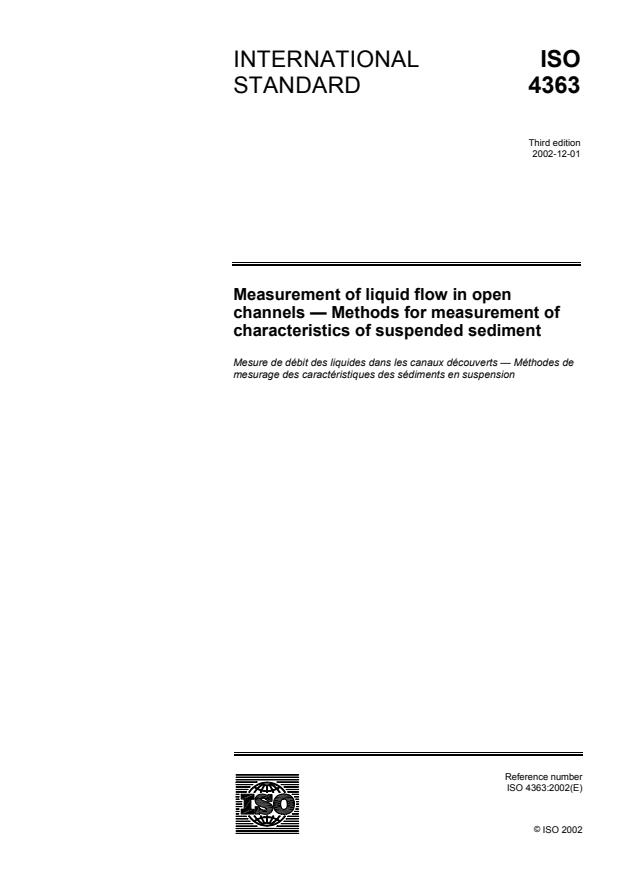
INTERNATIONAL ISO
STANDARD 4363
Third edition
2002-12-01
Measurement of liquid flow in open
channels — Methods for measurement of
characteristics of suspended sediment
Mesure de débit des liquides dans les canaux découverts — Méthodes de
mesurage des caractéristiques des sédiments en suspension
Reference number
©
ISO 2002
PDF disclaimer
This PDF file may contain embedded typefaces. In accordance with Adobe's licensing policy, this file may be printed or viewed but shall not
be edited unless the typefaces which are embedded are licensed to and installed on the computer performing the editing. In downloading this
file, parties accept therein the responsibility of not infringing Adobe's licensing policy. The ISO Central Secretariat accepts no liability in this
area.
Adobe is a trademark of Adobe Systems Incorporated.
Details of the software products used to create this PDF file can be found in the General Info relative to the file; the PDF-creation parameters
were optimized for printing. Every care has been taken to ensure that the file is suitable for use by ISO member bodies. In the unlikely event
that a problem relating to it is found, please inform the Central Secretariat at the address given below.
© ISO 2002
All rights reserved. Unless otherwise specified, no part of this publication may be reproduced or utilized in any form or by any means, electronic
or mechanical, including photocopying and microfilm, without permission in writing from either ISO at the address below or ISO's member body
in the country of the requester.
ISO copyright office
Case postale 56 • CH-1211 Geneva 20
Tel. + 41 22 749 01 11
Fax + 41 22 749 09 47
E-mail copyright@iso.ch
Web www.iso.ch
Printed in Switzerland
ii © ISO 2002 – All rights reserved
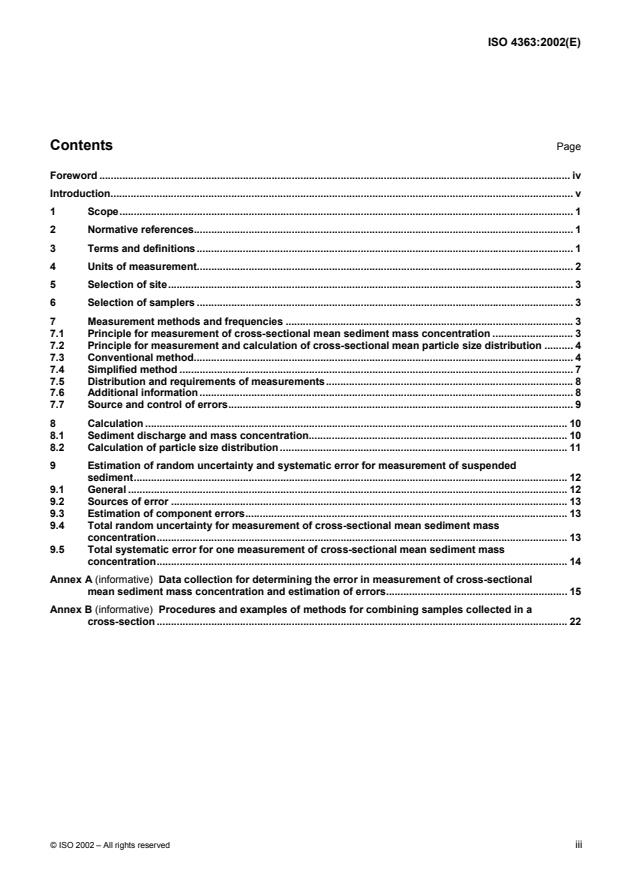
Contents Page
Foreword . iv
Introduction. v
1 Scope. 1
2 Normative references. 1
3 Terms and definitions. 1
4 Units of measurement. 2
5 Selection of site. 3
6 Selection of samplers . 3
7 Measurement methods and frequencies . 3
7.1 Principle for measurement of cross-sectional mean sediment mass concentration . 3
7.2 Principle for measurement and calculation of cross-sectional mean particle size distribution . 4
7.3 Conventional method. 4
7.4 Simplified method. 7
7.5 Distribution and requirements of measurements. 8
7.6 Additional information. 8
7.7 Source and control of errors. 9
8 Calculation. 10
8.1 Sediment discharge and mass concentration. 10
8.2 Calculation of particle size distribution. 11
9 Estimation of random uncertainty and systematic error for measurement of suspended
sediment. 12
9.1 General. 12
9.2 Sources of error . 13
9.3 Estimation of component errors. 13
9.4 Total random uncertainty for measurement of cross-sectional mean sediment mass
concentration. 13
9.5 Total systematic error for one measurement of cross-sectional mean sediment mass
concentration. 14
Annex A (informative) Data collection for determining the error in measurement of cross-sectional
mean sediment mass concentration and estimation of errors. 15
Annex B (informative) Procedures and examples of methods for combining samples collected in a
cross-section . 22
Foreword
ISO (the International Organization for Standardization) is a worldwide federation of national standards bodies (ISO
member bodies). The work of preparing International Standards is normally carried out through ISO technical
committees. Each member body interested in a subject for which a technical committee has been established has
the right to be represented on that committee. International organizations, governmental and non-governmental, in
liaison with ISO, also take part in the work. ISO collaborates closely with the International Electrotechnical
Commission (IEC) on all matters of electrotechnical standardization.
International Standards are drafted in accordance with the rules given in the ISO/IEC Directives, Part 3.
The main task of technical committees is to prepare International Standards. Draft International Standards adopted
by the technical committees are circulated to the member bodies for voting. Publication as an International
Standard requires approval by at least 75 % of the member bodies casting a vote.
Attention is drawn to the possibility that some of the elements of this International Standard may be the subject of
patent rights. ISO shall not be held responsible for identifying any or all such patent rights.
ISO 4363 was prepared by Technical Committee ISO/TC 113, Hydrometric determinations, Subcommittee SC 6,
Sediment transport.
This third edition cancels and replaces the second edition (ISO 4363:1993), which has been technically revised.
Annexes A and B of this International Standard are for information only.
iv © ISO 2002 – All rights reserved
Introduction
Sediment has been defined generally as solid particles that are moved or might be moved, by stream flow in a
channel. Sediment transportation creates numerous problems such as soil erosion, local scour, degradation and
aggradation of streams, siltation in irrigation canals and navigation channels, loss of capacity of reservoirs,
meandering of streams, damages to hydraulic machinery, etc. For solving varied sediment related issues arising
out of human endeavours for development and management of water resources, a comprehensive knowledge of
the mechanism of sediment transport and methods of determination of sediment load is highly essential.
Erosion is caused by water, wind, ice and human activities such as cultivation urbanization, mining, etc. Clods and
aggregates of soil in the catchment area are broken down into small particles which are thrown into suspension
and carried away as sediment. Not all the eroded material enters the stream channel. The total amount of eroded
material which travels from a source to a downstream measuring point is termed as sediment yield.
The purpose for making measurements on suspended sediment is to determine the variation of the cross-sectional
mean mass concentration and mean particle size distribution of suspended sediment in sediment transport
processes using appropriate methods at a suitable frequency; then to determine the characteristic values of
suspended sediment transport such as sediment load, mean particle size distribution, and sediment load of various
particle sizes in various periods by jointly using the data of water stage, discharge, and suspended sediment.
INTERNATIONAL STANDARD ISO 4363:2002(E)
Measurement of liquid flow in open channels — Methods for
measurement of characteristics of suspended sediment
1 Scope
This International Standard specifies conventional and simplified methods for the measurement of cross-sectional
mean suspended sediment mass concentration and mean particle size distribution. The conventional method is
used for routine measurements in periods of stable or slowly varied flow. The simplified method is mainly used for
sediment measurements for the purpose of observing the variation process of sediment transport and can be
performed under difficult conditions. Empirical relationships are established between the cross-sectional mean
suspended sediment mass concentrations and mean particle size distributions measured by conventional and
simplified methods.
The methods specified in this International Standard are applicable to suspended sediment measurements at
hydrological stations.
2 Normative references
The following normative documents contain provisions which, through reference in this text, constitute provisions of
this International Standard. For dated references, subsequent amendments to, or revisions of, any of these
publications do not apply. However, parties to agreements based on this International Standard are encouraged to
investigate the possibility of applying the most recent editions of the normative documents indicated below. For
undated references, the latest edition of the normative document referred to applies. Members of ISO and IEC
maintain registers of currently valid International Standards.
ISO 31 (all parts), Quantities and units
ISO 748, Measurement of liquid flow in open channels — Velocity-area methods
ISO 772, Hydrometric determinations — Vocabulary and symbols
ISO 1000, SI units and recommendations for the use of their multiples and of certain other units
ISO 3716, Liquid flow measurement in open channels — Functional requirements and characteristics of suspended
sediment load samplers
ISO 4365, Liquid flow in open channels — Sediment in streams and canals — Determination of concentration,
particle size distribution and relative density
3 Terms and definitions
For the purposes of this International Standard, the terms and definitions given in ISO 772 and the following apply.
3.1
suspended sediment discharge
mass of suspended sediment passing through a specific cross-section of streams or canals per unit time
3.2
suspended sediment load
total mass of suspended sediment, generally expressed in mass or volume of dry sediment, passing through a
specific cross-section of streams or canals in a given period of time
3.3
vertical average sediment mass concentration
ratio of the suspended sediment discharge per unit width (q ) to the flow discharge per unit width (q) in a vertical
s
3.4
cross-sectional mean sediment mass concentration
ratio of the cross-sectional suspended sediment discharge (Q ) to the cross-sectional flow discharge (Q )
A,s A
3.5
method for combining samples collected in a cross-section
method for measurement of cross-sectional mean sediment mass concentration in accordance with the segmental
discharge-weighted principle
NOTE The method involves dividing a cross-section by verticals into several segments with equal water surface width, or
equal flow area or equal discharge. Samples are taken by a specific method in each vertical passing through each segment
centre. (The flow velocity at a sediment sampling point should be measured simultaneously with the taking of the sediment
sample or as soon as practicable after the collection of the sediment sample. In rivers subjected to rapidly changing stage, it is
strongly recommended that the sediment sample be taken at the same time as the measurement of flow velocity.) Then the
sediment mass concentration of the combined samples is determined as the cross-sectional mean sediment mass
concentration.
3.6
particle size analysis
entire technological operation for determining the ratio of sediment mass of each size group to the total sediment
mass of a sample as specified in ISO 4365
3.7
particle size distribution
distribution in ratios of sediment mass of each size group to the total sediment mass of a sample
NOTE It is generally expressed in ratios of mass of sediment coarser or finer than a given diameter to the total sediment
mass of the sample.
3.8
cross-sectional mean size distribution of suspended sediment
conceptual characteristic value representing the ratios of sediment mass of each size group to the total suspended
sediment mass in the cross-section
4 Units of measurement
4.1 The International System of Units (SI Units) is used in this International Standard in accordance with ISO 31
(all parts) and ISO 1000.
4.2 The suspended sediment concentration is expressed in one of the following three ways.
a) Mass concentration of the water-sediment mixture ρ , generally expressed in milligrams per litre (mg/l),
ws
grams per litre (g/l) or kilograms per cubic metre (kg/m ), is dry sediment per unit volume of the water-
sediment mixture. This is the expression used in this International Standard.
b) Volume fraction ϕ, expressed as a percentage (%), is the ratio of the volume of sediment to the volume of the
water-sediment mixture and is given by Equation (1):
V
s
ϕ = (1)
V
ws
where
V is the volume of sediment;
s
V is the volume of the water-sediment mixture.
ws
2 © ISO 2002 – All rights reserved
c) Mass fraction, w , expressed as a percentage (%), is the ratio of the mass of dry sediment to the mass of
w
water-sediment mixture and is given by Equation (2):
ρ
ws
w = (2)
w
ρ
w
ρρ+−1
wws
ρ
s
where ρ is defined in a) and ρ and ρ are the mass concentrations of water and sediment, respectively,
ws w s
3 3
expressed in mg/l, g/l, or kg/m . If no measured data are available, ρ may be adopted as 2 650 kg/m .
s
5 Selection of site
The cross-section for measurement of suspended sediment shall preferably coincide with that for measurement of
velocity and shall meet the requirements specified in ISO 748.
6 Selection of samplers
Samplers shall conform to the requirements specified in ISO 3716.
In measurement of suspended sediment, a time-integration type sampler and an in-situ velocity measurement
device with good performance shall be used to eliminate or mitigate the influence of fluctuation of sediment
concentration.
7 Measurement methods and frequencies
7.1 Principle for measurement of cross-sectional mean sediment mass concentration
As the distributions of velocity and sediment mass concentration in a cross-section of a stream vary spatially, the
time-mean velocity v and sediment mass concentration ρ shall be measured at a number of points in the cross-
section, with each point representing a small area of dA = dhdb. From
BH BH
Qv= ddhb and Qv= ρ ddhb .
A A,s
∫∫ ∫∫
00 00
the cross-sectional flow discharge and sediment discharge can be calculated. From the definition given in 3.4, the
ρ
cross-sectional mean sediment mass concentration A is given by:
BH Q
ρρvhddb dq
A
∫∫ ∫
Q
A,s
00 0
ρ
== = (3)
A
BH Q
Q
A
vhddb
dq
A
∫∫ ∫
where
db and dh are the width and depth of the small area represented by the point, respectively;
B and H are the surface width and vertical depth of flow, respectively;
dq (= vdhdb) is the discharge passing through the small area.
A
The cross-sectional mean sediment mass concentration is determined by weighting the mass concentration for the
discharge of each section. This is the basic principle for measurement of cross-sectional mean sediment mass
concentration. In practice, it is normally simplified into the sediment discharge method and the method for
combining samples collected in a cross-section.
7.2 Principle for measurement and calculation of cross-sectional mean particle size distribution
The product of the cross-sectional mean particle size distribution and the cross-sectional sediment discharge shall
be equal to the sum of the products of segmental particle size distribution and the corresponding sediment
discharges. The cross-sectional mean particle size distribution conforms to the principle of weighting sediment
mass concentration based on water discharge. The particle size distribution determined by the method for
combining samples collected in a cross-section specified in this International Standard also conforms to the cross-
sectional mean particle size distribution.
The cross-sectional mean mass fraction of sediment finer than a given diameter in the total sediment mass of
w
sample can be expressed by Equation (4):
dA,
n
wq⋅
∑ di si
i=1
w
, = (4)
dA
n
q
si
∑
i=1
where
w is the average percentage of the mass of sediment finer than the given diameter in the total sediment
di
mass of sample for segment i;
q is the sediment discharge of segment i;
si
d is the given diameter;
n is the number of segments.
In practice, some simplified sampling methods may be designed based on the above principle. Normally, the same
sampling method for both measurements of cross-sectional mean sediment mass concentration and cross-
sectional particle size analysis may be used.
7.3 Conventional method
7.3.1 General
The conventional method is designed for measurement of cross-sectional mean sediment mass concentration in
accordance with the discharge-weighted principle. In this International Standard, the sediment discharge method
and the method for combining samples collected in a cross-section are specified with respect to their
characteristics.
7.3.2 Sediment discharge method (for measurement of sediment mass concentration)
7.3.2.1 Cross-sectional mean sediment mass concentration
In this method the cross-section is divided into several segments by verticals along the cross-section and the
velocity and sediment mass concentration are measured by the selected point method or depth integration method
in each vertical. The flow discharge and sediment discharge of each segment are calculated and totalled
respectively as the total cross-sectional flow discharge and sediment discharge. The ratio of the cross-sectional
sediment discharge to the cross-sectional flow discharge is taken as the cross-sectional mean sediment mass
concentration.
4 © ISO 2002 – All rights reserved
ρ
The cross-sectional mean sediment mass concentration determined by the sediment discharge method can be
A
expressed by Equation (5).
nn
ρ v
h
qbii
i
sii
∑∑
ii==11
ρ
== (5)
A
nn
v
h
qb
i
i
∑∑ii
ii==11
where
q and q are the sediment discharge and flow discharge passing through segment i, respectively;
si i
ρ and v are the mean sediment mass concentration and mean velocity of segment i, respectively;
i i
h and b are the mean flow depth and surface width of segment i;
i i
n is the number of segments.
Two methods, namely the mid-section method and mean-section method, are used to calculate the segmental
ρ v
sediment discharge and segmental flow discharge (see ISO 748). In using the mid-section method, i and i are
ρ v
the vertical mean values, h is the vertical depth. In using the mean-section method, i , i , and h are the
i i
average values of two neighbouring verticals.
7.3.2.2 Methods for selecting verticals
Factors such as the shape and stability of the cross-section, characteristics of lateral distribution of sediment,
sampling devices and methods, and requirement for accuracy shall be considered comprehensively for the method
for selecting verticals. The following two methods are available.
a) Method for selecting verticals at turning points of sediment discharge per unit width:
This method is applicable to the cross-sections with stable shape and lateral distributions of velocity and
sediment, and clear turning points of sediment discharge per unit width. Its main advantage is that of obtaining
relatively high accuracy using fewer verticals.
b) Method for selecting verticals at centrelines of segments with equal discharge:
This method is applicable to stable cross-sections. If it meets the requirements of equal discharge increment
(EDI) method (see 7.3.2.4), the EDI method can be used directly.
7.3.2.3 Number of verticals
The number of verticals shall be determined by analysing experimental data so as to meet the requirements for
accuracy. Generally, it shall not be less than seven verticals for a water surface width larger than 300 m or it shall
not be less than five verticals for a water surface width smaller than 300 m.
In measuring both sediment and velocity simultaneously, the number of verticals should be determined by the
requirements for discharge measurement, as this is generally more than is required for the measurement of
suspended sediment load.
7.3.2.4 Methods for sediment sampling in a vertical
In using the sediment discharge method to measure sediment, the point velocity or mean velocity in a vertical shall
be measured simultaneously. The following three methods are available.
a) Depth-integration method:
In the depth-integration method, the time-integration type sampler is moved at a uniform transit rate along the
vertical. In sampling, the moving rate of the sampler, volume of the sample should match the water depth and
flow velocity. The method is highly accurate when the water is deep, the sampler is moved slowly and the
effect of unmeasured layer near the bed is negligible.
b) Selected-point method:
It includes the two-point method (0,2h and 0,8h from water surface, where h is total vertical depth of the water),
the three-point method (0,2h, 0,6h, and 0,8h from water surface), the five-point method [near water surface,
0,2h, 0,6h, and 0,8h from water surface, and near bottom (0,95h to 0,98h)]. The one-point method (0,6h from
water surface) can be used for either low water depth or lower accuracy requirements.
NOTE The accuracy of the method for sediment sampling in a vertical can be improved by increasing the number of
sampling points in a vertical. In this case, the seven-point method (see annex A) is usually used.
c) Method for combining samples collected in a vertical:
All the samples collected in a vertical are put together as one sample and its mass concentration is taken as
the vertical mean sediment mass concentration.
The sampling points and duration for the method for combining samples collected in a vertical often used are
listed in Table 1.
Table 1 — Sampling points and duration for the method of combining samples
a b
Method
Relative depth of points (from water surface) Sampling durations
Two-point 0,2h; 0,8h 0,5t; 0,5t
Three-point 0,2h; 0,6h; 0,8h t/3, t/3; t/3
Near surface, 0,2h; 0,6h; 0,8h
Five-point 0,1t; 0,3t; 0,3t; 0,2t; 0,1t
near riverbed
NOTE Generally, the accuracy of the vertical mean sediment increases as the number of sampling points in
the vertical increases. An accurate measurement of the vertical mean sediment concentration also can be
obtained using the depth-integration method when the water depth does not exceed 4,5 m.
In using the selected-point method, a relatively long duration of sampling can eliminate the effect of fluctuation
between measured points. The depth-integration method takes samples over the whole vertical, so that a good
spatial representative sampling can be obtained. However the sampling is instantaneous and fluctuation effects
are eliminated by random compensation of all sampling points. Both the selected-point method and depth-
integration method have their own advantages and disadvantages.
In accuracy tests, the seven-point method is commonly used as a standard method to evaluate the accuracy of
other vertical sampling methods (see A.4).
a
h is total vertical depth of the water.
b
t is the total sampling duration in a vertical.
7.3.3 Methods for combining samples collected in a cross-section
7.3.3.1 General
There are three principal methods for combining samples collected in a cross-section. These methods are given in
7.3.3.2 to 7.3.3.4. Details for technical requirements and examples of methods for combining samples collected in
a cross-section are given in annex B.
7.3.3.2 Equal-width-increment (EWI) method
In this method, the cross-section is divided into several segments of equal width. Select the verticals at the
centrelines of segments. In each vertical, determine the mean sediment mass concentration using the depth-
6 © ISO 2002 – All rights reserved
integration method and/or the point sampling technique. Measure the velocity. Keep the nozzle diameter of the
sampler constant. Combine samples collected in all verticals in the cross-section into one sample and take the
sediment mass concentration as the cross-sectional mean sediment mass concentration.
7.3.3.3 Equal-area-increment (EAI) method
In this method, the cross-section is divided into several segments of equal area. Select the verticals at the centre of
segments. In each vertical, determine the mean sediment mass concentration using the depth-integration method
and/or point sampling technique. Keep the same sampling duration for all verticals. Keep the nozzle diameter of the
sampler constant. Measure the velocity. Combine samples collected in all verticals into one sample and take the
sediment mass concentration as the cross-sectional mean sediment mass concentration.
7.3.3.4 Equal-discharge-increment (EDI) method
In this method, a curve is obtained by plotting the percentage of cumulative discharge against the distance from the
left side or right side of the water surface using the discharge data. Using the curve, divide the cross-section into
several segments with equal discharge. Select the verticals at the segment centrelines. In each vertical, determine
the mean sediment mass concentration using the depth-integration method and/or the point sampling technique.
Collect the same volume from each vertical. Measure the velocity. Then combine all samples collected in the cross-
section into one sample and take the sediment mass concentration as the cross-sectional mean sediment mass
concentration.
If the volumes collected in verticals are not equal, treat each sample separately. Take the average value of
sediment mass concentrations from all verticals as the cross-sectional sediment mass concentration.
7.3.4 Sampling methods for particle size analysis
Another set of samples may be collected in all or a part of verticals for measurement of sediment mass
concentration using the same or different methods specifically for particle size analysis.
7.4 Simplified method
7.4.1 General
This method is a method for measurement of sediment mass concentration and particle size distribution in one or a
few verticals which are representative of the cross-sectional mean sediment mass concentration and the mean
particle size distribution.
7.4.2 Measurement of sediment mass concentration
7.4.2.1 Selection of sampling verticals
In the simplified method, it is necessary to statistically analyse the measured data and then to select verticals in a
cross-section. The ratio of the sediment mass concentration, obtained by the simplified method, to the cross-
sectional mean sediment mass concentration, obtained by the conventional method, shall be in the range of 0,90 to
1,10.
Sampling only in a fixed vertical is permissible if it has been established beforehand that the lateral sediment mass
concentration is stable. Otherwise, two to three verticals shall be selected based on data analysis. For composite
cross-sections where the lateral sediment mass concentration distribution varies largely with water levels, the
position of the verticals shall be selected with respect to the water levels and the data analysis.
7.4.2.2 Sampling method in verticals
The depth-integration method and method for combining samples collected in a vertical are normally to be used.
In depth-integration sampling for either a round trip of lifting and lowering or for a repeated single trip from the
bottom to the surface, use the sampler in the suspension mode.
7.4.3 Sampling method for particle size analysis
In sampling by the simplified method, the particle size distribution of sample shall be representative or have a
stable relationship with the cross-sectional mean particle size distribution. Consequently, the sampling method and
the location of verticals have to be selected using a statistical analysis of the data. Generally, the method can be
the same as that used for the measurement of sediment mass concentration. The sample used for the
measurement of the sediment mass concentration using the simplified method can also be used for particle size
analysis. If the lateral sediment particle size distribution is uneven and the particle size distribution of one vertical
has a systematic error, samples from three verticals at the thalweg, on the left side and the right side of the thalweg
shall be collected respectively, then mixed for particle size analysis to give a more representative sample.
7.4.4 Conditions for using the simplified method
If the results of the conventional and simplified methods agree well in comparing tests and the conversion
coefficient between them meets the requirements for cross-sections having a stable channel bed, lateral discharge
and sediment mass concentration distributions, then the simplified method may be used fully for later
measurements of the suspended sediment.
7.5 Distribution and requirements of measurements
7.5.1 General
The distribution of measurements is comprised of two aspects, their frequency and time intervals between
measurements. Inadequate and irregular measurements affect the accuracy of long-term sediment discharge,
particle size distribution and their characteristic values.
7.5.2 Distribution of measurements for sediment mass concentration
The distribution of suspended sediment mass concentration and sediment load generally varies over a period of a
year. Therefore, to cover the range in water discharge and sediment mass concentration, it is preferable to make
regular measurements of sediment mass concentration throughout the year.
In the dry season, if the sediment load over three consecutive months is less than 3,0 % of the annual average
sediment load and there is no special need, sediment measurements for this period may be stopped. The sediment
load during this period can be estimated to be zero.
7.5.3 Distribution of measurements for particle size analysis
The suspended sediment particle size distribution varies with the season and is also related to the sediment
source. Most of the measurements of particle size distribution should be carried out in the flood season to
represent the temporal variation of the particle size distribution. For hydrological stations where the particle size
distribution for different periods is not required, several samples per year may be collected for measurement of
particle size distribution.
Generally, long-term measurement of sediment particle size distribution need not be carried out as the particle size
distribution is unlikely to change significantly between years. After the data of wet, dry, and normal years have
been obtained, the measurement of sediment particle size distribution can be stopped.
Depending upon requirements, the measurement of the sediment mass concentration may or may not be
performed simultaneously with the measurement of the particle size distribution.
7.6 Additional information
For proper use of sediment measurement data, additional information is required. Therefore, for each suspended
sediment measurement, the following information shall be recorded in relation to the purpose of the measurement:
a) river (name);
b) river width and maximum depth;
8 © ISO 2002 – All rights reserved
c) site (name of hydrological station);
d) operator's name;
e) date;
f) weather conditions;
g) wind direction and speed;
h) air temperature;
i) water temperature;
j) sampler used;
k) time of sampling, i.e. from . to .;
l) gauge reading and discharge (at the beginning of measurement);
m) gauge reading and discharge (at the end of measurement);
n) water surface slope;
o) any other measurements taken simultaneously with the suspended sediment measurement (for example,
discharge measurement, bed load and bed material sampling, ice measurement, etc.).
7.7 Source and control of errors
7.7.1 General
Errors made when making sediment measurements mainly originate from the methods, the devices, the operation
technology, the treatment of samples and the technology of size analysis. All of these errors may cause relatively
large systematic errors. Therefore, systematic errors, having been confirmed by data analysis, shall be effectively
kept under control. Similarly, random errors shall be kept to a minimum.
7.7.2 Conventional method
7.7.2.1 In taking samples by the depth integration method, the water depth shall not be too shallow. The
distance between the sampler nozzle and the riverbed shall not be larger than 5 % of the vertical depth; and the
sampler shall be moved at a uniform transit rate. The ratio of the flow velocity at the entrance of the intake tube to
the local stream velocity shall be close to 1,0. The sampler cannot stay near the riverbed when its intake is open. If
o
the deviation of the cable suspending the sampler from the vertical exceeds 30 in fast flow, the depth integration
method is unsuitable.
7.7.2.2 In taking samples by the selected-point method, the sampling points shall be appropriately located. For
the five-point method, the lowest sampling point shall be located at a relative depth of 0,95 to 0,98.
7.7.2.3 Verticals for sediment sampling shall be placed at the turning points of lateral distribution of water
depth, flow velocity and sediment mass concentration. The number of verticals shall not be less than half of that for
the velocity measurement.
7.7.2.4 The accuracy of various methods for combining samples collected in a cross-section shall be checked
by the sediment discharge method. The selected method shall meet the requirement of accuracy.
7.7.3 Simplified method
The positions of verticals in the simplified method shall be determined by data analysis. The ratio of the sediment
mass concentration by the simplified method to the cross-sectional mean sediment mass concentration by the
sediment discharge method shall be in the range of 0,95 to 1,05. If the ratio is outside this range, the positions of
the verticals shall be readjusted. Significant systematic deviation shall not exist between the particle size
distribution by the simplified method and the cross-sectional mean particle size distribution by the sediment
discharge method. Otherwise, the positions of verticals shall be readjusted to meet the requirements of accuracy.
Sampling using the simplified method shall be repeated once.
8 Calculation
8.1 Sediment discharge and mass concentration
8.1.1 Sediment mass concentration
If using the mass of dry sediment in a unit volume of water-sediment mixture to express sediment mass
concentration, the sediment mass concentration of the sample can be calculated by the following equation:
m
ρ =
V
where
ρ is the sediment mass concentration, expressed in the unit specified in 4.2 a);
m is the mass, expressed in milligrams, grams or kilograms, of dry sediment in the sample;
V is the volume, expressed in litres or cubic metres, of the sample.
The sediment mass concentration of the sample determined using the depth integration method or the method for
combining samples collected in a vertical can be taken as the vertical mean sediment mass concentration. The
sediment mass concentration of the sample determined using the method for combining samples collected in a
cross-section can be taken as the cross-sectional mean sediment mass concentration.
The readings of an in-situ measurement device or its transmitted readings can be taken as the measured sediment
mass concentration.
The sediment mass concentration can be expressed in other forms by deriving its definition or converting
Equations (1) and (2).
8.1.2 Mean sediment mass concentration in a vertical
8.1.2.1 When sampling using the depth integration method or the method for combining samples collected in a
vertical, the sediment mass concentration can be taken as the mean sediment mass concentration in a vertical.
8.1.2.2 When sampling using the selected point method and measuring the velocity, the mean sediment mass
ρ
concentration in a vertical, v , can be calculated by one of the following equations.
For the two-point method:
vvρρ+
0,2 0,2 0,8 0,8
ρ
v = (7)
vv+
0,2 0,8
For the three-point method:
vvρρ++vρ
0,2 0,2 0,6 0,6 0,8 0,8
ρ
= (8)
v
vvv++
0,2 0,6 0,8
10 © ISO 2002 – All rights reserved
For the five-point method:
ρ
=+(3vvvρ ρρρ+3 +2v+vρ) (9)
v
0,00,0 0,2 0,2 0,60,6 0,80,8 1,0 1,0
v
v
where
vv,,.v are the velocities, expressed in metres per second (m/s), at the points 0,0h, 0,2h, .1,0h from
0,0 0,2 1,0
the water surface, respectively;
ρ ,,ρρ. are the sediment mass concentration (mg/l, g/l or kg/m ) at the points of 0,0h, 0,2h, .1,0h
0,0 0,2 1,0
from the water surface, respectively.
1
v
v = (3vvvv++++3 2 v) is the mean velocity in a vertical.
0,0 0,2 0,6 0,8 1,0
NOTE ρ is the sediment mass concentration at the level closest to the riverbed.
1,0
8.1.3 Cross-sectional sediment discharge and mean sediment mass concentration
8.1.3.1 The universal equation for the calculation of the cross-sectional sediment discharge Q is:
A,s
nn
Qq== ρq (10)
Ai,s∑∑s ii
ii==11
where q , ρ and q are the sediment discharge, sediment mass concentration, and flow discharge of segment i,
si i i
respectively.
In calculating the segmental sediment discharge by the mid-section method, ρ is the mean sediment mass
i
concentration of vertical i.
In calculating the segmental sediment discharge by the mean-section method, ρ , is the average sediment mass
i
concentration of two neighbouring verticals of segment i.
ρ
8.1.3.2 The cross-sectional mean sediment mass concentration, can be calculated in accordance with
A
Equation (11):
Q
A,s
ρ
= (11)
A
Q
A
where
Q is the cross-sectional flow discharge;
A
Q is the cross-sectional sediment discharge.
A,s
8.2 Calculation of particle size distribution
8.2.1 Vertical mean particle size distribution
8.2.1.1 The particle size distribution resulting from using the depth integration method or using the method for
combining samples collected in a vertical can be taken as the vertical mean particle size distribution.
8.2.1.2 In taking samples and measuring velocity by the selected point method, the vertical mean particle size
w
distribution , i.e. the percentage (%) of the mass of sediment finer than a given diameter accounting for the
d,v
total sediment mass of the sample, can be calculated by the following equations:
For the two-point method:
wvρρ+wv
dd0,2 0,2 0,2 0,8 0,8 0,8
w
= (12)
d,v
vvρρ+
0,2 0,2 0,8 0,8
For the three-point method:
wvρρ++w v wvρ
dd0,2 0,2 0,2 0,6 0,6 0,6d0,8 0,8 0,8
w
d,v = (13)
vvρρ++vρ
0,2 0,2 0,6 0,6 0,8 0,8
For the five-point method:
wv ρ++33wvρρρw v++2wv w vρ
ddd0,0 0,0 0,0 0,2 0,2 0,2 0,6 0,6 0,6d0,8 0,8 0,8d1,0 1,0 1,0
w = (14)
d,v
vvρ++33ρρρv ++2v vρ
0,0 0,0 0,2 0,2 0,6 0,6 0,8 0,8 1,0 1,0
where w , w , ., w are the percentages (%) of the masses of sediment finer than the given diameter at the
d0,0 d0,2 d1,0
points of 0,0h, 0,2h, ., 1,0h from the water surface accounting for the total sediment mass of the sample,
respectively.
8.2.2 Cross-sectional mean particle size distribution
The cross-sectional mean particle size distribution can be determined by the following.
a) Particle size distribution resulting from the sample combined to obtain cross-sectional mean sediment mass
concentration may be taken as the cross-sectional mean particle size distribution.
b) In the case where data from individual samples are to be used, the cross-sectional mean particle size
distribution can be calculated from Equation (4).
9 Estimation of random uncertainty and systematic error for measurement of
suspended sediment
9.1 General
The mass concentration and the particle size distribution of suspended sediment are dynamic variables without
repeatability. It is impossible to measure them directly, without error at a point, or indirectly as the cross-sectional
mean values. The aims of setting up this International Standard are to keep systematic error strictly under control,
to minimize random error and to eliminate any false error so as to ensure the necessary accuracy of measurement
and to check and evaluate the quality of measurements.
Error and uncertainty are two different but relevant variables. Error is defined as the difference between the
observed and the true values. Uncertainty is defined as a range in which the true value of the measured variable is
expected to fall at a specified probability. In this International Standard, the probability is specified as 95 %, the
corresponding uncertainty is 1,96 times the standard error.
As relatively large systematic error easily occurs in the measurement of suspended sediment, it is the main factor
affecting measurement quality but it can be identified and kept under control. Therefore in this International
Standard, random error and systematic error are treated individually.
12 © ISO 2002 – All rights reserved
9.2 Sources of error
Measurements of different sediment characteristics have different sources of error. Err
...
Frequently Asked Questions
ISO 4363:2002 is a standard published by the International Organization for Standardization (ISO). Its full title is "Measurement of liquid flow in open channels - Methods for measurement of characteristics of suspended sediment". This standard covers: ISO 4363:2002 specifies conventional and simplified methods for the measurement of cross-sectional mean suspended sediment mass concentration and mean particle size distribution. The conventional method is used for routine measurements in periods of stable or slowly varied flow. The simplified method is mainly used for sediment measurements for the purpose of observing the variation process of sediment transport and can be performed under difficult conditions. Empirical relationships are established between the cross-sectional mean suspended sediment mass concentrations and mean particle size distributions measured by conventional and simplified methods. The methods specified in ISO 4363:2002 are applicable to suspended sediment measurements at hydrological stations.
ISO 4363:2002 specifies conventional and simplified methods for the measurement of cross-sectional mean suspended sediment mass concentration and mean particle size distribution. The conventional method is used for routine measurements in periods of stable or slowly varied flow. The simplified method is mainly used for sediment measurements for the purpose of observing the variation process of sediment transport and can be performed under difficult conditions. Empirical relationships are established between the cross-sectional mean suspended sediment mass concentrations and mean particle size distributions measured by conventional and simplified methods. The methods specified in ISO 4363:2002 are applicable to suspended sediment measurements at hydrological stations.
ISO 4363:2002 is classified under the following ICS (International Classification for Standards) categories: 17.120.20 - Flow in open channels. The ICS classification helps identify the subject area and facilitates finding related standards.
ISO 4363:2002 has the following relationships with other standards: It is inter standard links to ISO 4363:1993. Understanding these relationships helps ensure you are using the most current and applicable version of the standard.
You can purchase ISO 4363:2002 directly from iTeh Standards. The document is available in PDF format and is delivered instantly after payment. Add the standard to your cart and complete the secure checkout process. iTeh Standards is an authorized distributor of ISO standards.
Questions, Comments and Discussion
Ask us and Technical Secretary will try to provide an answer. You can facilitate discussion about the standard in here.
Loading comments...