


ISO 12122-5:2018
(Main)Timber structures — Determination of characteristic values — Part 5: Mechanical connections
Timber structures — Determination of characteristic values — Part 5: Mechanical connections
This document gives methods of determination of characteristic values for a defined population of mechanical connections between timber components, calculated from full scale test values. It presents methods for the determination of: a) slip modulus of mechanical connections; b) characteristic strength of connections subjected to either monotonic or cyclic loads. Glued connections are excluded from the scope of this document. NOTE 1 It is assumed that the failure mode is the same for all specimens in the sample. NOTE 2 When a small number of test results is available, ISO 12122‑6 is used for the determination of the mean and the 5th percentile values. NOTE 3 Informative commentary to the clauses of this document can be found in Annex A.
Structures en bois — Détermination des valeurs caractéristiques — Partie 5: Assemblages
General Information
- Status
- Published
- Publication Date
- 12-Nov-2018
- Technical Committee
- ISO/TC 165 - Timber structures
- Drafting Committee
- ISO/TC 165/WG 10 - Characteristic values and design specifications
- Current Stage
- 9093 - International Standard confirmed
- Start Date
- 16-Apr-2024
- Completion Date
- 12-Feb-2026
Relations
- Effective Date
- 06-Jun-2022
Overview
ISO 12122-5:2018 - "Timber structures - Determination of characteristic values - Part 5: Mechanical connections" provides standardized methods to derive characteristic values (statistical design properties) for mechanical connections between timber components from full‑scale test results. The document covers calculation of the slip modulus and characteristic strength for connections under monotonic and cyclic loading. Glued connections are excluded. The standard assumes a consistent failure mode across specimens and references ISO 12122‑1 for basic requirements.
Key topics and requirements
- Reference population definition: Describe connector materials, dimensions, assembly method, timber species and density range, geometric details (end/edge distances, spacings), and moisture exposure conditions.
- Sampling and sample size: Sampling must represent the reference population and follow ISO 12122‑1. Sample size should account for expected coefficient of variation.
- Sample conditioning: Test specimens must be conditioned to match the declared reference population. For connectors driven into timber (nails, toothed plates) allow a minimum of seven days between assembly and testing for fibre relaxation.
- Test methods and data:
- Monotonic tests - follow ISO 6891 or equivalent.
- Cyclic tests - follow ISO 16670 or equivalent.
- Record peak (maximum) loads, stiffness (slip modulus), yield/ultimate displacements and failure modes.
- Only include data where the observed failure mode is appropriate to the measured property.
- Evaluation of characteristic values:
- Calculate mean, 5th percentile (lower characteristic for strength), and 95th percentile (upper characteristic for stiffness) with prescribed confidence limits.
- When sample size is small, use ISO 12122‑6 for estimating mean and 5th percentile.
- Reporting: Test conditions, adjustments, failure modes and statistical treatment must be documented; Annex A provides informative commentary.
Applications and users
ISO 12122‑5 is used by:
- Test laboratories performing connector performance tests.
- Manufacturers of mechanical fasteners, plates, bolts, screws and connector assemblies for timber.
- Structural engineers and designers validating connector capacities for design or for producing calibrated design values.
- Certification bodies and researchers establishing performance data for timber connections. Practical uses include generating validated slip modulus and capacity data for structural calculations, product datasheets, and regulatory compliance.
Related standards
- ISO 12122‑1 (Basic requirements for determining characteristic values)
- ISO 12122‑6 (Small sample procedures)
- ISO 6891 (Mechanical fastener joint testing principles)
- ISO 16670 (Quasi‑static reversed‑cyclic test method)
- ISO 8970 (Timber density declaration)
Keywords: ISO 12122‑5:2018, timber structures, mechanical connections, characteristic values, slip modulus, monotonic loading, cyclic loading, connector testing, sample conditioning.
Get Certified
Connect with accredited certification bodies for this standard

ICC Evaluation Service
Building products evaluation and certification.

QAI Laboratories
Building and construction product testing and certification.

Aboma Certification B.V.
Specialized in construction, metal, and transport sectors.
Sponsored listings
Frequently Asked Questions
ISO 12122-5:2018 is a standard published by the International Organization for Standardization (ISO). Its full title is "Timber structures — Determination of characteristic values — Part 5: Mechanical connections". This standard covers: This document gives methods of determination of characteristic values for a defined population of mechanical connections between timber components, calculated from full scale test values. It presents methods for the determination of: a) slip modulus of mechanical connections; b) characteristic strength of connections subjected to either monotonic or cyclic loads. Glued connections are excluded from the scope of this document. NOTE 1 It is assumed that the failure mode is the same for all specimens in the sample. NOTE 2 When a small number of test results is available, ISO 12122‑6 is used for the determination of the mean and the 5th percentile values. NOTE 3 Informative commentary to the clauses of this document can be found in Annex A.
This document gives methods of determination of characteristic values for a defined population of mechanical connections between timber components, calculated from full scale test values. It presents methods for the determination of: a) slip modulus of mechanical connections; b) characteristic strength of connections subjected to either monotonic or cyclic loads. Glued connections are excluded from the scope of this document. NOTE 1 It is assumed that the failure mode is the same for all specimens in the sample. NOTE 2 When a small number of test results is available, ISO 12122‑6 is used for the determination of the mean and the 5th percentile values. NOTE 3 Informative commentary to the clauses of this document can be found in Annex A.
ISO 12122-5:2018 is classified under the following ICS (International Classification for Standards) categories: 91.080.20 - Timber structures. The ICS classification helps identify the subject area and facilitates finding related standards.
ISO 12122-5:2018 has the following relationships with other standards: It is inter standard links to ISO 4833-2:2013/Amd 1:2022. Understanding these relationships helps ensure you are using the most current and applicable version of the standard.
ISO 12122-5:2018 is available in PDF format for immediate download after purchase. The document can be added to your cart and obtained through the secure checkout process. Digital delivery ensures instant access to the complete standard document.
Standards Content (Sample)
INTERNATIONAL ISO
STANDARD 12122-5
First edition
2018-11
Timber structures — Determination
of characteristic values —
Part 5:
Mechanical connections
Structures en bois — Détermination des valeurs caractéristiques —
Partie 5: Assemblages
Reference number
©
ISO 2018
© ISO 2018
All rights reserved. Unless otherwise specified, or required in the context of its implementation, no part of this publication may
be reproduced or utilized otherwise in any form or by any means, electronic or mechanical, including photocopying, or posting
on the internet or an intranet, without prior written permission. Permission can be requested from either ISO at the address
below or ISO’s member body in the country of the requester.
ISO copyright office
CP 401 • Ch. de Blandonnet 8
CH-1214 Vernier, Geneva
Phone: +41 22 749 01 11
Fax: +41 22 749 09 47
Email: copyright@iso.org
Website: www.iso.org
Published in Switzerland
ii © ISO 2018 – All rights reserved
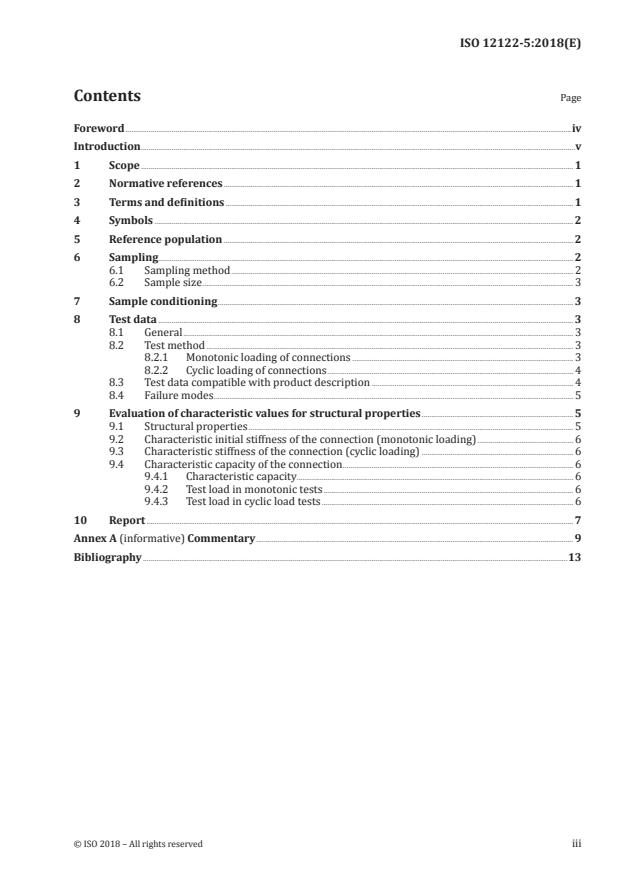
Contents Page
Foreword .iv
Introduction .v
1 Scope . 1
2 Normative references . 1
3 Terms and definitions . 1
4 Symbols . 2
5 Reference population . 2
6 Sampling . 2
6.1 Sampling method . 2
6.2 Sample size . 3
7 Sample conditioning . 3
8 Test data . 3
8.1 General . 3
8.2 Test method . 3
8.2.1 Monotonic loading of connections . 3
8.2.2 Cyclic loading of connections . 4
8.3 Test data compatible with product description . 4
8.4 Failure modes . 5
9 Evaluation of characteristic values for structural properties . 5
9.1 Structural properties . 5
9.2 Characteristic initial stiffness of the connection (monotonic loading) . 6
9.3 Characteristic stiffness of the connection (cyclic loading) . 6
9.4 Characteristic capacity of the connection . 6
9.4.1 Characteristic capacity. 6
9.4.2 Test load in monotonic tests . 6
9.4.3 Test load in cyclic load tests . 6
10 Report . 7
Annex A (informative) Commentary . 9
Bibliography .13
Foreword
ISO (the International Organization for Standardization) is a worldwide federation of national standards
bodies (ISO member bodies). The work of preparing International Standards is normally carried out
through ISO technical committees. Each member body interested in a subject for which a technical
committee has been established has the right to be represented on that committee. International
organizations, governmental and non-governmental, in liaison with ISO, also take part in the work.
ISO collaborates closely with the International Electrotechnical Commission (IEC) on all matters of
electrotechnical standardization.
The procedures used to develop this document and those intended for its further maintenance are
described in the ISO/IEC Directives, Part 1. In particular, the different approval criteria needed for the
different types of ISO documents should be noted. This document was drafted in accordance with the
editorial rules of the ISO/IEC Directives, Part 2 (see www .iso .org/directives).
Attention is drawn to the possibility that some of the elements of this document may be the subject of
patent rights. ISO shall not be held responsible for identifying any or all such patent rights. Details of
any patent rights identified during the development of the document will be in the Introduction and/or
on the ISO list of patent declarations received (see www .iso .org/patents).
Any trade name used in this document is information given for the convenience of users and does not
constitute an endorsement.
For an explanation of the voluntary nature of standards, the meaning of ISO specific terms and
expressions related to conformity assessment, as well as information about ISO's adherence to the
World Trade Organization (WTO) principles in the Technical Barriers to Trade (TBT) see www .iso
.org/iso/foreword .html.
This document was prepared by Technical Committee ISO/TC 165, Timber structures.
Any feedback or questions on this document should be directed to the user’s national standards body. A
complete listing of these bodies can be found at www .iso .org/members .html.
A list of all parts in the ISO 12122 series can be found on the ISO website.
iv © ISO 2018 – All rights reserved
Introduction
This document sets out a framework for establishing characteristic values from test results on a
sample drawn from a clearly defined reference population of connections. The characteristic value is an
estimate of the property of the reference population with a consistent level of confidence prescribed in
this document.
This document is intended to be used in conjunction with ISO 12122-1.
This document permits the evaluation of characteristic values from testing on connections made with
commercial components.
In some cases, characteristic values determined in accordance with this document may be modified to
become a design value.
INTERNATIONAL STANDARD ISO 12122-5:2018(E)
Timber structures — Determination of characteristic
values —
Part 5:
Mechanical connections
1 Scope
This document gives methods of determination of characteristic values for a defined population of
mechanical connections between timber components, calculated from full scale test values.
It presents methods for the determination of:
a) slip modulus of mechanical connections;
b) characteristic strength of connections subjected to either monotonic or cyclic loads.
Glued connections are excluded from the scope of this document.
NOTE 1 It is assumed that the failure mode is the same for all specimens in the sample.
NOTE 2 When a small number of test results is available, ISO 12122-6 is used for the determination of the
th
mean and the 5 percentile values.
NOTE 3 Informative commentary to the clauses of this document can be found in Annex A.
2 Normative references
The following documents are referred to in the text in such a way that some or all of their content
constitutes requirements of this document. For dated references, only the edition cited applies. For
undated references, the latest edition of the referenced document (including any amendments) applies.
ISO 6891, Timber structures — Joints made with mechanical fasteners — General principles for the
determination of strength and deformation characteristics
ISO 12122-1, Timber structures — Determination of characteristic values — Part 1: Basic requirements
ISO 16670, Timber structures — Joints made with mechanical fasteners — Quasi-static reversed-cyclic
test method
3 Terms and definitions
For the purposes of this document, the following terms and definitions apply.
ISO and IEC maintain terminological databases for use in standardization at the following addresses:
— ISO Online browsing platform: available at https: //www .iso .org/obp
— IEC Electropedia: available at http: //www .electropedia .org/
3.1
mechanical connection
assembly of one or more timber components connected directly together or connected together with
components made from other materials
Note 1 to entry: Other materials include steel dowels, bolts, nails, screws, shear connectors and plates.
3.2
test load
peak load achieved for each test specimen for both monotonic and cyclic tests
3.3
ultimate displacement
displacement associated with the maximum load or peak load or ultimate load, F , determined in
max
accordance with ISO 16670
4 Symbols
F estimated maximum load, in newtons
est
F maximum load or peak load or ultimate load, in newtons
max
υ yield displacement (determined only if a clear yield point can be established)
y
5 Reference population
In addition to the requirements for definition of the reference population in ISO 12122-1, the following
attributes of connections shall be described:
a) the material of the connecting components;
b) the dimensions of the connecting components;
c) the method of assembly;
d) the dimensions of the assembly, in particular end distances, edge distances and connector spacings;
e) the species and density range of timber used in the connections;
f) the presence or exclusion of specified features (e.g. knots or finger joints) in or near the connection;
g) the moisture exposure conditions (before and after specimen preparation);
h) the moisture conditions when the specimen is installed and tested (e.g. installed dry and tested
dry, installed wet and tested wet, installed dry and tested wet, installed wet and tested dry).
NOTE Where the densities of timber components comply with ISO 8970, this can be declared as part of the
reference population.
6 Sampling
6.1 Sampling method
The sampling method shall comply with the performance objective of sampling defined in ISO 12122-1.
Representation of each of the variants in the sample shall approximate the representation of the same
variants in the reference population.
2 © ISO 2018 – All rights reserved
Where the reference population includes a range of end distances, edge distances and connector
spacings, the sampling method shall ensure that the range of densities is covered in each variation of
dimensions.
NOTE A major variation is the range in individual properties of the timber components that make up the
connection.
6.2 Sample size
The sample size shall comply with the requirements of ISO 12122-1 and shall take into account the
coefficient of variation expected for the timber components in the reference population.
NOTE ISO 12122-1 gives some guidance on selecting the sample size.
7 Sample conditioning
The sample storage and testing environment shall reflect conditioning in accordance with the definition
of the reference population as indicated in ISO 12122-1.
For specimens that are constructed by forcing the connecting component into the timber (e.g. nails and
toothed plates), a minimum period of seven days shall elapse between assembly and testing of the test
specimens to allow for fibre relaxation.
NOTE 1 A case can be made for an allowance of shorter conditioning periods if all timber components are dry
at the time of fabrication and testing.
For reference populations in which the connections are constructed in a wet state but are dry during
service, appropriate conditioning shall be required for the test specimens to simulate these conditions.
NOTE 2 Such conditioning requires an appropriate time delay between connection construction and testing to
ensure that the service condition is replicated (this can be days or weeks).
8 Test data
8.1 General
This document uses data obtained from testing undertaken to relevant testing standards for mechanical
connections. Test loading of connections is undertaken either in a linear form (i.e. load versus
displacement) or an angular form (i.e. moment versus rotation). For the purposes of this document,
moment and rotation may be substituted for load and displacement respectively.
8.2 Test method
8.2.1 Monotonic loading of connections
The test data shall be obtained from:
a) tests that follow the principles of ISO 6891;
b) tests in accordance with the ISO document relevant to the connection; or
c) a standard test method appropriate for the reference population provided equivalency factors with
the relevant ISO document can be established.
The selection of test variables shall be appropriate to the objectives of the testing, and can require
some adjustments specified in 8.3.
NOTE 1 Test methods involve many variables that affect results including loading configuration and rates,
specimen positioning and measurement methods.
The peak load for each test specimen in a monotonic test, F , shall be recorded (see Figure 1).
max
NOTE 2 If a clear yield point can be obtained, then the yield can also be recorded.
Key
F/F load divided by estimated maximum load
est
F specimen peak load, expressed in newtons
max
t time
a
Displacement controlled.
Figure 1 — Monotonic test sequence
8.2.2 Cyclic loading of connections
The test data shall be obtained from:
a) tests that follow the principles of ISO 16670;
b) tests in accordance with the ISO document relevant to the connection; or
c) a standard test method appropriate for the reference population provided equivalency factors with
the relevan
...
Questions, Comments and Discussion
Ask us and Technical Secretary will try to provide an answer. You can facilitate discussion about the standard in here.
Loading comments...