

ISO 16484-3:2005
(Main)Building automation and control systems (BACS) — Part 3: Functions
General Information
- Abstract
ISO 16484-3:2005 specifies the requirements for the overall functionality and engineering services to achieve building automation and control systems. It defines terms, which shall be used for specifications and it gives guidelines for the functional documentation of project/application specific systems. It provides a sample template for documentation of plant/application specific functions, called BACS points list. The informative function block examples explain a method to display the referenced functions in system documentation; they do not standardize the method for programming functions and applications. ISO 16484-3:2005 covers requirements and definitions regarding BACS and application software, generic functions for plant/project specific applications and engineering functions for building controls and operations. It provides communication functions for the integration of other dedicated special system processes. ISO 16484-3:2005 defines a method for specifying the procurement specifications containing all essential elements required for the operational functioning of a BACS. The successful installation and operation of a BACS requires that its procurement be based on a complete and accurate functional specification.
- Status
- Published
- Publication Date
- 11-Apr-2005
- Technical Committee
- ISO/TC 205 - Building environment design
- Drafting Committee
- ISO/TC 205/WG 3 - Building Automation and Control System (BACS) Design
- Current Stage
- 9092 - International Standard to be revised
- Start Date
- 07-Apr-2025
- Completion Date
- 29-Aug-2026
Buy Documents

ISO 16484-3:2005 - Building automation and control systems (BACS) — Part 3: Functions Released:11/12/2007

ISO 16484-3:2005 - Systemes de gestion technique du bâtiment (SGTB) — Partie 3: Fonctions Released:11/12/2007
Overview
ISO 16484-3:2005 - “Building automation and control systems (BACS) - Part 3: Functions” defines the functional requirements, terminology and documentation methods needed to specify, procure and engineer building automation and control systems. The standard focuses on BACS functions, application software and engineering services, and supplies a template (the BACS function list, or BACS FL) to document project‑specific datapoints and functions. Annex A is normative (BACS FL); Annex B provides informative examples (function blocks and control schematics).
Key topics and technical requirements
- Functional scope and terminology: Defines terms and symbols to ensure unambiguous specifications and consistent documentation across projects.
- Functional documentation template: Provides a sample BACS points list / BACS function list to capture all operational elements required for procurement and commissioning.
- Software and function types: Covers system management, application software, human system interface programs, communication functions for integrating dedicated subsystems, service/commissioning functions and the operating system requirements.
- Engineering process guidance: Describes the engineering workflow, project‑specific system design, hardware configuration, control strategy configuration and commissioning tools.
- I/O, processing, management and operator functions: Specifies generic function types for inputs/outputs, processing logic, management services and operator interfaces required for building controls and operations.
- Integration and communication: Defines how communication functions should support integration of other special systems (lighting, security, energy management, etc.), and how functional specification supports interoperability.
- Procurement and quality: Establishes the method for creating procurement specifications that include all essential functional elements to assure successful installation and operation.
Applications
ISO 16484-3:2005 is used to:
- Produce complete functional specifications and tender documents for BACS procurement.
- Document project‑specific datapoints and control functions systematically (using the BACS FL).
- Guide engineering, commissioning and verification of HVAC, lighting, energy and other building control applications.
- Provide a common language for integration of disparate building systems and for future expansions or retrofits.
Who uses this standard
- Building owners and facility managers preparing specifications.
- Architects and consulting engineers designing control strategies.
- System integrators, manufacturers and contractors developing or delivering BACS solutions.
- Commissioning teams, maintenance staff and training organizations.
Related standards
ISO 16484 series (other parts) for complementary topics:
- Part 2: Hardware
- Part 5: Data communication (protocol)
- Part 6: Conformance testing
- Parts 4 and 7: (applications and project implementation - under development)
Keywords: ISO 16484-3:2005, BACS, building automation and control systems, BACS function list, functional specification, building controls, system integration, engineering, commissioning.
Relations
- Effective Date
- 25-Aug-2026
- Consolidates
EN ISO 16484-3:2005 - Building automation and control systems (BACS) - Part 3: Functions (ISO 16484-3:2005) - Effective Date
- 12-Feb-2026
Buy Documents
ISO 16484-3:2005 - Building automation and control systems (BACS) — Part 3: Functions Released:11/12/2007
ISO 16484-3:2005 - Systemes de gestion technique du bâtiment (SGTB) — Partie 3: Fonctions Released:11/12/2007
Get Certified
Connect with accredited certification bodies for this standard

BSI Group
BSI (British Standards Institution) is the business standards company that helps organizations make excellence a habit.

DIBt (Deutsches Institut für Bautechnik)
German Institute for Building Technology.
DIN CERTCO
DIN Group product certification.
Sponsored listings
Frequently Asked Questions
ISO 16484-3:2005 is a standard published by the International Organization for Standardization (ISO). Its full title is "Building automation and control systems (BACS) — Part 3: Functions". This standard covers: ISO 16484-3:2005 specifies the requirements for the overall functionality and engineering services to achieve building automation and control systems. It defines terms, which shall be used for specifications and it gives guidelines for the functional documentation of project/application specific systems. It provides a sample template for documentation of plant/application specific functions, called BACS points list. The informative function block examples explain a method to display the referenced functions in system documentation; they do not standardize the method for programming functions and applications. ISO 16484-3:2005 covers requirements and definitions regarding BACS and application software, generic functions for plant/project specific applications and engineering functions for building controls and operations. It provides communication functions for the integration of other dedicated special system processes. ISO 16484-3:2005 defines a method for specifying the procurement specifications containing all essential elements required for the operational functioning of a BACS. The successful installation and operation of a BACS requires that its procurement be based on a complete and accurate functional specification.
ISO 16484-3:2005 specifies the requirements for the overall functionality and engineering services to achieve building automation and control systems. It defines terms, which shall be used for specifications and it gives guidelines for the functional documentation of project/application specific systems. It provides a sample template for documentation of plant/application specific functions, called BACS points list. The informative function block examples explain a method to display the referenced functions in system documentation; they do not standardize the method for programming functions and applications. ISO 16484-3:2005 covers requirements and definitions regarding BACS and application software, generic functions for plant/project specific applications and engineering functions for building controls and operations. It provides communication functions for the integration of other dedicated special system processes. ISO 16484-3:2005 defines a method for specifying the procurement specifications containing all essential elements required for the operational functioning of a BACS. The successful installation and operation of a BACS requires that its procurement be based on a complete and accurate functional specification.
ISO 16484-3:2005 is classified under the following ICS (International Classification for Standards) categories: 35.240.67 - IT applications in building and construction industry; 91.040.01 - Buildings in general. The ICS classification helps identify the subject area and facilitates finding related standards.
ISO 16484-3:2005 has the following relationships with other standards: It is inter standard links to EN ISO 16484-1:2010, EN ISO 16484-3:2005. Understanding these relationships helps ensure you are using the most current and applicable version of the standard.
ISO 16484-3:2005 is available in PDF format for immediate download after purchase. The document can be added to your cart and obtained through the secure checkout process. Digital delivery ensures instant access to the complete standard document.
Standards Content (Sample)
INTERNATIONAL ISO
STANDARD 16484-3
First edition
2005-01-15
Corrected version
2007-11-15
Building automation and control systems
(BACS) —
Part 3:
Functions
Systèmes de gestion technique du bâtiment (SGTB) —
Partie 3: Fonctions
Reference number
©
ISO 2005
PDF disclaimer
This PDF file may contain embedded typefaces. In accordance with Adobe's licensing policy, this file may be printed or viewed but
shall not be edited unless the typefaces which are embedded are licensed to and installed on the computer performing the editing. In
downloading this file, parties accept therein the responsibility of not infringing Adobe's licensing policy. The ISO Central Secretariat
accepts no liability in this area.
Adobe is a trademark of Adobe Systems Incorporated.
Details of the software products used to create this PDF file can be found in the General Info relative to the file; the PDF-creation
parameters were optimized for printing. Every care has been taken to ensure that the file is suitable for use by ISO member bodies. In
the unlikely event that a problem relating to it is found, please inform the Central Secretariat at the address given below.
© ISO 2005
All rights reserved. Unless otherwise specified, no part of this publication may be reproduced or utilized in any form or by any means,
electronic or mechanical, including photocopying and microfilm, without permission in writing from either ISO at the address below or
ISO's member body in the country of the requester.
ISO copyright office
Case postale 56 • CH-1211 Geneva 20
Tel. + 41 22 749 01 11
Fax + 41 22 749 09 47
E-mail copyright@iso.org
Web www.iso.org
Published in Switzerland
ii © ISO 2005 – All rights reserved
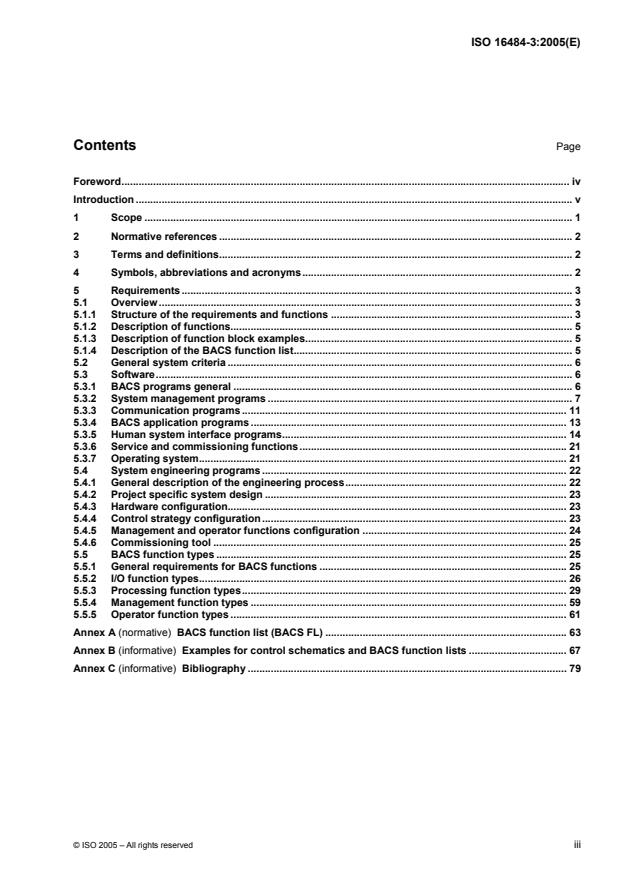
Contents Page
Foreword. iv
Introduction . v
1 Scope . 1
2 Normative references . 2
3 Terms and definitions. 2
4 Symbols, abbreviations and acronyms. 2
5 Requirements . 3
5.1 Overview . 3
5.1.1 Structure of the requirements and functions . 3
5.1.2 Description of functions. 5
5.1.3 Description of function block examples. 5
5.1.4 Description of the BACS function list. 5
5.2 General system criteria . 6
5.3 Software. 6
5.3.1 BACS programs general . 6
5.3.2 System management programs . 7
5.3.3 Communication programs . 11
5.3.4 BACS application programs . 13
5.3.5 Human system interface programs. 14
5.3.6 Service and commissioning functions.21
5.3.7 Operating system. 21
5.4 System engineering programs . 22
5.4.1 General description of the engineering process. 22
5.4.2 Project specific system design . 23
5.4.3 Hardware configuration. 23
5.4.4 Control strategy configuration . 23
5.4.5 Management and operator functions configuration . 24
5.4.6 Commissioning tool . 25
5.5 BACS function types . 25
5.5.1 General requirements for BACS functions . 25
5.5.2 I/O function types. 26
5.5.3 Processing function types. 29
5.5.4 Management function types . 59
5.5.5 Operator function types . 61
Annex A (normative) BACS function list (BACS FL) . 63
Annex B (informative) Examples for control schematics and BACS function lists . 67
Annex C (informative) Bibliography . 79
Foreword
ISO (the International Organization for Standardization) is a worldwide federation of national standards bodies
(ISO member bodies). The work of preparing International Standards is normally carried out through ISO
technical committees. Each member body interested in a subject for which a technical committee has been
established has the right to be represented on that committee. International organizations, governmental and
non-governmental, in liaison with ISO, also take part in the work. ISO collaborates closely with the
International Electrotechnical Commission (IEC) on all matters of electrotechnical standardization.
International Standards are drafted in accordance with the rules given in the ISO/IEC Directives, Part 2.
The main task of technical committees is to prepare International Standards. Draft International Standards
adopted by the technical committees are circulated to the member bodies for voting. Publication as an
International Standard requires approval by at least 75 % of the member bodies casting a vote.
Attention is drawn to the possibility that some of the elements of this document may be the subject of patent
rights. ISO shall not be held responsible for identifying any or all such patent rights.
ISO 16484-3 was prepared by the European Committee for Standardization (CEN) Technical Committee
CEN/TC 247, Building automation, controls and building management, in collaboration with Technical
Committee ISO/TC 205, Building environment design, in accordance with the Agreement on technical
cooperation between ISO and CEN (Vienna Agreement)
This corrected version of ISO 16484-3:2005 contains numerous changes to be consistent with
EN/ISO 16484-3:2005.
ISO 16484 consists of the following parts under the general title Building automation and control systems
(BACS):
⎯ Part 2: Hardware
⎯ Part 3: Functions
⎯ Part 5: Data communication protocol
⎯ Part 6: Data communication conformance testing
Two parts are under development:
⎯ Part 4 dealing with applications
⎯ Part 7 dealing with project implementation
Annex A (normative): BACS function list (BACS FL), forms a normative part of this standard.
The Annex B (informative): Examples for control schematic and BACS function list, and Annex C (informative):
Bibliography, are for information only.
NOTE National annexes may contain information provided for easier implementation of the standard, e.g. an
alphabetical index or national footnotes.
iv © ISO 2005 – All rights reserved
Introduction
This series of standards is intended for design of new buildings and retrofit of existing buildings for an
acceptable indoor environment, practical energy conservation, and efficiency.
The application of this series of standards for BACS is envisaged as follows:
- the environmental design for all building types requires complex methods for automation and control. The
functional integration of services other than HVAC is a general task for all parties employed to develop an
integrated multi-application system. The Integration comprises, e.g. lighting and electric power distribution
control, security control, transportation, maintenance management, or facilities management. This system
integration allows the user to take advantage of synergies between the different applications. This standard
will give guidance to architects, consultants, and contractors as well as to users on how to share such
resources;
- the innovation cycles between devices, systems, and networks vary. To make it possible to add and to
change existing devices, and extend the building automation and control network, several interfaces both
proprietary and standardized are defined between the BACS network and the other systems. A manufacturer
can design a product, both to meet his specific marketing objectives and to give the option to integrate that
special device into a multi-application BACS. Interfaces are also defined in appropriate parts of this standard
along with the necessary communications protocol and conformance test required to support the inter-working
of devices;
- a manufacturer, a systems house, or an electrical or mechanical contractor can assemble an implementation
of a building automation and control system;
- the application of this standard is not to standardize the hardware and software design or the architecture of
a System, but to define the process for the creation of project specifications, where functionality and the
quality of the solution are clearly defined.
The purpose of this series of standards is intended for use by those involved in the design, manufacture,
engineering, installation, commissioning, operational maintenance and training of BACS when contracted, i.e.:
⎯ as a guide to the terminology of the building automation and control trade. Unambiguous terminology is
required for a complete and accurate conveyance of the intent and details of this standard;
⎯ in product development, to avoid unnecessary duplication of function or terminology, but should not place
a restraint on the evolution of new products, systems or applications;
⎯ as a basis for interfacing products and systems. In order to interoperate, the elements of a BACS require
a unified data communication protocol and information model;
⎯ as a basis for drawing up a project specification for the procurement of building automation and control
products for systems suppliers and customers;
⎯ as a code of practice for expertly commissioning prior to handover of a system;
⎯ by educational establishments wishing to train people in the field of building automation and control
systems.
This entire series of BACS standards consists of the following contents:
Part 1: Overview and definitions (withdrawn)
Part 2: Hardware
Part 2 of this standard specifies the requirements for the hardware to perform the tasks within a BACS. It
provides the terms, definitions, and abbreviations for the understanding of Part 2 and Part 3.
Part 2 relates only to physical items/devices, i.e.:
⎯ operator stations and other human system interface devices;
⎯ devices for management functions;
⎯ control devices, automation stations and application specific controllers;
⎯ field devices and their interfaces;
⎯ cabling and interconnection of devices;
⎯ engineering and commissioning tools.
This part of this standard shows a generic system model to which all-different types of BACS and their
interconnections (BACS network) can fit. A graphical concept of the BACS network in terms of LAN and inter-
network topology will be provided in Part 5 of this standard.
National annexes:
National annexes may specify the local requirements of physical and electrical characteristics, the verifications
for BACS devices and equipment, and the code of practice for the physical installation of systems. The
annexes shall refer to the regional implementations of the relevant IEC standards.
Part 3: Functions (refer to the scope of this part)
Part 4: Applications
Part 4 of this standard specifies the requirements for specific communicating applications/devices, e.g. for
general room automation and for sophisticated optimization of controls for heating, fan coil and induction units,
CAV, VAV and radiant cooling.
This work will be coordinated at expert level with standards work from ISO/TC 205 WG 3 and CEN/TC 247.
Part 5: Data Communication – Protocol
Part 5 of this standard specifies data communication services and objects for computer equipment and
controllers used for monitoring and control of HVAC&R and other systems of building services.
This protocol provides a comprehensive set of object types for conveying encoded binary, analog, and
alphanumeric data between devices including, but not limited to:
⎯ input measuring: analog input object;
⎯ output positioning/setpoint: analog output object;
⎯ binary input counting;
⎯ input state: binary input object, multi-state input;
⎯ output switching: binary output object, multi-state output;
⎯ values: analog value, binary value, multi-state value, accumulated value, averaging object, trend log
object;
⎯ text string;
vi © ISO 2005 – All rights reserved
⎯ schedule information;
⎯ alarm and event information;
⎯ files; and
⎯ control programs and parameters respectively.
This protocol models each building automation and control system as a collection of data structures called
object types, the properties of which represent various aspects of the hardware, software, and operation of the
device. These objects provide a means of identifying and accessing information without requiring knowledge
of the details of the device's internal design or configuration.
NOTE An overview of possible integration with other systems in buildings, e.g. fire, security, access control,
maintenance and facilities management, is shown in Figure 1 of Part 2 of this standard.
Part 6: Data communication conformance testing
Part 6 of this standard specifies the technical requirements of the conformance test suite and the methods for
testing the products for the conformance with the protocol. It provides a comprehensive set of procedures for
verifying the correct implementation of each capability claimed on a BACS network protocol implementation
conformance statement (PICS) including:
⎯ support of each claimed BACS network service, either as a client (initiator), server (executor), or both;
⎯ support of each claimed BACS network object-type, including both required properties and each claimed
optional property;
⎯ support of the BACS network layer protocol;
⎯ support of each claimed data link option, and
⎯ support of all claimed special functionality.
Part 7: Project implementation
Part 7 of this standard specifies methods for project specification and implementation of BACS and for
integration of other systems into the BACS. This standard defines terms to be used for project specifications
and gives guidelines for integration of other systems.
a) Project specification and implementation:
This clause of the standard describes the procedures (codes of practice) required for the following:
⎯ project specification:
These procedures also contain an example for a plant/system/customer premises wide unique
structured addressing system for data point identification;
⎯ engineering;
⎯ installation;
⎯ project handover.
b) System integration:
This clause of the standard describes the special requirements/procedures for the integration and
implementation of intersystem communication with foreign systems and the interconnection of other
units/devices with integrated communications interfaces, e.g. chillers, elevators.
Building automation and control systems (BACS) —
Part 3:
Functions
1 Scope
This International Standard specifies the characteristics of software and functions used in Building automation
and control systems as well as a method for documentation of the design. It gives guidelines for the
engineering. It specifies a template for documentation of plant/application specific datapoints and functions,
called BACS function list in annex A.
The informative function block examples explain a method to display the referenced functions in system
documentation; they do not standardize the method for programming functions and applications.
This International Standard covers the following:
Requirements and definitions regarding BACS and application software, generic function types for
plant/project specific applications and engineering functions for building controls and operations. It provides
communication functions for the integration of other dedicated special system processes. The functional
requirements in this part of the standard are subdivided as follows:
⎯ System management and application software:
This clause describes the requirements for plant independent system and human system interface programs
related to a project, including the operating system. This standard does not dedicate the following system
functionality to any particular hardware, e.g.:
⎯ system diagnostics, watchdog, redundancy, time keeping, access control, log lists;
⎯ point identification, event message handling, print control;
⎯ database, statistics, data archiving, remote access;
⎯ system communications.
⎯ Human system interface (HSI), point information presentation, graphics, alarms, time scheduling
⎯ Engineering process and tool software:
This clause describes the requirements for configuring of the hardware and control strategies, the system
management, and the commissioning process.
⎯ BACS application processing programs and plant/application specific function types:
This clause describes the requirements for plant, application, and / or project specific functions and a method
for the documentation of a project. The functions are subdivided into the following types:
⎯ input and output functions;
⎯ processing functions;
⎯ management functions and required communications;
⎯ operator functions.
This International Standard defines a method for creating the procurement specifications containing all
essential elements required for the operational functioning of a BACS. The successful installation and
operation of a BACS requires that its procurement be based on a complete specification with accurate
functions.
The standard provides a template called the ‘BACS function list’ that can be found in annex A (normative). Its
purpose is to determine and document the options for plant / application specific functionality. Further
explanations can be given in form of plant/control descriptions, control flow chart diagrams, and plant/control
schematics. Examples are given in annex B (informative). The exact specifications will be project-specific.
Information about the standardized functions is given in the form of informative examples as function-blocks,
textual, and graphical descriptions in 5.5.
It is recognized, that functions can be described and implemented in many different ways, depending on:
⎯ climatic differences;
⎯ cultural and regional differences;
⎯ national regulations.
2 Normative references
The following referenced documents are indispensable for the application of this International Standard. For
dated references, only the edition cited applies. For undated references, the latest edition of the referenced
document (including any amendments) applies.
ISO 10628:1997, Flow diagrams for process plants — General rules
ISO 16484-2:2004, Building automation and control systems (BACS) — Part 2: Hardware
ISO 16484-5, Building automation and control systems (BACS) — Part 5: Data communication protocol
1)
IEC 60617-12:1997 , Graphical symbols for diagrams — Part 12: Binary logic elements
1)
IEC 60617-13:1993 , Graphical symbols for diagrams — Part 13: Analogue elements
3 Terms and definitions
For the purposes of this International Standard, the terms and definitions given in ISO 16484-2:2004 apply.
4 Symbols, abbreviations and acronyms
For the purposes of this standard, the symbols, abbreviations and acronyms given in ISO 16484-2:2004 apply.
NOTE The abbreviations used and explained within the tables for the function block examples are for information only.
1) Withdrawn. Replaced by IEC 60617:2001.
2 © ISO 2005 – All rights reserved
5 Requirements
5.1 Overview
5.1.1 Structure of the requirements and functions
5.1.1.1 General
This standard does not dedicate the system functionality to any particular hardware. The functional
requirements in this part of the standard are subdivided as follows:
⎯ system application and management software:
describes the requirements for plant independent system programs and human system interface
programs related to a project in general;
⎯ engineering and commissioning tools:
describes the requirements for the configuration of hardware, of control strategies and management
functions,
and the commissioning process;
⎯ project/plant specific functions:
describes the requirements for plant applications and/or project specific functions and methods for the
functional documentation of project and/or application specific systems.
The functions of a BACS in general are structured into three levels. These levels indicate functions for
⎯ management,
⎯ automation/control as processing functions, and
⎯ input/output as interface to field devices.
Operator functions are not assigned to a specific level.
NOTE Requirements for the hardware and communication means to perform the BACS software and functions that
are specified in Part 2 of this standard.
5.1.1.2 Operator functions
Human system interface for plant operation, i.e. for supervision, alarm annunciation, state monitoring and
human interaction are not assigned to any functional level.
The range of functionality covers:
a) system management, event management and state management, parameter adjustment and manual
on/off control;
b) local room operation;
c) local override/indication device functions to provide restricted access for service operation;
d) system engineering and servicing, engineered operator functions are, e.g. dynamic display, event
instruction text, remote messaging (see 5.5.5).
NOTE Human system interface devices in a BACS are on different types of hardware, as specified in Part 2:
- direct acting elements, as switches and signal lights;
- local override and/or indication devices;
- handheld units;
- monitoring and operator units or panels;
- operator stations including visual display units and
- Internet based browsers.
A VDU can provide a graphical user interface.
5.1.1.3 Management functions
Management functions are performed by the software of a BACS. The plant/application specific management
functions are for the activity of a user taking decisions for supervision of plant and evaluating energy use and
operational costs. The required functionality at this level is:
a) communications with devices of the control network, and any attached foreign systems;
b) communications for data exchange with dedicated special, or foreign systems to provide for operator and
management functions within the BACS;
c) recording, archiving and statistical analysis;
d) decision support for e.g. energy management.
5.1.1.4 Processing function types
The plant/project specific application software and parameters provide all automatic functionality for building
services in real-time within self-contained controllers/automation stations. The required groups of processing
function types are:
a) monitoring;
b) interlocks;
c) closed loop and open loop control;
d) calculation/cross plant/system optimization;
e) room control functions, e.g. individual zone control, lighting control, shades/blinds control, details will be
given in Part 4.
5.1.1.5 I/O function types
The I/O functions provide the interface between processing functions and the field devices. These function
types are subdivided in
a) physical input and output functions, and
b) shared input and output functions for communication with foreign products.
5.1.1.6 Field devices
Field devices are generally sensors and actuators, coupling units and local override/indication devices that are
connected to input/output interfaces of controllers/automation stations. Field devices can be connected to
controllers via field network or direct wiring. The field devices perform connection to the physical items of plant
providing the necessary information about the conditions, states, and values of the processes and effect the
programmed operations. Functions supported by field devices are
a) Switching;
b) Positioning;
4 © ISO 2005 – All rights reserved
c) state monitoring;
d) counting, and
e) measuring.
NOTE For field device requirements see Part 2 of this standard.
5.1.2 Description of functions
The normative functional descriptions within this section are provided for use by the specifier, e.g. consultant,
to describe the project functionality. The descriptions in 5.5 contain no direct hardware related specifications,
but the number of input and output functions help to determine the required physical or communication inputs
and outputs of a BACS, the processor performance, and memory size.
NOTE For the required hardware components see Part 2 of this standard.
For each project the system programs and the plant/application specific functions are to be specified to
determine the required engineering services.
The plant specific functions can be documented in plant/control schematics, control flow chart diagrams and
the BACS function list, preferred as spreadsheet for further data processing, which is shown in annex A as a
template.
Some complex projects and/or sophisticated control algorithms for optimal control performance require
additional information and methods in order to describe the requirements clearly and completely. These
additional requirements include plant and control descriptions, control flow charts, psychrometric charts, reset
schedules, field device mounting instructions/illustrations.
Annex B provides informative examples to indicate methods for creation of accurate documentation for a
design project.
5.1.3 Description of function block examples
This standard has adopted (where appropriate) a function block (FB) method of describing BACS applications.
2)
The FB examples are designed according to the graphical symbols for diagrams in IEC 60617-12 , Binary
2)
logic elements and in IEC 60617-13 , Analog elements.
The information in the FB examples provides common wording and descriptions of BACS functions. The
terminology provided by these descriptions should be used in any discussions and documents that represent
BACS applications. This involves describing inputs, outputs, parameters and functions in a common textual
and graphic format. A complete application scheme can be engineered using a series of interconnected
function blocks as shown in the informative examples. The function block principle can be used to introduce
new BACS functions and can be referred to using the BACS FL.
5.1.4 Description of the BACS function list
5.1.4.1 Scope
The BACS FL shown in annex A is based on the definitions in 5.5, and it provides the following benefits:
⎯ the determination of functions is based on the plant/control schematic, the plant/control description and
the control flow chart diagram if necessary;
2) Withdrawn. Replaced by IEC 60617:2001.
⎯ it allows one to determine the number of engineered function types for specific projects by using a spread
sheet program that provides for electronic data interchange;
⎯ it provides a common structured method for the plant/system design and specifying process;
⎯ it provides for the use of a unique structured point naming convention or addressing system, required
in 5.3.2.7;
⎯ the structured numbering scheme for the sections and columns of functions provides for the addition of
individually defined functions in the given categories, if required.
5.1.4.2 Purpose
The BACS FL allows a supplier-independent description of the controls requirements. It can be used for
tendering, costing, and billing purposes, although this aspect of its use is outside the scope of this standard. It
should be considered that the main expenditure when implementing a BACS is in the engineering. These
efforts are in direct relation to the number and type of functions required for the application.
BACS specifications shall contain all relevant detailed documents required to fully interpret the overall
functionality. This should enable comparable and thought through bids at tendering.
For each plant to be controlled and supervised a plant control schematic shall be drawn. The data points,
processing functions, and communication functions for complete control, as well as human system interface
for operation, energy, and maintenance management can be listed in a separate BACS FL by the specifier.
The control flow chart method or a state machine diagram can be used for description and documentation of
extensive control strategies and interlocks.
5.2 General system criteria
A BACS mainly consists of field and control devices, switchgear assembly, cabling, network, communication,
and computing devices (hardware), system software and functions achieved by engineering services.
Decisions regarding functionality are normally defined before determination of the structure and the hardware
of a BACS.
The following descriptions define the performance criteria and options to be specified and stated in each
project regarding the manufacturer specific and the project specific application software.
NOTE For Hardware requirements refer to Part 2 of this standard.
5.3 Software
5.3.1 BACS programs general
For this standard the software of a BACS is subdivided into
⎯ system management programs;
⎯ communication programs;
⎯ general application and optimization programs;
⎯ human system interface programs;
⎯ engineering programs.
6 © ISO 2005 – All rights reserved
5.3.2 System management programs
5.3.2.1 General
System management involves the initialization (see Part 2, 3.99), co-ordination, and maintenance of all
configuration information (see Part 2, 3.47) relating to the operation of the system as a whole including
network management. Each system function may be configured manually or automatically.
Remote system management and human system interface for system maintenance capabilities shall be
specified. These programs need not be mandatory due to system size and resources.
5.3.2.2 System time keeping
The management methods for time, date, and calendar within all management and control functions shall be
stated.
Performance criteria for system time keeping are:
1) internal/external clock, type of external clock;
2) system clock accuracy;
3) overall system time synchronization, e.g. by radio clock;
4) summer/winter time change handling for daylight savings;
5) change of time and date for local data processing device or server station;
6) change of time and date for networked and stand-alone devices.
5.3.2.3 Watchdog functions
Watchdog function requirements and system responses in case of a fault shall be specified for each project.
5.3.2.4 System diagnostics
Devices and functions of a BACS are supported by diagnostic tools to ensure constant operation, quality, and
performance. The system's diagnostic features monitor a variety of functions and report on failure situations,
or invoke corrective actions. Remote system diagnostics capabilities shall clearly be specified. The system
diagnostic features shall indicate:
a) memory usage and system resources;
b) failure percentage of communication activity on all system networks;
c) causes of system failures.
Further system diagnostic features shall be stated for a specific project.
5.3.2.5 Power down management and recovery
Any consequences due to loss of power shall be specified, i.e. for:
a) power down;
b) power return;
c) associated internal system functions;
Additionally, the requirements shall be specified for
d) operator initiated power on/off operation,
e) system power failure return method, and
f) uninterruptible power supply (UPS) options.
5.3.2.6 System activity logbook
A record of all system activity and events should be kept with date and time for subsequent displaying, printing,
and archiving. The full extent of system operations held within the system activity logbook is to be specified.
5.3.2.7 Point identification
For information accessing and processing within a BACS it is necessary to establish a project specific,
unambiguous naming convention for identification of all physical and virtual data points. Point addresses are
used for accessing and displaying information provided by functions throughout the system(s).
NOTE Point addresses used by an operator at the HSI are referred to as mnemonics or user addresses.
Point addresses within a BACS have to be unique and shall exist within a unique structure for a plant, a
system, or the entire customer premises. Associated descriptive text displayed with the information of data
points should be provided. The means by which the user interface navigates to the data point information shall
be specified.
For point information presentation requirements refer to 5.3.5.9.
Typical elements of user addresses in a BACS addressing system are: site, building, part, location (e.g. floor),
plant type (e.g. HVAC), plant number, type of function, information number. There are also customer specific
data point designation systems according to established standards possible.
5.3.2.8 System access control
A number of access levels defined in profiles shall be provided to protect the system from misuse. The
number and relevance of these access levels have to be specified e.g.:
Table 1 — access control levels
Level Activity
No password: Read only, restricted access to specific information
Level 1: Routine daily operations only allowed
Level 2: Operator access to all non configurable functions
Level 3: Engineering access, required to configure the entire system.
A BACS shall provide for all dialog oriented operator interfaces an operator/user authentication for
corroboration that the operator logging on to a device is identified to be the entity claimed.
For user access control requirements refer to 5.3.5.5.
5.3.2.9 Operator activity logbook
The extent of operations held within the operator activity logbook for subsequent displaying, printing and
archiving is to be specified. This can include a record of all operators logging in and out, with name, date and
time, command, event acknowledgment, parameter, and password change.
8 © ISO 2005 – All rights reserved
5.3.2.10 Data usage and storage
Change of state or change of value data sent from I/O, processing or other management functions can be
stored and shall be provided with a date and time stamp for subsequent analysis. This program refers to the
management functions event storage/historical database, BACS FL, col. 7.3/7.4, as specified in 5.5.4.3.
The requirements are subdivided into system specific and project specific features.
5.3.2.10.1 System specific features for data storage
The features required shall be specified:
a) type of inputs into log files;
EXAMPLE A Log entry can be: event, alarm, state message, measured value, totalized value, system failure log,
user message log.
b) minimum required number of records of each log file or database;
c) post collection format of provided alarm/event/measure log/counter log and system information data;
d) the means of retrieving the data;
e) search facilities provided for querying each of the lists;
f) print facilities offered.
Performance criteria:
1) maximum number of log lists as files on the data storage;
2) maximum number of entries per log list;
3) maximum number and types of records managed.
5.3.2.10.2 Project specific features of the database
The features required shall be specified:
a) log lists for states and values (e.g. alarm and/or maintenance criteria);
b) historical database, e.g. for statistical analysis, quality control;
c) system documentation.
The supplier shall state the type of database management system (DBMS) software and original license
provider with respect to copyright laws.
Performance criteria if DBMS software is used:
1) maximum number of entries in database;
2) data storage space used for application software and parameters;
3) data storage space proposed for user data;
4) method of filtering employed;
EXAMPLE Selection by message type, by plant address, by function type etc.
5) accuracy of time stamping;
6) resolution of time stamp.
5.3.2.11 Data archiving
Data gathered by the function historical data, described in 5.5.4.3, and other system data can be permanently
archived using a data archiving method, e.g. file server, tape data storage, CD-ROM. For cross-reference see
also backup and restore in 5.3.2.13.
Performance criteria:
1) maximum number, size and types of records managed;
2) if applicable: type of DBMS software and original license provider shall be stated with respect to
copyright laws.
5.3.2.12 Data import/export
Data that is intended to be used by a dedicated special system, often a third party or foreign system, shall be
made available by the source database, if required. Any capability that the data processing device or server
station has for import/export data is to be clearly specified.
The data format and, e.g., record type, descriptors, texts, delimiter to separate variables are to be specified.
Performance criteria:
1) import format of data for the data processing device or server station;
2) import format of data for onward transmission to controllers/automation stations;
3) export format of data collected from controllers/automation stations.
5.3.2.13 Backup and restore
At least one complete backup of all software and project specific data shall be given to the responsible user.
The way in which a user can make a full back up and restore of all functions and their configuration data at all
relevant levels shall be specified. Backup media to be used shall be specified.
Performance criteria:
⎯ Time needed for complete system backup and restoring.
5.3.2.14 Redundancy
Any capability for the use of multiple hardware to automatically overcome the failure of any piece(s) of
equipment is to be stated. The requested capability for stand-by operation shall be stated with respect to:
a) power supply;
b) processing unit;
c) input/output unit;
d) network interface/access unit and data interface unit;
e) hard disk e.g. RAID level;
10 © ISO 2005 – All rights reserved
f) main memory;
g) visual display;
h) keyboard, mouse/other pointing device;
i) printer failure/out of paper.
5.3.3 Communication programs
5.3.3.1 Communication interfaces
In case there is not a unique network for all functional network levels as shown in Figure 1 of Part 2 of this
standard, the typical data exchange communication interfaces (hardware and drivers) can be manufacturer
specific or standardized communication protocol(s).
For the management network (MN), proven international standards for LAN should be employed.
The failure of a part of a communication system shall not cause a disturbance or the failure of the whole
communication system for the BACS.
The network/bus architecture shall allow for testing and analyzing for each communication partner.
Communication services and objects for system neutral data transmission in BACS applications are described
in ISO 16484-5.
If manufacturer specific protocols are used, driver and protocol software for foreign data interfaces and their
description shall be supplied to allow project implementation, if required.
Performance criteria:
1) number of communication interfaces to be used simultaneously;
EXAMPLE Interface to router, gateway, MN, CN, FN, PU, MOU, DSS.
2) supported standardized protocols, degree of conformance or statement of interoperability;
3) peer to peer communication ability;
4) maximum baud rate of each communication network;
5) supported MODEM functionality;
EXAMPLE Capacity of phone numbers to be called automatically, automatic callback.
6) performance of MODEM interface by means of baud rate, data compression, data encryption;
7) conformance to international data transmission standards/national regulations.
5.3.3.2 Remote operation
The set up method for remote communications between management devices in distributed systems and
MOU/PU, is to be specified.
The functions offered by remote access shall be specified:
a) access to current live values and states;
b) automatic dial-up to demand receipt of alarms;
© IS
...
NORME ISO
INTERNATIONALE 16484-3
Première édition
2005-01-15
Systèmes de gestion technique du
bâtiment (SGTB) —
Partie 3:
Fonctions
Building automation and control systems (BACS) —
Part 3: Functions
Numéro de référence
©
ISO 2005
PDF – Exonération de responsabilité
Le présent fichier PDF peut contenir des polices de caractères intégrées. Conformément aux conditions de licence d'Adobe, ce fichier
peut être imprimé ou visualisé, mais ne doit pas être modifié à moins que l'ordinateur employé à cet effet ne bénéficie d'une licence
autorisant l'utilisation de ces polices et que celles-ci y soient installées. Lors du téléchargement de ce fichier, les parties concernées
acceptent de fait la responsabilité de ne pas enfreindre les conditions de licence d'Adobe. Le Secrétariat central de l'ISO décline toute
responsabilité en la matière.
Adobe est une marque déposée d'Adobe Systems Incorporated.
Les détails relatifs aux produits logiciels utilisés pour la création du présent fichier PDF sont disponibles dans la rubrique General Info
du fichier; les paramètres de création PDF ont été optimisés pour l'impression. Toutes les mesures ont été prises pour garantir
l'exploitation de ce fichier par les comités membres de l'ISO. Dans le cas peu probable où surviendrait un problème d'utilisation,
veuillez en informer le Secrétariat central à l'adresse donnée ci-dessous.
DOCUMENT PROTÉGÉ PAR COPYRIGHT
© ISO 2005
Droits de reproduction réservés. Sauf prescription différente, aucune partie de cette publication ne peut être reproduite ni utilisée sous
quelque forme que ce soit et par aucun procédé, électronique ou mécanique, y compris la photocopie et les microfilms, sans l'accord écrit
de l'ISO à l'adresse ci-après ou du comité membre de l'ISO dans le pays du demandeur.
ISO copyright office
Case postale 56 • CH-1211 Geneva 20
Tel. + 41 22 749 01 11
Fax. + 41 22 749 09 47
E-mail copyright@iso.org
Web www.iso.org
Version française parue en 2007
Publié en Suisse
ii © ISO 2005 – Tous droits réservés
Sommaire Page
Avant-propos. iv
Introduction . v
1 Domaine d'application. 1
2 Références normatives . 2
3 Termes et définitions. 3
4 Symboles, abréviations et mnémoniques. 3
5 Exigences . 3
5.1 Vue d’ensemble. 3
5.1.1 Organisation de l’expression des exigences fonctionnelles et des fonctions . 3
5.1.2 Descriptions des fonctions. 5
5.1.3 Description des exemples de blocs de fonctions . 6
5.1.4 Liste des fonctions GTB . 6
5.2 Critères généraux relatifs au système. 7
5.3 Logiciels . 7
5.3.1 Logiciel de GTB - Généralités. 7
5.3.2 Programmes de gestion du système. 7
5.3.3 Système de communication . 12
5.3.4 Logiciels d’application GTB . 14
5.3.5 Programme de l’interface homme-machine. 16
5.3.6 Fonctions de mise en service et d’entretien. 23
5.3.7 Système d’exploitation. 23
5.4 Fonctions d’ingénierie et de configuration.25
5.4.1 Généralités concernant le déroulement des opérations d’ingénierie et de configuration . 25
5.4.2 Conception du système . 25
5.4.3 Ingénierie de configuration du matériel . 25
5.4.4 Configuration des automatismes et de la régulation. 26
5.4.5 Configuration des fonctions de gestion. 27
5.4.6 Fonctionnalités des outils de mise en service . 28
5.5 Fonctions type d’une GTB . 28
5.5.1 Généralités . 28
5.5.2 Fonctions d’entrées/sorties. 29
5.5.3 Fonctions de traitement . 32
5.5.4 Fonctions de gestion. 63
5.5.5 Fonctions opérateurs . 65
Annexe A (normative) Liste des fonctions GTB. 69
Annexe B (informative) Exemples de schémas de procédés et listes des fonctions GTB. 74
Annexe C (informative) Bibliographie . 87
Avant-propos
L'ISO (Organisation internationale de normalisation) est une fédération mondiale d'organismes nationaux de
normalisation (comités membres de l'ISO). L'élaboration des Normes internationales est en général confiée
aux comités techniques de l'ISO. Chaque comité membre intéressé par une étude a le droit de faire partie du
comité technique créé à cet effet. Les organisations internationales, gouvernementales et non
gouvernementales, en liaison avec l'ISO participent également aux travaux. L'ISO collabore étroitement avec
la Commission électrotechnique internationale (CEI) en ce qui concerne la normalisation électrotechnique.
Les Normes internationales sont rédigées conformément aux règles données dans les Directives ISO/CEI,
Partie 2.
La tâche principale des comités techniques est d'élaborer les Normes internationales. Les projets de Normes
internationales adoptés par les comités techniques sont soumis aux comités membres pour vote. Leur
publication comme Normes internationales requiert l'approbation de 75 % au moins des comités membres
votants.
L'attention est appelée sur le fait que certains des éléments du présent document peuvent faire l'objet de
droits de propriété intellectuelle ou de droits analogues. L'ISO ne saurait être tenue pour responsable de ne
pas avoir identifié de tels droits de propriété et averti de leur existence.
L'ISO 16484-3 a été élaborée par le comité technique CEN/TC 247, Automatisation, régulation et gestion
technique du bâtiment, du Comité européen de normalisation (CEN) en collaboration avec le comité technique
ISO/TC 205, Conception de l'environnement intérieur des bâtiments, conformément à l'Accord de coopération
technique entre l'ISO et le CEN (Accord de Vienne).
L'ISO 16484 comprend les parties suivantes, présentées sous le titre général Systèmes de gestion technique
du bâtiment (SGTB):
⎯ Partie 2: Équipement
⎯ Partie 3: Fonctions
⎯ Partie 5: Protocole de communication de données
⎯ Partie 6: Essais de conformité de la communication de données
Deux autres parties sont en préparation:
⎯ Partie 4, portant sur les applications
⎯ Partie 7, portant sur la mise en œuvre des projets
La présente version française de l’ISO 16484-3:2005 correspond à la version anglaise corrigée du 2007-11-15.
L’Annexe A, Liste des fonctions GTB, est une annexe normative.
L’Annexe B, Exemples de schémas et listes de fonctions GTB de procédés, ainsi que l’Annexe C,
Bibliographie, sont des annexes informatives.
NOTE Des annexes nationales peuvent contenir des informations (index alphabétique ou notes de bas de page
nationales) permettant de faciliter la mise en œuvre de la norme.
iv © ISO 2005 – Tous droits réservés
Introduction
La présente série de normes est destinée à la conception de constructions neuves et à la réhabilitation de
bâtiments. Elle a pour but de concilier l’obtention d’une environnement intérieur satisfaisant, un bilan
d’exploitation correct, et une efficacité énergétique optimum.
L’application de cette série de normes GTB est envisagée dans le contexte suivant:
⎯ La conception de tout type de bâtiment, dans une perspective de développement durable, exige l’emploi
d’automatismes complexes. L’intégration, dans un système multifonctionnel, de l’automatisation de
services autres que le chauffage, la ventilation et la climatisation constitue une tâche commune, à
assumer par la totalité des intervenants. Cette intégration porte sur des services tels que l’éclairage et la
distribution électriques, la sécurité et la sûreté, le transport des personnes et des biens, la gestion de la
maintenance et du patrimoine. Une telle intégration permet à l’utilisateur final de profiter des synergies
entre les différentes applications. La présente Norme offre aux architectes, aux consultants, aux
différents maîtres d’œuvre et aux utilisateurs finaux, un guide méthodologique favorisant le partage de
ces ressources.
⎯ La durée de vie, sur le marché, d’une génération de produits, varie fortement entre équipements
d’automatismes, systèmes et réseaux. Pour rendre possibles l’ajout et/ou le remplacement
d’équipements et de dispositifs d’automatismes existants, ainsi que le déploiement des réseaux, par
étapes, on recourt à des interfaces standardisées ou propriétaires entre GTB et systèmes tiers. Un
fabricant peut élaborer un produit dans le but, à la fois, de satisfaire à ses objectifs marketing spécifiques
et d’autoriser l’intégration de tel ou tel dispositif/équipement dans un GTB multidisciplinaire. Les
interfaces, les protocoles de communication et les essais de conformité garantissant l’interopérabilité des
équipements sont définis dans les parties appropriées de la norme.
⎯ Un constructeur, un intégrateur, un ensemblier, doivent pouvoir y trouver un guide de configuration et de
mise en œuvre d’un système d’automatismes et de gestion du bâtiment.
⎯ La présente norme ne vise pas à normaliser la conception matérielle ou logicielle des GTB, ni leur
architecture, mais à définir le processus par lequel des spécifications de projets claires, comprenant une
description des fonctionnalités et du niveau de qualité des solutions requis, doivent être produites.
La présente série de normes s’adresse à l’ensemble des acteurs impliqués dans la conception, la construction,
les mises en œuvre et en service, la maintenance opérationnelle et la formation des utilisateurs de GTB. Pour
ce public, elle constitue:
⎯ une référence de la terminologie en usage dans les domaines de l’automatisation et de la gestion
technique du bâtiment, prérequis évitant toute ambiguïté et assurant la transmission complète et exacte
des intentions et des détails de la norme;
⎯ un guide de développement des produits, permettant d’éviter les redondances superflues dans les
fonctions ou la terminologie, sans pour autant constituer un frein à l’évolution des produits, systèmes et
applications;;
⎯ une plate-forme documentaire pour l’interfaçage de produits et de systèmes. Les interactions entre les
éléments d’un GTB exigent un modèle de structure de données et un ensemble de protocoles de
communication communs;
⎯ une référence et un guide pour la rédaction des spécifications d’appel d’offres, contractuelles entre clients
et fournisseurs, dans le domaine de l’automatisation du bâtiment;
⎯ un guide pratique des procédures de mise en service, avant réception d’un système;
⎯ une référence documentaire pour les établissements d’enseignement et de formation aux systèmes
d’automatisation ou de gestion technique du bâtiment.
La série complète des normes GTB comprend les parties suivantes:
Partie 1: Vue d’ensemble et définitions (annulée)
Partie 2: Équipement
La partie 2 de cette norme spécifie les exigences relatives aux matériels constituant la plate-forme de GTB.
Elle comprend les termes, abréviations et définitions nécessaires à la compréhension des parties 2 et 3.
Elle ne concerne que les éléments ou dispositifs physiques, tels que:
⎯ les stations de travail des opérateurs et autres interfaces homme – machine;
⎯ les dispositifs pour les fonctions de gestion;
⎯ les automates de régulation, automates concentrateurs, automates dédiés;
⎯ les dispositifs de terrain et leurs interfaces;
⎯ les câblages et interconnexions des équipements;
⎯ les équipements de configuration d’essai et de mise en service.
Cette partie de la norme comprend également une structure générique système, dans laquelle toutes les
déclinaisons de GTB et de leurs interconnexions (réseaux GTB) peuvent être représentées. Un modèle
graphique structurant les réseaux GTB, en termes de topologie physique et d’inter-réseaux, se trouve dans la
Partie 5 de cette norme.
Annexes nationales:
Peuvent faire l’objet d’annexes nationales les exigences locales concernant les caractéristiques électriques et
physiques, les essais et opérations de vérifications, ainsi que les guides de mise en œuvre pour l’installation
des équipements et dispositifs de GTB.
Partie 3: Fonctions (voir le «domaine d’application» de la présente partie)
Partie 4: Applications
La partie 4 de la présente norme fixe les exigences relatives aux applications ou dispositifs communicants,
dédiés à une fonction particulière, tels que l’automatisation multidisciplinaire des locaux, l’optimisation du
contrôle/commande des appareils de chauffage (dont celui à induction), des ventilo-convecteurs, des
systèmes de climatisation (à volume constant ou variable) et de refroidissement par rayonnement.
Ces travaux normatifs sont coordonnés en permanence, à un niveau d’expert, avec les travaux normatifs des
ISO/TC 205 WG 3 et CEN/TC 247.
Partie 5: Protocole de communication des données
La partie 5 définit les protocoles de communication de données entre le/les postes informatiques, les
automates utilisés pour la supervision et la commande du chauffage et de la climatisation ainsi que pour les
autres disciplines du bâtiment.
Le protocole offre un ensemble complet de messages autorisant, entre dispositifs communicants, le transport
des signaux encodés de données binaires, analogiques, alphanumériques. Ces dernières dont la liste n'est
pas exhaustive, comprennent:
⎯ les entrées de mesure: objet d’entrée analogique;
⎯ les sorties de positionnement ou de consigne: objet de sortie analogique;
vi © ISO 2005 – Tous droits réservés
⎯ les entrées de comptage binaire;
⎯ les entrées d’état: objet d’entrée binaire, objet d’entrée multi-états;
⎯ les sorties de commande: objet de sortie binaire, objet de sortie multi-états;
⎯ les valeurs, valeurs analogique, binaire, multi-état, totalisation, objet de moyenne, objet de suivi de
tendance;
⎯ les chaînes de caractères;
⎯ les informations de programmation temporelle;
⎯ les alarmes et événements;
⎯ les fichiers; et
⎯ les programmes et paramètres correspondant aux processus d’automatisme.
Ce protocole modélise, au niveau de la couche application, chaque dispositif d’instrumentation/d'automatisme
sous la forme d’une collection de structures de données dénommées «objets», dont les propriétés
représentent les différents aspects matériels, logiciels et d'opération du dispositif. Ces objets proposent un
moyen d'identifier et d'accéder à de l’information, sans avoir à connaître les particularités de conception ou les
détails de configuration de la structure interne du dispositif.
NOTE Un aperçu des possibilités d’intégration avec d’autres systèmes (par exemple: détection incendie, sûreté,
contrôle d’accès, gestion de la maintenance, gestion du patrimoine) est indiqué en Figure 1 de la partie 2 de la présente
Norme.
Partie 6: Essais de conformité de la communication des données
La partie 6 de la norme établit les exigences techniques relatives aux essais et aux méthodes à mettre en
œuvre pour la vérification de la conformité des produits aux spécifications du protocole de communication.
Elle propose un ensemble complet de procédures autorisant le contrôle de chacune des spécificités
annoncées dans le certificat de conformité de mise en œuvre d’un protocole (PICS), émis par le constructeur
du produit et notamment:
⎯ le support de chacun des services applicatifs réseau GTB comme client (initiateur), serveur (exécuteur),
ou les deux;
⎯ le support de chacun des types d’objets applicatifs réseau GTB déclarés, avec les attributs exigés par la
norme et ceux qu’elle donne en option;
⎯ le support du protocole de couche réseau GTB;
⎯ le support de chacune des options de sous-couches de liaison déclarées;
⎯ le support de toute fonctionnalité spéciale déclarée.
Partie 7: Mise en œuvre des projets
La partie 7 de la norme précise les méthodes à appliquer pour la spécification et la mise en œuvre d’un projet
de GTB ainsi que pour l’intégration d’autres systèmes dans la GTB dont elle définit les termes à utiliser dans
les spécifications, ainsi que les lignes directrices.
a) Spécification et mise en œuvre du projet:
Cet article décrit les procédures (guide de mise en œuvre) inhérentes à:
⎯ la spécification du système
Un exemple de système d’adressage structurant installation, système, lieux, pour identifier les objets
GTB, y est donné.
⎯ la configuration du système
⎯ l’installation et la mise en service du système
⎯ les opérations de réception du système.
b) Intégration multidisciplinaire:
Cet article stipule les exigences et les procédures nécessaires à l’intégration et la mise en œuvre de
communications inter-systèmes (GTB à autres systèmes de contrôle/commande de procédés), à
l’interconnexion avec d’autres dispositifs ou unités de procédé disposant d’interfaces de communication
intégrées, par exemple: groupes de production d’eau glacée, ascenseurs.
viii © ISO 2005 – Tous droits réservés
NORME INTERNATIONALE ISO 16484-3:2005(F)
Systèmes de gestion technique du bâtiment (SGTB) —
Partie 3:
Fonctions
1 Domaine d'application
La présente Norme internationale spécifie les caractéristiques des logiciels et fonctions utilisés dans les
systèmes de gestion technique du bâtiment ainsi qu’une méthode de documentation de la conception. Elle
propose des lignes directrices pour la documentation fonctionnelle concernant les systèmes desdits projet ou
application. Elle fournit, dans l’Annexe A, un tableau de recensement des fonctions spécifiques à une
installation/application, dénommé dans ce qui suit: «Liste des fonctions GTB».
Les exemples de blocs fonctionnels qui y sont livrés, à titre d’information, peuvent être réutilisés dans une
documentation technique, afin d’illustrer le contenu normatif des fonctions référencées. Ils ne sauraient, par
contre, être considérés comme une méthode normalisée décrivant la programmation de ces
fonctions/applications.
La présente Norme internationale couvre les aspects suivants:
Exigences et définitions attachées aux GTB et logiciels d’application; types de fonctions génériques des
applications spécifiques à une installation/un projet; fonctions de configuration pour les automatismes d’un
bâtiment et son exploitation; fonctions référençant les objets de communication destinés à l’intégration de
systèmes tiers dédiés. Les exigences fonctionnelles décrites dans la présente partie de la Norme sont
subdivisées comme suit:
⎯ Gestion du système et logiciel d’application:
Cette partie décrit les exigences relatives aux fonctionnalités de base du système - indépendantes d’une
installation/d’un projet, à l’interface homme machine et sa configuration projet spécifique, au système
d’exploitation. Les fonctionnalités listées ci-après ne font pas, pour cette norme, l’objet d’une référence à
une quelconque implémentation matérielle:
⎯ diagnostics système, chien de garde, architectures redondantes, mise à l’heure, accès au système,
journaux;
⎯ identification des «points» ou objets GTB, traitement des messages événementiels, traitement des
queues d’impression;
⎯ base de données, statistiques, archivage de données, accès distant;
⎯ communications système;
⎯ Interface Homme Machine (IHM), présentation des données des points/objets GTB, synoptiques, alarmes,
programmes temporels;
⎯ Procédures de configuration et logiciels d’assistance;
Cette partie décrit les exigences relatives à la configuration des stratégies, en termes de matériel et
d’automatismes; à la gestion du système; au processus de mise en service;
⎯ Programmes d’application GTB et fonctions génériques utilisés dans l’ingénierie des projets;
Cette partie décrit les exigences relatives aux fonctions génériques utilisables dans l’ingénierie d’une
installation, d’un projet ou d’une application et leur méthode de documentation. Les fonctions génériques
sont regroupées en types:
⎯ fonctions d’entrée/sortie;
⎯ fonctions de traitement;
⎯ fonctions de gestion et communication des données correspondantes;
⎯ fonctions opérateur.
La présente Norme internationale définit une méthode de spécification des appels d’offres susceptibles de
regrouper l’essentiel des éléments documentaires, nécessaires au bon fonctionnement opérationnel d’une
GTB. La garantie de succès d’un projet de GTB, son bon déroulement et ses performances à l’exploitation,
imposent au préalable que l’achat de prestations et d’équipements s’accorde à une spécification fonctionnelle
complète et exacte.
Elle présente, dans l’Annexe A (normative), un tableau de recensement des fonctions, dénommé «liste des
fonctions GTB», dont l’objectif consiste à documenter les options fonctionnelles d’une installation/application.
Des compléments d’information peuvent être donnés sous forme de descriptions d’analyse fonctionnelle et de
diagrammes d’automatismes. Des exemples sont donnés dans l’Annexe B (informative). Toutefois, la mise en
œuvre de cette liste restera spécifique à chaque projet. Les fonctions génériques standards sont décrites de
manière textuelle et graphique sous le titre 5.5, assorties d’un exemple de bloc fonctionnel cité à titre
d’information.
Il est admis que les fonctions peuvent être décrites et mises en œuvre de différentes façons, suivant:
⎯ les particularités climatiques;
⎯ les particularités régionales et culturelles;
⎯ les normes nationales.
2 Références normatives
Les documents de référence suivants sont indispensables pour l'application du présent document. Pour les
références datées, seule l'édition citée s'applique. Pour les références non datées, la dernière édition du
document de référence s'applique (y compris les éventuels amendements).
ISO 10628:1997, Schémas de procédé pour les unités de fabrication/de production — Règles générales
ISO 16484-2:2004, Systèmes de gestion technique du bâtiment — Partie 2: Équipement
ISO 16484-5, Systèmes d'automatisation et de gestion technique du bâtiment — Partie 5: Protocole de
communication de données
1)
CEI 60617-12:1997 , Symboles graphiques pour schémas — Partie 12: Opérateurs logiques binaires
1)
CEI 60617-13:1993 , Symboles graphiques pour schémas — Partie 13: Opérateurs analogiques
1) Annulée. Remplacée par la CEI 60617:2001.
2 © ISO 2005 – Tous droits réservés
3 Termes et définitions
Pour les besoins du présent document, les termes et définitions donnés dans l’ISO 16484-2:2004 s'appliquent.
4 Symboles, abréviations et mnémoniques
Symboles, abréviations et mnémoniques utilisés dans la présente partie de la Norme internationale, sont
donnés dans l’ISO 16484-2:2004.
NOTE Les abréviations utilisées dans les tableaux «exemples de blocs fonctionnels» sont donnés uniquement à titre
d’information.
5 Exigences
5.1 Vue d’ensemble
5.1.1 Organisation de l’expression des exigences fonctionnelles et des fonctions
5.1.1.1 Généralités
La présente norme ne définit pas les fonctionnalités en fonction d’équipements spécifiques. Les exigences
fonctionnelles, énumérées dans cette partie de la Norme, se subdivisent comme suit:
⎯ progiciel GTB, fonctions de base et de gestion:
description des exigences fonctionnelles du système de base, indépendamment de l’installation/du projet.
Des applicatifs d’interface homme machine, en relation aux spécificités de l’installation/du projet.
⎯ outils de configuration et de mise en service:
description des exigences relatives à la configuration matérielle et à celle des automatismes, des
fonctions de gestion, des procédures de mise en service;
⎯ fonctions spécifiques au projet/installation:
description des exigences relatives à la mise en œuvre des applications cibles et/ou des fonctions
spécifiques au projet, aux méthodes de documentation de l’analyse fonctionnelle.
Généralement, les fonctions d’automatisation d’une GTB se structurent suivant trois niveaux:
⎯ la gestion;
⎯ les automatismes du procédé (fonctions de traitement);
⎯ les entrées/sorties (interface aux dispositifs de terrain).
Les fonctions opérateurs ne sont pas dédiées à un niveau particulier.
NOTE Une description des moyens matériels et de communication nécessaires à la mise en œuvre des fonctions et
des applicatifs d’une GTB, est indiquée dans la partie 2 de la présente norme.
5.1.1.2 Fonctions de service opérateurs
L’interface homme/machine permettant les fonctionnalités de supervision, de traitement des alarmes, de
surveillance des états et, d’une manière générale, l’exploitation par les opérateurs, n’est pas dédiée à un
niveau particulier.
La gamme de fonctionnalités couvre:
a) la gestion du système, des événements et des états; la modification des paramètres et des commandes
d’équipement;
b) l’exploitation locale;
c) les fonctions des dispositifs de dérogation et d’affichage locaux, limitant les accès aux opérateurs
autorisés;
d) les configurations et maintenances du système, les fonctions d’exploitation configurées comme, par
exemple: l’animation de synoptiques graphiques, les textes de consigne, la re-direction de messages
(voir 5.5.5).
NOTE Les systèmes d’interface homme/machine d’une GTB fonctionnent avec différents types de matériel comme
spécifié dans la partie 2, à savoir:
⎯ les commandes locales, interrupteurs, voyants lumineux;
⎯ les dérogations manuelles et/ou indicateurs;
⎯ les unités à commande manuelle;
⎯ les unités ou modules locaux de visualisation et de commande;
⎯ les postes opérateurs et leurs consoles de visualisation;
⎯ les navigateurs internet.
Une console de visualisation peut fournir une interface de dialogue graphique.
5.1.1.3 Fonctions de gestion
Les fonctions de gestion sont traitées par le progiciel applicatif de GTB. Celles, configurées et spécifiques à
un projet ou une application donnés, sont destinées aux opérateurs habilités à prendre des décisions dans le
cadre de l’exploitation, en termes de contrôle/commande/maintenance et de coût d’exploitation. À ce niveau,
les exigences fonctionnelles couvrent:
a) les communications avec les dispositifs d’automatisation en réseau et les objets «points» partagés;
b) l’échange de données avec des systèmes dédiés à une application spécifique ou des systèmes tiers,
offrant des fonctionnalités de gestion ou de service aux exploitants, à ce niveau et/ou sur l’ensemble de
la GTB;
c) l’enregistrement et l’archivage de données, l’analyse statistique;
d) l’assistance à la prise de décision, par exemple, pour la gestion des énergies.
5.1.1.4 Types de fonctions de traitement
Le logiciel d’application et le paramétrage d’un projet donné couvrent, en temps REEL, l’ensemble des
besoins d’automatisation du procédé. Il doit être est implanté dans des stations d’automatismes ou des
automates autonomes. Les exigences fonctionnelles inhérentes à cette configuration sont regroupées comme
suit:
a) télésurveillance et téléalarme;
b) asservissements;
4 © ISO 2005 – Tous droits réservés
c) contrôle de procédé; régulation en boucle ouverte et fermée;
d) optimisation des valeurs calculées/intra-périmètre traité/système;
e) régulations individuelle par pièce: par exemple, régulation par zone, gestion de l’éclairage, stores, plus de
détails figurent dans la partie 4.
5.1.1.5 Entrées/sorties
Les fonctions entrées/sorties fournissent l’interface entre les fonctions du procédé et les équipements de
terrain. Ces fonctions sont subdivisées en:
a) fonctions entrées/sorties physiques;
b) fonctions entrées/sorties partagées pour communiquer avec un système tiers.
5.1.1.6 Équipements de terrain
Les dispositifs de terrain sont, d’une manière générale, les capteurs et actionneurs, les convertisseurs, les
dispositifs de commande et d’affichage locaux, les dispositifs connectés aux interfaces d’entrée/sortie des
automates. Ils peuvent être raccordés aux automates soit par câblage direct, soit au travers d’un bus de
terrain. Ils assurent l’interface aux organes/équipements du procédé en en reproduisant l’image de mesure
(conditions, états et valeurs) et en le commandant suivant les algorithmes configurés dans le système de GTB.
Les fonctions supportées par les dispositifs de terrain se classent en:
a) télécommandes;
b) téléréglages;
c) télésurveillance et téléalarmes;
d) télécomptages;
e) télémesures.
NOTE Pour les exigences concernant les équipements de terrain, voir la partie 2 de ce standard.
5.1.2 Descriptions des fonctions
Les descriptions de fonctions normatives, partie intégrante de cette section, sont génériques et destinées à
servir au prescripteur (par exemple un bureau d’étude ), d’éléments constitutifs de la spécification
fonctionnelle d’un projet de GTB. Les spécifications données en 5.5, tout en restant indépendantes d’un
quelconque choix de matériel, permettent, au travers des quantitatifs de fonctions d’entrées/sorties, la
détermination du nombre d’entrées/sorties physiques ou partagées, le dimensionnement de la GTB en termes
de mémoire(s) et de puissance processeur(s).
NOTE Voir la partie 2 de la norme pour les équipements de terrain requis.
Les programmes du progiciel applicatif de base, le système et la configuration fonctionnelle déterminant les
prestations d’ingénierie et de configuration, doivent être spécifiés pour chaque projet.
Les fonctions de la configuration du projet peuvent être documentées au moyen de schémas de procédé, de
schémas d’automatismes et de la «liste des fonctions GTB», de préférence sous forme électronique,
réutilisable ultérieurement. Le modèle en est donné à l’Annexe A.
Certains projets complexes et/ou certains algorithmes d’optimisation sophistiqués requièrent une
documentation plus complète et des méthodes descriptives plus détaillées. Celles-ci englobent la description
des composants de l’installation et l’analyse fonctionnelle associée, des schémas d’automatismes, des
diagrammes psychrométriques, des tables ou courbes de variation d’une loi, des instructions et illustrations de
montage et d’installations de dispositifs de terrain.
L’Annexe B illustre, par des exemples cités à titre informatif, des méthodes indicatives pour la documentation
précise d’un projet de GTB.
5.1.3 Description des exemples de blocs de fonctions
La présente Norme a adopté, pour la description des applications GTB appropriées, une méthode utilisant des
blocs de fonctions (FB). Les exemples donnés de ces FB ont été établis en accord avec les normes de
2)
symboles graphiques pour schémas de la CEI 60617-12 , pour ce qui concerne les éléments binaires et de
2)
la CEI 60617-13 , pour les éléments analogiques.
Ils offrent au lecteur des descriptions et un vocabulaire communs des fonctions de GTB. Il convient d’utiliser la
terminologie employée dans ces descriptions dans tout échange ou document au sujet d'applications GTB.
Cela implique de décrire les entrées, les sorties, les paramètres et les fonctions dans un format textuel et
graphique standard. Le schéma d’ensemble d’une application peut être réalisé par l’assemblage de séries de
FB interconnectés, à l’instar des exemples proposés. Le principe des blocs de fonctions peut être utilisé
également pour la mise en œuvre de nouvelles fonctions GTB qui doivent être référencées, par la suite, dans
les listes de fonctions GTB.
5.1.4 Liste des fonctions GTB
5.1.4.1 Domaine d’application
La liste des fonctions GTB dont le modèle est donné en Annexe A, fait référence aux descriptions que l’on
trouvera en 5.5. Son utilisation présente plusieurs avantages:
⎯ la détermination des fonctions repose sur un plan d’ensemble de l’installation, l’analyse fonctionnelle
associée et des schémas d’automatismes, si nécessaire;
⎯ elle permet de déterminer le nombre de types de fonctions configurées suivant le projet en utilisant des
tableurs permettant l’échange électronique des données;
⎯ elle fournit une méthode structurée commune de conception des installations et de spécification du
procédé;
⎯ elle permet l’emploi d’une convention d’identification unique et structurée des objets GTB «points»,
comme prévu en 5.3.2.7;
⎯ le schéma de numérotation des fonctions favorise, si nécessaire, l’addition de fonctions définies au cas
par cas, dans les catégories existantes.
5.1.4.2 Objectif
La liste de fonctions GTB utilisée dans les appels d’offres peut servir également au contrôle des coûts et à la
comptabilité, bien que ces derniers aspects échappent au domaine de spécification de la présente Norme. Il y
a lieu de considérer que le coût le plus élevé, en liaison avec l’exécution d’un projet de GTB, est lié aux
tâches d’ingénierie et de configuration. Leur valorisation est une fonction directe des types et des quantités de
fonctions nécessaires à la réalisation.
Les spécifications de projet d’une GTB doivent comprendre tous les détails pertinents nécessaires à
l’interprétation par le lecteur de la fonctionnalité d’ensemble. Par ce biais, il est possible d’aboutir à des offres
de prestations reflétant un niveau de détail commun, susceptible de faire l’objet d’une comparaison valable.
2) Annulée. Remplacée par la CEI 60617:2001.
6 © ISO 2005 – Tous droits réservés
Pour chacune des installations contrôlées par la GTB, un schéma d’ensemble du procédé et de
l’instrumentation doit être préparé. Les objets GTB ou «points de données», les fonctions de traitement et
celles de communication nécessaires aux fonctionnalités d’automatisation, d’interface homme - machine,
d’exploitation, de gestion des énergies et de la maintenance, peuvent être entrés par le prescripteur dans un
document distinct: la liste des fonctions GTB.
Un diagramme de contrôle des flux ou des états des machines peut être utilisé pour la description et la
documentation des stratégie de contrôle complètes et des asservissements correspondants.
5.2 Critères généraux relatifs au système
Un système de GTB se compose principalement d’éléments de terrain et d’automatismes, de tableaux
d’automatismes, d’un câblage, de dispositifs de traitement informatique et de communication, d’un ensemble
de logiciels applicatifs et de la configuration fonctionnelle établie spécifiquement pour le projet ou l’application.
En règle générale, les décisions concernant la fonctionnalité précèdent celles concernant la structure et les
aspects matériels de la GTB.
Les descriptions données ci-après définissent les critères de performances et les options à spécifier dans le
cadre de chaque projet, pour ce qui concerne les logiciels d’application du constructeur et les logiciels
spécifiques du projet.
NOTE Pour les critères relatifs aux matériels, se reporter à la partie 2 de la présente norme.
5.3 Logiciels
5.3.1 Logiciel de GTB - Généralités
Dans la présente Norme, la description du progiciel du GTB est subdivisée comme suit:
⎯ les applicatifs de gestion du système;
⎯ les applicatifs de communication;
⎯ les applicatifs généraux de contrôle/commande et d’optimisation;
⎯ les applicatifs de l’interface homme/machine (IHM);
⎯ les applicatifs de configuration.
5.3.2 Programmes de gestion du système
5.3.2.1 Généralités
La gestion du système implique des activités d’initiation (voir la partie 2, 3.99), de coordination et de
maintenance de toutes les informations de configuration (voir la partie 2, 3.47) relatives à l’exploitation du
système dans son ensemble, y compris la gestion des réseaux de communication. Chacune des fonctions
système peut être configurée soit manuellement, soit automatiquement.
Les capacités de télétraitement et l’interface opérateur, liées à la maintenance et à la gestion du système,
doivent être clairement spécifiées. Ces fonctions peuvent ne pas être obligatoirement présentes, en raison de
la taille et des ressources du système.
5.3.2.2 Date et heure système
La méthode de gestion de l’heure, de la date et des calendriers, pour l’ensemble des fonctions
d’automatismes et de gestion, doit être spécifiée.
Les critères de performance relatifs à la date et à l’heure système sont:
1) l’horloge interne/externe, le type d’horloge externe;
2) la précision de l’horloge système;
3) la synchronisation globale des horloges système, par exemple, sur des signaux d’horloge
radiodiffusés;
4) la prise en compte des changements heure d’hiver/heure d’été pour les économies d’énergie;
5) la mise à jour de la date et de l’heure des horloges locales des serveurs ou des stations
d’automatismes locales;
6) la mise à jour de la date et de l’heure des horloges pour les éléments autonomes et ceux connectés
au réseau.
5.3.2.3 Fonctions de surveillance du système (chien de garde)
Les exigences relatives aux fonctions de «chien de garde» et les réponses système doivent être spécifiées
pour chaque projet.
5.3.2.4 Diagnostics du système
Le diagnostic des composants et des fonctions de GTB est assuré par des outils garantissant à la fois un
fonctionnement constant, les performances et la qualité du service. Le moniteur de diagnostic surveille une
variété de fonctions, informe sur défauts, indique des mesures correctives. Les capacités de télédiagnostic du
système doivent être clairement spécifiées. Les caractéristiques du diagnostique système doivent indiquer:
a) l’utilisation de la mémoire et des ressources système;
b) le taux d’erreur de communication sur l’ensemble des réseaux du système;
c) l’origine des défauts système.
D’autres fonctionnalités de diagnostic, propres à un projet spécifique, peuvent être spécifiées.
5.3.2.5 Gestion des arrêts et des reprises, sur manque de tension
Tout risque de perte d’information causé par le manque de tension doit être clairement identifié. Ainsi, par
exemple, dans les cas de:
a) coupure de secteur;
b) rétablissement de secteur;
c) fonctions internes système associées.
Doivent également être spécifiées les exigences relatives aux:
d) opérations de mise en marche et arrêt, initiées par l’opérateur;
e) méthode de retour à la normale, après manque de tension;
f) options d’alimentation secourue.
8 © ISO 2005 – Tous droits réservés
5.3.2.6 Journal de l’activité du système
Un enregistrement horodaté de toute activité et tous événements du système peut être conservé, pour
traitement ultérieur d’affichage, d’impression et d’archivage. La liste complète des opérations à enregistrer
dans le journal de l’activité du système, doit être spécifiée.
5.3.2.7 Identification des objets GTB
Pour autoriser l’accès et le traitement des informations dans le système de GTB il est nécessaire d’établir une
convention permettant d’identifier sans ambiguïté les points physiques et virtuels, définis comme «objets
GTB», plus souvent dénommés, dans la culture professionnelle historique: «points de données». Les
adresses des objets GTB sont utilisées pour l’accès et l’affichage des informations produites par les fonctions
de traitement de l’ensemble du système.
NOTE Les adresses vues par l’opérateur dans les applicatifs d’IHM sont souvent appelées «mnémoniques» et / ou
«adresses».
Le concept d’adressage en GTB doit offrir des adresses uniques, dans une structure unique, pour les
éléments d’une installation, voire de l’ensemble des bâtiments d’un site donné. Chaque objet GTB/point de
données peut être muni de textes descriptifs associés à ses attributs (informations individuelles du point). Le
moyen de navigation de l’interface homme machine par lequel l’opérateur peut accéder aux objets GTB/points
de données et à leurs attributs doit être spécifié.
Voir en 5.3.5.9, les exigences relatives à la présentation des informations issues des objets GTB.
Dans une convention d’adressage GTB, les éléments constitutifs typiques d’une adresse sont: le site, le
bâtiment, la partie de, la localisation (par exemple l’étage), le type d’installation (par exemple: CVC) et son
numéro d’ordre, le type de fonctionnalité dans le procédé et son repère. Des variantes propres à l’organisation
cliente, obéissant à des standards établis, sont possibles.
5.3.2.8 Contrôle de l’accès au système
Pour protéger le système contre les intrusions abusives, une structure d’accès à plusieurs niveaux doit être
offerte. Le nombre et la pertinence de chacun de ces niveaux doiven
...