

ISO 21036:2025
(Main)Plastics piping systems for industrial applications — Unplasticized polyamide (PA-U) — Metric series for specifications for components and system
General Information
- Abstract
This document specifies the characteristics and requirements for a piping system and its components, made from unplasticized polyamide (PA-U) intended to be used for thermoplastics piping systems in industrial applications above and below ground. NOTE 1 Requirements applying to industrial valves are given in this document and in other standards. This document is applicable to PA-U pipes, fittings, valves and their joints, and to joints with components of other plastics and non-plastic materials, depending on their suitability, intended to be used for the conveyance of liquid and gaseous fluids as well as solid matter in fluids for industrial applications such as the following: — transport of oil, gaseous fuels and multiphase mixtures (exploration and production; general purpose hydrocarbon-based fluids); — transport of renewable gases (hydrogen, biomethane); — transport of contaminated sewer (e.g. contaminated with hydrocarbons); — transport of CO2 [carbon capture and utilisation or storage (CCUS)]. NOTE 2 National regulations can apply. NOTE 3 Other application areas are possible if the requirements of this document and/or applicable national requirements are fulfilled. Characteristics and requirements which are applicable for PA-U are covered by the relevant clauses of this document. Those characteristics and requirements which are dependent on the material are given in the relevant normative Annex A.
- Status
- Published
- Publication Date
- 28-Jan-2025
- Technical Committee
- ISO/TC 138/SC 3 - Plastics pipes and fittings for industrial applications
- Current Stage
- 6060 - International Standard published
- Start Date
- 29-Jan-2025
- Due Date
- 23-Jun-2026
- Completion Date
- 29-Jan-2025

Overview
ISO 21036:2025 - Plastics piping systems for industrial applications - Unplasticized polyamide (PA‑U) - Metric series for specifications for components and system - defines the characteristics and requirements for piping systems made from unplasticized polyamide (PA‑U). The standard applies to PA‑U pipes, fittings, valves and joints used above and below ground for industrial conveyance of liquids, gaseous fluids and solids-in-fluid (including hydrocarbons, renewable gases such as hydrogen and biomethane, contaminated sewer, and CO2 for CCUS).
This ISO standard is part of the metric series for industrial plastics piping and complements other standards addressing different polymer families.
Key topics and technical requirements
ISO 21036:2025 sets out comprehensive requirements and test criteria for PA‑U systems, including:
- Material requirements: definitions, material characteristics, long‑term hydrostatic strength, and provisions for virgin, reworkable and recyclable material. (See normative Annex A for material‑dependent requirements.)
- Geometrical characteristics: diameters, wall thickness tolerances, ovality, lengths, threads and joint dimensions.
- Mechanical characteristics: resistance to internal pressure, calculation of test pressures for pipes, fittings and valves, and resistance to rapid crack propagation (RCP).
- Physical, chemical and electrical characteristics: behaviour under service conditions, effects on fluids and components, and electrical properties where applicable.
- Performance and component requirements: fusion compatibility, component performance testing, classification, and conformity assessment.
- Design, installation and marking: installation guidance (informative Annex B), declaration of conformity and minimum marking requirements for pipes, fittings and valves.
- Joints and compatibility: joints with other plastics and non‑plastic materials depending on suitability for the intended service.
Note: some valve requirements are cross‑referenced to other standards; national regulations may also apply.
Practical applications and users
ISO 21036:2025 is intended for stakeholders involved in industrial piping systems where PA‑U offers performance advantages:
- Applications: oil and multiphase hydrocarbon transport (exploration/production), renewable gas distribution (hydrogen, biomethane), contaminated sewer lines, and CO2 transport for carbon capture, utilisation or storage (CCUS).
- Who uses it: design engineers, system specifiers, manufacturers of PA‑U pipes and fittings, valve makers, testing and certification bodies, installers, inspection bodies and end users/operators.
Related standards
- ISO 10931 (PVDF systems)
- ISO 15493 (ABS / PVC‑U / PVC‑C systems)
- ISO 15494 (PB, PE, PE‑RT, PE‑X, PP systems)
ISO 21036:2025 helps ensure consistent quality, safety and interoperability of PA‑U industrial piping systems and supports compliance, testing and procurement decisions.
Get Certified
Connect with accredited certification bodies for this standard

Institut za varilstvo d.o.o. (Welding Institute)
Slovenia's leading welding institute since 1952. ISO 3834, EN 1090, pressure equipment certification, NDT personnel, welder qualification. Only IIW Au
Sponsored listings
Frequently Asked Questions
ISO 21036:2025 is a standard published by the International Organization for Standardization (ISO). Its full title is "Plastics piping systems for industrial applications — Unplasticized polyamide (PA-U) — Metric series for specifications for components and system". This standard covers: This document specifies the characteristics and requirements for a piping system and its components, made from unplasticized polyamide (PA-U) intended to be used for thermoplastics piping systems in industrial applications above and below ground. NOTE 1 Requirements applying to industrial valves are given in this document and in other standards. This document is applicable to PA-U pipes, fittings, valves and their joints, and to joints with components of other plastics and non-plastic materials, depending on their suitability, intended to be used for the conveyance of liquid and gaseous fluids as well as solid matter in fluids for industrial applications such as the following: — transport of oil, gaseous fuels and multiphase mixtures (exploration and production; general purpose hydrocarbon-based fluids); — transport of renewable gases (hydrogen, biomethane); — transport of contaminated sewer (e.g. contaminated with hydrocarbons); — transport of CO2 [carbon capture and utilisation or storage (CCUS)]. NOTE 2 National regulations can apply. NOTE 3 Other application areas are possible if the requirements of this document and/or applicable national requirements are fulfilled. Characteristics and requirements which are applicable for PA-U are covered by the relevant clauses of this document. Those characteristics and requirements which are dependent on the material are given in the relevant normative Annex A.
This document specifies the characteristics and requirements for a piping system and its components, made from unplasticized polyamide (PA-U) intended to be used for thermoplastics piping systems in industrial applications above and below ground. NOTE 1 Requirements applying to industrial valves are given in this document and in other standards. This document is applicable to PA-U pipes, fittings, valves and their joints, and to joints with components of other plastics and non-plastic materials, depending on their suitability, intended to be used for the conveyance of liquid and gaseous fluids as well as solid matter in fluids for industrial applications such as the following: — transport of oil, gaseous fuels and multiphase mixtures (exploration and production; general purpose hydrocarbon-based fluids); — transport of renewable gases (hydrogen, biomethane); — transport of contaminated sewer (e.g. contaminated with hydrocarbons); — transport of CO2 [carbon capture and utilisation or storage (CCUS)]. NOTE 2 National regulations can apply. NOTE 3 Other application areas are possible if the requirements of this document and/or applicable national requirements are fulfilled. Characteristics and requirements which are applicable for PA-U are covered by the relevant clauses of this document. Those characteristics and requirements which are dependent on the material are given in the relevant normative Annex A.
ISO 21036:2025 is classified under the following ICS (International Classification for Standards) categories: 23.040.01 - Pipeline components and pipelines in general. The ICS classification helps identify the subject area and facilitates finding related standards.
ISO 21036:2025 is available in PDF format for immediate download after purchase. The document can be added to your cart and obtained through the secure checkout process. Digital delivery ensures instant access to the complete standard document.
Standards Content (Sample)
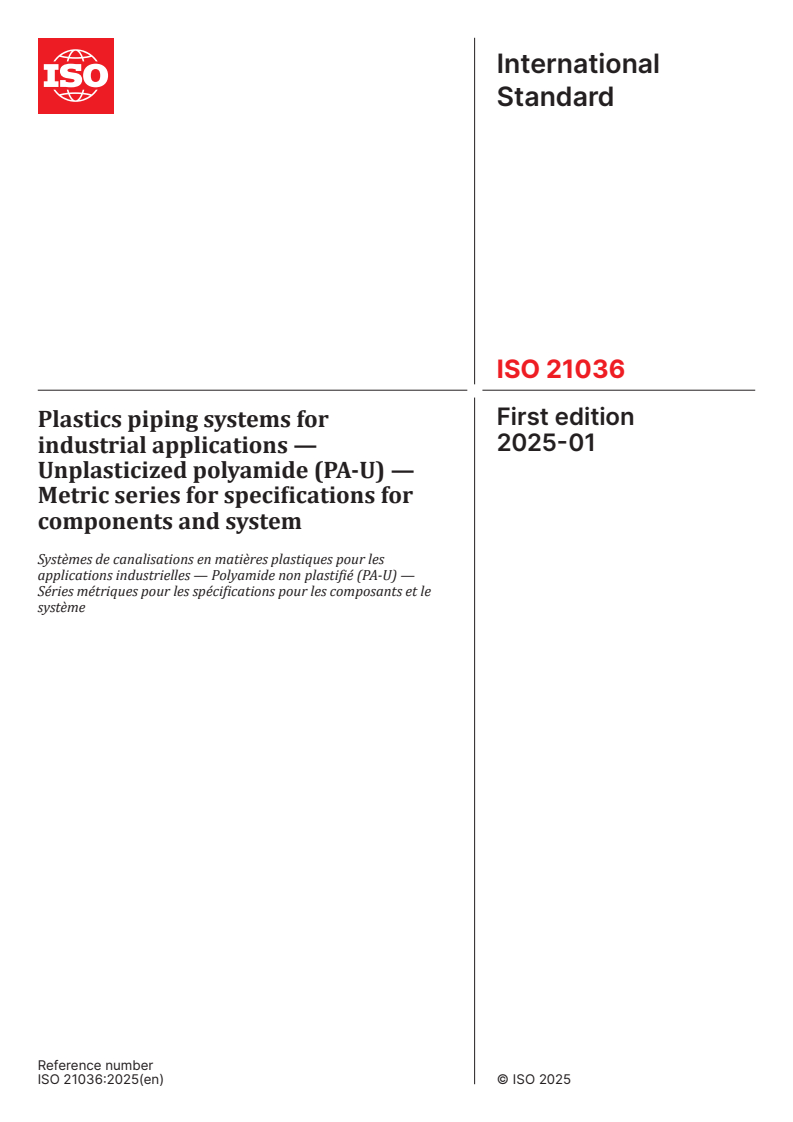
International
Standard
ISO 21036
First edition
Plastics piping systems for
2025-01
industrial applications —
Unplasticized polyamide (PA-U) —
Metric series for specifications for
components and system
Systèmes de canalisations en matières plastiques pour les
applications industrielles — Polyamide non plastifié (PA-U) —
Séries métriques pour les spécifications pour les composants et le
système
Reference number
© ISO 2025
All rights reserved. Unless otherwise specified, or required in the context of its implementation, no part of this publication may
be reproduced or utilized otherwise in any form or by any means, electronic or mechanical, including photocopying, or posting on
the internet or an intranet, without prior written permission. Permission can be requested from either ISO at the address below
or ISO’s member body in the country of the requester.
ISO copyright office
CP 401 • Ch. de Blandonnet 8
CH-1214 Vernier, Geneva
Phone: +41 22 749 01 11
Email: copyright@iso.org
Website: www.iso.org
Published in Switzerland
ii
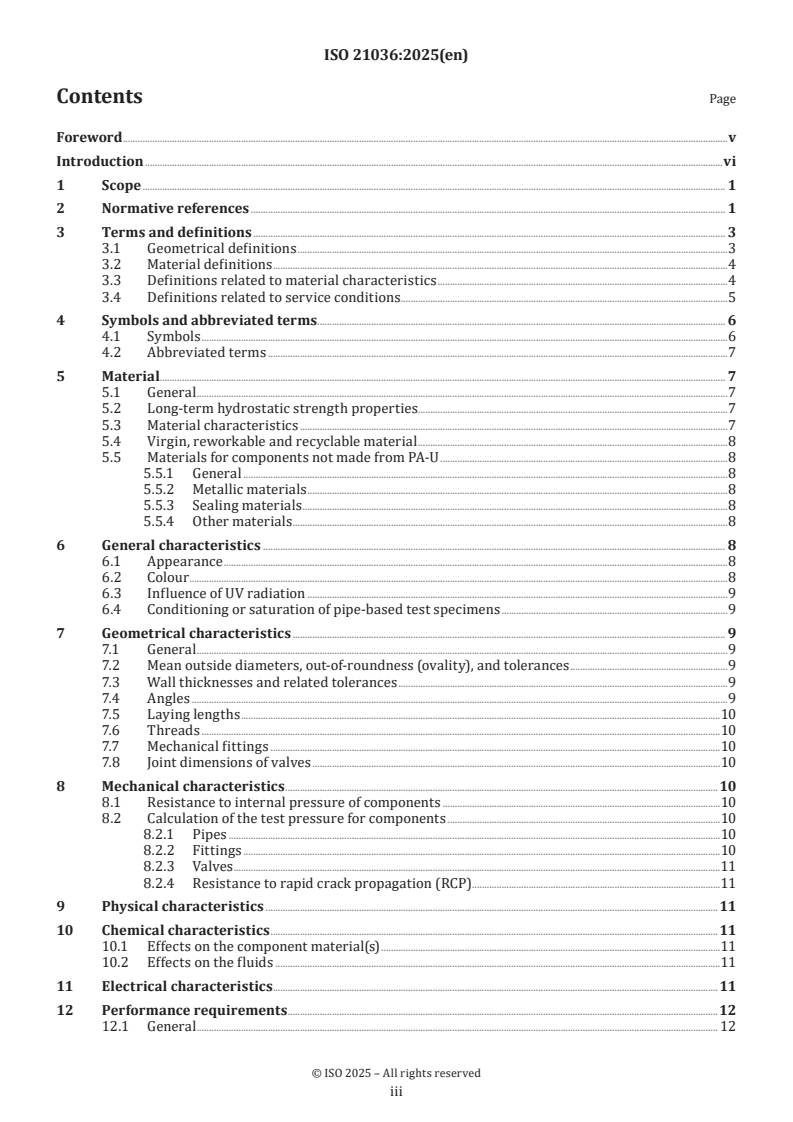
Contents Page
Foreword .v
Introduction .vi
1 Scope . 1
2 Normative references . 1
3 Terms and definitions . 3
3.1 Geometrical definitions .3
3.2 Material definitions .4
3.3 Definitions related to material characteristics .4
3.4 Definitions related to service conditions .5
4 Symbols and abbreviated terms. 6
4.1 Symbols .6
4.2 Abbreviated terms .7
5 Material. 7
5.1 General .7
5.2 Long-term hydrostatic strength properties.7
5.3 Material characteristics .7
5.4 Virgin, reworkable and recyclable material .8
5.5 Materials for components not made from PA-U .8
5.5.1 General .8
5.5.2 Metallic materials .8
5.5.3 Sealing materials .8
5.5.4 Other materials .8
6 General characteristics . 8
6.1 Appearance .8
6.2 Colour .8
6.3 Influence of UV radiation .9
6.4 Conditioning or saturation of pipe-based test specimens .9
7 Geometrical characteristics . 9
7.1 General .9
7.2 Mean outside diameters, out-of-roundness (ovality), and tolerances .9
7.3 Wall thicknesses and related tolerances .9
7.4 Angles .9
7.5 Laying lengths .10
7.6 Threads .10
7.7 Mechanical fittings .10
7.8 Joint dimensions of valves .10
8 Mechanical characteristics .10
8.1 Resistance to internal pressure of components .10
8.2 Calculation of the test pressure for components .10
8.2.1 Pipes .10
8.2.2 Fittings .10
8.2.3 Valves .11
8.2.4 Resistance to rapid crack propagation (RCP) .11
9 Physical characteristics .11
10 Chemical characteristics .11
10.1 Effects on the component material(s) .11
10.2 Effects on the fluids .11
11 Electrical characteristics .11
12 Performance requirements . .12
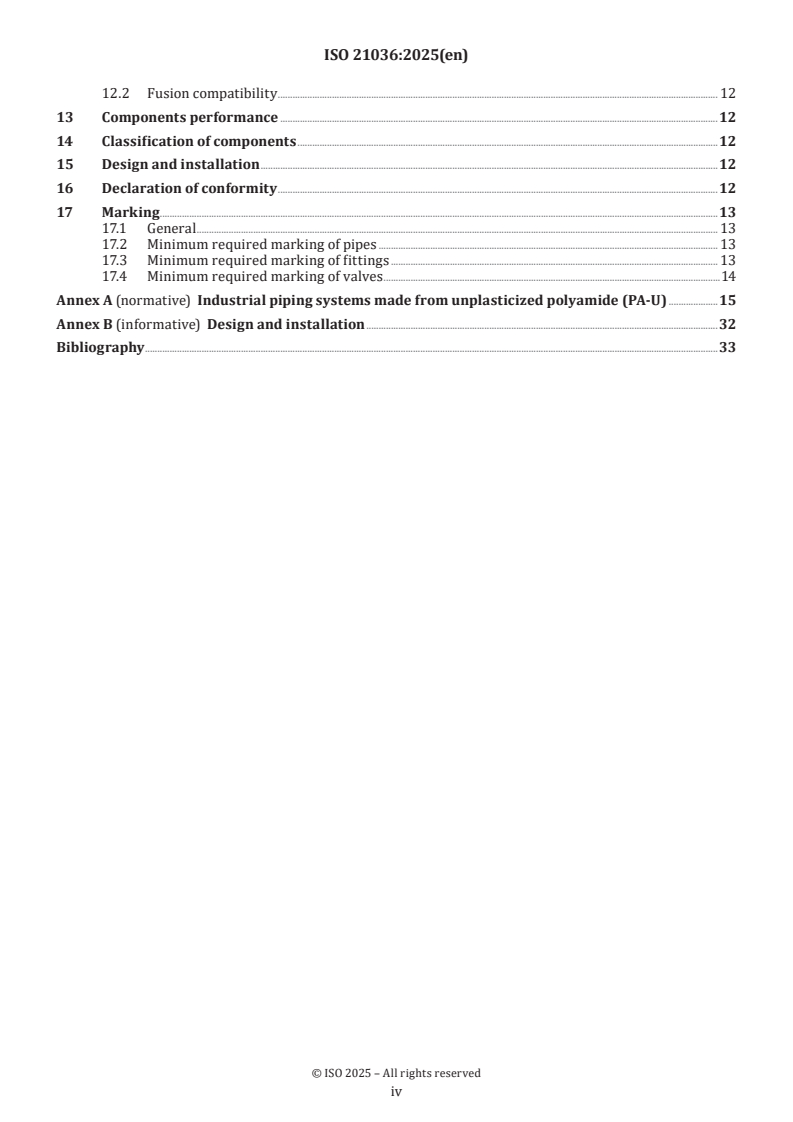
12.1 General . 12
iii
12.2 Fusion compatibility . 12
13 Components performance .12
14 Classification of components .12
15 Design and installation .12
16 Declaration of conformity .12
17 Marking . .13
17.1 General . 13
17.2 Minimum required marking of pipes . 13
17.3 Minimum required marking of fittings . 13
17.4 Minimum required marking of valves .14
Annex A (normative) Industrial piping systems made from unplasticized polyamide (PA-U) .15
Annex B (informative) Design and installation .32
Bibliography .33
iv
Foreword
ISO (the International Organization for Standardization) is a worldwide federation of national standards
bodies (ISO member bodies). The work of preparing International Standards is normally carried out through
ISO technical committees. Each member body interested in a subject for which a technical committee
has been established has the right to be represented on that committee. International organizations,
governmental and non-governmental, in liaison with ISO, also take part in the work. ISO collaborates closely
with the International Electrotechnical Commission (IEC) on all matters of electrotechnical standardization.
The procedures used to develop this document and those intended for its further maintenance are described
in the ISO/IEC Directives, Part 1. In particular, the different approval criteria needed for the different types
of ISO document should be noted. This document was drafted in accordance with the editorial rules of the
ISO/IEC Directives, Part 2 (see www.iso.org/directives).
ISO draws attention to the possibility that the implementation of this document may involve the use of (a)
patent(s). ISO takes no position concerning the evidence, validity or applicability of any claimed patent
rights in respect thereof. As of the date of publication of this document, ISO had not received notice of (a)
patent(s) which may be required to implement this document. However, implementers are cautioned that
this may not represent the latest information, which may be obtained from the patent database available at
www.iso.org/patents. ISO shall not be held responsible for identifying any or all such patent rights.
Any trade name used in this document is information given for the convenience of users and does not
constitute an endorsement.
For an explanation of the voluntary nature of standards, the meaning of ISO specific terms and expressions
related to conformity assessment, as well as information about ISO's adherence to the World Trade
Organization (WTO) principles in the Technical Barriers to Trade (TBT), see www.iso.org/iso/foreword.html.
This document was prepared by Technical Committee ISO/TC 138, Plastics pipes, fittings and valves for the
transport of fluids, Subcommittee SC 3, Plastics pipes and fittings for industrial applications.
Any feedback or questions on this document should be directed to the user’s national standards body. A
complete listing of these bodies can be found at www.iso.org/members.html.
v
Introduction
This document specifies the characteristics and requirements for a piping system and its components made
from unplasticized polyamide (PA-U), as applicable, intended to be used for industrial applications above
ground or below ground by authorities, design engineers, certification bodies, inspection bodies, testing
laboratories, manufacturers, and users.
At the date of publication of this document, standards for piping systems of other plastics used for industrial
applications include the following:
ISO 10931, Plastics piping systems for industrial applications — Poly(vinylidene fluoride) (PVDF) —
Specifications for components and the system
ISO 15493, Plastics piping systems for industrial applications — Acrylonitrile-butadiene-styrene (ABS),
unplasticized poly(vinyl chloride) (PVC-U) and chlorinated poly(vinyl chloride) (PVC-C) — Specifications for
components and the system — Metric series
ISO 15494, Plastics piping systems for industrial applications — Polybutene (PB), polyethylene (PE), polyethylene
of raised temperature resistance (PE-RT), crosslinked polyethylene (PE-X), polypropylene (PP) — Metric series
for specifications for components and the system
vi
International Standard ISO 21036:2025(en)
Plastics piping systems for industrial applications —
Unplasticized polyamide (PA-U) — Metric series for
specifications for components and system
1 Scope
This document specifies the characteristics and requirements for a piping system and its components, made
from unplasticized polyamide (PA-U) intended to be used for thermoplastics piping systems in industrial
applications above and below ground.
NOTE 1 Requirements applying to industrial valves are given in this document and in other standards.
This document is applicable to PA-U pipes, fittings, valves and their joints, and to joints with components
of other plastics and non-plastic materials, depending on their suitability, intended to be used for the
conveyance of liquid and gaseous fluids as well as solid matter in fluids for industrial applications such as
the following:
— transport of oil, gaseous fuels and multiphase mixtures (exploration and production; general purpose
hydrocarbon-based fluids);
— transport of renewable gases (hydrogen, biomethane);
— transport of contaminated sewer (e.g. contaminated with hydrocarbons);
— transport of CO [carbon capture and utilisation or storage (CCUS)].
NOTE 2 National regulations can apply.
NOTE 3 Other application areas are possible if the requirements of this document and/or applicable national
requirements are fulfilled.
Characteristics and requirements which are applicable for PA-U are covered by the relevant clauses of this
document. Those characteristics and requirements which are dependent on the material are given in the
relevant normative Annex A.
2 Normative references
The following documents are referred to in the text in such a way that some or all of their content constitutes
requirements of this document. For dated references, only the edition cited applies. For undated references,
the latest edition of the referenced document (including any amendments) applies.
ISO 7-1, Pipe threads where pressure-tight joints are made on the threads — Part 1: Dimensions, tolerances and
designation
ISO 228-1, Pipe threads where pressure-tight joints are not made on the threads — Part 1: Dimensions, tolerances
and designation
ISO 291, Plastics — Standard atmospheres for conditioning and testing
ISO 307, Plastics — Polyamides — Determination of viscosity number
ISO 472, Plastics — Vocabulary
ISO 1043-1, Plastics — Symbols and abbreviated terms — Part 1: Basic polymers and their special characteristics
ISO 1110, Plastics — Polyamides — Accelerated conditioning of test specimens
ISO 1133-2, Plastics — Determination of the melt mass-flow rate (MFR) and melt volume-flow rate (MVR) of
thermoplastics — Part 2: Method for materials sensitive to time-temperature history and/or moisture
ISO 1167-1, Thermoplastics pipes, fittings and assemblies for the conveyance of fluids — Determination of the
resistance to internal pressure — Part 1: General method
ISO 1167-2, Thermoplastics pipes, fittings and assemblies for the conveyance of fluids — Determination of the
resistance to internal pressure — Part 2: Preparation of pipe test pieces
ISO 1167-3, Thermoplastics pipes, fittings and assemblies for the conveyance of fluids — Determination of the
resistance to internal pressure — Part 3: Preparation of components
ISO 1167-4, Thermoplastics pipes, fittings and assemblies for the conveyance of fluids — Determination of the
resistance to internal pressure — Part 4: Preparation of assemblies
ISO 1183-1, Plastics — Methods for determining the density of non-cellular plastics — Part 1: Immersion method,
liquid pyknometer method and titration method
ISO 1183-2, Plastics — Methods for determining the density of non-cellular plastics — Part 2: Density gradient
column method
ISO 2505, Thermoplastics pipes — Longitudinal reversion — Test method and parameters
ISO 3126, Plastics piping systems — Plastics components — Determination of dimensions
ISO 6964, Polyolefin pipes and fittings — Determination of carbon black content by calcination and pyrolysis —
Test method
ISO 9080, Plastics piping and ducting systems — Determination of the long-term hydrostatic strength of
thermoplastics materials in pipe form by extrapolation
ISO 11922-1, Thermoplastics pipes for the conveyance of fluids — Dimensions and tolerances — Part 1: Metric series
ISO 12162, Thermoplastics materials for pipes and fittings for pressure applications — Classification, designation
and design coefficient
ISO 13478, Thermoplastics pipes for the conveyance of fluids — Determination of resistance to rapid crack
propagation (RCP) — Full-scale test (FST)
ISO 13479, Polyolefin pipes for the conveyance of fluids — Determination of resistance to crack propagation —
Test method for slow crack growth on notched pipes
ISO 15512:2019, Plastics — Determination of water content
ISO 15853, Thermoplastics materials — Preparation of tubular test pieces for the determination of the
hydrostatic strength of materials used for injection moulding
ISO 16135, Industrial valves — Ball valves of thermoplastics materials
ISO 16486-4, Plastics piping systems for the supply of gaseous fuels — Unplasticized polyamide (PA-U) piping
systems with fusion jointing and mechanical jointing — Part 4: Valves
ISO 18553, Method for the assessment of the degree of pigment or carbon black dispersion in polyolefin pipes,
fittings and compounds
IEC 60529, Degrees of protection provided by enclosures (IP-code)
EN 12099, Plastics piping systems — Polyethylene piping materials and components — Determination of
volatile content
3 Terms and definitions
For the purposes of this document, the terms and definitions given in ISO 472, ISO 1043-1, and the
following apply.
3.1 Geometrical definitions
3.1.1
nominal outside diameter
d
n
specified outside diameter assigned to a nominal size, DN/OD
Note 1 to entry: The nominal inside diameter of a socket is equal to the nominal outside diameter of the corresponding pipe.
Note 2 to entry: It is expressed in millimetres.
3.1.2
outside diameter
d
e
value of the measurement of the outside diameter through its cross-section at any point of the pipe, rounded
to the next greater 0,1 mm
Note 1 to entry: The symbol d corresponds to d given in other International Standards such as ISO 11922-1.
e ey
3.1.3
mean outside diameter
d
em
value of the measurement of the outer circumference of the pipe or spigot end of a fitting in any cross-section
divided by π (= 3,142), rounded to the next greater 0,1 mm
3.1.4
nominal size
DN/OD
numerical designation of the size of a component, other than a component designated by thread size, which
is a convenient round number, approximately equal to the manufacturing dimension in millimetres (mm)
and related to the outside diameter
3.1.5
nominal size of flange
DN
numerical designation of the size of a flange for reference purposes and related to the manufacturing
dimension in millimetres
3.1.6
out-of-roundness
ovality
difference between the maximum and the minimum outside diameter in the same cross-section of a pipe
or spigot
3.1.7
nominal wall thickness
e
n
numerical designation of the wall thickness of a component, which is a convenient round number,
approximately equal to the manufacturing dimension in millimetres (mm)
Note 1 to entry: For thermoplastics components conforming to Annexes A and B, the value of the nominal wall
thickness, e , is identical to the specified minimum wall thickness at any point, e .
n min
Note 2 to entry: The symbol e corresponds to e given in other International Standards, such as ISO 11922-1.
n ey
3.1.8
wall thickness at any point
e
wall thickness at any point around the circumference of a component, rounded to the next greater 0,1 mm
3.1.9
minimum wall thickness at any point
e
min
minimum value for the wall thickness at any point around the circumference of a component, as specified
3.1.10
pipe series
S
dimensionless number for pipe designation
Note 1 to entry: The pipe series, S, conforms to ISO 4065.
Note 2 to entry: The relationship between the pipe series, S, and the standard dimension ratio, SDR, is given by the
following formula as specified in ISO 4065:
SDR1−
S =
Note 3 to entry: Flanges are designated on the basis of nominal pressure, PN.
3.1.11
standard dimension ratio
SDR
numerical designation of a pipe series, which is a convenient round number, approximately equal to the
dimension ratio of the nominal outside diameter, d , and the nominal wall thickness, e
n n
3.2 Material definitions
3.2.1
virgin material
material in a form such as granules or powder that has not been subjected to use or processing other than
that required for its manufacture and to which no reprocessable or recyclable materials have been added
3.2.2
reworked material
plastics material from rejected unused products or trimmings capable of being reclaimed within the same
process that generated it
Note 1 to entry: Previously referred to as “own reprocessed material”.
3.3 Definitions related to material characteristics
3.3.1
lower confidence limit of the predicted hydrostatic strength
σ
LPL
quantity with the dimensions of stress, which represents the 97,5 % lower confidence limit of the predicted
hydrostatic strength at a temperature, T, and time, t
Note 1 to entry: It is expressed in megapascals.
3.3.2
minimum required strength
MRS
value of σ (lower confidence limit of the predicted hydrostatic strength) at 20 °C and 50 years, rounded
LPL
down to the next smaller value of the R10 series or the R20 series
Note 1 to entry: The R10 series conforms to ISO 3 and the R20 series conforms to ISO 497.
3.3.3
design stress
σ
s
allowable stress for a given application at 20 °C that is derived from the minimum required strength (MRS)
by dividing it by the coefficient C
Note 1 to entry: Design stress can be calculated using the following formula:
MRS
σ =
s
C
Note 2 to entry: It is expressed in megapascals.
3.3.4
design coefficient
C
coefficient with a value greater than one which takes into consideration service conditions as well as the
properties of the components of a piping system other than those represented in the lower confidence limit
3.4 Definitions related to service conditions
3.4.1
nominal pressure
PN
numerical designation used for reference purposes related to the mechanical characteristics of the
components of a piping system
Note 1 to entry: A pressure, in bar, with the numerical value of PN is identical with the pressure, PS, as defined by
Reference [19] if both pressures are taken at 20 °C.
Note 2 to entry: For plastics piping systems conveying water, PN corresponds to the maximum continuous operating
pressure in bar, which can be sustained for water at 20 °C for 50 years, based on the following minimum design
coefficient:
10σσ20
ss
PN= =
S SDR−1
[]
where
σ is expressed in MPa;
s
PN is expressed in bar.
5 2
Note 3 to entry: 1 bar = 0,1 MPa = 10 Pa; 1 MPa= 1 N/mm .
3.4.2
hydrostatic stress
σ
stress induced in the wall of a pipe when an internal hydrostatic pressure is applied
Note 1 to entry: The hydrostatic stress is related to the applied internal hydrostatic pressure (in bar), p, the wall
thickness at any point, e, and the mean outside diameter, d , of a pipe. It is calculated using the following formula:
em
de−
em min
σ =p
20e
min
Note 2 to entry: This formula is applicable for pipes only.
Note 3 to entry: The value is expressed in megapascals.
4 Symbols and abbreviated terms
4.1 Symbols
C design coefficient (design factor)
D mean inside diameter in the fusion zone
D minimum diameter of the flow channel through the body of the fitting
d outside diameter (at any point)
e
d mean outside diameter
em
d nominal outside diameter
n
D outside diameter of chamfer on shoulder
f1
D outside diameter of flange adaptor
f2
DN nominal size of flange
e wall thickness (at any point)
e nominal wall thickness
n
h height of the service pipe
H height of the saddle
L width of the tapping tee
L depth of penetration of the pipe or male end of a spigot end fitting
L nominal length of the fusion zone
L nominal unheated entrance length of the fitting
L outside tubular length
b2
p internal hydrostatic pressure
p critical pressure
c
p critical reference pressure
c,REF
p maximum allowable pressure
s
r radius of chamfer on shoulder
f
T temperature
t time
σ hydrostatic stress
4.2 Abbreviated terms
MOP maximum operating pressure
MRS minimum required strength
PA-U unplasticized polyamide (PA-U11 or PA-U12)
PN nominal pressure
RCP rapid crack propagation
S pipe series S
SDR standard dimension ratio
5 Material
5.1 General
The PA-U material from which the components are made shall either be PA-U 11 or PA-U 12, to which are
added those additives that are needed to facilitate the manufacture of pipes, fittings, and valves conforming
to this document.
If additives are used, they shall be uniformly dispersed.
The additives shall not be used separately or together in quantities sufficient to impair the fabrication or
fusion characteristics of the component or to impair the chemical, physical, or mechanical characteristics as
specified in this document.
5.2 Long-term hydrostatic strength properties
The material shall be evaluated in accordance with ISO 9080 by analysis of pressure tests carried out in
accordance with ISO 1167-1 and ISO 1167-2 to classify the material in accordance with ISO 12162.
EXAMPLE PA-U12 180 or PA-U11 180 compounds are classified for MRS 18 MPa.
Conformity of the relevant material to the reference curves given for PA-U 180 shall be proven according to
Annex A, Formula (A.1) and Formula (A.2) or corresponding Figure A.1. At least 97,5 % of the data points
shall be on or above the reference curves. For design, these reference curves shall be used as a basis.
The material shall be classified by the raw material producer.
NOTE In some cases, the component manufacturer can be regarded as the raw material producer.
Where fittings and valves are manufactured from the same material as pipes, the material classification
shall be the same as for pipes.
For the classification of a material intended only for the manufacture of fittings and valves, the test piece
shall be an injection-moulded or extruded test piece in the form of a pipe where a test pressure is applied
according to ISO 1167-1. The free length shall be 3d , as defined in ISO 1167-2 or ISO 15853.
n
5.3 Material characteristics
The details of the material characteristics of PA-U mechanical and physical properties with requirements
are given in Annex A.
5.4 Virgin, reworkable and recyclable material
Stress-bearing parts shall only be made from virgin material in accordance with Annex A. Non-stress-
bearing parts shall be made from virgin material or reworked material from a compound with the same
MRS or a mixture of both, virgin and reworked material.
The use of reworkable material obtained during the production and testing of components according to this
document is not permitted.
Reprocessable material obtained from external sources and recyclable material shall not be used.
5.5 Materials for components not made from PA-U
5.5.1 General
All components shall conform to the relevant International Standard(s). Alternative standards may be
applied in cases where suitable International Standard(s) do not exist. In all cases, fitness for purpose of the
components shall be demonstrated.
Materials and constituent elements used in making the relevant component (including rubber, greases, and
any metal parts used) shall have comparable resistance to the external and internal environments as all
other elements of the piping system according to this document.
Materials other than PA-U in contact with components conforming to this document shall not adversely
affect the performance of the components or initiate stress cracking.
5.5.2 Metallic materials
All metal parts susceptible to corrosion shall be adequately protected.
When dissimilar metallic materials are used which can be in contact with moisture, steps shall be taken to
avoid the possibility of galvanic corrosion.
5.5.3 Sealing materials
Sealing materials shall have no detrimental effects on the properties of the components, joints, and
assemblies.
5.5.4 Other materials
Greases or lubricants shall not exude onto fusion areas and shall not affect the long-term performance of
materials conforming to this document.
6 General characteristics
6.1 Appearance
When viewed without magnification, the internal and external surfaces of the components shall be smooth,
clean, and free from scoring, cavities, and other surface defects to an extent that would prevent conformity
to this document. The components shall not contain visible impurities.
Each end of a component shall be square to its axis and shall be deburred.
6.2 Colour
The colour of the components shall be as given in Clause A.2 of this document.
NOTE National or regional legislation relating to the colour coding of piping in respect of its purpose or contents
for the location in which the components are intended to be used can apply.
6.3 Influence of UV radiation
Components for external above ground installations shall be adequately protected against UV radiation or
the material shall be resistant to UV radiation for the intended application. For products which are usually
stored outside in direct sunlight prior to installation, the effect of UV radiation shall be taken into account.
To assess materials for resistance to UV radiation for storage purposes, pipe shall subject to a cumulative
radiant exposure of ≥7,0 GJ/m in accordance with ISO 16871. Following this exposure, the pipe is assessed
for any significant change in mechanical properties.
6.4 Conditioning or saturation of pipe-based test specimens
Unless otherwise specified in the applicable test method, test pieces shall be conditioned for at least 16 h at
23 °C and 50 % relative humidity in accordance with ISO 291 before testing.
The test pieces shall not be tested within the period of 48 h after their manufacture.
Long-term hydrostatic strength data shall be generated on saturated polyamide pipe specimens representing
the most severe case to prevent rising humidity content of the pipe over test duration and resulting effects
on the analysis of time to failure test results. The saturation process in water shall be accelerated according
to ISO 1110. Data shall show the uptake of water until saturation over time according to ISO 15512.
NOTE In ISO 16486-2:2024 Annex B, information is given about the saturation performance of pipes in water.
7 Geometrical characteristics
7.1 General
The measurement shall not be made less than 24 h after manufacture.
Dimensions shall be measured in accordance with ISO 3126 at (23 ± 2) °C after being conditioned for at least
4 h unless specified otherwise in Annex A.
Indirect measurement during the stage of production is allowed at shorter time periods providing that
evidence is shown of correlation.
The figures provided in Annex A are schematic sketches only, to indicate the relevant dimensions. They do
not necessarily represent the manufactured component(s). The given dimensions shall be followed.
Dimensions not given shall be specified by the manufacturer.
7.2 Mean outside diameters, out-of-roundness (ovality), and tolerances
For components made from PA-U the diameters, out-of-roundness (ovality) and related tolerances shall
conform to Clause A.3.
The out-of-roundness (ovality) shall be measured at the point of manufacture.
7.3 Wall thicknesses and related tolerances
For components made from PA-U, the wall thicknesses and related tolerances shall conform to Clause A.3.
7.4 Angles
The permitted deviations from the nominal or declared angle for a nonlinear fitting shall be ±2° where the
angle comprises the relevant change of axis of the flow through the fitting.
The recommended nominal angles for a nonlinear fitting are 45° or 90°.
7.5 Laying lengths
The laying lengths for fittings and valves shall be declared by the manufacturer.
The laying lengths are intended to assist in the design of moulds and are not intended to be used for quality
control purposes. ISO 265-1 may be used as a guideline.
7.6 Threads
Joints made pressure-tight by the mating of the threads shall conform to ISO 7-1 and fastening pipe threads
to ISO 228-1
International Standard with the same content as ISO 7-1 exist, e.g. EN 10226-1 and EN 10226-2.
7.7 Mechanical fittings
Mechanical fittings such as adaptors, unions, compression fittings, and reducing bushes may be used,
provided that their joint dimensions are in accordance with the applicable dimensions of components
conforming to this document.
7.8 Joint dimensions of valves
The joint dimensions of valves shall conform to the relevant dimensions of pipes and fittings conforming to
this document.
8 Mechanical characteristics
8.1 Resistance to internal pressure of components
Components shall withstand the hydrostatic stress induced by internal hydrostatic pressure without
bursting or leaking when tested in accordance with ISO 1167-1, ISO 1167-2, and ISO 1167-3 and the test
conditions specified for PA-U in Annex A.
8.2 Calculation of the test pressure for components
8.2.1 Pipes
For pipes, the relation between hoop stress, σ, expressed in MPa, and internal hydrostatic pressure, p,
expressed in bar, is given by Formula (1):
de−
em min
σ =p (1)
20e
min
For tests the internal hydrostatic pressure, p, expressed in bar, shall be determined for pipes using
Formula (2):
10σσ20
p= = (2)
[]S SDR−1
where σ is the hoop stress for PA-U conforming to the A.1.2.
8.2.2 Fittings
For tests the internal hydrostatic pressure, p, expressed in bar, shall be determined for fittings using
Formula (2). For S and SDR respectively, the value of the corresponding pipe shall be taken.
8.2.3 Valves
For tests the hydrostatic pressure, p, expressed in bar, is defined for valves in ISO 16486-4.
8.2.4 Resistance to rapid crack propagation (RCP)
For a pipeline system carrying air or a compressible gas, for design purposes, the resistance of the material
to the phenomenon known as rapid crack propagation shall be taken into account (see ISO 16486-1,
ISO 16486-2 and ISO 16486-5). The critical pressure p is dependent on the material, pipe diameter, and
c
operating temperature.
The critical reference pressure p measured in accordance with ISO 13478 shall be greater than 1,5 times
c,REF
the maximum operating pressure of the pipeline system.
Information provided by the pipe or material supplier should be taken into account when designing an
industrial pipeline system for the transport of air or a compressible gas. The maximal wall thickness for RCP
resistance shall be provided by the compound manufacturer.
NOTE For unplasticized polyamide (PA-U) SDR 11 pipe produced in accordance with ISO 16486-2 for natural gas
[9]
applications, the KRV listing show an RCP resistance for a wall thickness up to including 14,6 mm that allows an
operation at 18 bar (for CEN limited to 16 bar) for temperatures above 0 °C with diameters up to including 160 mm.
9 Physical characteristics
The physical characteristics of components made from PA-U shall conform to Annex A.
10 Chemical characteristics
10.1 Effects on the component material(s)
Where fluids other than water are to be conveyed, the effect of the fluid on the component material should
be considered.
NOTE Guidance is available in ISO/TR 10358 or from the component manufacturer.
The chemical resistance of the pipe shall be evaluated for a particular application. Then the pipe can be
classified in accordance with ISO 4433-1.
The influence of chemical fluids on the long-term hydrostatic strength of PA-U pressure pipes may be
determined by DIN 16463 or, if applicable, by long-term, in situ creep rupture tests as described in Reference
[13], where the results are used for ASTM F 3524.
10.2 Effects on the fluids
Where fluids other than water are to be conveyed, the effect of the component material on the fluid should
be considered.
11 Electrical characteristics
The electrical protection that shall be provided by the fusion process depends on the characteristics of the
electricity power source.
NOTE The relevant component during the fusion process is part of an electrical system, see Reference [21] or
Reference [15].
Protection against direct contacts with active parts (live conductors) shall be in accordance with IEC 60529.
This protection is a function of the work site conditions.
The surface finish of the terminal pins shall allow a minimum contact resistance.
12 Performance requirements
12.1 General
When components made from the same material conforming to this document are jointed to each other, the
pipes, fittings, valves, and the joints shall conform to the requirements of Clause A.6.
NOTE If test pressures defined for pipes are used for assemblies made from components of dissimilar materials
(e.g. screwed joints, flanged joints), the resulting strain exceeds the strain occurring under service conditions. These
strains unavoidably cause leakage. Therefore, in this document, the time related strain behaviour of the assemblies is
taken into account and the test pressures derived from the isochronous stress-strain-diagram are used.
12.2 Fusion compatibility
Pipes made from PA-U 11 shall be heat fusion jointed only to either pipes or component
...