


ISO/FDIS 20957-1
(Main)Stationary training equipment — Part 1: General safety requirements and test methods
Stationary training equipment — Part 1: General safety requirements and test methods
Équipement d'entraînement fixe — Partie 1: Exigences générales de sécurité et méthodes d'essai
General Information
Relations
Buy Standard
Standards Content (Sample)
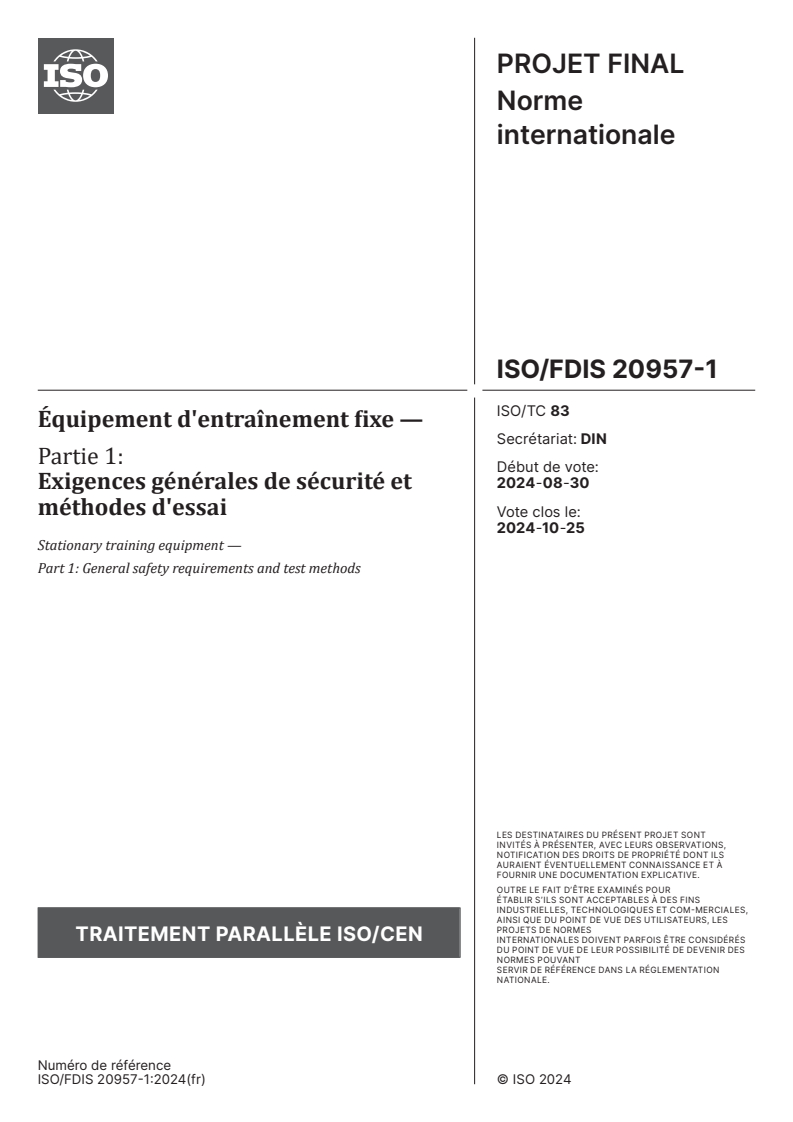
FINAL DRAFT
International
Standard
ISO/TC 83
Stationary training equipment —
Secretariat: DIN
Part 1:
Voting begins on:
2024-08-30
General safety requirements and
test methods
Voting terminates on:
2024-10-25
Équipement d'entraînement fixe —
Partie 1: Exigences générales de sécurité et méthodes d'essai
RECIPIENTS OF THIS DRAFT ARE INVITED TO SUBMIT,
WITH THEIR COMMENTS, NOTIFICATION OF ANY
RELEVANT PATENT RIGHTS OF WHICH THEY ARE AWARE
AND TO PROVIDE SUPPOR TING DOCUMENTATION.
IN ADDITION TO THEIR EVALUATION AS
BEING ACCEPTABLE FOR INDUSTRIAL, TECHNO-
ISO/CEN PARALLEL PROCESSING LOGICAL, COMMERCIAL AND USER PURPOSES, DRAFT
INTERNATIONAL STANDARDS MAY ON OCCASION HAVE
TO BE CONSIDERED IN THE LIGHT OF THEIR POTENTIAL
TO BECOME STAN DARDS TO WHICH REFERENCE MAY BE
MADE IN NATIONAL REGULATIONS.
Reference number
FINAL DRAFT
International
Standard
ISO/TC 83
Stationary training equipment —
Secretariat: DIN
Part 1:
Voting begins on:
General safety requirements and
2024-08-30
test methods
Voting terminates on:
Équipement d'entraînement fixe —
2024-10-25
Partie 1: Exigences générales de sécurité et méthodes d'essai
RECIPIENTS OF THIS DRAFT ARE INVITED TO SUBMIT,
WITH THEIR COMMENTS, NOTIFICATION OF ANY
RELEVANT PATENT RIGHTS OF WHICH THEY ARE AWARE
AND TO PROVIDE SUPPOR TING DOCUMENTATION.
© ISO 2024
IN ADDITION TO THEIR EVALUATION AS
All rights reserved. Unless otherwise specified, or required in the context of its implementation, no part of this publication may
BEING ACCEPTABLE FOR INDUSTRIAL, TECHNO-
ISO/CEN PARALLEL PROCESSING
LOGICAL, COMMERCIAL AND USER PURPOSES, DRAFT
be reproduced or utilized otherwise in any form or by any means, electronic or mechanical, including photocopying, or posting on
INTERNATIONAL STANDARDS MAY ON OCCASION HAVE
the internet or an intranet, without prior written permission. Permission can be requested from either ISO at the address below
TO BE CONSIDERED IN THE LIGHT OF THEIR POTENTIAL
or ISO’s member body in the country of the requester.
TO BECOME STAN DARDS TO WHICH REFERENCE MAY BE
MADE IN NATIONAL REGULATIONS.
ISO copyright office
CP 401 • Ch. de Blandonnet 8
CH-1214 Vernier, Geneva
Phone: +41 22 749 01 11
Email: copyright@iso.org
Website: www.iso.org
Published in Switzerland Reference number
ii
Contents Page
Foreword .v
Introduction .vi
1 Scope . 1
2 Normative references . 1
3 Terms and definitions . 1
4 Classification . 3
4.1 General .3
4.2 Accuracy classes.3
4.3 Usage classes .3
5 Safety requirements. 4
5.1 General .4
5.2 Stability .4
5.3 External construction .4
5.3.1 General .4
5.3.2 Edges and corners .4
5.3.3 Tube ends .4
5.3.4 Squeeze and shear points .5
5.3.5 Weights and other resistance means .5
5.4 Entrapment of the user .5
5.5 Adjustment components and locking mechanisms.5
5.6 Ropes, belts, chains and attachment components .6
5.6.1 General .6
5.6.2 Ropes and belts .6
5.6.3 Rope and belt guides .6
5.7 Pull-in points .6
5.7.1 General .6
5.7.2 Pulleys.6
5.7.3 Chains, gears and sprockets .6
5.8 Hand grips .7
5.8.1 Integral handgrips .7
5.8.2 Applied handgrips .7
5.8.3 Rotating handgrips .7
5.9 Endurance .7
5.10 Isometric test function .7
5.11 Heart rate measurement system .7
5.11.1 Indication .7
5.11.2 Heart rate control mode .7
5.12 Electrical safety .8
5.13 Loading .8
5.14 Care and maintenance .8
5.15 Assembly instructions .9
5.16 General instructions for use .9
5.17 Marking .10
5.17.1 Permanent marking .10
5.17.2 Additional marking .10
6 Test methods . 10
6.1 Test conditions .10
6.2 Stability test .11
6.2.1 Test in training position . .11
6.2.2 Test in folded or storage position .11
6.3 External construction .11
6.3.1 Test of edges and corners .11
6.3.2 Tube ends .11
iii
6.3.3 Testing of squeeze points and shear points.11
6.3.4 Weights and other resistant means .11
6.3.5 Testing of pull-in points .11
6.4 Testing of entrapment . 12
6.5 Adjustment components and locking mechanisms. 12
6.6 Tests for ropes, belts, chains and attachment components . 12
6.7 Testing of rope and belt guides .
...
ISO/TC 83
Secretariat: DIN
Date: 2024-07-0108-12
Stationary training equipment —
Part 1:
General safety requirements and test methods
AppareilsÉquipement d'entraînement fixes — fixe —
Partie 1: Exigences générales de sécurité et méthodes d'essai
FDIS stage
All rights reserved. Unless otherwise specified, or required in the context of its implementation, no part of this publication
may be reproduced or utilized otherwise in any form or by any means, electronic or mechanical, including photocopying,
or posting on the internet or an intranet, without prior written permission. Permission can be requested from either ISO
at the address below or ISO’s member body in the country of the requester.
ISO copyright office
CP 401 • Ch. de Blandonnet 8
CH-1214 Vernier, Geneva
Phone: + 41 22 749 01 11
EmailE-mail: copyright@iso.org
Website: www.iso.org
Published in Switzerland
ii © ISO 2024 – All rights reserved
ii
Contents
Foreword . v
Introduction . vii
1 Scope . 1
2 Normative references . 1
3 Terms and definitions . 1
4 Classification. 3
4.1 General. 3
4.2 Accuracy classes . 4
4.3 Usage classes . 4
5 Safety requirements . 4
5.1 General. 4
5.2 Stability . 4
5.3 External construction . 4
5.3.1 General. 4
5.3.2 Edges and corners . 5
5.3.3 Tube ends. 5
5.3.4 Squeeze and shear points . 5
5.3.5 Weights and other resistance means . 6
5.4 Entrapment of the user . 6
5.5 Adjustment components and locking mechanisms . 6
5.6 Ropes, belts, chains and attachment components . 6
5.6.1 General. 6
5.6.2 Ropes and belts . 6
5.6.3 Rope and belt guides . 7
5.7 Pull-in points . 7
5.7.1 General. 7
5.7.2 Pulleys . 7
5.7.3 Chains, gears and sprockets . 7
5.8 Hand grips . 7
5.8.1 Integral handgrips . 7
5.8.2 Applied handgrips . 7
5.8.3 Rotating handgrips . 8
5.9 Endurance . 8
5.10 Isometric test function . 8
5.11 Heart rate measurement system . 8
5.11.1 Indication . 8
5.11.2 Heart rate control mode . 8
5.12 Electrical safety . 8
5.13 Loading . 9
5.14 Care and maintenance . 9
5.15 Assembly instructions . 10
5.16 General instructions for use . 10
5.17 Marking . 11
5.17.1 Permanent marking . 11
5.17.2 Additional marking . 12
iii
6 Test methods . 12
6.1 Test conditions . 12
6.2 Stability test . 12
6.2.1 Test in training position . 12
6.2.2 Test in folded or storage position . 12
6.3 External construction . 12
6.3.1 Test of edges and corners . 12
6.3.2 Tube ends. 12
6.3.3 Testing of squeeze points and shear points . 13
6.3.4 Weights and other resistant means . 13
6.3.5 Testing of pull-in points . 13
6.4 Testing of entrapment . 14
6.5 Adjustment components and locking mechanisms . 14
6.6 Tests for ropes, belts, chains and attachment components . 14
6.7 Testing of rope and belt guides . 14
6.8 Testing of integral handgrips . 14
6.9 Testing of applied handgrips . 14
6.10 Testing of rotating handgrips . 14
6.11 Testing of endurance load . 14
6.12 Testing of isometric equipment. 15
6.13 Testing of indicator of the heart rate measurement system . 15
6.14 Testing of the heart rate control mode . 15
6.15 Load testing . 15
6.16 Testing of care and maintenance, assembly instructions, general instructions for use and
marking . 16
6.17 Test report . 16
Annex A (informative) Examples for carrying out load testing . 17
A.1 Example 1: stationary bicycle seat – body weight load only . 17
A.2 Example 2: squat exerciser – training load only . 18
A.3 Example 3: multi-adjustable bench – seat back . 19
A.4 Example 4: multi-adjustable bench – seat bottom . 20
A.5 Example 5: multi-adjustable bench – head support area . 21
Annex ZA (informative) Relationship between this European Standard and the safety
requirements of Directive 2001/95/EC aimed to be covered . 22
Bibliography . 25
iv © ISO 2024 – All rights reserved
iv
Foreword
ISO (the International Organization for Standardization) is a worldwide federation of national standards
bodies (ISO member bodies). The work of preparing International Standards is normally carried out through
ISO technical committees. Each member body interested in a subject for which a technical committee has been
established has the right to be represented on that committee. International organizations, governmental and
non-governmental, in liaison with ISO, also take part in the work. ISO collaborates closely with the
International Electrotechnical Commission (IEC) on all matters of electrotechnical standardization.
The procedures used to develop this document and those intended for its further maintenance are described
in the ISO/IEC Directives, Part 1. In particular, the different approval criteria needed for the differ
...
PROJET FINAL
Norme
internationale
ISO/TC 83
Équipement d'entraînement fixe —
Secrétariat: DIN
Partie 1:
Début de vote:
2024-08-30
Exigences générales de sécurité et
méthodes d'essai
Vote clos le:
2024-10-25
Stationary training equipment —
Part 1: General safety requirements and test methods
LES DESTINATAIRES DU PRÉSENT PROJET SONT
INVITÉS À PRÉSENTER, AVEC LEURS OBSERVATIONS,
NOTIFICATION DES DROITS DE PROPRIÉTÉ DONT ILS
AURAIENT ÉVENTUELLEMENT CONNAISSANCE ET À
FOURNIR UNE DOCUMENTATION EXPLICATIVE.
OUTRE LE FAIT D’ÊTRE EXAMINÉS POUR
ÉTABLIR S’ILS SONT ACCEPTABLES À DES FINS
INDUSTRIELLES, TECHNOLOGIQUES ET COM-MERCIALES,
AINSI QUE DU POINT DE VUE DES UTILISATEURS, LES
PROJETS DE NORMES
TRAITEMENT PARALLÈLE ISO/CEN
INTERNATIONALES DOIVENT PARFOIS ÊTRE CONSIDÉRÉS
DU POINT DE VUE DE LEUR POSSI BILITÉ DE DEVENIR DES
NORMES POUVANT
SERVIR DE RÉFÉRENCE DANS LA RÉGLEMENTATION
NATIONALE.
Numéro de référence
PROJET FINAL
Norme
internationale
ISO/TC 83
Équipement d'entraînement fixe —
Secrétariat: DIN
Partie 1:
Début de vote:
Exigences générales de sécurité et 2024-08-30
méthodes d'essai
Vote clos le:
2024-10-25
Stationary training equipment —
Part 1: General safety requirements and test methods
LES DESTINATAIRES DU PRÉSENT PROJET SONT
INVITÉS À PRÉSENTER, AVEC LEURS OBSERVATIONS,
NOTIFICATION DES DROITS DE PROPRIÉTÉ DONT ILS
AURAIENT ÉVENTUELLEMENT CONNAISSANCE ET À
FOURNIR UNE DOCUMENTATION EXPLICATIVE.
DOCUMENT PROTÉGÉ PAR COPYRIGHT
OUTRE LE FAIT D’ÊTRE EXAMINÉS POUR
ÉTABLIR S’ILS SONT ACCEPTABLES À DES FINS
© ISO 2024 INDUSTRIELLES, TECHNOLOGIQUES ET COM-MERCIALES,
AINSI QUE DU POINT DE VUE DES UTILISATEURS, LES
Tous droits réservés. Sauf prescription différente ou nécessité dans le contexte de sa mise en œuvre, aucune partie de cette
PROJETS DE NORMES
TRAITEMENT PARALLÈLE ISO/CEN
INTERNATIONALES DOIVENT PARFOIS ÊTRE CONSIDÉRÉS
publication ne peut être reproduite ni utilisée sous quelque forme que ce soit et par aucun procédé, électronique ou mécanique,
DU POINT DE VUE DE LEUR POSSI BILITÉ DE DEVENIR DES
y compris la photocopie, ou la diffusion sur l’internet ou sur un intranet, sans autorisation écrite préalable. Une autorisation peut
NORMES POUVANT
être demandée à l’ISO à l’adresse ci-après ou au comité membre de l’ISO dans le pays du demandeur.
SERVIR DE RÉFÉRENCE DANS LA RÉGLEMENTATION
NATIONALE.
ISO copyright office
Case postale 401 • Ch. de Blandonnet 8
CH-1214 Vernier, Genève
Tél.: +41 22 749 01 11
E-mail: copyright@iso.org
Web: www.iso.org
Publié en Suisse Numéro de référence
ii
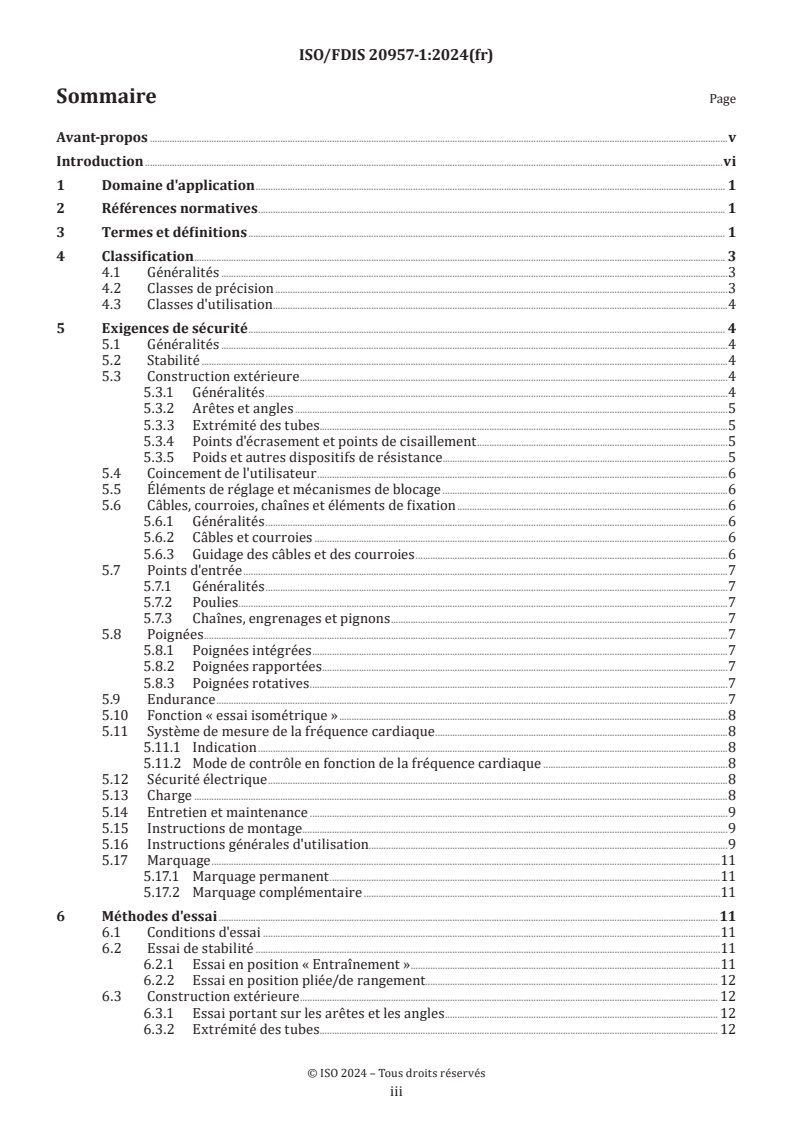
Sommaire Page
Avant-propos .v
Introduction .vi
1 Domaine d'application . 1
2 Références normatives . 1
3 Termes et définitions . 1
4 Classification . 3
4.1 Généralités .3
4.2 Classes de précision .3
4.3 Classes d'utilisation.4
5 Exigences de sécurité . 4
5.1 Généralités .4
5.2 Stabilité .4
5.3 Construction extérieure .4
5.3.1 Généralités .4
5.3.2 Arêtes et angles .5
5.3.3 Extrémité des tubes . .5
5.3.4 Points d'écrasement et points de cisaillement .5
5.3.5 Poids et autres dispositifs de résistance .5
5.4 Coincement de l'utilisateur .6
5.5 Éléments de réglage et mécanismes de blocage .6
5.6 Câbles, courroies, chaînes et éléments de fixation .6
5.6.1 Généralités .6
5.6.2 Câbles et courroies .6
5.6.3 Guidage des câbles et des courroies .6
5.7 Points d'entrée .7
5.7.1 Généralités .7
5.7.2 Poulies .7
5.7.3 Chaînes, engrenages et pignons .7
5.8 Poignées .7
5.8.1 Poignées intégrées .7
5.8.2 Poignées rapportées.7
5.8.3 Poignées rotatives .7
5.9 Endurance .7
5.10 Fonction « essai isométrique » .8
5.11 Système de mesure de la fréquence cardiaque .8
5.11.1 Indication .8
5.11.2 Mode de contrôle en fonction de la fréquence cardiaque .8
5.12 Sécurité électrique .8
5.13 Charge .8
5.14 Entretien et maintenance .9
5.15 Instructions de montage .9
5.16 Instructions générales d'utilisation.9
5.17 Marquage .11
5.17.1 Marquage permanent .11
5.17.2 Marquage complémentaire .11
6 Méthodes d'essai .11
6.1 Conditions d'essai .11
6.2 Essai de stabilité .11
6.2.1 Essai en position « Entraînement » .11
6.2.2 Essai en position pliée/de rangement. 12
6.3 Construction extérieure . 12
6.3.1 Essai portant sur les arêtes et les angles . 12
6.3.2 Extrémité des tubes . . . 12
iii
6.3.3 Essai portant sur les points d'écrasement et les points de cisaillement . 12
6.3.4 Poids et autres dispositifs de résistance . 12
6.3.5 Essai portant sur les points d'entrée . 12
6.4 Essai de coincement . 13
6.5 Éléments de réglage et mécanismes de blocage . 13
6.6 Essais portant sur les câbles, courroies, chaînes et éléments de fixation . 13
6.7 Essai portant sur le guidage des câbles et des courroies .14
6.8 Essai portant sur les poignées intégrées .
...
Questions, Comments and Discussion
Ask us and Technical Secretary will try to provide an answer. You can facilitate discussion about the standard in here.