


ISO 14934-2:2006
(Main)Fire tests — Calibration and use of heat flux meters — Part 2: Primary calibration methods
Fire tests — Calibration and use of heat flux meters — Part 2: Primary calibration methods
ISO 14934-2:2006 describes three methods for calibration of total hemispherical radiometers and total heat flux meters that are exposed to a well-defined radiation from a radiant heat source. The equipment is designed to minimize influences due to convective heat transfer during calibration. It is important to note that when the instruments are used in practice they measure a combination of radiant and convective heat transfers. The latter will depend on the design of the heat flux meter, the orientation, local temperature and flow conditions, and on the temperature of the cooling water.
Essais au feu — Étalonnage et utilisation des appareils de mesure du flux thermique — Partie 2: Méthodes d'étalonnage primaire
L'ISO 14934-2:2006 décrit trois méthodes d'étalonnage pour les radiomètres hémisphériques totaux et les fluxmètres thermiques totaux, ces appareils étant exposés à un rayonnement bien défini provenant d'une source de chaleur rayonnante. L'équipement est dimensionné pour minimiser les influences du transfert thermique par convection pendant l'étalonnage. Il est important de noter que, dans leur utilisation pratique, ces instruments mesurent une combinaison du transfert thermique par rayonnement et du transfert thermique par convection. L'influence de cette dernière composante dépendra de la conception du fluxmètre thermique, de l'orientation, des conditions locales de température et d'écoulement ainsi que de la température de l'eau de refroidissement.
General Information
- Status
- Withdrawn
- Publication Date
- 08-Feb-2006
- Withdrawal Date
- 08-Feb-2006
- Technical Committee
- ISO/TC 92/SC 1 - Fire initiation and growth
- Current Stage
- 9599 - Withdrawal of International Standard
- Start Date
- 15-Mar-2013
- Completion Date
- 14-Feb-2026
Relations
- Effective Date
- 21-Nov-2009
Buy Documents


ISO 14934-2:2006 - Fire tests -- Calibration and use of heat flux meters
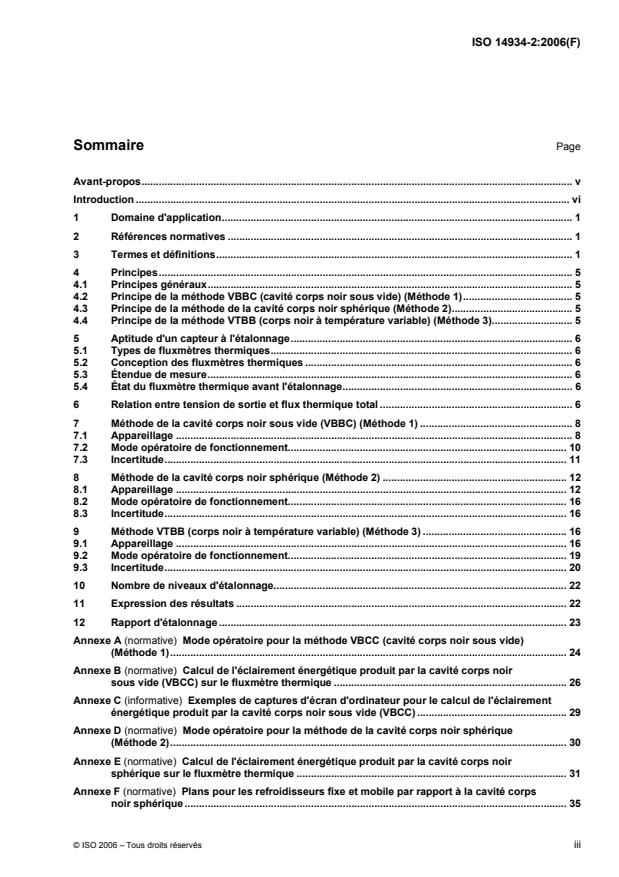

ISO 14934-2:2006 - Essais au feu -- Étalonnage et utilisation des appareils de mesure du flux thermique
Get Certified
Connect with accredited certification bodies for this standard

NSF International
Global independent organization facilitating standards development and certification.

CIS Institut d.o.o.
Personal Protective Equipment (PPE) certification body. Notified Body NB-2890 for EU Regulation 2016/425 PPE.

Kiwa BDA Testing
Building and construction product certification.
Sponsored listings
Frequently Asked Questions
ISO 14934-2:2006 is a standard published by the International Organization for Standardization (ISO). Its full title is "Fire tests — Calibration and use of heat flux meters — Part 2: Primary calibration methods". This standard covers: ISO 14934-2:2006 describes three methods for calibration of total hemispherical radiometers and total heat flux meters that are exposed to a well-defined radiation from a radiant heat source. The equipment is designed to minimize influences due to convective heat transfer during calibration. It is important to note that when the instruments are used in practice they measure a combination of radiant and convective heat transfers. The latter will depend on the design of the heat flux meter, the orientation, local temperature and flow conditions, and on the temperature of the cooling water.
ISO 14934-2:2006 describes three methods for calibration of total hemispherical radiometers and total heat flux meters that are exposed to a well-defined radiation from a radiant heat source. The equipment is designed to minimize influences due to convective heat transfer during calibration. It is important to note that when the instruments are used in practice they measure a combination of radiant and convective heat transfers. The latter will depend on the design of the heat flux meter, the orientation, local temperature and flow conditions, and on the temperature of the cooling water.
ISO 14934-2:2006 is classified under the following ICS (International Classification for Standards) categories: 13.220.40 - Ignitability and burning behaviour of materials and products; 13.220.50 - Fire-resistance of building materials and elements. The ICS classification helps identify the subject area and facilitates finding related standards.
ISO 14934-2:2006 has the following relationships with other standards: It is inter standard links to ISO 14934-2:2013. Understanding these relationships helps ensure you are using the most current and applicable version of the standard.
ISO 14934-2:2006 is available in PDF format for immediate download after purchase. The document can be added to your cart and obtained through the secure checkout process. Digital delivery ensures instant access to the complete standard document.
Standards Content (Sample)
INTERNATIONAL ISO
STANDARD 14934-2
First edition
2006-02-15
Corrected version
2006-04-15
Fire tests — Calibration and use of heat
flux meters —
Part 2:
Primary calibration methods
Essais au feu — Étalonnage et utilisation des appareils de mesure du
flux thermique —
Partie 2: Méthodes d'étalonnage primaire
Reference number
©
ISO 2006
PDF disclaimer
This PDF file may contain embedded typefaces. In accordance with Adobe's licensing policy, this file may be printed or viewed but
shall not be edited unless the typefaces which are embedded are licensed to and installed on the computer performing the editing. In
downloading this file, parties accept therein the responsibility of not infringing Adobe's licensing policy. The ISO Central Secretariat
accepts no liability in this area.
Adobe is a trademark of Adobe Systems Incorporated.
Details of the software products used to create this PDF file can be found in the General Info relative to the file; the PDF-creation
parameters were optimized for printing. Every care has been taken to ensure that the file is suitable for use by ISO member bodies. In
the unlikely event that a problem relating to it is found, please inform the Central Secretariat at the address given below.
© ISO 2006
All rights reserved. Unless otherwise specified, no part of this publication may be reproduced or utilized in any form or by any means,
electronic or mechanical, including photocopying and microfilm, without permission in writing from either ISO at the address below or
ISO's member body in the country of the requester.
ISO copyright office
Case postale 56 • CH-1211 Geneva 20
Tel. + 41 22 749 01 11
Fax + 41 22 749 09 47
E-mail copyright@iso.org
Web www.iso.org
Published in Switzerland
ii © ISO 2006 – All rights reserved
Contents Page
Foreword. v
Introduction . vii
1 Scope . 1
2 Normative references . 1
3 Terms and definitions. 1
4 Principles. 5
4.1 General principles. 5
4.2 Principle of the vacuum black-body cavity (VBBC) method (method 1). 5
4.3 Principle of the spherical black-body cavity method (method 2) . 5
4.4 Principle of the variable temperature black-body (VTBB) method (method 3) . 5
5 Suitability of a gauge for calibration. 6
5.1 Types of heat flux meters . 6
5.2 Design of heat flux meters. 6
5.3 Measuring range . 6
5.4 Status of heat flux meter prior to calibration. 6
6 Relationship between output voltage and total heat flux. 6
7 Vacuum black-body cavity (VBBC) method (method 1) . 7
7.1 Apparatus . 7
7.2 Operating procedure . 10
7.3 Uncertainty . 10
8 Spherical black-body cavity method (method 2). 11
8.1 Apparatus . 11
8.2 Operating procedure . 15
8.3 Uncertainty . 15
9 Variable-temperature black-body (VTBB) method (method 3). 16
9.1 Apparatus . 16
9.2 Operating procedure . 18
9.3 Uncertainty . 20
10 Number of calibration levels. 21
11 Expression of results . 22
12 Calibration report. 22
Annex A (normative) Operating procedure for vacuum black-body cavity method (VBBC)
(method 1). 24
Annex B (normative) Calculating the irradiance from the vacuum black-body cavity (VBBC) to the
heat flux meter . 26
Annex C (informative) Examples of computer screens for calculating the irradiance from the
vacuum black-body cavity (VBBC) . 29
Annex D (normative) Operating procedure for spherical black-body cavity method (method 2). 30
Annex E (normative) Calculating the irradiance from the spherical black-body cavity to the heat
flux meter. 31
Annex F (normative) Drawings for the fixed and movable cooler to the spherical black-body
cavity. 35
Annex G (informative) Guidance notes for operators using the spherical black-body cavity
method . 38
Annex H (normative) Electrical substitution radiometer (ESR) operating procedure. 39
Annex I (normative) Procedure for heat flux meter calibration using the 25-mm VTBB method
(method 3). 41
Annex J (normative) Data reduction procedure for the VTBB method (method 3) . 43
Bibliography . 45
iv © ISO 2006 – All rights reserved
Foreword
ISO (the International Organization for Standardization) is a worldwide federation of national standards bodies
(ISO member bodies). The work of preparing International Standards is normally carried out through ISO
technical committees. Each member body interested in a subject for which a technical committee has been
established has the right to be represented on that committee. International organizations, governmental and
non-governmental, in liaison with ISO, also take part in the work. ISO collaborates closely with the
International Electrotechnical Commission (IEC) on all matters of electrotechnical standardization.
International Standards are drafted in accordance with the rules given in the ISO/IEC Directives, Part 2.
The main task of technical committees is to prepare International Standards. Draft International Standards
adopted by the technical committees are circulated to the member bodies for voting. Publication as an
International Standard requires approval by at least 75 % of the member bodies casting a vote.
Attention is drawn to the possibility that some of the elements of this document may be the subject of patent
rights. ISO shall not be held responsible for identifying any or all such patent rights.
ISO 14934-2 was prepared by Technical Committee ISO/TC 92, Fire Safety, Subcommittee SC 1, Fire
initiation and growth.
ISO 14934 consists of the following parts, under the general title Fire tests — Calibration and use of heat flux
meters:
⎯ Part 1: General principles
⎯ Part 2: Primary calibration methods
⎯ Part 3: Secondary calibration methods
The following part is under preparation:
⎯ Part 4: Guidance on the use of heat flux meters in fire tests
This corrected version of ISO 14934-2 incorporates the following changes:
⎯ 7.1.1: the first item in unnumbered list changed to read as follows:
“.electrically heated [(3), (6)], black-body cavity (4).”;
2 2
⎯ 9.1.4: the radiometer range changed to “.0,4 kW/m to 42 kW/m , .”;
⎯ 9.2.3: the reference for the procedure for making calibration measurements changed to Annex I;
⎯ Clause 11: in the list in the fourth paragraph, the second bullet changed to read as follows:
“— field of view of the heat flux meter, expressed in degrees. In case of view-limiting apertures,
specify field of view from the centre of the sensing surface to the edge of the view-limiting aperture. In
case of flat receivers, specify 180°;”
⎯ Clause E.1: the note in Figure E.1 changed to read as follows:
“NOTE If a spacer ring is used, use curve 2. .”
2 2
⎯ Annex G, second paragraph: the radiation range changed to “.2 kW/m and 25 kW/m .”
⎯ Annex J, Figure J.1: “1” on the right changed to “2”.
vi © ISO 2006 – All rights reserved
Introduction
In many fire test methods, the radiation level is specified and, therefore, it is of great importance that the
radiant heat flux is well defined and measured with sufficient accuracy. Radiant heat transfer is also the
dominant mode of heat transfer in most real fires.
In practice, radiant heat flux is usually measured with so-called total heat flux meters of the Schmidt-Boelter
1)
(thermopile) or Gardon (foil) type. Such meters register the combined heat flux by radiation and convection
to a cooled surface. The contribution to the heat transfer by convection depends mainly on the temperature
difference between the surrounding gases and the sensing surface and on the velocity of the surrounding
gases. It will, however, also depend on size and shape of the heat flux meter, its orientation and on its
temperature level, which is near the cooling water temperature. In many practical situations in fire testing, the
contribution due to convection to the sensing surface of the instrument can amount to 25 % of the radiant heat
flux. Thus it is always necessary to determine and control this part.
To determine the fraction of total heat flux due to radiation, a calibration scheme is developed where primary
calibration is performed on two different types of heat flux meters: (1) a total hemispherical radiometer
sensitive to radiation only, and (2) a total heat flux meter, (most frequently used) sensitive to both radiant heat
transfer and to convective heat transfer. A comparison of measurements between the two types of meters in
secondary (or transfer) calibration methods allows a characterization of the influence of convection in the
method. Where possible, in all calibrations and measurements of radiative heat flux, the uncertainty
calculations should include the uncertainty associated with removing the convective component. For
secondary calibration methods, a combined use of hemispherical radiometers and total heat flux meters
makes it possible to estimate the convection contribution. The same arrangement can be used in calibration of
fire test methods as well.
Primary calibration is performed in a black-body cavity under conditions where the convective part of the heat
transfer can be neglected or controlled. One such apparatus is an evacuated black-body facility with the
unique characteristic of negligible convection and conduction effects described in this document as the
vacuum black-body cavity (VBBC) method (method 1). Other (non-evacuated) black-body facilities can also
be suitable as primary heat sources for calibration, providing they are fully characterized, particularly in terms
of any convection effects on the sensing surface of the heat flux meter being calibrated. One such facility,
described in this document as the spherical black-body cavity method (method 2), is a furnace with an orifice
pointing downwards to minimize the convection. Another is the variable temperature black-body method
(method 3) in which the effect of the convective component is minimized by the adoption of a substitution
procedure in which the heat flux meter to be calibrated is compared with a primary standard radiometer.
Under such conditions the convective effect for each measurement can be asumed to be of a similar
magnitude.
1) Schmidt-Boelter meters and Gardon meters are examples of suitable products available commercially. This
information is given for the convenience of users of this part of ISO 14934 and does not constitute an endorsement by ISO
of this product.
INTERNATIONAL STANDARD ISO 14934-2:2006(E)
Fire tests — Calibration and use of heat flux meters —
Part 2:
Primary calibration methods
1 Scope
This part of ISO 14934 describes three methods for calibration of total hemispherical radiometers and total
heat flux meters that are exposed to a well-defined radiation from a radiant heat source. The equipment is
designed to minimize influences due to convective heat transfer during calibration. It is important to note that
when the instruments are used in practice they measure a combination of radiant and convective heat
transfers. The latter will depend on the design of the heat flux meter, the orientation, local temperature and
flow conditions, and on the temperature of the cooling water.
2 Normative references
The following referenced documents are indispensable for the application of this document. For dated
references, only the edition cited applies. For undated references, the latest edition of the referenced
document (including any amendments) applies.
ISO 13943:2000, Fire safety — Vocabulary
IEC 60584-2:1982, Thermocouples — Part 2: Tolerances
International vocabulary of basic and general terms in metrology (VIM), BIPM/IEC/IFCC/ISO/IUPAC/IUPAP/OIML,
Guide to the expression of uncertainty in measurement (GUM), BIPM/IEC/IFCC/ISO/IUPAC/IUPAP/OIML,
1993 (Corrected and reprinted, 1995)
3 Terms and definitions
For the purposes of this document, the terms and definitions given in ISO 13943:2000, GUM, and the
following apply.
3.1
radiation
emission or transfer of energy in the form of electromagnetic waves with the associated photons
NOTE See Reference [1].
3.2
convection
movement of fluid
3.3
heat
thermal energy
NOTE Heat is expressed in joules.
3.4
heat transfer
movement of heat between bodies by means of radiation, convection, or conduction
EXAMPLE The bodies can be a gas, a liquid, a solid body or combinations of them.
NOTE Heat transfer is expressed in watts.
3.5
radiant heat transfer
heat transfer by radiation
NOTE Radiant heat transfer is expressed in watts.
3.6
convective heat transfer
heat transfer from a surrounding fluid to a surface by convection depending on the fluid velocity and the
temperature difference between fluid and surface
NOTE Convective heat transfer is expressed in watts.
3.7
total heat transfer
sum of the radiant heat transfer and the convective heat transfer
NOTE Total heat transfer is expressed in watts.
3.8
heat flux
heat passing through a surface per unit area and unit time
NOTE Heat flux for fire testing purposes is expressed in watts per square metre. Outside the fire testing field, this
definition is given as heat flux density.
3.9
incident heat radiation
incoming radiant heat flux to a surface
NOTE Incident heat radiation is expressed in watts per square metre.
3.10
absorbed heat radiation
radiant heat absorbed by a surface
NOTE Absorbed heat radiation is expressed in watts per square metre.
3.11
emitted heat radiation
radiant heat emitted from a surface
NOTE Emitted heat radiation is expressed in watts per square metre.
2 © ISO 2006 – All rights reserved
3.12
net heat radiation
absorbed heat radiation minus emitted heat radiation
NOTE Net heat radiation is expressed in watts per square metre.
3.13
leaving heat flux
composed of emitted heat radiation and reflected heat radiation
NOTE The term is also called radiosity. Leaving heat flux is expressed in watts per square metre.
3.14
radiant heat flux
heat flux by radiant heat transfer
NOTE Radiant heat flux is expressed in watts per square metre.
3.15
convective heat flux
heat flux by convective heat transfer
NOTE Convective heat flux is expressed in watts per square metre.
3.16
total heat flux
sum of net heat radiation and convective (heat) flux
NOTE Total heat flux is expressed in watts per square metre.
3.17
black-body radiant source
ideal thermal radiating source which absorbs completely all incident heat radiation, whatever wavelength and
direction
NOTE This definition is part of the definition given in Reference [1].
3.18
irradiance
incident radiant heat flux arriving from all hemispherical directions
NOTE Irradiance is expressed in watts per square metre.
3.19
emissivity
ratio of the radiant heat flux emitted by a surface to the radiant heat flux emitted by a black-body radiator at
the same temperature
NOTE Emissivity is dimensionless.
3.20
absorptivity
ratio of the absorbed radiant heat flux to the incident radiant heat flux
NOTE Absorptivity is dimensionless.
3.21
radiant intensity
radiant heat transfer per unit solid angle leaving a source in a given direction
NOTE Radiant intensity is expressed in watts per steradian.
3.22
heat flux meter
instrument responding to incident radiant heat flux and/or to convective heat transfer to a cooled surface
3.23
radiometer
heat flux meter responding to incident radiant heat flux only
3.24
total hemispherical radiometer
radiometer equally sensitive to radiant intensity arriving from all directions above the sensing surface
3.25
total heat flux meter
heat flux meter responding to both incident radiant heat flux and convective heat transfer to a cooled surface
NOTE The expression “heat flux meter” without the denotation “total” should only be used when it is not defined
whether the instrument is a radiometer or a total heat flux meter. When the instrument responds to both radiant and
convective heat flux the expression “total heat flux meter” is the proper designation.
3.26
primary standard
standard that is designated or widely acknowledged as having the highest metrological qualities and whose
value is accepted without reference to other standards of the same quantity
[VIM:1993]
3.27
secondary-standard heat flux meter
heat flux meter with a calibration traceable to a primary standard, used only for calibration of working-standard
heat flux meters
3.28
working-standard heat flux meter
heat flux meter to be calibrated by reference to a secondary standard for subsequent use during the course of
fire tests
3.29
sensing surface
surface of the heat flux meter which detects the irradiance
3.30
sensitivity
ratio of the output voltage to the measured quantity
3.31
Stefan-Boltzmann constant
σ
constant in the expression for calculating the radiant heat flux from the absolute temperature equal to
–8
5,67 × 10 watt per square metre Kelvin to the fourth power
NOTE See Reference [2].
4 © ISO 2006 – All rights reserved
4 Principles
4.1 General principles
Calibration of heat flux meters (total hemispherical radiometers and total heat flux meters) is performed with a
black-body radiant heat source.
4.2 Principle of the vacuum black-body cavity (VBBC) method (method 1)
2 2
This method is used to calibrate heat flux meters between 2 kW/m and 70 kW/m . It is designed to accept
total heat flux meters or total hemispherical radiometers with a housing diameter of up to 50 mm. These may
have pipes for water or/and air that are located axially. Calibration of heat flux meters consists of reading the
output voltage of total heat flux meters or total hemispherical radiometers when irradiated by a traceable
black-body radiant source operating under vacuum. By lowering the absolute pressure in the black-body
cavity to between 0,5 Pa and 2 Pa, the convective heat transfer is significantly reduced. Heat flux meters to be
calibrated are fixed on a support and form a part of the closed system. The operating procedure is given in
Annex A. The relation between the furnace and the irradiance to the heat flux meter is given in Annex B.
Examples of computer screens are given in Annex C.
4.3 Principle of the spherical black-body cavity method (method 2)
2 2
This method is used to calibrate heat flux meters between 2 kW/m and 70 kW/m . A black-body radiant heat
source designed as a spherical furnace with an aperture at the bottom is used. The temperature level of the
furnace is controlled with high precision and is very uniform inside the furnace assuring a high precision of the
radiant heat level.
Heat flux meters to be calibrated are inserted through the aperture at the bottom of the furnace with the
sensing surface of the heat flux meter oriented horizontally. The influence of convection is thus reduced to a
minimum. The heat flux meter sees nothing but the controlled environment of the black-body emitter. The
radiation level of this black-body emitter depends primarily on the measured temperature making it traceable
to international thermal calibration standards.
The accuracy of the method depends on the design of the test apparatus. The operating procedure is given in
Annex D. The relation between the furnace temperature and the irradiance to the heat flux meter is described
in Annex E. The limits of errors assume that the apparatus is constructed according to the figures in Annex F.
Guidance notes for operators are given in Annex G.
4.4 Principle of the variable temperature black-body (VTBB) method (method 3)
The technique uses the principle of electrical substitution radiometry to calibrate heat flux sensors up to
50 kW/m . The sensors are calibrated with reference to a room-temperature electrical substitution radiometer
whose calibration is traceable to a primary standard high accuracy cryogenic radiometer (HACR). This is a
standard for optical radiation power and is supported through a chain of independent calibrations.
The calibration uses the 25 mm cavity diameter variable temperature black-body (VTBB) facility as broadband
radiant source. The VTBB consists of a dual-cavity, electrically heated graphite tube. The black-body
temperature is controlled and is stable within ± 0,1 K of the set value.
The heat flux sensor to be calibrated and the reference standard radiometer are located at a fixed distance
away from the black-body aperture, depending on the heat flux level. The variation in the incident heat flux
level at the sensor location is obtained by varying the VTBB temperature. The operating procedure for
electrical substitution radiometer is given in Annex H. The calibration procedure is given in Annex I. The data
reduction procedure is given in Annex J.
5 Suitability of a gauge for calibration
5.1 Types of heat flux meters
All three methods are intended for calibration of total hemispherical radiometers and of total heat flux meters.
The total heat flux meters are usually of so called Schmidt-Boelter and Gardon types. Along with the
experimental calibration data, an expression of the sensitivity of the heat flux meter is normally also given. It
should be noted that for each given wavelength, λ, the heat flux meter has a specific spectral sensitivity. For
heat flux meters used in fire tests, it can, however, be assumed that the sensitivity does not depend on the
wavelength over the spectral range of the radiating sources commonly examined. Deviations from the ideal
directional response characteristics may be neglected.
The field of view is assumed to be hemispherical (solid angle 180°), and the surface is assumed to behave as
a perfect black-body, both regarding the spectral characteristics and the directional response.
The methods can be used for radiometers with a limited field of view, provided that this field of view is
characterized, and that corrections made for this field of view are traceable.
5.2 Design of heat flux meters
Radiometers and heat flux meters with a housing diameter of up to 50 mm and a sensing surface diameter up
to 10 mm can be accommodated in methods 1 and 2. During the calibration the heat flux meter body
temperature must remain constant. This is usually achieved by using water-cooling. In some cases an air
supply is used to keep the window free from dust. If possible, water and/or air supply piping are routed parallel
to the axis of the meter so as to keep the lines within the housing diameter of 50 mm.
For the NIST open-mode method, there is no restriction on the sensor-housing diameter, and on how the
cooling water or purge gas lines are routed. However, it is recommended that the sensing surface of the
gauge is limited to less 10 mm in diameter.
5.3 Measuring range
Radiometers are typically designed for use within a certain range. They should be calibrated within this range.
For radiometers that will be used beyond the range of the method used extrapolation of the obtained
calibration results may not be used unless justified.
5.4 Status of heat flux meter prior to calibration
The coating on the sensor is visually inspected, and if the conditions indicate the need for repainting, the
customer is informed accordingly.
6 Relationship between output voltage and total heat flux
The sensitivity of heat flux meters is primarily determined by the physical composition of the sensor itself. The
combined properties of the absorber, surrounding geometry (limiting the field of view), window, and thermopile
will result in a certain output at a certain level of incident heat radiation.
The total heat flux to the sensor, q , may be written as
tot
qq=−q +q (1)
tot rad emi con
where
q is the total heat flux to the sensor;
tot
q is the heat radiation absorbed by the sensor;
rad
6 © ISO 2006 – All rights reserved
q is the emitted heat radiation from the sensor;
emi
q is the convective heat transfer to the sensor.
con
The heat radiation that is absorbed by the sensor depends on the absorptivity of the sensor surface as
qI=⋅ε (2)
rad rad
where
ε is the absorptivity of the sensor; the absorptivity and the emissivity of the sensor are assumed
equal;
I is the incident heat radiation as defined by the calibration method (Clauses 7, 8, and 9); the view
rad
angle dependence for the method is included in the value.
The emitted heat radiation from the sensor, q , is
emi
qT=⋅εσ (3)
emi w
where
T is the absolute temperature of the cooling water, which is assumed to represent also the
w
temperature of the sensor
The convective heat transfer, q is specific for the calibration method. It depends on calibration
con,
configuration and on the temperature of the cooling water and the ambient air.
The total heat flux to the sensor, q , is assumed to be a second-degree polynomial of the output voltage
tot
signal:
qA=+A⋅U +A⋅U (4)
tot 0 1 out 2 out
where
A , A , A are constants to be determined by the calibration procedure in a best-fit procedure as
0 1 2
described in Clause 10;
U is the output voltage signal.
out
7 Vacuum black-body cavity (VBBC) method (method 1)
7.1 Apparatus
7.1.1 General description of apparatus for method 1
The primary calibration apparatus is a closed and insulated system including two essential parts (see a
schematic drawing in Figure 1):
⎯ a gun which is a moving cylindrical tube (1) including the electrically heated [(3), (6)], black-body cavity
(4), the diaphragms (5), the heat flux meter (10) and its cooling pipes,
⎯ an insulated and cooled chamber (2).
Key
1 water cooled heat flux meter holder
2 ceramic tube
3 electric heater
4 black-body cavity
5 diaphragm
6 three electric heaters
7 multi-points radial thermocouple
8 vacuum pump
9 mobile carriage
10 heat flux meter
11 multi-points longitudinal thermocouple
a
See Figure 3.
b
See Figure 2.
Figure 1 — Cross-section of the furnace (VBBC)
7.1.2 The vacuum black-body cavity (VBBC)
The cavity is a horizontally orientated cylinder with a diameter of about 160 mm and a length of about 420 mm
(see Figures 2 and 3). The heat flux meter is put flush to the diaphragm in order to close the system
composed of the black-body and the diaphragm.
The black-body cavity is put under vacuum using a combination of a primary pump and a molecular turbo
pump. The pressure within the cavity is measured and recorded continuously.
The black-body cavity is electrically heated through the cylindrical wall by means of coils. Four proportional
integral differential regulators (PID) control the heating of the cavity. These PID controllers maintain the
black-body temperature to approximately ± 0,3 K of the set value. A ceramic jacket is placed around the cavity
to reduce heat losses. The heat flux meter is surrounded by three diaphragms in order to reflect the radiation
coming from the cavity and to limit the losses generated by this opening. The black-body can be operated up
to a temperature of about 900 °C.
8 © ISO 2006 – All rights reserved
Key
1 diaphragm
2 heat flux meter interface for smooth body with and without flange
3 heat flux meter
Figure 2 — Cross-section of the heat flux meter flush to the diaphragms
Dimensions in millimetres
Figure 3 — Cross-section of the black-body cavity
7.1.3 Temperature measurement
Temperature profiles of the cavity are measured with thermocouples.
a) A set of type-S thermocouples measure the radial temperature variation at the back of the cavity; radial
positions of the thermocouples from the centre are 0 mm, 27 mm, 54 mm, 81 mm.
b) Type-K thermocouples are inserted at different points along the cavity to measure the temperature
gradient. Positions of the thermocouples from the front of the black-body are 0 mm, 17 mm, 33 mm,
50 mm, 67 mm, 83 mm, 100 mm, 133 mm, 167 mm, 200 mm, 250 mm, 300 mm, 350 mm, 410 mm.
c) A ceramic tube containing a calibrated type-S thermocouple is used to give a reference and to check the
temperature variation along the cavity.
7.1.4 Pressure measurement
The pumping system is composed of two pumps:
a) mechanical primary pump, which lowers the pressure from the atmospheric pressure to 10 000 Pa,
b) molecular turbo pump, known as the secondary pump, which makes it possible to reduce the pressure to
less than 1 Pa. The measurement of the pressure is performed using a Pirani gauge.
Returning to atmospheric pressure is carried out under nitrogen.
7.1.5 Data measurement and software – interfacing of the calibration set-up
The incident heat radiation on a heat flux sensor inserted in the black-body cavity can be determined from
measuring the temperatures and pressure in the cavity and the position and geometry of the sensor. A
systematic calculation has been developed to determine the incident heat radiation.
The response of the heat flux meter and different thermocouples are measured using a voltmeter with the
appropriate accuracy. All required output voltages (pressure gauge, thermocouple, etc.) are recorded using a
scanning data logging system.
The data reduction and calculation of the irradiance produced on the sensor is carried out using a special
computer routine.
7.2 Operating procedure
The heat flux meter is inserted into the black-body cavity working under vacuum. In this case and to a first
approximation, the heat flux meter output signal is directly proportional to the total incident heat flux irradiating
the sensor.
In a preliminary step, the relationship between total incident heat flux on a typical laboratory heat flux meter
and cavity temperature was calculated using a net heat radiation method and convection heat transfer
modelling inside the black-body cavity. Then, when a heat flux meter is calibrated, this relationship with the
same assumptions about experimental boundary conditions is used to obtain the total incident heat flux from
measurements of cavity temperature.
The calibration procedure is given in detail in Annex A. The data reduction procedure is described in Annex B.
7.3 Uncertainty
7.3.1 Uncertainty in general
The estimation of the expanded uncertainty of a measurement is based on an analysis of the main sources of
uncertainties. The contribution of each component arising from the method, the medium and the devices used
is analysed. A summary of the estimated uncertainties is given in Table 1.
10 © ISO 2006 – All rights reserved
7.3.2 Black-body temperature, heat transfer modelling and emissivity
The black-body temperature component takes all details of a temperature measurement into account. Heat
transfer modelling component is obtained by an analysis of the influence of thermocouple positions, radiation
and convection modelling and thermal resistance (about 1,3 % at low heat flux level). This part is the most
important source of uncertainty. Emissivity uncertainty of each part of the black-body cavity can be considered
as a negligible contribution to the total uncertainty.
7.3.3 Pressure output reading
The uncertainty on the pressure output reading is determined from details of the calibration and resolution of
the instruments.
7.3.4 Radiometer reading
This contribution is calculated for a water-cooled gauge. Repeatability and influence of the cooling flow are in
particular taken into account. Depending of the heat flux level, different scenarios for data acquisition of
radiometer readings are applied. The result obtained is a compromise between the effect of time of equilibrium
in the calibration programme heat flux levels and the resistance of the gauge’s coating.
Table 1 — Summary of sources of uncertainty
Relative uncertainty
Uncertainty source
± % at
Type
272 °C 375 °C 542 °C 671 °C 700 °C 800 °C
Component
2 2 2 2 2 2
(5,0 kW/m ) (10,0 kW/m ) (25,0 kW/m ) (45,1 kW/m ) (50,8 kW/m ) (75,2 kW/m )
Black-body temperature A-B 0,24 0,20 0,20 0,19 0,19 0,18
Heat transfer modelling B 1,27 1,07 0,85 0,73 0,71 0,64
Black-body emissivity B 0,00 0,00 0,00 0,00 0,00 0,00
Pressure output reading B 0,10 0,07 0,03 0,02 0,02 0,01
Radiometer reading A-B 0,84 0,54 0,43 0,42 0,41 0,41
Combined expanded (k = 2) 3,1 2,4 1,9 1,7 1,7 1,6
relative uncertainty
The relative expanded uncertainty (k = 2) is estimated to be less than ± 2,5 % for the heat flux range between
10 and 75 kW/m .
8 Spherical black-body cavity method (method 2)
8.1 Apparatus
8.1.1 General description of apparatus for method 2
The method is a semi-closed method based on the use of a well-insulated, electrically heated spherical
furnace chamber. A water cooled heat flux meter holder housing the heat flux meter is inserted in the opening
at the bottom of the furnace. The furnace is shown in Figure 4.
The spherical furnace should have a large area compared to the opening to act as a nearly perfect black-body
emitter. The aperture in the water cooled sight tube defines the view factor under which the furnace radiates to
the heat flux meter. The sight tube and the heat flux meter with its holder are at the bottom of the furnace to
reduce the effect of convective currents.
8.1.2 The spherical furnace chamber
2)
The spherical furnace consists of an inner shell of Inconel material which is heavily oxidized to enhance its
spectral emissivity. On the outside of that Inconel shell, evenly distributed electrical heating coils are attached
with a ceramic compound with good thermal conductivity. The furnace chamber is embedded in high
temperature resistant ceramic insulation to minimize heat losses and establish an even temperature
distribution. The inner diameter of the furnace chamber should be larger than 4,5 times the restricting aperture
of the water cooled sight tube.
Key
1 spherical cavity with heater in ceramic casting
2 low density ceramic insulation
3 interior stainless steel housing
4 thermocouple attached to sphere interior surface
5 hard ceramic insulator
6 water cooled sight tube
7 heat flux meter
8 ceramic insulator stand-offs
9 movable, water cooled, heat flux meter holder
10 interior support structure
11 bottom face plate
Figure 4 — Vertical cross-section of the spherical furnace
2) Inconel is an example of a suitable product available commercially. This information is given for the convenience of
users of this part of ISO 14934 and does not constitute an endorsement by ISO of this product.
12 © ISO 2006 – All rights reserved
8.1.3 The sight tube and the heat flux meter holder
The water cooled sight tube consists of an assembly of concentric cylinders, with a system of water channels
in between. The sight tube shall be carefully machined to accurate dimensions. Its top opening forms an
aperture, through which the furnace radiates to the heat flux meter. Some distance down (X in Figures 5
and 6), a flange is located. This flange serves partly as a stray radiation shield, but mainly as a rest, in order to
position the water cooled heat flux meter holder exactly. The sight tube with the heat flux meter holder is
shown in Figure 5 where the main details are identified.
Dimensions in millimetres
Key
1 restricting aperture
2 upper shielding flange and rest for heat flux meter holder
3 aperture disc
4 shielding flanges of heat flux meter holder
5 inner part of sight tube with water channels
6 heat flux meter holder with water channels
7 sensing surface
8 heat flux meter body (schematic)
NOTE 1 The aperture diameter, d , is (60,18 ± 0,01) mm and the distance X is (13,05 ± 0,03) mm. Note that the
1 1
distance X varies, depending on the heat flux meter design, as it is the distance between the top of the holder and the
g
sensing surface of the heat flux meter. Normally it is around 17 mm.
NOTE 2 The figure shows the cross-section at the level of the cut. Parts that lay behind the cut and that should be
visible are not included.
Figure 5 — Cross-section of the inner part of the water cooled sight tube with the heat flux meter
holder in its top position
Dimensions in millimetres
Key
1 spacer ring with shielding flange
2 sensing surface
3 heat flux meter body (schematic)
NOTE 1 The distance X is (40 ± 0,02) mm.
NOTE 2 The figure shows the cross-section at the level of the cut. Parts that lay behind the cut and that should be
visible are not included.
Figure 6 — Cross-section of the inner part of the water cooled sight tube with the heat flux meter
holder 40 mm below the top position and with the spacer ring inserted
The sight tube is designed for use with the heat flux meter holder in two positions without causing reflections
from the cooler walls. The top position and a position 40 mm below that provides for radiation ranges of
2 2 2 2
6 kW/m to 75 kW/m and 2 kW/m to 25 kW/m , respectively, at the temperature interval 400 °C to1 000 °C.
The sight tube and the heat flux meter holder shall be accurately manufactured to provide an exact input for
calculation of the radiation level at the sensing surface.
Figure 5 shows the heat flux meter holder in its top position. The holder has a number of flanges which protect
the heat flux meter from receiving radiation reflected from the cooled holder wall. The flanges also help to
conserve the stratification of air, which reduces convective heat transfer to the heat flux meter sensing surface.
Figure 6 shows the heat flux meter holder in its lowest position, with the spacer ring inserted between the stop
flange and the holder. Inside the removable spacer ring there is another flange for shielding of reflection. The
spacer also serves to ensure exact positioning of the holder in its lowest position.
If the diameter of the heat flux meter body is smaller than the inside diameter of the heat flux meter holder, a
fixture shall be used to position the heat flux meter along the centre line of the holder.
14 © ISO 2006 – All rights reserved
8.1.4 Temperature measurement
The furnace temperature is measured with thermocouple type S (Platinum-Platinum/Rhodium) with protective
alumina sheathing of high purity. The bare-wires of the thermocouple are welded together with a bead size of
about 1,2 mm. The thermocouple is further protected against radiation by inserting it into welded tubing into
the interior of the inner shell of the Inconel sphere.
The cooling water temperature is measured with a type K thermocouple. The thermocouple for measurin
...
NORME ISO
INTERNATIONALE 14934-2
Première édition
2006-02-15
Essais au feu — Étalonnage et utilisation
des appareils de mesure du flux
thermique —
Partie 2:
Méthodes d'étalonnage primaire
Fire tests — Calibration and use of heat flux meters —
Part 2: Primary calibration methods
Numéro de référence
©
ISO 2006
PDF – Exonération de responsabilité
Le présent fichier PDF peut contenir des polices de caractères intégrées. Conformément aux conditions de licence d'Adobe, ce fichier
peut être imprimé ou visualisé, mais ne doit pas être modifié à moins que l'ordinateur employé à cet effet ne bénéficie d'une licence
autorisant l'utilisation de ces polices et que celles-ci y soient installées. Lors du téléchargement de ce fichier, les parties concernées
acceptent de fait la responsabilité de ne pas enfreindre les conditions de licence d'Adobe. Le Secrétariat central de l'ISO décline toute
responsabilité en la matière.
Adobe est une marque déposée d'Adobe Systems Incorporated.
Les détails relatifs aux produits logiciels utilisés pour la création du présent fichier PDF sont disponibles dans la rubrique General Info
du fichier; les paramètres de création PDF ont été optimisés pour l'impression. Toutes les mesures ont été prises pour garantir
l'exploitation de ce fichier par les comités membres de l'ISO. Dans le cas peu probable où surviendrait un problème d'utilisation,
veuillez en informer le Secrétariat central à l'adresse donnée ci-dessous.
© ISO 2006
Droits de reproduction réservés. Sauf prescription différente, aucune partie de cette publication ne peut être reproduite ni utilisée sous
quelque forme que ce soit et par aucun procédé, électronique ou mécanique, y compris la photocopie et les microfilms, sans l'accord écrit
de l'ISO à l'adresse ci-après ou du comité membre de l'ISO dans le pays du demandeur.
ISO copyright office
Case postale 56 • CH-1211 Geneva 20
Tel. + 41 22 749 01 11
Fax. + 41 22 749 09 47
E-mail copyright@iso.org
Web www.iso.org
Publié en Suisse
ii © ISO 2006 – Tous droits réservés
Sommaire Page
Avant-propos. v
Introduction . vi
1 Domaine d'application. 1
2 Références normatives . 1
3 Termes et définitions. 1
4 Principes. 5
4.1 Principes généraux. 5
4.2 Principe de la méthode VBBC (cavité corps noir sous vide) (Méthode 1). 5
4.3 Principe de la méthode de la cavité corps noir sphérique (Méthode 2). 5
4.4 Principe de la méthode VTBB (corps noir à température variable) (Méthode 3). 5
5 Aptitude d'un capteur à l'étalonnage. 6
5.1 Types de fluxmètres thermiques. 6
5.2 Conception des fluxmètres thermiques . 6
5.3 Étendue de mesure. 6
5.4 État du fluxmètre thermique avant l'étalonnage. 6
6 Relation entre tension de sortie et flux thermique total . 6
7 Méthode de la cavité corps noir sous vide (VBBC) (Méthode 1) . 8
7.1 Appareillage . 8
7.2 Mode opératoire de fonctionnement. 10
7.3 Incertitude. 11
8 Méthode de la cavité corps noir sphérique (Méthode 2) . 12
8.1 Appareillage . 12
8.2 Mode opératoire de fonctionnement. 16
8.3 Incertitude. 16
9 Méthode VTBB (corps noir à température variable) (Méthode 3) . 16
9.1 Appareillage . 16
9.2 Mode opératoire de fonctionnement. 19
9.3 Incertitude. 20
10 Nombre de niveaux d'étalonnage. 22
11 Expression des résultats . 22
12 Rapport d'étalonnage . 23
Annexe A (normative) Mode opératoire pour la méthode VBCC (cavité corps noir sous vide)
(Méthode 1). 24
Annexe B (normative) Calcul de l'éclairement énergétique produit par la cavité corps noir
sous vide (VBCC) sur le fluxmètre thermique . 26
Annexe C (informative) Exemples de captures d'écran d'ordinateur pour le calcul de l'éclairement
énergétique produit par la cavité corps noir sous vide (VBCC) . 29
Annexe D (normative) Mode opératoire pour la méthode de la cavité corps noir sphérique
(Méthode 2). 30
Annexe E (normative) Calcul de l'éclairement énergétique produit par la cavité corps noir
sphérique sur le fluxmètre thermique . 31
Annexe F (normative) Plans pour les refroidisseurs fixe et mobile par rapport à la cavité corps
noir sphérique . 35
Annexe G (informative) Recommandations pour les opérateurs utilisant la méthode
de la cavité corps noir sphérique. 38
Annexe H (normative) Mode opératoire du radiomètre à substitution électrique (ESR) . 39
Annexe I (normative) Mode opératoire pour l'étalonnage du fluxmètre thermique à l'aide
de la méthode du VTBB de 25 mm (Méthode 3). 41
Annexe J (normative) Procédure de réduction des données pour la méthode VTBB (Méthode 3). 43
Bibliographie . 45
iv © ISO 2006 – Tous droits réservés
Avant-propos
L'ISO (Organisation internationale de normalisation) est une fédération mondiale d'organismes nationaux de
normalisation (comités membres de l'ISO). L'élaboration des Normes internationales est en général confiée
aux comités techniques de l'ISO. Chaque comité membre intéressé par une étude a le droit de faire partie du
comité technique créé à cet effet. Les organisations internationales, gouvernementales et non
gouvernementales, en liaison avec l'ISO participent également aux travaux. L'ISO collabore étroitement avec
la Commission électrotechnique internationale (CEI) en ce qui concerne la normalisation électrotechnique.
Les Normes internationales sont rédigées conformément aux règles données dans les Directives ISO/CEI,
Partie 2.
La tâche principale des comités techniques est d'élaborer les Normes internationales. Les projets de Normes
internationales adoptés par les comités techniques sont soumis aux comités membres pour vote. Leur
publication comme Normes internationales requiert l'approbation de 75 % au moins des comités membres
votants.
L'attention est appelée sur le fait que certains des éléments du présent document peuvent faire l'objet de
droits de propriété intellectuelle ou de droits analogues. L'ISO ne saurait être tenue pour responsable de ne
pas avoir identifié de tels droits de propriété et averti de leur existence.
L'ISO 14934-2 a été élaborée par le comité technique ISO/TC 92, Sécurité au feu, sous-comité SC 1,
Amorçage et développement du feu.
L'ISO 14934 comprend les parties suivantes, présentées sous le titre général Essais au feu — Étalonnage et
utilisation des appareils de mesure du flux thermique:
⎯ Partie 1: Principes généraux
⎯ Partie 2: Méthodes d'étalonnage primaire
⎯ Partie 3: Méthode d'étalonnage secondaire
La partie suivante est en cours de préparation:
⎯ Partie 4: Lignes directrices pour l'utilisation des fluxmètres thermiques dans les essais de feu
Introduction
Dans de nombreuses méthodes d'essais au feu, le niveau de rayonnement est spécifié et, donc, il est très
important que le flux thermique radiatif soit bien défini et mesuré avec une précision suffisante. Le transfert
thermique radiatif est également le mode prépondérant de transfert thermique dans la plupart des feux réels.
Dans la pratique, le flux thermique radiatif est habituellement mesuré au moyen des fluxmètres thermiques
1) 1)
totaux du type Schmidt-Boelter (thermopile) ou du type Gardon (feuil). Ces fluxmètres enregistrent le flux
thermique combiné par rayonnement et convection par rapport à une surface refroidie. La contribution au
transfert thermique par convection dépend principalement de la différence de température entre les gaz
environnants et la surface sensible et de la vitesse des gaz environnants. Elle dépendra également de la taille
et de la forme du fluxmètre thermique, de son orientation et de sa température qui est proche de la
température de l'eau de refroidissement. Dans de nombreuses situations pratiques dans les essais de feu, la
contribution de la convection à la surface sensible de l'instrument peut s'élever à 25 % du flux thermique
radiatif. Par conséquent, il est toujours nécessaire de déterminer et contrôler cette composante.
Pour déterminer la fraction du flux thermique total dû au rayonnement, un schéma d'étalonnage a été mis au
point dans lequel l'étalonnage primaire est réalisé sur deux types différents de fluxmètres thermiques: (1) un
radiomètre hémisphérique total, sensible uniquement au rayonnement, et (2) un fluxmètre thermique total
(plus fréquemment utilisé), sensible à la fois au transfert thermique par rayonnement et au transfert thermique
par convection. La comparaison des mesures entre les deux types d'appareils de mesure dans des méthodes
d'étalonnage (ou de transfert) secondaire permet de caractériser l'influence de la convection dans la méthode.
Pour tous les étalonnages et mesures du flux thermique radiatif, il convient dans toute la mesure du possible
d'inclure dans les calculs d'incertitude celle qui est associée à l'élimination de la composante de convection.
Pour les méthodes d'étalonnage secondaire, l'utilisation combinée des radiomètres hémisphériques et
fluxmètres thermiques totaux permet d'estimer la contribution de la convection. La même configuration peut
être également utilisée dans l'étalonnage des méthodes d'essais de feu.
L'étalonnage primaire est réalisé dans une cavité corps noir dans des conditions où la composante convective
du transfert thermique peut être négligée ou contrôlée. Un exemple d'un tel appareillage est une installation
de corps noir sous vide ayant la caractéristique unique de présenter des effets négligeables de la convection
et de la conduction décrits dans le présent document comme étant la méthode de cavité corps noir sous vide
(Méthode 1). D'autres installations de corps noirs (non sous vide) peuvent également être appropriées comme
sources primaires de chaleur pour l'étalonnage, sous réserve qu'elles soient complètement caractérisées,
particulièrement en termes d'effets convectifs éventuels sur la surface sensible du fluxmètre thermique qui est
en cours d'étalonnage. Un exemple d'une telle installation décrite dans le présent document comme étant la
méthode de la cavité corps noir sphérique (Méthode 2) est un four ayant un orifice orienté vers le bas afin de
réduire la convection au minimum. Un autre exemple en est la méthode du corps noir à température variable
(Méthode 3) dans laquelle l'effet de la composante convective est réduit au minimum par l'adoption d'une
procédure de substitution où le fluxmètre thermique devant être étalonné est comparé à un radiomètre étalon
primaire. Dans ces conditions, l'effet convectif pour chaque mesurage peut être supposé comme étant d'un
même ordre de grandeur.
1) Les fluxmètres Schmidt-Boelter et Gardon sont des exemples de produits appropriés dispopnibles sur le marché.
Cette information est donnée à l'intention des utilisateurs du présent document et ne signifie nullement que l'ISO approuve
ou recommande l'emploi exclusif des produits ainsi désignés.
vi © ISO 2006 – Tous droits réservés
NORME INTERNATIONALE ISO 14934-2:2006(F)
Essais au feu — Étalonnage et utilisation des appareils
de mesure du flux thermique —
Partie 2:
Méthodes d'étalonnage primaire
1 Domaine d'application
La présente partie de l'ISO 14934 décrit trois méthodes d'étalonnage pour les radiomètres hémisphériques
totaux et les fluxmètres thermiques totaux, ces appareils étant exposés à un rayonnement bien défini
provenant d'une source de chaleur rayonnante. L'équipement est dimensionné pour minimiser les influences
du transfert thermique par convection pendant l'étalonnage. Il est important de noter que, dans leur utilisation
pratique, ces instruments mesurent une combinaison du transfert thermique par rayonnement et du transfert
thermique par convection. L'influence de cette dernière composante dépendra de la conception du fluxmètre
thermique, de l'orientation, des conditions locales de température et d'écoulement ainsi que de la température
de l'eau de refroidissement.
2 Références normatives
Les documents de référence suivants sont indispensables pour l'application du présent document. Pour les
références datées, seule l'édition citée s'applique. Pour les références non datées, la dernière édition du
document de référence s'applique (y compris les éventuels amendements).
ISO 13943:2000, Sécurité au feu — Vocabulaire
CEI 60584-2:1982, Couples thermoélectriques — Partie 2: Tolérances
Vocabulaire international des termes fondamentaux et généraux de métrologie (VIM), BIPM/CEI/FICC/ISO/
OIML/ICPA/UIPPA
Guide pour l'expression de l'incertitude de mesure (GUM), BIPM/CEI/FICC/ISO/OIML/UICPA/UIPPA
3 Termes et définitions
Pour les besoins du présent document, les termes et définitions donnés dans l'ISO 13943:2000 et dans le
GUM ainsi que les suivants s'appliquent.
3.1
rayonnement
émission ou transfert d'énergie sous la forme d'ondes électromagnétiques avec les photons associés
NOTE Voir la Référence [1].
3.2
convection
mouvement de fluide
3.3
chaleur
énergie thermique
NOTE La chaleur est exprimée en joules.
3.4
transfert thermique
mouvement de la chaleur entre des corps par rayonnement, convection ou conduction
EXEMPLE Les corps peuvent être un gaz, un liquide, un corps solide ou leurs combinaisons.
NOTE Le transfert thermique est exprimé en watts.
3.5
transfert thermique radiatif
transfert thermique par rayonnement
NOTE Le transfert thermique radiatif est exprimé en watts.
3.6
transfert thermique convectif
transfert thermique entre un fluide environnant et une surface par convection dépendant de la vitesse du
fluide et de la différence de température entre le fluide et la surface
NOTE Le transfert thermique convectif est exprimé en watts.
3.7
transfert thermique total
somme du transfert thermique radiatif et du transfert thermique convectif
NOTE Le transfert thermique total est exprimé en watts.
3.8
flux thermique
chaleur passant à travers une surface par aire et par temps
NOTE Le flux thermique pour les besoins de l'essai est exprimé en watts par mètre carré. Hors du champ des essais
de feu, la définition devient «densité de flux thermique».
3.9
rayonnement thermique incident
flux thermique radiatif qui arrive sur une surface
NOTE Le rayonnement thermique incident est exprimé en watts par mètre carré.
3.10
rayonnement thermique absorbé
flux thermique radiatif absorbé par une surface
NOTE Le rayonnement thermique absorbé est exprimé en watts par mètre carré.
3.11
rayonnement thermique émis
flux thermique émis depuis une surface
NOTE Le rayonnement thermique émis est exprimé en watts par mètre carré.
2 © ISO 2006 – Tous droits réservés
3.12
rayonnement thermique net
rayonnement thermique absorbé diminué du rayonnement thermique émis
NOTE Le rayonnement thermique net est exprimé en watts par mètre carré.
3.13
flux thermique quittant une surface
flux composé du rayonnement thermique émis et du rayonnement thermique réfléchi
NOTE Le terme est également appelé «radiosité». Le flux thermique quittant une surface est exprimé en watts par
mètre carré.
3.14
flux thermique radiatif
flux thermique par transfert thermique radiatif
NOTE Le flux thermique radiatif est exprimé en watts par mètre carré.
3.15
flux thermique convectif
flux thermique par transfert thermique convectif
NOTE Le flux thermique convectif est exprimé en watts par mètre carré.
3.16
flux thermique total
somme du flux thermique net radiatif et convectif
NOTE Le flux thermique total est exprimé en watts par mètre carré.
3.17
source rayonnante corps noir
source rayonnante thermique idéale qui absorbe tout le rayonnement thermique incident, quelles que soient la
longueur d'onde et la direction
NOTE Cette définition est une partie de la définition donnée dans la Référence [1].
3.18
éclairement énergétique
flux thermique radiatif incident qui arrive de toutes les directions hémisphériques
NOTE L'éclairement énergétique est exprimé en watts par mètre carré.
3.19
émissivité
quotient du flux thermique radiatif émis par une surface par le flux thermique radiatif émis par un radiateur
corps noir à la même température
NOTE L'émissivité est sans dimension.
3.20
absorptivité
quotient du flux thermique radiatif absorbé par le flux thermique radiatif incident
NOTE L'absorptivité est sans dimension.
3.21
intensité énergétique
transfert thermique radiatif par angle solide quittant une source dans une direction donnée
NOTE L'intensité énergétique est exprimée en watts par stéradian.
3.22
fluxmètre
appareil de mesure de flux thermique
instrument réagissant au flux thermique radiatif incident et/ou au transfert thermique convectif vers une
surface refroidie
3.23
radiomètre
appareil de mesure du flux rayonné
fluxmètre thermique qui n'est sensible qu'au flux thermique radiatif incident
3.24
radiomètre hémisphérique total
radiomètre également sensible à l'intensité énergétique provenant de toutes les directions au-dessus de la
surface sensible
3.25
fluxmètre thermique total
fluxmètre thermique sensible tant au flux thermique radiatif incident qu'au transfert thermique convectif vers
une surface refroidie
NOTE Il convient de n'utiliser l'expression «fluxmètre thermique» sans le qualificatif «total» que lorsqu'il n'est pas
précisé que l'instrument est un radiomètre ou un fluxmètre thermique total. Lorsque l'instrument est sensible tant au flux
thermique radiatif qu'au flux thermique convectif, il convient de toujours utiliser l'expression «fluxmètre thermique total».
3.26
étalon primaire
étalon qui est réputé ou largement reconnu comme ayant les plus hautes qualités métrologiques et dont la
valeur est acceptée sans référence à d'autres étalons de la même quantité
[VIM:1993]
3.27
fluxmètre thermique étalon secondaire
fluxmètre thermique avec un étalonnage traçable par rapport à un étalon primaire, utilisé uniquement pour
l'étalonnage des fluxmètres thermiques étalons de travail
3.28
fluxmètre thermique étalon de travail
fluxmètre thermique étalonné par rapport à un étalon secondaire pour une utilisation ultérieure au cours des
essais de feu
3.29
surface sensible
surface du fluxmètre thermique qui détecte l'éclairement énergétique
3.30
sensibilité
quotient de la tension de sortie par la quantité mesurée
3.31
constante de Stefan-Boltzmann
σ
constante dans l'expression utilisée pour calculer le flux thermique radiatif à partir de la température absolue,
−8
égale à 5,67 × 10 watts par mètre carré Kelvin à la quatrième puissance
NOTE Voir la Référence [2].
4 © ISO 2006 – Tous droits réservés
4 Principes
4.1 Principes généraux
L'étalonnage des fluxmètres thermiques (radiomètres hémisphériques totaux et fluxmètres thermiques totaux)
est effectué avec une source de chaleur rayonnante de type corps noir.
4.2 Principe de la méthode VBBC (cavité corps noir sous vide) (Méthode 1)
2 2
Cette méthode est utilisée pour étalonner les fluxmètres thermiques entre 2 kW/m et 70 kW/m . Elle est
conçue pour les fluxmètres thermiques totaux ou les radiomètres hémisphériques totaux ayant un diamètre
hors tout de 50 mm au maximum. Ces appareils peuvent avoir des tubes pour l'eau et/ou l'air qui sont placés
dans la direction axiale. L'étalonnage des fluxmètres thermiques consiste à lire la tension de sortie des
fluxmètres thermiques totaux ou des radiomètres hémisphériques totaux lorsqu'ils sont éclairés par une
source rayonnante corps noir traçable fonctionnant sous vide. Le fait de baisser la pression absolue dans la
cavité corps noir à une valeur comprise entre 0,5 Pa et 2 Pa réduit considérablement le transfert thermique
convectif. Les fluxmètres thermiques devant être étalonnés sont fixés sur un support et font partie intégrante
du système fermé. Le mode opératoire en est donné en Annexe A. La relation entre la température du four et
l'éclairement énergétique au niveau du fluxmètre thermique est donnée en Annexe B. Des exemples de
captures d'écran d'ordinateur sont donnés en Annexe C.
4.3 Principe de la méthode de la cavité corps noir sphérique (Méthode 2)
2 2
Cette méthode est utilisée pour étalonner les fluxmètres thermiques entre 2 kW/m et 70 kW/m . Une source
de chaleur rayonnante corps noir conçue comme un four sphérique comportant une ouverture à sa partie
inférieure est utilisée. La température du four, réglée avec une précision élevée, est très uniforme à l'intérieur
du four, assurant un niveau élevé de précision de la chaleur rayonnante.
Les fluxmètres thermiques devant être étalonnés sont insérés par l'ouverture située au fond du four, la
surface sensible du fluxmètre thermique étant orientée horizontalement. L'influence de la convection est
réduite à un minimum. Le fluxmètre thermique ne «voit» que l'environnement contrôlé de l'émetteur corps noir.
Le niveau de rayonnement de cet émetteur corps noir dépend principalement de la température mesurée, ce
qui le rend traçable par rapport aux étalons internationaux de température.
L'exactitude de la méthode dépend de la conception de l'appareillage d'essai. Le mode opératoire est donnée
en Annexe D. La relation entre la température du four et l'éclairement énergétique au niveau du fluxmètre
thermique est décrit en Annexe E. Les limites d'erreurs supposent que l'appareillage est construit
conformément aux figures montrées dans l'Annexe F. Des recommandations pour les opérateurs sont
données dans l'Annexe G.
4.4 Principe de la méthode VTBB (corps noir à température variable) (Méthode 3)
La méthode exploite le principe de la radiométrie à substitution électrique pour étalonner des capteurs de flux
thermique pouvant atteindre 50 kW/m au maximum. Les capteurs sont étalonnés en se référant à un
radiomètre à substitution électrique à température ambiante dont l'étalonnage est traçable par rapport à un
radiomètre cryogénique de haute précision (HACR) étalon primaire. Il s'agit d'un étalon qui est utilisé pour la
puissance optique rayonnée et qui est soutenu par une chaîne d'étalonnages indépendants.
L'étalonnage utilise un corps noir à température variable (VTBB) de 25 mm de diamètre de cavité comme
source rayonnante à large bande. Le VTBB se compose d'une cavité double dans un tube de graphite
chauffée électriquement. La température de corps noir est régulée et stable à ± 0,1 K par rapport à la valeur
de consigne.
Le capteur de flux thermique devant être étalonné et le radiomètre étalon de référence sont placés à une
distance fixe de l'ouverture du corps noir, en fonction du niveau du flux thermique. La variation du niveau du
flux thermique incident au droit de l'emplacement du capteur est obtenue en faisant varier la température du
VTBB. Le mode opératoire pour le radiomètre à substitution électrique est donnée en Annexe H. Le mode
opératoire de l'étalonnage est donné en Annexe I. La procédure de réduction des données est donnée en
Annexe J.
5 Aptitude d'un capteur à l'étalonnage
5.1 Types de fluxmètres thermiques
Toutes les trois méthodes sont prévues pour l'étalonnage des radiomètres hémisphériques totaux et des
fluxmètres thermiques totaux. Les fluxmètres thermiques totaux sont généralement du type Schmidt-Boelter et
du type Gardon. Les données d'étalonnage expérimentales sont normalement accompagnées d'une
expression indiquant la sensibilité du fluxmètre. Il convient de noter que le fluxmètre a une sensibilité
spectrale spécifique à chaque longueur d'onde λ. Toutefois, pour les fluxmètres thermiques utilisés dans les
essais de feu, la sensibilité peut être supposée indépendante de la longueur d'onde sur la plage spectrale des
sources rayonnantes communément examinées. Les écarts par rapport aux caractéristiques idéales de
réponse directionnelle peuvent être négligés.
Le champ est admis hémisphérique (angle solide de 180°) et la surface est censée se comporter comme un
corps noir parfait, tant du point de vue des caractéristiques spectrales que de celui de la réponse
directionnelle.
Les méthodes peuvent être utilisées pour les radiomètres ayant un champ limité, à condition que ce champ
soit bien caractérisé et que les corrections apportées pour ce champ soient traçables.
5.2 Conception des fluxmètres thermiques
Les radiomètres et les fluxmètres thermiques ayant un diamètre hors tout maximal de 50 mm et un diamètre
de surface sensible pouvant atteindre 10 mm peuvent être pris en charge par les Méthodes 1 et 2. Au cours
de l'étalonnage, la température de corps du fluxmètre thermique doit rester constante. Un refroidissement à
l'eau permet de s'en assurer. Dans un certain nombre de cas, une alimentation d'air est utilisée pour maintenir
la fenêtre exempte de poussière. Dans la mesure du possible, les canalisations d'eau et/ou d'air suivent un
chemin parallèle à l'axe de l'appareil de mesure afin de maintenir les conduites dans les limites du diamètre
hors tout de 50 mm.
Pour la méthode du mode ouvert, aucune restriction n'est imposée sur le diamètre hors tout du capteur ou sur
la manière d'acheminer les conduites d'eau de refroidissement ou de gaz de purge. Toutefois, il est
recommandé que la surface sensible du capteur ait un diamètre inférieur ou égal à 10 mm.
5.3 Étendue de mesure
Les radiomètres étant généralement conçus pour être utilisés dans une certaine plage, il convient de les
étalonner dans cette plage. Pour les radiomètres qui seront utilisés hors de la plage de la méthode choisie, il
n'est pas permis, sauf justification, d'extrapoler les résultats d'étalonnage obtenus.
5.4 État du fluxmètre thermique avant l'étalonnage
Le revêtement sur le capteur est examiné visuellement et, si une réparation est nécessaire, le client en est
informé.
6 Relation entre tension de sortie et flux thermique total
La sensibilité des fluxmètres thermiques est principalement déterminée par la composition physique du
capteur lui-même. Les propriétés combinées de l'absorbeur, de la géométrie environnante (limitant le champ
de vision) de la fenêtre et de la thermopile se traduiront par une certaine tension de sortie pour un niveau de
rayonnement thermique incident donné.
6 © ISO 2006 – Tous droits réservés
Le flux thermique total arrivant au capteur, q , peut s'écrire:
tot
qq=−q +q (1)
tot rad emi con
où
q est le flux thermique total arrivant au capteur;
tot
q est le rayonnement thermique absorbé par le capteur;
rad
q est le rayonnement thermique émis par le capteur;
emi
q est le transfert thermique convectif arrivant au capteur.
con
Le rayonnement thermique absorbé par le capteur dépend de l'absorptivité de la surface du capteur et s'écrit:
qI=⋅ε (2)
rad rad
où
ε est l'absorptivité du capteur; l'absorptivité et l'émissivité du capteur sont supposées égales;
I est le rayonnement thermique incident tel que défini par la méthode d'étalonnage (Articles 7, 8
rad
et 9); la valeur tient compte de la dépendance de l'angle de visée pour la méthode.
Le rayonnement thermique émis par le capteur, q , est:
emi
qT=⋅εσ (3)
emi w
où
T est la température absolue de l'eau de refroidissement, qui est supposée représenter également
w
la température du capteur.
Le transfert de chaleur convectif, q , est spécifique à la méthode d'étalonnage. Il dépend de la configuration
con
de l'étalonnage ainsi que de la température de l'eau de refroidissement et de l'air ambiant.
Le flux thermique total arrivant au capteur, q , est supposé être un polynôme du second degré du signal de
tot
tension de sortie:
qA=+A⋅U +A⋅U (4)
tot 0 1 out 2 out
où
A , A , A sont des constantes devant être déterminées par le mode opératoire d'étalonnage selon la
0 1 2
procédure de meilleur ajustement décrite dans l'Article 10;
U est le signal de tension de sortie.
out
7 Méthode de la cavité corps noir sous vide (VBBC) (Méthode 1)
7.1 Appareillage
7.1.1 Description générale d'un appareillage pour la Méthode 1
L'appareillage d'étalonnage primaire est un système isolé fermé comportant deux pièces essentielles (voir le
schéma de la Figure 1):
⎯ un canon qui est un tube cylindrique mobile (1) comprenant la cavité corps noir (4) chauffée
électriquement [(3), (6)], les diaphragmes (5), le fluxmètre thermique (10) et ses tubes de refroidissement,
⎯ une chambre isolée et refroidie (2).
Légende
1 porte-fluxmètre refroidi à l'eau 7 thermocouples radiaux multipoints
2 tube de céramique 8 pompe à vide
3 dispositif de chauffage électrique 9 chariot mobile
4 cavité corps noir 10 fluxmètre thermique
5 diaphragmes 11 thermocouples longitudinaux multipoints
6 trois dispositifs de chauffage électrique
a
Voir Figure 3.
b
Voir Figure 2.
Figure 1 — Coupe du four (VBBC)
7.1.2 Cavité corps noir sous vide (VBBC)
La cavité est un cylindre horizontal ayant un diamètre de 160 mm environ et une longueur de 420 mm environ
(voir Figures 2 et 3). Le fluxmètre thermique affleure le diaphragme afin de fermer le système composé du
corps noir et du diaphragme.
La cavité corps noir est mise sous vide au moyen d'une pompe primaire et d'une turbopompe moléculaire. La
pression dans la cavité est mesurée et enregistrée en continu.
8 © ISO 2006 – Tous droits réservés
La cavité corps noir est chauffée électriquement à travers la paroi cylindrique au moyen d'enroulements.
Quatre régulateurs du type PID (commande proportionnelle-intégrale-dérivée) commandent le chauffage de la
cavité. Ces régulateurs PID maintiennent la température du corps noir à ± 0,3 K environ par rapport à la
valeur de consigne. Une chemise de céramique est placée autour de la cavité afin de réduire les pertes
thermiques. Le fluxmètre thermique est entouré de trois diaphragmes afin de réfléchir le rayonnement
provenant de la cavité et de limiter les pertes créées par cette ouverture. La température de fonctionnement
du corps noir peut atteindre jusqu'à 900 °C environ.
Légende
1 diaphragme
2 interface du fluxmètre thermique pour un corps lisse avec et sans bride
3 fluxmètre thermique
Figure 2 — Coupe du fluxmètre thermique affleurant les diaphragmes
Dimensions en millimètres
Figure 3 — Coupe de la cavité corps noir
7.1.3 Mesure de la température
Les profils thermiques de la cavité sont mesurés à l'aide de thermocouples.
a) Un ensemble de thermocouples du type S mesure la variation de température radiale à l'arrière de la
cavité; en partant du centre; les emplacements radiaux des thermocouples sont 0 mm, 27 mm, 54 mm,
81 mm.
b) Des thermocouples du type K sont insérés en différents points le long de la cavité pour mesurer le
gradient de température. Les thermocouples sont placés respectivement à une distance de l'avant du
corps noir de 0 mm, 17 mm, 33 mm, 50 mm, 67 mm, 83 mm, 100 mm, 133 mm, 167 mm, 200 mm,
250 mm, 300 mm, 350 mm, 410 mm.
c) Un tube de céramique, contenant un thermocouple de type S étalonné, est utilisé pour donner la
référence et vérifier la variation de température le long de la cavité.
7.1.4 Mesure de la pression
Le système de pompage comprend deux pompes:
a) une pompe primaire mécanique, qui baisse la pression de la pression atmosphérique jusqu'à 10 000 Pa,
b) une turbopompe moléculaire, appelée pompe secondaire, qui permet d'abaisser la pression à moins de
1 Pa. La pression est mesurée à l'aide d'un manomètre de Pirani.
Le retour à la pression atmosphérique est effectué sous azote.
7.1.5 Acquisition des données et logiciel — interfaçage de l'installation d'étalonnage
Le rayonnement thermique incident sur le capteur de flux thermique inséré dans la cavité corps noir peut être
déterminé à partir de la mesure des températures et de la pression dans la cavité et à partir de l'emplacement
et de la géométrie du capteur. Un calcul systématique a été mis au point pour déterminer le rayonnement
thermique incident.
Les réponses du fluxmètre et des différents thermocouples sont mesurées à l'aide d'un voltmètre ayant la
précision appropriée. Toutes les tensions de sortie requises (manomètre, thermocouple, etc.) sont
enregistrées à l'aide d'un système enregistreur de données.
La réduction des données et le calcul de l'éclairement énergétique produit sur le capteur sont effectués à
l'aide d'un programme informatique spécial.
7.2 Mode opératoire de fonctionnement
Le fluxmètre thermique est inséré dans la cavité corps noir sous vide. Dans ce cas et en première
approximation, le signal de sortie délivré par le fluxmètre est proportionnel au flux thermique incident total qui
irradie le capteur.
Dans une étape préliminaire, la relation entre le flux thermique incident total arrivant sur un fluxmètre type de
laboratoire et la température de la cavité a été calculée à l'aide de la méthode du rayonnement thermique net
et de la modélisation du transfert thermique par convection à l'intérieur de la cavité corps noir. Puis, lorsqu'un
fluxmètre est étalonné, cette relation, avec les mêmes hypothèses relatives aux conditions aux limites
expérimentales, est utilisée pour obtenir le flux thermique incident total à partir des mesures de la température
de cavité.
Le mode opératoire de l'étalonnage est décrit dans le détail en Annexe A. La procédure de réduction des
données est décrite en Annexe B.
10 © ISO 2006 – Tous droits réservés
7.3 Incertitude
7.3.1 Incertitude d'une manière générale
L'estimation de l'incertitude élargie d'une mesure est basée sur une analyse des principales sources
d'incertitudes. La contribution de chaque composante due à la méthode, au milieu et aux dispositifs utilisés
est analysée. Un récapitulatif des incertitudes estimées est consigné dans le Tableau 1.
7.3.2 Température de corps noir, modélisation du transfert thermique et émissivité
La composante «température de corps noir» prend en compte tous les détails d'une mesure de température.
La composante «modélisation de transfert thermique» s'obtient par une analyse de l'influence qu'ont les
positions des thermocouples, la modélisation du rayonnement et de la convection ainsi que la résistance
thermique (environ 1,3 % au bas niveau de flux thermique). Cette composante est la plus importante source
d'incertitude. L'incertitude liée à l'émissivité de chaque partie de la cavité corps noir peut être considérée
comme étant une contribution négligeable à l'incertitude totale.
7.3.3 Relevé de la pression de sortie
L'incertitude liée au relevé de la pression de sortie est déterminée par les détails relatifs à l'étalonnage et à la
résolution des instruments.
7.3.4 Lecture du radiomètre
Cette contribution est calculée pour un capteur refroidi à l'eau. La répétabilité et l'influence du flux de
refroidissement sont en particulier prises en compte. En fonction du niveau du flux thermique, différents
scénarios sont appliqués pour l'acquisition de données des relevés du radiomètre. Le résultat obtenu est un
compromis entre l'effet du temps d'équilibre dans les niveaux de flux thermique du programme d'étalonnage
et la résistance du revêtement du capteur.
Tableau 1 — Récapitulatif des sources d'incertitude
Incertitude relative
Source d'incertitude
± % à
Type
272 °C 375 °C 542 °C 671 °C 700 °C 800 °C
Composante
2 2 2 2 2 2
(5,0 kW/m ) (10,0 kW/m ) (25,0 kW/m ) (45,1 kW/m ) (50,8 kW/m ) (75,2 kW/m )
Température de corps A-B 0,24 0,20 0,20 0,19 0,19 0,18
noir
Modélisation du B 1,27 1,07 0,85 0,73 0,71 0,64
transfert
thermique
Émissivité de corps noir B 0,00 0,00 0,00 0,00 0,00 0,00
Relevé de la pression
B 0,10 0,07 0,03 0,02 0,02 0,01
de sortie
Lecture du radiomètre A-B 0,84 0,54 0,43 0,42 0,41 0,41
Incertitude élargie
(k = 2)
3,1 2,4 1,9 1,7 1,7 1,6
relative combinée
L'incertitude élargie relative (k = 2) est estimée comme étant inférieure à ± 2,5 % pour la plage des flux
2 2
thermiques compris entre 10 kW/m et 75 kW/m .
8 Méthode de la cavité corps noir sphérique (Méthode 2)
8.1 Appareillage
8.1.1 Description générale d'un appareillage pour la Méthode 2
La méthode est une méthode semi-fermée qui est basée sur l'utilisation d'une chambre de four sphérique bien
isolée chauffée électriquement. Un porte-fluxmètre refroidi à l'eau contenant le fluxmètre thermique est inséré
dans l'ouverture pratiquée au fond du four. Le four est représenté à la Figure 4.
Il convient que le four sphérique, pour fonctionner comme émetteur corps noir presque parfait, ait une grande
superficie par rapport à l'ouverture. L'ouverture dans le tube de visée refroidi à l'eau définit le facteur de forme
sous lequel le four rayonne vers le fluxmètre thermique. Le tube de visée et le fluxmètre avec son
porte-fluxmètre sont placés au fond du tube pour réduire l'effet des courants de convection.
Légende
1 cavité sphérique avec dispositif chauffant en céramique moulée 7 fluxmètre thermique
2 matériau isolant thermique en céramique basse densité 8 pare-chocs d'isolant céramique
3 carter intérieur en acier inoxydable 9 porte-fluxmètre mobile refroidi à l'eau
4 thermocouple fixé à la surface intérieure de la sphère 10 structure support intérieure
5 isolant thermique en céramique dure 11 semelle frontale inférieure
6 tube de visée refroidi à l'eau
Figure 4 — Coupe verticale du four sphérique
12 © ISO 2006 – Tous droits réservés
8.1.2 Chambre du four sphérique
2)
Le four sphérique consiste en une coque interne en matériau à base d'Inconel qui est fortement oxydé pour
améliorer son émissivité spectrale. À l'extérieur de cette coque d'Inconel, des enroulements chauffants
électriques uniformément répartis sont fixés avec un composé céramique ayant une bonne conductivité
thermique. La chambre du four est enrobée dans un matériau isolant thermique céramique résistant aux
hautes températures afin de réduire au minimum les pertes thermiques et établir une distribution uniforme de
la température. Il convient que le diamètre intérieur de la chambre du four soit supérieur à 4,5 fois l'ouverture
restrictive du tube de visée refroidi à l'eau.
8.1.3 Tube de visée et porte-fluxmètre
Le tube de visée refroidi à l'eau consiste en un assemblage de cylindres concentriques ayant un système de
voies d'eau entre eux. Le tube de visée doit être soigneusement usiné à des cotes précises. Son ouverture
supérieure forme une ouverture par laquelle le four rayonne vers le fluxmètre thermique. Une bride se trouve
à une certaine distance vers le bas (X dans les Figures 5 et 6). Cette bride sert partiellement d'écran contre
le rayonnement parasite, mais surtout d'appui, pour positionner précisément le porte-fluxmètre refroidi à l'eau.
Le tube de visée avec le porte-fluxmètre est montré à la Figure 5 où les principaux détails sont identifiés.
Le tube de visée est calculé pour être utilisé avec le porte-fluxmètre en deux positions, sans occasionner de
réflexions par les parois du refroidisseur: la position supérieure et un emplacement situé à 40 mm en dessous
2 2 2 2
prenant en charge des plages de rayonnement de 6 kW/m à 75 kW/m et de 2 kW/m à 25 kW/m ,
respectivement, à l'intervalle de températures de 400 °C à 1 000 °C. Le tube de visée et le porte-fluxmètre
doivent être fabriqués avec précision afin de fournir la donnée d'entrée exacte pour le calcul du niveau de
rayonnement à la surface sensible.
La Figure 5 montre
...
Questions, Comments and Discussion
Ask us and Technical Secretary will try to provide an answer. You can facilitate discussion about the standard in here.
Loading comments...