


IEC 80000-14:2008
(Main)Quantities and units — Part 14: Telebiometrics related to human physiology
Quantities and units — Part 14: Telebiometrics related to human physiology
In IEC 80000-14:2008, names, symbols, and definitions for quantities and units of telebiometrics related to human physiology are given. This part of IEC 80000 encompasses quantities and units for physiological, biological or behavioural characteristics that might provide input or output to telebiometric identification or verification systems (recognition systems), including any known detection or safety thresholds. It also includes quantities and units concerned with effects on a human being caused by the use of a telebiometric device. International Standard IEC 80000-14 has been prepared by IEC technical committee 25: Quantities and units, and their letter symbols in co-operation with ISO/TC 12.
Grandeurs et unités — Partie 14: Télébiométrique relative à la physiologie humaine
La Norme Internationale CEI 80000-14:2008 donne les noms, les symboles et les définitions des grandeurs et les unités employées en télébiométrique relative à la physiologie humaine. Cette partie de la CEI 80000 contient les grandeurs et les unités concernant les caractéristiques physiologiques, biologiques et comportementales qui pourraient engendrer des entrées et des sorties pour les systèmes télébiométriques d'identification ou de vérification (systèmes de reconnaissance), y compris les seuils de détection ou de sécurité déjà connus. Elle contient aussi les grandeurs et les unités concernant les effets de l'utilisation d'appareils télébiométriques sur les êtres humains. La Norme internationale CEI 80000-14 a été établie par le comité d'études 25 de la CEI: Grandeurs et unités, et leurs symboles littéraux en collaboration avec le TC 12 de l'ISO.
Veličine in enote - 14. del: Telebiometrija v povezavi s človekovo fiziologijo
General Information
- Status
- Withdrawn
- Publication Date
- 10-Apr-2008
- Withdrawal Date
- 10-Apr-2008
- Technical Committee
- ISO/TC 12 - Quantities and units
- Drafting Committee
- ISO/TC 12 - Quantities and units
- Current Stage
- 9599 - Withdrawal of International Standard
- Start Date
- 04-May-2017
- Completion Date
- 14-Feb-2026
Frequently Asked Questions
IEC 80000-14:2008 is a standard published by the International Organization for Standardization (ISO). Its full title is "Quantities and units — Part 14: Telebiometrics related to human physiology". This standard covers: In IEC 80000-14:2008, names, symbols, and definitions for quantities and units of telebiometrics related to human physiology are given. This part of IEC 80000 encompasses quantities and units for physiological, biological or behavioural characteristics that might provide input or output to telebiometric identification or verification systems (recognition systems), including any known detection or safety thresholds. It also includes quantities and units concerned with effects on a human being caused by the use of a telebiometric device. International Standard IEC 80000-14 has been prepared by IEC technical committee 25: Quantities and units, and their letter symbols in co-operation with ISO/TC 12.
In IEC 80000-14:2008, names, symbols, and definitions for quantities and units of telebiometrics related to human physiology are given. This part of IEC 80000 encompasses quantities and units for physiological, biological or behavioural characteristics that might provide input or output to telebiometric identification or verification systems (recognition systems), including any known detection or safety thresholds. It also includes quantities and units concerned with effects on a human being caused by the use of a telebiometric device. International Standard IEC 80000-14 has been prepared by IEC technical committee 25: Quantities and units, and their letter symbols in co-operation with ISO/TC 12.
IEC 80000-14:2008 is classified under the following ICS (International Classification for Standards) categories: 01.060 - Quantities and units. The ICS classification helps identify the subject area and facilitates finding related standards.
IEC 80000-14:2008 is available in PDF format for immediate download after purchase. The document can be added to your cart and obtained through the secure checkout process. Digital delivery ensures instant access to the complete standard document.
Standards Content (Sample)
IEC 80000-14
Edition 1.0 2008-03
INTERNATIONAL
STANDARD
NORME
INTERNATIONALE
Quantities and units –
Part 14: Telebiometrics related to human physiology
Grandeurs et unités –
Partie 14: Télébiométrique relative à la physiologie humaine
All rights reserved. Unless otherwise specified, no part of this publication may be reproduced or utilized in any form or by
any means, electronic or mechanical, including photocopying and microfilm, without permission in writing from either IEC or
IEC's member National Committee in the country of the requester.
If you have any questions about IEC copyright or have an enquiry about obtaining additional rights to this publication,
please contact the address below or your local IEC member National Committee for further information.
Droits de reproduction réservés. Sauf indication contraire, aucune partie de cette publication ne peut être reproduite
ni utilisée sous quelque forme que ce soit et par aucun procédé, électronique ou mécanique, y compris la photocopie
et les microfilms, sans l'accord écrit de la CEI ou du Comité national de la CEI du pays du demandeur.
Si vous avez des questions sur le copyright de la CEI ou si vous désirez obtenir des droits supplémentaires sur cette
publication, utilisez les coordonnées ci-après ou contactez le Comité national de la CEI de votre pays de résidence.
IEC Central Office
3, rue de Varembé
CH-1211 Geneva 20
Switzerland
Email: inmail@iec.ch
Web: www.iec.ch
About the IEC
The International Electrotechnical Commission (IEC) is the leading global organization that prepares and publishes
International Standards for all electrical, electronic and related technologies.
About IEC publications
The technical content of IEC publications is kept under constant review by the IEC. Please make sure that you have the
latest edition, a corrigenda or an amendment might have been published.
ƒ Catalogue of IEC publications: www.iec.ch/searchpub
The IEC on-line Catalogue enables you to search by a variety of criteria (reference number, text, technical committee,…).
It also gives information on projects, withdrawn and replaced publications.
ƒ IEC Just Published: www.iec.ch/online_news/justpub
Stay up to date on all new IEC publications. Just Published details twice a month all new publications released. Available
on-line and also by email.
ƒ Electropedia: www.electropedia.org
The world's leading online dictionary of electronic and electrical terms containing more than 20 000 terms and definitions
in English and French, with equivalent terms in additional languages. Also known as the International Electrotechnical
Vocabulary online.
ƒ Customer Service Centre: www.iec.ch/webstore/custserv
If you wish to give us your feedback on this publication or need further assistance, please visit the Customer Service
Centre FAQ or contact us:
Email: csc@iec.ch
Tel.: +41 22 919 02 11
Fax: +41 22 919 03 00
A propos de la CEI
La Commission Electrotechnique Internationale (CEI) est la première organisation mondiale qui élabore et publie des
normes internationales pour tout ce qui a trait à l'électricité, à l'électronique et aux technologies apparentées.
A propos des publications CEI
Le contenu technique des publications de la CEI est constamment revu. Veuillez vous assurer que vous possédez
l’édition la plus récente, un corrigendum ou amendement peut avoir été publié.
ƒ Catalogue des publications de la CEI: www.iec.ch/searchpub/cur_fut-f.htm
Le Catalogue en-ligne de la CEI vous permet d’effectuer des recherches en utilisant différents critères (numéro de référence,
texte, comité d’études,…). Il donne aussi des informations sur les projets et les publications retirées ou remplacées.
ƒ Just Published CEI: www.iec.ch/online_news/justpub
Restez informé sur les nouvelles publications de la CEI. Just Published détaille deux fois par mois les nouvelles
publications parues. Disponible en-ligne et aussi par email.
ƒ Electropedia: www.electropedia.org
Le premier dictionnaire en ligne au monde de termes électroniques et électriques. Il contient plus de 20 000 termes et
définitions en anglais et en français, ainsi que les termes équivalents dans les langues additionnelles. Egalement appelé
Vocabulaire Electrotechnique International en ligne.
ƒ Service Clients: www.iec.ch/webstore/custserv/custserv_entry-f.htm
Si vous désirez nous donner des commentaires sur cette publication ou si vous avez des questions, visitez le FAQ du
Service clients ou contactez-nous:
Email: csc@iec.ch
Tél.: +41 22 919 02 11
Fax: +41 22 919 03 00
IEC 80000-14
Edition 1.0 2008-03
INTERNATIONAL
STANDARD
NORME
INTERNATIONALE
Quantities and units –
Part 14: Telebiometrics related to human physiology
Grandeurs et unités –
Partie 14: Télébiométrique relative à la physiologie humaine
INTERNATIONAL
ELECTROTECHNICAL
COMMISSION
COMMISSION
ELECTROTECHNIQUE
PRICE CODE
INTERNATIONALE
XB
CODE PRIX
ICS 01.060 ISBN 2-8318-9603-7
– 2 – 80000-14 © IEC:2008
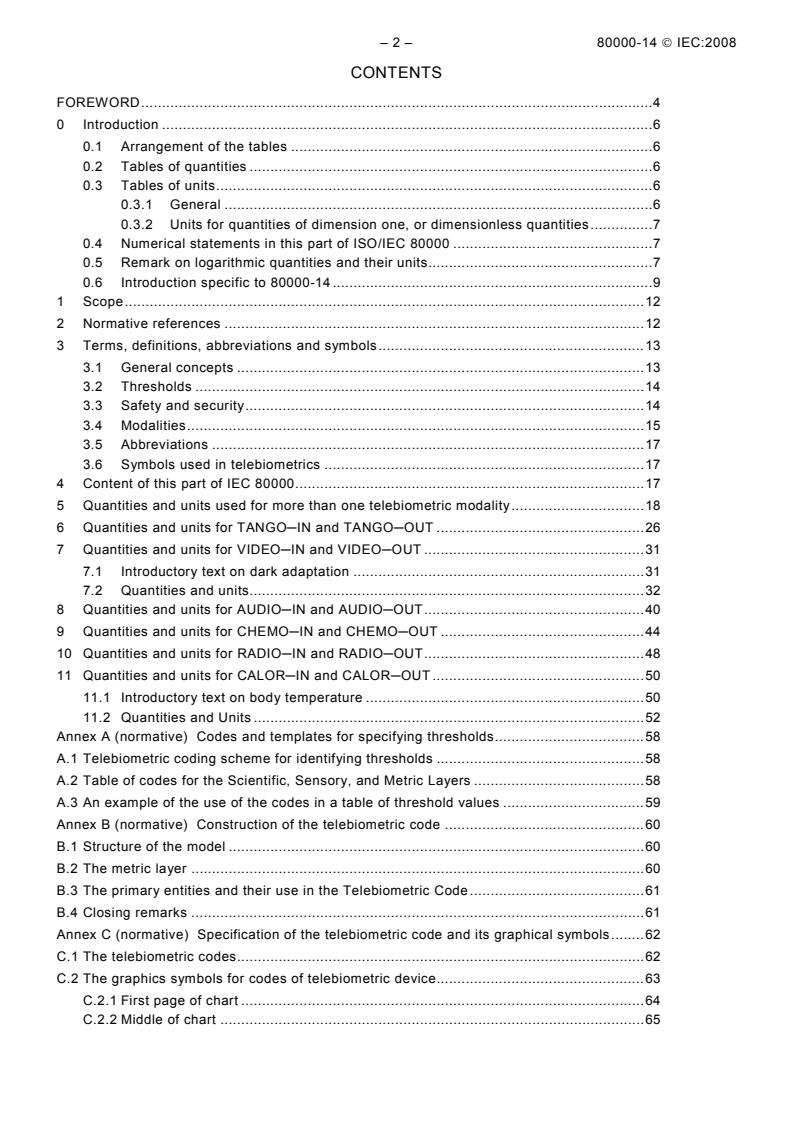
CONTENTS
FOREWORD.4
0 Introduction .6
0.1 Arrangement of the tables .6
0.2 Tables of quantities .6
0.3 Tables of units.6
0.3.1 General .6
0.3.2 Units for quantities of dimension one, or dimensionless quantities.7
0.4 Numerical statements in this part of ISO/IEC 80000 .7
0.5 Remark on logarithmic quantities and their units.7
0.6 Introduction specific to 80000-14.9
1 Scope.12
2 Normative references .12
3 Terms, definitions, abbreviations and symbols.13
3.1 General concepts .13
3.2 Thresholds .14
3.3 Safety and security.14
3.4 Modalities.15
3.5 Abbreviations .17
3.6 Symbols used in telebiometrics .17
4 Content of this part of IEC 80000.17
5 Quantities and units used for more than one telebiometric modality.18
6 Quantities and units for TANGO─IN and TANGO─OUT .26
7 Quantities and units for VIDEO─IN and VIDEO─OUT .31
7.1 Introductory text on dark adaptation .31
7.2 Quantities and units.32
8 Quantities and units for AUDIO─IN and AUDIO─OUT.40
9 Quantities and units for CHEMO─IN and CHEMO─OUT .44
10 Quantities and units for RADIO─IN and RADIO─OUT.48
11 Quantities and units for CALOR─IN and CALOR─OUT .50
11.1 Introductory text on body temperature .50
11.2 Quantities and Units .52
Annex A (normative) Codes and templates for specifying thresholds.58
A.1 Telebiometric coding scheme for identifying thresholds .58
A.2 Table of codes for the Scientific, Sensory, and Metric Layers .58
A.3 An example of the use of the codes in a table of threshold values .59
Annex B (normative) Construction of the telebiometric code .60
B.1 Structure of the model .60
B.2 The metric layer .60
B.3 The primary entities and their use in the Telebiometric Code.61
B.4 Closing remarks .61
Annex C (normative) Specification of the telebiometric code and its graphical symbols.62
C.1 The telebiometric codes.62
C.2 The graphics symbols for codes of telebiometric device.63
C.2.1 First page of chart .64
C.2.2 Middle of chart .65
80000-14 © IEC:2008 – 3 –
C.2.3 End of chart.66
Annex D (informative) Explanatory notes .67
D.1 Unimodal and multimodal wetware interaction .67
D.2 Wetware protocols.67
D.3 Semi-open telebiometric systems .67
D.4 Technophobia.67
Bibliography.68
LIST OF FIGURES
Figure 1 – Schematic drawing of a cross-section of glabrous skin .10
Figure 2 – Schematic drawing of a cross-section of hairy skin.10
Figure 3 – Detection thresholds for vibration contactors, measured at the thenar eminence
in decibels per peak with reference to 1,0 µm .30
Figure 4 – Subjective magnitude of vibration in assigned numbers as a function of vibration
amplitude in decibels per peak with reference to 1,0 µm .31
Figure 5 – Spectral sensitivity of the eye.36
Figure 6 – Temporal summation – Bloch law .37
Figure 7 – Threshold of the fovea and periphery of the eye for detection of a test flash
using a white disc after dark adaptation (see [9]) .38
Figure 8 – Spatial summation.39
Figure 9 – Thresholds as a function of frequency .42
Figure 10 – Subjective magnitude in assigned numbers as a function of sound pressure
level in decibels.43
LIST OF TABLES
Table 1 – Quantities, units, and definitions for multiple modalities.18
Table 2 – Quantities, units, and definitions for the TANGO modality.26
Table 3 – Quantities, units, and definitions for the VIDEO modality .32
Table 4 – Quantities, units, and definitions for the AUDIO modality.40
Table 5 – Quantities, units, and definitions for the CHEMO modality .44
Table 6 – Quantities, units, and definitions for the RADIO modality.48
Table 7 – Quantities, units, and definitions for the CALOR modality.52
Table A.1 – Primary entities and their codes for the scientific layer .58
Table A.2 – Primary entities and their codes for the sensory layer .58
Table A.3 – Examples of primary entities and their codes for the metric layer .59
Table A.4 – Telebiometric code of sample phenomena .59
Table C.1 – Part of the table of all combinations of human-machine IN and OUT interaction
states and all types of possible telebiometric unimodal and multimodal devices.62
– 4 – 80000-14 © IEC:2008
INTERNATIONAL ELECTROTECHNICAL COMMISSION
____________
QUANTITIES AND UNITS –
Part 14: Telebiometrics related to human physiology
FOREWORD
1) The International Electrotechnical Commission (IEC) is a worldwide organization for standardization comprising all national
electrotechnical committees (IEC National Committees). The object of IEC is to promote international co-operation on all
questions concerning standardization in the electrical and electronic fields. To this end and in addition to other activities, IEC
publishes International Standards, Technical Specifications, Technical Reports, Publicly Available Specifications (PAS) and
Guides (hereafter referred to as “IEC Publication(s)”). Their preparation is entrusted to technical committees; any IEC
National Committee interested in the subject dealt with may participate in this preparatory work. International, governmental
and non-governmental organizations liaising with the IEC also participate in this preparation. IEC collaborates closely with the
International Organization for Standardization (ISO) in accordance with conditions determined by agreement between the two
organizations.
2) The formal decisions or agreements of IEC on technical matters express, as nearly as possible, an international consensus of
opinion on the relevant subjects since each technical committee has representation from all interested IEC National
Committees.
3) IEC Publications have the form of recommendations for international use and are accepted by IEC National Committees in
that sense. While all reasonable efforts are made to ensure that the technical content of IEC Publications is accurate, IEC
cannot be held responsible for the way in which they are used or for any misinterpretation by any end user.
4) In order to promote international uniformity, IEC National Committees undertake to apply IEC Publications transparently to the
maximum extent possible in their national and regional publications. Any divergence between any IEC Publication and the
corresponding national or regional publication shall be clearly indicated in the latter.
5) IEC provides no marking procedure to indicate its approval and cannot be rendered responsible for any equipment declared to
be in conformity with an IEC Publication.
6) All users should ensure that they have the latest edition of this publication.
7) No liability shall attach to IEC or its directors, employees, servants or agents including individual experts and members of its
technical committees and IEC National Committees for any personal injury, property damage or other damage of any nature
whatsoever, whether direct or indirect, or for costs (including legal fees) and expenses arising out of the publication, use of,
or reliance upon, this IEC Publication or any other IEC Publications.
8) Attention is drawn to the Normative references cited in this publication. Use of the referenced publications is indispensable for
the correct application of this publication.
9) Attention is drawn to the possibility that some of the elements of this IEC Publication may be the subject of patent rights. IEC
shall not be held responsible for identifying any or all such patent rights.
International Standard IEC 80000-14 has been prepared by IEC technical committee 25: Quantities and
units, and their letter symbols.
The text of this part of IEC 80000 is based on the following documents:
FDIS Report on voting
25/366/FDIS 25/372/RVD
Full information on the voting for the approval of this part of IEC 80000 can be found in the report on
voting indicated in the above table.
This international standard has been prepared in co-operation with ISO/TC 12.
This publication has been drafted in accordance with the ISO/IEC Directives, Part 2.
80000-14 © IEC:2008 – 5 –
The committee has decided that the contents of this publication will remain unchanged until the
maintenance result date indicated on the IEC web site under "http://webstore.iec.ch" in the data related to
the specific publication. At this date, the publication will be
• reconfirmed,
• withdrawn,
• replaced by a revised edition, or
• amended.
IEC 80000 consists of the following parts, under the general title Quantities and units:
Part 6: Electromagnetism
Part 13: Information science and technology
Part 14: Telebiometrics related to human physiology
The following parts are published by ISO:
Part 1: General
Part 2: Mathematical signs and symbols for use in the natural sciences and technology
Part 3: Space and time
Part 4: Mechanics
Part 5: Thermodynamics
Part 7: Light
Part 8: Acoustics
Part 9: Physical chemistry and molecular physics
Part 10: Atomic and nuclear physics
Part 11: Characteristic numbers
Part 12: Solid state physics
– 6 – 80000-14 © IEC:2008
0 Introduction
Subclauses 0.1 to 0.5 are text that is common to many Parts of ISO/IEC 80000. Some of this text is not
applicable to this Part of ISO/IEC 80000, but is included for consistency with other parts. Subclause 0.6
is specific to this part of ISO/IEC 80000.
0.1 Arrangement of the tables
The tables of quantities and units in ISO/IEC 80000 are arranged so that the quantities are presented on
the left-hand pages and the units on the corresponding right-hand pages.
All units between two full lines on the right-hand pages belong to the quantities between the
corresponding full lines on the left-hand pages.
Where the numbering of an item has been changed in the revision of a part of ISO 31, the number in the
preceding edition is shown in parenthesis on the left-hand page under the new number for the quantity; a
dash is used to indicate that the quantity in question did not appear in the preceding edition.
0.2 Tables of quantities
The names in English and in French of the most important quantities within the field of this part of
ISO/IEC 80000 are given together with their symbols and, in most cases, definitions. These names and
symbols are recommendations. The definitions are given for identification of the quantities in the
International System of Quantities (ISQ), listed on the left hand pages of the Tables in this part of
ISO/IEC 80000; they are not intended to be complete.
The scalar, vectorial or tensorial character of quantities is pointed out, especially when this is needed for
the definitions.
In most cases only one name and only one symbol for the quantity are given; where two or more names
or two or more symbols are given for one quantity and no special distinction is made, they are on an
equal footing. When two types of italic letters exist (for example as with ϑ and θ; φ and φ; a and a; g and
g) only one of these is given. This does not mean that the other is not equally acceptable. It is
recommended that such variants should not be given different meanings. A symbol within parenthesis
implies that it is a reserve symbol, to be used when, in a particular context, the main symbol is in use with
a different meaning.
In this English edition the quantity names in French are printed in an italic font, and are preceded by fr.
The gender of the French name is indicated by (m) for masculine and (f) for feminine, immediately after the
noun in the French name.
0.3 Tables of units
0.3.1 General
The names of units for the corresponding quantities are given together with the international symbols and
the definitions. These unit names are language-dependent, but the symbols are international and the
th
same in all languages. For further information, see the SI Brochure (8 edition 2006) from BIPM and ISO
80000-1.
The units are arranged in the following way:
a) The coherent SI units are given first. The SI units have been adopted by the General Conference on
Weights and Measures (Conférence Générale des Poids et Mesures, CGPM). The coherent SI units,
and their decimal multiples and submultiples formed with the SI prefixes, are recommended, although
the decimal multiples and submultiples are not explicitly mentioned.
b) Some non-SI units are then given, being those accepted by the International Committee for Weights
and Measures (Comité International des Poids et Mesures, CIPM), or by the International
Organization of Legal Metrology (Organisation Internationale de Métrologie Légale, OIML), or by ISO
and IEC, for use with the SI. Such units are separated from the SI units in the item by use of a
broken line between the SI units and the other units.
80000-14 © IEC:2008 – 7 –
c) Non-SI units currently accepted by the CIPM for use with the SI are given in small print (smaller than
the text size) in the “Conversion factors and remarks” column.
d) Non-SI units that are not recommended are given only in annexes in some parts of ISO/IEC 80000.
These annexes are informative, in the first place for the conversion factors, and are not integral parts
of the standard. These deprecated units are arranged in two groups:
1) units in the CGS system with special names;
2) units based on the foot, pound, second, and some other related units;
e) Other non-SI units given for information, especially regarding the conversion factors are given in
another informative annex.
0.3.2 Units for quantities of dimension one, or dimensionless quantities
The coherent unit for any quantity of dimension one, also called a dimensionless quantity, is the number
one, symbol 1. When the value of such a quantity is expressed, the unit symbol 1 is generally not written
out explicitly.
EXAMPLE 1 Refractive index n = 1,53 × 1 = 1,53
Prefixes shall not be used to form multiples or submultiples of this unit. Instead of prefixes, powers of 10
are recommended.
EXAMPLE 2 Reynolds number Re = 1,32 × 10
Considering that plane angle is generally expressed as the ratio of two lengths and solid angle as the
ratio of two areas, in 1995 the CGPM specified that, in the SI, the radian, symbol rad, and steradian,
symbol sr, are dimensionless derived units. This implies that the quantities plane angle and solid angle
are considered as derived quantities of dimension one. The units radian and steradian are thus equal to
one; they may either be omitted, or they may be used in expressions for derived units to facilitate
distinction between quantities of different kind but having the same dimension.
0.4 Numerical statements in this part of ISO/IEC 80000
The sign = is used to denote “is exactly equal to”, the sign ≈ is used to denote “is approximately equal to”,
and the sign := is used to denote “is by definition equal to”.
Numerical values of physical quantities that have been experimentally determined always have an
associated measurement uncertainty. This uncertainty should always be specified. In this part of ISO/IEC
80000, the magnitude of the uncertainty is represented as in the following example.
EXAMPLE l = 2,347 82(32) m
In this example, l = a(b) m, the numerical value of the uncertainty b indicated in parentheses is assumed
to apply to the last (and least significant) digits of the numerical value a of the length l. This notation is
used when b represents one standard uncertainty (estimated standard deviation) in the last digits of a.
The numerical example given above may be interpreted to mean that the best estimate of the numerical
value of the length l when l is expressed in the unit metre is 2,347 82 and that the unknown value of l is
believed to lie between (2,347 82 – 0,000 32) m and (2,347 82 + 0,000 32) m with a probability
determined by the standard uncertainty 0,000 32 m and the probability distribution of the values of l.
0.5 Remark on logarithmic quantities and their units
The expression for the time dependence of a damped harmonic oscillation can be written either in real
notation or as the real part of a complex notation
–δt (–δ + iω)t
F(t) = A e cos ωt = Re (A e ), A = F(0)
This simple relation involving δ and ω can be obtained only when e (base of natural logarithms) is used
as the base of the exponential function. The coherent SI unit for the damping coefficient δ and the angular
–1
frequency ω is second to the power minus one, symbol s . Using the special names neper, symbol Np,
– 8 – 80000-14 © IEC:2008
and radian, symbol rad, for the units of δt and ωt, respectively, the units for δ and ω become neper per
second, symbol Np/s and radian per second, symbol rad/s, respectively.
Corresponding variation in space is treated in the same manner
–αx –γx
F(x) = Ae cos βx = Re(Ae ), A = F(0) γ = α + iβ
where the unit for α is neper per metre, symbol Np/m, and the unit for β is radian per metre, symbol rad/m.
The taking of logarithms of complex quantities is usefully done only with the natural logarithm. In ISO/IEC
80000, the level L of a field quantity F is therefore defined by convention as the natural logarithm of a
F
ratio of the field quantity and a reference value F , L = ln(F/F ), in accordance with decisions by CIPM
0 F 0
and OIML. Since a field quantity is defined as a quantity the square of which is proportional to power
when it acts on a linear system, a factor 1/2 is introduced in the expression of the level of a power
quantity, L = (1/2) ln(P/P ), when defined by convention using the natural logarithm, in order to make the
P 0
level of the power quantity equal to the level of the corresponding field quantity when the proportionality
factors are the same for the considered quantities and the reference quantities, respectively. See IEC
60027-3:2002, subclause 4.2 .
The neper and the bel, symbol B, are units for such logarithmic quantities. The neper is the coherent unit
when the logarithmic quantities are defined by convention using the natural logarithm, 1 Np = 1. The bel
is the unit when the numerical value of the logarithmic quantity is expressed in terms of decimal
logarithms, 1 B = (1/2) ln 10 Np ≈ 1,151 293. The use of the neper is mostly restricted to theoretical
calculations on field quantities, when this unit is most convenient, whereas in other cases, especially for
power quantities, the bel, or in practice its submultiple decibel, symbol dB, is widely used. It should be
emphasized that the fact that the neper is chosen as the coherent unit does not imply that the use of the
bel should be avoided. The bel is accepted by the CIPM and the OIML for use with the SI. This situation
is in some respect similar to the fact that the unit degree (…°) is commonly used in practice instead of the
coherent SI unit radian (rad) for plane angle.
Generally it is not the logarithmic quantity itself (such as L or L ) that is of interest; it is only the
F P
argument of the logarithm that is of interest.
To avoid ambiguities in practical applications of logarithmic quantities the unit should always be written
out explicitly after the numerical value, even if the unit is neper, 1 Np = 1. Thus, for power quantities, the
level is generally given by L = 10 lg(P/P ) dB, and it is the numerical value 10 lg(P/P ) and the argument
P 0 0
P/P that are of interest. This numerical value is, however, not the same as the quantity L , because the
0 P
unit decibel (or the unit bel) is not equal to one, 1. The corresponding applies to field quantities where the
level is generally given by L = 10 lg(F/F ) dB.
F 0
EXAMPLES
The implication of the statement that L = 3 dB (= 0,3 B) for the level of a field quantity is to be read as meaning:
F
2 2 0,3
lg(F/F ) = 0,3, or (F/F ) = 10 . It also implies that L ≈ 0,3 × 1,151 293 = 0,345 387 9 Np, but this is not often used in
0 0 F
practice.
Similarly the implication of the statement that L = 3 dB (= 0,3 B) for the level of a power quantity is to be read as
P
0,3
meaning: lg(P/P ) = 0,3, or (P/P ) = 10 . It also implies thatL ≈ 0,3 × 1,151 293 = 0,345 387 9, but this is not often used
0 0 P
in practice.
Meaningful measures of power quantities generally require time averaging to form a mean-square value
that is proportional to power. Corresponding field quantities may then be obtained as the root-mean-
square value. Peak values during specified time intervals are also important. For such applications, the
decimal (base 10) logarithm is generally used to form the level of field or power quantities. However, the
natural logarithm could also be used for these applications, especially when the quantities are complex.
IEC 60027-3, Letter symbols to be used in electrical technology ─ Part 3: Logarithmic and related quantities, and their units.
80000-14 © IEC:2008 – 9 –
0.6 Introduction specific to 80000-14
0.6.1 The basis for the determination of the quantities and units to be addressed is the taxonomy
specified in the Telebiometric Multimodal Model (TMM, see ITU-T Rec. X.1081). In the TMM ten aspects
of the interaction between the human body and its environment are recognised (base modalities). These
interactions are assumed to occur at various scales of propinquity and at various intensities across the
"personal privacy sphere" (see Figure 1 of ITU-T Rec. X.1081).
0.6.2 Using the terminology of the TMM, these interactions (base modalities) are classified as follows
(see the definition of terms in clause 3):
• TANGO─IN
• TANGO─OUT
• VIDEO─IN
• VIDEO─OUT
• AUDIO─IN
• AUDIO─OUT
• CHEMO─IN
• CHEMO─OUT
• RADIO─IN
• RADIO─OUT
0.6.3 It is also recognised that the temperature of (parts of) the human body is important both for safe
operation of a telebiometric device and for its use in providing telebiometric security. This aspect of the
interaction of a human body with its environment uses the base modalities TANGO─IN, TANGO─OUT,
VIDEO─IN, and VIDEO─OUT, but is sufficiently important that it is defined in this part of ISO/IEC 80000
as an additional derived modality:
• CALOR─IN describes the absorption of heat by the whole human body mediated by electromagnetic
radiation (including infra-red or micro-wave radiation), heat conduction (by direct contact) or heat
convection (by a heat transporting liquid or gas).
• CALOR─OUT describes the loss of heat by the whole human body mediated by electromagnetic
radiation, heat conduction, heat convection or evaporation.
0.6.4 Clauses 5 to 11 define quantities and units for the in and out aspects of one of the interactions of
the human body with a telebiometric device – see [10].
0.6.5 The terminology used in this classification is derived as follows:
• TANGO: from Latin: tangō, -ēre, tetigī, tāctum Latin, meaning "I touch"
NOTE 1 TANGO─IN has been listed first, because in terms of the development of life, skin sensitivity came first, and other input
organs were specialisations of that.
NOTE 2 There are two forms of skin, glabrous and hairy (see Figures 1 and 2). These have different properties for sensitivity
(see VIM, 4-12), giving rise to different TANGO─IN units.
• VIDEO: from Latin: videō, -ēre, vīdī, vīsum Latin, meaning "I see"
• AUDIO: from Latin: audiō, -īre, -īvī (iī), -ītum Latin, meaning "I hear"
• CHEMO: from Medieval Latin: chemia, from Arabic al-kimia
meaning “chemistry”
• RADIO: from Latin: radiō, -āre, -āvi, ātum Latin, meaning "I radiate"
and: Latin: radius, -iī (m) Latin, meaning "ray, beam"
• CALOR: from Latin: calor, calōris (m) Latin, meaning "warmth, heat"
0.6.6 In Annex C (normative) a code is specified that can be applied to classify a telebiometric device,
and a compact graphical symbol that can be used to represent that code. This is based essentially on
whether the device is an actuator or a sensor, and on which modalities it uses.
– 10 – 80000-14 © IEC:2008
Meissner's corpuscle
Merkel's discs
Pacinian corpuscles
Figure 1 – Schematic drawing of a cross-section of glabrous skin
Ruffini endings
Pacinian corpuscles
Figure 2 – Schematic drawing of a cross-section of hairy skin
80000-14 © IEC:2008 – 11 –
This page is intentionally blank in order to ensure
that the tables of Quantities appear on an even numbered page
and the tables of units on an odd numbered page.
– 12 – 80000-14 © IEC:2008
QUANTITIES AND UNITS –
Part 14: Telebiometrics related to human physiology
1 Scope
In this part of ISO/IEC 80000 names, symbols, and definitions for quantities and units of telebiometrics
related to human physiology are given.
This part of ISO/IEC 80000 encompasses quantities and units for physiological, biological or behavioural
characteristics that might provide input or output to telebiometric identification or verification systems
(recognition systems), including any known detection or safety thresholds.
It also includes quantities and units concerned with effects on a human being caused by the use of a
telebiometric device.
NOTE The quantities and units, their names and letter symbols, specified here are those widely used in the disciplines and
specialities related to telebiometrics: the telebiometric industry and telebiometry. Telebiometric units are SI units (see ISO
80000-1).
A code and an associated graphical symbol for the identification of the type of a telebiometric device are
also specified in this part of ISO/IEC 80000.
2 Normative references
The following referenced documents are indispensable for the application of this document. For dated
references, only the edition cited applies. For undated references, the latest edition of the referenced
document (including any amendments) applies.
ISO 80000-1, Quantities and units ─ Part 1: General
ISO 80000-3:2006, Quantities and units ─ Part 3: Space and time
ISO 80000-4:2006, Quantities and units ─ Part 4: Mechanics
ISO 80000-5, Quantities and units ─ Part 5: Thermodynamics
IEC 80000-6, Quantities and units ─ Part 6: Electromagnetism
ISO 80000-7, Quantities and units ─ Part 7: Light
ISO 80000-8, Quantities and units ─ Part 8: Acoustics
ISO 80000-9, Quantities and units ─ Part 9: Physical chemistry and molecular physics
ISO 80000-10, Quantities and units ─ Part 10: Atomic and nuclear physics
ITU-T Rec. X.1081, The Telebiometric Multimodal Model ─ A Framework for the Specification of Security
and Safety Aspects of Telebiometrics
VIM (2007), International Vocabulary of Metrology ─ Basic and General Concepts and Associated
rd
Terms – 3 edition
)
In preparation.
80000-14 © IEC:2008 – 13 –
3 Terms, definitions, abbreviations and symbols
For the purpose of this document, the following terms and definitions apply.
3.1 General concepts
3.1.1
base modality
one of the classifications of the interaction of a human body with its environment based on the physical nature of the
interaction or on the human sensory system that it affects (see 3.4.1 to 3.4.10)
NOTE If the interaction is from the environment to the human body it is described as an in-modality. If it is from the human
body to the environment is described as an out-modality
3.1.2
derived modality
one of the classifications of the interaction of a human body with its environment based on a property of the human
body that is determined or changed using one or more of the base modalities (see 3.4.11 to 3.4.12)
NOTE The temperature of the human body or parts of the human body can be detected (CALOR─OUT) by an infrared detector
or by conduction to a thermometer and can be changed by convection, conduction, or various forms of radiation (CALOR─IN).
3.1.3
in-modality
modality of interactions from the environment to the human body
3.1.4
out-modality
modality of interactions from the human body to the environment
3.1.5
wetware
that physical aspect of a human being that is affected by or affects telebiometric devices
NOTE This term is not used in the normative text, but it is extensively used in Annex D and the definition is provided here for
completeness.
3.1.6
biometrics
automated recognition of individuals based on their behavioural and biological characteristics
NOTE In some other disciplines the meaning of biometrics encompasses counting, measuring and statistical analysis of any
kind of data in the biological sciences including the relevant medical sciences.
3.1.7
telebiometrics
application of biometrics to telecommunications and of telecommunications to remote biometric sensing
3.1.8
telebiometric device
sensor or actuator interacting remotely with a human being, using telecommunications
3.1.9
telebiometric multimodal model
model of the interactions of a human being with its environment using modalities based on the human
senses.
3.1.10
TMM metric layer
layer in the TMM taxonomy that identifies the SI units used to describe an IN or OUT interaction.
3.1.11
TMM scientific layer
layer in the TMM taxonomy that identifies the scientific discipline that investigates the properties and
thresholds of an IN or OUT interaction.
– 14 – 80000-14 © IEC:2008
3.1.12
TMM sensory layer
layer in the TMM taxonomy that identifies the human senses involved in producing or detecting an IN or
OUT interaction.
3.2 Thresholds
3.2.1
threshold
boundary between two identifiable regions of the stimulus to response curve for human sensors
3.2.2
detection threshold
level at which a stimulus applied to a conscious human subject just produces a response
3.2.3
suprathreshold stimulus
stimulus greater than the detection threshold
3.2.4
comfort threshold
level (above or below) which a stimulus is known to cause discomfort for most human beings
3.2.5
safety threshold
level at which a stimulus changes from being safe to not being safe.
NOTE In many cases a stimulus is safe below a safety threshold (a maximum safe level) and unsafe above (for example a hot
object), but there are cases where the stimulus is safe above a safety threshold (a minimum safe level) and unsafe below (for
example a cold object).
3.2.6
pain threshold
level above which a stimulus is known to cause the sensation of pain
3.2.7
damage threshold
level above which a stimulus may cause temporary or permanent damage
NOTE Damage thresholds often depend on the duration of the exposure to a stimulus as well as the level of that stimulus.
3.3 Safety and security
3.3.1
safety
property of a physical device or procedure that determines (and limits through mechanisms, procedures,
regulations and permitted operating thresholds) the extent of the damage that the device can cause to
one or more human beings.
NOTE Examples of mechanisms, procedures, regulations, and permitted operating thresholds are permitted electronic emissions
from devices, the temperature of surfaces on operating devices, the volume of sounds in public entertainment, and mechanisms
to ensure the shut-down of nuclear power plants in the event of some failure. In many cases the operation of a device within
these limits can be both sensed and controlled by telecommunications.
3.3.2
security
protection of a human being's activities (particularly those involving privileges and financial activities)
from attack by other human or computer activities, usually achieved by the use of mechanical or
electronic devices or mechanisms associated with the protected human being.
NOTE Examples of security devices and mechanisms are physical door-locks, the use of PINs or biometrics to protect credit
cards or passports, and the use of biometrics for access control. In many cases these devices and mechanisms use
telecommunications as an essential part of their operation.
80000-14 © IEC:2008 – 15 –
3.3.3
safe telebiometric device
telebiometric device that is harmless to human physiology, culture, psychology, and meets public
information rights requirements and privacy requirements
NOTE 1 The Telebiometric Multimodal Model (see ITU-T Rec. X.1081) provides a framework for the identification of safety
aspects of biometric devices, and for the specification of limits (safety thresholds) by analysing and categorising the interactions
between a human body and its environment.
NOTE 2 Safe telebiometric devices meet a specified set of conditions derived from identified safety thresholds.
3.3.4
telebiometric security
security obtained through the use of telebiometric devices for authentication of a human being, using one
or more of the modalities of interaction between a human body and its environment, meeting public
information rights requirements and privacy requirements
NOTE The "out" modalities specified in the Telebiometric Multimodal Model (see ITU-T Rec. X.1081) provide a framework for
the identification of devices that can provide telebiometric acquisition and processing.
3.3.5
telebiometric identification
telebiometric system function that performs a one-to-many search to obtain a candidate list using
telecommunications to access one or more biometric systems.
3.3.6
telebiometric verification
telebiometric system function that performs a one-to-one comparison to show true or false, using
telecommunications to access one or more biometric systems.
3.4 Modalities
3.4.1
TANGO─IN
characterization of any stimulus that can be detected by nerve endings in the human body, other than by
the specialised nerves active in seeing, hearing, tasting and smelling, or that affects or damages human
cells
NOTE 1 The term TANGO─IN is used both as an adjective applied to a stimulus, but more commonly as a noun referring to a
TANGO─IN stimulus.
NOTE 2 The human body is sensitive to the impact of objects or to irritation by (for example) nano-particles or abrasion or
chemical substances related to the u
...
Questions, Comments and Discussion
Ask us and Technical Secretary will try to provide an answer. You can facilitate discussion about the standard in here.
Loading comments...