

ISO/IEC 4396-5:2023
(Main)Telecommunications and information exchange between systems — Recursive inter-network architecture — Part 5: Incremental enrolment procedures
General Information
- Abstract
This document defines the procedure executed by a Member of a distributed inter-process communication (IPC) facility (DIF) or distributed application facility (DAF) to initialize a new Member as a fully functioning Member. This document defines the procedure for a new Member to enrol when the new Member was recently a Member of the DIF or DAF. This document is defined for use with DIFs, but it can be used equally well by a DAF that wants to assign synonyms with a scope limited to the DAF.
- Status
- Published
- Publication Date
- 04-Dec-2023
- Current Stage
- 6060 - International Standard published
- Start Date
- 05-Dec-2023
- Due Date
- 30-Nov-2023
- Completion Date
- 05-Dec-2023

Overview
ISO/IEC 4396-5:2023 is part of the Recursive Inter-Network Architecture (RINA) series, specifically defining incremental enrolment procedures for members of distributed inter-process communication (IPC) facilities (DIFs) or distributed application facilities (DAFs). This standard provides a detailed procedure for initializing new Members who were recently part of the network, allowing them to re-enrol efficiently as fully functioning Members.
The enrolment process is designed to facilitate seamless re-integration with minimal data exchange, assuming that the Member was temporarily disconnected due to crashes or physical media failures. While primarily developed for DIFs, the procedures are equally applicable to DAFs that manage scoped synonym assignments.
Key Topics
Scope and Purpose
Defines the enrolment mechanism for Members joining or re-joining a DIF or DAF, focusing on efficient reconnection after short disconnections.Enrolment Procedure Steps
- Establish CDAP (Common Distributed Application Protocol) connection
- Authentication and connection response
- Exchange of static, near static, and dynamic information essential for operation
- Address verification and assignment based on expiry or validity
- Initialization through commands like A_Start Enrolment, A_Create, and A_Stop Enrolment
- Final transition to operational state triggered by A_Start Operation
Information Categories
- Static: Core parameters defining the DIF
- Near Static: Rarely changing data such as addresses or added QoS cubes
- Dynamic: Routine data including routing and directory updates handled by Resource Information Base (RIB)
Resilience and Optimization
Enrolment recognizes scenarios like rapid rejoining of failed Members, allowing shorter initialization phases leveraging recently cached state information.Standards Integration
Closely linked with ISO 4396-1 and ISO 4396-2 for reference model and connection establishment context.
Applications
ISO/IEC 4396-5:2023 serves a critical role in telecommunications and distributed system frameworks where recursive inter-network architecture methods are employed. Key practical applications include:
Network Recovery and Fault Tolerance
Enables rapid reconnection of IPC-process Members after network failures or process crashes, minimizing downtime.Distributed Systems Management
Supports efficient management and synchronization of distributed components in complex inter-network systems.Dynamic Network Environments
Useful for environments requiring frequent or incremental enrolments and maintaining state consistency across dynamic network topologies.Quality of Service (QoS) Maintenance
Helps enforce network policies by facilitating accurate and timely enrollment of Members with the right parameters and scopes.Interoperability in Recursive Networks
Promotes interoperability between diverse recursive IPC and application systems conforming to RINA principles.
Related Standards
ISO/IEC 4396-5 is part of the broader ISO 4396 series, which collectively define the Recursive Inter-Network Architecture. Related documents include:
ISO/IEC 4396-1: Recursive Inter-Network Architecture - Part 1: Reference Model
Provides foundational concepts, terminology, and architectural framework.ISO/IEC 4396-2: Recursive Inter-Network Architecture - Part 2: Common Application Connection Establishment Procedure (CACEP)
Details procedures for establishing connections between application processes.Other parts of the ISO 4396 series can offer complementary procedures and architectural details applicable to various aspects of recursive telecommunications systems.
Benefits of ISO/IEC 4396-5:2023
- Facilitates incremental enrolment, reducing resource consumption for rejoining Members.
- Enhances network resilience through rapid recovery processes.
- Supports efficient management of dynamic recursive network infrastructures.
- Ensures compatibility and standardization in modern telecommunications and distributed system environments.
- Improves scalability of recursive inter-network systems by minimizing enrolment overhead.
For network architects, system integrators, and telecommunications engineers, ISO/IEC 4396-5:2023 establishes a clear, standardized approach for Member enrolment in recursive inter-network architectures, streamlining operations while maintaining robust communication and control. This standard is indispensable for ensuring dependable and scalable recursive network implementations.
Get Certified
Connect with accredited certification bodies for this standard

BSI Group
BSI (British Standards Institution) is the business standards company that helps organizations make excellence a habit.

NYCE
Mexican standards and certification body.
Sponsored listings
Frequently Asked Questions
ISO/IEC 4396-5:2023 is a standard published by the International Organization for Standardization (ISO). Its full title is "Telecommunications and information exchange between systems — Recursive inter-network architecture — Part 5: Incremental enrolment procedures". This standard covers: This document defines the procedure executed by a Member of a distributed inter-process communication (IPC) facility (DIF) or distributed application facility (DAF) to initialize a new Member as a fully functioning Member. This document defines the procedure for a new Member to enrol when the new Member was recently a Member of the DIF or DAF. This document is defined for use with DIFs, but it can be used equally well by a DAF that wants to assign synonyms with a scope limited to the DAF.
This document defines the procedure executed by a Member of a distributed inter-process communication (IPC) facility (DIF) or distributed application facility (DAF) to initialize a new Member as a fully functioning Member. This document defines the procedure for a new Member to enrol when the new Member was recently a Member of the DIF or DAF. This document is defined for use with DIFs, but it can be used equally well by a DAF that wants to assign synonyms with a scope limited to the DAF.
ISO/IEC 4396-5:2023 is classified under the following ICS (International Classification for Standards) categories: 35.100.30 - Network layer. The ICS classification helps identify the subject area and facilitates finding related standards.
ISO/IEC 4396-5:2023 is available in PDF format for immediate download after purchase. The document can be added to your cart and obtained through the secure checkout process. Digital delivery ensures instant access to the complete standard document.
Standards Content (Sample)
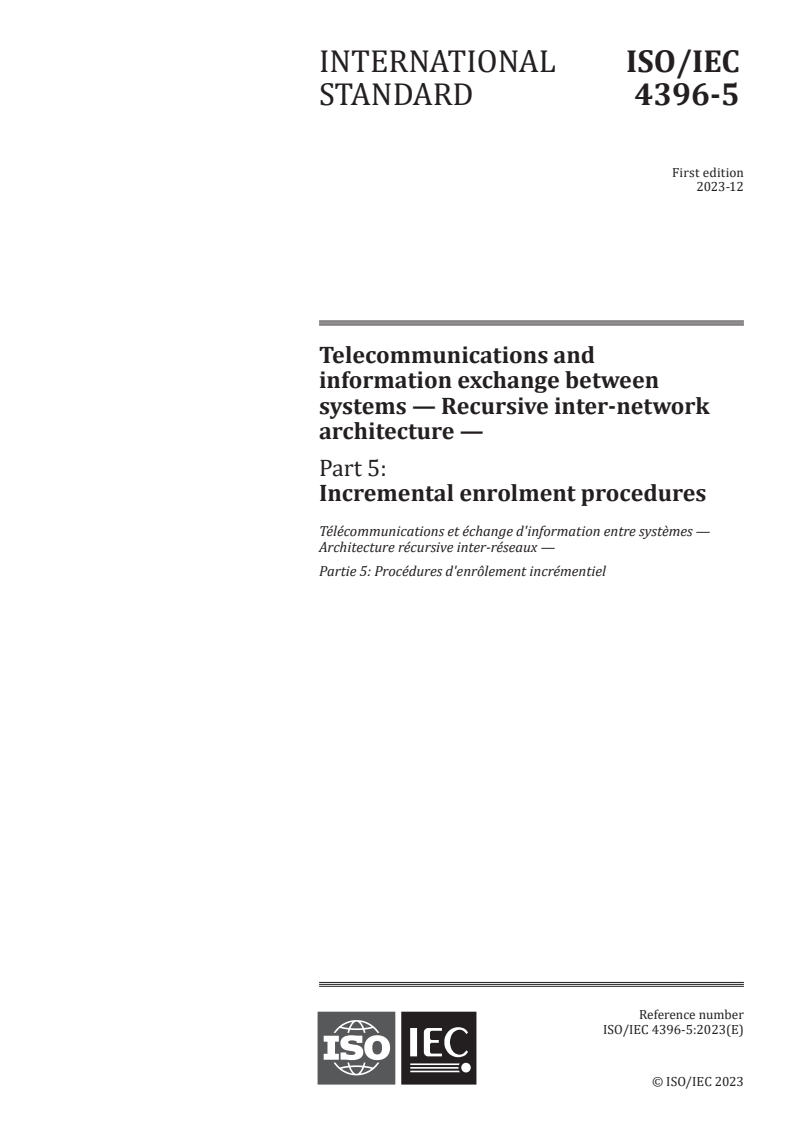
INTERNATIONAL ISO/IEC
STANDARD 4396-5
First edition
2023-12
Telecommunications and
information exchange between
systems — Recursive inter-network
architecture —
Part 5:
Incremental enrolment procedures
Télécommunications et échange d'information entre systèmes —
Architecture récursive inter-réseaux —
Partie 5: Procédures d'enrôlement incrémentiel
Reference number
© ISO/IEC 2023
© ISO/IEC 2023
All rights reserved. Unless otherwise specified, or required in the context of its implementation, no part of this publication may
be reproduced or utilized otherwise in any form or by any means, electronic or mechanical, including photocopying, or posting on
the internet or an intranet, without prior written permission. Permission can be requested from either ISO at the address below
or ISO’s member body in the country of the requester.
ISO copyright office
CP 401 • Ch. de Blandonnet 8
CH-1214 Vernier, Geneva
Phone: +41 22 749 01 11
Email: copyright@iso.org
Website: www.iso.org
Published in Switzerland
ii
© ISO/IEC 2023 – All rights reserved
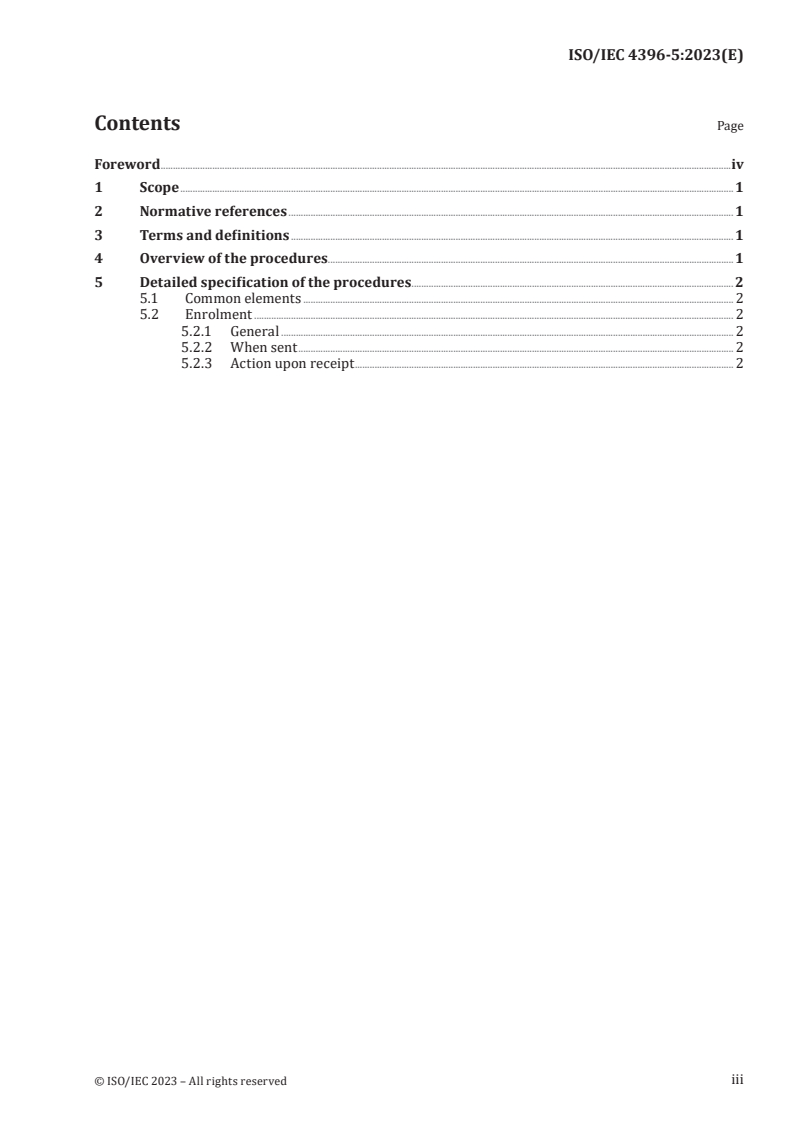
Contents Page
Foreword .iv
1 Scope . 1
2 Normative references . 1
3 Terms and definitions . 1
4 Overview of the procedures . .1
5 Detailed specification of the procedures . 2
5.1 Common elements . 2
5.2 Enrolment . 2
5.2.1 General . 2
5.2.2 When sent . 2
5.2.3 Action upon receipt . 2
iii
© ISO/IEC 2023 – All rights reserved
Foreword
ISO (the International Organization for Standardization) and IEC (the International Electrotechnical
Commission) form the specialized system for worldwide standardization. National bodies that are
members of ISO or IEC participate in the development of International Standards through technical
committees established by the respective organization to deal with particular fields of technical
activity. ISO and IEC technical committees collaborate in fields of mutual interest. Other international
organizations, governmental and non-governmental, in liaison with ISO and IEC, also take part in the
work.
The procedures used to develop this document and those intended for its further maintenance
are described in the ISO/IEC Directives, Part 1. In particular, the different approval criteria
needed for the different types of document should be noted. This document was drafted in
accordance with the editorial rules of the ISO/IEC Directives, Part 2 (see www.iso.org/directives or
www.iec.ch/members_experts/refdocs).
ISO and IEC draw attention to the possibility that the implementation of this document may involve the
use of (a) patent(s). ISO and IEC take no position concerning the evidence, validity or applicability of
any claimed patent rights in respect thereof. As of the date of publication of this document, ISO and IEC
had not received notice of (a) patent(s) which may be required to implement this document. However,
implementers are cautioned that this may not represent the latest information, which may be obtained
from the patent database available at www.iso.org/patents and https://patents.iec.ch. ISO and IEC shall
not be held responsible for identifying any or all such patent rights.
Any trade name used in this document is information given for the convenience of users and does not
constitute an endorsement.
For an explanation of the voluntary nature of standards, the meaning of ISO specific terms and
expressions related to conformity assessment, as well as information about ISO's adherence to
the World Trade Organization (WTO) principles in the Technical Barriers to Trade (TBT) see
www.iso.org/iso/foreword.html. In the IEC, see www.iec.ch/understanding-standards.
This document was prepared by Joint Technical Committee ISO/IEC JTC 1, Information technology,
Subcommittee SC 6 Telecommunications and information exchange between systems.
A list of all parts in the ISO/IEC 4396 series can be found on the ISO and IEC websites.
Any feedback or questions on this document should be directed to the user’s national standards
body. A complete listing of these bodies can be found at www.iso.org/members.html and
www.iec.ch/national-committees.
iv
© ISO/IEC 2023 – All rights reserved
INTERNATIONAL STANDARD ISO/IEC 4396-5:2023(E)
Tel
...