

ISO 10356:1996
(Main)Cinematography — Storage and handling of nitrate-base motion-picture films
General Information
- Abstract
Specifies safety aspects for handling and storage of radiation-sensitive motion-picture films which do not comply with the requirements of ISO 543. Applies to all nitrate-base films which are or have been used in motion-picture photographic systems.
- Status
- Published
- Publication Date
- 30-Oct-1996
- Technical Committee
- ISO/TC 36 - Cinematography
- Drafting Committee
- ISO/TC 36/WG 2 - Laboratory and distribution services technology
- Current Stage
- 9060 - Close of review
- Completion Date
- 04-Mar-2029


Overview
ISO 10356:1996 - "Cinematography - Storage and handling of nitrate‑base motion‑picture films" specifies safety requirements and practical guidance for handling, storing, inspecting and disposing of cellulose‑nitrate film stocks. It applies to all nitrate‑base motion‑picture films (those that fail the ignition/burning tests in ISO 543) and focuses on the fire, chemical‑deterioration and toxic‑gas hazards unique to nitrate film. The standard is intended to complement legal and transport rules (dangerous‑goods regulations) rather than replace them.
Key topics and requirements
- Scope and identification
- Applies to radiation‑sensitive nitrate‑base films; identification is carried out per ISO 543. Films lacking ISO 543 safety markings should be treated as nitrate until proven otherwise.
- Hazards
- Cellulose nitrate is highly flammable, has low ignition temperature, can decompose autocatalytically to produce toxic/oxidising gases and can auto‑ignite, especially in closed containers.
- Transportation and legal compliance
- Transport must follow national and international dangerous‑goods laws and regulations; nitrate‑base film must not be sent by mail.
- Storage practice
- Store rolls in individual metal cans (aluminium or stainless steel) with fitted but unsealed lids until duplication.
- Keep nitrate film in dedicated storage rooms or chambers equipped with ventilation, fire detection, sprinklers and segregation to prevent fumes reaching other areas.
- The standard recommends limiting quantities per room (example figure used in the text: up to 50 000 m of film per room) and following recommended climate conditions (see Table 1 of ISO 10356 for short‑ and long‑term values).
- Lower relative humidity can slow chemical deterioration but may make film brittle; allow acclimatization before handling.
- Inspection and testing
- Inspect stored nitrate film regularly - at least once per year, preferably every three months; visual inspection includes unwinding to check images, odour and physical changes.
- Annex C describes a qualitative stability test using alizarin red C or Congo red: heat film samples (indicator paper detects nitric oxides) and interpret time‑to‑colour‑change to decide retest, copying, or destruction.
- Preservation and destruction
- Deterioration is irreversible - duplicate usable content to safety film and then destroy the nitrate original in accordance with laws and regulations.
Applications and users
ISO 10356 is practical for:
- Film archives, museums and cultural heritage institutions managing nitrate collections
- Film laboratories and restoration facilities planning duplication to safety stock
- Storage facility designers and safety officers implementing fire‑safe storage and ventilation
- Transport and logistics teams handling historical film reels
Related standards
- ISO 543:1990 - Photography - Specifications for safety film (normative reference used for identifying safety vs nitrate film)
Keywords: ISO 10356:1996, nitrate‑base film, cellulose nitrate, storage and handling, motion‑picture film, film preservation, nitrate film safety, ISO 543, inspection, alizarin red, Congo red.
Frequently Asked Questions
ISO 10356:1996 is a standard published by the International Organization for Standardization (ISO). Its full title is "Cinematography — Storage and handling of nitrate-base motion-picture films". This standard covers: Specifies safety aspects for handling and storage of radiation-sensitive motion-picture films which do not comply with the requirements of ISO 543. Applies to all nitrate-base films which are or have been used in motion-picture photographic systems.
Specifies safety aspects for handling and storage of radiation-sensitive motion-picture films which do not comply with the requirements of ISO 543. Applies to all nitrate-base films which are or have been used in motion-picture photographic systems.
ISO 10356:1996 is classified under the following ICS (International Classification for Standards) categories: 37.060.20 - Motion picture films. Cartridges. The ICS classification helps identify the subject area and facilitates finding related standards.
ISO 10356:1996 is associated with the following European legislation: EU Directives/Regulations: 2017-01-2140. When a standard is cited in the Official Journal of the European Union, products manufactured in conformity with it benefit from a presumption of conformity with the essential requirements of the corresponding EU directive or regulation.
ISO 10356:1996 is available in PDF format for immediate download after purchase. The document can be added to your cart and obtained through the secure checkout process. Digital delivery ensures instant access to the complete standard document.
Standards Content (Sample)
INTERNATIONAL
STANDARD
First edition
1996-l I-01
Cinematography - Storage and handling
of nitrate-base motion-picture films
Cingmatographie - En treposage et manipulation de films
cin&matographiques ;j base de nitrate
Reference number
IS0 10356:1996(E)
IS0 10356:1996(E)
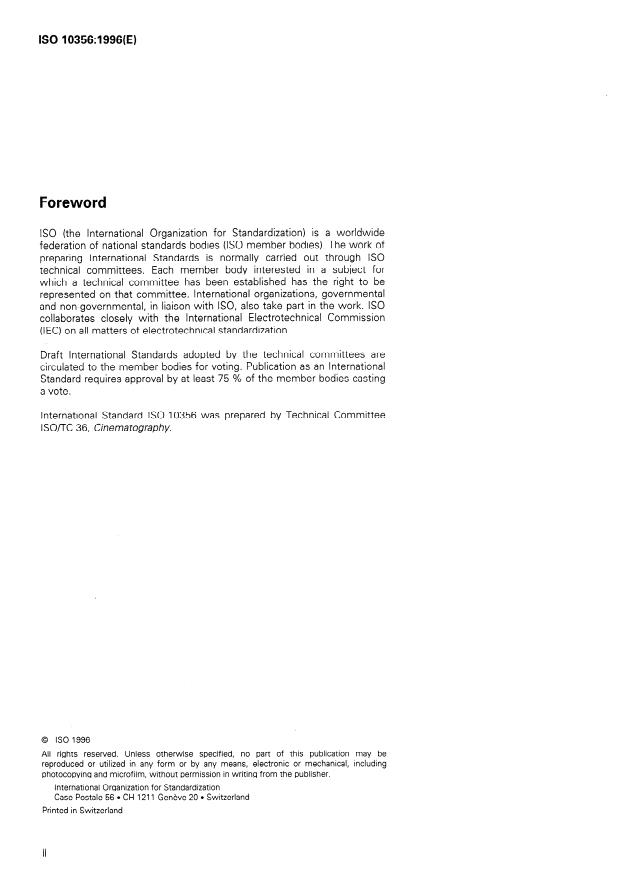
Foreword
IS0 (the International Organization for Standardization) is a worldwide
federation of national standards bodies (IS0 member bodies). The work of
preparing International Standards is normally carried out through IS0
technical committees. Each member body interested in a subject for
which a technical committee has been established has the right to be
represented on that committee. International organizations, governmental
and non-governmental, in liaison with ISO, also take part in the work. IS0
collaborates closely with the International Electrotechnical Commission
(IEC) on all matters of electrotechnical standardization.
Draft International Standards adopted by the technical committees are
circulated to the member bodies for voting. Publication as an International
Standard requires approval by at least 75 % of the member bodies casting
a vote.
International Standard IS0 10356 was prepared by Technical Committee
ISO~C 36, Cinematography.
0 IS0 1996
All rights reserved. Unless otherwise specified, no part of this publication may be
reproduced or utilized in any form or by any means, electronic or mechanical, including
photocopying and microfilm, without permission in writing from the publisher.
International Organization for Standardization
Case Postale 56 l CH-121 1 Geneve 20 l Switzer land
Printed in Switzerland
II
IS0 10356:1996(E)
INTERNATIONAL STANDARD @ IS0
Cinematography - Storage and handling of nitrate-base
motion-picture films
1 Scope
This International Standard specifies safety aspects for handling and storage of radiation-sensitive motion-picture
films which do not comply with the requirements of IS0 543. This International Standard applies to all nitrate-base
films which are or have been used in motion-picture photographic systems.
Compliance with the storage and handling conditions specified in this International Standard does not ensure
protection of the film from deterioration nor reduce its safety hazards.
2 Normative reference
The following standard contains provisions which, through reference in this text, constitute provisions of this
International Standard. At the time of publication, the edition indicated was valid. All standards are subject to
revision, and parties to agreements based on this International Standard are encouraged to investigate the
possibility of applying the most recent editions of the standard indicated below. Members of IEC and IS0 maintain
registers of currently valid International Standards.
IS0 543: 1990, Photography - Photographic films - Specifications for safety film.
3 Definitions
For the purposes of this International Standard, the following definitions apply.
3.1 radiation-sensitive film: All kinds of radiation-sensitive camera, duplicating and printing films and also
processed original films, duplicates and prints.
3.2 safety photographic film: Photographic film which passes the ignition time test and burning time test as
specified in IS0 543.
IS0 543, in specifying safety film, makes a primary distinction based upon requiring a long or infinite burning time
NOTE -
for a sample in a specified test. Additional information is given concerning films whose composition is such that they may be
expected to fail, or to give ambiguous results in, the burning test.
3.3 nitrate-base film; cellulose nitrate film: Radiation-sensitive nitrate-base film which fails the burning and
ignition tests of IS0 543.
NOTE .- Because of the precautions required for the safe handling and storage of nitrate-base film, all radiation-sensitive
films that do not originally (as opposed to being transferred from some other film) carry the marking specified by annex B of
IS0 543:1990 should be considered to be nitrate-base films until proven otherwise.
@ IS0
IS0 10356:1996(E)
4 Composition (see annex A)
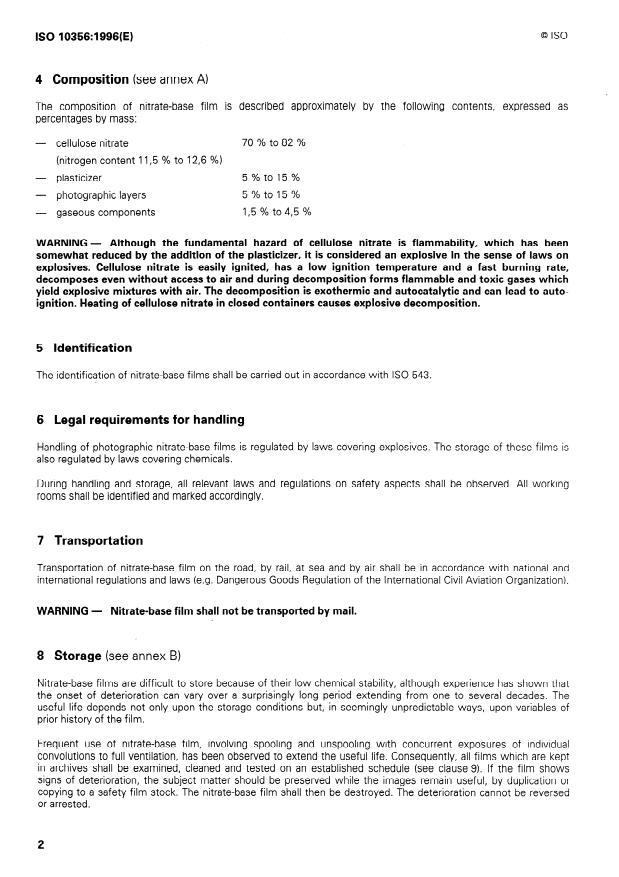
The composition of nitrate-base film is described approximately by the following contents, expressed as
percentages by mass:
70 % to 82 %
- cellulose nitrate
(nitrogen content II,5 % to 12,6 %)
5 % to 15 %
- plasticizer
5 % to 15 %
- photographic layers
I,5 % to 4,5 %
- gaseous components
Although the fundamental hazard of cellulose nitrate is flammability, which has been
WARNING -
somewhat reduced by the addition of the plasticizer, it is considered an explosive in the sense of laws on
explosives. Cellulose nitrate is easily ignited, has a low ignition temperature and a fast burning rate,
decomposes even without access to air and during decomposition forms flammable and toxic gases which
yield explosive mixtures with air. The decomposition is exothermic and autocatalytic and can lead to auto-
ignition. Heating of cellulose nitrate in closed containers causes explosive decomposition.
5 Identification
The identification of nitrate-base films shall be carried out in accordance with IS0 543.
6 Legal requirements for handling
Ihic nitrate-base films is regulated by laws covering explosives. The storage of these films is
Handling of photograp
also regulated by laws covering them cals.
During handling and storage, all relevant laws and regulations on safety aspects shall be observed. All working
rooms shall be identified and marked accordingly.
7 Transportation
Transportation of nitrate-base filn on the road, by rail, at sea and by air shall be in accordance with national and
international regulations and laws ( e.g. Dangerous Goods Regulation of the International Civil Aviation Organizat ion).
WARNING - Nitrate-base film shall not be transported by mail.
8 Storage (see annex B)
Nitrate-base films are difficult to store because of their low chemical stability, although experience has shown that
the onset of deterioration can vary over a surprisingly long period extending from one to several decades. The
useful life depends not only upon the storage conditions but, in seemingly unpredictable ways, upon variables of
prior history of the film.
Frequent use of nitrate-base film, involving spooling and unspooling with concurrent exposures of individual
convolutions to full ventilation, has been observed to extend the useful life. Consequently, all films which are kept
in archives shall be examined, cleaned and tested on an established schedule (see clause 9). If the film shows
signs of deterioration, the subject matter should be preserved while the images remain useful, by duplication or
copying to a safety film stock. The nitrate-base film shall then be destroyed. The deterioration cannot be reversed
or arrested.
@ IS0
IS0 10356:1996(E)
Rolls of nitrate-base film that have not yet deteriorated shall be placed in individual metal cans (aluminium or
stainless steel) with fitted but unsealed closures until they can be duplicated to safety film. Storage rooms and
chambers should contain only nitrate-base film. Good practice requires that the amount of film placed in an
individual room be limited, for example, to a maximum of 50 000 m each. Storage rooms should be equipped with
appropriate ventilating systems, fire sensors, water sprinklers, etc. so that any possible conflagration can be
confined to that room. These rooms should be constructed and ventilated so that toxic and flammable fumes and
gases cannot reach other rooms.
Recommended climatic conditions for storage are given in table 1.
Table 1
Maximum temperature Relative humidity
Storage
“C ( F) %
I
Short term 1) 25 (77) 25 to 50
Long term (36) 20 to 30
1) For example, examination, cleaning or duplication.
I I
A lower relative humidity can delay deterioration of nitrate-base films and their emulsion images, including reducing
NOTE -
the alteration rates of dyes in colour films. Lower relative humidity will also reversibly change the physical properties, making
the film more brittle and subject to accidental damage. This effect can be reversed by providing a suitable period of
acclimatization to relative humidities of 40 % to 50 % prior to unspooling. In any event, a suitable period of accommodation to
room temperature should always be provided for all film stored at reduced temperature before handling the film.
9 Inspection (see annex B)
Regular inspections shall be made in order to recognize any deterioration as soon as possible. If nitrate-base film is
stored under the conditions given in clause 8, the film should be inspected at least once per year, and preferably
every three months.
The preferred method of inspection is accomplished by winding through the film so that the complete length is
subjected to visual examination. At the same time, when first opening the container the inspector should be alert
for typical odours of deterioration, which approximate a mixture of fetid pungency with faint fumes of nitric acid.
The very first indication of deterioration is an
...