


ISO 8601-1:2019
(Main)Date and time — Representations for information interchange — Part 1: Basic rules
Date and time — Representations for information interchange — Part 1: Basic rules
This document specifies representations of dates of the Gregorian calendar and times based on the 24-hour clock, as well as composite elements of them, as character strings for use in information interchange. It is also applicable for representing times and time shifts based on Coordinated Universal Time (UTC). This document excludes the representation of date elements from non-Gregorian calendars or times not from the 24-hour clock. This document does not address character encoding of representations specified in this document.
Date et heure — Représentations pour l'échange d'information — Partie 1: Règles de base
General Information
- Status
- Published
- Publication Date
- 24-Feb-2019
- Technical Committee
- ISO/TC 154 - Processes, data elements and documents in commerce, industry and administration
- Drafting Committee
- ISO/TC 154/WG 5 - Representation of dates and times
- Current Stage
- 9092 - International Standard to be revised
- Start Date
- 31-Oct-2024
- Completion Date
- 14-Feb-2026
Relations
- Effective Date
- 10-Feb-2026
- Effective Date
- 10-Feb-2026
- Effective Date
- 10-Feb-2026
- Effective Date
- 10-Feb-2026
- Effective Date
- 10-Feb-2026
- Effective Date
- 10-Feb-2026
- Effective Date
- 10-Feb-2026
- Effective Date
- 10-Feb-2026
- Effective Date
- 10-Feb-2026
- Effective Date
- 10-Feb-2026
- Effective Date
- 10-Feb-2026
- Effective Date
- 10-Feb-2026
- Effective Date
- 10-Feb-2026
- Effective Date
- 06-Jun-2022
- Effective Date
- 14-Aug-2021
Overview
ISO 8601-1:2019 - "Date and time - Representations for information interchange - Part 1: Basic rules" is the ISO standard that defines how to represent dates and times as character strings for reliable information interchange. It specifies representations for dates of the Gregorian calendar, times based on the 24-hour clock, composite date‑time elements and time shifts referenced to Coordinated Universal Time (UTC). The standard aims to minimize ambiguity and support both human‑readable and machine‑readable date/time formats.
Key topics and technical requirements
- Scope and exclusions
- Applies to Gregorian calendar dates and 24‑hour clock times.
- Excludes non‑Gregorian calendars and clocks not using the 24‑hour convention.
- Does not prescribe character encoding (e.g., UTF‑8) for the strings.
- Terminology and symbols
- Defines precise terms (date, time, time of day, local time scale) and a set of symbols used in representations.
- Date representations
- Covers calendar date, ordinal date, and week date representations for the Gregorian calendar.
- Time representations
- Specifies local time of day, UTC of day, and rules for time shifts and beginning‑of‑day semantics (replacing the ambiguous term “midnight”).
- Composite and extended forms
- Rules for combining date and time elements into complete date‑time strings.
- Intervals and recurring intervals
- Methods for representing durations, time intervals and recurring time intervals; links to Part 2 for extended repeat rules.
- Fundamental rules
- Leading zeros, expansion rules, and treatment of leap seconds (representation clarified compared to earlier editions).
- Consistency and backwards context
- First edition reorganized from ISO 8601:2004 and coordinated with ISO 8601-2:2019 (Extensions).
Practical applications
- Ensures unambiguous date/time exchange between systems, databases, APIs and documents.
- Supports interoperability in:
- Enterprise software, RESTful APIs and microservices
- Databases and logging systems (timestamps, event ordering)
- Financial systems, supply chain, scheduling and calendaring
- IoT, telemetry and sensor data where precise time shifts and UTC alignment matter
- Improves data quality, parsing reliability and internationalization for multinational products.
Who should use this standard
- Software developers, data architects and API designers
- Database administrators, systems integrators and DevOps engineers
- Standards bodies, technical writers and documentation teams
- Organizations requiring legal, audit or regulatory timestamp consistency
Related standards
- ISO 8601-2:2019 - Part 2: Extensions (repeat rules and advanced interval expressions)
- ISO 8601:2004 - earlier version canceled and replaced by the Part 1/Part 2 structure
- ISO/IEC 646 - character repertoire referenced for allowed characters
Adopting ISO 8601-1:2019 helps reduce misinterpretation of date and time data, improves interoperability across international systems and provides a clear baseline for implementing consistent, machine‑readable timestamps.
Buy Documents
ISO 8601-1:2019 - Date and time -- Representations for information interchange
ISO 8601-1:2019 - Date and time — Representations for information interchange — Part 1: Basic rules Released:2/25/2019
Frequently Asked Questions
ISO 8601-1:2019 is a standard published by the International Organization for Standardization (ISO). Its full title is "Date and time — Representations for information interchange — Part 1: Basic rules". This standard covers: This document specifies representations of dates of the Gregorian calendar and times based on the 24-hour clock, as well as composite elements of them, as character strings for use in information interchange. It is also applicable for representing times and time shifts based on Coordinated Universal Time (UTC). This document excludes the representation of date elements from non-Gregorian calendars or times not from the 24-hour clock. This document does not address character encoding of representations specified in this document.
This document specifies representations of dates of the Gregorian calendar and times based on the 24-hour clock, as well as composite elements of them, as character strings for use in information interchange. It is also applicable for representing times and time shifts based on Coordinated Universal Time (UTC). This document excludes the representation of date elements from non-Gregorian calendars or times not from the 24-hour clock. This document does not address character encoding of representations specified in this document.
ISO 8601-1:2019 is classified under the following ICS (International Classification for Standards) categories: 01.140.30 - Documents in administration, commerce and industry. The ICS classification helps identify the subject area and facilitates finding related standards.
ISO 8601-1:2019 has the following relationships with other standards: It is inter standard links to EN IEC 62541-6:2020, EN 50600-4-8:2022, EN IEC 61978-1:2024, EN IEC 61158-6-10:2023, EN 50600-4-6:2020, EN IEC 62074-1:2025, EN IEC 62541-6:2026, EN IEC 61158-5-10:2023, EN IEC 62077:2022, EN IEC 62656-8:2020, EN 50600-4-9:2022, EN IEC 61977:2020, EN IEC 61158-5-2:2023, ISO 15877-3:2009/Amd 2:2021, ISO 8601-1:2019/Amd 1:2022. Understanding these relationships helps ensure you are using the most current and applicable version of the standard.
ISO 8601-1:2019 is available in PDF format for immediate download after purchase. The document can be added to your cart and obtained through the secure checkout process. Digital delivery ensures instant access to the complete standard document.
Standards Content (Sample)
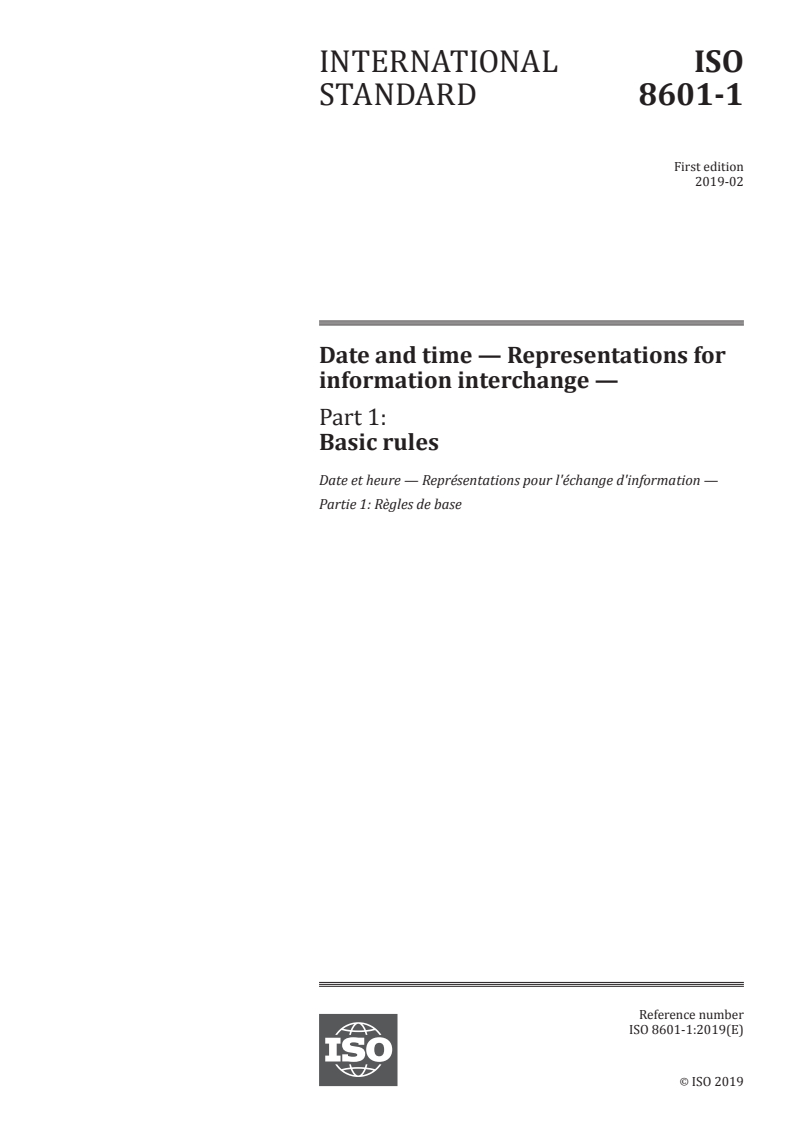
INTERNATIONAL ISO
STANDARD 8601-1
First edition
2019-02
Date and time — Representations for
information interchange —
Part 1:
Basic rules
Date et heure — Représentations pour l'échange d'information —
Partie 1: Règles de base
Reference number
©
ISO 2019
© ISO 2019
All rights reserved. Unless otherwise specified, or required in the context of its implementation, no part of this publication may
be reproduced or utilized otherwise in any form or by any means, electronic or mechanical, including photocopying, or posting
on the internet or an intranet, without prior written permission. Permission can be requested from either ISO at the address
below or ISO’s member body in the country of the requester.
ISO copyright office
CP 401 • Ch. de Blandonnet 8
CH-1214 Vernier, Geneva
Phone: +41 22 749 01 11
Fax: +41 22 749 09 47
Email: copyright@iso.org
Website: www.iso.org
Published in Switzerland
ii © ISO 2019 – All rights reserved
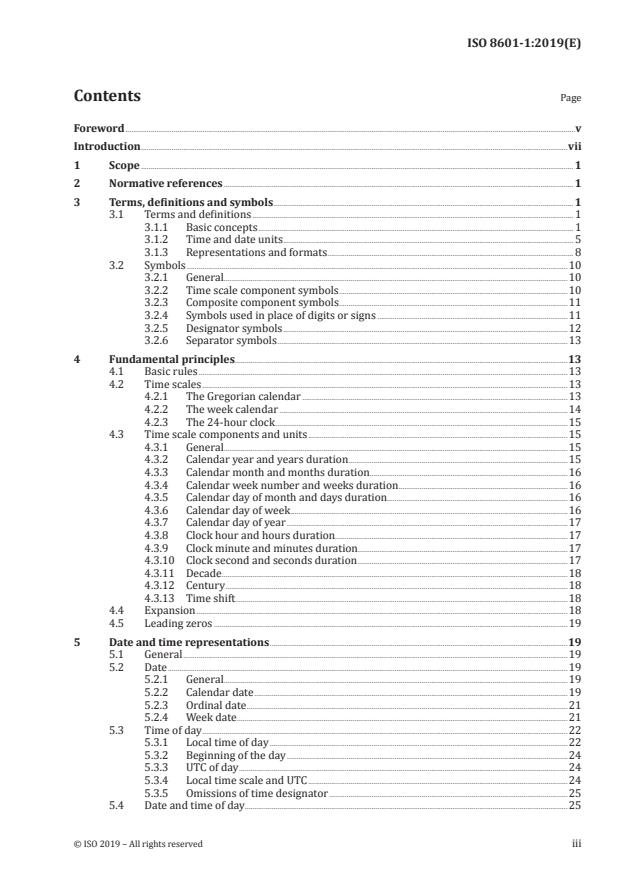
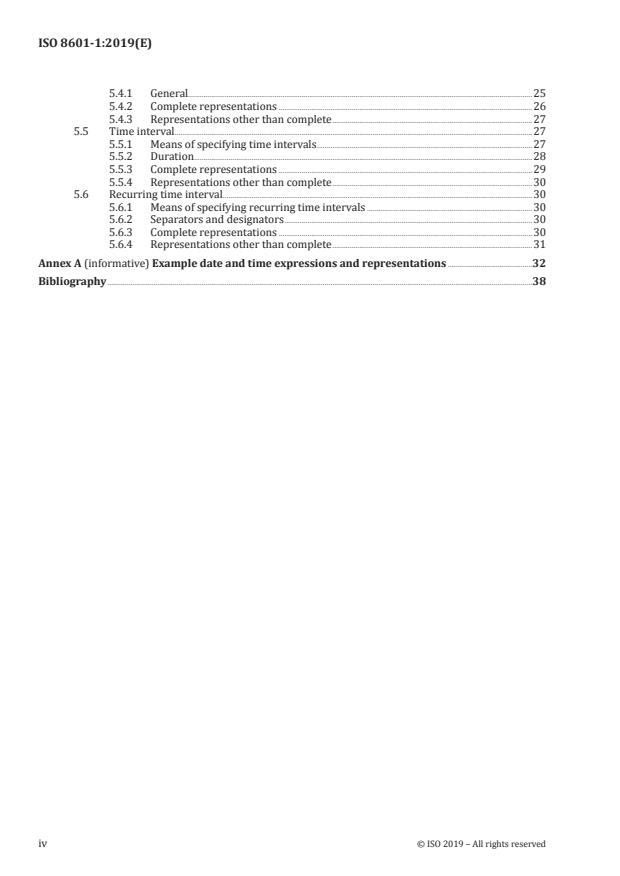
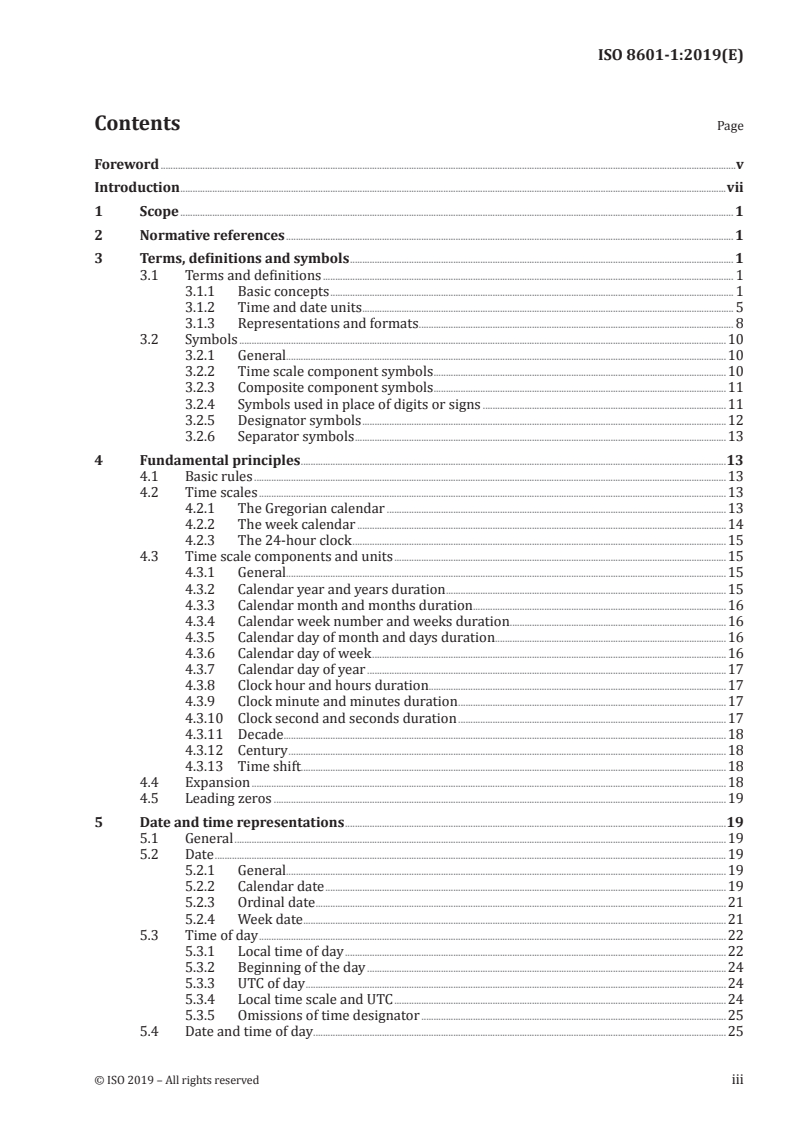
Contents Page
Foreword .v
Introduction .vii
1 Scope . 1
2 Normative references . 1
3 Terms, definitions and symbols . 1
3.1 Terms and definitions . 1
3.1.1 Basic concepts . 1
3.1.2 Time and date units . 5
3.1.3 Representations and formats . 8
3.2 Symbols .10
3.2.1 General.10
3.2.2 Time scale component symbols .10
3.2.3 Composite component symbols .11
3.2.4 Symbols used in place of digits or signs .11
3.2.5 Designator symbols .12
3.2.6 Separator symbols .13
4 Fundamental principles .13
4.1 Basic rules .13
4.2 Time scales .13
4.2.1 The Gregorian calendar .13
4.2.2 The week calendar .14
4.2.3 The 24-hour clock .15
4.3 Time scale components and units .15
4.3.1 General.15
4.3.2 Calendar year and years duration .15
4.3.3 Calendar month and months duration.16
4.3.4 Calendar week number and weeks duration .16
4.3.5 Calendar day of month and days duration.16
4.3.6 Calendar day of week .16
4.3.7 Calendar day of year .17
4.3.8 Clock hour and hours duration.17
4.3.9 Clock minute and minutes duration .17
4.3.10 Clock second and seconds duration .17
4.3.11 Decade . .18
4.3.12 Century .18
4.3.13 Time shift.18
4.4 Expansion .18
4.5 Leading zeros .19
5 Date and time representations .19
5.1 General .19
5.2 Date .19
5.2.1 General.19
5.2.2 Calendar date .19
5.2.3 Ordinal date .21
5.2.4 Week date .21
5.3 Time of day .22
5.3.1 Local time of day .22
5.3.2 Beginning of the day .24
5.3.3 UTC of day .24
5.3.4 Local time scale and UTC .24
5.3.5 Omissions of time designator .25
5.4 Date and time of day .25
5.4.1 General.25
5.4.2 Complete representations .26
5.4.3 Representations other than complete .27
5.5 Time interval .27
5.5.1 Means of specifying time intervals .27
5.5.2 Duration.28
5.5.3 Complete representations .29
5.5.4 Representations other than complete .30
5.6 Recurring time interval.30
5.6.1 Means of specifying recurring time intervals .30
5.6.2 Separators and designators .30
5.6.3 Complete representations .30
5.6.4 Representations other than complete .31
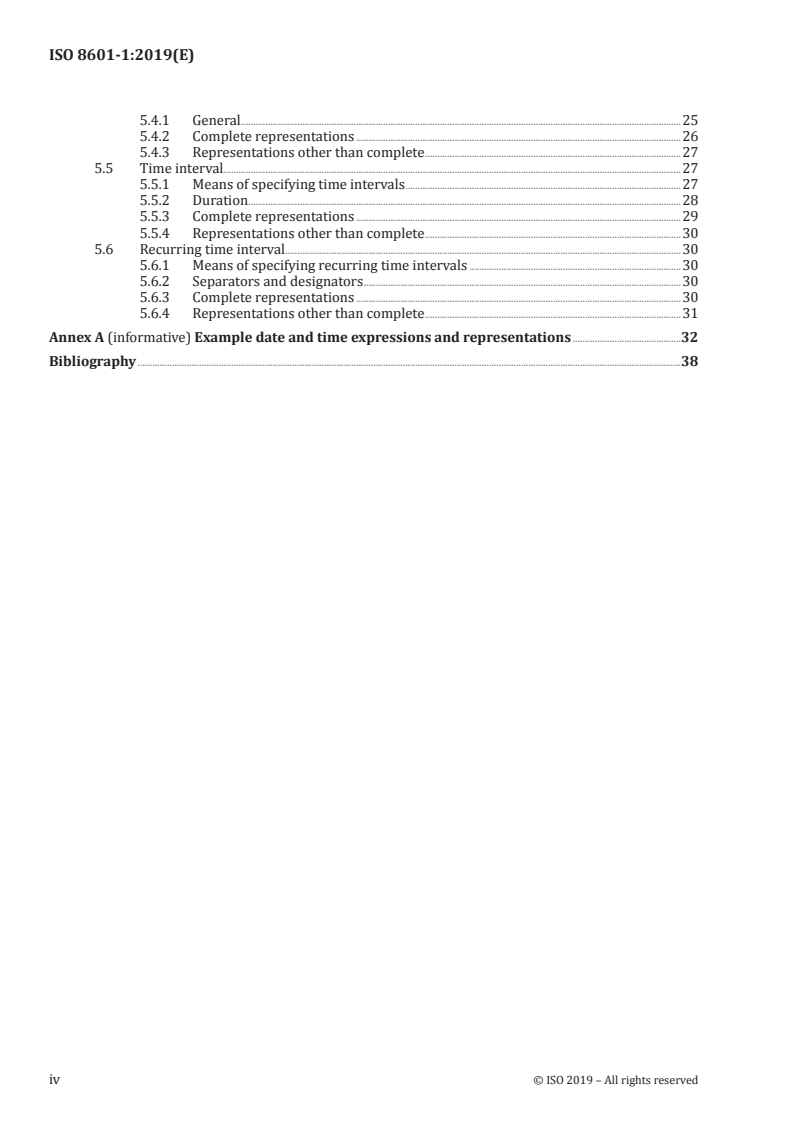
Annex A (informative) Example date and time expressions and representations .32
Bibliography .38
iv © ISO 2019 – All rights reserved
Foreword
ISO (the International Organization for Standardization) is a worldwide federation of national standards
bodies (ISO member bodies). The work of preparing International Standards is normally carried out
through ISO technical committees. Each member body interested in a subject for which a technical
committee has been established has the right to be represented on that committee. International
organizations, governmental and non-governmental, in liaison with ISO, also take part in the work.
ISO collaborates closely with the International Electrotechnical Commission (IEC) on all matters of
electrotechnical standardization.
The procedures used to develop this document and those intended for its further maintenance are
described in the ISO/IEC Directives, Part 1. In particular, the different approval criteria needed for the
different types of ISO documents should be noted. This document was drafted in accordance with the
editorial rules of the ISO/IEC Directives, Part 2 (see www .iso .org/directives).
Attention is drawn to the possibility that some of the elements of this document may be the subject of
patent rights. ISO shall not be held responsible for identifying any or all such patent rights. Details of
any patent rights identified during the development of the document will be in the Introduction and/or
on the ISO list of patent declarations received (see www .iso .org/patents).
Any trade name used in this document is information given for the convenience of users and does not
constitute an endorsement.
For an explanation of the voluntary nature of standards, the meaning of ISO specific terms and
expressions related to conformity assessment, as well as information about ISO's adherence to the
World Trade Organization (WTO) principles in the Technical Barriers to Trade (TBT), see www .iso
.org/iso/foreword .html.
This document was prepared by Technical Committee ISO/TC 154, Processes, data elements and
documents in commerce, industry and administration.
This first edition of ISO 8601-1, together with ISO 8601-2, cancels and replaces ISO 8601:2004, which
has been technically revised.
The main changes compared to ISO 8601:2004 are as follows:
— conversion of the content as Part 1 with the Part title “Basic rules” due to the addition of another
Part 2 “Extensions” of ISO 8601;
— replacement of the term “midnight” with “beginning of day”, disallowing the value “24” for hour;
— update of terms and definitions:
— “time point” is now “time”;
— “local time” is now “local time of day”;
— added definition for “time of day” and “local time scale”;
— updated definitions for “standard time of day”, “local time of day” and “UTC of day” to rely on
“time of day”;
— combined two “day” terms in different domains for consistency;
— change of the representation of “leap seconds”;
— clarification of “calendar day” expressions intended to mean “calendar day of week” (etc.);
— amendment of the recurring time interval (3.1.1.11) to provide a link to ISO 8601-2:2019 which
contains in Clause 5 the “repeat rules for recurring time intervals”.
A list of all parts in the ISO 8601 series can be found on the ISO website.
Any feedback or questions on this document should be directed to the user’s national standards body. A
complete listing of these bodies can be found at www .iso .org/members .html.
vi © ISO 2019 – All rights reserved
Introduction
The purpose of this document is to provide a standard set of date and time format representations
for information interchange, in order to minimize the risk of misinterpretation, confusion and their
consequences.
This document specifies a set of date and time format representations utilizing numbers, alphabets and
symbols defined in ISO/IEC 646. These representations are meant to be both human recognizable and
machine readable.
This document retains the most commonly used expressions for date and time of day and their
representations from earlier International Standards in the field, including earlier editions of ISO 8601
and its predecessors.
INTERNATIONAL STANDARD ISO 8601-1:2019(E)
Date and time — Representations for information
interchange —
Part 1:
Basic rules
1 Scope
This document specifies representations of dates of the Gregorian calendar and times based on the
24-hour clock, as well as composite elements of them, as character strings for use in information
interchange. It is also applicable for representing times and time shifts based on Coordinated Universal
Time (UTC).
This document excludes the representation of date elements from non-Gregorian calendars or times
not from the 24-hour clock. This document does not address character encoding of representations
specified in this document.
2 Normative references
There are no normative references in this document.
3 Terms, definitions and symbols
3.1 Terms and definitions
For the purposes of this document, the following terms and definitions apply.
ISO and IEC maintain terminological databases for use in standardization at the following addresses:
— ISO Online browsing platform: available at https: //www .iso .org/obp
— IEC Electropedia: available at http: //www .electropedia .org/
3.1.1 Basic concepts
3.1.1.1
date
time (3.1.1.2) on the calendar (3.1.1.18) time scale (3.1.1.5)
Note 1 to entry: Common forms of date include calendar date (3.1.2.7), ordinal date (3.1.2.8) or week date (3.1.2.9).
3.1.1.2
time
mark attributed to an instant (3.1.1.3) or a time interval (3.1.1.6) on a specified time scale (3.1.1.5)
Note 1 to entry: The term “time” is often used in common language. However, it should only be used if the meaning
is clearly visible from the context.
Note 2 to entry: On a time scale consisting of successive time intervals, such as a clock (3.1.1.9) or calendar
(3.1.1.18), distinct instants may be expressed by the same time.
Note 3 to entry: This definition corresponds with the definition of the term “date” in IEC 60050-113:2011,
113-01-12.
3.1.1.3
instant
point on the time axis (3.1.1.4)
Note 1 to entry: An instantaneous event occurs at a specific instant.
[SOURCE: IEC 60050-113:2011, 113-01-08]
3.1.1.4
time axis
mathematical representation of the succession in time according to the space-time model of
instantaneous events along a unique axis
Note 1 to entry: According to the theory of special relativity, the time axis depends on the choice of a spatial
reference frame.
Note 2 to entry: In IEC 60050-113:2011, 113-01-03, time according to the space-time model is defined to be the
one-dimensional subspace of space-time, locally orthogonal to space.
[SOURCE: IEC 60050-113:2011, 113-01-07, modified — The words “according to the space-time” have
been added; the phrase “special theory of relativity” has been changed to “theory of special relativity”
for clarity; Note 2 to entry has been added.]
3.1.1.5
time scale
system of ordered marks which can be attributed to instants (3.1.1.3) on the time axis (3.1.1.4), one
instant being chosen as the origin
Note 1 to entry: A time scale may amongst others be chosen as:
— continuous, e.g. international atomic time (TAI) (see IEC 60050-713:1998, 713-05-18);
— continuous with discontinuities, e.g. UTC (3.1.1.12) due to leap seconds (3.1.1.24), standard time (3.1.1.14) due
to summer time and winter time;
— successive steps, e.g. calendars (3.1.1.18), where the time axis (3.1.1.4) is split up into a succession of
consecutive time intervals (3.1.1.6) and the same mark is attributed to all instants of each time interval;
— discrete, e.g. in digital techniques.
[SOURCE: IEC 60050-113:2011, 113-01-11, modified — The words “amongst others” in Note 1 to entry
have been added; NOTEs 2 and 3 have been deleted.]
3.1.1.6
time interval
part of the time axis (3.1.1.4) limited by two instants (3.1.1.3) and, unless otherwise stated, the limiting
instants themselves
[SOURCE: IEC 60050-113:2011, 113-01-10, modified — The words “and, unless otherwise stated, the
limiting instants themselves” have been added; the NOTEs have been deleted.]
3.1.1.7
time scale unit
unit of measurement of a duration (3.1.1.8)
EXAMPLE 1 Calendar year, calendar month and calendar day are time scale units of the Gregorian calendar.
EXAMPLE 2 Clock hour, clock minutes and clock seconds are time scale units of the 24-hour clock.
2 © ISO 2019 – All rights reserved
3.1.1.8
duration
non-negative quantity of time equal to the difference between the final and initial instants (3.1.1.3) of a
time interval (3.1.1.6)
Note 1 to entry: The duration is one of the base quantities in the International System of Quantities (ISQ) on
which the International System of Units (SI) is based. The term “time” instead of “duration” is often used in this
context and also for an infinitesimal duration.
Note 2 to entry: For the term “duration”, expressions such as “time” or “time interval” are often used, but the
term “time” is not recommended in this sense and the term “time interval” is deprecated in this sense to avoid
confusion with the concept of “time interval”.
Note 3 to entry: The exact duration of a time scale unit (3.1.1.7) depends on the time scale (3.1.1.5) used. For
example, the durations of a year, month, week, day, hour or minute, may depend on when they occur [in a
Gregorian calendar (3.1.1.19), a calendar month (3.1.2.19) can have a duration of 28, 29, 30, or 31 days; in a 24-hour
clock (3.1.1.10), a clock minute (3.1.2.4) can have a duration of 59, 60, or 61 seconds, etc.]. Therefore, the exact
duration can only be evaluated if the exact duration of each is known.
Note 4 to entry: This definition is closely related to NOTE 1 of the terminological entry “duration” in IEC 60050-
113:2011, 113-01-13.
3.1.1.9
clock
time scale (3.1.1.5) suited for intra-day time measurements
EXAMPLE The 24-hour clock (3.1.1.10) is a type of clock.
Note 1 to entry: clock second (3.1.2.2), clock minute (3.1.2.4) and clock hour (3.1.2.6) are often time scale units
(3.1.1.7) included in a clock.
3.1.1.10
24-hour clock
clock (3.1.1.9) that subdivides a calendar day (3.1.2.11) into 24 clock hours (3.1.2.6)
Note 1 to entry: UTC (3.1.1.12) forms the basis of today’s 24-hour clocks and is used in this document as a type of
24-hour clock, as described in 4.2.3.
3.1.1.11
recurring time interval
series of consecutive time intervals (3.1.1.6) of identical duration (3.1.1.8)
Note 1 to entry: If the duration of the time intervals is measured in calendar (3.1.1.18) entities, the duration of
each time interval depends on the calendar dates (3.1.2.7) of its start and end.
Note 2 to entry: If the starting instants (3.1.1.3) of time intervals are repeated according to a set of rules, the
“repeat rules for recurring time intervals” in ISO 8601-2:2019, Clause 5 apply.
3.1.1.12
UTC
Coordinated Universal Time
time scale (3.1.1.5) with the same rate as International Atomic Time (TAI), but differing from TAI only
by an integral number of seconds (3.1.2.1)
Note 1 to entry: UTC is the time standard commonly used across the world from which local time is derived.
Note 2 to entry: UTC is produced by the Bureau International des Poids et Mesures (BIPM), i.e. the International
Bureau of Weights and Measures.
Note 3 to entry: TAI is a continuous time scale produced by the BIPM based on the best realizations of the
SI second. TAI is a realization of Terrestrial Time (TT) with the same rate as that of TT, as defined by the
International Astronomical Union Resolution B1.9 (2000).
[SOURCE: BIPM Recommendation CCTF 3 (2017), modified — The definition of TAI has been included as
Note 3 to entry.]
3.1.1.13
UTC of day
time of day (3.1.1.16) in UTC (3.1.1.12)
3.1.1.14
standard time
time scale (3.1.1.5) derived from UTC (3.1.1.12), by a time shift (3.1.1.25) established in a given location
by the competent authority
EXAMPLE 1 Some standard times do not vary within a year, such as US Eastern Standard Time (EST), US
Eastern Daylight Time (EDT), Australia Western Standard Time (AWST), China Standard Time (CST), Hong Kong
Standard Time (HKT), Korea Standard Time (KST) and Japanese Standard Time (JST).
EXAMPLE 2 Some standard times vary within a year, such as US Eastern Time (ET) and Australian Central
Standard Time (ACST).
Note 1 to entry: The time shift of a standard time may vary in the course of a year, such as due to daylight savings.
[SOURCE: IEC 60050-113:2011, 113-01-17, modified — The original NOTE has been deleted; EXAMPLE 1
and 2 and Note 1 to entry has been added.]
3.1.1.15
local time scale
locally-applicable time scale (3.1.1.5) such as standard time (3.1.1.14) or a non-UTC (3.1.1.12) based
time scale
3.1.1.16
time of day
time (3.1.1.2) occurring within a calendar day (3.1.2.11)
Note 1 to entry: Generally, time of day relates to the duration (3.1.1.8) elapsed after the beginning of the day.
However, this correlation breaks when changes occur in the time scale (3.1.1.5) that applies to the time of day,
such as time shifts (3.1.1.25) and leap seconds (3.1.1.24).
Note 2 to entry: This definition corresponds closely with the definition of “clock time” given in IEC 60050-
113:2011, 113-01-18, except that the concepts of duration and time scale are not used in this definition.
3.1.1.17
local time of day
time of day (3.1.1.16) in a local time scale (3.1.1.15)
3.1.1.18
calendar
time scale (3.1.1.5) that uses the time scale unit (3.1.1.7) of calendar day (3.1.2.11) as its basic unit
EXAMPLE The Gregorian calendar (3.1.1.19) is a type of calendar.
Note 1 to entry: calendar month (3.1.2.19) and calendar year (3.1.2.21) are time scale units often included in a
calendar.
3.1.1.19
Gregorian calendar
calendar (3.1.1.18) in general use that defines a calendar year (3.1.2.21) that closely approximates the
tropical year
Note 1 to entry: In this document the term “Gregorian calendar” is used to refer to the time scale (3.1.1.5)
described in 4.2.1.
4 © ISO 2019 – All rights reserved
3.1.1.20
common year
calendar year (3.1.2.21) in the Gregorian calendar (3.1.1.19) that has 365 calendar days (3.1.2.11)
3.1.1.21
leap year
calendar year (3.1.2.21) in the Gregorian calendar (3.1.1.19) that has 366 calendar days (3.1.2.11)
Note 1 to entry: A leap year is a calendar year whose year number is divisible by four and is not a centennial year
(3.1.1.22), or a centennial year whose year number is divisible by four hundred.
3.1.1.22
centennial year
calendar year (3.1.2.21) in the Gregorian calendar (3.1.1.19) whose year number is divisible without
remainder by one hundred
3.1.1.23
week calendar
calendar (3.1.1.18) based on an unbounded series of contiguous calendar weeks (3.1.2.16) that uses
the time scale unit (3.1.1.7) of calendar week as its basic unit to represent a calendar year (3.1.2.21),
according to the rule that the first calendar week of a calendar year is the week including the first
Thursday of that year, and that the last one is the week immediately preceding the first calendar week
of the next calendar year
Note 1 to entry: This rule is based on the principle that a week belongs to the calendar year to which the majority
of its calendar days (3.1.2.11) belong.
Note 2 to entry: In the week calendar, calendar days of the first and last calendar week of a calendar year may
belong to the previous and the next calendar year respectively in the Gregorian calendar (3.1.1.19).
Note 3 to entry: The week calendar is described in 4.2.2.
3.1.1.24
leap second
intentional time step of one second (3.1.2.1) to adjust UTC (3.1.1.12) to ensure appropriate agreement
with UT1, a time scale (3.1.1.5) based on the rotation of the Earth
Note 1 to entry: See also ITU-R TF.460-6.
Note 2 to entry: An inserted second is called a positive leap second and an omitted second is called a negative leap
second. A positive leap second is inserted after [23:59:59Z] and can be represented as [23:59:60Z]. A negative
leap second is achieved by the omission of [23:59:59Z]. Insertion or omission takes place as determined by the
International Earth Rotation and Reference Systems Service (IERS), normally on 30 June or 31 December, but if
necessary on 31 March or 30 September.
3.1.1.25
time shift
constant duration (3.1.1.8) difference between times (3.1.1.2) of two time scales (3.1.1.5)
3.1.2 Time and date units
3.1.2.1
second
base unit of duration (3.1.1.8) measurement in the International System of Units (SI)
Note 1 to entry: Second is as defined by the CGPM (Conférence générale des poids et mesures, General Conference
on Weights and Measures) on the proposal of the CIPM (Comité international des poids et mesures, International
Committee of Weights and Measures).
Note 2 to entry: See also ISO 80000-3.
3.1.2.2
clock second
time scale unit (3.1.1.7) whose duration (3.1.1.8) is one second (3.1.2.1).
Note 1 to entry: Clock second is in common parlance often referred to as second, however in this document clock
second and second have different definitions.
3.1.2.3
minute
duration (3.1.1.8) of 60 seconds (3.1.2.1)
Note 1 to entry: See also ISO 80000-3.
Note 2 to entry: The duration of a minute is 60 seconds except if modified by the insertion or deletion of a leap
second (3.1.1.24).
3.1.2.4
clock minute
time scale unit (3.1.1.7) whose duration (3.1.1.8) is one minute (3.1.2.3)
Note 1 to entry: Clock minute is in common parlance often referred to as minute, however in this document clock
minute and minute have different definitions.
3.1.2.5
hour
duration (3.1.1.8) of 60 minutes (3.1.2.3)
Note 1 to entry: See also ISO 80000-3.
3.1.2.6
clock hour
time scale unit (3.1.1.7) whose duration (3.1.1.8) is one hour (3.1.2.5)
Note 1 to entry: Clock hour is in common parlance often referred to as hour, however in this document clock hour
and hour have different definitions.
3.1.2.7
calendar date
particular calendar day (3.1.2.11) represented by its calendar year (3.1.2.21), its calendar month
(3.1.2.19) and its calendar day of month (3.1.2.13)
3.1.2.8
ordinal date
particular calendar day (3.1.2.11) represented by its calendar year (3.1.2.21) and its calendar day of year
(3.1.2.14)
3.1.2.9
week date
particular calendar day (3.1.2.11) represented by the calendar year (3.1.2.21) to which its calendar week
(3.1.2.16) belongs, its calendar week of year (3.1.2.17) and its calendar day of week (3.1.2.12)
3.1.2.10
day
duration (3.1.1.8) of a calendar day (3.1.2.11)
Note 1 to entry: The term “day” applies also to the duration of any time interval (3.1.1.6) which starts at a certain
time of day (3.1.1.16) on a certain calendar day and ends at the same time of day on the next calendar day.
Note 2 to entry: See also ISO 80000-3.
6 © ISO 2019 – All rights reserved
3.1.2.11
calendar day
time scale unit (3.1.1.7) starting at the beginning of the day and ending with the beginning of the next
day, the latter being the starting instant (3.1.1.3) of the next calendar day
Note 1 to entry: Calendar day is in common parlance often referred to as day, however in this document calendar
day and day have different definitions.
Note 2 to entry: The duration (3.1.1.8) of a calendar day using the 24-hour clock (3.1.1.10) is 24 hours (3.1.2.5);
except if modified by
— the insertion or deletion of leap seconds (3.1.1.24), by decision of the IERS, or
— the insertion or deletion of other time intervals, as may be prescribed by local authorities to alter the time
scale (3.1.1.5) of local time.
3.1.2.12
calendar day of week
day amongst the sequence of week calendar (3.1.1.23) days, namely, Monday, Tuesday, Wednesday,
Thursday, Friday, Saturday or Sunday
Note 1 to entry: The week calendar is defined in 4.2.2.
3.1.2.13
calendar day of month
ordinal number of a calendar day (3.1.2.11) within a calendar month (3.1.2.19)
3.1.2.14
calendar day of year
ordinal number of a calendar day (3.1.2.11) within a calendar year (3.1.2.21)
3.1.2.15
week
duration (3.1.1.8) of a calendar week (3.1.2.16)
Note 1 to entry: The term “week” applies also to the duration of any time interval (3.1.1.6) which starts at a
certain time of day (3.1.1.16) at a certain calendar day (3.1.2.11) and ends at the same time of day at the same
calendar day of the next calendar week.
3.1.2.16
calendar week
time scale unit (3.1.1.7) of seven calendar days (3.1.2.11) which begins on Monday and ends on Sunday,
according to the week calendar (3.1.1.23)
3.1.2.17
calendar week of year
ordinal number of a calendar week (3.1.2.16) within a calendar year (3.1.2.21) of the week calendar
(3.1.1.23)
3.1.2.18
month
duration (3.1.1.8) of a calendar month (3.1.2.19)
Note 1 to entry: The term “month” applies also to the duration of any time interval (3.1.1.6) which starts at a
certain time of day (3.1.1.16) at a certain calendar day (3.1.2.11) of the calendar month and ends at the same time
of day at the same calendar day of the next calendar month, if it exists.
Note 2 to entry: In certain applications a month is considered as a duration of 30 calendar days.
3.1.2.19
calendar month
time scale unit (3.1.1.7) resulting from a defined division of a calendar year (3.1.2.21), each containing a
specific number of calendar days (3.1.2.11)
Note 1 to entry: A calendar month is in common parlance often referred to as month, however in this document
calendar month and month have different definitions.
3.1.2.20
year
duration (3.1.1.8) of a calendar year (3.1.2.21)
Note 1 to entry: In the Gregorian calendar (3.1.1.19), a year has 365 or 366 days. The duration is 366 days if the
corresponding time interval (3.1.1.6) begins February 28 or earlier in a leap year (3.1.1.21) or March 2 or later in
a year immediately preceding a leap year. If the interval begins February 29 (on a leap year), or March 1 of a year
preceding a leap year, the end date has to be agreed on. Otherwise the duration is 365 days.
Note 2 to entry: The term “year” applies also to the duration of any time interval (3.1.1.6) which starts at a certain
time of day (3.1.1.16) at a certain calendar date (3.1.2.7) of the calendar year and ends at the same time of day at
the same calendar date of the next calendar year with the exception noted in Note 1 to entry.
3.1.2.21
calendar year
time scale unit (3.1.1.7) defined by the calendar (3.1.1.18) system
3.1.2.22
decade
time scale unit (3.1.1.7) of 10 calendar years (3.1.2.21), beginning with a year whose year number is
divisible without remainder by ten
Note 1 to entry: Decade is also used to refer to an arbitrary duration (3.1.1.8) of 10 years, however decade is not
used as such in this document.
3.1.2.23
century
time scale unit (3.1.1.7) of 100 calendar years (3.1.2.21) duration (3.1.1.8), beginning with a year whose
year number is divisible without remainder by 100
EXAMPLE The 19th century covers the years 1800 through 1899.
Note 1 to entry: Century is also used to refer to an arbitrary duration of 100 years, however century is not used
as such in this document.
3.1.3 Representations and formats
3.1.3.1
date and time expression
expression indicating a time (3.1.1.2), time interval (3.1.1.6) or recurring time interval (3.1.1.11)
EXAMPLE ‘2018-08-01’ is a date and time expression that indicates the first day of August of 2018 in the
Gregorian calendar (3.1.1.19).
3.1.3.2
date and time representation
representation of the format of one or more date and time expressions (3.1.3.1)
EXAMPLE [date] is a date and time representation that can be expanded as [year][month][day], which
itself can be expanded into [YYYY][MM][DD]; ‘20180801’ is a date and time expression that conforms to this
representation.
8 © ISO 2019 – All rights reserved
3.1.3.3
time scale component
representation of a time scale unit (3.1.1.7) within a date and time expression (3.1.3.1) or representation
(3.1.3.2)
EXAMPLE 1 calendar year (3.1.2.21), calendar month (3.1.2.19), calendar day (3.1.2.11), clock hour (3.1.2.6),
clock minute (3.1.2.4), clock second (3.1.2.2) are time scale components of a complete representation (3.1.3.6).
EXAMPLE 2 The calendar year time scale component is considered of a higher order than the calendar month
time scale component, which is in turn of a higher order than the calendar day time scale component.
Note 1 to entry: A time scale component is considered of a higher order of another, if the time scale unit it
represents has a strictly larger time interval (3.1.1.6) than that of another; the latter time scale component is
therefore considered to be of a lower order.
Note 2 to entry: Common usage of this term often omits the leading phrase “time scale”, such as representing a
“time scale component calendar year” by just “calendar year component”. This usage is deemed accepted in this
document.
3.1.3.4
basic format
date and time representation (3.1.3.2) that does not include separators between its time scale components
(3.1.3.3)
3.1.3.5
extended format
extension of the basic format (3.1.3.4) that includes separators between its time scale components
(3.1.3.3)
3.1.3.6
complete representation
date and time representation (3.1.3.2) that includes all the time scale components (3.1.3.3) associated
with the expression (3.1.3.1)
3.1.3.7
representation with reduced precision
abbreviation of a date and time representation (3.1.3.2) by omission of lower order time scale components
(3.1.3.3)
3.1.3.8
representation with decimal fraction
expansion of a date and time representation (3.1.3.2) by addition of a decimal fraction to the lowest
order time scale component (3.1.3.3)
3.1.3.9
decimal sign
character used in a representation with decimal fraction (3.1.3.8) to separate the integer part from the
decimal fraction of a number
Note 1 to entry: The representations of the decimal signs (period or comma) and their usage rules are specified
in ISO 80000-1.
3.1.3.10
expanded representation
expansion of a date and time representation (3.1.3.2) to allow identification of calendar dates (3.1.2.7)
where the ordinal number identifying the calendar year (3.1.2.21) exceeds four digits
3.2 Symbols
3.2.1 General
Representations and expressions specified in this document make use of the symbols listed in 3.2.2
through 3.2.6.
Representations (also referred to as “format representations”) give rise to expressions for dates, times,
intervals and recurring intervals.
EXAMPLE 1 [YYYY] is a format representation for a calendar year, where each Y is to be replaced by a single
digit creating an expression, for example ‘1985’.
EXAMPLE 2 The date and time representation [YYYY][“-”][MM][“-”][DD] gives rise to the expression ‘2003-
02-10’ which identifies 10 February 2003.
To clearly separate date and time representations from the text, punctuation marks and associated
symbols used to describe them, the following symbols are used to demarcate boundaries of expressions
and representations in this document:
— single quotation marks enclose expressions (for example ‘1985’); in some cases they are omitted to
reflect the actualities of the examples; they are omitted in Clause 5;
— all individual tokens that are part of a representation are contained between the open and close
bracket symbols (“[“ and “]”);
EXAMPLE 3 For the date and time representation [YYYY][“-”][MM][“-”][DD], [YYYY], [“-”], [MM], [“-”],
and [DD] are individual tokens enclosed by brackets.
— when double quotations marks enclose a string within a representation, that string is literal and
becomes part of any expression of that representation.
EXAMPLE 4 The representation [i][“Y”] represents a positive integer followed by the symbol “Y”. ‘12Y’
meaning “12 years” is an expression of that representation.
Quotation marks and brackets are not part of the expression or representation itself and shall be
omitted in implementation.
All characters used in date and time expressions and representations are part of the ISO/IEC 646
repertoire, except for “hyphen”, “minus” and “plus-minus”. In an environment where use is made
of a character repertoire based on ISO/IEC 646, “hyphen” and “minus” should be both mapped onto
“hyphen-minus”.
The character “space” shall not be used in the expressions.
3.2.2 Time scale component symbols
The following time scale component symbols are in implied form, for the representation of date and time.
year time scale component calendar year
month time scale component calendar month
week time scale component calendar week of year
day time scale component calendar day of month
dayk time scale component calendar day of week
dayo time scale component calendar day of year
10 © ISO 2019 – All rights reserved
hour time scale component clock hour
min time scale component clock minute
sec time scale component clock second
dec time scale component decade
cent time scale component century
c(x, y) time scale component c extended to accept a fixed-point number, with x digits in the deci-
mal part and y digits in the fractional part; for example, [year(6,0)] represents a year time
scale component that accepts 6 digits for year; [min(2,3)] represents a minute time scale
component that accepts 2 digits in the decimal part and 3 digits in the fraction part, sepa-
rated by a decimal sign
NOTE If y is omitted it is assumed to be zero. Thus [year(6)] means the same as [year(6,0)].
3.2.3 Composite component symbols
date the composite time scale components for the complete representation of a date as deter-
mined in 5.2.2.1 a)
dateX the composite time scale components for the complete representation of a date as deter-
mined in 5.2.2.1 b)
odate the composite time scale components for the complete representation of an ordinal date of
year as determined in 5.2.3.1 a)
odateX the composite time scale components for the complete representation of an ordinal date of
year as determined in 5.2.3.1 b)
wdate the composite time scale components for the complete representation of a week date as
determined in 5.2.4.1 a)
wdateX the composite time scale components for the complete representation of a week date as
determined in 5.2.4.1 b)
shift the composite time scale component for time shift in basic form with hours and minutes, as
determined in 4.3.13 a)
shiftH the composite time scale component for time shift in basic hourly form, as dete
...
INTERNATIONAL ISO
STANDARD 8601-1
First edition
2019-02
Date and time — Representations for
information interchange —
Part 1:
Basic rules
Date et heure — Représentations pour l'échange d'information —
Partie 1: Règles de base
Reference number
©
ISO 2019
© ISO 2019
All rights reserved. Unless otherwise specified, or required in the context of its implementation, no part of this publication may
be reproduced or utilized otherwise in any form or by any means, electronic or mechanical, including photocopying, or posting
on the internet or an intranet, without prior written permission. Permission can be requested from either ISO at the address
below or ISO’s member body in the country of the requester.
ISO copyright office
CP 401 • Ch. de Blandonnet 8
CH-1214 Vernier, Geneva
Phone: +41 22 749 01 11
Fax: +41 22 749 09 47
Email: copyright@iso.org
Website: www.iso.org
Published in Switzerland
ii © ISO 2019 – All rights reserved
Contents Page
Foreword .v
Introduction .vii
1 Scope . 1
2 Normative references . 1
3 Terms, definitions and symbols . 1
3.1 Terms and definitions . 1
3.1.1 Basic concepts . 1
3.1.2 Time and date units . 5
3.1.3 Representations and formats . 8
3.2 Symbols .10
3.2.1 General.10
3.2.2 Time scale component symbols .10
3.2.3 Composite component symbols .11
3.2.4 Symbols used in place of digits or signs .11
3.2.5 Designator symbols .12
3.2.6 Separator symbols .13
4 Fundamental principles .13
4.1 Basic rules .13
4.2 Time scales .13
4.2.1 The Gregorian calendar .13
4.2.2 The week calendar .14
4.2.3 The 24-hour clock .15
4.3 Time scale components and units .15
4.3.1 General.15
4.3.2 Calendar year and years duration .15
4.3.3 Calendar month and months duration.16
4.3.4 Calendar week number and weeks duration .16
4.3.5 Calendar day of month and days duration.16
4.3.6 Calendar day of week .16
4.3.7 Calendar day of year .17
4.3.8 Clock hour and hours duration.17
4.3.9 Clock minute and minutes duration .17
4.3.10 Clock second and seconds duration .17
4.3.11 Decade . .18
4.3.12 Century .18
4.3.13 Time shift.18
4.4 Expansion .18
4.5 Leading zeros .19
5 Date and time representations .19
5.1 General .19
5.2 Date .19
5.2.1 General.19
5.2.2 Calendar date .19
5.2.3 Ordinal date .21
5.2.4 Week date .21
5.3 Time of day .22
5.3.1 Local time of day .22
5.3.2 Beginning of the day .24
5.3.3 UTC of day .24
5.3.4 Local time scale and UTC .24
5.3.5 Omissions of time designator .25
5.4 Date and time of day .25
5.4.1 General.25
5.4.2 Complete representations .26
5.4.3 Representations other than complete .27
5.5 Time interval .27
5.5.1 Means of specifying time intervals .27
5.5.2 Duration.28
5.5.3 Complete representations .29
5.5.4 Representations other than complete .30
5.6 Recurring time interval.30
5.6.1 Means of specifying recurring time intervals .30
5.6.2 Separators and designators .30
5.6.3 Complete representations .30
5.6.4 Representations other than complete .31
Annex A (informative) Example date and time expressions and representations .32
Bibliography .38
iv © ISO 2019 – All rights reserved
Foreword
ISO (the International Organization for Standardization) is a worldwide federation of national standards
bodies (ISO member bodies). The work of preparing International Standards is normally carried out
through ISO technical committees. Each member body interested in a subject for which a technical
committee has been established has the right to be represented on that committee. International
organizations, governmental and non-governmental, in liaison with ISO, also take part in the work.
ISO collaborates closely with the International Electrotechnical Commission (IEC) on all matters of
electrotechnical standardization.
The procedures used to develop this document and those intended for its further maintenance are
described in the ISO/IEC Directives, Part 1. In particular, the different approval criteria needed for the
different types of ISO documents should be noted. This document was drafted in accordance with the
editorial rules of the ISO/IEC Directives, Part 2 (see www .iso .org/directives).
Attention is drawn to the possibility that some of the elements of this document may be the subject of
patent rights. ISO shall not be held responsible for identifying any or all such patent rights. Details of
any patent rights identified during the development of the document will be in the Introduction and/or
on the ISO list of patent declarations received (see www .iso .org/patents).
Any trade name used in this document is information given for the convenience of users and does not
constitute an endorsement.
For an explanation of the voluntary nature of standards, the meaning of ISO specific terms and
expressions related to conformity assessment, as well as information about ISO's adherence to the
World Trade Organization (WTO) principles in the Technical Barriers to Trade (TBT), see www .iso
.org/iso/foreword .html.
This document was prepared by Technical Committee ISO/TC 154, Processes, data elements and
documents in commerce, industry and administration.
This first edition of ISO 8601-1, together with ISO 8601-2, cancels and replaces ISO 8601:2004, which
has been technically revised.
The main changes compared to ISO 8601:2004 are as follows:
— conversion of the content as Part 1 with the Part title “Basic rules” due to the addition of another
Part 2 “Extensions” of ISO 8601;
— replacement of the term “midnight” with “beginning of day”, disallowing the value “24” for hour;
— update of terms and definitions:
— “time point” is now “time”;
— “local time” is now “local time of day”;
— added definition for “time of day” and “local time scale”;
— updated definitions for “standard time of day”, “local time of day” and “UTC of day” to rely on
“time of day”;
— combined two “day” terms in different domains for consistency;
— change of the representation of “leap seconds”;
— clarification of “calendar day” expressions intended to mean “calendar day of week” (etc.);
— amendment of the recurring time interval (3.1.1.11) to provide a link to ISO 8601-2:2019 which
contains in Clause 5 the “repeat rules for recurring time intervals”.
A list of all parts in the ISO 8601 series can be found on the ISO website.
Any feedback or questions on this document should be directed to the user’s national standards body. A
complete listing of these bodies can be found at www .iso .org/members .html.
vi © ISO 2019 – All rights reserved
Introduction
The purpose of this document is to provide a standard set of date and time format representations
for information interchange, in order to minimize the risk of misinterpretation, confusion and their
consequences.
This document specifies a set of date and time format representations utilizing numbers, alphabets and
symbols defined in ISO/IEC 646. These representations are meant to be both human recognizable and
machine readable.
This document retains the most commonly used expressions for date and time of day and their
representations from earlier International Standards in the field, including earlier editions of ISO 8601
and its predecessors.
INTERNATIONAL STANDARD ISO 8601-1:2019(E)
Date and time — Representations for information
interchange —
Part 1:
Basic rules
1 Scope
This document specifies representations of dates of the Gregorian calendar and times based on the
24-hour clock, as well as composite elements of them, as character strings for use in information
interchange. It is also applicable for representing times and time shifts based on Coordinated Universal
Time (UTC).
This document excludes the representation of date elements from non-Gregorian calendars or times
not from the 24-hour clock. This document does not address character encoding of representations
specified in this document.
2 Normative references
There are no normative references in this document.
3 Terms, definitions and symbols
3.1 Terms and definitions
For the purposes of this document, the following terms and definitions apply.
ISO and IEC maintain terminological databases for use in standardization at the following addresses:
— ISO Online browsing platform: available at https: //www .iso .org/obp
— IEC Electropedia: available at http: //www .electropedia .org/
3.1.1 Basic concepts
3.1.1.1
date
time (3.1.1.2) on the calendar (3.1.1.18) time scale (3.1.1.5)
Note 1 to entry: Common forms of date include calendar date (3.1.2.7), ordinal date (3.1.2.8) or week date (3.1.2.9).
3.1.1.2
time
mark attributed to an instant (3.1.1.3) or a time interval (3.1.1.6) on a specified time scale (3.1.1.5)
Note 1 to entry: The term “time” is often used in common language. However, it should only be used if the meaning
is clearly visible from the context.
Note 2 to entry: On a time scale consisting of successive time intervals, such as a clock (3.1.1.9) or calendar
(3.1.1.18), distinct instants may be expressed by the same time.
Note 3 to entry: This definition corresponds with the definition of the term “date” in IEC 60050-113:2011,
113-01-12.
3.1.1.3
instant
point on the time axis (3.1.1.4)
Note 1 to entry: An instantaneous event occurs at a specific instant.
[SOURCE: IEC 60050-113:2011, 113-01-08]
3.1.1.4
time axis
mathematical representation of the succession in time according to the space-time model of
instantaneous events along a unique axis
Note 1 to entry: According to the theory of special relativity, the time axis depends on the choice of a spatial
reference frame.
Note 2 to entry: In IEC 60050-113:2011, 113-01-03, time according to the space-time model is defined to be the
one-dimensional subspace of space-time, locally orthogonal to space.
[SOURCE: IEC 60050-113:2011, 113-01-07, modified — The words “according to the space-time” have
been added; the phrase “special theory of relativity” has been changed to “theory of special relativity”
for clarity; Note 2 to entry has been added.]
3.1.1.5
time scale
system of ordered marks which can be attributed to instants (3.1.1.3) on the time axis (3.1.1.4), one
instant being chosen as the origin
Note 1 to entry: A time scale may amongst others be chosen as:
— continuous, e.g. international atomic time (TAI) (see IEC 60050-713:1998, 713-05-18);
— continuous with discontinuities, e.g. UTC (3.1.1.12) due to leap seconds (3.1.1.24), standard time (3.1.1.14) due
to summer time and winter time;
— successive steps, e.g. calendars (3.1.1.18), where the time axis (3.1.1.4) is split up into a succession of
consecutive time intervals (3.1.1.6) and the same mark is attributed to all instants of each time interval;
— discrete, e.g. in digital techniques.
[SOURCE: IEC 60050-113:2011, 113-01-11, modified — The words “amongst others” in Note 1 to entry
have been added; NOTEs 2 and 3 have been deleted.]
3.1.1.6
time interval
part of the time axis (3.1.1.4) limited by two instants (3.1.1.3) and, unless otherwise stated, the limiting
instants themselves
[SOURCE: IEC 60050-113:2011, 113-01-10, modified — The words “and, unless otherwise stated, the
limiting instants themselves” have been added; the NOTEs have been deleted.]
3.1.1.7
time scale unit
unit of measurement of a duration (3.1.1.8)
EXAMPLE 1 Calendar year, calendar month and calendar day are time scale units of the Gregorian calendar.
EXAMPLE 2 Clock hour, clock minutes and clock seconds are time scale units of the 24-hour clock.
2 © ISO 2019 – All rights reserved
3.1.1.8
duration
non-negative quantity of time equal to the difference between the final and initial instants (3.1.1.3) of a
time interval (3.1.1.6)
Note 1 to entry: The duration is one of the base quantities in the International System of Quantities (ISQ) on
which the International System of Units (SI) is based. The term “time” instead of “duration” is often used in this
context and also for an infinitesimal duration.
Note 2 to entry: For the term “duration”, expressions such as “time” or “time interval” are often used, but the
term “time” is not recommended in this sense and the term “time interval” is deprecated in this sense to avoid
confusion with the concept of “time interval”.
Note 3 to entry: The exact duration of a time scale unit (3.1.1.7) depends on the time scale (3.1.1.5) used. For
example, the durations of a year, month, week, day, hour or minute, may depend on when they occur [in a
Gregorian calendar (3.1.1.19), a calendar month (3.1.2.19) can have a duration of 28, 29, 30, or 31 days; in a 24-hour
clock (3.1.1.10), a clock minute (3.1.2.4) can have a duration of 59, 60, or 61 seconds, etc.]. Therefore, the exact
duration can only be evaluated if the exact duration of each is known.
Note 4 to entry: This definition is closely related to NOTE 1 of the terminological entry “duration” in IEC 60050-
113:2011, 113-01-13.
3.1.1.9
clock
time scale (3.1.1.5) suited for intra-day time measurements
EXAMPLE The 24-hour clock (3.1.1.10) is a type of clock.
Note 1 to entry: clock second (3.1.2.2), clock minute (3.1.2.4) and clock hour (3.1.2.6) are often time scale units
(3.1.1.7) included in a clock.
3.1.1.10
24-hour clock
clock (3.1.1.9) that subdivides a calendar day (3.1.2.11) into 24 clock hours (3.1.2.6)
Note 1 to entry: UTC (3.1.1.12) forms the basis of today’s 24-hour clocks and is used in this document as a type of
24-hour clock, as described in 4.2.3.
3.1.1.11
recurring time interval
series of consecutive time intervals (3.1.1.6) of identical duration (3.1.1.8)
Note 1 to entry: If the duration of the time intervals is measured in calendar (3.1.1.18) entities, the duration of
each time interval depends on the calendar dates (3.1.2.7) of its start and end.
Note 2 to entry: If the starting instants (3.1.1.3) of time intervals are repeated according to a set of rules, the
“repeat rules for recurring time intervals” in ISO 8601-2:2019, Clause 5 apply.
3.1.1.12
UTC
Coordinated Universal Time
time scale (3.1.1.5) with the same rate as International Atomic Time (TAI), but differing from TAI only
by an integral number of seconds (3.1.2.1)
Note 1 to entry: UTC is the time standard commonly used across the world from which local time is derived.
Note 2 to entry: UTC is produced by the Bureau International des Poids et Mesures (BIPM), i.e. the International
Bureau of Weights and Measures.
Note 3 to entry: TAI is a continuous time scale produced by the BIPM based on the best realizations of the
SI second. TAI is a realization of Terrestrial Time (TT) with the same rate as that of TT, as defined by the
International Astronomical Union Resolution B1.9 (2000).
[SOURCE: BIPM Recommendation CCTF 3 (2017), modified — The definition of TAI has been included as
Note 3 to entry.]
3.1.1.13
UTC of day
time of day (3.1.1.16) in UTC (3.1.1.12)
3.1.1.14
standard time
time scale (3.1.1.5) derived from UTC (3.1.1.12), by a time shift (3.1.1.25) established in a given location
by the competent authority
EXAMPLE 1 Some standard times do not vary within a year, such as US Eastern Standard Time (EST), US
Eastern Daylight Time (EDT), Australia Western Standard Time (AWST), China Standard Time (CST), Hong Kong
Standard Time (HKT), Korea Standard Time (KST) and Japanese Standard Time (JST).
EXAMPLE 2 Some standard times vary within a year, such as US Eastern Time (ET) and Australian Central
Standard Time (ACST).
Note 1 to entry: The time shift of a standard time may vary in the course of a year, such as due to daylight savings.
[SOURCE: IEC 60050-113:2011, 113-01-17, modified — The original NOTE has been deleted; EXAMPLE 1
and 2 and Note 1 to entry has been added.]
3.1.1.15
local time scale
locally-applicable time scale (3.1.1.5) such as standard time (3.1.1.14) or a non-UTC (3.1.1.12) based
time scale
3.1.1.16
time of day
time (3.1.1.2) occurring within a calendar day (3.1.2.11)
Note 1 to entry: Generally, time of day relates to the duration (3.1.1.8) elapsed after the beginning of the day.
However, this correlation breaks when changes occur in the time scale (3.1.1.5) that applies to the time of day,
such as time shifts (3.1.1.25) and leap seconds (3.1.1.24).
Note 2 to entry: This definition corresponds closely with the definition of “clock time” given in IEC 60050-
113:2011, 113-01-18, except that the concepts of duration and time scale are not used in this definition.
3.1.1.17
local time of day
time of day (3.1.1.16) in a local time scale (3.1.1.15)
3.1.1.18
calendar
time scale (3.1.1.5) that uses the time scale unit (3.1.1.7) of calendar day (3.1.2.11) as its basic unit
EXAMPLE The Gregorian calendar (3.1.1.19) is a type of calendar.
Note 1 to entry: calendar month (3.1.2.19) and calendar year (3.1.2.21) are time scale units often included in a
calendar.
3.1.1.19
Gregorian calendar
calendar (3.1.1.18) in general use that defines a calendar year (3.1.2.21) that closely approximates the
tropical year
Note 1 to entry: In this document the term “Gregorian calendar” is used to refer to the time scale (3.1.1.5)
described in 4.2.1.
4 © ISO 2019 – All rights reserved
3.1.1.20
common year
calendar year (3.1.2.21) in the Gregorian calendar (3.1.1.19) that has 365 calendar days (3.1.2.11)
3.1.1.21
leap year
calendar year (3.1.2.21) in the Gregorian calendar (3.1.1.19) that has 366 calendar days (3.1.2.11)
Note 1 to entry: A leap year is a calendar year whose year number is divisible by four and is not a centennial year
(3.1.1.22), or a centennial year whose year number is divisible by four hundred.
3.1.1.22
centennial year
calendar year (3.1.2.21) in the Gregorian calendar (3.1.1.19) whose year number is divisible without
remainder by one hundred
3.1.1.23
week calendar
calendar (3.1.1.18) based on an unbounded series of contiguous calendar weeks (3.1.2.16) that uses
the time scale unit (3.1.1.7) of calendar week as its basic unit to represent a calendar year (3.1.2.21),
according to the rule that the first calendar week of a calendar year is the week including the first
Thursday of that year, and that the last one is the week immediately preceding the first calendar week
of the next calendar year
Note 1 to entry: This rule is based on the principle that a week belongs to the calendar year to which the majority
of its calendar days (3.1.2.11) belong.
Note 2 to entry: In the week calendar, calendar days of the first and last calendar week of a calendar year may
belong to the previous and the next calendar year respectively in the Gregorian calendar (3.1.1.19).
Note 3 to entry: The week calendar is described in 4.2.2.
3.1.1.24
leap second
intentional time step of one second (3.1.2.1) to adjust UTC (3.1.1.12) to ensure appropriate agreement
with UT1, a time scale (3.1.1.5) based on the rotation of the Earth
Note 1 to entry: See also ITU-R TF.460-6.
Note 2 to entry: An inserted second is called a positive leap second and an omitted second is called a negative leap
second. A positive leap second is inserted after [23:59:59Z] and can be represented as [23:59:60Z]. A negative
leap second is achieved by the omission of [23:59:59Z]. Insertion or omission takes place as determined by the
International Earth Rotation and Reference Systems Service (IERS), normally on 30 June or 31 December, but if
necessary on 31 March or 30 September.
3.1.1.25
time shift
constant duration (3.1.1.8) difference between times (3.1.1.2) of two time scales (3.1.1.5)
3.1.2 Time and date units
3.1.2.1
second
base unit of duration (3.1.1.8) measurement in the International System of Units (SI)
Note 1 to entry: Second is as defined by the CGPM (Conférence générale des poids et mesures, General Conference
on Weights and Measures) on the proposal of the CIPM (Comité international des poids et mesures, International
Committee of Weights and Measures).
Note 2 to entry: See also ISO 80000-3.
3.1.2.2
clock second
time scale unit (3.1.1.7) whose duration (3.1.1.8) is one second (3.1.2.1).
Note 1 to entry: Clock second is in common parlance often referred to as second, however in this document clock
second and second have different definitions.
3.1.2.3
minute
duration (3.1.1.8) of 60 seconds (3.1.2.1)
Note 1 to entry: See also ISO 80000-3.
Note 2 to entry: The duration of a minute is 60 seconds except if modified by the insertion or deletion of a leap
second (3.1.1.24).
3.1.2.4
clock minute
time scale unit (3.1.1.7) whose duration (3.1.1.8) is one minute (3.1.2.3)
Note 1 to entry: Clock minute is in common parlance often referred to as minute, however in this document clock
minute and minute have different definitions.
3.1.2.5
hour
duration (3.1.1.8) of 60 minutes (3.1.2.3)
Note 1 to entry: See also ISO 80000-3.
3.1.2.6
clock hour
time scale unit (3.1.1.7) whose duration (3.1.1.8) is one hour (3.1.2.5)
Note 1 to entry: Clock hour is in common parlance often referred to as hour, however in this document clock hour
and hour have different definitions.
3.1.2.7
calendar date
particular calendar day (3.1.2.11) represented by its calendar year (3.1.2.21), its calendar month
(3.1.2.19) and its calendar day of month (3.1.2.13)
3.1.2.8
ordinal date
particular calendar day (3.1.2.11) represented by its calendar year (3.1.2.21) and its calendar day of year
(3.1.2.14)
3.1.2.9
week date
particular calendar day (3.1.2.11) represented by the calendar year (3.1.2.21) to which its calendar week
(3.1.2.16) belongs, its calendar week of year (3.1.2.17) and its calendar day of week (3.1.2.12)
3.1.2.10
day
duration (3.1.1.8) of a calendar day (3.1.2.11)
Note 1 to entry: The term “day” applies also to the duration of any time interval (3.1.1.6) which starts at a certain
time of day (3.1.1.16) on a certain calendar day and ends at the same time of day on the next calendar day.
Note 2 to entry: See also ISO 80000-3.
6 © ISO 2019 – All rights reserved
3.1.2.11
calendar day
time scale unit (3.1.1.7) starting at the beginning of the day and ending with the beginning of the next
day, the latter being the starting instant (3.1.1.3) of the next calendar day
Note 1 to entry: Calendar day is in common parlance often referred to as day, however in this document calendar
day and day have different definitions.
Note 2 to entry: The duration (3.1.1.8) of a calendar day using the 24-hour clock (3.1.1.10) is 24 hours (3.1.2.5);
except if modified by
— the insertion or deletion of leap seconds (3.1.1.24), by decision of the IERS, or
— the insertion or deletion of other time intervals, as may be prescribed by local authorities to alter the time
scale (3.1.1.5) of local time.
3.1.2.12
calendar day of week
day amongst the sequence of week calendar (3.1.1.23) days, namely, Monday, Tuesday, Wednesday,
Thursday, Friday, Saturday or Sunday
Note 1 to entry: The week calendar is defined in 4.2.2.
3.1.2.13
calendar day of month
ordinal number of a calendar day (3.1.2.11) within a calendar month (3.1.2.19)
3.1.2.14
calendar day of year
ordinal number of a calendar day (3.1.2.11) within a calendar year (3.1.2.21)
3.1.2.15
week
duration (3.1.1.8) of a calendar week (3.1.2.16)
Note 1 to entry: The term “week” applies also to the duration of any time interval (3.1.1.6) which starts at a
certain time of day (3.1.1.16) at a certain calendar day (3.1.2.11) and ends at the same time of day at the same
calendar day of the next calendar week.
3.1.2.16
calendar week
time scale unit (3.1.1.7) of seven calendar days (3.1.2.11) which begins on Monday and ends on Sunday,
according to the week calendar (3.1.1.23)
3.1.2.17
calendar week of year
ordinal number of a calendar week (3.1.2.16) within a calendar year (3.1.2.21) of the week calendar
(3.1.1.23)
3.1.2.18
month
duration (3.1.1.8) of a calendar month (3.1.2.19)
Note 1 to entry: The term “month” applies also to the duration of any time interval (3.1.1.6) which starts at a
certain time of day (3.1.1.16) at a certain calendar day (3.1.2.11) of the calendar month and ends at the same time
of day at the same calendar day of the next calendar month, if it exists.
Note 2 to entry: In certain applications a month is considered as a duration of 30 calendar days.
3.1.2.19
calendar month
time scale unit (3.1.1.7) resulting from a defined division of a calendar year (3.1.2.21), each containing a
specific number of calendar days (3.1.2.11)
Note 1 to entry: A calendar month is in common parlance often referred to as month, however in this document
calendar month and month have different definitions.
3.1.2.20
year
duration (3.1.1.8) of a calendar year (3.1.2.21)
Note 1 to entry: In the Gregorian calendar (3.1.1.19), a year has 365 or 366 days. The duration is 366 days if the
corresponding time interval (3.1.1.6) begins February 28 or earlier in a leap year (3.1.1.21) or March 2 or later in
a year immediately preceding a leap year. If the interval begins February 29 (on a leap year), or March 1 of a year
preceding a leap year, the end date has to be agreed on. Otherwise the duration is 365 days.
Note 2 to entry: The term “year” applies also to the duration of any time interval (3.1.1.6) which starts at a certain
time of day (3.1.1.16) at a certain calendar date (3.1.2.7) of the calendar year and ends at the same time of day at
the same calendar date of the next calendar year with the exception noted in Note 1 to entry.
3.1.2.21
calendar year
time scale unit (3.1.1.7) defined by the calendar (3.1.1.18) system
3.1.2.22
decade
time scale unit (3.1.1.7) of 10 calendar years (3.1.2.21), beginning with a year whose year number is
divisible without remainder by ten
Note 1 to entry: Decade is also used to refer to an arbitrary duration (3.1.1.8) of 10 years, however decade is not
used as such in this document.
3.1.2.23
century
time scale unit (3.1.1.7) of 100 calendar years (3.1.2.21) duration (3.1.1.8), beginning with a year whose
year number is divisible without remainder by 100
EXAMPLE The 19th century covers the years 1800 through 1899.
Note 1 to entry: Century is also used to refer to an arbitrary duration of 100 years, however century is not used
as such in this document.
3.1.3 Representations and formats
3.1.3.1
date and time expression
expression indicating a time (3.1.1.2), time interval (3.1.1.6) or recurring time interval (3.1.1.11)
EXAMPLE ‘2018-08-01’ is a date and time expression that indicates the first day of August of 2018 in the
Gregorian calendar (3.1.1.19).
3.1.3.2
date and time representation
representation of the format of one or more date and time expressions (3.1.3.1)
EXAMPLE [date] is a date and time representation that can be expanded as [year][month][day], which
itself can be expanded into [YYYY][MM][DD]; ‘20180801’ is a date and time expression that conforms to this
representation.
8 © ISO 2019 – All rights reserved
3.1.3.3
time scale component
representation of a time scale unit (3.1.1.7) within a date and time expression (3.1.3.1) or representation
(3.1.3.2)
EXAMPLE 1 calendar year (3.1.2.21), calendar month (3.1.2.19), calendar day (3.1.2.11), clock hour (3.1.2.6),
clock minute (3.1.2.4), clock second (3.1.2.2) are time scale components of a complete representation (3.1.3.6).
EXAMPLE 2 The calendar year time scale component is considered of a higher order than the calendar month
time scale component, which is in turn of a higher order than the calendar day time scale component.
Note 1 to entry: A time scale component is considered of a higher order of another, if the time scale unit it
represents has a strictly larger time interval (3.1.1.6) than that of another; the latter time scale component is
therefore considered to be of a lower order.
Note 2 to entry: Common usage of this term often omits the leading phrase “time scale”, such as representing a
“time scale component calendar year” by just “calendar year component”. This usage is deemed accepted in this
document.
3.1.3.4
basic format
date and time representation (3.1.3.2) that does not include separators between its time scale components
(3.1.3.3)
3.1.3.5
extended format
extension of the basic format (3.1.3.4) that includes separators between its time scale components
(3.1.3.3)
3.1.3.6
complete representation
date and time representation (3.1.3.2) that includes all the time scale components (3.1.3.3) associated
with the expression (3.1.3.1)
3.1.3.7
representation with reduced precision
abbreviation of a date and time representation (3.1.3.2) by omission of lower order time scale components
(3.1.3.3)
3.1.3.8
representation with decimal fraction
expansion of a date and time representation (3.1.3.2) by addition of a decimal fraction to the lowest
order time scale component (3.1.3.3)
3.1.3.9
decimal sign
character used in a representation with decimal fraction (3.1.3.8) to separate the integer part from the
decimal fraction of a number
Note 1 to entry: The representations of the decimal signs (period or comma) and their usage rules are specified
in ISO 80000-1.
3.1.3.10
expanded representation
expansion of a date and time representation (3.1.3.2) to allow identification of calendar dates (3.1.2.7)
where the ordinal number identifying the calendar year (3.1.2.21) exceeds four digits
3.2 Symbols
3.2.1 General
Representations and expressions specified in this document make use of the symbols listed in 3.2.2
through 3.2.6.
Representations (also referred to as “format representations”) give rise to expressions for dates, times,
intervals and recurring intervals.
EXAMPLE 1 [YYYY] is a format representation for a calendar year, where each Y is to be replaced by a single
digit creating an expression, for example ‘1985’.
EXAMPLE 2 The date and time representation [YYYY][“-”][MM][“-”][DD] gives rise to the expression ‘2003-
02-10’ which identifies 10 February 2003.
To clearly separate date and time representations from the text, punctuation marks and associated
symbols used to describe them, the following symbols are used to demarcate boundaries of expressions
and representations in this document:
— single quotation marks enclose expressions (for example ‘1985’); in some cases they are omitted to
reflect the actualities of the examples; they are omitted in Clause 5;
— all individual tokens that are part of a representation are contained between the open and close
bracket symbols (“[“ and “]”);
EXAMPLE 3 For the date and time representation [YYYY][“-”][MM][“-”][DD], [YYYY], [“-”], [MM], [“-”],
and [DD] are individual tokens enclosed by brackets.
— when double quotations marks enclose a string within a representation, that string is literal and
becomes part of any expression of that representation.
EXAMPLE 4 The representation [i][“Y”] represents a positive integer followed by the symbol “Y”. ‘12Y’
meaning “12 years” is an expression of that representation.
Quotation marks and brackets are not part of the expression or representation itself and shall be
omitted in implementation.
All characters used in date and time expressions and representations are part of the ISO/IEC 646
repertoire, except for “hyphen”, “minus” and “plus-minus”. In an environment where use is made
of a character repertoire based on ISO/IEC 646, “hyphen” and “minus” should be both mapped onto
“hyphen-minus”.
The character “space” shall not be used in the expressions.
3.2.2 Time scale component symbols
The following time scale component symbols are in implied form, for the representation of date and time.
year time scale component calendar year
month time scale component calendar month
week time scale component calendar week of year
day time scale component calendar day of month
dayk time scale component calendar day of week
dayo time scale component calendar day of year
10 © ISO 2019 – All rights reserved
hour time scale component clock hour
min time scale component clock minute
sec time scale component clock second
dec time scale component decade
cent time scale component century
c(x, y) time scale component c extended to accept a fixed-point number, with x digits in the deci-
mal part and y digits in the fractional part; for example, [year(6,0)] represents a year time
scale component that accepts 6 digits for year; [min(2,3)] represents a minute time scale
component that accepts 2 digits in the decimal part and 3 digits in the fraction part, sepa-
rated by a decimal sign
NOTE If y is omitted it is assumed to be zero. Thus [year(6)] means the same as [year(6,0)].
3.2.3 Composite component symbols
date the composite time scale components for the complete representation of a date as deter-
mined in 5.2.2.1 a)
dateX the composite time scale components for the complete representation of a date as deter-
mined in 5.2.2.1 b)
odate the composite time scale components for the complete representation of an ordinal date of
year as determined in 5.2.3.1 a)
odateX the composite time scale components for the complete representation of an ordinal date of
year as determined in 5.2.3.1 b)
wdate the composite time scale components for the complete representation of a week date as
determined in 5.2.4.1 a)
wdateX the composite time scale components for the complete representation of a week date as
determined in 5.2.4.1 b)
shift the composite time scale component for time shift in basic form with hours and minutes, as
determined in 4.3.13 a)
shiftH the composite time scale component for time shift in basic hourly form, as dete
...
Questions, Comments and Discussion
Ask us and Technical Secretary will try to provide an answer. You can facilitate discussion about the standard in here.
Loading comments...