


ISO/IEEE 11073-10207:2019
(Main)Health informatics — Personal health device communication — Part 10207: Domain information and service model for service-oriented point-of-care medical device communication
Health informatics — Personal health device communication — Part 10207: Domain information and service model for service-oriented point-of-care medical device communication
The scope of this standard is the definition and structuring of information that is communicated in a distributed system of point-of-care medical devices and medical information technology (IT) systems in which medical data needs to be exchanged or networked point-of-care medical devices need to be controlled. The standard provides a Participant Model and Communication Model derived from the IEEE 11073? Domain Information Model (IEEE 11073-10201? DIM). Furthermore, it utilizes the IEEE 11073 Nomenclature (IEEE 11073-10101?) and supports other coding systems to convey the semantics of any information elements.[1] The definition of network transport mechanisms is outside the scope of this standard. [1] Information on normative references can be found in Clause 2.
Informatique de santé — Communication entre dispositifs de santé personnels — Partie 10207: Informations de domaine et modèle de services pour la communication orientée services entre dispositifs médicaux sur le site des soins
General Information
- Status
- Published
- Publication Date
- 07-Mar-2019
- Technical Committee
- ISO/TC 215 - Health informatics
- Drafting Committee
- ISO/TC 215 - Health informatics
- Current Stage
- 9093 - International Standard confirmed
- Start Date
- 26-Aug-2024
- Completion Date
- 14-Feb-2026
Overview
ISO/IEEE 11073-10207:2019 - "Health informatics - Personal health device communication - Part 10207" defines a domain information and service model for service-oriented, point-of-care medical device communication. The standard specifies how medical information objects are structured and exchanged in distributed systems of point-of-care devices and medical IT systems. It provides a Participant Model derived from the IEEE 11073 Domain Information Model (IEEE 11073-10201) and an abstract Communication Model; all model elements are expressed using XML Schema. Network transport mechanisms are intentionally outside the scope.
Key topics
- Participant Model: structure and semantics for medical information objects (measurements, device settings, alerts, contextual data such as patient demographics and location, remote control and archival data).
- Communication Model: abstract, service-oriented framework to support exchange and management of the Participant Model objects.
- Data semantics: use of IEEE 11073 Nomenclature (IEEE 11073-10101) and support for other coding systems to convey meaning.
- XML Schema: formal specification of all model elements enabling implementation, validation and extensibility.
- Extensibility & interoperability: model designed to be extended via XML Schema while maintaining semantic interoperability across devices and systems.
- Scope limits: defines information models and services; does not define specific network transport protocols.
Applications
ISO/IEEE 11073-10207:2019 is targeted at systems and implementations requiring standardized, service-oriented point-of-care device information exchange:
- Real-time vital signs capture and electronic data capture at the bedside
- Clinical device networks in hospitals, ambulatory clinics and remote monitoring environments
- Integration of bedside monitors, infusion pumps, wearable personal health devices and EHR/medical IT systems
- Implementation of device remote-control services, alerting and archival of device and patient data
- Enabling plug-and-play interoperability for multi-vendor device ecosystems
Who uses this standard
- Medical device manufacturers implementing interoperable device data models
- Healthcare IT vendors and EHR integrators integrating point-of-care data flows
- System architects and engineers designing service-oriented medical device networks
- Clinical engineers and hospitals planning device integration and data capture
- Standards developers and testing bodies validating conformance to IEEE 11073 models
Related standards
- IEEE 11073-10201 - Domain Information Model (source of the Participant Model)
- IEEE 11073-10101 - Nomenclature (coding of medical concepts)
- Other parts of the ISO/IEEE 11073 series covering device communication profiles and transports
Keywords: ISO/IEEE 11073-10207:2019, health informatics, personal health device communication, point-of-care, Participant Model, Communication Model, XML Schema, IEEE 11073, service-oriented architecture, medical device interoperability.
Buy Documents
ISO/IEEE 11073-10207:2019 - Health informatics -- Personal health device communication
ISO/IEEE 11073-10207:2019 - Health informatics — Personal health device communication — Part 10207: Domain information and service model for service-oriented point-of-care medical device communication Released:3/8/2019
Get Certified
Connect with accredited certification bodies for this standard

BSI Group
BSI (British Standards Institution) is the business standards company that helps organizations make excellence a habit.

NYCE
Mexican standards and certification body.
Sponsored listings
Frequently Asked Questions
ISO/IEEE 11073-10207:2019 is a standard published by the International Organization for Standardization (ISO). Its full title is "Health informatics — Personal health device communication — Part 10207: Domain information and service model for service-oriented point-of-care medical device communication". This standard covers: The scope of this standard is the definition and structuring of information that is communicated in a distributed system of point-of-care medical devices and medical information technology (IT) systems in which medical data needs to be exchanged or networked point-of-care medical devices need to be controlled. The standard provides a Participant Model and Communication Model derived from the IEEE 11073? Domain Information Model (IEEE 11073-10201? DIM). Furthermore, it utilizes the IEEE 11073 Nomenclature (IEEE 11073-10101?) and supports other coding systems to convey the semantics of any information elements.[1] The definition of network transport mechanisms is outside the scope of this standard. [1] Information on normative references can be found in Clause 2.
The scope of this standard is the definition and structuring of information that is communicated in a distributed system of point-of-care medical devices and medical information technology (IT) systems in which medical data needs to be exchanged or networked point-of-care medical devices need to be controlled. The standard provides a Participant Model and Communication Model derived from the IEEE 11073? Domain Information Model (IEEE 11073-10201? DIM). Furthermore, it utilizes the IEEE 11073 Nomenclature (IEEE 11073-10101?) and supports other coding systems to convey the semantics of any information elements.[1] The definition of network transport mechanisms is outside the scope of this standard. [1] Information on normative references can be found in Clause 2.
ISO/IEEE 11073-10207:2019 is classified under the following ICS (International Classification for Standards) categories: 35.240.80 - IT applications in health care technology. The ICS classification helps identify the subject area and facilitates finding related standards.
ISO/IEEE 11073-10207:2019 is available in PDF format for immediate download after purchase. The document can be added to your cart and obtained through the secure checkout process. Digital delivery ensures instant access to the complete standard document.
Standards Content (Sample)
ISO/IEEE
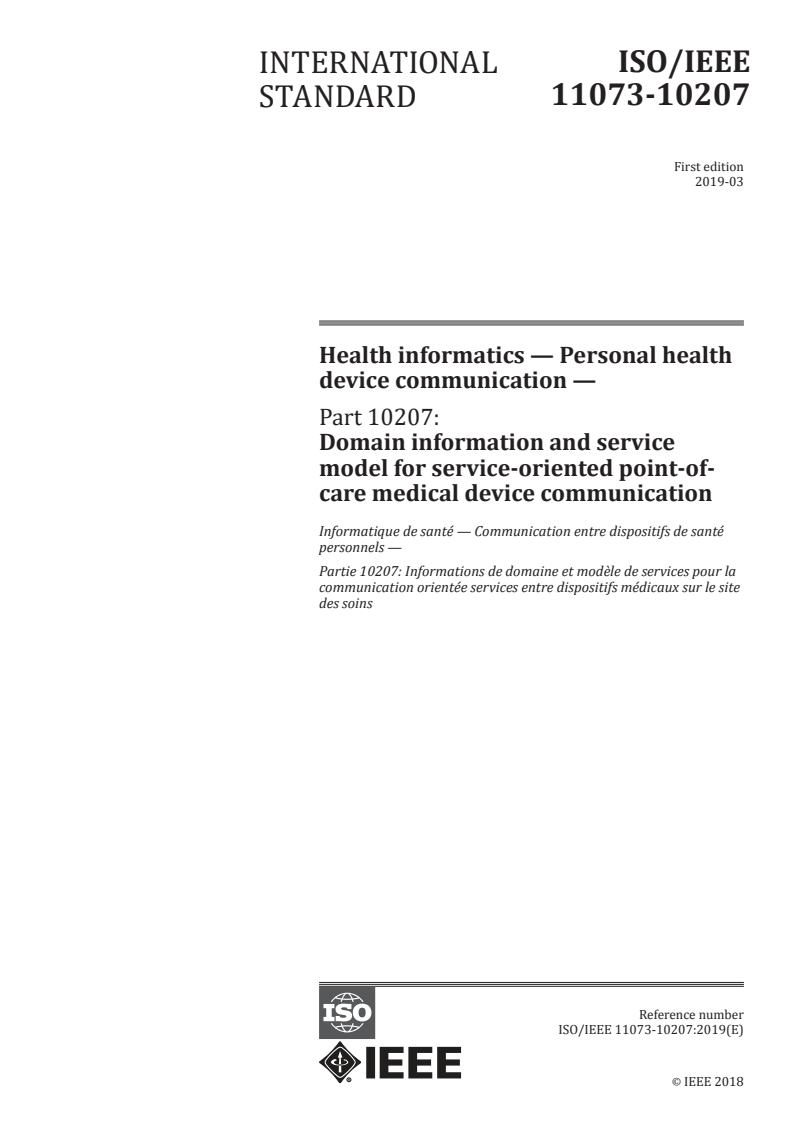
INTERNATIONAL
11073-10207
STANDARD
First edition
2019-03
Health informatics — Personal health
device communication —
Part 10207:
Domain information and service
model for service-oriented point-of-
care medical device communication
Informatique de santé — Communication entre dispositifs de santé
personnels —
Partie 10207: Informations de domaine et modèle de services pour la
communication orientée services entre dispositifs médicaux sur le site
des soins
Reference number
©
IEEE 2018
© IEEE 2018
All rights reserved. Unless otherwise specified, or required in the context of its implementation, no part of this publication may
be reproduced or utilized otherwise in any form or by any means, electronic or mechanical, including photocopying, or posting
on the internet or an intranet, without prior written permission. Permission can be requested from IEEE at the address below.
Institute of Electrical and Electronics Engineers, Inc
3 Park Avenue, New York
NY 10016-5997, USA
Email: stds.ipr@ieee.org
Website: www.ieee.org
Published in Switzerland
ii © IEEE 2018 – All rights reserved
Foreword
ISO (the International Organization for Standardization) is a worldwide federation of national
standards bodies (ISO member bodies). The work of preparing International Standards is normally
carried out through ISO technical committees. Each member body interested in a subject for which a
technical committee has been established has the right to be represented on that committee.
International organizations, governmental and non-governmental, in liaison with ISO, also take part
in the work. ISO collaborates closely with the International Electrotechnical Commission (IEC) on all
matters of electrotechnical standardization.
The procedures used to develop this document and those intended for its further maintenance are
described in the ISO/IEC Directives, Part 1. In particular, the different approval criteria needed for
the different types of ISO documents should be noted (see www.iso.org/directives).
IEEE Standards documents are developed within the IEEE Societies and the Standards Coordinating
Committees of the IEEE Standards Association (IEEE-SA) Standards Board. The IEEE develops its
standards through a consensus development process, approved by the American National Standards
Institute, which brings together volunteers representing varied viewpoints and interests to achieve
the final product. Volunteers are not necessarily members of the Institute and serve without
compensation. While the IEEE administers the process and establishes rules to promote fairness in
the consensus development process, the IEEE does not independently evaluate, test, or verify the
accuracy of any of the information contained in its standards.
Attention is drawn to the possibility that some of the elements of this document may be the subject
of patent rights. ISO shall not be held responsible for identifying any or all such patent rights. Details
of any patent rights identified during the development of the document will be in the Introduction
and/or on the ISO list of patent declarations received (see www.iso.org/patents).
Any trade name used in this document is information given for the convenience of users and does not
constitute an endorsement.
For an explanation of the voluntary nature of standards, the meaning of ISO specific terms and
expressions related to conformity assessment, as well as information about ISO's adherence to the
World Trade Organization (WTO) principles in the Technical Barriers to Trade (TBT), see
www.iso.org/iso/foreword.html.
ISO/IEEE 11073-10207 was prepared by the IEEE 11073 Standards Committee of the IEEE
Engineering in Medicine and Biology Society (as IEEE Std 11073-10207-2017) and drafted in
accordance with its editorial rules. It was adopted, under the “fast-track procedure” defined in the
Partner Standards Development Organization cooperation agreement between ISO and IEEE, by
Technical Committee ISO/TC 215, Health informatics.
A list of all parts in the ISO 11073 series can be found on the ISO website.
Any feedback or questions on this document should be directed to the user’s national standards
body. A complete listing of these bodies can be found at www.iso.org/members.html.
© IEEE 2018 – All rights reserved
iii
Abstract: Within the context of the ISO/IEEE 11073™ family of standards for point-of-care
medical device communication, a Participant Model derived from the ISO/IEEE11073-10201
Domain Information Model is provided in this standard. The Participant Model specifies the
structure of medical information objects. This standard also defines an abstract Communication
Model to support the exchange of medical information objects. All elements of the Participant
Model and Communication Model are specified using XML Schema. Core subjects of the
Participant Model comprise modelling of medical device-related data, e.g., measurements and
settings, alert systems, contextual information (e.g., patient demographics and location
information), remote control, and archival information. Model extensibility is provided inherently
through the use of XML Schema.
Keywords: alert systems, IEEE 11073-10207™, medical device communication, patient, point-
of-care, remote control, service-oriented architecture, XML Schema
•
The Institute of Electrical and Electronics Engineers, Inc.
3 Park Avenue, New York, NY 10016-5997, USA
All rights reserved. Published 21 February 2018. Printed in the United States of America.
IEEE is a registered trademark in the U.S. Patent & Trademark Office, owned by The Institute of Electrical and Electronics
Engineers, Incorporated.
PDF: ISBN 978-1-5044-4627-3 STD22961
Print: ISBN 978-1-5044-4628-0 STDPD22961
IEEE prohibits discrimination, harassment, and bullying.
For more information, visit http://www.ieee.org/web/aboutus/whatis/policies/p9-26.html.
No part of this publication may be reproduced in any form, in an electronic retrieval system or otherwise, without the prior written permission
of the publisher.
Important Notices and Disclaimers Concerning IEEE Standards Documents
IEEE documents are made available for use subject to important notices and legal disclaimers. These
notices and disclaimers, or a reference to this page, appear in all standards and may be found under the
heading “Important Notices and Disclaimers Concerning IEEE Standards Documents.” They can also be
obtained on request from IEEE or viewed at http://standards.ieee.org/IPR/disclaimers.html.
Notice and Disclaimer of Liability Concerning the Use of IEEE Standards
Documents
IEEE Standards documents (standards, recommended practices, and guides), both full-use and trial-use, are
developed within IEEE Societies and the Standards Coordinating Committees of the IEEE Standards
Association (“IEEE-SA”) Standards Board. IEEE (“the Institute”) develops its standards through a
consensus development process, approved by the American National Standards Institute (“ANSI”), which
brings together volunteers representing varied viewpoints and interests to achieve the final product.
Volunteers are not necessarily members of the Institute and participate without compensation from IEEE.
While IEEE administers the process and establishes rules to promote fairness in the consensus development
process, IEEE does not independently evaluate, test, or verify the accuracy of any of the information or the
soundness of any judgments contained in its standards.
IEEE does not warrant or represent the accuracy or content of the material contained in its standards, and
expressly disclaims all warranties (express, implied and statutory) not included in this or any other
document relating to the standard, including, but not limited to, the warranties of: merchantability; fitness
for a particular purpose; noninfringement; and quality, accuracy, effectiveness, currency, or completeness
of material. In addition, IEEE disclaims any and all conditions relating to: results; and workmanlike effort.
IEEE standards documents are supplied “AS IS” and “WITH ALL FAULTS.”
Use of an IEEE standard is wholly voluntary. The existence of an IEEE standard does not imply that there
are no other ways to produce, test, measure, purchase, market, or provide other goods and services related
to the scope of the IEEE standard. Furthermore, the viewpoint expressed at the time a standard is approved
and issued is subject to change brought about through developments in the state of the art and comments
received from users of the standard.
In publishing and making its standards available, IEEE is not suggesting or rendering professional or other
services for, or on behalf of, any person or entity nor is IEEE undertaking to perform any duty owed by any
other person or entity to another. Any person utilizing any IEEE Standards document, should rely upon his
or her own independent judgment in the exercise of reasonable care in any given circumstances or, as
appropriate, seek the advice of a competent professional in determining the appropriateness of a given
IEEE standard.
IN NO EVENT SHALL IEEE BE LIABLE FOR ANY DIRECT, INDIRECT, INCIDENTAL, SPECIAL,
EXEMPLARY, OR CONSEQUENTIAL DAMAGES (INCLUDING, BUT NOT LIMITED TO:
PROCUREMENT OF SUBSTITUTE GOODS OR SERVICES; LOSS OF USE, DATA, OR PROFITS;
OR BUSINESS INTERRUPTION) HOWEVER CAUSED AND ON ANY THEORY OF LIABILITY,
WHETHER IN CONTRACT, STRICT LIABILITY, OR TORT (INCLUDING NEGLIGENCE OR
OTHERWISE) ARISING IN ANY WAY OUT OF THE PUBLICATION, USE OF, OR RELIANCE
UPON ANY STANDARD, EVEN IF ADVISED OF THE POSSIBILITY OF SUCH DAMAGE AND
REGARDLESS OF WHETHER SUCH DAMAGE WAS FORESEEABLE.
Translations
The IEEE consensus development process involves the review of documents in English only. In the event
that an IEEE standard is translated, only the English version published by IEEE should be considered the
approved IEEE standard.
Official statements
A statement, written or oral, that is not processed in accordance with the IEEE-SA Standards Board
Operations Manual shall not be considered or inferred to be the official position of IEEE or any of its
committees and shall not be considered to be, or be relied upon as, a formal position of IEEE. At lectures,
symposia, seminars, or educational courses, an individual presenting information on IEEE standards shall
make it clear that his or her views should be considered the personal views of that individual rather than the
formal position of IEEE.
Comments on standards
Comments for revision of IEEE Standards documents are welcome from any interested party, regardless of
membership affiliation with IEEE. However, IEEE does not provide consulting information or advice
pertaining to IEEE Standards documents. Suggestions for changes in documents should be in the form of a
proposed change of text, together with appropriate supporting comments. Since IEEE standards represent a
consensus of concerned interests, it is important that any responses to comments and questions also receive
the concurrence of a balance of interests. For this reason, IEEE and the members of its societies and
Standards Coordinating Committees are not able to provide an instant response to comments or questions
except in those cases where the matter has previously been addressed. For the same reason, IEEE does not
respond to interpretation requests. Any person who would like to participate in revisions to an IEEE
standard is welcome to join the relevant IEEE working group.
Comments on standards should be submitted to the following address:
Secretary, IEEE-SA Standards Board
445 Hoes Lane
Piscataway, NJ 08854 USA
Laws and regulations
Users of IEEE Standards documents should consult all applicable laws and regulations. Compliance with
the provisions of any IEEE Standards document does not imply compliance to any applicable regulatory
requirements. Implementers of the standard are responsible for observing or referring to the applicable
regulatory requirements. IEEE does not, by the publication of its standards, intend to urge action that is not
in compliance with applicable laws, and these documents may not be construed as doing so
Copyrights
IEEE draft and approved standards are copyrighted by IEEE under U.S. and international copyright laws.
They are made available by IEEE and are adopted for a wide variety of both public and private uses. These
include both use, by reference, in laws and regulations, and use in private self-regulation, standardization,
and the promotion of engineering practices and methods. By making these documents available for use and
adoption by public authorities and private users, IEEE does not waive any rights in copyright to the
documents.
Photocopies
Subject to payment of the appropriate fee, IEEE will grant users a limited, nonexclusive license to
photocopy portions of any individual standard for company or organizational internal use or individual,
noncommercial use only. To arrange for payment of licensing fees, please contact Copyright Clearance
Center, Customer Service, 222 Rosewood Drive, Danvers, MA 01923 USA; +1 978 750 8400. Permission
to photocopy portions of any individual standard for educational classroom use can also be obtained
through the Copyright Clearance Center.
Updating of IEEE Standards documents
Users of IEEE Standards documents should be aware that these documents may be superseded at any time
by the issuance of new editions or may be amended from time to time through the issuance of amendments,
corrigenda, or errata. An official IEEE document at any point in time consists of the current edition of the
document together with any amendments, corrigenda, or errata then in effect.
Every IEEE standard is subjected to review at least every ten years. When a document is more than ten
years old and has not undergone a revision process, it is reasonable to conclude that its contents, although
still of some value, do not wholly reflect the present state of the art. Users are cautioned to check to
determine that they have the latest edition of any IEEE standard.
In order to determine whether a given document is the current edition and whether it has been amended
through the issuance of amendments, corrigenda, or errata, visit the IEEE-SA Website at
http://ieeexplore.ieee.org/xpl/standards.jsp or contact IEEE at the address listed previously. For more
information about the IEEE SA or IEEE’s standards development process, visit the IEEE-SA Website at
http://standards.ieee.org.
Errata
Errata, if any, for all IEEE standards can be accessed on the IEEE-SA Website at the following URL:
http://standards.ieee.org/findstds/errata/index.html. Users are encouraged to check this URL for errata
periodically.
Patents
Attention is called to the possibility that implementation of this standard may require use of subject matter
covered by patent rights. By publication of this standard, no position is taken by the IEEE with respect to
the existence or validity of any patent rights in connection therewith. If a patent holder or patent applicant
has filed a statement of assurance via an Accepted Letter of Assurance, then the statement is listed on the
IEEE-SA Website at http://standards.ieee.org/about/sasb/patcom/patents.html. Letters of Assurance may
indicate whether the Submitter is willing or unwilling to grant licenses under patent rights without
compensation or under reasonable rates, with reasonable terms and conditions that are demonstrably free of
any unfair discrimination to applicants desiring to obtain such licenses.
Essential Patent Claims may exist for which a Letter of Assurance has not been received. The IEEE is not
responsible for identifying Essential Patent Claims for which a license may be required, for conducting
inquiries into the legal validity or scope of Patents Claims, or determining whether any licensing terms or
conditions provided in connection with submission of a Letter of Assurance, if any, or in any licensing
agreements are reasonable or nondiscriminatory. Users of this standard are expressly advised that
determination of the validity of any patent rights, and the risk of infringement of such rights, is entirely
their own responsibility. Further information may be obtained from the IEEE Standards Association.
Participants
At the time this standard was submitted to the IEEE-SA Standards Board for approval, the Point of Care
Devices Working Group had the following membership:
Jan Wittenber, Chair
Stefan Schlichting, Subgroup Chair
Bjoern Anderson Frank Golatowski Stephan Poehlsen
Malcolm Clarke David Gregorczyk Tracy Rausch
Todd Cooper Kai Hassing John Rhoads
Chris Courville John Hatcliff Paul Schluter
Michael Faughn Stefan Karl Masato Tanaka
Kenneth Fuchs Martin Kasparick Eugene Vasserman
John Garguilo Koichiro Matsumoto Stan Wiley
Joerg-Uwe Meyer
The following members of the individual balloting committee voted on this standard. Balloters may have
voted for approval, disapproval, or abstention.
Bjoern Andersen David Gregorczyk Martin Kasparick
Susan Burgess Randall Groves Joerg-Uwe Meyer
Craig Carlson Kai Hassing Stephan Poehlsen
Keith Chow Robert Heile Beth Pumo
Malcolm Clarke Werner Hoelzl Stefan Schlichting
Todd Cooper Noriyuki Ikeuchi Eugene Stoudenmire
Sourav Dutta Atsushi Ito Walter Struppler
Kenneth Fuchs Stefan Karl J. Wiley
Joel Goergen Piotr Karocki Jan Wittenber
Frank Golatowski Oren Yuen
When the IEEE-SA Standards Board approved this standard on 6 December 2017, it had the following
membership:
Jean-Philippe Faure, Chair
Gary Hoffman, Vice Chair
John D. Kulick, Past Chair
Konstantinos Karachalios, Secretary
Chuck Adams
Thomas Kochy Robby Robson
Masayuki Ariyoshi Joseph L. Koepfinger* Dorothy Stanley
Ted Burse Kevin Lu Adrian Stephens
Stephen Dukes Daleep Mohla Mehmet Ulema
Doug Edwards Damir Novosel Phil Wennblom
J. Travis Griffith Ronald C. Petersen Howard Wolfman
Michael Janezic Annette D. Reilly Yu Yuan
*Member Emeritus
Introduction
This introduction is not part of IEEE Std 11073-10207-2017, Health informatics—Point-of-care medical device
communication—Part 10207: Domain Information and Service Model for Service-Oriented Point-of-Care Medical
Device Communication.
ISO/IEEE 11073 standards enable communication between medical devices and external computer
systems. They provide automatic and detailed electronic data capture of patient vital signs information and
device operational data. The primary goals of these standards are to
Provide real-time, plug-and-play interoperability for patient-connected medical devices.
Facilitate the efficient exchange of vital signs and medical device data, acquired at the point of
care, in all health care environments.
“Real-time” means that data from multiple devices can be retrieved, time correlated, and displayed or
processed in fractions of a second. “Plug-and-play” means that all the clinician has to do is make the
connection—the systems automatically detect, configure, and communicate without any other human
interaction.
“Efficient exchange of medical device data” means that information that is captured at the point of care
(e.g., patient vital signs data) can be archived, retrieved, and processed by many different types of
applications without extensive software and equipment support and without needless loss of information.
The standards are especially targeted at acute and continuing care devices, such as patient monitors,
ventilators, infusion pumps, and electrocardiogram (EKG) devices. This family of standards can be layered
together to provide connectivity optimized for the specific devices being interfaced.
Note that normative statements of requirements are presented in this standard in the following manner:
Rnnnn: Statement text here.
where "nnnn" is replaced by a number that is unique among the requirements in this standard and thereby
forms a unique requirement identifier, for example,
R0007: All HANDLEs SHALL be unique within one MDIB sequence of a SERVICE PROVIDER.
Contents
1. Overview .21
1.1 Scope .21
1.2 Purpose .21
2. Normative references .22
3. Definitions and notational conventions .23
3.1 Definitions .23
3.2 Notational conventions .25
4. Introduction to BICEPS .28
5. Participant Model .30
5.1 Overview .30
5.2 Background .30
5.3 Descriptive part.34
5.4 State part .41
6. Alert signal delegation .49
6.1 General .49
6.2 Delegable alert signals .49
6.3 Fallback alert signals .52
7. Communication Model .53
7.1 General .53
7.2 Message exchange patterns .53
7.3 Service Model .54
7.4 Message Model .59
8. Extension Model .62
9. Discovery Model .63
9.1 General .63
9.2 Implicit discovery .63
9.3 Explicit discovery .63
10. Nonfunctional requirements .64
10.1 General .64
10.2 Patient safety considerations .64
10.3 Cybersecurity considerations .64
10.4 Clinical effectiveness .65
10.5 Regulatory considerations .65
11. Conformance .66
11.1 Overview .66
11.2 General format .66
11.3 ICS tables .67
Annex A (normative) Extension Model .70
A.1 Extension .70
A.2 ExtensionType .71
A.3 MustUnderstand .71
Annex B (normative) Participant Model .72
B.1 AbstractAlertDescriptor .74
B.2 AbstractAlertState .74
B.3 AbstractAlertState/@ActivationState .75
B.4 AbstractComplexDeviceComponentDescriptor .75
B.5 AbstractComplexDeviceComponentDescriptor/AlertSystem .76
B.6 AbstractComplexDeviceComponentDescriptor/Sco .77
B.7 AbstractComplexDeviceComponentState .78
B.8 AbstractContextDescriptor .79
B.9 AbstractContextState .80
B.10 AbstractContextState/@ContextAssociation .81
B.11 AbstractContextState/@BindingMdibVersion .81
B.12 AbstractContextState/@UnbindingMdibVersion.81
B.13 AbstractContextState/@BindingStartTime .82
B.14 AbstractContextState/@BindingEndTime .82
B.15 AbstractContextState/Validator .82
B.16 AbstractContextState/Identification .83
B.17 AbstractDescriptor .83
B.18 AbstractDescriptor/@Handle .84
B.19 AbstractDescriptor/@DescriptorVersion .84
B.20 AbstractDescriptor/@SafetyClassification .84
B.21 AbstractDescriptor/Type .85
B.22 AbstractDeviceComponentDescriptor .86
B.23 AbstractDeviceComponentDescriptor/ProductionSpecification .86
B.24 AbstractDeviceComponentDescriptor/ProductionSpecification/SpecType .87
B.25 AbstractDeviceComponentDescriptor/ProductionSpecification/ ProductionSpec .88
B.26 AbstractDeviceComponentDescriptor/ProductionSpecification/ComponentId .88
B.27 AbstractDeviceComponentState .89
B.28 AbstractDeviceComponentState/@ActivationState .90
B.29 AbstractDeviceComponentState/@OperatingHours .90
B.30 AbstractDeviceComponentState/@OperatingCycles .90
B.31 AbstractDeviceComponentState/CalibrationInfo .90
B.32 AbstractDeviceComponentState/NextCalibration.91
B.33 AbstractDeviceComponentState/PhysicalConnector .92
B.34 AbstractMetricDescriptor .93
B.35 AbstractMetricDescriptor/@MetricCategory .94
B.36 AbstractMetricDescriptor/@DerivationMethod.94
B.37 AbstractMetricDescriptor/@MetricAvailability .95
B.38 AbstractMetricDescriptor/@MaxMeasurementTime .95
B.39 AbstractMetricDescriptor/@MaxDelayTime .95
B.40 AbstractMetricDescriptor/@DeterminationPeriod.96
B.41 AbstractMetricDescriptor/@LifeTimePeriod .96
B.42 AbstractMetricDescriptor/@ActivationDuration .96
B.43 AbstractMetricDescriptor/Unit .97
B.44 AbstractMetricDescriptor/BodySite .98
B.45 AbstractMetricDescriptor/Relation .99
B.46 AbstractMetricDescriptor/Relation/@Kind .100
B.47 AbstractMetricDescriptor/Relation/@Entries .100
B.48 AbstractMetricDescriptor/Relation/Code .101
B.49 AbstractMetricDescriptor/Relation/Identification .102
B.50 AbstractMetricState .103
B.51 AbstractMetricState/@ActivationState .104
B.52 AbstractMetricState/@ActiveDeterminationPeriod .104
B.53 AbstractMetricState/@LifeTimePeriod .104
B.54 AbstractMetricState/BodySite.105
B.55 AbstractMetricState/PhysicalConnector .106
B.56 AbstractMetricValue .106
B.57 AbstractMetricValue/@StartTime .107
B.58 AbstractMetricValue/@StopTime .107
B.59 AbstractMetricValue/@DeterminationTime .107
B.60 AbstractMetricValue/MetricQuality .107
B.61 AbstractMetricValue/MetricQuality/@Validity.108
B.62 AbstractMetricValue/MetricQuality/@Mode .108
B.63 AbstractMetricValue/MetricQuality/@Qi .108
B.64 AbstractMetricValue/Annotation .109
B.65 AbstractMetricValue/Annotation/Type .109
B.66 AbstractMultiState .110
B.67 AbstractMultiState/@Handle .111
B.68 AbstractMultiState/Category .111
B.69 AbstractOperationDescriptor .112
B.70 AbstractOperationDescriptor/@OperationTarget .113
B.71 AbstractOperationDescriptor/@MaxTimeToFinish.113
B.72 AbstractOperationDescriptor/@InvocationEffectiveTimeout .113
B.73 AbstractOperationDescriptor/@Retriggerable .113
B.74 AbstractOperationDescriptor/@AccessLevel .114
B.75 AbstractOperationState .114
B.76 AbstractOperationState/@OperatingMode .115
B.77 AbstractSetStateOperationDescriptor .115
B.78 AbstractSetStateOperationDescriptor/ModifiableData .116
B.79 AbstractState .116
B.80 AbstractState/@StateVersion .117
B.81 AbstractState/@DescriptorHandle .117
B.82 AbstractState/@DescriptorVersion .117
B.83 ActivateOperationDescriptor .118
B.84 ActivateOperationDescriptor/Argument .119
B.85 ActivateOperationDescriptor/Argument/ArgName .119
B.86 ActivateOperationDescriptor/Argument/Arg .120
B.87 ActivateOperationState .120
B.88 AlertConditionDescriptor .121
B.89 AlertConditionDescriptor/@Kind .122
B.90 AlertConditionDescriptor/@Priority .122
B.91 AlertConditionDescriptor/@DefaultConditionGenerationDelay .122
B.92 AlertConditionDescriptor/@CanEscalate .122
B.93 AlertConditionDescriptor/@CanDeescalate .123
B.94 AlertConditionDescriptor/Source .123
B.95 AlertConditionDescriptor/CauseInfo .123
B.96 AlertConditionState .124
B.97 AlertConditionState/@ActualConditionGenerationDelay .125
B.98 AlertConditionState/@ActualPriority .125
B.99 AlertConditionState/@Rank .125
B.100 AlertConditionState/@Presence .125
B.101 AlertConditionState/@DeterminationTime .125
B.102 AlertSignalDescriptor .126
B.103 AlertSignalDescriptor/@ConditionSignaled .127
B.104 AlertSignalDescriptor/@Manifestation.127
B.105 AlertSignalDescriptor/@Latching .128
B.106 AlertSignalDescriptor/@DefaultSignalGenerationDelay .128
B.107 AlertSignalDescriptor/@MinSignalGenerationDelay .128
B.108 AlertSignalDescriptor/@MaxSignalGenerationDelay .128
B.109 AlertSignalDescriptor/@SignalDelegationSupported .128
B.110 AlertSignalDescriptor/@AcknowledgementSupported .128
B.111 AlertSignalDescriptor/@AcknowledgeTimeout .129
B.112 AlertSignalState .129
B.113 AlertSignalState/@ActualSignalGenerationDelay .130
B.114 AlertSignalState/@Presence .130
B.115 AlertSignalState/@Location .130
B.116 AlertSignalState/@Slot .130
B.117 AlertSystemDescriptor .131
B.118 AlertSystemDescriptor/@MaxPhysiologicalParallelAlarms .132
B.119 AlertSystemDescriptor/@MaxTechnicalParallelAlarms .132
B.120 AlertSystemDescriptor/@SelfCheckPeriod .132
B.121 AlertSystemDescriptor/AlertCondition .132
B.122 AlertSystemDescriptor/AlertSignal .133
B.123 AlertSystemState .134
B.124 AlertSystemState/@LastSelfCheck .
...
ISO/IEEE
INTERNATIONAL
11073-10207
STANDARD
First edition
2019-03
Health informatics — Personal health
device communication —
Part 10207:
Domain information and service
model for service-oriented point-of-
care medical device communication
Informatique de santé — Communication entre dispositifs de santé
personnels —
Partie 10207: Informations de domaine et modèle de services pour la
communication orientée services entre dispositifs médicaux sur le site
des soins
Reference number
©
IEEE 2018
© IEEE 2018
All rights reserved. Unless otherwise specified, or required in the context of its implementation, no part of this publication may
be reproduced or utilized otherwise in any form or by any means, electronic or mechanical, including photocopying, or posting
on the internet or an intranet, without prior written permission. Permission can be requested from IEEE at the address below.
Institute of Electrical and Electronics Engineers, Inc
3 Park Avenue, New York
NY 10016-5997, USA
Email: stds.ipr@ieee.org
Website: www.ieee.org
Published in Switzerland
ii © IEEE 2018 – All rights reserved
Foreword
ISO (the International Organization for Standardization) is a worldwide federation of national
standards bodies (ISO member bodies). The work of preparing International Standards is normally
carried out through ISO technical committees. Each member body interested in a subject for which a
technical committee has been established has the right to be represented on that committee.
International organizations, governmental and non-governmental, in liaison with ISO, also take part
in the work. ISO collaborates closely with the International Electrotechnical Commission (IEC) on all
matters of electrotechnical standardization.
The procedures used to develop this document and those intended for its further maintenance are
described in the ISO/IEC Directives, Part 1. In particular, the different approval criteria needed for
the different types of ISO documents should be noted (see www.iso.org/directives).
IEEE Standards documents are developed within the IEEE Societies and the Standards Coordinating
Committees of the IEEE Standards Association (IEEE-SA) Standards Board. The IEEE develops its
standards through a consensus development process, approved by the American National Standards
Institute, which brings together volunteers representing varied viewpoints and interests to achieve
the final product. Volunteers are not necessarily members of the Institute and serve without
compensation. While the IEEE administers the process and establishes rules to promote fairness in
the consensus development process, the IEEE does not independently evaluate, test, or verify the
accuracy of any of the information contained in its standards.
Attention is drawn to the possibility that some of the elements of this document may be the subject
of patent rights. ISO shall not be held responsible for identifying any or all such patent rights. Details
of any patent rights identified during the development of the document will be in the Introduction
and/or on the ISO list of patent declarations received (see www.iso.org/patents).
Any trade name used in this document is information given for the convenience of users and does not
constitute an endorsement.
For an explanation of the voluntary nature of standards, the meaning of ISO specific terms and
expressions related to conformity assessment, as well as information about ISO's adherence to the
World Trade Organization (WTO) principles in the Technical Barriers to Trade (TBT), see
www.iso.org/iso/foreword.html.
ISO/IEEE 11073-10207 was prepared by the IEEE 11073 Standards Committee of the IEEE
Engineering in Medicine and Biology Society (as IEEE Std 11073-10207-2017) and drafted in
accordance with its editorial rules. It was adopted, under the “fast-track procedure” defined in the
Partner Standards Development Organization cooperation agreement between ISO and IEEE, by
Technical Committee ISO/TC 215, Health informatics.
A list of all parts in the ISO 11073 series can be found on the ISO website.
Any feedback or questions on this document should be directed to the user’s national standards
body. A complete listing of these bodies can be found at www.iso.org/members.html.
© IEEE 2018 – All rights reserved
iii
Abstract: Within the context of the ISO/IEEE 11073™ family of standards for point-of-care
medical device communication, a Participant Model derived from the ISO/IEEE11073-10201
Domain Information Model is provided in this standard. The Participant Model specifies the
structure of medical information objects. This standard also defines an abstract Communication
Model to support the exchange of medical information objects. All elements of the Participant
Model and Communication Model are specified using XML Schema. Core subjects of the
Participant Model comprise modelling of medical device-related data, e.g., measurements and
settings, alert systems, contextual information (e.g., patient demographics and location
information), remote control, and archival information. Model extensibility is provided inherently
through the use of XML Schema.
Keywords: alert systems, IEEE 11073-10207™, medical device communication, patient, point-
of-care, remote control, service-oriented architecture, XML Schema
•
The Institute of Electrical and Electronics Engineers, Inc.
3 Park Avenue, New York, NY 10016-5997, USA
All rights reserved. Published 21 February 2018. Printed in the United States of America.
IEEE is a registered trademark in the U.S. Patent & Trademark Office, owned by The Institute of Electrical and Electronics
Engineers, Incorporated.
PDF: ISBN 978-1-5044-4627-3 STD22961
Print: ISBN 978-1-5044-4628-0 STDPD22961
IEEE prohibits discrimination, harassment, and bullying.
For more information, visit http://www.ieee.org/web/aboutus/whatis/policies/p9-26.html.
No part of this publication may be reproduced in any form, in an electronic retrieval system or otherwise, without the prior written permission
of the publisher.
Important Notices and Disclaimers Concerning IEEE Standards Documents
IEEE documents are made available for use subject to important notices and legal disclaimers. These
notices and disclaimers, or a reference to this page, appear in all standards and may be found under the
heading “Important Notices and Disclaimers Concerning IEEE Standards Documents.” They can also be
obtained on request from IEEE or viewed at http://standards.ieee.org/IPR/disclaimers.html.
Notice and Disclaimer of Liability Concerning the Use of IEEE Standards
Documents
IEEE Standards documents (standards, recommended practices, and guides), both full-use and trial-use, are
developed within IEEE Societies and the Standards Coordinating Committees of the IEEE Standards
Association (“IEEE-SA”) Standards Board. IEEE (“the Institute”) develops its standards through a
consensus development process, approved by the American National Standards Institute (“ANSI”), which
brings together volunteers representing varied viewpoints and interests to achieve the final product.
Volunteers are not necessarily members of the Institute and participate without compensation from IEEE.
While IEEE administers the process and establishes rules to promote fairness in the consensus development
process, IEEE does not independently evaluate, test, or verify the accuracy of any of the information or the
soundness of any judgments contained in its standards.
IEEE does not warrant or represent the accuracy or content of the material contained in its standards, and
expressly disclaims all warranties (express, implied and statutory) not included in this or any other
document relating to the standard, including, but not limited to, the warranties of: merchantability; fitness
for a particular purpose; noninfringement; and quality, accuracy, effectiveness, currency, or completeness
of material. In addition, IEEE disclaims any and all conditions relating to: results; and workmanlike effort.
IEEE standards documents are supplied “AS IS” and “WITH ALL FAULTS.”
Use of an IEEE standard is wholly voluntary. The existence of an IEEE standard does not imply that there
are no other ways to produce, test, measure, purchase, market, or provide other goods and services related
to the scope of the IEEE standard. Furthermore, the viewpoint expressed at the time a standard is approved
and issued is subject to change brought about through developments in the state of the art and comments
received from users of the standard.
In publishing and making its standards available, IEEE is not suggesting or rendering professional or other
services for, or on behalf of, any person or entity nor is IEEE undertaking to perform any duty owed by any
other person or entity to another. Any person utilizing any IEEE Standards document, should rely upon his
or her own independent judgment in the exercise of reasonable care in any given circumstances or, as
appropriate, seek the advice of a competent professional in determining the appropriateness of a given
IEEE standard.
IN NO EVENT SHALL IEEE BE LIABLE FOR ANY DIRECT, INDIRECT, INCIDENTAL, SPECIAL,
EXEMPLARY, OR CONSEQUENTIAL DAMAGES (INCLUDING, BUT NOT LIMITED TO:
PROCUREMENT OF SUBSTITUTE GOODS OR SERVICES; LOSS OF USE, DATA, OR PROFITS;
OR BUSINESS INTERRUPTION) HOWEVER CAUSED AND ON ANY THEORY OF LIABILITY,
WHETHER IN CONTRACT, STRICT LIABILITY, OR TORT (INCLUDING NEGLIGENCE OR
OTHERWISE) ARISING IN ANY WAY OUT OF THE PUBLICATION, USE OF, OR RELIANCE
UPON ANY STANDARD, EVEN IF ADVISED OF THE POSSIBILITY OF SUCH DAMAGE AND
REGARDLESS OF WHETHER SUCH DAMAGE WAS FORESEEABLE.
Translations
The IEEE consensus development process involves the review of documents in English only. In the event
that an IEEE standard is translated, only the English version published by IEEE should be considered the
approved IEEE standard.
Official statements
A statement, written or oral, that is not processed in accordance with the IEEE-SA Standards Board
Operations Manual shall not be considered or inferred to be the official position of IEEE or any of its
committees and shall not be considered to be, or be relied upon as, a formal position of IEEE. At lectures,
symposia, seminars, or educational courses, an individual presenting information on IEEE standards shall
make it clear that his or her views should be considered the personal views of that individual rather than the
formal position of IEEE.
Comments on standards
Comments for revision of IEEE Standards documents are welcome from any interested party, regardless of
membership affiliation with IEEE. However, IEEE does not provide consulting information or advice
pertaining to IEEE Standards documents. Suggestions for changes in documents should be in the form of a
proposed change of text, together with appropriate supporting comments. Since IEEE standards represent a
consensus of concerned interests, it is important that any responses to comments and questions also receive
the concurrence of a balance of interests. For this reason, IEEE and the members of its societies and
Standards Coordinating Committees are not able to provide an instant response to comments or questions
except in those cases where the matter has previously been addressed. For the same reason, IEEE does not
respond to interpretation requests. Any person who would like to participate in revisions to an IEEE
standard is welcome to join the relevant IEEE working group.
Comments on standards should be submitted to the following address:
Secretary, IEEE-SA Standards Board
445 Hoes Lane
Piscataway, NJ 08854 USA
Laws and regulations
Users of IEEE Standards documents should consult all applicable laws and regulations. Compliance with
the provisions of any IEEE Standards document does not imply compliance to any applicable regulatory
requirements. Implementers of the standard are responsible for observing or referring to the applicable
regulatory requirements. IEEE does not, by the publication of its standards, intend to urge action that is not
in compliance with applicable laws, and these documents may not be construed as doing so
Copyrights
IEEE draft and approved standards are copyrighted by IEEE under U.S. and international copyright laws.
They are made available by IEEE and are adopted for a wide variety of both public and private uses. These
include both use, by reference, in laws and regulations, and use in private self-regulation, standardization,
and the promotion of engineering practices and methods. By making these documents available for use and
adoption by public authorities and private users, IEEE does not waive any rights in copyright to the
documents.
Photocopies
Subject to payment of the appropriate fee, IEEE will grant users a limited, nonexclusive license to
photocopy portions of any individual standard for company or organizational internal use or individual,
noncommercial use only. To arrange for payment of licensing fees, please contact Copyright Clearance
Center, Customer Service, 222 Rosewood Drive, Danvers, MA 01923 USA; +1 978 750 8400. Permission
to photocopy portions of any individual standard for educational classroom use can also be obtained
through the Copyright Clearance Center.
Updating of IEEE Standards documents
Users of IEEE Standards documents should be aware that these documents may be superseded at any time
by the issuance of new editions or may be amended from time to time through the issuance of amendments,
corrigenda, or errata. An official IEEE document at any point in time consists of the current edition of the
document together with any amendments, corrigenda, or errata then in effect.
Every IEEE standard is subjected to review at least every ten years. When a document is more than ten
years old and has not undergone a revision process, it is reasonable to conclude that its contents, although
still of some value, do not wholly reflect the present state of the art. Users are cautioned to check to
determine that they have the latest edition of any IEEE standard.
In order to determine whether a given document is the current edition and whether it has been amended
through the issuance of amendments, corrigenda, or errata, visit the IEEE-SA Website at
http://ieeexplore.ieee.org/xpl/standards.jsp or contact IEEE at the address listed previously. For more
information about the IEEE SA or IEEE’s standards development process, visit the IEEE-SA Website at
http://standards.ieee.org.
Errata
Errata, if any, for all IEEE standards can be accessed on the IEEE-SA Website at the following URL:
http://standards.ieee.org/findstds/errata/index.html. Users are encouraged to check this URL for errata
periodically.
Patents
Attention is called to the possibility that implementation of this standard may require use of subject matter
covered by patent rights. By publication of this standard, no position is taken by the IEEE with respect to
the existence or validity of any patent rights in connection therewith. If a patent holder or patent applicant
has filed a statement of assurance via an Accepted Letter of Assurance, then the statement is listed on the
IEEE-SA Website at http://standards.ieee.org/about/sasb/patcom/patents.html. Letters of Assurance may
indicate whether the Submitter is willing or unwilling to grant licenses under patent rights without
compensation or under reasonable rates, with reasonable terms and conditions that are demonstrably free of
any unfair discrimination to applicants desiring to obtain such licenses.
Essential Patent Claims may exist for which a Letter of Assurance has not been received. The IEEE is not
responsible for identifying Essential Patent Claims for which a license may be required, for conducting
inquiries into the legal validity or scope of Patents Claims, or determining whether any licensing terms or
conditions provided in connection with submission of a Letter of Assurance, if any, or in any licensing
agreements are reasonable or nondiscriminatory. Users of this standard are expressly advised that
determination of the validity of any patent rights, and the risk of infringement of such rights, is entirely
their own responsibility. Further information may be obtained from the IEEE Standards Association.
Participants
At the time this standard was submitted to the IEEE-SA Standards Board for approval, the Point of Care
Devices Working Group had the following membership:
Jan Wittenber, Chair
Stefan Schlichting, Subgroup Chair
Bjoern Anderson Frank Golatowski Stephan Poehlsen
Malcolm Clarke David Gregorczyk Tracy Rausch
Todd Cooper Kai Hassing John Rhoads
Chris Courville John Hatcliff Paul Schluter
Michael Faughn Stefan Karl Masato Tanaka
Kenneth Fuchs Martin Kasparick Eugene Vasserman
John Garguilo Koichiro Matsumoto Stan Wiley
Joerg-Uwe Meyer
The following members of the individual balloting committee voted on this standard. Balloters may have
voted for approval, disapproval, or abstention.
Bjoern Andersen David Gregorczyk Martin Kasparick
Susan Burgess Randall Groves Joerg-Uwe Meyer
Craig Carlson Kai Hassing Stephan Poehlsen
Keith Chow Robert Heile Beth Pumo
Malcolm Clarke Werner Hoelzl Stefan Schlichting
Todd Cooper Noriyuki Ikeuchi Eugene Stoudenmire
Sourav Dutta Atsushi Ito Walter Struppler
Kenneth Fuchs Stefan Karl J. Wiley
Joel Goergen Piotr Karocki Jan Wittenber
Frank Golatowski Oren Yuen
When the IEEE-SA Standards Board approved this standard on 6 December 2017, it had the following
membership:
Jean-Philippe Faure, Chair
Gary Hoffman, Vice Chair
John D. Kulick, Past Chair
Konstantinos Karachalios, Secretary
Chuck Adams
Thomas Kochy Robby Robson
Masayuki Ariyoshi Joseph L. Koepfinger* Dorothy Stanley
Ted Burse Kevin Lu Adrian Stephens
Stephen Dukes Daleep Mohla Mehmet Ulema
Doug Edwards Damir Novosel Phil Wennblom
J. Travis Griffith Ronald C. Petersen Howard Wolfman
Michael Janezic Annette D. Reilly Yu Yuan
*Member Emeritus
Introduction
This introduction is not part of IEEE Std 11073-10207-2017, Health informatics—Point-of-care medical device
communication—Part 10207: Domain Information and Service Model for Service-Oriented Point-of-Care Medical
Device Communication.
ISO/IEEE 11073 standards enable communication between medical devices and external computer
systems. They provide automatic and detailed electronic data capture of patient vital signs information and
device operational data. The primary goals of these standards are to
Provide real-time, plug-and-play interoperability for patient-connected medical devices.
Facilitate the efficient exchange of vital signs and medical device data, acquired at the point of
care, in all health care environments.
“Real-time” means that data from multiple devices can be retrieved, time correlated, and displayed or
processed in fractions of a second. “Plug-and-play” means that all the clinician has to do is make the
connection—the systems automatically detect, configure, and communicate without any other human
interaction.
“Efficient exchange of medical device data” means that information that is captured at the point of care
(e.g., patient vital signs data) can be archived, retrieved, and processed by many different types of
applications without extensive software and equipment support and without needless loss of information.
The standards are especially targeted at acute and continuing care devices, such as patient monitors,
ventilators, infusion pumps, and electrocardiogram (EKG) devices. This family of standards can be layered
together to provide connectivity optimized for the specific devices being interfaced.
Note that normative statements of requirements are presented in this standard in the following manner:
Rnnnn: Statement text here.
where "nnnn" is replaced by a number that is unique among the requirements in this standard and thereby
forms a unique requirement identifier, for example,
R0007: All HANDLEs SHALL be unique within one MDIB sequence of a SERVICE PROVIDER.
Contents
1. Overview .21
1.1 Scope .21
1.2 Purpose .21
2. Normative references .22
3. Definitions and notational conventions .23
3.1 Definitions .23
3.2 Notational conventions .25
4. Introduction to BICEPS .28
5. Participant Model .30
5.1 Overview .30
5.2 Background .30
5.3 Descriptive part.34
5.4 State part .41
6. Alert signal delegation .49
6.1 General .49
6.2 Delegable alert signals .49
6.3 Fallback alert signals .52
7. Communication Model .53
7.1 General .53
7.2 Message exchange patterns .53
7.3 Service Model .54
7.4 Message Model .59
8. Extension Model .62
9. Discovery Model .63
9.1 General .63
9.2 Implicit discovery .63
9.3 Explicit discovery .63
10. Nonfunctional requirements .64
10.1 General .64
10.2 Patient safety considerations .64
10.3 Cybersecurity considerations .64
10.4 Clinical effectiveness .65
10.5 Regulatory considerations .65
11. Conformance .66
11.1 Overview .66
11.2 General format .66
11.3 ICS tables .67
Annex A (normative) Extension Model .70
A.1 Extension .70
A.2 ExtensionType .71
A.3 MustUnderstand .71
Annex B (normative) Participant Model .72
B.1 AbstractAlertDescriptor .74
B.2 AbstractAlertState .74
B.3 AbstractAlertState/@ActivationState .75
B.4 AbstractComplexDeviceComponentDescriptor .75
B.5 AbstractComplexDeviceComponentDescriptor/AlertSystem .76
B.6 AbstractComplexDeviceComponentDescriptor/Sco .77
B.7 AbstractComplexDeviceComponentState .78
B.8 AbstractContextDescriptor .79
B.9 AbstractContextState .80
B.10 AbstractContextState/@ContextAssociation .81
B.11 AbstractContextState/@BindingMdibVersion .81
B.12 AbstractContextState/@UnbindingMdibVersion.81
B.13 AbstractContextState/@BindingStartTime .82
B.14 AbstractContextState/@BindingEndTime .82
B.15 AbstractContextState/Validator .82
B.16 AbstractContextState/Identification .83
B.17 AbstractDescriptor .83
B.18 AbstractDescriptor/@Handle .84
B.19 AbstractDescriptor/@DescriptorVersion .84
B.20 AbstractDescriptor/@SafetyClassification .84
B.21 AbstractDescriptor/Type .85
B.22 AbstractDeviceComponentDescriptor .86
B.23 AbstractDeviceComponentDescriptor/ProductionSpecification .86
B.24 AbstractDeviceComponentDescriptor/ProductionSpecification/SpecType .87
B.25 AbstractDeviceComponentDescriptor/ProductionSpecification/ ProductionSpec .88
B.26 AbstractDeviceComponentDescriptor/ProductionSpecification/ComponentId .88
B.27 AbstractDeviceComponentState .89
B.28 AbstractDeviceComponentState/@ActivationState .90
B.29 AbstractDeviceComponentState/@OperatingHours .90
B.30 AbstractDeviceComponentState/@OperatingCycles .90
B.31 AbstractDeviceComponentState/CalibrationInfo .90
B.32 AbstractDeviceComponentState/NextCalibration.91
B.33 AbstractDeviceComponentState/PhysicalConnector .92
B.34 AbstractMetricDescriptor .93
B.35 AbstractMetricDescriptor/@MetricCategory .94
B.36 AbstractMetricDescriptor/@DerivationMethod.94
B.37 AbstractMetricDescriptor/@MetricAvailability .95
B.38 AbstractMetricDescriptor/@MaxMeasurementTime .95
B.39 AbstractMetricDescriptor/@MaxDelayTime .95
B.40 AbstractMetricDescriptor/@DeterminationPeriod.96
B.41 AbstractMetricDescriptor/@LifeTimePeriod .96
B.42 AbstractMetricDescriptor/@ActivationDuration .96
B.43 AbstractMetricDescriptor/Unit .97
B.44 AbstractMetricDescriptor/BodySite .98
B.45 AbstractMetricDescriptor/Relation .99
B.46 AbstractMetricDescriptor/Relation/@Kind .100
B.47 AbstractMetricDescriptor/Relation/@Entries .100
B.48 AbstractMetricDescriptor/Relation/Code .101
B.49 AbstractMetricDescriptor/Relation/Identification .102
B.50 AbstractMetricState .103
B.51 AbstractMetricState/@ActivationState .104
B.52 AbstractMetricState/@ActiveDeterminationPeriod .104
B.53 AbstractMetricState/@LifeTimePeriod .104
B.54 AbstractMetricState/BodySite.105
B.55 AbstractMetricState/PhysicalConnector .106
B.56 AbstractMetricValue .106
B.57 AbstractMetricValue/@StartTime .107
B.58 AbstractMetricValue/@StopTime .107
B.59 AbstractMetricValue/@DeterminationTime .107
B.60 AbstractMetricValue/MetricQuality .107
B.61 AbstractMetricValue/MetricQuality/@Validity.108
B.62 AbstractMetricValue/MetricQuality/@Mode .108
B.63 AbstractMetricValue/MetricQuality/@Qi .108
B.64 AbstractMetricValue/Annotation .109
B.65 AbstractMetricValue/Annotation/Type .109
B.66 AbstractMultiState .110
B.67 AbstractMultiState/@Handle .111
B.68 AbstractMultiState/Category .111
B.69 AbstractOperationDescriptor .112
B.70 AbstractOperationDescriptor/@OperationTarget .113
B.71 AbstractOperationDescriptor/@MaxTimeToFinish.113
B.72 AbstractOperationDescriptor/@InvocationEffectiveTimeout .113
B.73 AbstractOperationDescriptor/@Retriggerable .113
B.74 AbstractOperationDescriptor/@AccessLevel .114
B.75 AbstractOperationState .114
B.76 AbstractOperationState/@OperatingMode .115
B.77 AbstractSetStateOperationDescriptor .115
B.78 AbstractSetStateOperationDescriptor/ModifiableData .116
B.79 AbstractState .116
B.80 AbstractState/@StateVersion .117
B.81 AbstractState/@DescriptorHandle .117
B.82 AbstractState/@DescriptorVersion .117
B.83 ActivateOperationDescriptor .118
B.84 ActivateOperationDescriptor/Argument .119
B.85 ActivateOperationDescriptor/Argument/ArgName .119
B.86 ActivateOperationDescriptor/Argument/Arg .120
B.87 ActivateOperationState .120
B.88 AlertConditionDescriptor .121
B.89 AlertConditionDescriptor/@Kind .122
B.90 AlertConditionDescriptor/@Priority .122
B.91 AlertConditionDescriptor/@DefaultConditionGenerationDelay .122
B.92 AlertConditionDescriptor/@CanEscalate .122
B.93 AlertConditionDescriptor/@CanDeescalate .123
B.94 AlertConditionDescriptor/Source .123
B.95 AlertConditionDescriptor/CauseInfo .123
B.96 AlertConditionState .124
B.97 AlertConditionState/@ActualConditionGenerationDelay .125
B.98 AlertConditionState/@ActualPriority .125
B.99 AlertConditionState/@Rank .125
B.100 AlertConditionState/@Presence .125
B.101 AlertConditionState/@DeterminationTime .125
B.102 AlertSignalDescriptor .126
B.103 AlertSignalDescriptor/@ConditionSignaled .127
B.104 AlertSignalDescriptor/@Manifestation.127
B.105 AlertSignalDescriptor/@Latching .128
B.106 AlertSignalDescriptor/@DefaultSignalGenerationDelay .128
B.107 AlertSignalDescriptor/@MinSignalGenerationDelay .128
B.108 AlertSignalDescriptor/@MaxSignalGenerationDelay .128
B.109 AlertSignalDescriptor/@SignalDelegationSupported .128
B.110 AlertSignalDescriptor/@AcknowledgementSupported .128
B.111 AlertSignalDescriptor/@AcknowledgeTimeout .129
B.112 AlertSignalState .129
B.113 AlertSignalState/@ActualSignalGenerationDelay .130
B.114 AlertSignalState/@Presence .130
B.115 AlertSignalState/@Location .130
B.116 AlertSignalState/@Slot .130
B.117 AlertSystemDescriptor .131
B.118 AlertSystemDescriptor/@MaxPhysiologicalParallelAlarms .132
B.119 AlertSystemDescriptor/@MaxTechnicalParallelAlarms .132
B.120 AlertSystemDescriptor/@SelfCheckPeriod .132
B.121 AlertSystemDescriptor/AlertCondition .132
B.122 AlertSystemDescriptor/AlertSignal .133
B.123 AlertSystemState .134
B.124 AlertSystemState/@LastSelfCheck .
...
Questions, Comments and Discussion
Ask us and Technical Secretary will try to provide an answer. You can facilitate discussion about the standard in here.
Loading comments...