

ISO 22287:2024
(Main)Health informatics — Workforce roles and capabilities for terminology and terminology services in healthcare (term workforce)
General Information
- Abstract
This document specifies the tasks, roles, and key skills, requirements and competencies for personnel involved in terminology services in healthcare organizations. This document specifies: — terminology services in healthcare organizations including the selection, authoring, and deployment and use of terminology subsets, data sets and maps; developing and managing terminology management processes and health information management-related policies; performing terminology business analysis; and supporting the adoption, planning and deployment of terminologies; — workforce needs to perform these services; — job roles in the healthcare organizations and related organizations responsible for performing terminology related tasks; NOTE Examples of these roles include terminologist, terminology standards developer/manager, mapping specialist, data conversion analyst, interface analyst, coding specialist, data developer/designer, data modeller, and content manager [including Clinical Documentation Improvement (CDI) specialist]. — skill and competency level requirements to safely and effectively undertake each task, taking into account the focus of the task from the perspectives of health information and communication technology (HICT), information management, information governance including information privacy and security, clinical practice and healthcare decision making.
- Status
- Published
- Publication Date
- 14-May-2024
- Technical Committee
- ISO/TC 215 - Health informatics
- Drafting Committee
- ISO/TC 215 - Health informatics
- Current Stage
- 6060 - International Standard published
- Start Date
- 15-May-2024
- Due Date
- 19-Jan-2025
- Completion Date
- 15-May-2024

Overview
ISO 22287:2024 - Health informatics - Workforce roles and capabilities for terminology and terminology services in healthcare - defines the tasks, roles, skills and competency levels required for personnel who implement, operate and govern terminology services in healthcare. The standard helps organizations safely deploy and manage code systems, subsets, value sets, maps and terminology services to support semantic interoperability across EHRs, HIS and other health information and communication technology (HICT) systems.
Key topics and requirements
- Workforce roles and job descriptions: Defines job roles and examples (terminologist, terminology standards developer/manager, mapping specialist, data conversion analyst, interface analyst, coding specialist, data developer/designer, data modeller, content manager, Clinical Documentation Improvement specialist, implementation specialist).
- Tasks and services: Selection, authoring, extension and deployment of code systems; creation and management of terminology subsets, data sets and value sets; mapping between code systems; and operation of terminology services.
- Skills, competencies and qualification levels: Competency frameworks and educational objectives tied to safe, effective execution of terminology tasks - spanning HICT, information management, information governance (privacy/security), and clinical decision-making perspectives.
- Governance and processes: Guidance on terminology management processes, policy development, business analysis and workforce planning to address known workforce shortages and their impact.
- Technical principles: Emphasis on semantic interoperability, FAIR principles, metadata importance and standards-based implementation to enable consistent interpretation and exchange of health data.
Applications
ISO 22287:2024 is practical guidance for organizations that need to ensure consistent, safe use of clinical terminologies and interoperable data exchange:
- Healthcare providers and hospitals: Define hires and roles for EHR terminology implementation, coding quality and clinical documentation improvement.
- HICT vendors and implementers: Specify required competencies when building or operating terminology services, APIs and mappings.
- Health ministries & regional/national programs: Plan workforce capacity for large-scale terminology adoption and national code system deployments.
- Academic programs & professional bodies: Develop curricula, certification and training aligned to terminology competencies.
- Information governance teams: Establish policies for privacy, security and lifecycle management of terminology assets.
Who should use this standard
- Health informatics professionals, HIM/HIT teams, CIOs, HR/recruiting for healthcare IT roles, curriculum designers, terminology managers, system integrators and standards developers.
Related standards
- ISO/TC 215 portfolio of health informatics standards (supports semantic interoperability).
- ISO 21298 (roles within healthcare organizations) - related role descriptions and potential overlaps.
- Previous edition: ISO/TS 22287:2019 (replaced by this first edition of ISO 22287:2024).
Keywords: ISO 22287:2024, health informatics, terminology services, semantic interoperability, terminology management, clinical terminologies, workforce competencies, HICT, EHR.
Relations
- Effective Date
- 28-Jan-2023
Get Certified
Connect with accredited certification bodies for this standard

BSI Group
BSI (British Standards Institution) is the business standards company that helps organizations make excellence a habit.

NYCE
Mexican standards and certification body.
Sponsored listings
Frequently Asked Questions
ISO 22287:2024 is a standard published by the International Organization for Standardization (ISO). Its full title is "Health informatics — Workforce roles and capabilities for terminology and terminology services in healthcare (term workforce)". This standard covers: This document specifies the tasks, roles, and key skills, requirements and competencies for personnel involved in terminology services in healthcare organizations. This document specifies: — terminology services in healthcare organizations including the selection, authoring, and deployment and use of terminology subsets, data sets and maps; developing and managing terminology management processes and health information management-related policies; performing terminology business analysis; and supporting the adoption, planning and deployment of terminologies; — workforce needs to perform these services; — job roles in the healthcare organizations and related organizations responsible for performing terminology related tasks; NOTE Examples of these roles include terminologist, terminology standards developer/manager, mapping specialist, data conversion analyst, interface analyst, coding specialist, data developer/designer, data modeller, and content manager [including Clinical Documentation Improvement (CDI) specialist]. — skill and competency level requirements to safely and effectively undertake each task, taking into account the focus of the task from the perspectives of health information and communication technology (HICT), information management, information governance including information privacy and security, clinical practice and healthcare decision making.
This document specifies the tasks, roles, and key skills, requirements and competencies for personnel involved in terminology services in healthcare organizations. This document specifies: — terminology services in healthcare organizations including the selection, authoring, and deployment and use of terminology subsets, data sets and maps; developing and managing terminology management processes and health information management-related policies; performing terminology business analysis; and supporting the adoption, planning and deployment of terminologies; — workforce needs to perform these services; — job roles in the healthcare organizations and related organizations responsible for performing terminology related tasks; NOTE Examples of these roles include terminologist, terminology standards developer/manager, mapping specialist, data conversion analyst, interface analyst, coding specialist, data developer/designer, data modeller, and content manager [including Clinical Documentation Improvement (CDI) specialist]. — skill and competency level requirements to safely and effectively undertake each task, taking into account the focus of the task from the perspectives of health information and communication technology (HICT), information management, information governance including information privacy and security, clinical practice and healthcare decision making.
ISO 22287:2024 is classified under the following ICS (International Classification for Standards) categories: 35.240.80 - IT applications in health care technology. The ICS classification helps identify the subject area and facilitates finding related standards.
ISO 22287:2024 has the following relationships with other standards: It is inter standard links to ISO/TS 22287:2019. Understanding these relationships helps ensure you are using the most current and applicable version of the standard.
ISO 22287:2024 is available in PDF format for immediate download after purchase. The document can be added to your cart and obtained through the secure checkout process. Digital delivery ensures instant access to the complete standard document.
Standards Content (Sample)
International
Standard
ISO 22287
First edition
Health informatics — Workforce
2024-05
roles and capabilities for
terminology and terminology
services in healthcare (term
workforce)
Informatique de santé — Rôles et capacités des effectifs en
charge de la terminologie et des services de terminologie dans le
domaine de la santé (effectif à durée déterminée)
Reference number
© ISO 2024
All rights reserved. Unless otherwise specified, or required in the context of its implementation, no part of this publication may
be reproduced or utilized otherwise in any form or by any means, electronic or mechanical, including photocopying, or posting on
the internet or an intranet, without prior written permission. Permission can be requested from either ISO at the address below
or ISO’s member body in the country of the requester.
ISO copyright office
CP 401 • Ch. de Blandonnet 8
CH-1214 Vernier, Geneva
Phone: +41 22 749 01 11
Email: copyright@iso.org
Website: www.iso.org
Published in Switzerland
ii
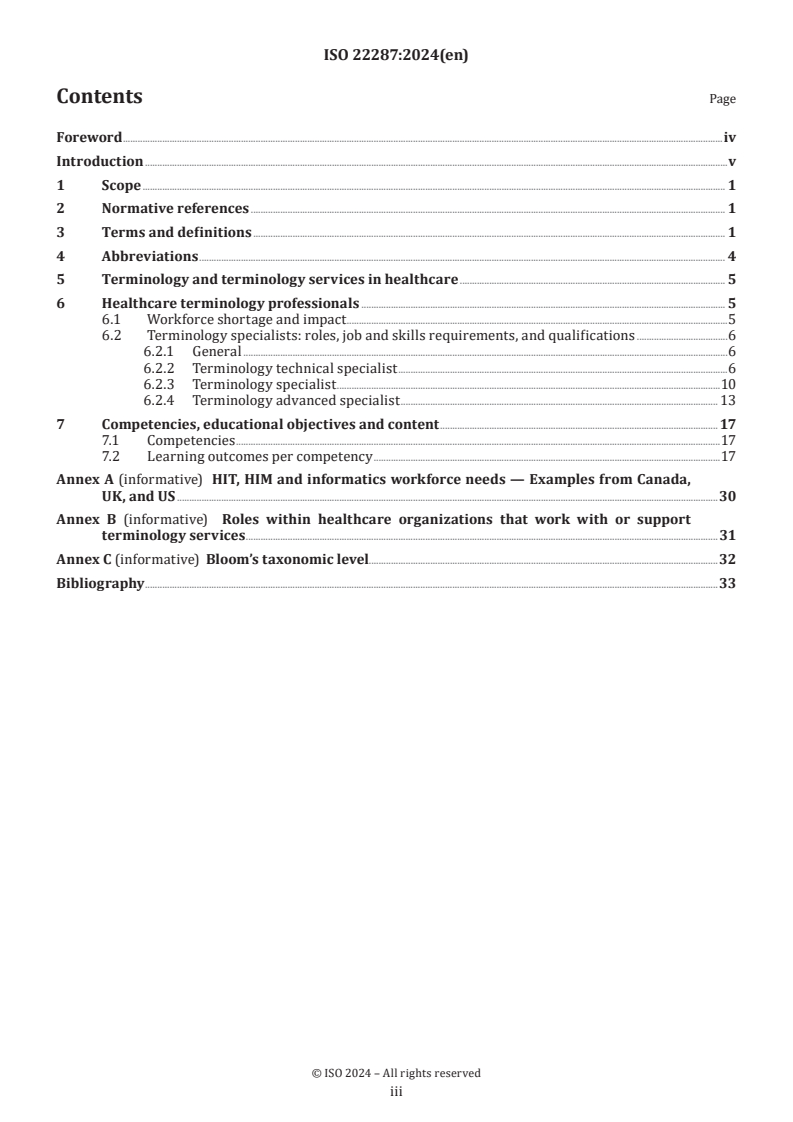
Contents Page
Foreword .iv
Introduction .v
1 Scope . 1
2 Normative references . 1
3 Terms and definitions . 1
4 Abbreviations . 4
5 Terminology and terminology services in healthcare . 5
6 Healthcare terminology professionals . 5
6.1 Workforce shortage and impact .5
6.2 Terminology specialists: roles, job and skills requirements, and qualifications .6
6.2.1 General .6
6.2.2 Terminology technical specialist .6
6.2.3 Terminology specialist .10
6.2.4 Terminology advanced specialist . 13
7 Competencies, educational objectives and content . 17
7.1 Competencies .17
7.2 Learning outcomes per competency .17
Annex A (informative) HIT, HIM and informatics workforce needs — Examples from Canada,
UK, and US .30
Annex B (informative) Roles within healthcare organizations that work with or support
terminology services .31
Annex C (informative) Bloom’s taxonomic level.32
Bibliography .33
iii
Foreword
ISO (the International Organization for Standardization) is a worldwide federation of national standards
bodies (ISO member bodies). The work of preparing International Standards is normally carried out through
ISO technical committees. Each member body interested in a subject for which a technical committee
has been established has the right to be represented on that committee. International organizations,
governmental and non-governmental, in liaison with ISO, also take part in the work. ISO collaborates closely
with the International Electrotechnical Commission (IEC) on all matters of electrotechnical standardization.
The procedures used to develop this document and those intended for its further maintenance are described
in the ISO/IEC Directives, Part 1. In particular, the different approval criteria needed for the different types
of ISO document should be noted. This document was drafted in accordance with the editorial rules of the
ISO/IEC Directives, Part 2 (see www.iso.org/directives).
ISO draws attention to the possibility that the implementation of this document may involve the use of (a)
patent(s). ISO takes no position concerning the evidence, validity or applicability of any claimed patent
rights in respect thereof. As of the date of publication of this document, ISO had not received notice of (a)
patent(s) which may be required to implement this document. However, implementers are cautioned that
this may not represent the latest information, which may be obtained from the patent database available at
www.iso.org/patents. ISO shall not be held responsible for identifying any or all such patent rights.
Any trade name used in this document is information given for the convenience of users and does not
constitute an endorsement.
For an explanation of the voluntary nature of standards, the meaning of ISO specific terms and expressions
related to conformity assessment, as well as information about ISO's adherence to the World Trade
Organization (WTO) principles in the Technical Barriers to Trade (TBT), see www.iso.org/iso/foreword.html.
This document was prepared by Technical Committee ISO/TC 215, Health informatics.
This first edition of ISO 22287 cancels and replaces ISO/TS 22287:2019, which has been technically revised.
The main changes are as follows:
— inclusion of FAIR principles and the importance of metadata;
— inclusion of implementation specialist as a terminology role.
Any feedback or questions on this document should be directed to the user’s national standards body. A
complete listing of these bodies can be found at www.iso.org/members.html.
iv
Introduction
Countries that began the adoption of health information and communication technology (HICT) products
have reported shortfalls in the quantity and skills of the workforce in health information technology (HIT),
health information management (HIM), and health informatics (HI).
This document addresses workforce needs when implementing terminology resources (products)
in healthcare organizations and related supporting organizations, including regional, national and
international HICT programs.
The purpose of this document is to enable healthcare organizations and related supporting organizations
that deploy HICT products to safely and effectively support semantic interoperability within systems and
between systems locally, nationally, or globally. Semantic interoperability, the ability of computer systems
to exchange data with unambiguous and shared meaning, is impacted by the generation, management and
sharing of health-related data and information.
Implementation and operation of complex terminologies in healthcare organizations and related supporting
organizations without proper knowledge and skills of personnel in those terminological resources is a
contributing factor in the resulting failure to deliver expected care outcomes, in delays in electronic health
record (EHR) and health information systems (HIS) implementations, and in some cases, in injury caused to
patients. Employers need to be able to hire workers with confidence that they have the right skill set for the job.
This document specifies tasks associated with electronic capture, management, sharing and use of health
record content in EHR and HIS in the context of clinical care, business processes and information governance
activities in healthcare.
This document is targeted to stakeholders involved in HICT products development, deployment and use.
Specific values include the following.
— Healthcare organizations and HICT vendors: requirements and guidance for tasks and the skills for
human resource staff to guide hiring of terminology standards personnel.
— Professional associations: guidance for terminology skill requirements, training and certification of HIT,
HIM and Informatics professionals, as well as accreditation of terminology services programs.
— Academia: guidance for (a) the overall curricula development to support semantic interoperability
education under HIT, HIM, and informatics programs, and (b) terminology competencies to support
course development.
— eHealth, HIM, HIT, Informatics professionals and others: provide a mechanism to consistently and
accurately indicate career pathways and skill expectations.
— Consumers (patients, clinicians, governments, society): safe, quality information is available.
This document supports the deployment of semantic content standards developed by TC 215 in healthcare
organizations and governmental entities involved in electronic information sharing using interoperable
standards-based HICT products. It provides direction on workforce needs for deployment and operation of
terminological resources as well as the roles, competencies and skills to support these needs. Consideration
of a business case development and potential numbers needed (i.e. terminology workers) would also be
helpful in determining workforce requirements.
It also supports the development of the TC 215 reference standards portfolio (an assembly of individual
standards) for interoperable HICT solutions in specific health domains, by identifying specific content
area(s) for which a qualified terminology services workforce is needed.
ISO 21298 also describes a number of roles in healthcare. It is possible that some staff with roles described
in this document undertake roles described in ISO 21298, or there can be naming collisions.
v
International Standard ISO 22287:2024(en)
Health informatics — Workforce roles and capabilities for
terminology and terminology services in healthcare (term
workforce)
1 Scope
This document specifies the tasks, roles, and key skills, requirements and competencies for personnel
involved in terminology services in healthcare organizations.
This document specifies:
— terminology services in healthcare organizations including the selection, authoring, and deployment
and use of terminology subsets, data sets and maps; developing and managing terminology management
processes and health information management-related policies; performing terminology business
analysis; and supporting the adoption, planning and deployment of terminologies;
— workforce needs to perform these services;
— job roles in the healthcare organizations and related organizations responsible for performing
terminology related tasks;
NOTE Examples of these roles include terminologist, terminology standards developer/manager, mapping
specialist, data conversion analyst, interface analyst, coding specialist, data developer/designer, data modeller,
and content manager [including Clinical Documentation Improvement (CDI) specialist].
— skill and competency level requirements to safely and effectively undertake each task, taking into
account the focus of the task from the perspectives of health information and communication technology
(HICT), information management, information governance including information privacy and security,
clinical practice and healthcare decision making.
2 Normative references
There are no normative references in this document.
3 Terms and definitions
For the purposes of this document, the following terms and definitions apply.
ISO and IEC maintain terminological databases for use in standardization at the following addresses:
— ISO Online browsing platform: available at https:// www .iso .org/ obp
— IEC Electropedia: available at https:// www .electropedia .org/
3.1
adoption
act of taking up or following something
3.2
author
entity or set of entities that create and can modify an asset
3.3
classification
terminology which aggregates data at a prescribed level of abstraction for a particular domain
3.4
code system
organized, managed collection of codes, each of which has associated designations, meanings and in some
cases relationships, properties or rules
[SOURCE: ISO/TS 17117-2:2022, 3.2]
3.5
code system extension
set of code system (3.4) components and derivatives that add to and are dependent on a published code system
3.6
competency
knowledge, skills (3.18), abilities and behaviours of an individual to perform a job properly
3.7
conformity
conformance
fulfilment of specified requirements
3.8
data set
identifiable collection of data available for access or download in one or more formats
Note 1 to entry: A data set can be a smaller grouping of data which, though limited by some constraint such as spatial
extent or feature type, is located physically within a larger data set. Theoretically, a data set can be as small as a single
feature or feature attribute contained within a larger data set.
Note 2 to entry: A data set can be presented in a tabular form and stored and distributed in tables in word processed
documents, spread sheets or databases. It can also be presented in a number of alternative formats, including AVRO,
JSON, RDF and XML.
Note 3 to entry: A data set can include attributes to facilitate adoption (3.1) and maintenance and it can contain maps
to a Reference Terminology. Therefore, it should not be confused with a subset (3.20) or a value set (3.23).
[SOURCE: ISO/IEC 11179-33:2023, 3.5, modified — Note 3 to entry was added.]
3.9
interface terminology
a collection of commonly used terms to support user entry of health information into computer clinical
applications
3.10
information management
planning, collection, control, distribution and exploitation of information resources within an organization,
including systems development and disposal or long-term preservation
[SOURCE: ISO 5127:2017, 3.2.1.23, modified — Note 1 to entry has been removed.]
3.11
information governance
processes by which an organization obtains assurance that the risks to its information, and thereby the
operational capabilities and integrity of the organization, are effectively identified and managed
3.12
information privacy
rights and obligations of individuals and organizations with respect to the collection, use, retention,
disclosure and disposal of personal information
[SOURCE: ISO/TS 14441:2013, 3.26]
3.13
information technology
resources (especially computers and telecommunication) used to acquire, process, store and disseminate
information
[SOURCE: ISO/IEC 38500:2015, 2.12, modified — "(especially computers and telecommunications)" was
added to the definition; the Note 1 to entry was removed.]
3.14
mapping
process of defining a relationship between concepts in one coding system to concepts in another coding
system in accordance with a documented rationale, for a given purpose
3.15
safety
freedom from unacceptable risk
3.16
security
combination of confidentiality, integrity and availability
3.17
semantic interoperability
ability of computer systems supporting health care practice and management to correctly and consistently
interpret the information being exchanged
3.18
skill
ability to perform a task or activity with a specific intended outcome acquired through education, training,
experience or other means
[SOURCE: ISO/IEC/TS 17027:2014, 2.74]
3.19
standards development organization
organization one of whose functions is to create and/or publish standards
[SOURCE: ISO/TS 27790:2009, 3.70]
3.20
subset
code set
a list of coded concepts that meet a specific need
Note 1 to entry: A subset can be used for data entry or health system use extract. The concepts can be drawn or not
from a code system (3.4).
3.21
terminology service
service that allows healthcare applications to make use of codes and value sets (3.23) without having
to become experts in the fine details of code system (3.4), value set and concept map resources, and the
underlying code systems and terminological principles
3.22
terminology standards certification
general accomplishments, competencies (3.6) or skills (3.18) that fulfil the requirements as outlined in a
terminology standards’ program
3.23
value set
identifiable set of coded values associated with a data element that consists of concept representations
drawn from one or more code system (3.4)
Note 1 to entry: a value set is not the same as a value domain as defined in ISO/IEC 11179-1:2023.
Note 2 to entry: In HL7 value sets are all uniquely identified.
[SOURCE: Leveraged from HL7]
3.24
workforce
people who provide a service or labour to contribute to business or organizational outcomes
[SOURCE: ISO 30400:2022, 3.8.1]
4 Abbreviations
CDA Clinical Document Architecture
CDI Clinical Documentation Improvement
CPT Current Procedural Terminology
CT Controlled Terminology
DICOM Digital Imaging and Communications in Medicine
EHIS Electronic Health Information Systems
EHR Electronic Health Record
FAIR Findable Accessible Interoperable Reusable
FHIR Fast Healthcare Interoperability Resources
HI Health Informatics
HIM Health Information Management
HICT Health Information and Communication Technology
HIT Health Information Technology
HL7 Health Level Seven
ICD International Classification of Diseases
IHE Integrating the Healthcare Enterprise
LOINC Logical Observation Identifiers Names and Codes
SDO Standards Development Organization
SNOMED SNOMED International
SNOMED CT Systematized Nomenclature of Medicine Clinical Terms
WHO World Health Organization
5 Terminology and terminology services in healthcare
The use of clinical terminologies, such as SNOMED CT and LOINC, has been increasing as part of the growing
investments in health information technologies. There is a business need in health care organizations to
establish services to support the implementation and maintenance of e-health solutions including electronic
capture, management, sharing and use of health record content in the context of clinical care, business
processes and information governance activities. The following “terminology” roles, activities and products
have been identified as in demand or anticipated to be in demand in healthcare organizations.
— Terminology subsets and data sets: creating, maintaining, extending, quality assurance, and distributing
and/or publishing subsets or data sets and supporting derivatives.
— Terminology maps: creating, maintaining, extending, quality assurance, and distributing and/or
publishing maps and supporting material.
— Terminology management processes/policies: developing, managing and updating health information
management-related policies and processes to manage terminologies, including how to create subsets
and terminology maps, how to maintain terminologies and requests for change, how to engage clinical
experts for validation and overall decision-making processes related to terminology management.
— Terminology business analysis: gathering terminology requirements and defining terminology needs
for e-health solutions and/or other tools (e.g. terminology tools, tools to support health analytics),
development of recommendations for adopting, adapting or developing terminologies to meet specific
business needs, supporting the definition of functional requirements, evaluating requirements as part of a
procurement process, documenting workflow, providing terminology guidance to support configuration
as required, support deployment of solutions from a terminology perspective (e.g. development of
training manuals, development of test scenarios, testing).
— Implementation planning and deployment of terminologies: supporting implementation planning and
deployment of terminologies within an organization, region, or jurisdiction as part of an overall strategic
plan or solution deployment including communication, education, change management, etc.
— Data retrieval and analysis: utilizing terminologies for effective meaning-based retrieval to support
epidemiology, research, evidence gathering and service planning (clinical and administrative), and
ensuring the organization is using health information standards appropriately and effectively.
— Decision support protocols, guidelines and other knowledge resources: providing guidance from a health
information management perspective on how to integrate terminologies into these resources (e.g. policy
requirements, patient care outcome improvements).
— Research of clinical terms and definitions: providing an understanding of clinical terms and how context
plays a role in selecting the correct concept or term for the right usage or setting.
Healthcare organizations and supporting organizations need a trained and experienced workforce to
support terminology activities.
6 Healthcare terminology professionals
6.1 Workforce shortage and impact
Healthcare terminology professionals are those members of the workforce who are involved in the tasks
associated with the terminology services described in Clause 5. Countries that have begun HICT adoption
have reported shortfalls in the quantity and skills of the workforce in health information technology, health
information management and health informatics. Specific examples of countries’ workforce needs are
presented in Annex A.
Annex A indicates the impact of human resource competencies and skills on the adoption of HICT technologies
and investments in HICT. Workforce impacts have been identified as the following two key demand drivers
in various countries:
a) the “employment effect” ‒ increases the number of professionals required;
b) the “skill-broadening effect” ‒ many professionals require additional training or experience to meet
terminology services demands.
The occupational group of terminology specialist was specifically identified as needing to grow in number
[27]
and also requiring broader skills. Organizations such as SNOMED International have begun investing in
developing educational materials to promote the effective deployment and use of its product – SNOMED CT.
6.2 Terminology specialists: roles, job and skills requirements, and qualifications
6.2.1 General
Annex B provides the list of specific roles related to terminology and terminology services in healthcare
organizations and related supporting organizations. These include, but are not limited to:
— terminology implementation specialist;
— terminology author;
— terminology standards developer/manager;
— mapping specialist;
— data conversion analyst;
— user interface analyst;
— coding specialist;
— data developer/designer;
— data modeller;
— content manager (including clinical documentation improvement specialist).
These various roles can be consolidated under the three levels of specialists performing terminology
services:
Level 1 ‒ Terminology technical specialist;
Level 2 ‒ Terminology specialist;
Level 3 ‒ Terminology advanced specialist.
The roles, job requirements, terminology skill requirements, general skills and qualifications for each level
are described in 6.2.2, 6.2.3 and 6.2.4. Specific tasks under these roles shall take into account the focus
of the task from the perspective of HICT, information management, information governance (including
information privacy and security), clinical practice and healthcare decision making.
6.2.2 Terminology technical specialist
6.2.2.1 Role
The terminology technical specialist is responsible for the technical and/or tooling aspects of terminology
development, mapping, terminology analytics, maintenance and implementation. The terminology technical
specialist will work in a team setting with clinicians, project teams, operational teams, business analysts,
mapping specialists and terminology specialists providing knowledge transfer to clients and team members,
implementation support, development of terminology deliverables and overall maintenance of mappings
or other products. A key function of this role is the ability to contribute to data quality development and
maintenance by enabling the primary and secondary functional aspects of developing, implementing and
managing terminology products.
6.2.2.2 Job requirements
— Responsible for technical management of healthcare data, including but not limited to the following:
— data export from a database to a terminology tool;
— design and execution of queries on data within a terminology tool or database to support terminology
business functions including data analytics;
— configuration and maintenance of terminology tools including application rules engine(s);
— installation of version upgrades and managing database functions;
— provision of backups and ensuring redundancy of data holdings.
— Participates in the selection of tools for mapping, terminology searching, browsing and selecting
terminology authoring, and maintenance.
— Provides terminology tool training, installation, and updates.
— Manages subscription services.
— Supports both the clinical, business and technical resources within a project and program:
— provides the liaison between both types of resources;
— provides mentorship to junior resources and other team members.
— Provides support in the terminology use and requirements for implementation of data content in HL7
and DICOM standards and/or value sets including messaging, data content, and documents.
— Provides continuous knowledge transfer with clients and other resources on the team, including
knowledge transfer for new members to the project or team.
— Governance:
— Ensures the standards, guidelines, procedures, health information management-related policies and
processes are aligned with client’s existing policies and standards development organizations, and
assists with the development of new health information management-related policies.
— Identifies potential issues and the impact of existing regulations on the project, and for continued
use of the program.
— Responsible for documentation related to terminology work which includes:
— status updates;
— assumptions, risks, issues, principles and decisions;
— roles, responsibilities and processes for sustained use of mappings.
— Develops or utilizes a quality assurance framework for terminology deliverables, including:
— quality assurance process for procedures and deliverables;
— developing evaluation methods including development of scripts to verify data integrity;
— managing the use of terminology testing tools and associated processes;
— versioning as part of maintenance and sustainability.
— Communication:
— Provides updates to the team and client (tailored to the specific audience).
— Develops material to enable a good understanding of options analysis.
— Works to ensure a high level of client satisfaction.
6.2.2.3 Skills requirements for terminology services
— Understanding of the distinction between classifications and clinical terminologies.
— Experience with developing processes for managing unstructured and structured data.
— Experience with and knowledge of terminology tools and tooling requirements.
— Experience with and understanding of natural language processing, data mining and artificial
intelligence.
— Understanding of how the coded data are represented in HL7 standards such as Version 2.x, V3, CDA, FHIR.
— Understanding of terminology and mapping principles, terminology business functions, and best
practices.
— Understanding of concept representation and links to alternative terms (synonyms) including terms in
different languages.
— Expertise and understanding of healthcare clinical information systems.
— Broad understanding and experience with healthcare vocabularies including the World Health
Organizations Family of Classifications and national code system extensions and standards.
— Broad understanding and knowledge of clinical terminologies such as SNOMED CT, LOINC.
— Understanding of standards development organizations and their role in and ownership of terminologies.
— Knowledge of healthcare industry and current global healthcare informatics standards.
— Database query knowledge and experience.
— Experience working with transactional databases and data warehouses.
— Experience with extracting, transforming, and loading of data from databases and data warehouses.
— Understanding of effective and practical strategies for search and data capture.
— Experience and understanding from a technical perspective of the possible terminology solutions to
support an implementation, including:
— understanding of the types of limitations that can occur in some clinical systems (such as limitations
in field length and data element structure) and the ways that these limitations can be addressed.
— Understanding of licensing requirements for terminologies and clinical information systems, electronic
medical and electronic health records.
— Understanding of retrieval and analysis approaches to meet different business needs.
— Awareness of meaning-based retrieval and the value of description logics in supporting this is also
required at least for the advanced roles.
— Understanding of how transitive closure, concept subsumption and equivalency, and the information
model play a role in retrieval and analysis.
— Understanding of how data capture and meaning-based retrieval play a role in decision support.
6.2.2.4 General skills
— Excellent communication skills, both verbal and written, and the ability to work closely with customers
and third parties to complete large system integration projects.
— Ability to relay complex topics and information in an audience-appropriate manner.
— Excellent problem-solving, time and project management skills.
— Clinical information systems integration project skills.
— Detail and technically oriented.
— Ability to work independently and set priorities.
— Logical thinker.
— Critical thinking skills.
— Self-motivated.
— Ability to complete assignments with little direction.
— Ability to work in a team environment.
— Attention to detail.
— Knowledge of medical language.
® 1)
— Experience managing large amounts of data (in database or Microsoft Excel ).
— Ability to collaborate with a variety of different stakeholders.
6.2.2.5 Qualifications and assets
— Understanding of clinical information systems and other health information systems.
— Terminology standards certification.
— Diploma or bachelor’s degree in health information management, health informatics, a health profession,
or related program.
— Two years minimum experience working in an electronic health record environment and with clinical
classifications and terminologies (e.g. SNOMED CT, LOINC, ICD-10).
— Experience in the use medical language is a requirement.
® [32]
— Database management including data manipulation and analysis (e.g. using Microsoft Access or SQL ).
— Leadership experience is an asset.
— Proven success in a team environment is an asset.
— Project management experience is an asset.
— Experience working with terminology implementations is an asset. ®
1) Microsoft office (including Excel, Word and Access) is an example of a suitable product available commercially. This
information is given for the convenience of users of this document and does not constitute an endorsement by ISO of this
product.
— HIM and/or HI professional certification is an asset.
6.2.3 Terminology specialist
6.2.3.1 Role
The terminology specialist develops and maintains mappings, data sets and subsets between healthcare
related data and clinical terminology systems (including SNOMED CT and LOINC) and classifications. The
terminology specialist will work in a multi-disciplinary team in multiple care settings with clinicians, other
health care providers, terminology technical specialists, project managers, business analysts, advanced
terminology specialists, and vendors as well as in close interaction with the client or implementer. A key
component to this role is the ability to understand and use terminologies in different contexts and apply
domain knowledge and terminology expertise to tailor and integrate best practices in mapping, to support
data set and subset development, and to apply a quality assurance framework in clinical projects or within
an operational context to support best practices.
6.2.3.2 Job requirements
— Responsible for developing and validating subsets, data sets, data mapping and transformation of
healthcare data into the integration service and/or data warehouse, including the following:
— performing environmental scan to identify factors that will shape and potentially impact the
terminology content development and implementation, such as:
— the current state of:
— existing terminology artefacts within the jurisdiction;
— systems that will be impacted by the new terminology;
— management/secondary business reporting of the new terminology.
— other jurisdictions’ experience in developing similar terminology artefacts;
— terminology requirements suitable to meet the needs of any new solution the terminology
artefact is intended to be used in.
— determining mapping, subset and/or data set approach and requirements based upon intended use,
purpose and context;
— performing scans to determine if there is an asset to leverage (adopt, adapt, create);
— identifying terminology tool requirements;
— developing version control processes;
— developing validation and quality assurance processes;
— developing mapping and subset rule-based processes;
— developing tooling test plans and verify tooling integrity with technical experts;
— identifying and resolving mapping and subset tool errors;
— developing and verifying maps, subsets and data sets;
— developing or applying mapping and subset heuristics by following established data mapping and
terminology principles and best practices.
— Develops and executes a mapping, subset and/or data set development, maintenance and sustainability
plan including the development of maintainable processes for changes to client data and changes
including versioning with the target terminological system.
— Works with clients and other terminology team members (such as the terminology advanced specialist)
to analyse and transform data from disparate healthcare systems into the integration service and data
warehouse, including:
— providing education to multiple stakeholder groups using audience-appropriate communication on
the value and benefits of clinical terminology adoption;
— providing education and guidance to clinical stakeholders to allow them to contribute to the content
questions;
— providing mentorship to junior terminology resources and other team members;
— providing continuous knowledge transfer with clients and other resources on the team ensuring
that knowledge is transitioned as new members join a project or operational team.
— Responsible for communication with clinical stakeholders and team members to:
— provide high level of client satisfaction and assurance in the quality and reliability of terminology
artefacts;
— recommend the appropriate standardized clinical terminologies and classifications as part of the
selection process;
— assess and recommend the requirement for and/or deprecation of terminology code system
extensions and local code sets;
— progress updates and facilitation of discussion on mapping, data set and subset related issues;
— propose and implement solutions for mapping, data set and subset issues;
— provide support to users of the maps, data sets and subsets.
— Governance:
— Responsible for content development to meet stakeholder needs with standards development
[35] [38]
organizations such as SNOMED International and Regenstrief Institute .
— Ensures that health information management-related policies, standards, guidelines and procedures
exist to ensure the appropriate validation and approvals occur throughout the terminology life cycle,
and assists with the development of new health information management-related policies.
— Ensures the process is aligned with client’s existing governance structures.
— Responsible for documentation during the life of a project and/or operational initiative and for
continued use of the program which includes:
— receiving request for change;
— gathering requirements;
— prioritization of requests for change;
— status updates;
— assumptions, risks, issues, principles and decisions;
— roles, responsibilities, and processes for sustained use of mappings and deprecation;
— benefits evaluation;
— lessons learned.
— Develops or utilizes a quality assurance framework for terminology deliverables, including:
— quality assurance process for deliverables and editorial review process;
— developing scripts to verify data integrity;
— testing of maps and associated terminology tools.
6.2.3.3 Skills requirements for terminology services
[29]
— Ability to apply clinical terminology principles.
— Understanding of the distinction between statistical classifications and clinical terminologies.
— Broad understanding and experience with healthcare vocabularies including the World Health
Organizations Family of Classifications and national code system extensions and standards.
— Experience working with clinical terminologies such as SNOMED CT, LOINC, and others.
— Understanding of concept representation and links to alternative terms (synonyms) including terms in
different languages.
— Understanding of the FAIR principles and the importance of metadata within the framework of the FAIR
principles.
— Understanding of standards development organizations and their role in terminologies.
— Experience with the subset and mapping process and determination of related requirements including
[30]
mapping best practices such as available from AHIMA. Understanding of the critical success factors
of a good mapping and subset process such as:
— how the use, purpose and context of the map/subset affects the mapping and subset development
process;
— the way in which the computer system and stakeholders will use the map;
— the need for client source data cleansing.
— Experience with and understanding of how to use the following types of terminology tools:
— terminology browsers to access, search, browse and select terminology concepts;
— data set;
— subset;
— mapping tools.
— Ability to apply the basic concepts of the terminology model within the mapping approach.
— Understanding of the processes to develop, implement, maintain, publish and deprecate maps, subsets
and content within data sets.
— Experience with clinical information system desirable.
— Knowledge and understanding of clinical documentation practices at the point of care recommended.
— Understanding of the principles and requirements for syntactic and semantic interoperability.
6.2.3.4 General skills
— Excellent written and verbal communication skills.
®2)
— Experience with Microsoft office , including Excel, Word and Access. ®
2) Microsoft office (including Excel, Word and Access) is an example of a suitable product available commercially. This
information is given for the convenience of users of this document and does not constitute an endorsement by ISO of this
product.
— Ability to prioritize workload to meet shifting deadlines and tight timelines.
— Logical thinker.
— Critical thinking skills.
— Self-motivated and self-directed.
— Ability to complete assignments with little direction.
— Ability to work in a team environment.
— Ability to communicate complex concepts using audience-appropriate language.
— Attention to detail.
— Knowledge of medical language, anatomy and physiology.
— Ability to collaborate with a variety of different stakeholders and disciplines.
6.2.3.5 Qualifications and assets
— Terminology standards certification.
— Diploma or bachelor’s degree and professional experience working in health information management,
health informatics or a health profession.
— Experience working in an electronic health record environment and with terminologies (e.g. SNOMED
CT, LOINC) is considered an asset.
— Experience in the use medical language, anatomy and physiology is a requirement.
— Project management experience is an asset.
— HIM and/or HI professional certification is an asset.
6.2.4 Terminology advanced specialist
6.2.4.1 Role
The role of the advanced terminology specialist is to lead terminology activities related to developing,
implementing and managing mappings, data sets and subsets, (including strategies and tactics to use
coded terminology for clinical decision support and identifying and targeting patient/cohort populations
to proactively provide improved care), providing knowledge transfer to clients and team members,
implementation support, development of terminology deliverables and overall maintenance (including
versioning and deprecating) of mappings or other products. The terminology advanced specialist is
responsible for the terminology aspects of the project(s) and will work in a t
...