

ISO 14602:2010
(Main)Non-active surgical implants — Implants for osteosynthesis — Particular requirements
- Abstract
ISO 14602:2010 specifies particular requirements for non-active surgical Implants for osteosynthesis, referred to as implants. In addition to ISO 14630, ISO 14602:2010 gives particular requirements for intended performance, design attributes, materials, design evaluation, manufacturing, sterilization, packaging and information supplied by the manufacturer.
- Status
- Published
- Publication Date
- 11-Apr-2010
- Technical Committee
- ISO/TC 150/SC 5 - Osteosynthesis and spinal devices
- Drafting Committee
- ISO/TC 150/SC 5 - Osteosynthesis and spinal devices
- Current Stage
- 9092 - International Standard to be revised
- Start Date
- 06-Oct-2026
- Completion Date
- 10-Oct-2026
Buy Documents
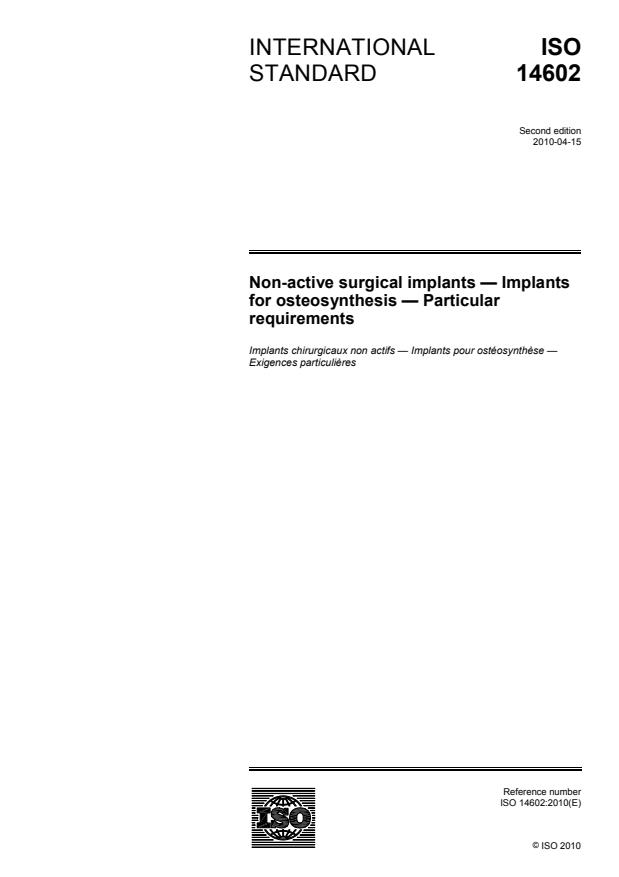
ISO 14602:2010 - Non-active surgical implants — Implants for osteosynthesis — Particular requirements Released:4/12/2010
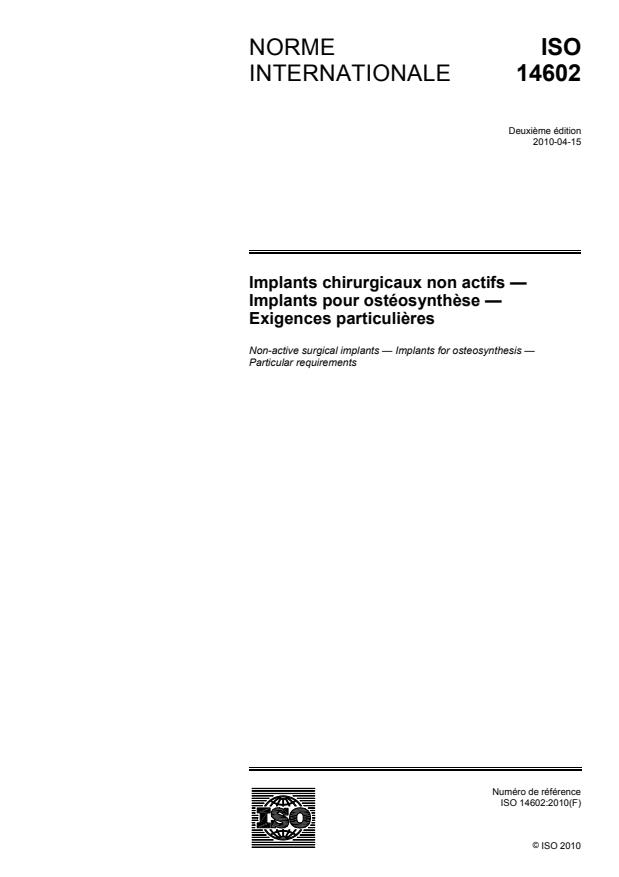
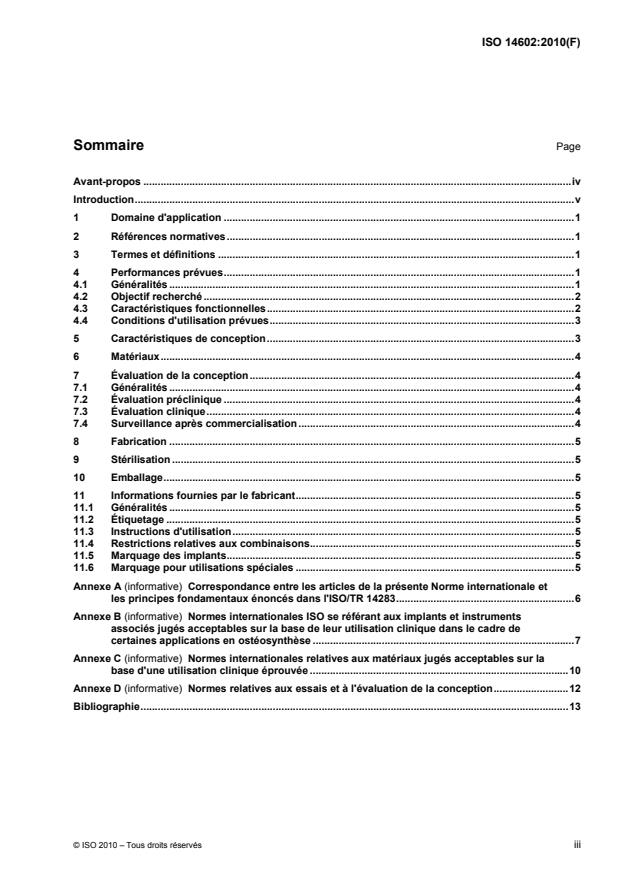
ISO 14602:2010 - Implants chirurgicaux non actifs — Implants pour ostéosynthese — Exigences particulieres Released:4/12/2010
ISO 14602:2010 - Non-active surgical implants — Implants for osteosynthesis — Particular requirements Released:12/12/2012
Overview
ISO 14602:2010 - Non‑active surgical implants - Implants for osteosynthesis - Particular requirements - is a Level‑2 ISO standard that supplements the general requirements of ISO 14630. It specifies particular requirements for non‑active surgical implants used in osteosynthesis (orthopaedic fixation), addressing intended performance, design attributes, materials, design evaluation, manufacturing, sterilization, packaging and the information supplied by the manufacturer.
This standard helps manufacturers and regulators demonstrate conformity with fundamental safety and performance principles (including those in ISO/TR 14283) and can support compliance with medical device regulatory frameworks (for example, the essential requirements of European Council Directive 93/42/EEC as amended).
Key topics and requirements
- Intended performance: Define intended purpose (e.g., fracture treatment, spinal stabilization, arthrodesis, bone lengthening, tendon/ligament reconstruction) and typical anatomical sites.
- Functional characteristics: Describe fixation type, anchorage, component linkage, removability, and action on bone and adjacent tissues (stabilization, compression/distraction, alignment control).
- Design attributes: Requirements for interconnecting systems, dimensional tolerances, anatomical sizing, ergonomics and measures to reduce use error during implantation.
- Materials: Material selection consistent with ISO 14630 and Annex C (informative list of materials with proven clinical use).
- Design evaluation:
- Pre‑clinical: in‑vitro handling tests, cadaveric evaluation where required, static/dynamic mechanical testing, validated modelling and biomechanical simulations.
- Clinical evaluation and post‑market surveillance in line with ISO 14630.
- Annex D lists relevant testing and design‑evaluation standards.
- Manufacturing, sterilization and packaging: Specific controls to preserve device integrity and sterility through distribution.
- Information supplied: Labelling, instructions for use, restrictions on combinations and implant marking requirements.
Practical applications and users
ISO 14602 is directly applicable to:
- Medical device manufacturers designing and producing orthopaedic and spinal fixation implants.
- Design and R&D engineers specifying materials, tolerances and biomechanical testing.
- Quality assurance and regulatory teams preparing technical documentation and conformity evidence.
- Notified bodies and regulatory assessors reviewing device compliance and clinical evidence.
- Clinical researchers and hospitals evaluating implant performance and post‑market data.
Typical use cases include device development for fracture fixation plates, screws, rods, spinal constructs and other osteosynthesis systems, and preparing pre‑clinical test plans, clinical evaluations and labelling.
Related standards
- ISO 14630 - General requirements for non‑active surgical implants (to be applied together).
- ISO/TR 14283 - Fundamental principles correspondence.
- Annexes in ISO 14602 list level‑3 standards, material standards and testing standards helpful for specific implant types.
Keywords: ISO 14602, implants for osteosynthesis, non‑active surgical implants, orthopedic implants standard, design evaluation, implant materials, sterilization, medical device regulatory compliance.
Relations
- Effective Date
- 12-Feb-2026
- Effective Date
- 06-Jun-2022
- Effective Date
- 03-Oct-2008
Buy Documents
ISO 14602:2010 - Non-active surgical implants — Implants for osteosynthesis — Particular requirements Released:4/12/2010
ISO 14602:2010 - Implants chirurgicaux non actifs — Implants pour ostéosynthese — Exigences particulieres Released:4/12/2010
ISO 14602:2010 - Non-active surgical implants — Implants for osteosynthesis — Particular requirements Released:12/12/2012
Get Certified
Connect with accredited certification bodies for this standard

BSI Group
BSI (British Standards Institution) is the business standards company that helps organizations make excellence a habit.

TÜV Rheinland
TÜV Rheinland is a leading international provider of technical services.

TÜV SÜD
TÜV SÜD is a trusted partner of choice for safety, security and sustainability solutions.
Sponsored listings
Frequently Asked Questions
ISO 14602:2010 is a standard published by the International Organization for Standardization (ISO). Its full title is "Non-active surgical implants — Implants for osteosynthesis — Particular requirements". This standard covers: ISO 14602:2010 specifies particular requirements for non-active surgical Implants for osteosynthesis, referred to as implants. In addition to ISO 14630, ISO 14602:2010 gives particular requirements for intended performance, design attributes, materials, design evaluation, manufacturing, sterilization, packaging and information supplied by the manufacturer.
ISO 14602:2010 specifies particular requirements for non-active surgical Implants for osteosynthesis, referred to as implants. In addition to ISO 14630, ISO 14602:2010 gives particular requirements for intended performance, design attributes, materials, design evaluation, manufacturing, sterilization, packaging and information supplied by the manufacturer.
ISO 14602:2010 is classified under the following ICS (International Classification for Standards) categories: 11.040.40 - Implants for surgery, prosthetics and orthotics. The ICS classification helps identify the subject area and facilitates finding related standards.
ISO 14602:2010 has the following relationships with other standards: It is inter standard links to EN ISO 14602:2011, ISO/TS 22476-11:2005, ISO 14602:1998. Understanding these relationships helps ensure you are using the most current and applicable version of the standard.
ISO 14602:2010 is available in PDF format for immediate download after purchase. The document can be added to your cart and obtained through the secure checkout process. Digital delivery ensures instant access to the complete standard document.
Standards Content (Sample)
INTERNATIONAL ISO
STANDARD 14602
Second edition
2010-04-15
Non-active surgical implants — Implants
for osteosynthesis — Particular
requirements
Implants chirurgicaux non actifs — Implants pour ostéosynthèse —
Exigences particulières
Reference number
©
ISO 2010
PDF disclaimer
This PDF file may contain embedded typefaces. In accordance with Adobe's licensing policy, this file may be printed or viewed but
shall not be edited unless the typefaces which are embedded are licensed to and installed on the computer performing the editing. In
downloading this file, parties accept therein the responsibility of not infringing Adobe's licensing policy. The ISO Central Secretariat
accepts no liability in this area.
Adobe is a trademark of Adobe Systems Incorporated.
Details of the software products used to create this PDF file can be found in the General Info relative to the file; the PDF-creation
parameters were optimized for printing. Every care has been taken to ensure that the file is suitable for use by ISO member bodies. In
the unlikely event that a problem relating to it is found, please inform the Central Secretariat at the address given below.
© ISO 2010
All rights reserved. Unless otherwise specified, no part of this publication may be reproduced or utilized in any form or by any means,
electronic or mechanical, including photocopying and microfilm, without permission in writing from either ISO at the address below or
ISO's member body in the country of the requester.
ISO copyright office
Case postale 56 • CH-1211 Geneva 20
Tel. + 41 22 749 01 11
Fax + 41 22 749 09 47
E-mail copyright@iso.org
Web www.iso.org
Published in Switzerland
ii © ISO 2010 – All rights reserved
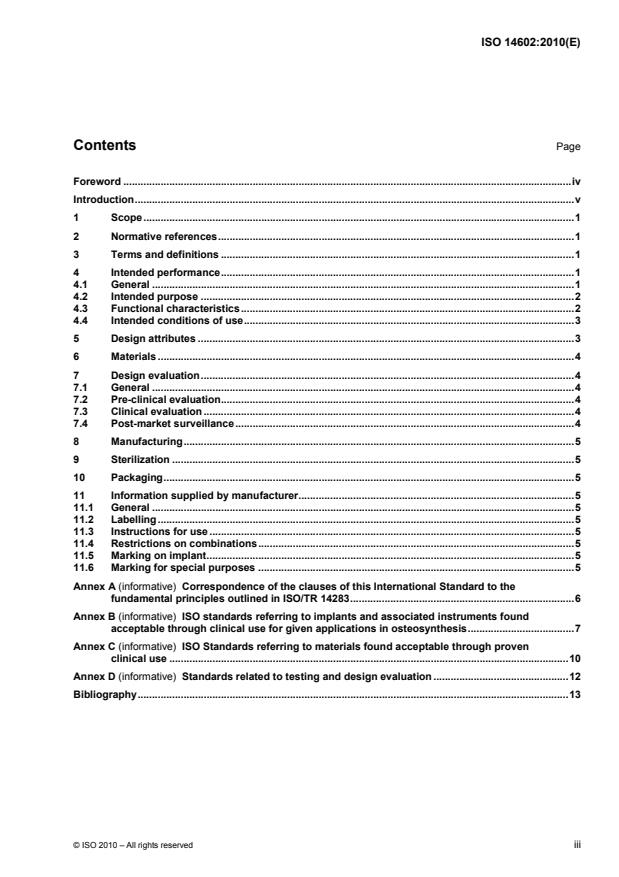
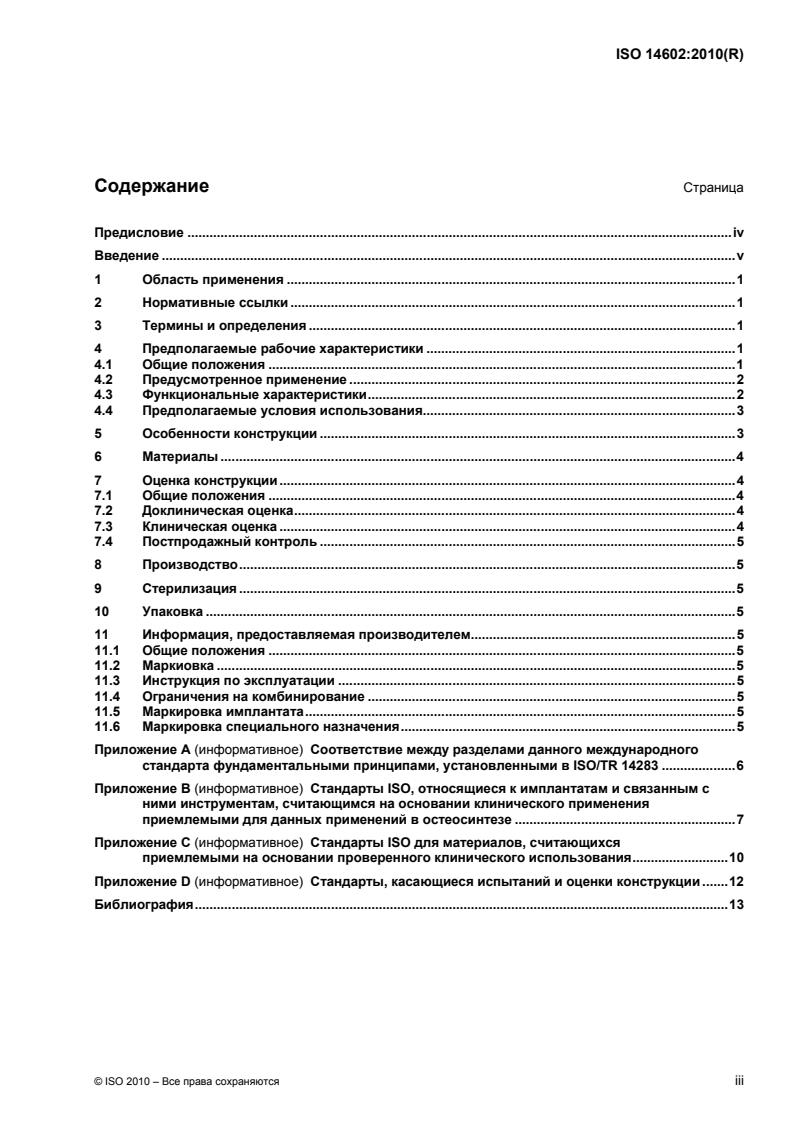
Contents Page
Foreword .iv
Introduction.v
1 Scope.1
2 Normative references.1
3 Terms and definitions .1
4 Intended performance.1
4.1 General .1
4.2 Intended purpose .2
4.3 Functional characteristics.2
4.4 Intended conditions of use.3
5 Design attributes .3
6 Materials .4
7 Design evaluation.4
7.1 General .4
7.2 Pre-clinical evaluation.4
7.3 Clinical evaluation .4
7.4 Post-market surveillance.4
8 Manufacturing.5
9 Sterilization .5
10 Packaging.5
11 Information supplied by manufacturer.5
11.1 General .5
11.2 Labelling.5
11.3 Instructions for use .5
11.4 Restrictions on combinations.5
11.5 Marking on implant.5
11.6 Marking for special purposes .5
Annex A (informative) Correspondence of the clauses of this International Standard to the
fundamental principles outlined in ISO/TR 14283.6
Annex B (informative) ISO standards referring to implants and associated instruments found
acceptable through clinical use for given applications in osteosynthesis.7
Annex C (informative) ISO Standards referring to materials found acceptable through proven
clinical use .10
Annex D (informative) Standards related to testing and design evaluation .12
Bibliography.13
Foreword
ISO (the International Organization for Standardization) is a worldwide federation of national standards bodies
(ISO member bodies). The work of preparing International Standards is normally carried out through ISO
technical committees. Each member body interested in a subject for which a technical committee has been
established has the right to be represented on that committee. International organizations, governmental and
non-governmental, in liaison with ISO, also take part in the work. ISO collaborates closely with the
International Electrotechnical Commission (IEC) on all matters of electrotechnical standardization.
International Standards are drafted in accordance with the rules given in the ISO/IEC Directives, Part 2.
The main task of technical committees is to prepare International Standards. Draft International Standards
adopted by the technical committees are circulated to the member bodies for voting. Publication as an
International Standard requires approval by at least 75 % of the member bodies casting a vote.
Attention is drawn to the possibility that some of the elements of this document may be the subject of patent
rights. ISO shall not be held responsible for identifying any or all such patent rights.
ISO 14602 was prepared by Technical Committee ISO/TC 150, Implants for surgery, Subcommittee SC 5,
Osteosynthesis and spinal devices.
This second edition cancels and replaces the first edition (ISO 14602:1998), which has been technically
revised.
iv © ISO 2010 – All rights reserved
Introduction
In general, non-active surgical implants for osteosynthesis are used in trauma treatment or corrective surgery.
They maintain the reduction of fractured bones and stabilize bony (or adjacent) structures to allow bone
healing or fusion and/or to provide support or correction. When they have achieved their objective, the
implants are either retrieved or left in situ.
This International Standard, in addition to the requirements in ISO 14630, provides a method for addressing
the fundamental principles in ISO/TR 14283 as they apply to non-active surgical implants for osteosynthesis.
Annex A shows the correspondence between the clauses of this International Standard and those of
ISO/TR 14283:2004.
This International Standard also provides a method of demonstrating compliance with the relevant essential
requirements (ERs) as outlined in general terms in Annex 1 of European Council Directive 93/42/EEC of
14 June 1993 concerning medical devices, amended by Directive 2007/47/EC of 5 September 2007, as they
apply to non-active surgical implants for osteosynthesis. It might also assist manufacturers to comply with the
requirements of other regulatory bodies.
Alternative methods of demonstrating compliance might be acceptable, in particular with respect to implants
which have demonstrated satisfactory long-term clinical performance.
There are three levels of standard concerned with non-active surgical implants and related instrumentation.
For the implants themselves, there are the following levels, with level 1 being the highest:
⎯ level 1: general requirements for non-active surgical implants;
⎯ level 2: particular requirements for families of non-active surgical implants;
⎯ level 3: specific requirements for types of non-active surgical implants.
Level 1 standards contain requirements that apply to all non-active surgical implants. They also indicate that
additional requirements are given in the level 2 and level 3 standards.
Level 2 standards, such as this International Standard, contain requirements that apply to a more restricted
set or family of non-active surgical implants. This International Standard is a Level 2 standard that lays down
particular requirements for non-active surgical implants for osteosynthesis that are in addition to those general
requirements stated in ISO 14630 for non-active surgical implants. It is to be applied in conjunction with
ISO 14630.
Level 3 standards, such as those listed in the annexes, apply to specific types of implant within a family of
non-active surgical implants, in this case particular types of non-active surgical implant for osteosynthesis.
To address all requirements for a specific implant, it is advisable that the standard of the lowest available level
be consulted first.
NOTE The requirements in this International Standard correspond to international consensus. Individual or national
standards or regulatory bodies can prescribe other requirements.
INTERNATIONAL STANDARD ISO 14602:2010(E)
Non-active surgical implants — Implants for osteosynthesis —
Particular requirements
1 Scope
This International Standard specifies particular requirements for non-active surgical implants for
osteosynthesis, hereafter referred to as implants.
In addition to ISO 14630, this International Standard gives particular requirements for intended performance,
design attributes, materials, design evaluation, manufacturing, sterilization, packaging and information
supplied by the manufacturer.
2 Normative references
The following referenced documents are indispensable for the application of this document. For dated
references, only the edition cited applies. For undated references, the latest edition of the referenced
document (including any amendments) applies.
ISO 14630:2008, Non-active surgical implants — General requirements
3 Terms and definitions
For the purposes of this document, the terms and definitions given in ISO 14630 and the following apply.
3.1
non-active surgical implant for osteosynthesis
non-active implantable device intended to provide support to bony, cartilaginous, tendinous or ligamentous
structures
4 Intended performance
4.1 General
The intended performance of implants shall conform to ISO 14630:2008, Clause 4, taking account of the
additional aspects listed in 4.2, 4.3 and 4.4 as applicable.
NOTE Because of variations in anatomy, fracture sites and applications, it is necessary that implants for
osteosynthesis be versatile. For anatomical reasons the size of the implants is necessarily restricted. The condition of the
bone and the configuration of bony and other defects can affect the performance of the implants.
4.2 Intended purpose
The intended purpose is osteosynthesis, which can include the areas of application listed below. In describing
and documenting the implant's intended performance for osteosynthesis, the area(s) of intended typical
application(s) shall be specified, for example:
a) fracture treatment;
b) tumour treatment;
c) stabilization of osteotomy;
d) stabilization of arthrodesis;
e) bone lengthening, shortening or transport;
f) support of bone replacement (bone graft sites);
g) adjunct to joint replacement;
h) scoliosis treatment;
i) spinal stabilization;
j) treatment of degenerative diseases;
k) tendon reconstruction;
l) ligament reconstruction.
NOTE Where appropriate, the anatomical site(s) should be indicated.
4.3 Functional characteristics
In describing and documenting the functional characteristics of the implants, the following aspects shall be
addressed as appropriate:
a) type of fixation to bony, cartilaginous, tendinous or ligamentous structures;
b) means of attachment to or anchorage in bone;
c) linkage between implant components and bone or other structures;
d) use for revision procedures;
e) ability to be removed;
f) action on bone and adjacent structures, for example:
⎯ stabilization;
⎯ support of the reduction of fractures and dislocations of bone and other structures;
⎯ correction or control of alignment;
⎯ transport of fragments;
⎯ control of compression or distraction;
⎯ safe placement in relation to adjacent structures.
2 © ISO 2010 – All rights reserved
4.4 Intended conditions of use
Variables that can influence the intended performance of the implant, including the following, shall be taken
into account:
a) body build (size, weight);
b) age of patient;
c) pathological conditions;
d) bone quality;
e) tissue vitality;
f) surrounding tissue conditions;
g) loading conditions;
h) method of implantation;
i) interaction and combination with other fixation device;
j) activity level of the patient;
NOTE Certain conditions might restrict the application of the implants or call for caution in clinical usage. The
performance of the implant might be affected by patient-related conditions.
k) operative techniques;
l) methods of post-operative treatment.
5 Design attributes
The requirements of Clause 5 of ISO 1
...
NORME ISO
INTERNATIONALE 14602
Deuxième édition
2010-04-15
Implants chirurgicaux non actifs —
Implants pour ostéosynthèse —
Exigences particulières
Non-active surgical implants — Implants for osteosynthesis —
Particular requirements
Numéro de référence
©
ISO 2010
PDF – Exonération de responsabilité
Le présent fichier PDF peut contenir des polices de caractères intégrées. Conformément aux conditions de licence d'Adobe, ce fichier
peut être imprimé ou visualisé, mais ne doit pas être modifié à moins que l'ordinateur employé à cet effet ne bénéficie d'une licence
autorisant l'utilisation de ces polices et que celles-ci y soient installées. Lors du téléchargement de ce fichier, les parties concernées
acceptent de fait la responsabilité de ne pas enfreindre les conditions de licence d'Adobe. Le Secrétariat central de l'ISO décline toute
responsabilité en la matière.
Adobe est une marque déposée d'Adobe Systems Incorporated.
Les détails relatifs aux produits logiciels utilisés pour la création du présent fichier PDF sont disponibles dans la rubrique General Info
du fichier; les paramètres de création PDF ont été optimisés pour l'impression. Toutes les mesures ont été prises pour garantir
l'exploitation de ce fichier par les comités membres de l'ISO. Dans le cas peu probable où surviendrait un problème d'utilisation,
veuillez en informer le Secrétariat central à l'adresse donnée ci-dessous.
DOCUMENT PROTÉGÉ PAR COPYRIGHT
© ISO 2010
Droits de reproduction réservés. Sauf prescription différente, aucune partie de cette publication ne peut être reproduite ni utilisée sous
quelque forme que ce soit et par aucun procédé, électronique ou mécanique, y compris la photocopie et les microfilms, sans l'accord écrit
de l'ISO à l'adresse ci-après ou du comité membre de l'ISO dans le pays du demandeur.
ISO copyright office
Case postale 56 • CH-1211 Geneva 20
Tel. + 41 22 749 01 11
Fax + 41 22 749 09 47
E-mail copyright@iso.org
Web www.iso.org
Publié en Suisse
ii © ISO 2010 – Tous droits réservés
Sommaire Page
Avant-propos .iv
Introduction.v
1 Domaine d'application .1
2 Références normatives.1
3 Termes et définitions .1
4 Performances prévues.1
4.1 Généralités .1
4.2 Objectif recherché .2
4.3 Caractéristiques fonctionnelles.2
4.4 Conditions d'utilisation prévues.3
5 Caractéristiques de conception.3
6 Matériaux.4
7 Évaluation de la conception.4
7.1 Généralités .4
7.2 Évaluation préclinique .4
7.3 Évaluation clinique.4
7.4 Surveillance après commercialisation.4
8 Fabrication .5
9 Stérilisation .5
10 Emballage.5
11 Informations fournies par le fabricant.5
11.1 Généralités .5
11.2 Étiquetage .5
11.3 Instructions d'utilisation.5
11.4 Restrictions relatives aux combinaisons.5
11.5 Marquage des implants.5
11.6 Marquage pour utilisations spéciales .5
Annexe A (informative) Correspondance entre les articles de la présente Norme internationale et
les principes fondamentaux énoncés dans l'ISO/TR 14283.6
Annexe B (informative) Normes internationales ISO se référant aux implants et instruments
associés jugés acceptables sur la base de leur utilisation clinique dans le cadre de
certaines applications en ostéosynthèse .7
Annexe C (informative) Normes internationales relatives aux matériaux jugés acceptables sur la
base d'une utilisation clinique éprouvée .10
Annexe D (informative) Normes relatives aux essais et à l'évaluation de la conception.12
Bibliographie.13
Avant-propos
L'ISO (Organisation internationale de normalisation) est une fédération mondiale d'organismes nationaux de
normalisation (comités membres de l'ISO). L'élaboration des Normes internationales est en général confiée
aux comités techniques de l'ISO. Chaque comité membre intéressé par une étude a le droit de faire partie du
comité technique créé à cet effet. Les organisations internationales, gouvernementales et non
gouvernementales, en liaison avec l'ISO participent également aux travaux. L'ISO collabore étroitement avec
la Commission électrotechnique internationale (CEI) en ce qui concerne la normalisation électrotechnique.
Les Normes internationales sont rédigées conformément aux règles données dans les Directives ISO/CEI,
Partie 2.
La tâche principale des comités techniques est d'élaborer les Normes internationales. Les projets de Normes
internationales adoptés par les comités techniques sont soumis aux comités membres pour vote. Leur
publication comme Normes internationales requiert l'approbation de 75 % au moins des comités membres
votants.
L'attention est appelée sur le fait que certains des éléments du présent document peuvent faire l'objet de
droits de propriété intellectuelle ou de droits analogues. L'ISO ne saurait être tenue pour responsable de ne
pas avoir identifié de tels droits de propriété et averti de leur existence.
L'ISO 14602 a été élaborée par le comité technique ISO/TC 150, Implants chirurgicaux, sous-comité SC 5,
Ostéosynthèse et dispositifs spinaux.
Cette deuxième édition annule et remplace la première édition (ISO 14602:1998), qui a fait l'objet d'une
révision technique.
iv © ISO 2010 – Tous droits réservés
Introduction
En général, les implants chirurgicaux non actifs pour ostéosynthèse sont utilisés en traumatologie ou en
chirurgie corrective. Ils maintiennent la réduction des os fracturés et stabilisent les structures osseuses (ou
adjacentes) pour permettre la reconstitution ou la guérison des os et/ou assurer un support ou une correction.
Les implants sont soit retirés soit laissés en place une fois qu'ils ont atteint leur objectif.
En plus des exigences figurant dans l'ISO 14630, la présente Norme internationale décrit une méthode
appliquant les principes fondamentaux exposés dans l'ISO/TR 14283, tels qu'ils s'appliquent aux implants
chirurgicaux non actifs pour ostéosynthèse. L'Annexe A indique la correspondance entre les articles de la
présente Norme internationale et ceux de l'ISO/TR 14283:2004.
La présente Norme internationale précise également une méthode qui permet de faire la preuve de la
conformité aux exigences essentielles pertinentes exposées en termes généraux dans l'Annexe 1 de la
Directive 93/42/CEE du Conseil du 14 Juin 1993, relatives aux dispositifs médicaux, modifiée par la Directive
2007/47/CE du 5 septembre 2007, telles qu'elles s'appliquent aux implants chirurgicaux non actifs pour
ostéosynthèse. Elle peut également aider les fabricants à se conformer aux exigences d'autres organismes
réglementaires.
D'autres méthodes permettant de faire la preuve de la conformité sont acceptables, en particulier dans le cas
des implants dont les performances cliniques à long terme ont été jugées satisfaisantes.
Il existe trois niveaux de normes concernant les implants chirurgicaux non actifs et les instruments associés.
Pour les implants eux-mêmes, il existe les niveaux suivants, le niveau 1 étant le plus élevé:
⎯ niveau 1: exigences générales relatives aux implants chirurgicaux non actifs;
⎯ niveau 2: exigences particulières relatives aux différentes familles d'implants chirurgicaux non actifs;
⎯ niveau 3: exigences spécifiques relatives aux différents types d'implants chirurgicaux non actifs.
Les normes de niveau 1 fixent les exigences applicables à tous les implants chirurgicaux non actifs. Elles
indiquent également que des exigences supplémentaires sont données dans les normes des niveaux 2 et 3.
Les normes de niveau 2 comme la présente Norme internationale contiennent des exigences qui s'appliquent
à une famille ou à un ensemble plus restreint d'implants chirurgicaux non actifs. La présente Norme
internationale est une norme de niveau 2 qui fixe les exigences particulières relatives aux implants
chirurgicaux non actifs pour ostéosynthèse, en complément des exigences générales énoncées dans
l'ISO 14630 relative aux implants chirurgicaux non actifs. Elle doit être appliquée conjointement avec
l'ISO 14630.
Les normes de niveau 3, comme celles répertoriées dans les annexes, s'appliquent à des types spécifiques
d'implants qui appartiennent à une famille d'implants chirurgicaux non actifs, en l'occurrence des types
particuliers d'implants chirurgicaux non actifs pour ostéosynthèse.
Pour aborder toutes les exigences relatives à un implant spécifique, il est recommandé de consulter tout
d'abord la norme du plus bas niveau disponible.
NOTE Les exigences indiquées dans la présente Norme internationale correspondent à un consensus international.
Des normes individuelles ou nationales ou des organismes de réglementation peuvent prescrire d'autres exigences.
NORME INTERNATIONALE ISO 14602:2010(F)
Implants chirurgicaux non actifs — Implants pour
ostéosynthèse — Exigences particulières
1 Domaine d'application
La présente Norme internationale spécifie des exigences particulières relatives aux implants chirurgicaux non
actifs pour ostéosynthèse, ci-après désignés implants.
En complément de l'ISO 14630, la présente Norme internationale donne des exigences particulières en
matière de performances prévues, de caractéristiques de conception, de matériaux, d'évaluation de la
conception, de fabrication, de stérilisation, d'emballage et d'informations fournies par le fabricant.
2 Références normatives
Les documents de référence suivants sont indispensables pour l'application du présent document. Pour les
références datées, seule l'édition citée s'applique. Pour les références non datées, la dernière édition du
document de référence s'applique (y compris les éventuels amendements).
ISO 14630:2008, Implants chirurgicaux non actifs — Exigences générales
3 Termes et définitions
Pour les besoins du présent document, les termes et définitions donnés dans l'ISO 14630 ainsi que les
suivants s'appliquent.
3.1
implant chirurgical non actif pour ostéosynthèse
dispositif non actif implantable destiné à assurer un support à des structures osseuses, cartilagineuses,
tendineuses ou ligamentaires
4 Performances prévues
4.1 Généralités
Les performances attendues des implants doivent être conformes à l'ISO 14630:2008, Article 4, en tenant
compte des aspects supplémentaires cités en 4.2, 4.3 et 4.4 selon le cas.
NOTE En raison des variations de l'anatomie, des sites de fracture et des applications, la versatilité des implants
pour ostéosynthèse est nécessaire. Pour des raisons anatomiques, la taille des implants est nécessairement limitée. L'état
de l'os et la configuration des défauts osseux et autres peuvent influer sur les performances des implants.
4.2 Objectif recherché
L'utilisation prévue est l'ostéosynthèse, laquelle peut inclure les domaines d'application indiqués ci-dessous.
Lors de la description et de la documentation des performances prévues de l'implant pour ostéosynthèse,
le(s) domaine(s) d'application(s) type(s) prévu(s) doi(ven)t être spécifié(s), par exemple
a) traitement des fractures,
b) traitement des tumeurs,
c) stabilisation d'une ostéotomie,
d) stabilisation d'une arthrodèse,
e) raccourcissement ou rallongement d'un os, ou transport,
f) support d'une prothèse osseuse (sites de greffe osseuse),
g) ajout à une prothèse articulaire,
h) traitement des scolioses,
i) stabilisation de la colonne vertébrale,
j) traitement des maladies dégénératives,
k) reconstruction des tendons,
l) reconstruction des ligaments.
NOTE En cas de besoin, il convient d'indiquer le ou les sites anatomiques.
4.3 Caractéristiques fonctionnelles
Lors de la description et de la documentation des caractéristiques fonctionnelles des implants, les aspects
suivants doivent être pris en considération, suivant le cas:
a) type de fixation aux structures osseuses, cartilagineuses, tendineuses ou ligamentaires;
b) moyens de fixation à un ancrage dans l'os;
c) liaison entre les composants de l'implant et l'os ou toute autre structure;
d) utilisation pour les procédures de révision;
e) aptitude à être retiré;
f) effet induit sur l'os et les structures adjacentes, par exemple
⎯ stabilisation,
⎯ soutien pour la réduction des fractures et des luxations d'os et autres structures,
⎯ correction ou contrôle de l'alignement,
⎯ transport de fragments,
⎯ contrôle d'une compression ou distraction,
⎯ positionnement sûr par rapport aux structures adjacentes.
2 © ISO 2010 – Tous droits réservés
4.4 Conditions d'utilisation prévues
Les variables qui peuvent influer sur les performances prévues de l'implant, y compris les suivantes, doivent
être prises en compte:
a) corpulence (taille, poids);
b) âge du patient;
c) état pathologique;
d) qualité de l'os;
e) vitalité des tissus;
f) état des tissus environnants;
g) conditions de charge;
h) méthode d'implantation;
i) interaction et combinaison avec tout autre dispositif de fixation;
j) degré d'activité du patient;
NOTE Certaines conditions peuvent limiter l'utilisation des implants ou nécessiter des précautions lors de leur usage
clinique. Les performances de l'implant peuvent être influencées par l'état du patient.
k) techniques opératoires;
l) méthodes de traitement post-opératoires.
5 Caractéristiques de conception
Les exigences de l'ISO 14630:2008, Article 5, doivent s'appliquer conjointement avec les exigences
particulières suivantes.
a) Lorsque l'implant est conçu en tant que composant de connexion, sa forme, ses dimensions et les
tolérances qui y sont associées ne doivent pas compromettre l'utilisation qu'il est prévu d'en faire, ni ses
performances.
NOTE 1 Lorsque l'implant comprend deux ou plus de deux
...
МЕЖДУНАРОДНЫЙ ISO
СТАНДАРТ 14602
Второе издание
2010-04-15
Имплантаты неактивные
хирургические. Имплантаты для
остеосинтеза. Специальные
требования
Non-active surgical implants — Implants for osteosynthesis —
Particular requirements
Ответственность за подготовку русской версии несёт GOST R
(Российская Федерация) в соответствии со статьёй 18.1 Устава ISO
Ссылочный номер
©
ISO 2010
Отказ от ответственности при работе в PDF
Настоящий файл PDF может содержать интегрированные шрифты. В соответствии с условиями лицензирования, принятыми
фирмой Adobe, этот файл можно распечатать или смотреть на экране, но его нельзя изменить, пока не будет получена
лицензия на интегрированные шрифты и они не будут установлены на компьютере, на котором ведется редактирование. В
случае загрузки настоящего файла заинтересованные стороны принимают на себя ответственность за соблюдение
лицензионных условий фирмы Adobe. Центральный секретариат ISO не несет никакой ответственности в этом отношении.
Adobe - торговый знак фирмы Adobe Systems Incorporated.
Подробности, относящиеся к программным продуктам, использованные для создания настоящего файла PDF, можно найти в
рубрике General Info файла; параметры создания PDF были оптимизированы для печати. Были приняты во внимание все
меры предосторожности с тем, чтобы обеспечить пригодность настоящего файла для использования комитетами-членами
ISO. В редких случаях возникновения проблемы, связанной со сказанным выше, просьба проинформировать Центральный
секретариат по адресу, приведенному ниже.
ДОКУМЕНТ ЗАЩИЩЕН АВТОРСКИМ ПРАВОМ
Все права сохраняются. Если не указано иное, никакую часть настоящей публикации нельзя копировать или использовать в
какой-либо форме или каким-либо электронным или механическим способом, включая фотокопии и микрофильмы, без
предварительного письменного согласия ISO по адресу ниже или представительства ISO в соответствующей стране.
Бюро авторского права ISO
Почтовый ящик 56 • CH-1211 Женева 20
Тел. + 41 22 749 01 11
Факс + 41 22 749 09 47
E-mail copyright@iso.org
Web www.iso.org
Опубликовано в Швейцарии
ii © ISO 2010 – Все права сохраняются
Содержание Страница
Предисловие .iv
Введение .v
1 Область применения .1
2 Нормативные ссылки .1
3 Термины и определения .1
4 Предполагаемые рабочие характеристики .1
4.1 Общие положения .1
4.2 Предусмотренное применение .2
4.3 Функциональные характеристики.2
4.4 Предполагаемые условия использования.3
5 Особенности конструкции .3
6 Материалы .4
7 Оценка конструкции.4
7.1 Общие положения .4
7.2 Доклиническая оценка.4
7.3 Клиническая оценка .4
7.4 Постпродажный контроль .5
8 Производство.5
9 Стерилизация .5
10 Упаковка .5
11 Информация, предоставляемая производителем.5
11.1 Общие положения .5
11.2 Маркиовка .5
11.3 Инструкция по эксплуатации .5
11.4 Ограничения на комбинирование .5
11.5 Маркировка имплантата.5
11.6 Маркировка специального назначения.5
Приложение A (информативное) Соответствие между разделами данного международного
стандарта фундаментальными принципами, установленными в ISO/TR 14283 .6
Приложение B (информативное) Стандарты ISO, относящиеся к имплантатам и связанным с
ними инструментам, считающимся на основании клинического применения
приемлемыми для данных применений в остеосинтезе .7
Приложение C (информативное) Стандарты ISO для материалов, считающихся
приемлемыми на основании проверенного клинического использования.10
Приложение D (информативное) Стандарты, касающиеся испытаний и оценки конструкции .12
Библиография.13
Предисловие
Международная организация по стандартизации (ISO) является всемирной федерацией национальных
организаций по стандартизации (комитетов-членов ISO). Разработка международных стандартов
обычно осуществляется техническими комитетами ISO. Каждый комитет-член, заинтересованный в
деятельности, для которой был создан технический комитет, имеет право быть представленным в этом
комитете. Международные правительственные и неправительственные организации, имеющие связи с
ISO, также принимают участие в работах. Что касается стандартизации в области электротехники, то
ISO работает в тесном сотрудничестве с Международной электротехнической комиссией (IEC).
Проекты международных стандартов разрабатываются в соответствии с правилами Директив ISO/IEC,
Часть 2.
Основная задача технических комитетов заключается в подготовке международных стандартов.
Проекты международных стандартов, принятые техническими комитетами, рассылаются комитетам-
членам на голосование. Их опубликование в качестве международных стандартов требует одобрения
не менее 75 % комитетов-членов, принимающих участие в голосовании.
Следует иметь в виду, что некоторые элементы настоящего международного стандарта могут быть
объектом патентных прав. ISO не может нести ответственность за идентификацию какого-либо одного
или всех патентных прав.
ISO 14602 ISO 8638 был подготовлен Техническим Комитетом ISO/TC 150, Имплантаты
хирургические, Подкомитетом SC 5, Остеосинтез и спинальные изделия.
Настоящее второе издание отменяет и заменяет первое издание (ISO 14602:1998), которое было
технически пересмотрено.
iv © ISO 2010 – Все права сохраняются
Введение
В общем, неактивные хирургические имплантаты для остеосинтеза используются в лечении травм или
в корректирующей хирургии. Они сдерживают дробление сломанной кости и стабилизируют костную
(или окружающую) структуру, что позволяет кости срастись или обеспечивают поддержку синтеза
и/или коррекции. По достижении цели, имплантаты либо извлекаются, либо остаются in situ.
В данном международном стандарте в дополнение к требованиям ISO 14630, определен порядок
соблюдения фундаментальных принципов ISO/TR 14283 в той мере, как они относятся к неактивным
хирургическим имплантатам для остеосинтеза. В Приложении А показано соответствие между
разделами данного международного стандарта, и положениями ISO/TR 14283:2004.
В данном международном стандарте также определен метод демонстрации соответствия
соответствующим основным требованиям (essential requirement, ER) приведенным в общих чертах в
Приложении 1 Директивы европейского совета 93/42/EEC от 14 июня 1993 года, касающейся
медицинских изделий, с поправками, внесенными Директивой 2007/47/EC от 5 сентября 2007 года, в
той мере, как они относятся к неактивным хирургическим имплантатам для остеосинтеза. Он также
может помочь производителям соблюдать требования других регулирующих органов.
Могут использоваться альтернативные методы демонстрации соответствия, в особенности для
имплантатов, которые показали удовлетворительную долгосрочную клиническую эффективность.
Три уровня международных стандартов посвящены неактивным хирургическим имплантатам и
связанным инструментам. Для самих имплантатов это следующие три уровня с уровнем 1, который
является наивысшим:
⎯ уровень 1: общие требования к неактивным имплантатам;
⎯ уровень 2: специальные требования к семействам неактивных хирургических имплантатов;
⎯ уровень 3: специальные требования для типов неактивных хирургических имплантатов.
Данный международный стандарт является стандартом второго уровня и содержит требования,
которые применяются для всех неактивных имплантатов семейства имплантатов для замены сустава.
Стандарт 1 уровня содержит требования, которые применяются для всех неактивных хирургических
имплантатов. Данный стандарт также указывает, что существуют дополнительные требования в
стандартах 2 и 3 уровня.
Стандарты 2 уровня, такие как данный международный стандарт, содержат требования, которые
относятся к более ограниченному набору или семейству неактивных хирургических имплантатов.
Данный международный стандарт 2 уровня, устанавливает специальные требования к неактивным
хирургическим имплантатам для остеосинтеза, которые являются дополнением к общим требованиям,
изложенным в ISO 14630 для неактивных хирургических имплантатов. Он должен применяться
совместно с ISO 14630.
Стандарты 3 уровня, такие как перечисленные в приложениях, применяются в отношении конкретных
типов имплантатов в пределах семейства неактивных хирургических имплантатов, в данном случае
отдельных видов неактивных хирургических имплантатов для остеосинтеза.
Для того чтобы охватить все требования к конкретному имплантату, следует начинать рассмотрение с
применимого стандарта наиболее низкого уровня.
ПРИМЕЧАНИЕ Требования в данном международном стандарте, соответствуют международному соглашению.
Индивидуальные или национальные стандарты или регулирующие органы могут выдвигать иные требования.
МЕЖДУНАРОДНЫЙ СТАНДАРТ ISO 14602:2010(R)
Имплантаты неактивные хирургические. Имплантаты для
остеосинтеза. Специальные требования
1 Область применения
Данный стандарт устанавливает специальные требования к неактивным хирургическим имплантатам
для остеосинтеза, здесь и далее называемым имплантатами.
В дополнение к ISO 14630, в данном стандарте приведены специальные требования к
предполагаемым рабочим характеристикам, особенностям конструкции, материалам, оценке
конструкции, производству, стерилизации, упаковке и информации, предоставляемой производителем.
2 Нормативные ссылки
Ссылка на следующие документы обязательна при использовании данного документа. Для жестких
ссылок применяются только указанное по тексту издание. Для плавающих ссылок необходимо
использовать самое последнее издание нормативного ссылочного документа (включая любые
изменения).
ISO 14630:2008, Неактивные хирургические имплантаты. Общие требования
3 Термины и определения
В рамках данного документа применяются термины и определения, приведенные в ISO 14630, и
нижеследующие.
3.1
неактивный хирургический имплантат для остеосинтеза
non-active surgical implant for osteosynthesis
неактивное имплантируемое изделие, предназначенное для обеспечения поддержки костной,
хрящевой, связочной структурам или сухожилиям
4 Предполагаемые рабочие характеристики
4.1 Общие положения
Предполагаемые рабочие характеристики имплантатов должны соответствовать ISO 14630:2008,
Раздел 4, принимая во внимание дополнительные аспекты, перечисленные в 4.2, 4.3 и 4.4, если
применимо.
ПРИМЕЧАНИЕ Из-за различий в анатомии, мест переломов и наложения, необходимо, чтобы имплантаты для
остеосинтеза были универсальными. По анатомическим причинам размер имплантатов строго ограничен.
Состояние костей и конфигурация костных и других дефектов может повлиять на рабочие характеристики
имплантатов.
4.2 Предусмотренное применение
Предусмотренным применением является остеосинтез, который может включать области применения,
перечисленные ниже. При описании и документировании предполагаемых рабочих характеристик
имплантата для остеосинтеза, должны быть указаны области предполагаемого типичного применения,
например:
a) лечение перелома;
b) лечения опухолей;
c) стабилизации остеотомии;
d) стабилизация артродеза;
e) удлинение, укорочение или транспортировка кости;
f) поддержка замены кости (часть костного трансплантата);
g) дополнение к замене сустава;
h) лечения сколиоза;
i) спинальная стабилизации;
j) лечения дегенеративных заболеваний;
k) реконструкция сухожилия;
l) реконструкция связки.
ПРИМЕЧАНИЕ В случае необходимости должны быть указаны анатомические участки.
4.3 Функциональные характеристики
При описании и документирования функциональных характеристик имплантатов, должны быть
рассмотрены следующие аспекты в соответствующих случаях:
a) тип фиксации на костных, хрящевых, связочных структурах и сухожилиях;
b) средства крепления к или в кости;
c) связь между компонентами имплантата и костью или другими структурами;
d) использование для процедур проверки;
e) возможность извлечения;
f) действие на кость и прилегающие структуры, например:
⎯ стабилизация;
⎯ поддержка снижения переломов и вывихов костей и других структур;
⎯ коррекция или контроль выравнивания;
⎯ перенос фрагментов;
⎯ контроль сжатия или растяжения;
⎯ безопасное размещение относительно прилегающих структур.
2 © ISO 2010 – Все права сохраняются
4.4 Предполагаемые условия использования
Должны быть учтены условия, которые могут повлиять на предполагаемые характеристики имплантата,
в том числе следующие:
a) телосложение (рост, вес);
b) возраст пациента;
c) патологические состояния;
d) качество костной ткани;
e) жизнеспособность ткани;
f) состояние окружающих тканей;
g) условия нагрузки;
h) метод имплантации;
i) взаимодействия и комбинации с другими фиксирующими изделиями;
j) уровень активности пациента;
ПРИМЕЧАНИЕ Определенные условия могут ограничивать применение имплантатов или призывать к
осторожности при клиническом применении. Рабочие характеристики имплантата могут зависеть от условий,
связанных с пациентом.
k) техника проведения операции;
l) методы послеоперационного лечения.
5 Особенности конструкции
Применяется требования Раздела 5 ISO 14630:2008 apply, а также следующие специальные
требования.
a) Если имплантаты разработаны как часть взаимосвязанной системы, форма, размеры и допуски
должны быть такими, чтобы не было негативного влияния на предполагаемое использование и
рабочие характеристики имплантата.
ПРИМЕЧАНИЕ 1 Если имплантат состоит из двух или более компонентов, конструкция должна быть такой,
чтобы учитывались потенциальный износ, а также электролитическое и коррозионное воздействие [сравнить
с п
...