

ISO 4243:1979
(Main)Cinematography — Picture image area and photographic sound record on 16 mm motion-picture release prints — Positions and dimensions
General Information
- Abstract
The specifications apply to image and photographic sound records on release prints. Also specified are the width and lateral position of the soubnd record scanning beam and its diplacement relative to the corresponding image frame. The sound record shall be properly reproduced at 24 perforations per second which corresponds to a film projection speed of 24 frames per second.
- Status
- Published
- Publication Date
- 30-Nov-1979
- Technical Committee
- ISO/TC 36 - Cinematography
- Drafting Committee
- ISO/TC 36/WG 2 - Laboratory and distribution services technology
- Current Stage
- 9093 - International Standard confirmed
- Start Date
- 10-Jul-2023
- Completion Date
- 29-Aug-2026
Buy Documents
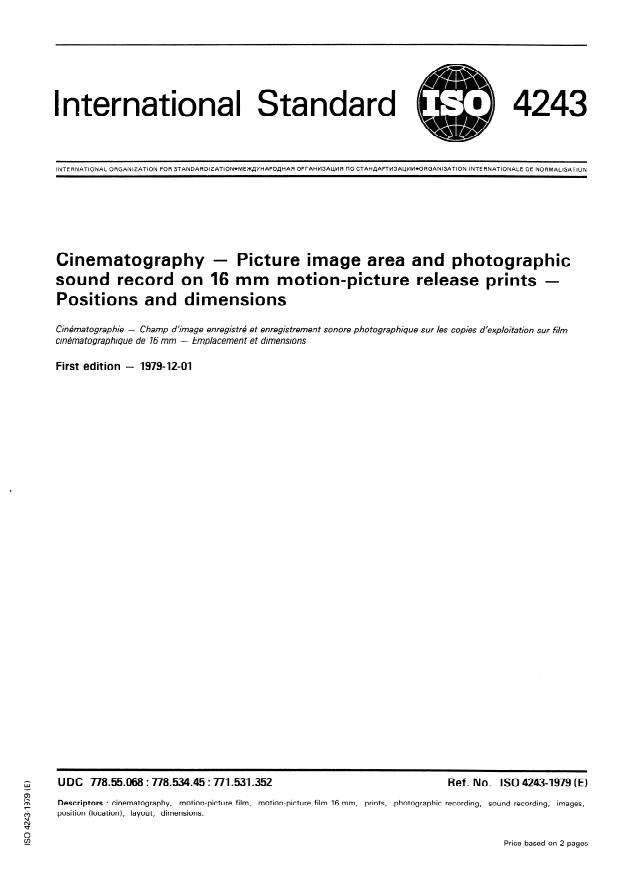
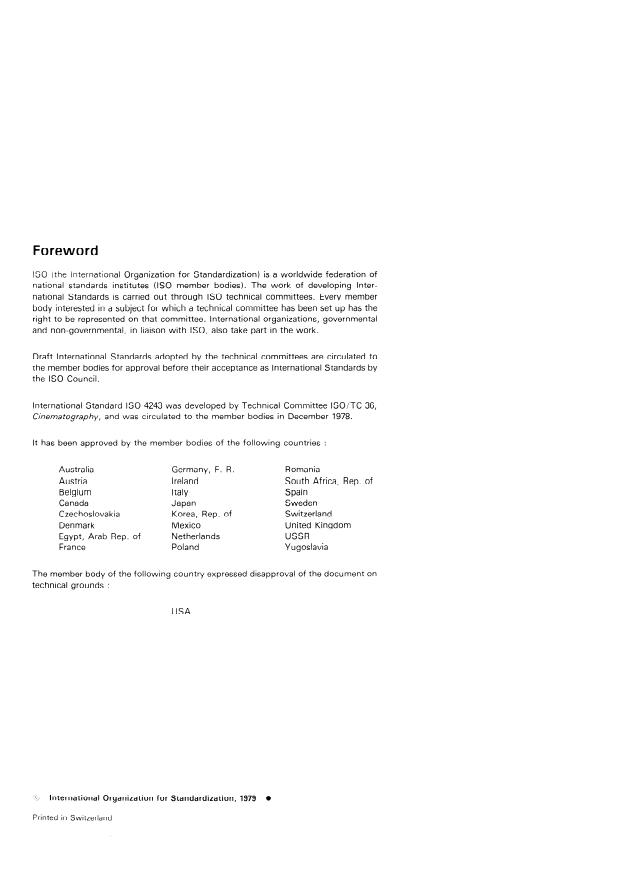
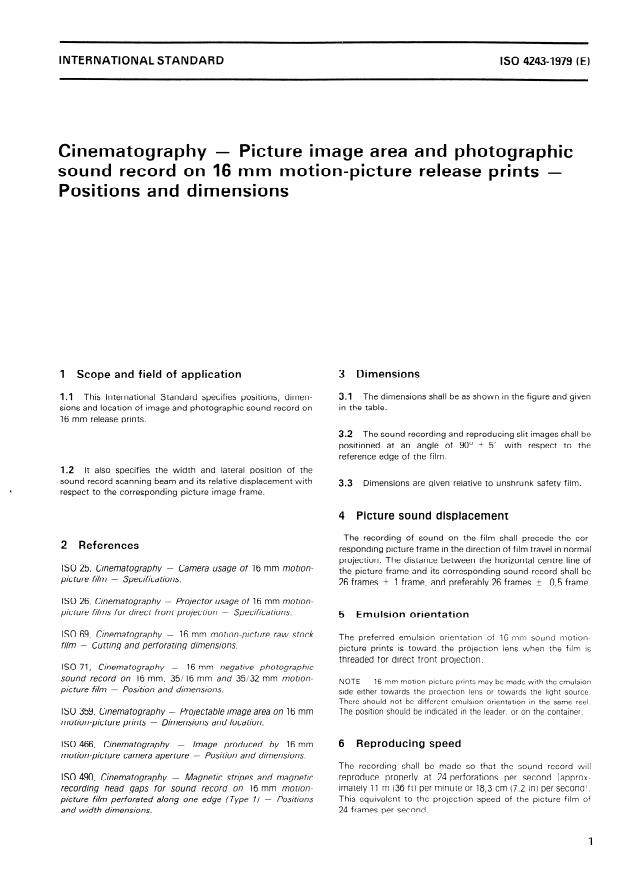

ISO 4243:1979 - Cinematography — Picture image area and photographic sound record on 16 mm motion-picture release prints — Positions and dimensions Released:12/1/1979
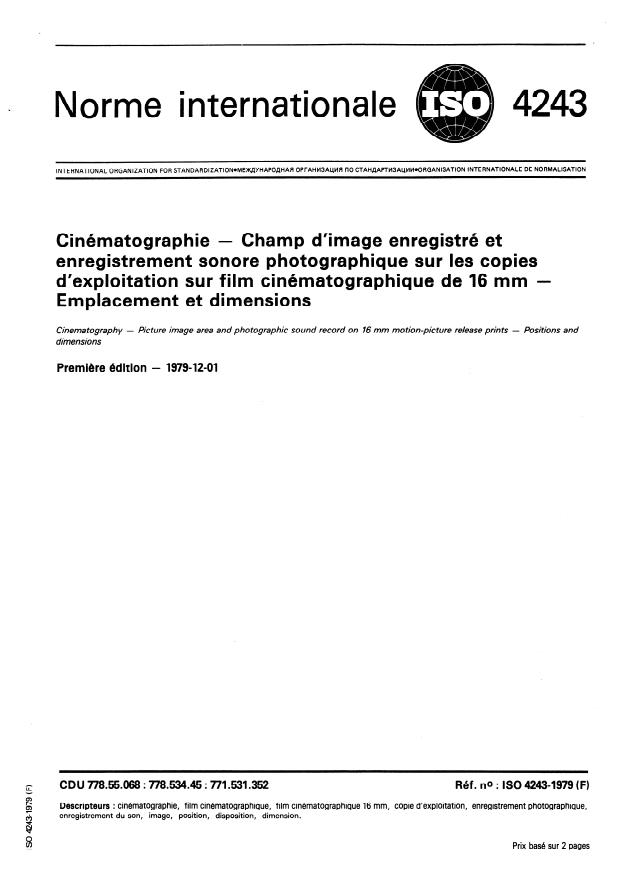

ISO 4243:1979 - Cinématographie — Champ d'image enregistré et enregistrement sonore photographique sur les copies d'exploitation sur film cinématographique de 16 mm — Emplacement et dimensions
Overview
ISO 4243:1979 is an international standard published by the International Organization for Standardization (ISO) that specifies the positions and dimensions of the picture image area and photographic sound record on 16 mm motion-picture release prints. This standard is critical for ensuring consistent quality, alignment, and sound reproduction in 16 mm film projection. It details the layout for both picture frames and photographic sound records on release prints, ensuring compatibility across various projection and sound systems.
The standard applies to image and photographic sound records on 16 mm release prints and defines the width and lateral position of the sound record scanning beam. It also specifies how the sound record aligns and displaces relative to the corresponding image frame. Importantly, the sound track is designed to be properly reproduced at a standard speed of 24 perforations per second, aligning with the normal 24 frames per second film projection speed.
Key Topics
Picture Image Area Dimensions
Defines exact dimensions and positional tolerances for the picture image on 16 mm release prints to ensure uniformity.Photographic Sound Record Positioning
Specifies the location of the sound track relative to the film’s reference edge and the adjacent image frame, including the scanning beam width and lateral displacement.Sound Track Orientation and Displacement
The sound record is positioned ahead of the corresponding picture frame in the direction of film travel, typically at a displacement of 26 frames, enabling proper synchronization during projection.Emulsion Orientation Recommendations
ISO 4243 recommends the emulsion of 16 mm prints face the projection lens during direct front projection, preventing orientation inconsistencies within reels.Reproduction Speed Compliance
Ensures sound records are made for reproduction at 24 perforations per second (approximately 11 meters per minute), matching the standard film projection rate of 24 frames per second.Dimensional Tolerances and Angular Positioning
Includes details on the acceptable tolerances for dimensions relative to unshrunk safety film and positions the sound record slit images at 90° ± 5° to the film’s reference edge.
Applications
Motion Picture Film Manufacturing
Enables film producers to standardize film print layouts, ensuring seamless compatibility and high-quality sound/image synchrony for 16 mm film prints.Film Projection Equipment Design
Assists projector manufacturers in calibrating equipment for accurate positioning of optical sound readers and image apertures, optimizing playback quality.Cinematography and Archival Work
Provides guidelines for the restoration, duplication, and archival preservation of 16 mm films, maintaining original sound and image fidelity.Educational and Independent Film Release Prints
Commonly applied in educational and independent film sectors relying on 16 mm release prints to guarantee standard sound/image positioning for consistent projection.
Related Standards
- ISO 25 – Cinematography: Camera usage of 16 mm motion-picture film – Specifications
- ISO 26 – Cinematography: Projector usage of 16 mm motion-picture films for direct front projection – Specifications
- ISO 69 – Cinematography: 16 mm motion-picture raw stock – Cutting and perforating dimensions
- ISO 71 – Cinematography: 16 mm negative photographic sound record – Positions and dimensions
- ISO 359 – Cinematography: Projectable image area on 16 mm motion-picture prints – Dimensions and location
- ISO 466 – Cinematography: Image produced by 16 mm motion-picture camera aperture – Position and dimensions
- ISO 490 – Cinematography: Magnetic stripes and magnetic recording head gaps for 16 mm motion-picture film – Positions and width dimensions
By adhering to ISO 4243:1979, filmmakers, projectionists, and manufacturers ensure precision in sound and image reproduction on 16 mm motion-picture prints, promoting global compatibility and enhancing viewer experience in film presentations.
Buy Documents
ISO 4243:1979 - Cinematography — Picture image area and photographic sound record on 16 mm motion-picture release prints — Positions and dimensions Released:12/1/1979
ISO 4243:1979 - Cinématographie — Champ d'image enregistré et enregistrement sonore photographique sur les copies d'exploitation sur film cinématographique de 16 mm — Emplacement et dimensions
Frequently Asked Questions
ISO 4243:1979 is a standard published by the International Organization for Standardization (ISO). Its full title is "Cinematography — Picture image area and photographic sound record on 16 mm motion-picture release prints — Positions and dimensions". This standard covers: The specifications apply to image and photographic sound records on release prints. Also specified are the width and lateral position of the soubnd record scanning beam and its diplacement relative to the corresponding image frame. The sound record shall be properly reproduced at 24 perforations per second which corresponds to a film projection speed of 24 frames per second.
The specifications apply to image and photographic sound records on release prints. Also specified are the width and lateral position of the soubnd record scanning beam and its diplacement relative to the corresponding image frame. The sound record shall be properly reproduced at 24 perforations per second which corresponds to a film projection speed of 24 frames per second.
ISO 4243:1979 is classified under the following ICS (International Classification for Standards) categories: 37.060.20 - Motion picture films. Cartridges. The ICS classification helps identify the subject area and facilitates finding related standards.
ISO 4243:1979 is available in PDF format for immediate download after purchase. The document can be added to your cart and obtained through the secure checkout process. Digital delivery ensures instant access to the complete standard document.
Standards Content (Sample)
International Standard
INTERNATIONAL ORGANIZATION FOR STANDARDIZATION.ME>KIIYHAPOCIHAfl OPI-AHM3AUMR fl0 CTAH~APTM3A~bIk’l*ORGANlSATlON INTERNATIONALE DE NORMALISATION
Picture image area and photographic
Cinematography -
Sound record on 16 mm motion-picture release prints -
Positions and dimensions
Cinhatographie - Champ d ‘image enregistrb et enregistrement sonore photographique sur les copies d ‘exploitation sur film
cinhatographique de 76 mm - Emplacement et dirnensions
First edition - 1979-12-01
Ref. No. ISO 4243-1979 (E)
UDC 77855.068 : 778.534.45 : 771531.352
w
motion-picture film 16 mm, prints, photographic recording, Sound recording, images,
Descriptors : cinematography, motion-picture film,
Position (location), layout, dimensions.
Price based on 2 pages
Foreword
ISO (the International Organization for Standardization) is a worldwide federation of
national Standards institutes (ISO member bodies). The work of developing Inter-
national Standards is carried out through ISO technical committees. Every member
body interested in a subject for which a technical committee has been set up has the
right to be represented on that committee. International organizations, governmental
and non-governmental, in liaison with ISO, also take part in the work.
Draft International Standards adopted by the technical committees are circulated to
the member bodies for approval before their acceptance as International Standards by
the ISO Council.
International Standard ISO 4243 was developed by Technical Committee ISO/TC 36,
Cinematography, and was circulated to the member bodies in December 1978.
lt has been approved by the member bodies of the following countries :
Australia Germany, F. R. Romania
Austria South Africa, Rep. of
Ireland
Belgium Italy Spain
Sweden
Canada Japan
Czechoslovakia Korea, Rep. of Switzerland
Denmark Mexico United Kingdom
Egypt, Arab Rep. of Netherlands USSR
France Poland Y ugoslavia
The member body of the following country expressed disapproval of the document on
tech nical gro unds
USA
‘C
J
International Organkation for Standardkation, 1979
Printed in Switzerland
INTERNATIONAL STANDARD ISO 4243-1979 (EI
Cinematography - Picture image area and photographic
Sound record on 16 mm motion-picture release prints -
Positions and dimensions
3 Dimensions
1 Scope and field of application
3.1 The dimensions shall be as shown in the figure and given
1.1 This International Standard specifies positions, dimen-
in the table.
sions and location of image and photographic Sound record on
16 mm release prints.
3.2 The Sound recording and reproducing slit images shall be
positioned at an angle of 90’ ZL 5’ with respect to the
reference edge of the film.
‘1.2 lt also specifies the width and lateral Position of the
Sound record scanning beam and its relative displacement wi
...
Norme internationale
INTERNATIONAL ORGANIZATION FOR STANDARDIZATION.MEWYHAPO~HAR OPf-AHM3ALlMR Il0 CTAH~APTH3A~klWORGANISATION INTERNATIONALE DE NORMALISATION
Cinématographie - Champ d’image enregistré et
enregistrement sonore photographique sur les copies
d’exploitation sur film cinématographique de 16 mm -
Emplacement et dimensions
Cinema tograph y - Picture image area and photographie sound record on 16 mm motion-picture release prints - Positions and
dimensions
Première Csdition - 1979-12-01
CDU 778.55068 : 778.534.45 : 771.531352
Réf. no : 60 42434979 (F)
z
Descripteurs : cinématographie, film cinématographique, film cinématographique 16 mm; copie d’exploitation, enregistrement photographique,
enregistrement du son, image, position, disposition, dimension.
Prix basé sur 2 pages
Avant-propos
L’ISO (Organisation internationale de normalisation) est une fédération mondiale
d’organismes nationaux de normalisation (comités membres de I’ISO). L’élaboration
des Normes internationales est confiée aux comités techniques de I’ISO. Chaque
comité membre intéressé par une étude a le droit de faire partie du comité technique
correspondant. Les organisations internationales, gouvernementales et non gouverne-
mentales, en liaison avec I’ISO, participent également aux travaux.
Les projets de Normes internationales adoptés par les comités techniques sont soumis
aux comités membres pour approbation, avant leur acceptation comme Normes inter-
nationales par le Conseil de I’ISO.
La Norme internationale ISO 4243 a été élaborée par le comité technique ISO/TC 36,
Cinématographie, et a été soumise aux comités membres en décembre 1978.
Les comités membres des pays suivants l’ont approuvée :
Afrique du Sud, Rép. d’ Égypte, Rép. arabe d’
Pologne
Allemagne, R. F. Espagne Roumanie
Australie France Royaume-Uni
Autriche Irlande Suède
Belgique Italie Suisse
Canada Japon Tchécoslovaquie
Corée, Rép. de Mexique URSS
Danemark Pays-Bas Yougoslavie
Le comité membre du pays suivant l’a désapprouvée pour des raisons techniques :
USA
Organisation internationale de normalisation, 1979
Imprimé en Suisse
60 42434979 (FI
NORME INTERNATIONALE
Champ d’image enregistré et
Cinématographie -
enregistrement sonore photographique sur les copies
d’exploitation sur film cinématographique de 16 m.m -
Emplacement et dimensions
1 Objet et domaine d’application 3.2 Les images de l’enregistrement sonore et la fente de lec-
ture doivent former un angle de 90° k 5’ avec le bord de réfé-
rence du film.
1.1 La présente Norme internationale spécifie la position, les
dimensions et l’emplacement de l’image et de l’enregistrement
sonore photographique sur les copies d’exploitation sur film
3.3 Les dimensions données s’entendent pour le film de
cinématographique de 16 mm.
sécurité sans retrait.
1.2 Elle spécifie aussi la largeur et la position latérale du fais-
ceau de lecture de l’enregistrement sonore et le décalage entre
ce dernier et le cadre d’image correspondant.
4 Décalage image-son
L’enregistrement du son sur le film doit précéder le cadre
2 Références
...