


ISO/IEC 14888-1:2008
(Main)Information technology - Security techniques - Digital signatures with appendix - Part 1: General
Information technology - Security techniques - Digital signatures with appendix - Part 1: General
There are two types of digital signature mechanism: When the verification process needs the message as part of the input, the mechanism is called "signature mechanism with appendix". A hash-function is in used in the calculation of the appendix. When the verification process reveals all or part of the message, the mechanism is called a "signature mechanism giving message recovery". A hash-function is also used in the generation and verification of these signatures. ISO/IEC 14888 specifies digital signatures with appendix. ISO/IEC 14888-1:2008 specifies general principles and requirements for digital signatures with appendix. ISO/IEC 14888-2 addresses digital signatures based on integer factoring, and ISO/IEC 14888-3 addresses digital signatures based on discrete logarithm. Signature mechanisms giving message recovery are specified in ISO/IEC 9796. Hash-functions are specified in ISO/IEC 10118.
Technologies de l'information — Techniques de sécurité — Signatures numériques avec appendice — Partie 1: Généralités
General Information
Relations
Overview
ISO/IEC 14888-1:2008 specifies general principles and requirements for digital signatures with appendix - a class of asymmetric cryptographic mechanisms where the verifier requires the message as part of the verification input. The standard defines the model, terminology, and mandatory processes (key generation, signature process, verification process) and sets security objectives for signature mechanisms that use a collision-resistant hash-function to compute the appendix appended to a message.
Key topics and technical requirements
- Signature mechanism with appendix: Defines how a signature (the appendix) and optional text field are formed and attached to a message so verifiers can relate the signature to the message.
- Core processes: Requirements for key generation, the signature process (probabilistic or deterministic) and the verification process.
- Security properties: The standard requires that given only the verification key it is computationally infeasible to forge valid message/signature pairs, recover the private signature key, or find two different messages that share the same signature.
- Hash-function binding: Strong emphasis on binding the chosen hash-function to the signature mechanism to prevent forgery. The document describes options for binding (restricting to a single hash-function, indicating the hash in certificate domain parameters, or specifying the hash in the message) and warns of associated risks.
- Notation and conventions: Defines symbols (H, M, X, Y, Σ, etc.), coding conventions and formats for constructing the appendix and signed message.
- Implementation choices and options: Specifies options for how identification data and optional text fields can be used to convey signer identity or verification key information.
Applications and who uses it
ISO/IEC 14888-1 is aimed at organizations and professionals implementing or evaluating digital signature systems that require the full message for verification:
- Security architects and cryptographic engineers designing PKI-aware applications
- Software developers building signing/verification libraries or secure messaging systems
- PKI operators, certificate authorities and system integrators specifying certificate parameters and hash-policy bindings
- Auditors, compliance officers and security assessors validating that signature mechanisms meet recognized security properties
Practical uses include document signing, code signing, secure email, authentication of transactions, and any application requiring data origin authentication, integrity and non-repudiation using an appendix-style digital signature.
Related standards
- ISO/IEC 14888-2: integer factorization–based mechanisms
- ISO/IEC 14888-3: discrete logarithm–based mechanisms
- ISO/IEC 9796: signature mechanisms giving message recovery
- ISO/IEC 10118: hash-function specifications
Keywords: ISO/IEC 14888-1:2008, digital signatures with appendix, signature mechanism with appendix, hash-function, collision-resistant hash, verification key, signature key, key generation, signature process, verification process, PKI.
Standards Content (Sample)
INTERNATIONAL ISO/IEC
STANDARD 14888-1
Second edition
2008-04-15
Information technology — Security
techniques — Digital signatures with
appendix —
Part 1:
General
Technologies de l'information — Techniques de sécurité — Signatures
numériques avec appendice —
Partie 1: Généralités
Reference number
©
ISO/IEC 2008
PDF disclaimer
This PDF file may contain embedded typefaces. In accordance with Adobe's licensing policy, this file may be printed or viewed but
shall not be edited unless the typefaces which are embedded are licensed to and installed on the computer performing the editing. In
downloading this file, parties accept therein the responsibility of not infringing Adobe's licensing policy. The ISO Central Secretariat
accepts no liability in this area.
Adobe is a trademark of Adobe Systems Incorporated.
Details of the software products used to create this PDF file can be found in the General Info relative to the file; the PDF-creation
parameters were optimized for printing. Every care has been taken to ensure that the file is suitable for use by ISO member bodies. In
the unlikely event that a problem relating to it is found, please inform the Central Secretariat at the address given below.
© ISO/IEC 2008
All rights reserved. Unless otherwise specified, no part of this publication may be reproduced or utilized in any form or by any means,
electronic or mechanical, including photocopying and microfilm, without permission in writing from either ISO at the address below or
ISO's member body in the country of the requester.
ISO copyright office
Case postale 56 • CH-1211 Geneva 20
Tel. + 41 22 749 01 11
Fax + 41 22 749 09 47
E-mail copyright@iso.org
Web www.iso.org
Published in Switzerland
ii © ISO/IEC 2008 – All rights reserved
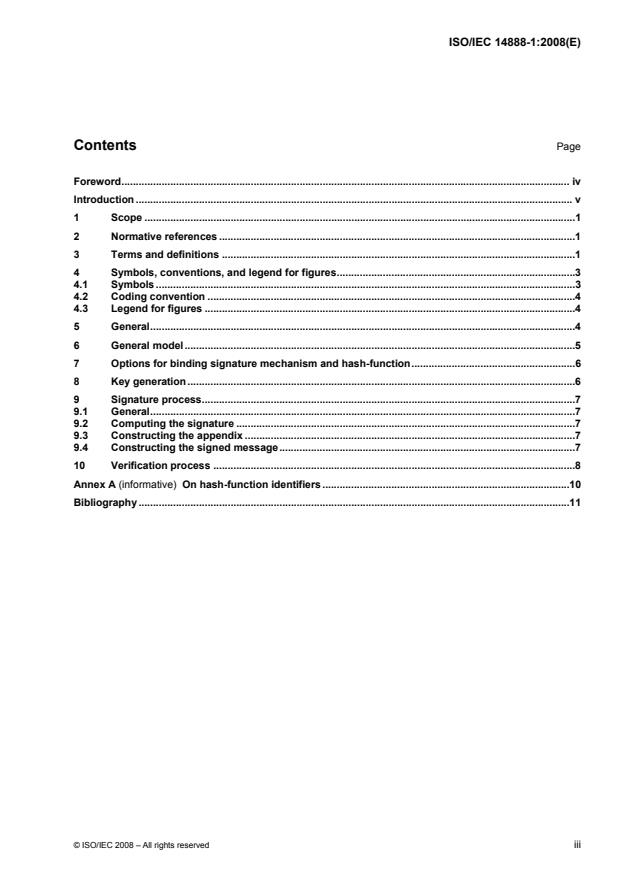
Contents Page
Foreword. iv
Introduction . v
1 Scope .1
2 Normative references .1
3 Terms and definitions .1
4 Symbols, conventions, and legend for figures.3
4.1 Symbols .3
4.2 Coding convention .4
4.3 Legend for figures .4
5 General.4
6 General model.5
7 Options for binding signature mechanism and hash-function.6
8 Key generation.6
9 Signature process.7
9.1 General.7
9.2 Computing the signature .7
9.3 Constructing the appendix .7
9.4 Constructing the signed message.7
10 Verification process .8
Annex A (informative) On hash-function identifiers .10
Bibliography .11
© ISO/IEC 2008 – All rights reserved iii
Foreword
ISO (the International Organization for Standardization) and IEC (the International Electrotechnical
Commission) form the specialized system for worldwide standardization. National bodies that are members of
ISO or IEC participate in the development of International Standards through technical committees
established by the respective organization to deal with particular fields of technical activity. ISO and IEC
technical committees collaborate in fields of mutual interest. Other international organizations, governmental
and non-governmental, in liaison with ISO and IEC, also take part in the work. In the field of information
technology, ISO and IEC have established a joint technical committee, ISO/IEC JTC 1.
International Standards are drafted in accordance with the rules given in the ISO/IEC Directives, Part 2.
The main task of the joint technical committee is to prepare International Standards. Draft International
Standards adopted by the joint technical committee are circulated to national bodies for voting. Publication as
an International Standard requires approval by at least 75 % of the national bodies casting a vote.
Attention is drawn to the possibility that some of the elements of this document may be the subject of patent
rights. ISO and IEC shall not be held responsible for identifying any or all such patent rights.
ISO/IEC 14888-1 was prepared by Joint Technical Committee ISO/IEC JTC 1, Information technology,
Subcommittee SC 27, IT Security techniques.
This second edition cancels and replaces the first edition (ISO/IEC 14888-1:1998), which has been technically
revised.
ISO/IEC 14888 consists of the following parts, under the general title Information technology — Security
techniques — Digital signatures with appendix:
⎯ Part 1: General
⎯ Part 2: Integer factorization based mechanisms
⎯ Part 3: Discrete logarithm based mechanisms
iv © ISO/IEC 2008 – All rights reserved
Introduction
Digital signature mechanisms are asymmetric cryptographic techniques which can be used to provide entity
authentication, data origin authentication, data integrity and non-repudiation services. There are two types of
digital signature mechanisms:
⎯ When the verification process needs the message as part of the input, the mechanism is called a
“signature mechanism with appendix”. A hash-function is used in the calculation of the appendix.
⎯ When the verification process reveals all or part of the message, the mechanism is called a “signature
mechanism giving message recovery”. A hash-function is also used in the generation and verification of
these signatures.
Signature mechanisms with appendix are specified in ISO/IEC 14888. Signature mechanisms giving message
recovery are specified in ISO/IEC 9796. Hash-functions are specified in ISO/IEC 10118.
© ISO/IEC 2008 – All rights reserved v
INTERNATIONAL STANDARD ISO/IEC 14888-1:2008(E)
Information technology — Security techniques — Digital
signatures with appendix —
Part 1:
General
1 Scope
ISO/IEC 14888 specifies several digital signature mechanisms with appendix for messages of arbitrary length.
This part of ISO/IEC 14888 contains general principles and requirements for digital signatures with appendix.
It also contains definitions and symbols which are used in all parts of ISO/IEC 14888.
Various means are available to obtain a reliable copy of the public verification key, e.g., a public key
certificate. Techniques for managing keys and certificates are outside the scope of ISO/IEC 14888. For
further information, see ISO/IEC 9594-8 [4], ISO/IEC 11770-3 [3] and ISO/IEC 15945 [5].
2 Normative references
The following referenced documents are indispensable for the application of this document. For dated
references, only the edition cited applies. For undated references, the latest edition of the referenced
document (including any amendments) applies.
None.
3 Terms and definitions
For the purposes of this document, the following terms and definitions apply.
3.1
appendix
string of bits formed by the signature and an optional text field
3.2
collision-resistant hash-function
hash-function satisfying the following property: it is computationally infeasible to find any two distinct inputs
which map to the same output
NOTE Computational feasibility depends on the specific security requirements and environment.
[ISO/IEC 10118-1]
3.3
data element
integer, bit string, set of integers or set of bit strings
© ISO/IEC 2008 – All rights reserved 1
3.4
domain
set of entities operating under a single security policy
EXAMPLES public key certificates created by a single authority or by a set of authorities using the same security
policy
3.5
domain parameter
data element which is common to and known by or accessible to all entities within the domain
3.6
hash-code
string of bits which is the output of a hash-function
[ISO/IEC 10118-1]
3.7
hash-function
function which maps strings of bits to fixed-length strings of bits, satisfying the following two properties:
⎯ for a given output, it is computationally infeasible to find an input which maps to this output;
⎯ for a given input, it is computationally infeasible to find a second input which maps to the same output
NOTE 1 Computational feasibility depends on the specific security requirements and environment.
NOTE 2 This definition of hash-function is referred to as one-way hash-function.
[ISO/IEC 10118-1]
3.8
identification data
sequence of data elements, including the distinguishing identifier for an entity, assigned to an entity and used
to identify it
NOTE The identification data may additionally contain data elements such as identifier of the signature process,
identifier of the signature key, validity period of the signature key, restrictions on key usage, associated security policy
parameters, key serial number, or domain parameters.
3.9
key pair
pair consisting of a signature key and a verification key, i.e.,
⎯ a set of data elements that shall be totally or partially kept secret, to be used only by the signer;
⎯ a set of data elements that can be totally made public, to be used by any verifier
3.10
message
string of bits of any length
3.11
parameter
integer, bit string or hash-function
3.12
signature
one or more data elements resulting from the signature process
2 © ISO/IEC 2008 – All rights reserved
3.13
signature key
set of private data elements specific to an entity and usable only by this entity in the signature process
NOTE Sometimes called a private signature key in other standards, e.g. ISO/IEC 9796-2, ISO/IEC 9796-3 and
ISO/IEC 9798-3.
3.14
signature process
process which takes as inputs the message, the signature key and the domain parameters, and which gives
as output the signature
3.15
signed message
set of data elements consisting of the signature, the part of the message which cannot be recovered from the
signature, and an optional text field
NOTE In the context of this part of ISO/IEC 14888, the entire message is included in the signed message and no part
of the message is recovered from the signature.
3.16
verification key
set of public data elements which is mathematically related to an entity's signature key and which is used by
the verifier in the verification process
NOTE Sometimes called a public verification key in other standards, e.g. ISO/IEC 9796-2, ISO/IEC 9796-3 and
ISO/IEC 9798-3.
3.17
verification process
process which takes as input the signed message, the verification key and the domain parameters, and which
gives as output the result of the signature verification: valid or invalid
4 Symbols, conventions, and legend for figures
4.1 Symbols
Throughout all parts of ISO/IEC 14888 the following symbols are used.
H hash-code
K randomizer
M message
R first part of a signature
NOTE First part of a signature R is alternatively called a witness.
R recomputed first part of a signature
S second part of a signature
X signature key
Y verification key
© ISO/IEC 2008 – All rights reserved 3
Z set of domain parameters
Σ signature
A mod N the unique integer B from 0 to N − 1 so that N divides A − B
A ≡ B (mod N) Integer A is congruent to integer B modulo N, i.e. (A − B) mod N = 0.
4.2 Coding convention
All integers in all parts of ISO/IEC 14888 are written with the most significant digit (or bit, or byte) in the
leftmost position.
4.3 Legend for figures
The following legend for figures is used in all parts of ISO/IEC 14888.
data
optional data
procedure
principal procedure
optional principal procedure
data flow
optional data flow
another optional data flow
two data flows of which at
least one is mandatory
5 General
The mechanisms specified in ISO/IEC 14888 are based upon asymmetric cryptographic techniques. Every
asymmetric digital signature mechanism involves three basic operations.
⎯ A process for generating pairs of keys, where each pair consists of a signature key and the corresponding
verification key.
⎯ A process using the signature key called the signature process.
• When, for a given message and signature key, the probability of obtaining the same signature twice is
negligible, the operation is probabilistic.
...
Frequently Asked Questions
ISO/IEC 14888-1:2008 is a standard published by the International Organization for Standardization (ISO). Its full title is "Information technology - Security techniques - Digital signatures with appendix - Part 1: General". This standard covers: There are two types of digital signature mechanism: When the verification process needs the message as part of the input, the mechanism is called "signature mechanism with appendix". A hash-function is in used in the calculation of the appendix. When the verification process reveals all or part of the message, the mechanism is called a "signature mechanism giving message recovery". A hash-function is also used in the generation and verification of these signatures. ISO/IEC 14888 specifies digital signatures with appendix. ISO/IEC 14888-1:2008 specifies general principles and requirements for digital signatures with appendix. ISO/IEC 14888-2 addresses digital signatures based on integer factoring, and ISO/IEC 14888-3 addresses digital signatures based on discrete logarithm. Signature mechanisms giving message recovery are specified in ISO/IEC 9796. Hash-functions are specified in ISO/IEC 10118.
There are two types of digital signature mechanism: When the verification process needs the message as part of the input, the mechanism is called "signature mechanism with appendix". A hash-function is in used in the calculation of the appendix. When the verification process reveals all or part of the message, the mechanism is called a "signature mechanism giving message recovery". A hash-function is also used in the generation and verification of these signatures. ISO/IEC 14888 specifies digital signatures with appendix. ISO/IEC 14888-1:2008 specifies general principles and requirements for digital signatures with appendix. ISO/IEC 14888-2 addresses digital signatures based on integer factoring, and ISO/IEC 14888-3 addresses digital signatures based on discrete logarithm. Signature mechanisms giving message recovery are specified in ISO/IEC 9796. Hash-functions are specified in ISO/IEC 10118.
ISO/IEC 14888-1:2008 is classified under the following ICS (International Classification for Standards) categories: 35.030 - IT Security; 35.040 - Information coding. The ICS classification helps identify the subject area and facilitates finding related standards.
ISO/IEC 14888-1:2008 has the following relationships with other standards: It is inter standard links to ISO/IEC 14888-1:1998. Understanding these relationships helps ensure you are using the most current and applicable version of the standard.
You can purchase ISO/IEC 14888-1:2008 directly from iTeh Standards. The document is available in PDF format and is delivered instantly after payment. Add the standard to your cart and complete the secure checkout process. iTeh Standards is an authorized distributor of ISO standards.
Questions, Comments and Discussion
Ask us and Technical Secretary will try to provide an answer. You can facilitate discussion about the standard in here.
Loading comments...