


ISO 19903:2006
(Main)Petroleum and natural gas industries — Fixed concrete offshore structures
Petroleum and natural gas industries — Fixed concrete offshore structures
ISO 19903:2006 specifies requirements and provides recommendations applicable to fixed concrete offshore structures for the petroleum and natural gas industries, and specifically addresses the design, construction, transportation and installation of new structures, including requirements for in-service inspection and possible removal of structures, the assessment of structures in service, and the assessment of structures for reuse at other locations.
Industries du pétrole et du gaz naturel — Structures en mer fixes en béton
L'ISO 19903:2006 spécifie les exigences et délivre des recommandations applicables à des structures en mer fixes en béton pour les industries du pétrole et du gaz naturel, et aborde en particulier la conception, la construction, le transport et l'installation de nouvelles structures, y compris les exigences concernant une inspection en service et un retrait possible de structures, l'évaluation de structures en service et l'évaluation de structures destinées à être réutilisées à d'autres endroits.
General Information
- Status
- Withdrawn
- Publication Date
- 28-Nov-2006
- Withdrawal Date
- 28-Nov-2006
- Technical Committee
- ISO/TC 67/SC 7 - Offshore structures
- Drafting Committee
- ISO/TC 67/SC 7/WG 4 - Fixed concrete structures
- Current Stage
- 9599 - Withdrawal of International Standard
- Start Date
- 14-Aug-2019
- Completion Date
- 14-Feb-2026
Relations
- Effective Date
- 12-Feb-2026
- Effective Date
- 05-Jul-2014
Buy Documents
ISO 19903:2006 - Petroleum and natural gas industries -- Fixed concrete offshore structures
ISO 19903:2006 - Industries du pétrole et du gaz naturel -- Structures en mer fixes en béton
Get Certified
Connect with accredited certification bodies for this standard

ABS Quality Evaluations Inc.
American Bureau of Shipping quality certification.

Element Materials Technology
Materials testing and product certification.

ABS Group Brazil
ABS Group certification services in Brazil.
Sponsored listings
Frequently Asked Questions
ISO 19903:2006 is a standard published by the International Organization for Standardization (ISO). Its full title is "Petroleum and natural gas industries — Fixed concrete offshore structures". This standard covers: ISO 19903:2006 specifies requirements and provides recommendations applicable to fixed concrete offshore structures for the petroleum and natural gas industries, and specifically addresses the design, construction, transportation and installation of new structures, including requirements for in-service inspection and possible removal of structures, the assessment of structures in service, and the assessment of structures for reuse at other locations.
ISO 19903:2006 specifies requirements and provides recommendations applicable to fixed concrete offshore structures for the petroleum and natural gas industries, and specifically addresses the design, construction, transportation and installation of new structures, including requirements for in-service inspection and possible removal of structures, the assessment of structures in service, and the assessment of structures for reuse at other locations.
ISO 19903:2006 is classified under the following ICS (International Classification for Standards) categories: 75.180.10 - Exploratory, drilling and extraction equipment. The ICS classification helps identify the subject area and facilitates finding related standards.
ISO 19903:2006 has the following relationships with other standards: It is inter standard links to EN ISO 19903:2006, ISO 19903:2019. Understanding these relationships helps ensure you are using the most current and applicable version of the standard.
ISO 19903:2006 is available in PDF format for immediate download after purchase. The document can be added to your cart and obtained through the secure checkout process. Digital delivery ensures instant access to the complete standard document.
Standards Content (Sample)
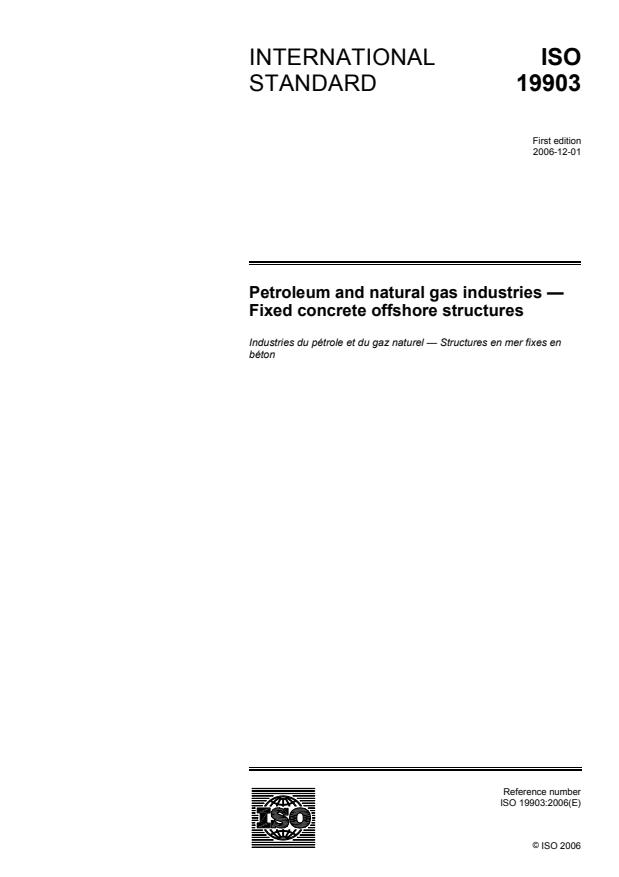
INTERNATIONAL ISO
STANDARD 19903
First edition
2006-12-01
Petroleum and natural gas industries —
Fixed concrete offshore structures
Industries du pétrole et du gaz naturel — Structures en mer fixes en
béton
Reference number
©
ISO 2006
PDF disclaimer
This PDF file may contain embedded typefaces. In accordance with Adobe's licensing policy, this file may be printed or viewed but
shall not be edited unless the typefaces which are embedded are licensed to and installed on the computer performing the editing. In
downloading this file, parties accept therein the responsibility of not infringing Adobe's licensing policy. The ISO Central Secretariat
accepts no liability in this area.
Adobe is a trademark of Adobe Systems Incorporated.
Details of the software products used to create this PDF file can be found in the General Info relative to the file; the PDF-creation
parameters were optimized for printing. Every care has been taken to ensure that the file is suitable for use by ISO member bodies. In
the unlikely event that a problem relating to it is found, please inform the Central Secretariat at the address given below.
© ISO 2006
All rights reserved. Unless otherwise specified, no part of this publication may be reproduced or utilized in any form or by any means,
electronic or mechanical, including photocopying and microfilm, without permission in writing from either ISO at the address below or
ISO's member body in the country of the requester.
ISO copyright office
Case postale 56 • CH-1211 Geneva 20
Tel. + 41 22 749 01 11
Fax + 41 22 749 09 47
E-mail copyright@iso.org
Web www.iso.org
Published in Switzerland
ii © ISO 2006 – All rights reserved
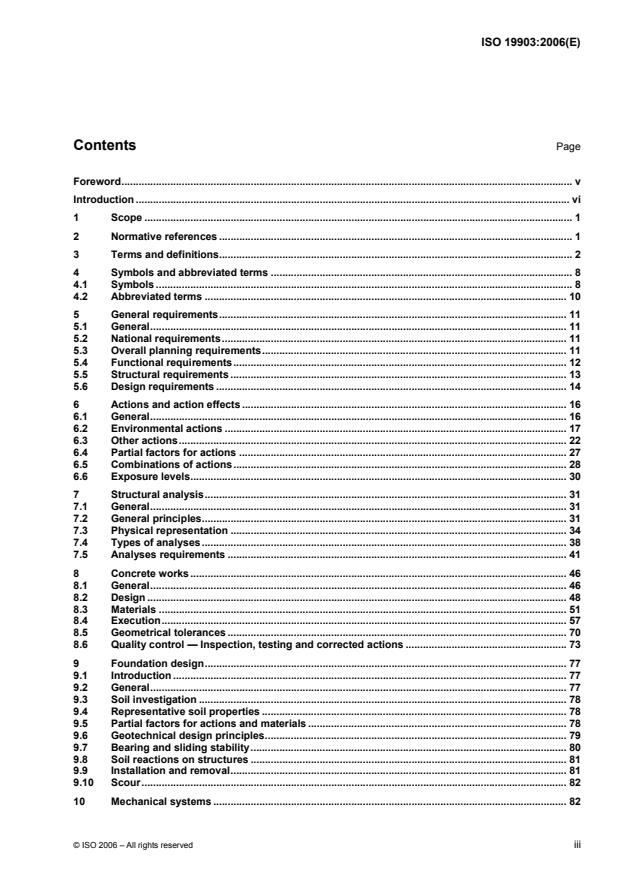
Contents Page
Foreword. v
Introduction . vi
1 Scope . 1
2 Normative references . 1
3 Terms and definitions. 2
4 Symbols and abbreviated terms . 8
4.1 Symbols . 8
4.2 Abbreviated terms . 10
5 General requirements. 11
5.1 General. 11
5.2 National requirements. 11
5.3 Overall planning requirements. 11
5.4 Functional requirements. 12
5.5 Structural requirements . 13
5.6 Design requirements . 14
6 Actions and action effects . 16
6.1 General. 16
6.2 Environmental actions . 17
6.3 Other actions. 22
6.4 Partial factors for actions . 27
6.5 Combinations of actions. 28
6.6 Exposure levels. 30
7 Structural analysis. 31
7.1 General. 31
7.2 General principles. 31
7.3 Physical representation . 34
7.4 Types of analyses. 38
7.5 Analyses requirements . 41
8 Concrete works . 46
8.1 General. 46
8.2 Design . 48
8.3 Materials . 51
8.4 Execution. 57
8.5 Geometrical tolerances . 70
8.6 Quality control — Inspection, testing and corrected actions . 73
9 Foundation design. 77
9.1 Introduction . 77
9.2 General. 77
9.3 Soil investigation . 78
9.4 Representative soil properties . 78
9.5 Partial factors for actions and materials . 78
9.6 Geotechnical design principles. 79
9.7 Bearing and sliding stability. 80
9.8 Soil reactions on structures . 81
9.9 Installation and removal. 81
9.10 Scour. 82
10 Mechanical systems . 82
10.1 Introduction . 82
10.2 Permanent mechanical systems. 83
10.3 Mechanical systems — Temporary . 90
10.4 Attachments and penetrations . 93
10.5 Mechanical systems — Special considerations . 94
11 Marine operations and construction afloat . 95
11.1 General . 95
11.2 Engineering and planning. 96
12 Corrosion control. 96
12.1 Introduction . 96
12.2 Design for corrosion control. 98
12.3 Fabrication and installation of systems for corrosion control. 102
13 Topsides interface design. 103
13.1 Introduction . 103
13.2 Basis for design . 104
13.3 Deck/shaft structural connection . 104
13.4 Topsides — Structure mating. 105
13.5 Transportation, tow-to-field . 105
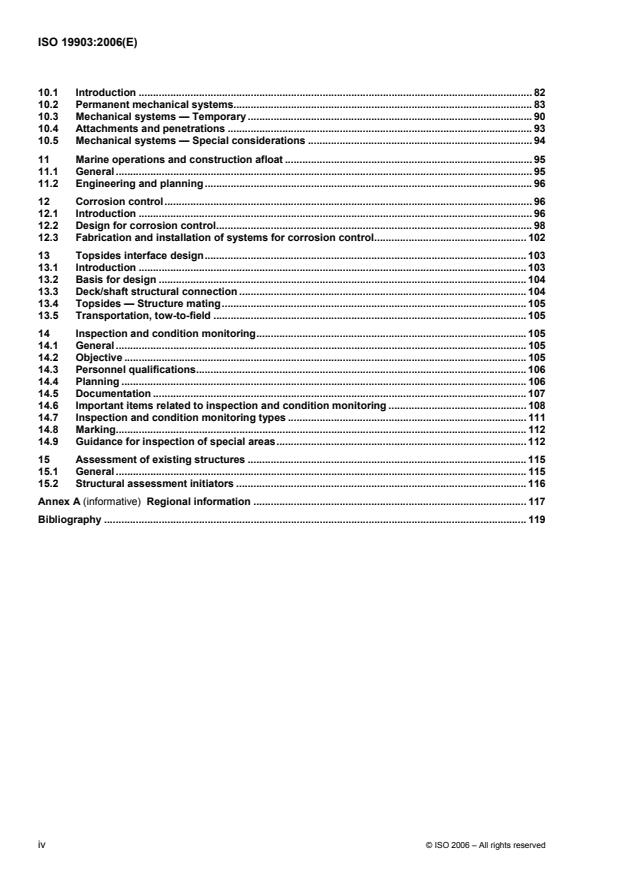
14 Inspection and condition monitoring. 105
14.1 General . 105
14.2 Objective . 105
14.3 Personnel qualifications. 106
14.4 Planning . 106
14.5 Documentation . 107
14.6 Important items related to inspection and condition monitoring . 108
14.7 Inspection and condition monitoring types . 111
14.8 Marking. 112
14.9 Guidance for inspection of special areas. 112
15 Assessment of existing structures . 115
15.1 General . 115
15.2 Structural assessment initiators . 116
Annex A (informative) Regional information . 117
Bibliography . 119
iv © ISO 2006 – All rights reserved
Foreword
ISO (the International Organization for Standardization) is a worldwide federation of national standards bodies
(ISO member bodies). The work of preparing International Standards is normally carried out through ISO
technical committees. Each member body interested in a subject for which a technical committee has been
established has the right to be represented on that committee. International organizations, governmental and
non-governmental, in liaison with ISO, also take part in the work. ISO collaborates closely with the
International Electrotechnical Commission (IEC) on all matters of electrotechnical standardization.
International Standards are drafted in accordance with the rules given in the ISO/IEC Directives, Part 2.
The main task of technical committees is to prepare International Standards. Draft International Standards
adopted by the technical committees are circulated to the member bodies for voting. Publication as an
International Standard requires approval by at least 75 % of the member bodies casting a vote.
Attention is drawn to the possibility that some of the elements of this document may be the subject of patent
rights. ISO shall not be held responsible for identifying any or all such patent rights.
ISO 19903 was prepared by Technical Committee ISO/TC 67, Materials, equipment and offshore structures
for petroleum, petrochemical and natural gas industries, Subcommittee SC 7, Offshore structures.
ISO 19903 is one of a series of standards for offshore structures. The full series consists of the following
International Standards.
⎯ ISO 19900, Petroleum and natural gas industries — General requirements for offshore structures
⎯ ISO 19901 (all parts), Petroleum and natural gas industries — Specific requirements for offshore
structures
1)
⎯ ISO 19902, Petroleum and natural gas industries — Fixed steel offshore structures
⎯ ISO 19903, Petroleum and natural gas industries — Fixed concrete offshore structures
⎯ ISO 19904-1, Petroleum and natural gas industries — Floating offshore structures — Part 1: Monohulls,
semi-submersibles and spars
⎯ ISO 19904-2, Petroleum and natural gas industries — Floating offshore structures — Part 2: Tension leg
2)
platforms
⎯ ISO 19905-1, Petroleum and natural gas industries — Site-specific assessment of mobile offshore
2)
units — Part 1: Jack-ups
⎯ ISO/TR 19905-2, Petroleum and natural gas industries — Site-specific assessment of mobile offshore
2)
units — Part 2: Jack-ups commentary
2)
⎯ ISO 19906, Petroleum and natural gas industries — Arctic offshore structures
1) To be published.
2) Under preparation.
Introduction
The series of International Standards applicable to offshore structures, ISO 19900 to ISO 19906, constitutes a
common basis covering those aspects that address design requirements and assessments of all offshore
structures used by the petroleum and natural gas industries worldwide. Through their application the intention
is to achieve reliability levels appropriate for manned and unmanned offshore structures, whatever the type of
structure and nature or combination of the materials used.
It is important to recognize that structural integrity is an overall concept comprising models for describing
actions, structural analyses, design rules, safety elements, workmanship, quality control procedures and
national requirements, all of which are mutually dependent. The modification of one aspect of design in
isolation can disturb the balance of reliability inherent in the overall concept or structural system. The
implications involved in modifications, therefore, need to be considered in relation to the overall reliability of all
offshore structural systems.
The series of International Standards applicable to the various types of offshore structure is intended to
provide wide latitude in the choice of structural configurations, materials and techniques without hindering
innovation. Sound engineering judgement is therefore necessary in the use of these International Standards.
International Standard ISO 19903 was developed based on experience gained from the design, execution and
use of a number of fixed concrete platforms, in particular from more than 30 years of experience with such
structures in the North Sea. The background documents when developing this International Standard are from
the following types of documents:
⎯ national regulations and other requirements from the authorities;
⎯ regional standards;
⎯ national standards;
⎯ operator’s company specifications;
⎯ scientific papers and reports;
⎯ reports from inspection of structures in use.
This International Standard draws on the experience gained with fixed concrete offshore structures. This
experience shows that fixed concrete offshore structures perform well and are durable in the marine
environment. These structures are all unique, one-of-a-kind structures, purpose-made for a particular location
and a particular set of operating requirements. This is reflected in ISO 19903 by the fact that the standard
gives guidance rather than detailed prescriptive rules. This International Standard reflects in particular the
experience and the conditions in the North Sea and the east coast of Canada, and the design rules and
practices used there, but is intended for worldwide application.
vi © ISO 2006 – All rights reserved
INTERNATIONAL STANDARD ISO 19903:2006(E)
Petroleum and natural gas industries — Fixed concrete
offshore structures
1 Scope
This International Standard specifies requirements and provides recommendations applicable to fixed
concrete offshore structures for the petroleum and natural gas industries, and specifically addresses
a) the design, construction, transportation and installation of new structures, including requirements for
in-service inspection and possible removal of structures,
b) the assessment of structures in service, and
c) the assessment of structures for reuse at other locations.
This International Standard is intended to cover the engineering processes needed for the major engineering
disciplines to establish a facility for offshore operation. It can also be used for the design of floating concrete
[11] [12]
structures as specified in ISO 19904-1 (and the future ISO 19904-2 when published) and for arctic
[7]
structures (as specified in the future ISO 19906 when published).
In order to provide a standard that will be useful to the industry, a comprehensive treatment of some topics is
provided where there is currently no relevant reference. For such well-known topics as the design formulas for
concrete structural members, this International Standard is intended to be used in conjunction with a suitable
reference standard for basic concrete design (see 8.2.1). The designer can use suitable national or regional
design standards that provide the required level of safety. Only other ISO documents will be referenced
directly in the text.
2 Normative references
The following referenced documents are indispensable for the application of this document. For dated
references, only the edition cited applies. For undated references, the latest edition of the referenced
document (including any amendments) applies.
ISO 1920-3, Testing of concrete — Part 3: Making and curing test specimens
ISO 1920-4, Testing of concrete — Part 4: Strength of hardened concrete
ISO 2394, General principles on reliability for structures
ISO 4463-1, Measurement methods for building — Setting-out and measurement — Part 1: Planning and
organization, measuring procedures, acceptance criteria
ISO 6934 (all parts), Steel for the prestressing of concrete
ISO 6935 (all parts), Steel for the reinforcement of concrete
ISO 19900, Petroleum and natural gas industries — General requirements for offshore structures
ISO 19901-1, Petroleum and natural gas industries — Specific requirements for offshore structures — Part 1:
Metocean design and operating considerations
ISO 19901-2, Petroleum and natural gas industries — Specific requirements for offshore structures — Part 2:
Seismic design procedures and criteria
ISO 19901-4, Petroleum and natural gas industries — Specific requirements for offshore structures — Part 4:
Geotechnical and foundation design considerations
ISO 19901-5, Petroleum and natural gas industries — Specific requirements for offshore structures — Part 5:
Weight control during engineering and construction
ISO 19901-6, Petroleum and natural gas industries — Specific requirements for offshore structures — Part 6:
3)
Marine operations
3)
ISO 19902, Petroleum and natural gas industries — Fixed steel offshore structures
3 Terms and definitions
For the purposes of this document, the terms and definitions given in ISO 19900 and the following apply.
NOTE Terms and definitions relevant for the use of this International Standard are also found in ISO 19901-1,
ISO 19901-2, ISO 19901-4 and ISO 19901-6 and in ISO 19902.
3.1
abnormal design situation
design situation in which conditions exceed conventionally specified design conditions and which is used to
mitigate against very remote events
−4
NOTE Abnormal design situations are used to provide robustness against events with a probability of typically 10
per annum or lower by avoiding, for example, gross overloading.
[ISO 19901-2]
3.2
abnormal level earthquake
ALE
intense earthquake of abnormal severity under the action of which the structure should not suffer complete
loss of integrity
NOTE The ALE event is comparable to the abnormal event in the design of fixed structures which are described in
ISO 19902 and ISO 19903. When exposed to the ALE, a manned structure is supposed to maintain structural and/or
floatation integrity for a sufficient period of time to enable evacuation to take place.
[ISO 19901-2]
3.3
accidental design situation
design situation involving exceptional conditions of the structure or its exposure
EXAMPLE Impact, fire, explosion, local failure or loss of intended differential pressure (e.g. buoyancy).
3.4
action
external load applied to the structure (direct action) or an imposed deformation or acceleration (indirect action)
NOTE 1 An imposed deformation can be caused by fabrication tolerances, settlement, temperature change or moisture
variation.
3) To be published.
2 © ISO 2006 – All rights reserved
NOTE 2 An earthquake typically generates imposed accelerations.
[ISO 19900]
3.5
action effect
effect of action on structural components
EXAMPLE Internal force, moment, stress or strain.
[ISO 19900]
3.6
addition
finely divided material used in concrete in order to improve certain properties or to achieve special properties
NOTE This International Standard deals with two types of inorganic additions:
⎯ nearly inert additions (type I);
⎯ pozzolanic or latent hydraulic additions (type II).
3.7
admixture
material added during the mixing process of concrete in small quantities related to the mass of cement to
modify the properties of fresh or hardened concrete
3.8
after-damage design situation
design situation for which the condition of the structure reflects damage due to an accidental design situation
and for which the environmental conditions are specially defined
3.9
aggregate
granular mineral material suitable for use in concrete
NOTE Aggregate can be natural, artificial or recycled from material previously used in construction.
3.10
air cushion
air pumped into underbase compartments of the structure
NOTE Normally applied in order to reduce the draft and increase the freeboard of the structure and/or to alter the
structural loading.
3.11
atmospheric zone
part of the load-bearing structure that is above the splash zone
3.12
caisson
major portion of fixed concrete offshore structure, providing buoyancy during floating phases and the
possibility of oil storage within the structure
NOTE The caisson is generally divided into watertight compartments, which can be subdivided into
intercommunicating cells for structural reasons. The caisson can also be filled, or partly filled, with ballast water and solid
ballast.
3.13
characteristic value of a material property
value of a material or product property having a prescribed probability of not being attained in a hypothetical
unlimited test series, a nominal value being used as the characteristic value in some circumstances
NOTE The characteristic material property generally corresponds to a specified fractile of the assumed statistical
distribution of the particular property of the material or product. Characteristic strength is normally defined as the value of
the strength below which 5 % of the population of all possible strength determinations of the material under consideration
are expected to fall or, alternatively, 95 % if an upper value is more severe.
3.14
critical shear zone
zone in which the shear stress is at a maximum in relation to the shear strength
3.15
concrete
material formed by mixing cement, coarse and fine aggregate and water, with or without the incorporation of
admixtures and additions, which develops its properties by hydration of the cement
3.16
condition monitoring
evaluation of the condition and behaviour of the load-bearing structure(s) in service using data from design,
inspection and instrumentation
3.17
construction afloat
fabrication, construction and related activities taking place on a structure that is afloat, normally at an inshore
location and restrained by a temporary mooring system
3.18
deck mating
marine operation in which the platform topsides is floated into position and connected to the substructure
NOTE This operation is normally conducted by ballasting and deballasting of the substructure.
3.19
deep water construction site
site for construction of the structure while afloat
NOTE The use of a deep water site might not always be required, depending on the construction method. It might or
might not be the same location as that where mating of topsides to the substructure takes place.
3.20
design rules
rules in accordance with the chosen reference standard for concrete design
NOTE See 8.2.
3.21
dynamic amplification factor
DAF
ratio of a dynamic action effect to the corresponding static action effect
NOTE An appropriately selected dynamic amplification factor can be applied to static actions to simulate the effects
of dynamic actions.
3.22
extreme level earthquake
ELE
earthquake with a severity which the structure should sustain without major damage
4 © ISO 2006 – All rights reserved
NOTE The ELE event is comparable to the extreme environmental event in the design of fixed structures which are
described in ISO 19902 and ISO 19903. When exposed to an ELE, a structure is supposed to retain its full capacity for all
subsequent conditions.
[ISO 19901-2]
3.23
execution
all activities carried out for the physical completion of the work including procurement, inspection and
documentation thereof
NOTE The term covers work on site; it might also signify the fabrication of components off-site and their subsequent
erection on site.
3.24
exposure level
classification system used to define the requirements for a structure based on consideration of life safety and
of environmental and economic consequences of failure
NOTE The method for determining exposure levels is described in ISO 19902. An exposure level 1 platform is the
most critical and exposure level 3 the least. A normally manned platform which cannot be reliably evacuated before a
design event will be an exposure level 1 platform.
[ISO 19900]
3.25
finite element analysis
FEA
analysis method whereby a structure or a part thereof is subdivided into small elements of known or assumed
behaviour, then analysed by numerical matrix methods to determine action effects, static or dynamic
3.26
fixed concrete offshore structure
FCS
concrete structure designed to rest on the sea floor
NOTE Sufficient structural stability can be achieved through its own weight, or in combination with suction in skirt
compartments, or founding of the structure on piles into the seabed. It includes the mechanical outfitting of the structure.
3.27
fixed structure
structure that is bottom founded and transfers all actions on it to the seabed
[ISO 19900]
3.28
float-out
transfer of a major assembly from a dry construction site to a self-floating condition
NOTE Typically, it is the transfer of the lower part of the concrete structure from a flooded drydock.
3.29
global analysis
determination of a consistent set of either internal forces and moments or of stresses in a structure that are in
equilibrium with a defined set of actions on the entire structure and which depend on geometrical, structural
and material properties
NOTE For a global analysis of a transient situation (e.g. seismic), the internal response is part of the equilibrium.
3.30
inspection
conformity evaluation by observation and judgement accompanied, as appropriate, by measurement, testing
or gauging to verify that the execution is in accordance with the project work specification
3.31
installation
marine operation in which the platform is positioned and set down on the sea floor at the offshore site
3.32
instrumentation
outfitting of a fixed concrete offshore structure with instruments for data measurement and recording
3.33
interface manual
document defining all interfaces between the various parties and disciplines involved in the design and
construction, ensuring that responsibilities, reporting and information routines, as appropriate, are established
and maintained
3.34
lightweight aggregate
aggregate of mineral origin having an oven-dry particle density u 2 000 kg/m or a loose oven-dry bulk
density u 1 200 kg/m
3.35
local analysis
determination of a consistent set of internal forces and moments, or stresses, in a cross-section of a structural
component, or in a subset of structural components forming part of the structural system, that are in
equilibrium with the boundary conditions
3.36
marine operation
planned and controlled vertical or horizontal movement of a structure or component thereof over, in or on
water
3.37
method statement
document stating the methods and procedures to be used to perform the work
3.38
normal-weight aggregate
3 3
aggregate with an oven-dry particle density between 2 000 kg/m and 3 000 kg/m
3.39
offshore site
offshore location where the structure is to be installed for its operational life
3.40
operations manual
document giving the requirements and restrictions related to a safe operation of the concrete structure and all
its systems
3.41
owner
representative of the companies which own a development
NOTE The owner will normally be the operator on behalf of co-licensees.
6 © ISO 2006 – All rights reserved
3.42
primary structure
all main structural components (concrete or steelwork) that provide the structure’s main strength and stiffness
3.43
procedure
document that describes a specified way to carry out an activity or a process, the detailed sequence and inter-
relationships required for the completion of a particular task
3.44
project specification
document giving the overall technical requirements provided by the owner
3.45
project work specification
all information and technical requirements necessary for the execution of the works, includes documents and
drawings, etc. as well as references to relevant regulations, specifications, etc.
3.46
quality plan
document specifying which procedures and associated resources shall be applied by whom and when,
covering the entire project or defined parts of the project and all relevant products, processes or contracts
3.47
secondary structure
structural components that do not contribute significantly to the overall strength and stiffness of the structure
but which support individual items of equipment, transferring the actions thereon onto the primary structure
3.48
shaft
compartment extending from the caisson of the fixed concrete offshore structure to the topsides
NOTE A shaft is generally used to house and support the wells (drill shaft), mechanical systems (utility shaft) and
risers and J-tubes (riser shaft). The part of a shaft extending above a caisson is also often referred to as a leg.
3.49
skirts
structural components constructed in concrete and/or steel that extend from the foundation downwards and
penetrate into the seabed
NOTE Skirts are used to increase the capacity of the foundation to resist vertical and horizontal actions and improve
erosion resistance. Skirts can also be needed to form compartments facilitating the under-base grouting.
3.50
solid ballast
non-structural material added to a structure
NOTE Solid ballast is normally applied in order to increase the self weight of the structure or to lower the centre of
gravity for floating stability purposes.
3.51
splash zone
area of a structure that is frequently wetted due to waves and tidal variations
[ISO 19900]
3.52
structure
organized combination of connected parts designed to withstand actions and provide adequate rigidity
[ISO 19900]
3.53
submerged zone
part of the structure that is normally submerged and exposed to the constant influence of sea water
3.54
subsidence
that part of the settlement of the structure that results from extraction of reservoir hydrocarbons and factors
other than the weight of the structure
3.55
summary report
document including the most important assumptions on which the design, construction and installation work is
based with regard to the load-bearing structure
3.56
topsides
structures and equipment placed on a supporting structure (fixed or floating) to provide some or all of a
platform’s functions
NOTE A separate fabricated deck or module support frame is part of the topsides.
[ISO 19900]
3.57
tow to field
marine operation in which the complete platform or structure is moved from the dry dock or inshore
construction site to the offshore site
3.58
works
construction work described in the project work specification
3.59
works certificate
mill certificate
document issued by the manufacturer or a testing institute certifying the materials delivered, and giving
⎯ test method, specifications and criteria (e.g. test standard used),
⎯ all relevant test data,
⎯ certification that the tests have been carried out on samples taken from the delivered products, and
⎯ all necessary information for identification of product, producer and purchaser.
NOTE A works certificate is normally required for construction materials that are not subject to an accepted
certification scheme.
4 Symbols and abbreviated terms
4.1 Symbols
A accidental action
A actual surface area to be protected
c
C total current capacity of the anodes
a
8 © ISO 2006 – All rights reserved
D action due to imposed deformation
E environmental action
o
E design closed-circuit anode potential
a
o
E design protective potential
c
G permanent action
I anode current output
a
I initial current output
a,initial
I final current output
a,final
I current demand
c
I average current demand
c,average
I initial current demand
c,initial
I final current demand
c,final
L lap length
M , M , M six force components giving stresses in the plane of the member
x y xy
N , N , N
x y xy
R radius
R anode resistance
a
Q variable action
a mass content of the active addition (type II)
c cement mass content
c current capacity of an anode
a
f coating breakdown factor for any coated surfaces (f = 1 for bare steel)
c c
f design compressive strength of concrete
cd
f characteristic compressive strength of concrete
ck
f nominal compressive strength of concrete
cn
f characteristic strength of steel
yk
i design current density
c
k factor which takes into account the activity of a type II addition
m effective water/cement ratio
m total net anode mass
T
n number of anodes
t thickness
u utilization factor of the anode
w water mass content in concrete
t design life of the cathodic protection system
f
ε anode material's electrochemical efficiency
ν Poisson ratio
γ partial factor for action taking account of model and geometrical uncertainties
F
γ partial factor for material resistance properties taking account of material, model and geometric
M
uncertainties
γ partial factor for permanent actions, also accounting for dimensional variations
G
γ partial factor for variable actions
Q
γ partial factor for environmental actions
E
γ partial factor for actions resulting from imposed deformations
D
γ partial factor for accidental actions
A
4.2 Abbreviated terms
AAR alkali aggregate reaction
ALE abnormal level earthquake
ALS accidental limit state
CCTV closed-circuit television
CFD computational fluid dynamics
ELE extreme level earthquake
FCS fixed concrete offshore structure
FLS fatigue limit state
GRP glass-fibre reinforced plastic
HAT highest astronomical tide
HAZOP hazard and operability analysis
HISC hydrogen-induced stress cracking
HVAC heating, ventilation and air conditioning
IC inspection class
10 © ISO 2006 – All rights reserved
LAT lowest astronomical tide
MIC microbiologically induced corrosion
ROV remotely operated vehicle
SCC self-compacting concrete
SLS serviceability limit state
SRB sulfate-reducing bacteria
ULS ultimate limit state
5 General requirements
5.1 General
Fixed concrete offshore structures shall be designed in accordance with ISO 19900, this International
Standard and the requirements given in the project specification.
The structure shall be designed, constructed, transported and installed in such a way that
⎯ the installed structure meets the intended reliability level, and
⎯ all functional and structural requirements are met.
General principles for the verification of the reliability of the structure shall be in accordance with ISO 2394.
This International Standard assumes that the owners will operate an organization that supervises and
monitors the project, and ensures that an appropriate level of independent verification of design and
construction is performed.
5.2 National requirements
National regulations and standards applicable in the place where a structure will be used can be different from
those given in this International Standard. In such cases it shall be ensured that the requirements of safety,
reliability and durability implicit from the requirements of this International Standard are met. This applies to all
phases of planning, design, construction, transportation, installation, service in-place and possible removal.
5.3 Overall planning requirements
5.3.1 General
A fixed concrete offshore structure shall be planned in such a manner that it can meet all requirements related
to its functions and use, as well as to its structural safety, reliability and durability. Adequate planning shall be
done before design is started in order to have sufficient basis for the engineering to obtain a safe, workable
and economical structure that will fulfil the required functions.
The initial planning shall include determination and description of all functions the structure shall fulfil, and all
requirements and criteria that the design of the structure shall meet. Site-specific data such as water depth,
environmental conditions and soil properties shall be sufficiently known and documented to serve as a basis
for the design. All functional and operational requirements in temporary and in-service phases, as well as
robustness against accidental situations that can influence the layout and the structural design, shall be
considered.
All functional requirements affecting the layout and design of the structure shall be established in a clear
format such that these can form the basis for the engineering process and the structural design.
Investigation of site-specific data such as seabed topography, soil conditions and environmental conditions
shall be carried out in accordance with the requirements of ISO 19901-1 and ISO 19901-4.
5.3.2 Quality systems
The quality system shall comply with the requirements of ISO 19900 and specific requirements quoted for the
various engineering disciplines in this International Standard.
All work performed in accordance with this document shall be subject to quality control in accordance with an
implemented quality plan. The quality plan shall be in accordance with an internationally accepted quality
system, for example, the ISO 9000 series. There can be one quality plan covering all activities or one overall
plan with separate plans for the various phases and activities to be performed.
The quality plan shall ensure that all responsibilities are defined. An interface manual should be developed
that defines all interfaces between the various parties and disciplines involved, and ensures that
responsibilities, reporting and information routines are established as appropriate.
5.3.3 Qualifications of personnel
All activities that are performed in the engineering, design, construction, transportation, installation, inspection
and maintenance of offshore structures according to this International Standard shall be performed by
competent personnel with the qualifications and experience necessary to meet the objectives
...
NORME ISO
INTERNATIONALE 19903
Première édition
2006-12-01
Industries du pétrole et du gaz naturel —
Structures en mer fixes en béton
Petroleum and natural gas industries — Fixed concrete offshore
structures
Numéro de référence
©
ISO 2006
PDF – Exonération de responsabilité
Le présent fichier PDF peut contenir des polices de caractères intégrées. Conformément aux conditions de licence d'Adobe, ce fichier
peut être imprimé ou visualisé, mais ne doit pas être modifié à moins que l'ordinateur employé à cet effet ne bénéficie d'une licence
autorisant l'utilisation de ces polices et que celles-ci y soient installées. Lors du téléchargement de ce fichier, les parties concernées
acceptent de fait la responsabilité de ne pas enfreindre les conditions de licence d'Adobe. Le Secrétariat central de l'ISO décline toute
responsabilité en la matière.
Adobe est une marque déposée d'Adobe Systems Incorporated.
Les détails relatifs aux produits logiciels utilisés pour la création du présent fichier PDF sont disponibles dans la rubrique General Info
du fichier; les paramètres de création PDF ont été optimisés pour l'impression. Toutes les mesures ont été prises pour garantir
l'exploitation de ce fichier par les comités membres de l'ISO. Dans le cas peu probable où surviendrait un problème d'utilisation,
veuillez en informer le Secrétariat central à l'adresse donnée ci-dessous.
DOCUMENT PROTÉGÉ PAR COPYRIGHT
© ISO 2006
Droits de reproduction réservés. Sauf prescription différente, aucune partie de cette publication ne peut être reproduite ni utilisée sous
quelque forme que ce soit et par aucun procédé, électronique ou mécanique, y compris la photocopie et les microfilms, sans l'accord écrit
de l'ISO à l'adresse ci-après ou du comité membre de l'ISO dans le pays du demandeur.
ISO copyright office
Case postale 56 • CH-1211 Geneva 20
Tel. + 41 22 749 01 11
Fax + 41 22 749 09 47
E-mail copyright@iso.org
Web www.iso.org
Version française parue en 2009
Publié en Suisse
ii © ISO 2006 – Tous droits réservés
Sommaire Page
Avant-propos. v
Introduction . vi
1 Domaine d'application. 1
2 Références normatives . 1
3 Termes et définitions. 2
4 Symboles et abréviations . 9
4.1 Symboles . 9
4.2 Termes abrégés . 11
5 Exigences générales . 12
5.1 Généralités . 12
5.2 Exigences nationales . 12
5.3 Exigences globales de planification. 12
5.4 Exigences en termes de fonctionnement. 13
5.5 Exigences en termes de structure . 15
5.6 Exigences en termes de conception. 16
6 Actions et effets des actions . 17
6.1 Généralités . 17
6.2 Actions dues à l'environnement. 18
6.3 Autres actions . 25
6.4 Coefficients partiels concernant des actions . 30
6.5 Combinaisons d'actions . 31
6.6 Niveaux d'exposition . 33
7 Analyse structurelle. 34
7.1 Généralités . 34
7.2 Principes généraux. 34
7.3 Représentation physique. 38
7.4 Types d'analyses . 42
7.5 Exigences des analyses. 46
8 Ouvrages en béton . 51
8.1 Généralités . 51
8.2 Conception . 53
8.3 Matériaux . 56
8.4 Exécution. 63
8.5 Tolérances géométriques . 77
8.6 Contrôle de qualité — Inspection, essais et actions corrigées . 80
9 Conception des fondations . 85
9.1 Introduction . 85
9.2 Généralités . 85
9.3 Étude du sol . 86
9.4 Propriétés représentatives du sol. 86
9.5 Coefficients partiels concernant des actions et des matériaux . 86
9.6 Principes de conception géotechniques. 87
9.7 Stabilité de support et au glissement. 89
9.8 Réactions du sol sur les structures. 89
9.9 Installation et retrait. 90
9.10 Affouillement . 91
10 Systèmes mécaniques. 91
10.1 Introduction . 91
10.2 Systèmes mécaniques permanents .92
10.3 Systèmes mécaniques temporaires. 99
10.4 Fixations et pénétrations. 103
10.5 Systèmes mécaniques — Considérations spéciales . 104
11 Opérations marines et construction à flot. 105
11.1 Généralités. 105
11.2 Ingénierie et planification. 106
12 Lutte contre la corrosion. 106
12.1 Introduction . 106
12.2 Conception dans le cadre d'une lutte contre la corrosion . 108
12.3 Fabrication et installation des systèmes dans le cadre d'une lutte contre la corrosion. 113
13 Conception d'interface de superstructures. 114
13.1 Introduction . 114
13.2 Base de conception . 114
13.3 Raccordement structurel pont/puits . 115
13.4 Superstructures — Accouplement de structure. 115
13.5 Transport, remorquage sur site. 116
14 Inspection et surveillance de conditions. 116
14.1 Généralités. 116
14.2 Objectif. 116
14.3 Qualifications du personnel. 116
14.4 Planification. 117
14.5 Documentation . 118
14.6 Éléments importants se rapportant à l'inspection et à la surveillance des conditions. 119
14.7 Types d'inspection et de surveillance de conditions. 122
14.8 Marquage . 123
14.9 Lignes directrices pour l'inspection de zones spéciales. 123
15 Évaluation des structures existantes . 127
15.1 Généralités. 127
15.2 Initiateurs d'évaluation structurelle . 127
Annexe A (informative) Informations régionales. 129
Bibliographie . 131
iv © ISO 2006 – Tous droits réservés
Avant-propos
L'ISO (Organisation internationale de normalisation) est une fédération mondiale d'organismes nationaux de
normalisation (comités membres de l'ISO). L'élaboration des Normes internationales est en général confiée
aux comités techniques de l'ISO. Chaque comité membre intéressé par une étude a le droit de faire partie du
comité technique créé à cet effet. Les organisations internationales, gouvernementales et non
gouvernementales, en liaison avec l'ISO participent également aux travaux. L'ISO collabore étroitement avec
la Commission électrotechnique internationale (CEI) en ce qui concerne la normalisation électrotechnique.
Les Normes internationales sont rédigées conformément aux règles données dans les Directives ISO/CEI,
Partie 2.
La tâche principale des comités techniques est d'élaborer les Normes internationales. Les projets de Normes
internationales adoptés par les comités techniques sont soumis aux comités membres pour vote. Leur
publication comme Normes internationales requiert l'approbation de 75 % au moins des comités membres
votants.
L'attention est appelée sur le fait que certains des éléments du présent document peuvent faire l'objet de
droits de propriété intellectuelle ou de droits analogues. L'ISO ne saurait être tenue pour responsable de ne
pas avoir identifié de tels droits de propriété et averti de leur existence.
L'ISO 19903 a été élaborée par le comité technique ISO/TC 67, Matériel, équipement et structures en mer
pour les industries pétrolière, pétrochimique et du gaz naturel, sous-comité SC 7, Structures en mer.
L'ISO 19903 fait partie d'une série de normes relatives aux structures en mer. La série complète comprend les
Norme internationales suivantes:
⎯ ISO 19900, Industries du pétrole et du gaz naturel — Exigences générales pour les structures en mer
⎯ ISO 19901 (toutes les parties), Industries du pétrole et du gaz naturel — Exigences spécifiques relatives
aux structures en mer
1)
⎯ ISO 19902, Industries du pétrole et du gaz naturel — Structures en mer fixes en acier
⎯ ISO 19903, Industries du pétrole et du gaz naturel — Structures en mer fixes en béton
⎯ ISO 19904-1, Industries du pétrole et du gaz naturel — Structures en mer flottantes — Partie 1: Unités
monocoques, unités semi-submersibles et unités spars
⎯ ISO 19904-2, Industries du pétrole et du gaz naturel — Structures en mer flottantes — Partie 2:
2)
Plate-formes à câbles tendus
⎯ ISO 19905-1, Industries du pétrole et du gaz naturel — Évaluation liée au site des unités marines
2)
mobiles — Partie 1: Plates-formes auto-élévatrices
⎯ ISO 19905-2, Industries du pétrole et du gaz naturel — Évaluation liée au site des unités marines
2)
mobiles — Partie 2: Compléments sur les plates-formes auto-élévatrices
2)
⎯ ISO 19906, Industries du pétrole et du gaz naturel — Structures arctiques en mer
1) À publier.
2) En préparation.
Introduction
La série de Normes internationales applicables aux structures en mer, ISO 19900 à ISO 19906, constitue une
base de référence couvrant les aspects qui traitent des exigences de conception et d'évaluation de toutes les
structures en mer utilisées dans le monde entier par les industries du pétrole et du gaz naturel. Leur
application a pour finalité d'obtenir des niveaux de fiabilité appropriés pour les structures en mer occupées ou
non par du personnel, quel que soit le type de la structure et quelle que soit la nature ou la combinaison des
matériaux utilisés.
Il est important de reconnaître que l'intégrité structurelle est un concept global comprenant des modèles
destinés à décrire des actions, les analyses structurelles, les règles de conception, les éléments de sécurité,
les méthodes de fabrication, les modes opératoires de contrôle de la qualité et les réglementations nationales,
tous étant interdépendants. La modification d'un aspect isolé de la conception peut perturber l'équilibre de
fiabilité intrinsèque au concept global ou au système structurel. Les effets de modifications apportées à toute
structure en mer doivent être considérés par rapport à la fiabilité de l'ensemble du système.
La série de Normes internationales applicables aux divers types de structures en mer est destinée à fournir un
choix étendu de configurations structurelles, de matériaux et de techniques de construction sans faire
obstacle à l'innovation. Il est par conséquent nécessaire d'en faire usage à la lumière d'un jugement technique
avisé.
La Norme internationale ISO 19903 a été élaborée sur la base des expériences acquises à partir de la
conception, de l'exécution et de l'utilisation d'un certain nombre de plates-formes fixes en béton, reposant en
particulier sur une expérience de plus de 30 ans avec de telles structures en mer du Nord. Dans le cadre de
l'élaboration de la présente Norme internationale, les documents d'arrière-plan sont issus des documents
suivants:
⎯ réglementations nationales et autres exigences émanant des autorités;
⎯ normes régionales;
⎯ normes nationales;
⎯ spécifications des sociétés exploitantes;
⎯ documents et rapports scientifiques;
⎯ rapports émanant de l'inspection des structures utilisées.
La présente Norme internationale s'appuie sur l'expérience obtenue avec les structures en mer fixes en béton.
Cette expérience démontre que les structures en mer fixes en béton fonctionnent correctement et résistent
tout à fait à l'environnement marin. Ces structures sont toutes des structures uniques et spécifiques, réalisées
spécialement pour un endroit particulier et pour un ensemble particulier d'exigences de fonctionnement.
L'ISO 19903 reflète parfaitement ce concept en raison du fait que la norme donne des lignes directrices plutôt
que des règles prescriptives détaillées. La présente Norme internationale reflète en particulier l'expérience et
les conditions en mer du Nord et sur la côte est du Canada et les règles et pratiques de conception utilisées
pour ces zones géographiques, même si elle est destinée à une application mondiale.
vi © ISO 2006 – Tous droits réservés
NORME INTERNATIONALE ISO 19903:2006(F)
Industries du pétrole et du gaz naturel — Structures en mer
fixes en béton
1 Domaine d'application
La présente Norme internationale spécifie les exigences et délivre des recommandations applicables à des
structures en mer fixes en béton pour les industries du pétrole et du gaz naturel, et aborde en particulier les
aspects suivants:
a) la conception, la construction, le transport et l'installation de nouvelles structures, y compris les exigences
concernant une inspection en service et un retrait possible de structures;
b) l'évaluation de structures en service; et
c) l'évaluation de structures destinées à être réutilisées à d'autres endroits.
La présente Norme internationale est destinée à couvrir les processus d'ingénierie nécessaires aux
disciplines d'ingénierie majeures afin d'établir une installation destinée à une utilisation en mer. Elle peut
également être utilisée pour la conception de structures en béton flottantes comme spécifié dans
[10] [11]
l'ISO 19904-1 (et la prochaine norme ISO 19904-2 lorsqu'elle sera publiée) et pour la conception de
[7]
structures en zones arctiques (comme spécifié dans la future norme ISO 19906 lorsqu'elle sera publiée).
De manière à fournir une norme qui sera utile à l'industrie, certains sujets pour lesquels il n'existe
actuellement aucune référence pertinente sont traités pour une bonne compréhension. Pour de tels sujets
bien connus comme les formules de conception pour les éléments structurels en béton, la présente Norme
internationale est destinée à être utilisée conjointement à une norme de référence appropriée concernant la
conception en béton de base (voir 8.2.1). Le concepteur peut utiliser des normes de conception nationales ou
régionales appropriées qui offrent le niveau requis de sécurité. Seuls d'autres documents ISO seront
référencés directement dans le texte.
2 Références normatives
Les documents de référence suivants sont indispensables pour l'application du présent document. Pour les
références datées, seule l'édition citée s'applique. Pour les références non datées, la dernière édition du
document de référence s'applique (y compris les éventuels amendements).
ISO 1920-3, Essais du béton — Partie 3: Confection et prise des éprouvettes
ISO 1920-4, Essais du béton — Partie 4: Résistance du béton durci
ISO 2394, Principes généraux de la fiabilité des constructions
ISO 4463-1, Méthodes de mesurage pour la construction — Piquetage et mesurage — Partie 1: Planification
et organisation, procédures de mesurage et critères d'acceptation
ISO 6934 (toutes les parties), Acier pour armatures de précontrainte
ISO 6935 (toutes les parties), Acier pour l'armature du béton
ISO 19900, Industries du pétrole et du gaz naturel — Exigences générales pour les structures en mer
ISO 19901-1, Industries du pétrole et du gaz naturel — Exigences spécifiques relatives aux structures en
mer — Partie 1: Dispositions océano-météorologiques pour la conception et l'exploitation
ISO 19901-2, Industries du pétrole et du gaz naturel — Exigences spécifiques relatives aux structures en
mer — Partie 2: Procédures de conception et critères sismiques
ISO 19901-4, Industries du pétrole et du gaz naturel — Exigences spécifiques relatives aux structures en
mer — Partie 4: Bases conceptuelles des fondations
ISO 19901-5, Industries du pétrole et du gaz naturel — Exigences spécifiques relatives aux structures en
mer — Partie 5: Contrôles des poids durant la conception et la fabrication
ISO 19901-6, Industries du pétrole et du gaz naturel — Exigences spécifiques relatives aux structures en
3)
mer — Partie 6: Opérations marines
3)
ISO 19902, Industries du pétrole et du gaz naturel — Structures en mer fixes en acier
3 Termes et définitions
Pour les besoins du présent document, les termes et définitions donnés dans l'ISO 19900 ainsi que les
suivants s'appliquent.
NOTE Les termes et définitions se rapportant à l'utilisation de la présente Norme internationale se trouvent
également dans l'ISO 19901-1, l'ISO 19901-2, l'ISO 19901-4 et l'ISO 19901-6 ainsi que dans l'ISO 19902.
3.1
situation conceptuelle anormale
situation conceptuelle dans laquelle les conditions dépassent les conditions de conception spécifiées de
manière conventionnelle et qui est utilisée pour amoindrir les conséquences d'événements très distants
NOTE Des situations conceptuelles anormales sont utilisées pour apporter une robustesse vis-à-vis d'événements se
−4
produisant selon une probabilité habituellement inférieure ou égale à 10 par année en évitant par exemple une
surcharge brute.
[ISO 19901-2]
3.2
séisme de niveau anormal
ALE
séisme intense d'une importance anormale sous l'action duquel il convient que la structure ne subisse aucune
perte d'intégrité complète
NOTE L'événement de séisme ALE (abnormal level earthquake) est comparable à un événement anormal lors de la
conception de structures fixes qui sont décrites dans l'ISO 19902 et dans la présente Norme internationale. Lorsqu'elle est
exposée à un séisme ALE, une structure occupée par du personnel est supposée conserver une intégrité structurelle
et/ou de flottabilité pendant une période suffisante pour permettre qu'une évacuation ait lieu.
[ISO 19901-2]
3.3
situation conceptuelle accidentelle
situation conceptuelle impliquant des conditions exceptionnelles de la structure ou de son exposition
EXEMPLE Impact, incendie, explosion, défaillance locale ou pertes d'une pression différentielle prévue (par exemple
flottabilité).
3) À publier.
2 © ISO 2006 – Tous droits réservés
3.4
action
charge extérieure appliquée à la structure (action directe) ou déformation ou accélération imposée (action
indirecte)
NOTE 1 Une déformation imposée peut être provoquée par des tolérances de fabrication, un tassement, une variation
de température ou une variation d'humidité.
NOTE 2 Un séisme génère habituellement des accélérations imposées.
[ISO 19900]
3.5
effet d'une action
effet d'une action exercée sur les composants structurels
EXEMPLE Force interne, moment, contrainte ou déformation.
[ISO 19900]
3.6
additif
matériau finement divisé utilisé dans le béton de manière à améliorer certaines propriétés ou à atteindre des
propriétés spéciales
NOTE La présente Norme internationale traite de deux types d'ajouts inorganiques:
⎯ additifs presque inertes (type I);
⎯ additifs hydrauliques pouzzolaniques ou latents (type II).
3.7
adjuvant
matériau ajouté au cours du processus de mélange du béton par petites quantités par rapport à la masse de
ciment pour modifier les propriétés du béton frais ou durci
3.8
situation conceptuelle après endommagement
situation conceptuelle pour laquelle la condition de la structure reflète un endommagement dû à une situation
conceptuelle accidentelle et pour laquelle les conditions environnementales sont particulièrement définies
3.9
agrégat
matériau minéral granulaire approprié à une utilisation dans du béton
NOTE L'agrégat peut être naturel, artificiel ou recyclé à partir d'un matériau précédemment utilisé en construction.
3.10
coussin d'air
air pompé dans les compartiments sous la base de la structure
NOTE Normalement appliqué de manière à réduire le tirant d'eau et à augmenter le franc-bord de la structure et/ou à
modifier la charge structurelle.
3.11
zone atmosphérique
partie de la structure de support de charge qui est au-dessus de la zone d'éclaboussure
3.12
caisson
partie principale de la structure en mer fixe en béton, permettant une flottabilité au cours des phases de
flottaison et l'éventualité d'un stockage de pétrole à l'intérieur de la structure
NOTE Le caisson est généralement divisé en compartiments étanches à l'eau, qui peuvent être subdivisés en
cellules intercommunicantes pour des raisons structurelles. Le caisson peut également être rempli, ou partiellement rempli,
avec de l'eau de ballastage et un ballast plein.
3.13
valeur caractéristique d'une propriété de matériau
valeur d'une propriété de matériau ou de produit présentant une probabilité prédéterminée de ne pas être
atteinte dans une série d'essais illimités hypothétiques, une valeur nominale étant utilisée en tant que valeur
caractéristique dans certaines circonstances
NOTE La propriété de matériau caractéristique correspond généralement à un fractile spécifié de la distribution
statistique supposée de la propriété particulière du matériau ou du produit. La résistance caractéristique est normalement
définie en tant que valeur de la résistance au-dessous de laquelle on s'attend à trouver 5 % de l'ensemble des
déterminations de résistance éventuelle du matériau considéré ou, en variante, 95 % si une valeur supérieure est plus
stricte.
3.14
zone de cisaillement critique
zone dans laquelle la contrainte de cisaillement est à son maximum par rapport à la résistance au cisaillement
3.15
béton
matériau formé en mélangeant le ciment, des agrégats grossiers et fins et de l'eau, avec ou sans
l'incorporation d'adjuvants et de produits d'addition, qui développe ses propriétés grâce à l'hydratation du
ciment
3.16
surveillance de conditions
évaluation de la condition et du comportement de la ou des structures de support de charge en service à
partir de données issues de la conception, de l'inspection et de l'instrumentation
3.17
construction à flot
fabrication, construction et activités associées ayant lieu sur une structure qui est à flot, normalement à un
endroit côtier, et qui est retenue par un système de mouillage temporaire
3.18
accouplement au pont
opération marine dans laquelle les superstructures de la plate-forme sont mises à flot et reliées à la sous-
structure
NOTE Cette opération est normalement exécutée par un ballastage et un déballastage de la sous-structure.
3.19
site de construction en eaux profondes
site de construction de la structure lorsqu'elle est à flot
NOTE L'utilisation d'un site en eaux profondes peut ne pas être toujours requis, en fonction de la méthode de
construction. L'endroit peut être identique à celui où un accouplement des superstructures à la sous-structure a lieu ou
être différent de celui-ci.
3.20
règles de conception
règles conformes à la norme de référence choisie pour une conception en béton
NOTE Voir 8.2.
4 © ISO 2006 – Tous droits réservés
3.21
facteur d'amplification dynamique
DAF
rapport d'un effet d'action dynamique sur l'effet d'action statique correspondant
NOTE Un facteur d'amplification dynamique (DAF: dynamic amplification factor) sélectionné de façon appropriée
peut être appliqué à des actions statiques afin de simuler les effets d'actions dynamiques.
3.22
séisme de niveau extrême
ELE
séisme d'une certaine importance qu'il convient que la structure supporte sans endommagement majeur
NOTE L'événement ELE (extreme level earthquake) est comparable à l'événement environnemental extrême pour la
conception de structures fixes qui sont décrites dans l'ISO 19902 et dans la présente Norme internationale. Lorsqu'elle est
exposée à un événement ELE, une structure est supposée conserver toute sa capacité afin de réponde à toutes les
conditions suivantes.
[ISO 19901-2]
3.23
exécution
toutes les activités exécutées pour la réalisation physique d'une tâche comprenant l'obtention, l'inspection et
la documentation de celle-ci
NOTE Le terme couvre les travaux sur site, mais il peut également signifier la fabrication de composants hors site et
leur montage ultérieur sur site.
3.24
niveau d'exposition
système de classification utilisé pour définir les exigences requises pour une structure à partir de
considérations sur la sécurité des personnes et sur les conséquences environnementales et économiques en
cas de ruine structurelle
NOTE La méthode utilisée pour déterminer les niveaux d'exposition est décrite dans l'ISO 19902. Pour une
plate-forme, le niveau 1 correspond au niveau le plus critique et le niveau 3 correspond au niveau le plus tolérant. Une
plate-forme normalement occupée par du personnel et qui ne peut pas être évacuée en toute sécurité avant l'arrivée d'un
événement dimensionnant sera classée en niveau 1.
[ISO 19900]
3.25
analyse par éléments finis
FEA
méthode d'analyse grâce à laquelle une structure ou une partie de celle-ci est subdivisée en de petits
éléments ayant un comportement connu ou supposé, puis analysée par des méthodes de matrice numériques
afin de déterminer les effets d'actions, statiques ou dynamiques
NOTE Le terme abrégé FEA vient de l'anglais finite element analysis.
3.26
structure en mer fixe en béton
FCS
structure en béton conçue pour reposer sur le fond marin
NOTE 1 Une stabilité structurelle suffisante peut être réalisée par le propre poids de la structure, ou en combinaison
avec une aspiration dans des compartiments de jupe, ou bien par l'assise de la structure sur des piles enfoncées dans le
fond marin. Elle inclut les équipements mécaniques de la structure.
NOTE 2 Le terme abrégé FCS vient de l'anglais fixed concrete structure.
3.27
structure fixe
structure qui prend appui sur le fond de la mer et qui répercute sur le fond marin toutes les actions qui lui sont
appliquées
[ISO 19900]
3.28
mise à l'eau
transfert d'un ensemble majeur d'un site de construction à sec vers un état auto-flottant
NOTE Habituellement, il s'agit du transfert de la partie inférieure de la structure en béton à partir d'une cale sèche
remplie d'eau.
3.29
analyse globale
détermination d'un ensemble cohérent de forces internes et de moments ou bien de contraintes dans une
structure qui sont en équilibre par rapport à un ensemble défini d'actions sur la structure entière et qui
dépendent des propriétés géométriques, structurelles et des matériaux
NOTE Pour une analyse globale d'une situation transitoire (par exemple un séisme), la réponse interne fait partie de
l'équilibre.
3.30
inspection
évaluation de conformité par observation et jugement accompagnés, selon le cas, par des mesures, des
essais ou un jaugeage pour vérifier que l'exécution est conforme à la spécification de tâche du projet
3.31
installation
opération marine dans laquelle la plate-forme est positionnée et déposée sur le fond marin au niveau du site
en mer
3.32
instrumentation
équipement d'une structure en mer fixe en béton, muni d'instruments destinés au mesurage et à
l'enregistrement des données
3.33
manuel d'interfaces
document définissant toutes les interfaces entre les diverses parties et disciplines impliquées dans la
conception et la construction, garantissant que les responsabilités, les programmes de comptes rendus et
d'informations, comme il convient, sont établis et maintenus
3.34
agrégat léger
un agrégat d'origine minérale ayant une masse volumique de particules à l'état anhydre u 2 000 kg/m ou une
masse volumique apparente à l'état anhydre en vrac u 1 200 kg/m
3.35
analyse locale
détermination d'un ensemble cohérent de forces internes et de moments, ou bien de contraintes, dans une
section transversale d'un composant structurel, ou bien dans un sous-ensemble de composants structurels
faisant partie du système structurel, qui sont en équilibre avec les conditions limites
3.36
opération marine
mouvement vertical ou horizontal planifié et commandé d'une structure ou d'un de ses composants, au-
dessus, dans ou sur l'eau
6 © ISO 2006 – Tous droits réservés
3.37
énoncé de méthode
document établissant les méthodes et modes opératoires à utiliser pour réaliser une tâche
3.38
agrégat de poids normal
3 3
agrégat ayant une masse volumique de particules à l'état anhydre entre 2 000 kg/m et 3 000 kg/m
3.39
site en mer
endroit en mer où la structure doit être installée pour sa durée de vie de fonctionnement
3.40
manuel d'utilisation
document transmettant les exigences et restrictions associées à un fonctionnement sûr de la structure en
béton et de tous ses systèmes
3.41
propriétaire
représentant des sociétés qui possèdent un droit de développement
NOTE Le propriétaire sera normalement l'opérateur agissant pour le compte de colicenciés.
3.42
structure principale
tous les composants structurels principaux (en béton ou en acier) qui fournissent la résistance et la rigidité
principales de la structure
3.43
mode opératoire
document qui décrit une manière spécifiée d'exécuter une activité ou un processus, la séquence et les inter-
relations détaillées requises pour l'achèvement d'une tâche particulière
3.44
spécification de projet
document donnant toutes les exigences techniques apportées par le propriétaire
3.45
spécification des travaux du projet
toutes les informations et exigences techniques nécessaires pour l'exécution des travaux, comprend les
documents et les plans, etc. de même que les références à des réglementations, spécifications pertinentes,
etc.
3.46
plan de qualité
document spécifiant quels modes opératoires et quelles ressources associées doivent être appliqués et
spécifiant par quelle personne et à quel moment, englobant le projet entier ou des parties définies du projet et
tous les produits, processus ou contrats pertinents
3.47
structure secondaire
composants structurels qui ne contribuent pas particulièrement à la résistance et à la rigidité globale de la
structure mais qui supportent des éléments individuels de l'équipement, en transférant les actions qui leur
sont appliquées à la structure principale
3.48
puits
compartiment s'étendant depuis le caisson de la structure en mer fixe en béton vers les superstructures
NOTE Un puits est généralement utilisé pour recevoir et supporter les forages (puits de forage), les systèmes
mécaniques (puits d'exploitation) et les tubes prolongateurs et tubes en J (puits de tube prolongateur). La partie d'un puits
s'étendant au-dessus d'un caisson est également communément appelée une jambe.
3.49
jupes
composants structurels conçus en béton et/ou acier qui s'étendent depuis la fondation vers le bas et pénètrent
dans le fond marin
NOTE Les jupes sont utilisées pour augmenter la capacité de la fondation à résister à des actions verticales et
horizontales et pour améliorer la résistance à l'érosion. Les jupes peuvent également être nécessaires en vue de former
des compartiments facilitant l'injection de ciment sous la base.
3.50
ballast plein
matériau structurel ajouté à une structure
NOTE Le ballast plein est normalement appliqué de manière à augmenter le propre poids de la structure ou à
abaisser le centre de gravité à des fins de stabilité au flottement.
3.51
zone d'éclaboussure
zone d'une structure qui est régulièrement atteinte par l'eau de mer du fait de la marée et des vagues
[ISO 19900]
3.52
structure
combinaison organisée de parties reliées conçues pour supporter les actions et offrir une rigidité adéquate
[ISO 19900]
3.53
zone immergée
partie de la structure qui est normalement immergée et exposée à l'influence constante de l'eau de mer
3.54
affaissement
partie du tassement de la structure qui résulte d'une extraction des hydrocarbures du réservoir et de facteurs
autres que le poids de la structure
3.55
compte rendu récapitulatif
document comprenant les hypothèses les plus importantes sur lesquelles le travail de conception, de
construction et d'installation est fondé par rapport à la structure de support de charge
3.56
superstructures
structures et équipements placés sur une structure de support (fixe ou flottante) et destinés à remplir la totalité
ou une partie des fonctions dévolues à la plate-forme
NOTE Un pont fabriqué séparément ou bien une charpente support de module fait partie des superstructures.
[ISO 19900]
8 © ISO 2006 – Tous droits réservés
3.57
remorquage sur site
opération marine dans laquelle la plate-forme ou la structure complète est déplacée de la cale sèche ou du
site de construction côtier vers le site en mer
3.58
travaux
travaux de construction décrits dans la spécification des travaux du projet
3.59
certificat de travail
certificat de fraisage
document émis par le fabricant ou un institut d'essai certifiant les matériaux délivrés et fournissant:
⎯ une méthode d'essai, des spécifications et des critères (par exemple une norme d'essai utilisée);
⎯ toutes les données d'essai pertinentes;
⎯ un certificat attestant que les essais ont été réalisés sur les échantillons prélevés des produits délivrés; et
⎯ toutes les informations nécessaires pour une identification de produit, de producteur et d'acheteur.
NOTE Un certificat de travail est normalement requis pour les matériaux de construction qui ne sont pas soumis à un
principe de certification accepté.
4 Symboles et abréviations
4.1 Symboles
A action accidentelle
A superficie réelle devant être protégée
c
C capacité de courant totale des anodes
a
D action due à des déformations imposées
E action due à l'environnement
o
E tension d'une anode en circuit fermé de conception
a
o
E tension de protection de conception
c
G action permanente
I intensité de courant en sortie d'une anode
a
I intensité de courant en sortie initiale
a,initiale
I intensité de courant en sortie finale
a,finale
I demande en courant
c
I demande en courant moyenne
c,moyenne
I demande en courant initiale
c,initiale
I demande en courant finale
c,finale
L longueur de recouvrement
M , M , M six composantes de force conférant des contraintes dans le plan de l'élément
x y xy
N , N , N
x y xy
R rayon
R résistance d'une anode
a
Q action variable
a teneur en masse de l'additif actif (type II)
c teneur en masse du ciment
c capacité du courant d'une anode
a
f facteur d'altération du revêtement pour toute surface revêtue (f = 1 pour acier nu)
c c
f résistance à la compression de calcul du béton
cd
f résistance à la compression caractéristique du béton
ck
f résistance à la compression nominale du béton
cn
f résistance caractéristique de l'acier
yk
i densité de courant dimensionnant
c
k facteur qui prend en compte l'activité d'un additif de type II
m rapport effectif eau/ciment
m masse totale nette des anodes
T
n nombre d'anodes
t épaisseur
u facteur d'utilisation de l'anode
w teneur de la masse d'eau dans le béton
t durée de vie de conception du système de protection cathodique
f
ε rendement électrochimique du matériau d'anode
ν nombre de Poisson
γ coefficient partiel d'action prenant en compte les incertitudes du modèle et les incertitudes
F
géométriques
γ coefficient partiel concernant les propriétés de résistance des matériaux prenant en compte les
M
incertitudes des matériaux et des modèles ainsi que les incertitudes géométriques
γ coefficient partiel pour des conditions permanentes, prenant également en compte les variations
G
de dimension
γ coefficient partiel concernant les actions variables
Q
10 © ISO 2006 – Tous droits réservés
γ coefficient partiel concernant les actions dues à l'environnement
E
γ coefficient partiel concernant les actions résultant de déformations imposées
D
γ coefficient partiel concernant les actions accidentelles
A
4.2 Termes abrégés
AAR alkali aggregate reaction (réaction des agrégats alcalins)
ALE abnormal level earthquake (séisme de niveau anormal)
ALS accidental limit state (état limite accidentel)
CCTV closed-circuit television (télévision en circuit fermé)
CFD computational fluid
...
Questions, Comments and Discussion
Ask us and Technical Secretary will try to provide an answer. You can facilitate discussion about the standard in here.
Loading comments...