

ISO 8686-2:2018
(Main)Cranes — Design principles for loads and load combinations — Part 2: Mobile cranes
General Information
- Abstract
This document applies the principles set forth in ISO 8686‑1 to mobile cranes, as defined in ISO 4306‑2, and presents loads and load combinations appropriate for use in proof-of-competence calculations for the steel structures of mobile cranes. This document is applicable to mobile cranes used for normal and duty cycle service. NOTE Means for proof-of-competence testing will be addressed in another document.
- Status
- Published
- Publication Date
- 14-Jun-2018
- Technical Committee
- ISO/TC 96/SC 6 - Mobile cranes
- Drafting Committee
- ISO/TC 96/SC 6 - Mobile cranes
- Current Stage
- 9093 - International Standard confirmed
- Start Date
- 15-Feb-2024
- Completion Date
- 29-Aug-2026
Buy Documents



ISO 8686-2:2018 - Cranes -- Design principles for loads and load combinations
REDLINE ISO 8686-2:2018 - Cranes — Design principles for loads and load combinations — Part 2: Mobile cranes Released:6/15/2018


ISO 8686-2:2018 - Cranes — Design principles for loads and load combinations — Part 2: Mobile cranes/15/2018
Overview
ISO 8686-2:2018 - Cranes: Design principles for loads and load combinations - Part 2: Mobile cranes applies the general principles of ISO 8686‑1 to mobile cranes (as defined in ISO 4306‑2). It specifies the loads and load combinations to be used in proof‑of‑competence calculations for the steel load‑supporting structures of mobile cranes used in normal and duty‑cycle service. The standard focuses on the design assumptions (accelerations, side loading, erection/dismantling states, automatic cut‑outs) required to evaluate structural strength and stability; test procedures for proof‑of‑competence are addressed in separate documents.
Key technical topics and requirements
- Scope: Applies to mobile cranes for normal and duty cycle service; excludes detailed test methods (handled elsewhere).
- Load selection & combinations: Tables in the standard (Table 1, Table 2) define combinations for both the allowable stress and limit state design approaches, including overall strength coefficients (γ) and partial load factors.
- Acceleration effects: Rules for slewing, hoisting, driving, luffing and telescoping accelerations; loads on the crane mass are amplified by a dynamic amplification factor (φ) per ISO 8686‑1.
- Simultaneous accelerations: Guidance (Annex A) limits assumed simultaneous accelerating drives (hoisting plus one drive; otherwise up to two drives).
- Side loading: Addresses sources of side loads (slewing, wind, reeving offsets, boom foot inclination). Minimum lateral forces for slewing must not be taken less than the greater of:
- 1% of rated load + 1% of boom/jib mass (reduced to boom/jib head), or
- 2% of rated load for latticed booms (3% for telescopic booms).
- Erection & dismantling: Requires separate evaluations for each significant step using the load combination rules (load combination group B).
- Automatically initiated actions: Includes calculations for emergency cut‑outs/automatic braking (column C4).
- Special limits: Latticed booms and fly jibs supported by wire rope must have side‑load deflection ≤ 2% of effective length under rated load plus 2% side load; verify by calculation and test (see ISO 11662‑2).
Practical applications and users
ISO 8686‑2 is essential for:
- Crane designers and structural engineers developing or validating mobile‑crane steel structures
- Manufacturer design verification and proof‑of‑competence calculations
- Test laboratories and certification bodies evaluating structural competence
- Asset owners, safety engineers and maintenance teams concerned with structural integrity, erection/dismantling safety and compliance
Keywords: ISO 8686-2, mobile cranes, loads and load combinations, proof-of-competence, crane design, side loading, dynamic amplification factor, allowable stress, limit state.
Related standards
- ISO 8686‑1:2012 - General design principles for loads and load combinations
- ISO 4306‑2 - Vocabulary: Mobile cranes
- ISO 4305 - Mobile cranes: Determination of stability
- ISO 11662‑2 - Experimental determination: structural competence under static loading
- ISO 20332 - Proof of competence of steel structures
- ISO 10721‑1 / ‑2 - Steel structures: materials, design, fabrication and erection
- ISO 4310 / ISO 4302 - Test code / Wind load assessment
For implementation, consult the full ISO 8686‑2:2018 document and referenced standards to ensure correct interpretation of tables, factors and annex guidance.
Relations
- Effective Date
- 06-Jun-2022
- Revises
ISO 8686-2:2004 - Cranes — Design principles for loads and load combinations — Part 2: Mobile cranes - Effective Date
- 18-Jun-2016
Buy Documents
ISO 8686-2:2018 - Cranes -- Design principles for loads and load combinations
REDLINE ISO 8686-2:2018 - Cranes — Design principles for loads and load combinations — Part 2: Mobile cranes Released:6/15/2018
ISO 8686-2:2018 - Cranes — Design principles for loads and load combinations — Part 2: Mobile cranes/15/2018
Frequently Asked Questions
ISO 8686-2:2018 is a standard published by the International Organization for Standardization (ISO). Its full title is "Cranes — Design principles for loads and load combinations — Part 2: Mobile cranes". This standard covers: This document applies the principles set forth in ISO 8686‑1 to mobile cranes, as defined in ISO 4306‑2, and presents loads and load combinations appropriate for use in proof-of-competence calculations for the steel structures of mobile cranes. This document is applicable to mobile cranes used for normal and duty cycle service. NOTE Means for proof-of-competence testing will be addressed in another document.
This document applies the principles set forth in ISO 8686‑1 to mobile cranes, as defined in ISO 4306‑2, and presents loads and load combinations appropriate for use in proof-of-competence calculations for the steel structures of mobile cranes. This document is applicable to mobile cranes used for normal and duty cycle service. NOTE Means for proof-of-competence testing will be addressed in another document.
ISO 8686-2:2018 is classified under the following ICS (International Classification for Standards) categories: 53.020.20 - Cranes. The ICS classification helps identify the subject area and facilitates finding related standards.
ISO 8686-2:2018 has the following relationships with other standards: It is inter standard links to ISO 4254-7:2017/Amd 1:2025, ISO 8686-2:2004. Understanding these relationships helps ensure you are using the most current and applicable version of the standard.
ISO 8686-2:2018 is available in PDF format for immediate download after purchase. The document can be added to your cart and obtained through the secure checkout process. Digital delivery ensures instant access to the complete standard document.
Standards Content (Sample)
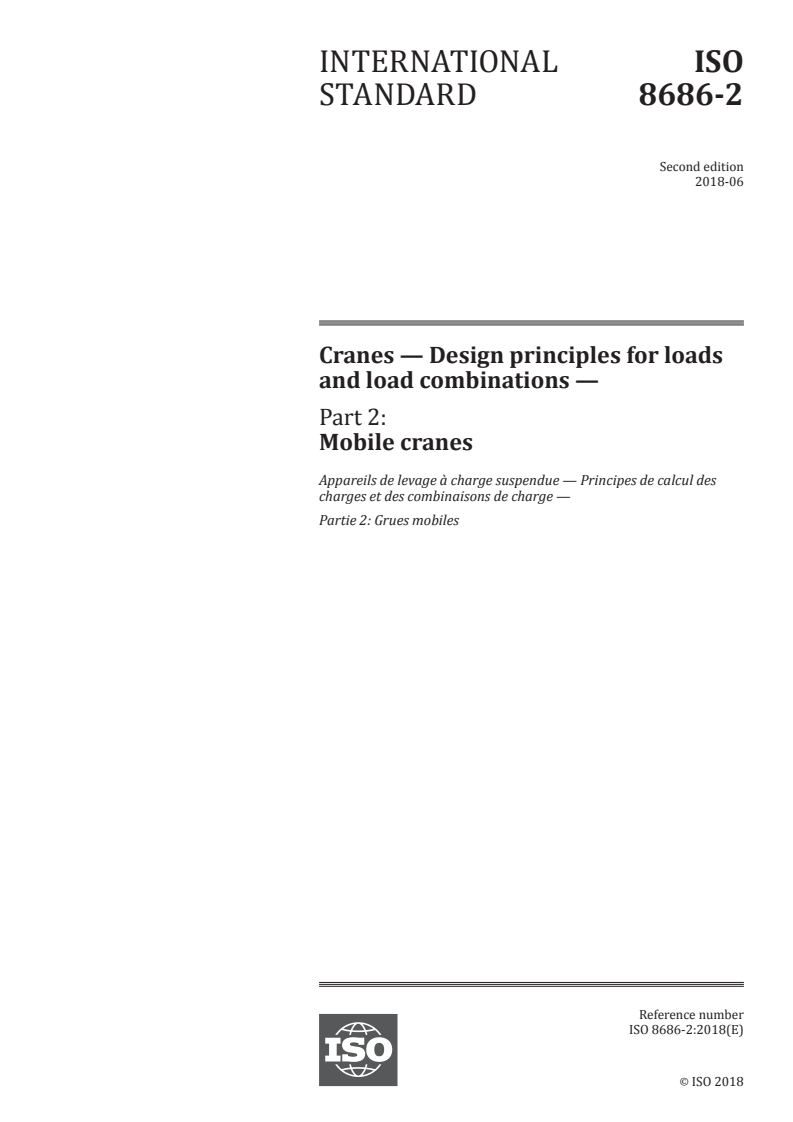
INTERNATIONAL ISO
STANDARD 8686-2
Second edition
2018-06
Cranes — Design principles for loads
and load combinations —
Part 2:
Mobile cranes
Appareils de levage à charge suspendue — Principes de calcul des
charges et des combinaisons de charge —
Partie 2: Grues mobiles
Reference number
©
ISO 2018
© ISO 2018
All rights reserved. Unless otherwise specified, or required in the context of its implementation, no part of this publication may
be reproduced or utilized otherwise in any form or by any means, electronic or mechanical, including photocopying, or posting
on the internet or an intranet, without prior written permission. Permission can be requested from either ISO at the address
below or ISO’s member body in the country of the requester.
ISO copyright office
CP 401 • Ch. de Blandonnet 8
CH-1214 Vernier, Geneva
Phone: +41 22 749 01 11
Fax: +41 22 749 09 47
Email: copyright@iso.org
Website: www.iso.org
Published in Switzerland
ii © ISO 2018 – All rights reserved
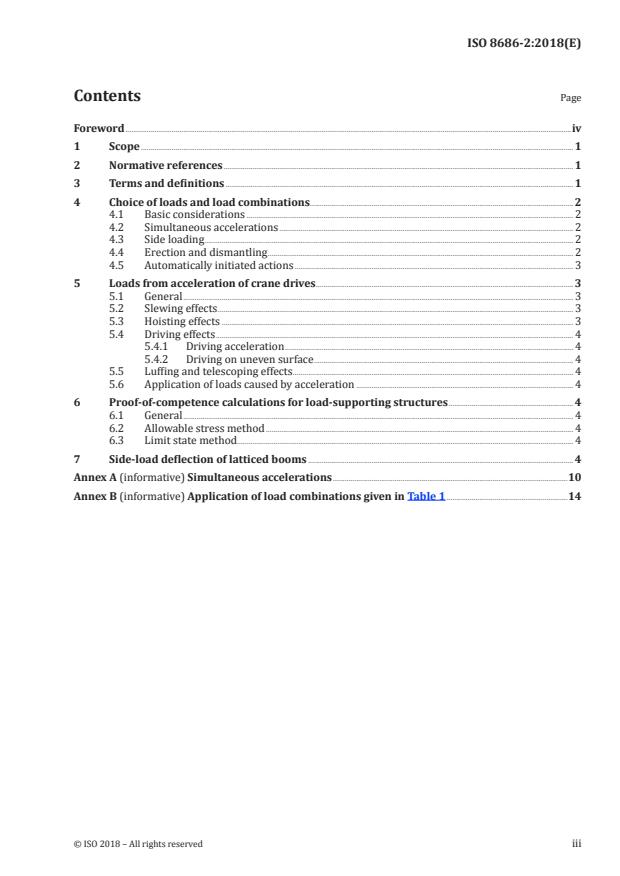
Contents Page
Foreword .iv
1 Scope . 1
2 Normative references . 1
3 Terms and definitions . 1
4 Choice of loads and load combinations . 2
4.1 Basic considerations . 2
4.2 Simultaneous accelerations . 2
4.3 Side loading . 2
4.4 Erection and dismantling . 2
4.5 Automatically initiated actions . 3
5 Loads from acceleration of crane drives . 3
5.1 General . 3
5.2 Slewing effects . 3
5.3 Hoisting effects . 3
5.4 Driving effects . 4
5.4.1 Driving acceleration . 4
5.4.2 Driving on uneven surface . 4
5.5 Luffing and telescoping effects . 4
5.6 Application of loads caused by acceleration . 4
6 Proof-of-competence calculations for load-supporting structures .4
6.1 General . 4
6.2 Allowable stress method . 4
6.3 Limit state method . 4
7 Side-load deflection of latticed booms . 4
Annex A (informative) Simultaneous accelerations .10
Annex B (informative) Application of load combinations given in Table 1 .14
Foreword
ISO (the International Organization for Standardization) is a worldwide federation of national standards
bodies (ISO member bodies). The work of preparing International Standards is normally carried out
through ISO technical committees. Each member body interested in a subject for which a technical
committee has been established has the right to be represented on that committee. International
organizations, governmental and non-governmental, in liaison with ISO, also take part in the work.
ISO collaborates closely with the International Electrotechnical Commission (IEC) on all matters of
electrotechnical standardization.
The procedures used to develop this document and those intended for its further maintenance are
described in the ISO/IEC Directives, Part 1. In particular the different approval criteria needed for the
different types of ISO documents should be noted. This document was drafted in accordance with the
editorial rules of the ISO/IEC Directives, Part 2 (see www .iso .org/directives).
Attention is drawn to the possibility that some of the elements of this document may be the subject of
patent rights. ISO shall not be held responsible for identifying any or all such patent rights. Details of
any patent rights identified during the development of the document will be in the Introduction and/or
on the ISO list of patent declarations received (see www .iso .org/patents).
Any trade name used in this document is information given for the convenience of users and does not
constitute an endorsement.
For an explanation on the voluntary nature of standards, the meaning of ISO specific terms and
expressions related to conformity assessment, as well as information about ISO's adherence to the
World Trade Organization (WTO) principles in the Technical Barriers to Trade (TBT) see the following
URL: www .iso .org/iso/foreword .html.
This document was prepared by Technical Committee ISO/TC 96, Cranes, Subcommittee SC 6, Mobile
cranes.
This second edition cancels and replaces the first edition (ISO 8686-2:2004), which has been technically
revised. The main changes compared to the previous edition are as follows:
— the document has been adapted to ISO 8686-1:2012;
— the Annexes have been renumbered after former Annex A has been deleted;
— Tables 1 and 2 have also been technically revised.
A list of all parts in the ISO 8686 series can be found on the ISO website.
iv © ISO 2018 – All rights reserved
INTERNATIONAL STANDARD ISO 8686-2:2018(E)
Cranes — Design principles for loads and load
combinations —
Part 2:
Mobile cranes
1 Scope
This document applies the principles set forth in ISO 8686-1 to mobile cranes, as defined in ISO 4306-2,
and presents loads and load combinations appropriate for use in proof-of-competence calculations for
the steel structures of mobile cranes.
This document is applicable to mobile cranes used for normal and duty cycle service.
NOTE Means for proof-of-competence testing will be addressed in another document.
2 Normative references
The following documents are referred to in the text in such a way that some or all of their content
constitutes requirements of this document. For dated references, only the edition cited applies. For
undated references, the latest edition of the referenced document (including any amendments) applies.
ISO 4302:2016, Cranes — Wind load assessment
ISO 4306-2, Cranes — Vocabulary — Part 2: Mobile cranes
ISO 4305, Mobile cranes — Determination of stability
ISO 4310, Cranes — Test code and procedures
ISO 8686-1:2012, Cranes — Design principles for loads and load combinations — Part 1: General
ISO 10721-1, Steel structures — Part 1: Materials and design
ISO 10721-2, Steel structures — Part 2: Fabrication and erection
ISO 11662-2, Mobile cranes — Experimental determination of crane performance — Part 2: Structural
competence under static loading
ISO 20332:2016, Cranes — Proof of competence of steel structures
3 Terms and definitions
For the purposes of this document, the terms and definitions given in ISO 4306-2 and the following apply.
ISO and IEC maintain terminological databases for use in standardization at the following addresses:
— ISO Online browsing platform: available at https: //www .iso .org/obp
— IEC Electropedia: available at http: //www .electropedia .org/
3.1
rated capacity
rated load
hoist medium load which includes the mass of lifting attachments
3.2
normal service
hook duties for which fatigue analysis of the steel load-supporting structure is not required
3.3
duty cycle service
repetitive duties for which fatigue analysis of the steel load-supporting structure may be required
EXAMPLE Grab, dragline, magnet or comparable repetitive duty.
4 Choice of loads and load combinations
4.1 Basic considerations
Loads shall be combined with the intention of discovering maximum load effects on mobile crane
components or members during operation, in accordance with the manufacturer’s instructions, as
simulated by elastostatic calculation. To achieve this, the following considerations govern preparation
of proof-of-competence calculations.
a) The crane is taken in its most unfavourable position and configuration, while the loads are assumed
to act in magnitude, position and direction causing unfavourable stresses at the critical points
selected for evaluation on the basis of engineering considerations; and
b) conservatively, loads can be combined at the values defined in this document or, when appropriate,
they can be combined with certain loads, adjusted by reduction factors for the probability of
combined actions to more closely reflect loading conditions currently found in practice.
4.2 Simultaneous accelerations
The effect of one accelerating drive, e.g. slewing, luffing or telescoping, is assumed to act simultaneously
with hoisting acceleration; only two drives are assumed to accelerate simultaneously in the absence of
hoisting acceleration. See Annex A for further information on simultaneous accelerations.
4.3 Side loading
Certain design features may have the effect of inducing side loading on booms. When those features are
present in a design, they shall be included with all applicable load combinations for which calculations
are performed, combined so as to maximize side loading. In addition to slewing and wind effects,
features affecting side loading may include:
a) reeving arrangements that cause the hoist line to deviate from the boom centreline, between the
boom point sheave and the most extreme position on the hoisting drum; and
b) inclination of the boom foot due to deflection of the supporting crane structure.
4.4 Erection and dismantling
An evaluation shall be made for each step in the erection and dismantling processes, as appropriate to
the crane type and configuration, and proof-of-competence calculations shall be carried out for each
instance of significant member or component loading. Calculations shall utilize factors from Table 1 as
given under load combinations B.
2 © ISO 2018 – All rights reserved
4.5 Automatically initiated actions
When mobile cranes are furnished with controls or devices that cut out drives and apply brakes without
an initiating action by the driver, or are furnished with brakes that automatically engage on loss of
power or control function, calculations reflecting those effects shall be carried out under Emergency
cut-out, see column C4.
5 Loads from acceleration of crane drives
5.1 General
Mobile cranes are typically designed to accommodate a range of boom lengths and various extensions
or front-end attachments. Therefore, some cranes can possess excess power in some configurations,
power that crane drivers in practice do not fully utilize (in accordance with the manufacturer’s
instructions). Therefore, in proof-of-competence calculations, the effects acting on the mass of the
crane, either acceleration or deceleration may need to be chosen on the basis of a simulation or tests
rather than on drive or brake characteristics.
5.2 Slewing effects
In practice, slewing acceleration and deceleration rates can vary depending on the front-end attachment
fitted, the operating radius, the control scheme employed, the crane driver’s operating practices, and
the characteristics of the slewing drive and braking mechanisms. For proof-of-competence calculations,
the forces on the mass of the crane and the rated load by slewing acceleration or deceleration which
produce side loading can be taken as follows.
a) For cranes with stepped drive controls and for cranes in which the driver does not have control
over slewing acceleration or deceleration rates, the forces on the mass of the crane and the rated
load shall be calculated from drive/brake characteristics.
b) For cranes with stepless continuously variable drive controls, the forces on the mass of the crane
and the rated load shall be calculated based either on:
1) the highest forces which occur during normal operation as described in the manufacturer’s
instructions; or
2) a simulation or tests; or
3) drive/brake characteristics.
But the resulting lateral force from slewing, applied to the boom tip, shall not be taken less than the
maximum of:
— 1 % of the rated load plus 1 % of the mass of the main boom and jib reduced to the boom head or jib
head (see ISO 4305, ISO 4310); and
— 2 % of the rated load for latticed booms or 3 % for telescopic booms.
5.3 Hoisting effects
5.3.1 Hoisting effects acting on the mass of the crane, except for the rated load itself, shall be calculated
according to ISO 8686-1:2012, 6.1.1 (see also Table 2, line 1)
5.3.2 Hoisting effects acting on the mass of the rated load shall be calculated according to
ISO 8686-1:2012, 6.1.2.
5.4 Driving effects
5.4.1 Driving acceleration
Loads caused by driving acceleration or deceleration, with or without load, shall be estimated from
experience or experiment, or by calculation using an appropriate model for the crane.
5.4.2 Driving on uneven surface
Loads caused by travelling on uneven surface shall be calculated according to ISO 8686-1:2012, 6.1.3
5.5 Luffing and telescoping effects
Loads caused by luffing and telescoping, with or without load, shall be estimated from experience or
experiment, or by calculation using an appropriate model for the crane.
5.6 Application of loads caused by acceleration
The forces on the mass of the crane caused by acceleration are amplified by an appropriate dynamic
amplification factor value, ϕ , according ISO 8686-1:2012, 6.1.4.
6 Proof-of-competence calculations for load-supporting structures
6.1 General
Principally, a proof of fatigue according to ISO 20332 and proof of rigid body stability according to
ISO 4305 shall be performed.
6.2 Allowable stress method
6.2.1 Table 1 gives loads and load combinations for the all
...
Error! Reference source not found.
ISO/TC 96/SC 6
Date: 2017‐02‐3
Deleted: /FDIS
ISO/TC 96/SC 6/WG
Secretariat: ANSI
Cranes — Design principles for loads and load combinations — Part 2: Mobile
cranes
Appareils de levage à charge suspendue — Principes de calcul des charges et des
combinaisons de charge — Partie 2: Grues mobiles
Warning
This document is not an ISO International Standard. It is distributed for review and
comment. It is subject to change without notice and may not be referred to as an
International Standard.
Recipients of this draft are invited to submit, with their comments, notification of any
relevant patent rights of which they are aware and to provide supporting
documentation.
Document type: Error! Reference source not found.
Document subtype: Error! Reference source not found.
Document stage: Error! Reference source not found.
Document language: Error! Reference source not found.
Error! Reference source not found.
Error! Reference source not found.
COPYRIGHT PROTECTED DOCUMENT
All rights reserved. Unless otherwise specified, no part of this publication may be reproduced or
utilized otherwise in any form or by any means, electronic or mechanical, including photocopying,
or posting on the internet or an intranet, without prior written permission. Permission can be
requested from either ISO at the address below or ISO’s member body in the country of the
requester.
ISO copyright office
Ch. de Blandonnet 8 • CP 401
CH‐1214 Vernier, Geneva, Switzerland
Tel. + 41 22 749 01 11
Fax + 41 22 749 09 47
copyright@iso.org
www.iso.org
Error! Reference source not found.
ii
Error! Reference source not found.
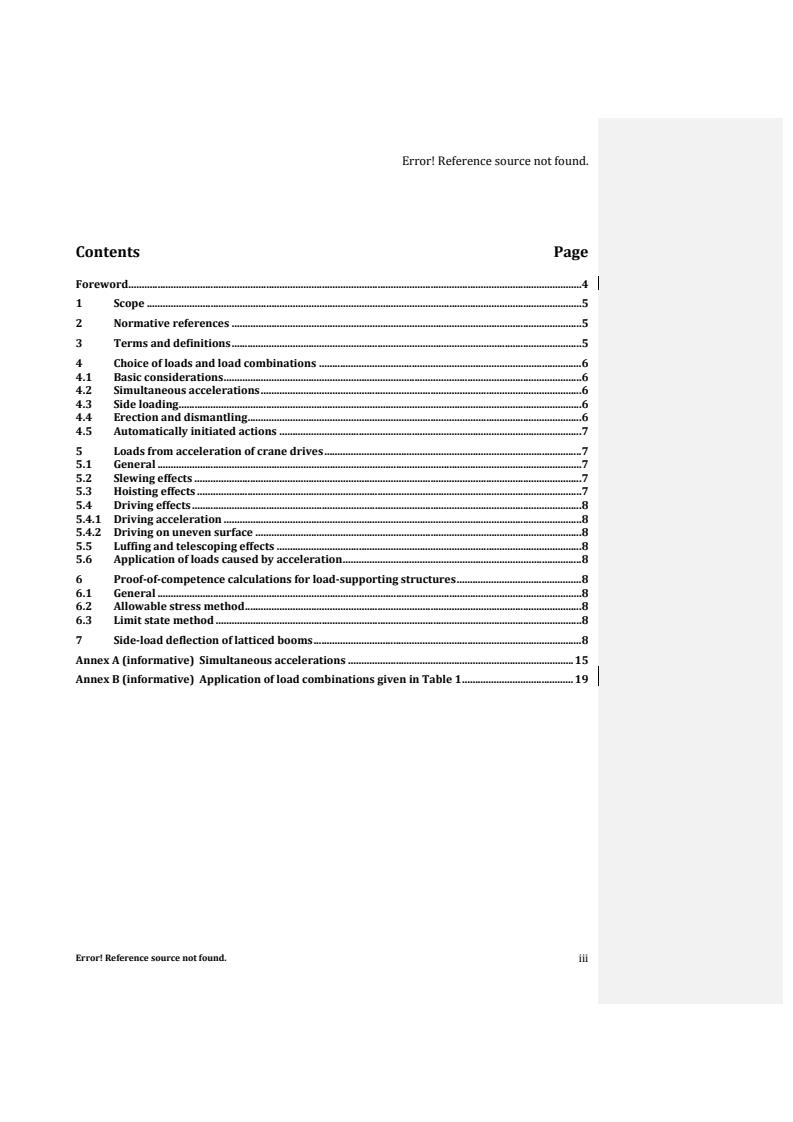
Contents Page
Foreword . 4
1 Scope . 5
2 Normative references . 5
3 Terms and definitions . 5
4 Choice of loads and load combinations . 6
4.1 Basic considerations . 6
4.2 Simultaneous accelerations . 6
4.3 Side loading . 6
4.4 Erection and dismantling . 6
4.5 Automatically initiated actions . 7
5 Loads from acceleration of crane drives . 7
5.1 General . 7
5.2 Slewing effects . 7
5.3 Hoisting effects . 7
5.4 Driving effects . 8
5.4.1 Driving acceleration . 8
5.4.2 Driving on uneven surface . 8
5.5 Luffing and telescoping effects . 8
5.6 Application of loads caused by acceleration . 8
6 Proof-of-competence calculations for load-supporting structures . 8
6.1 General . 8
6.2 Allowable stress method . 8
6.3 Limit state method . 8
7 Side-load deflection of latticed booms . 8
Annex A (informative) Simultaneous accelerations . 15
Annex B (informative) Application of load combinations given in Table 1 . 19
Error! Reference source not found.
iii
Error! Reference source not found.
Foreword
ISO (the International Organization for Standardization) is a worldwide federation of national
standards bodies (ISO member bodies). The work of preparing International Standards is normally
carried out through ISO technical committees. Each member body interested in a subject for which a
technical committee has been established has the right to be represented on that committee.
International organizations, governmental and non‐governmental, in liaison with ISO, also take part in
the work. ISO collaborates closely with the International Electrotechnical Commission (IEC) on all
matters of electrotechnical standardization. Deleted:
The procedures used to develop this document and those intended for its further maintenance are
described in the ISO/IEC Directives, Part 1. In particular the different approval criteria needed for the
different types of ISO documents should be noted. This document was drafted in accordance with the
editorial rules of the ISO/IEC Directives, Part 2 (see www.iso.org/directives).
Attention is drawn to the possibility that some of the elements of this document may be the subject of
patent rights. ISO shall not be held responsible for identifying any or all such patent rights. Details of
any patent rights identified during the development of the document will be in the Introduction and/or
on the ISO list of patent declarations received (see www.iso.org/patents).
Any trade name used in this document is information given for the convenience of users and does not
constitute an endorsement. Deleted:
For an explanation on the voluntary nature of standards, the meaning of ISO specific terms and
expressions related to conformity assessment, as well as information about ISO's adherence to the
World Trade Organization (WTO) principles in the Technical Barriers to Trade (TBT) see the following
URL: www.iso.org/iso/foreword.html.
This document was prepared by Technical Committee ISO/TC 96, Cranes, Subcommittee SC 6, Mobile
cranes.
This second edition cancels and replaces the first edition (ISO 8686‐2:2004), which has been technically
revised. The main changes compared to the previous edition are as follows:
— the document has been adapted to ISO 8686‐1:2012;
— the Annexes have been renumbered after former Annex A has been deleted;
— Tables 1 and 2 have also been technically revised.
A list of all parts in the ISO 8686 series can be found on the ISO website.
Error! Reference source not found.
iv
Deleted: FINAL
Error! Reference source not found. Error! Reference source not found.
Cranes — Design principles for loads and load
combinations — Part 2: Mobile cranes
1 Scope
This document applies the principles set forth in ISO 8686‐1 to mobile cranes, as defined in ISO 4306‐2,
and presents loads and load combinations appropriate for use in proof‐of‐competence calculations for
the steel structures of mobile cranes.
This document is applicable to mobile cranes used for normal and duty cycle service.
NOTE Means for proof‐of‐competence testing will be addressed in another document.
2 Normative references
The following documents are referred to in the text in such a way that some or all of their content
constitutes requirements of this document. For dated references, only the edition cited applies. For
undated references, the latest edition of the referenced document (including any amendments) applies.
ISO 4302:2016, Cranes — Wind load assessment
ISO 4306‐2, Cranes — Vocabulary — Part 2: Mobile cranes
ISO 4305, Mobile cranes — Determination of stability
ISO 4310, Cranes — Test code and procedures
ISO 8686‐1:2012, Cranes — Design principles for loads and load combinations — Part 1: General
ISO 10721‐1, Steel structures — Part 1: Materials and design
ISO 10721‐2, Steel structures — Part 2: Fabrication and erection
ISO 11662‐2, Mobile cranes — Experimental determination of crane performance — Part 2: Structural
competence under static loading
ISO 20332:2016, Cranes — Proof of competence of steel structures
3 Terms and definitions
For the purposes of this document, the terms and definitions given in ISO 4306‐2 and the following
apply.
ISO and IEC maintain terminological databases for use in standardization at the following addresses:
— ISO Online browsing platform: available at https://www.iso.org/obp
— IEC Electropedia: available at http://www.electropedia.org/
Error! Reference source not found.
Error! Reference source not found.
3.1
rated capacity
rated load
hoist medium load which includes the mass of lifting attachments
3.2
normal service
hook duties for which fatigue analysis of the steel load‐supporting structure is not required
3.3
duty cycle service
repetitive duties for which fatigue analysis of the steel load‐supporting structure may be required
EXAMPLE Grab, dragline, magnet or comparable repetitive duty.
4 Choice of loads and load combinations
4.1 Basic considerations
Loads shall be combined with the intention of discovering maximum load effects on mobile crane
components or members during operation, in accordance with the manufacturer’s instructions, as
simulated by elastostatic calculation. To achieve this, the following considerations govern preparation
of proof‐of‐competence calculations.
a) The crane is taken in its most unfavourable position and configuration, while the loads are assumed
to act in magnitude, position and direction causing unfavourable stresses at the critical points
selected for evaluation on the basis of engineering considerations; and
b) conservatively, loads can be combined at the values defined in this document or, when appropriate,
they can be combined with certain loads, adjusted by reduction factors for the probability of
combined actions to more closely reflect loading conditions currently found in practice.
4.2 Simultaneous accelerations
The effect of one accelerating drive, e.g. slewing, luffing or telescoping, is assumed to act simultaneously
with hoisting acceleration; only two drives are assumed to accelerate simultaneously in the absence of
hoisting acceleration. See Annex A for further information on simultaneous accelerations.
4.3 Side loading
Certain design features may have the effect of inducing side loading on booms. When those features are
present in a design, they shall be included with all applicable load combinations for which calculations
are performed, combined so as to maximize side loading. In addition to slewing and wind effects,
features affecting side loading may include:
a) reeving arrangements that cause the hoist line to deviate from the boom centreline, between the
boom point sheave and the most extreme position on the hoisting drum; and
b) inclination of the boom foot due to deflection of the supporting crane structure.
4.4 Erection and dismantling
An evaluation shall be made for each step in the erection and dismantling processes, as appropriate to
the crane type and configuration, and proof‐of‐competence calculations shall be carried out for each
Error! Reference source not found.
Error! Reference source not found.
instance of significant member or component loading. Calculations shall utilize factors from Table 1 as
given under load combinations B.
4.5 Automatically initiated actions
When mobile cranes are furnished with controls or devices that cut out drives and apply brakes without
an initiating action by the driver, or are furnished with brakes that automatically engage on loss of
power or control function, calculations reflecting those effects shall be carried out under Emergency
cut‐out, see column C4.
5 Loads from acceleration of crane drives
5.1 General
Mobile cranes are typically designed to accommodate a range of boom lengths and various extensions
or front‐end attachments. Therefore, some cranes can possess excess power in some configurations,
power that crane drivers in practice do not fully utilize (in accordance with the manufacturer’s
instructions). Therefore, in proof‐of‐competence calculations, the effects acting on the mass of the
crane, either acceleration or deceleration may need to be chosen on the basis of a simulation or tests
rather than on drive or brake characteristics.
5.2 Slewing effects
In practice, slewing acceleration and deceleration rates can vary depending on the front‐end
attachment fitted, the operating radius, the control scheme employed, the crane driver’s operating
practices, and the characteristics of the slewing drive and braking mechanisms. For proof‐of‐
competence calculations, the forces on the mass of the crane and the rated load by slewing acceleration
or deceleration which produce side loading can be taken as follows.
a) For cranes with stepped drive controls and for cranes in which the driver does not have control
over slewing acceleration or deceleration rates, the forces on the mass of the crane and the rated
load shall be calculated from drive/brake characteristics.
b) For cranes with stepless continuously variable drive controls, the forces on the mass of the crane
and the rated load shall be calculated based either on:
1) the highest forces which occur during normal operation as described in the manufacturer’s
instructions; or
2) a simulation or tests; or
3) drive/brake characteristics.
But the resulting lateral force from slewing, applied to the boom tip, shall not be taken less than the
maximum of:
— 1 % of the rated load plus 1 % of the mass of the main boom and jib reduced to the boom head or
jib head (see ISO 4305, ISO 4310); and
— 2 % of the rated load for latticed booms or 3 % for telescopic booms.
5.3 Hoisting effects
5.3.1 Hoisting effects acting on the mass of the crane, except for the rated load itself, shall be
calculated according to ISO 8686‐1:2012, 6.1.1 (see also Table 2, line 1)
Error! Reference source not found.
Error! Reference source not found.
5.3.2 Hoisting effects acting on the mass of the rated load shall be calculated according to
ISO 8686‐1:2012, 6.1.2.
5.4 Driving effects
5.4.1 Driving acceleration
Loads caused by driving acceleration or deceleration, with or without load, shall be estimated from
experience or experiment, or by calculation using an appropriate model for the crane.
5.4.2 Driving on uneven surface
Loads caused by travelling on uneven surface shall be calculated according to ISO 8686‐1:2012, 6.1.3
5.5 Luffing and telescoping effects
Loads caused by luffing and telescoping, with or without load, shall be estimated from experience or
experiment, or by calculation using an appropriate model for the crane.
5.6 Application of loads caused by acceleration
The forces on the mass of the crane caused by acceleration are amplified by an appropriate dynamic
amplification factor value, ϕ , according ISO 8686‐1:2012, 6.1.4.
6 Proof-of-competence calculations for load-supporting structures
6.1 General
Principally, a proof of fatigue according to ISO 20332 and proof of rigid body stability according to
ISO 4305 shall be performed.
6.2 Allowable stress method
6.2.1 Table 1 gives loads and load combinations for the allowable stress method, together with an
overall strength coefficient γf and dynamic amplification factors, ϕn. Table 2 gives values for the factors
ϕn and other pertinent load information.
6.2.2 For members under axial compression, the overall strength coefficient, γ, given in Table 1 shall
f
only be used in conjunction with a column formula (or curve) from ISO 10721‐1 or ISO 10721‐2.
6.3 Limit state method
6.3.1 Table 1 gives loads and load combinations for the limit state method,
...
INTERNATIONAL ISO
STANDARD 8686-2
Second edition
2018-06
Cranes — Design principles for loads
and load combinations —
Part 2:
Mobile cranes
Appareils de levage à charge suspendue — Principes de calcul des
charges et des combinaisons de charge —
Partie 2: Grues mobiles
Reference number
©
ISO 2018
© ISO 2018
All rights reserved. Unless otherwise specified, or required in the context of its implementation, no part of this publication may
be reproduced or utilized otherwise in any form or by any means, electronic or mechanical, including photocopying, or posting
on the internet or an intranet, without prior written permission. Permission can be requested from either ISO at the address
below or ISO’s member body in the country of the requester.
ISO copyright office
CP 401 • Ch. de Blandonnet 8
CH-1214 Vernier, Geneva
Phone: +41 22 749 01 11
Fax: +41 22 749 09 47
Email: copyright@iso.org
Website: www.iso.org
Published in Switzerland
ii © ISO 2018 – All rights reserved
Contents Page
Foreword .iv
1 Scope . 1
2 Normative references . 1
3 Terms and definitions . 1
4 Choice of loads and load combinations . 2
4.1 Basic considerations . 2
4.2 Simultaneous accelerations . 2
4.3 Side loading . 2
4.4 Erection and dismantling . 2
4.5 Automatically initiated actions . 3
5 Loads from acceleration of crane drives . 3
5.1 General . 3
5.2 Slewing effects . 3
5.3 Hoisting effects . 3
5.4 Driving effects . 4
5.4.1 Driving acceleration . 4
5.4.2 Driving on uneven surface . 4
5.5 Luffing and telescoping effects . 4
5.6 Application of loads caused by acceleration . 4
6 Proof-of-competence calculations for load-supporting structures .4
6.1 General . 4
6.2 Allowable stress method . 4
6.3 Limit state method . 4
7 Side-load deflection of latticed booms . 4
Annex A (informative) Simultaneous accelerations .10
Annex B (informative) Application of load combinations given in Table 1 .14
Foreword
ISO (the International Organization for Standardization) is a worldwide federation of national standards
bodies (ISO member bodies). The work of preparing International Standards is normally carried out
through ISO technical committees. Each member body interested in a subject for which a technical
committee has been established has the right to be represented on that committee. International
organizations, governmental and non-governmental, in liaison with ISO, also take part in the work.
ISO collaborates closely with the International Electrotechnical Commission (IEC) on all matters of
electrotechnical standardization.
The procedures used to develop this document and those intended for its further maintenance are
described in the ISO/IEC Directives, Part 1. In particular the different approval criteria needed for the
different types of ISO documents should be noted. This document was drafted in accordance with the
editorial rules of the ISO/IEC Directives, Part 2 (see www .iso .org/directives).
Attention is drawn to the possibility that some of the elements of this document may be the subject of
patent rights. ISO shall not be held responsible for identifying any or all such patent rights. Details of
any patent rights identified during the development of the document will be in the Introduction and/or
on the ISO list of patent declarations received (see www .iso .org/patents).
Any trade name used in this document is information given for the convenience of users and does not
constitute an endorsement.
For an explanation on the voluntary nature of standards, the meaning of ISO specific terms and
expressions related to conformity assessment, as well as information about ISO's adherence to the
World Trade Organization (WTO) principles in the Technical Barriers to Trade (TBT) see the following
URL: www .iso .org/iso/foreword .html.
This document was prepared by Technical Committee ISO/TC 96, Cranes, Subcommittee SC 6, Mobile
cranes.
This second edition cancels and replaces the first edition (ISO 8686-2:2004), which has been technically
revised. The main changes compared to the previous edition are as follows:
— the document has been adapted to ISO 8686-1:2012;
— the Annexes have been renumbered after former Annex A has been deleted;
— Tables 1 and 2 have also been technically revised.
A list of all parts in the ISO 8686 series can be found on the ISO website.
iv © ISO 2018 – All rights reserved
INTERNATIONAL STANDARD ISO 8686-2:2018(E)
Cranes — Design principles for loads and load
combinations —
Part 2:
Mobile cranes
1 Scope
This document applies the principles set forth in ISO 8686-1 to mobile cranes, as defined in ISO 4306-2,
and presents loads and load combinations appropriate for use in proof-of-competence calculations for
the steel structures of mobile cranes.
This document is applicable to mobile cranes used for normal and duty cycle service.
NOTE Means for proof-of-competence testing will be addressed in another document.
2 Normative references
The following documents are referred to in the text in such a way that some or all of their content
constitutes requirements of this document. For dated references, only the edition cited applies. For
undated references, the latest edition of the referenced document (including any amendments) applies.
ISO 4302:2016, Cranes — Wind load assessment
ISO 4306-2, Cranes — Vocabulary — Part 2: Mobile cranes
ISO 4305, Mobile cranes — Determination of stability
ISO 4310, Cranes — Test code and procedures
ISO 8686-1:2012, Cranes — Design principles for loads and load combinations — Part 1: General
ISO 10721-1, Steel structures — Part 1: Materials and design
ISO 10721-2, Steel structures — Part 2: Fabrication and erection
ISO 11662-2, Mobile cranes — Experimental determination of crane performance — Part 2: Structural
competence under static loading
ISO 20332:2016, Cranes — Proof of competence of steel structures
3 Terms and definitions
For the purposes of this document, the terms and definitions given in ISO 4306-2 and the following apply.
ISO and IEC maintain terminological databases for use in standardization at the following addresses:
— ISO Online browsing platform: available at https: //www .iso .org/obp
— IEC Electropedia: available at http: //www .electropedia .org/
3.1
rated capacity
rated load
hoist medium load which includes the mass of lifting attachments
3.2
normal service
hook duties for which fatigue analysis of the steel load-supporting structure is not required
3.3
duty cycle service
repetitive duties for which fatigue analysis of the steel load-supporting structure may be required
EXAMPLE Grab, dragline, magnet or comparable repetitive duty.
4 Choice of loads and load combinations
4.1 Basic considerations
Loads shall be combined with the intention of discovering maximum load effects on mobile crane
components or members during operation, in accordance with the manufacturer’s instructions, as
simulated by elastostatic calculation. To achieve this, the following considerations govern preparation
of proof-of-competence calculations.
a) The crane is taken in its most unfavourable position and configuration, while the loads are assumed
to act in magnitude, position and direction causing unfavourable stresses at the critical points
selected for evaluation on the basis of engineering considerations; and
b) conservatively, loads can be combined at the values defined in this document or, when appropriate,
they can be combined with certain loads, adjusted by reduction factors for the probability of
combined actions to more closely reflect loading conditions currently found in practice.
4.2 Simultaneous accelerations
The effect of one accelerating drive, e.g. slewing, luffing or telescoping, is assumed to act simultaneously
with hoisting acceleration; only two drives are assumed to accelerate simultaneously in the absence of
hoisting acceleration. See Annex A for further information on simultaneous accelerations.
4.3 Side loading
Certain design features may have the effect of inducing side loading on booms. When those features are
present in a design, they shall be included with all applicable load combinations for which calculations
are performed, combined so as to maximize side loading. In addition to slewing and wind effects,
features affecting side loading may include:
a) reeving arrangements that cause the hoist line to deviate from the boom centreline, between the
boom point sheave and the most extreme position on the hoisting drum; and
b) inclination of the boom foot due to deflection of the supporting crane structure.
4.4 Erection and dismantling
An evaluation shall be made for each step in the erection and dismantling processes, as appropriate to
the crane type and configuration, and proof-of-competence calculations shall be carried out for each
instance of significant member or component loading. Calculations shall utilize factors from Table 1 as
given under load combinations B.
2 © ISO 2018 – All rights reserved
4.5 Automatically initiated actions
When mobile cranes are furnished with controls or devices that cut out drives and apply brakes without
an initiating action by the driver, or are furnished with brakes that automatically engage on loss of
power or control function, calculations reflecting those effects shall be carried out under Emergency
cut-out, see column C4.
5 Loads from acceleration of crane drives
5.1 General
Mobile cranes are typically designed to accommodate a range of boom lengths and various extensions
or front-end attachments. Therefore, some cranes can possess excess power in some configurations,
power that crane drivers in practice do not fully utilize (in accordance with the manufacturer’s
instructions). Therefore, in proof-of-competence calculations, the effects acting on the mass of the
crane, either acceleration or deceleration may need to be chosen on the basis of a simulation or tests
rather than on drive or brake characteristics.
5.2 Slewing effects
In practice, slewing acceleration and deceleration rates can vary depending on the front-end attachment
fitted, the operating radius, the control scheme employed, the crane driver’s operating practices, and
the characteristics of the slewing drive and braking mechanisms. For proof-of-competence calculations,
the forces on the mass of the crane and the rated load by slewing acceleration or deceleration which
produce side loading can be taken as follows.
a) For cranes with stepped drive controls and for cranes in which the driver does not have control
over slewing acceleration or deceleration rates, the forces on the mass of the crane and the rated
load shall be calculated from drive/brake characteristics.
b) For cranes with stepless continuously variable drive controls, the forces on the mass of the crane
and the rated load shall be calculated based either on:
1) the highest forces which occur during normal operation as described in the manufacturer’s
instructions; or
2) a simulation or tests; or
3) drive/brake characteristics.
But the resulting lateral force from slewing, applied to the boom tip, shall not be taken less than the
maximum of:
— 1 % of the rated load plus 1 % of the mass of the main boom and jib reduced to the boom head or jib
head (see ISO 4305, ISO 4310); and
— 2 % of the rated load for latticed booms or 3 % for telescopic booms.
5.3 Hoisting effects
5.3.1 Hoisting effects acting on the mass of the crane, except for the rated load itself, shall be calculated
according to ISO 8686-1:2012, 6.1.1 (see also Table 2, line 1)
5.3.2 Hoisting effects acting on the mass of the rated load shall be calculated according to
ISO 8686-1:2012, 6.1.2.
5.4 Driving effects
5.4.1 Driving acceleration
Loads caused by driving acceleration or deceleration, with or without load, shall be estimated from
experience or experiment, or by calculation using an appropriate model for the crane.
5.4.2 Driving on uneven surface
Loads caused by travelling on uneven surface shall be calculated according to ISO 8686-1:2012, 6.1.3
5.5 Luffing and telescoping effects
Loads caused by luffing and telescoping, with or without load, shall be estimated from experience or
experiment, or by calculation using an appropriate model for the crane.
5.6 Application of loads caused by acceleration
The forces on the mass of the crane caused by acceleration are amplified by an appropriate dynamic
amplification factor value, ϕ , according ISO 8686-1:2012, 6.1.4.
6 Proof-of-competence calculations for load-supporting structures
6.1 General
Principally, a proof of fatigue according to ISO 20332 and proof of rigid body stability according to
ISO 4305 shall be performed.
6.2 Allowable stress method
6.2.1 Table 1 gives loads and load combinations for the all
...