

ISO 3483:2023
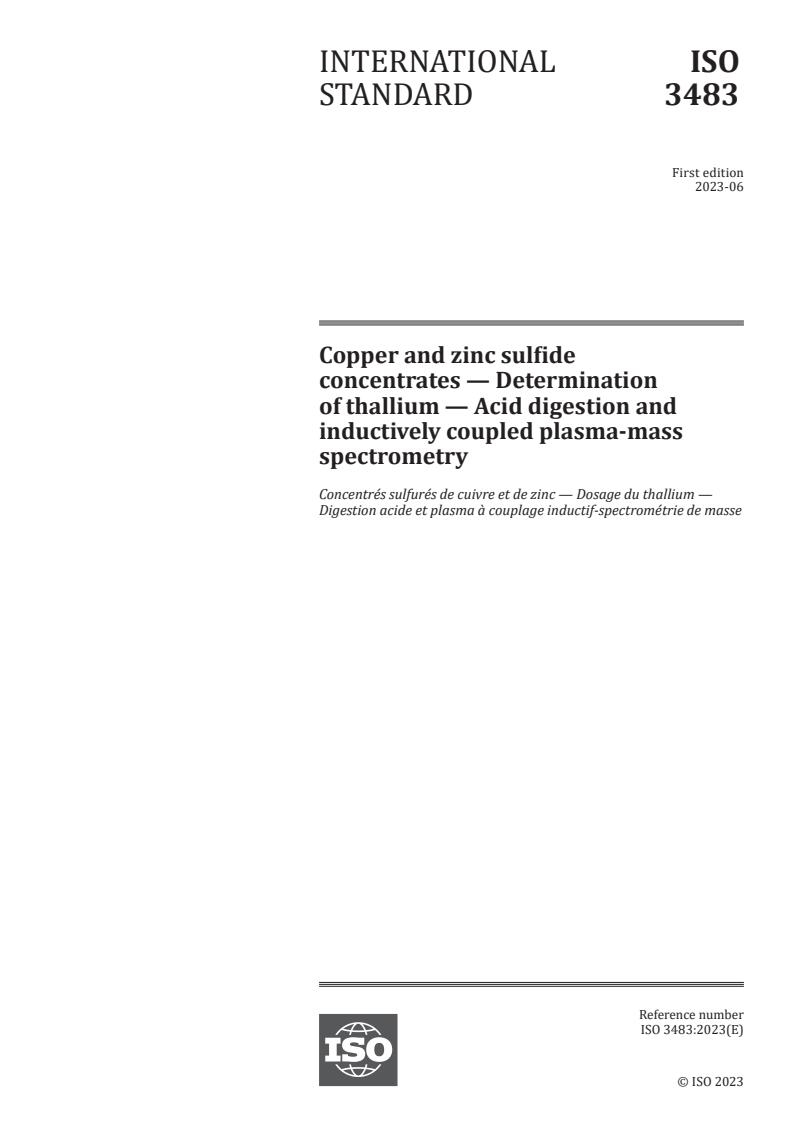
(Main)Copper and zinc sulfide concentrates — Determination of thallium — Acid digestion and inductively coupled plasma-mass spectrometry
General Information
- Abstract
This Document specifies an acid digestion and inductively coupled plasma mass spectrometry (ICP-MS) procedure for determination of the mass fraction of thallium in copper and zinc sulfide concentrates as follows. a) For copper sulfide concentrates, the method is applicable to the determination of mass fractions of thallium from 0,000 1 % to 0,002 5 %. b) For zinc sulfide concentrates, the method is applicable to the determination of mass fractions of thallium from 0,000 1 % to 0,025 %.
- Status
- Published
- Publication Date
- 25-Jun-2023
- Technical Committee
- ISO/TC 183 - Copper, lead, zinc and nickel ores and concentrates
- Drafting Committee
- ISO/TC 183 - Copper, lead, zinc and nickel ores and concentrates
- Current Stage
- 6060 - International Standard published
- Start Date
- 26-Jun-2023
- Due Date
- 06-Jul-2023
- Completion Date
- 26-Jun-2023
Overview
ISO 3483:2023 specifies an acid digestion and ICP‑MS procedure for the quantitative determination of thallium (Tl) in copper and zinc sulfide concentrates. The method uses a multi‑acid decomposition (HCl, HNO3, HF, HClO4) followed by inductively coupled plasma mass spectrometry (ICP‑MS) with iridium (Ir) as an internal standard. Applicable concentration ranges are:
- Copper sulfide concentrates: 0.0001 % to 0.0025 % Tl
- Zinc sulfide concentrates: 0.0001 % to 0.025 % Tl
ISO 3483:2023 is intended for laboratories performing routine thallium determination as part of mineral analysis, quality control and regulatory compliance.
Key Topics and Requirements
- Analytical principle: Acid digestion of a test portion, removal of volatile fumes, dilution and measurement by ICP‑MS using a constant Ir internal standard.
- Reagents and standards: Specifies reagent grades (HCl, HNO3, HF, HClO4, H2O2) and preparation of thallium and iridium standard solutions (including 100 ng/ml, 10 µg/ml, 100 µg/ml Tl standards and 1 µg/ml Ir internal standard).
- Apparatus: Standard laboratory glassware (class A volumetrics), PTFE digestion beaker, analytical balance (0.1 mg), and a properly configured ICP‑MS (Tl and Ir mass settings).
- Sampling and sample prep: Laboratory and test sample preparation in accordance with ISO 12743 (sampling) and ISO 9599 (hygroscopic moisture); option for pre‑dried test portions (Annex A).
- Quality control: Blank tests, duplicate determinations (minimum duplicate), calibration curve preparation, and procedures for precision, repeatability and between‑laboratory checks.
- Safety: Warning about hazardous acids and high‑temperature digestion-users must establish appropriate health and safety practices.
Applications and Users
ISO 3483:2023 is practical for:
- Mining and mineral processing laboratories analysing thallium in sulfide concentrates
- Commercial analytical labs performing contract assays for metal content and impurities
- Quality assurance/quality control (QA/QC) teams monitoring concentrate specifications
- Environmental and regulatory testing where Tl content in concentrates is relevant to downstream processing or compliance
Benefits include improved comparability of results between labs, traceable calibration procedures, and defined detection ranges for Tl in copper and zinc concentrates.
Related Standards
- ISO 12743 - Sampling procedures for concentrates
- ISO 9599 - Determination of hygroscopic moisture content
- ISO/GUIDE 35 - Reference materials principles
- ISO 385 / ISO 648 / ISO 1042 / ISO 4787 - Laboratory glassware and volumetric instrument standards
Keywords: ISO 3483, thallium determination, ICP‑MS, acid digestion, copper sulfide concentrates, zinc sulfide concentrates, analytical method, laboratory procedure, thallium analysis.
Get Certified
Connect with accredited certification bodies for this standard

Bureau Veritas Chile
Bureau Veritas certification services in Chile.
Bureau Veritas Peru
Bureau Veritas certification services in Peru.
BVQI Peru
Bureau Veritas certification in Peru.
Sponsored listings
Frequently Asked Questions
ISO 3483:2023 is a standard published by the International Organization for Standardization (ISO). Its full title is "Copper and zinc sulfide concentrates — Determination of thallium — Acid digestion and inductively coupled plasma-mass spectrometry". This standard covers: This Document specifies an acid digestion and inductively coupled plasma mass spectrometry (ICP-MS) procedure for determination of the mass fraction of thallium in copper and zinc sulfide concentrates as follows. a) For copper sulfide concentrates, the method is applicable to the determination of mass fractions of thallium from 0,000 1 % to 0,002 5 %. b) For zinc sulfide concentrates, the method is applicable to the determination of mass fractions of thallium from 0,000 1 % to 0,025 %.
This Document specifies an acid digestion and inductively coupled plasma mass spectrometry (ICP-MS) procedure for determination of the mass fraction of thallium in copper and zinc sulfide concentrates as follows. a) For copper sulfide concentrates, the method is applicable to the determination of mass fractions of thallium from 0,000 1 % to 0,002 5 %. b) For zinc sulfide concentrates, the method is applicable to the determination of mass fractions of thallium from 0,000 1 % to 0,025 %.
ISO 3483:2023 is classified under the following ICS (International Classification for Standards) categories: 73.060.99 - Other metalliferous minerals. The ICS classification helps identify the subject area and facilitates finding related standards.
ISO 3483:2023 is available in PDF format for immediate download after purchase. The document can be added to your cart and obtained through the secure checkout process. Digital delivery ensures instant access to the complete standard document.
Standards Content (Sample)
INTERNATIONAL ISO
STANDARD 3483
First edition
2023-06
Copper and zinc sulfide
concentrates — Determination
of thallium — Acid digestion and
inductively coupled plasma-mass
spectrometry
Concentrés sulfurés de cuivre et de zinc — Dosage du thallium —
Digestion acide et plasma à couplage inductif-spectrométrie de masse
Reference number
© ISO 2023
All rights reserved. Unless otherwise specified, or required in the context of its implementation, no part of this publication may
be reproduced or utilized otherwise in any form or by any means, electronic or mechanical, including photocopying, or posting on
the internet or an intranet, without prior written permission. Permission can be requested from either ISO at the address below
or ISO’s member body in the country of the requester.
ISO copyright office
CP 401 • Ch. de Blandonnet 8
CH-1214 Vernier, Geneva
Phone: +41 22 749 01 11
Email: copyright@iso.org
Website: www.iso.org
Published in Switzerland
ii
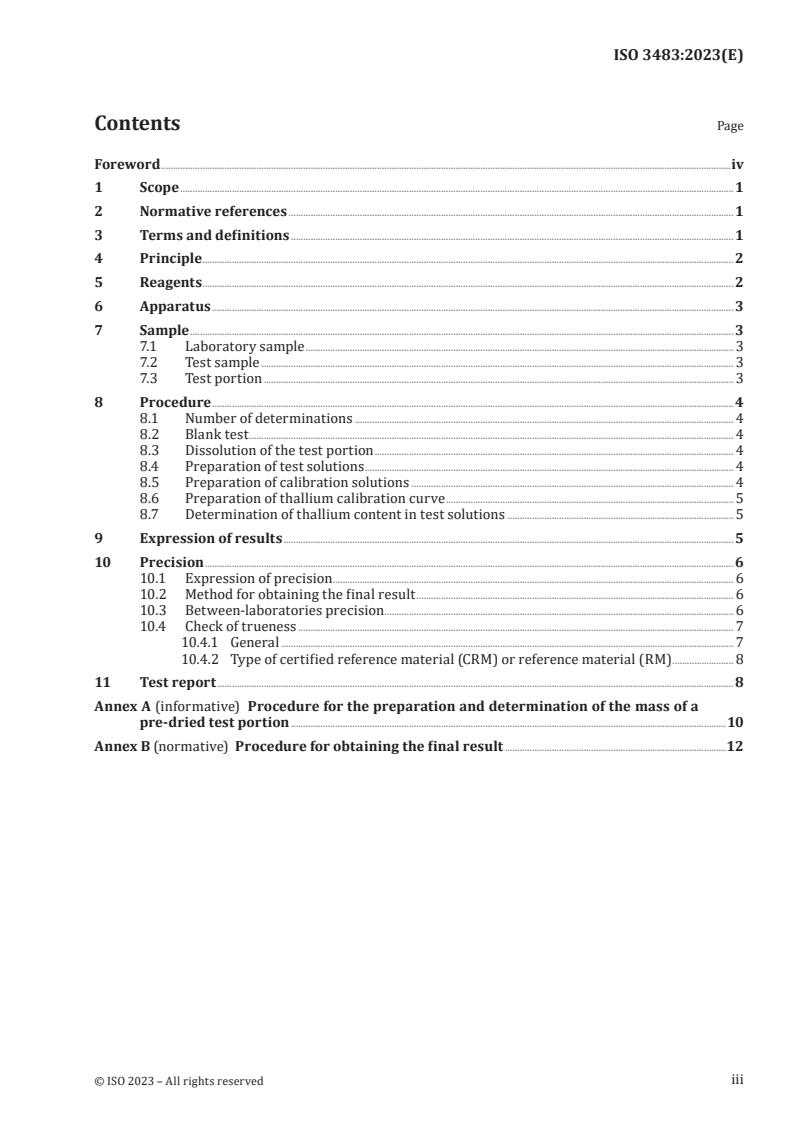
Contents Page
Foreword .iv
1 Scope . 1
2 Normative references . 1
3 Terms and definitions . 1
4 Principle . 2
5 Reagents . 2
6 Apparatus . 3
7 Sample . 3
7.1 Laboratory sample . 3
7.2 Test sample . 3
7.3 Test portion . 3
8 Procedure .4
8.1 Number of determinations . 4
8.2 Blank test . 4
8.3 Dissolution of the test portion . 4
8.4 Preparation of test solutions . . 4
8.5 Preparation of calibration solutions . 4
8.6 Preparation of thallium calibration curve . 5
8.7 Determination of thallium content in test solutions . 5
9 Expression of results . 5
10 Precision . 6
10.1 Expression of precision . 6
10.2 Method for obtaining the final result . 6
10.3 Between-laboratories precision . . 6
10.4 Check of trueness . 7
10.4.1 General . 7
10.4.2 Type of certified reference material (CRM) or reference material (RM). 8
11 Test report . 8
Annex A (informative) Procedure for the preparation and determination of the mass of a
pre-dried test portion .10
Annex B (normative) Procedure for obtaining the final result .12
iii
Foreword
ISO (the International Organization for Standardization) is a worldwide federation of national standards
bodies (ISO member bodies). The work of preparing International Standards is normally carried out
through ISO technical committees. Each member body interested in a subject for which a technical
committee has been established has the right to be represented on that committee. International
organizations, governmental and non-governmental, in liaison with ISO, also take part in the work.
ISO collaborates closely with the International Electrotechnical Commission (IEC) on all matters of
electrotechnical standardization.
The procedures used to develop this document and those intended for its further maintenance are
described in the ISO/IEC Directives, Part 1. In particular, the different approval criteria needed for the
different types of ISO document should be noted. This document was drafted in accordance with the
editorial rules of the ISO/IEC Directives, Part 2 (see www.iso.org/directives).
ISO draws attention to the possibility that the implementation of this document may involve the use
of (a) patent(s). ISO takes no position concerning the evidence, validity or applicability of any claimed
patent rights in respect thereof. As of the date of publication of this document, ISO had not received
notice of (a) patent(s) which may be required to implement this document. However, implementers are
cautioned that this may not represent the latest information, which may be obtained from the patent
database available at www.iso.org/patents. ISO shall not be held responsible for identifying any or all
such patent rights.
Any trade name used in this document is information given for the convenience of users and does not
constitute an endorsement.
For an explanation of the voluntary nature of standards, the meaning of ISO specific terms and
expressions related to conformity assessment, as well as information about ISO's adherence to
the World Trade Organization (WTO) principles in the Technical Barriers to Trade (TBT), see
www.iso.org/iso/foreword.html.
This document was prepared by Technical Committee ISO/TC 183, Copper, lead, zinc and nickel ores and
concentrates.
Any feedback or questions on this document should be directed to the user’s national standards body. A
complete listing of these bodies can be found at www.iso.org/members.html.
iv
INTERNATIONAL STANDARD ISO 3483:2023(E)
Copper and zinc sulfide concentrates — Determination of
thallium — Acid digestion and inductively coupled plasma-
mass spectrometry
WARNING — This Document may involve hazardous materials, operations and equipment.
It is the responsibility of the user of this document to establish appropriate health and safety
practices prior to use.
1 Scope
This Document specifies an acid digestion and inductively coupled plasma mass spectrometry (ICP-MS)
procedure for determination of the mass fraction of thallium in copper and zinc sulfide concentrates as
follows.
a) For copper sulfide concentrates, the method is applicable to the determination of mass fractions of
thallium from 0,000 1 % to 0,002 5 %.
b) For zinc sulfide concentrates, the method is applicable to the determination of mass fractions of
thallium from 0,000 1 % to 0,025 %.
2 Normative references
The following documents are referred to in the text in such a way that some or all of their content
constitutes requirements of this document. For dated references, only the edition cited applies. For
undated references, the latest edition of the referenced document (including any amendments) applies.
ISO 385, Laboratory glassware — Burettes
ISO 648, Laboratory glassware — Single-volume pipettes
ISO 1042, Laboratory glassware — One-mark volumetric flasks
ISO 4787, Laboratory glass and plastic ware — Volumetric instruments — Methods for testing of capacity
and for use
ISO 9599, Copper, lead, zinc and nickel sulfide concentrates — Determination of hygroscopic moisture
content of the analysis sample — Gravimetric method
ISO 12743, Copper, lead, zinc and nickel concentrates — Sampling procedures for determination of metal
and moisture content
ISO/GUIDE 35, Reference materials — General and statistical principles for certification
3 Terms and definitions
No terms and definitions are listed in this document.
ISO and IEC maintain terminology databases for use in standardization at the following addresses:
— ISO Online browsing platform: available at https:// www .iso .org/ obp
— IEC Electropedia: available at https:// www .electropedia .org/
4 Principle
The test portion is decomposed in hydrochloric, nitric, hydrofluoric and perchloric acids. The thallium
concentration is determined by ICP-MS using a constant amount of iridium as the internal standard.
5 Reagents
During the analysis, use only reagents of recognized guaranteed reagent quality and distilled water or
water of equivalent purity.
5.1 Hydrochloric acid, concentrated (ρ 1,19 g/ml).
5.2 Nitric acid, concentrated (ρ 1,42 g/ml).
5.3 Nitric acid, dilute 1 + 1.
5.4 Hydrofluoric acid, concentrated (ρ 1,15 g/ml).
5.5 Perchloric acid, concentrated (ρ 1,70 g/ml).
5.6 Hydrogen peroxide, concentrated (ρ 1,13 g/ml).
5.7 Thallium oxide (Tl O ), minimum purity 99,99 %.
2 3
5.8 Thallium standard solution, 1 ml contains 100 μg of Tl.
Weigh, to the nearest 0,1 mg, 0,111 8 g of thallium oxide (5.7), transfer to a 250 ml beaker. Add 50 ml of
nitric acid (5.3) and heat gently until the oxide is dissolved. Then cool to room temperature. Transfer to
a 100 0 ml one-mark volumetric flask, dilute to the mark with water and mix thoroughly.
5.9 Thallium standard solution, 1 ml contains 10 μg of Tl.
Pipette 10,00 ml of thallium standard solution (5.8) into a 100 ml one-mark volumetric flask. Add 3 ml
of nitric acid (5.2), fill up nearly to the mark with water, mix, and cool to room temperature, then fill up
exactly to the mark with water and mix again.
5.10 Thallium standard solution, 1 ml contains 100 ng of Tl.
Pipette 2,00 ml of thallium standard solution (5.9) into a 200 ml one-mark volumetric flask. Add 6 ml
of nitric acid (5.2), fill up nearly to the mark with water, mix, and cool to room temperature, then fill up
exactly to the mark with water and mix again.
5.11 Iridium standard stock solution, 1 ml contains 1 mg of Ir.
Weigh, to the nearest 0,1 mg, 0,1 g of iridium powder (w ≥ 99,99 %, transfer to a 50 ml glass tube. Add
Ir
8 ml of hydrochloric acid (5.1), 2 ml hydrogen peroxide (5.6), sealing pipe. Under the temperature of
150 °C to dissolve 48 h until the powder is dissolved, then cool to room temperature, open the tube.
Transfer to a 100 ml one-mark volumetric flask, add 10 ml of hydrochloric acid (5.1), fill up nearly to the
mark with water, mix, and cool to room temperature, then fill up exactly to the mark with water and
mix again.
5.12 Iridium internal standard solution, 1 ml contains 1 μg of Ir.
Pipette 1,00 ml of iridium standard stock solution (5.11) into a 1 000 ml one-mark volumetric flask. Add
20 ml of hydrochloric acid (5.1), fill up nearly to the mark with water, mix, and cool to room temperature,
then fill up exactly to the mark with water and mix again.
NOTE Commercial and certified standard solutions can also be used.
6 Apparatus
6.1 Usual laboratory equipment, including fume hoods, hotplates and a drying oven.
6.2 Ordinary laboratory glassware.
6.3 Volumetric glassware, of class A complying with ISO 385, ISO 648 and ISO 1042, and used in
accordance with ISO 4787.
6.4 Polytetrafluoroethylene beaker, of capacity 200 ml.
6.5 Analytical balance, sensitive to 0,1 mg.
6.6 Inductively Coupled Plasma Mass Spectrometer (ICP-MS). The ICP-MS should be set up
according to the manufacturer's guidelines. The mass number of thallium should be set to Tl. The
mass number of internal standard should be set to Ir.
7 Sample
7.1 Laboratory sample
Laboratory sample shall be taken and prepared in acc
...