

ISO 15136-1:2009
(Main)Petroleum and natural gas industries — Progressing cavity pump systems for artificial lift — Part 1: Pumps
General Information
- Abstract
ISO 15136-1:2009 provides requirements for the design, design verification and validation, manufacturing and data control, performance ratings, functional evaluation, repair, handling and storage of progressing cavity pumps for use in the petroleum and natural gas industry. ISO 15136-1:2009 is applicable to those products meeting the definition of progressing cavity pumps (PCP) included herein. Connections to the drive string and tubulars are not covered in ISO 15136-1:2009. ISO 15136-1:2009 establishes requirements for characterization and testing of stator elastomer material, design validation and functional evaluation and provides information for PCP elastomer selection and testing, installation, start-up and operation guidelines, equipment selection and application guidelines, functional specification form, used pump evaluation, drive string selection and use, repair and reconditioning procedures and auxiliary equipment. Equipment not covered by the requirements of ISO 15136-1:2009 includes bottom-drive systems except for the PCP components, drive-string components and auxiliary equipment such as tag bars, gas separators and torque anchors.
- Status
- Published
- Publication Date
- 16-Nov-2009
- Technical Committee
- ISO/TC 67/SC 4 - Drilling and production equipment
- Drafting Committee
- ISO/TC 67/SC 4/WG 4 - Production equipment
- Current Stage
- 9092 - International Standard to be revised
- Start Date
- 15-Aug-2023
- Completion Date
- 29-Aug-2026

Overview
ISO 15136-1:2009 - "Petroleum and natural gas industries - Progressing cavity pump systems for artificial lift - Part 1: Pumps" - defines requirements and guidance for progressing cavity pumps (PCP) used in oil and gas artificial lift. This second-edition ISO standard covers design, verification and validation, manufacturing and data control, performance ratings, functional evaluation, repair, handling and storage of PCPs. It also addresses stator elastomer characterization and testing and provides practical information on elastomer selection, installation, start-up and operation.
Key Topics and Requirements
- Design and design verification/validation requirements for PCP components (rotor and stator).
- Manufacturing and data-control practices to support traceability and quality assurance.
- Performance ratings and functional evaluation to define operational capabilities and acceptance criteria.
- Stator elastomer characterization and testing, plus guidance for elastomer selection based on application fluids and conditions.
- Repair, reconditioning, handling and storage procedures to preserve pump integrity and life cycle value.
- Installation, start-up and operation guidelines, including equipment selection and application considerations.
- Used pump evaluation and functional specification form templates.
- Electronic inserts include troubleshooting guidance, functional requirement specifications, and rotor/stator inspection tables to support maintenance and inspection workflows.
Note: Connections to the drive string and tubing are not covered in this part. Auxiliary equipment (e.g., tag bars, gas separators, torque anchors) and bottom-drive systems are outside the scope except for PCP components.
Practical Applications
ISO 15136-1:2009 is a practical reference for specifying, procuring, testing and maintaining progressing cavity pumps in onshore and offshore petroleum production. Common applications include:
- Creating technical specifications and purchase orders for PCP equipment.
- Conducting acceptance testing and performance verification of new pumps.
- Selecting stator elastomers suited to produced fluids and operating temperatures.
- Establishing repair, reconditioning and inspection criteria for used pumps.
- Reducing field downtime through standardized installation, start-up and troubleshooting practices.
Who Should Use This Standard
- Petroleum and natural gas operators and production engineers
- PCP manufacturers and suppliers
- Mechanical and reliability engineers responsible for artificial lift systems
- Maintenance, repair and overhaul (MRO) providers
- Procurement and quality assurance teams specifying pump performance and warranty terms
- Test laboratories performing elastomer and pump performance testing
Related Standards
For complete system-level requirements and complementary topics, consult the ISO catalog for additional parts of the ISO 15136 series and other petroleum industry standards that cover drive strings, surface equipment and artificial lift system integration.
Keywords: ISO 15136-1:2009, progressing cavity pump, PCP, artificial lift, stator elastomer, pump performance ratings, pump testing, petroleum and natural gas.
Relations
- Effective Date
- 09-Feb-2026
- Effective Date
- 15-Apr-2008
Get Certified
Connect with accredited certification bodies for this standard

Element Materials Technology
Materials testing and product certification.

ABS Group Brazil
ABS Group certification services in Brazil.

ABS Quality Evaluations Inc.
American Bureau of Shipping quality certification.
Sponsored listings
Frequently Asked Questions
ISO 15136-1:2009 is a standard published by the International Organization for Standardization (ISO). Its full title is "Petroleum and natural gas industries — Progressing cavity pump systems for artificial lift — Part 1: Pumps". This standard covers: ISO 15136-1:2009 provides requirements for the design, design verification and validation, manufacturing and data control, performance ratings, functional evaluation, repair, handling and storage of progressing cavity pumps for use in the petroleum and natural gas industry. ISO 15136-1:2009 is applicable to those products meeting the definition of progressing cavity pumps (PCP) included herein. Connections to the drive string and tubulars are not covered in ISO 15136-1:2009. ISO 15136-1:2009 establishes requirements for characterization and testing of stator elastomer material, design validation and functional evaluation and provides information for PCP elastomer selection and testing, installation, start-up and operation guidelines, equipment selection and application guidelines, functional specification form, used pump evaluation, drive string selection and use, repair and reconditioning procedures and auxiliary equipment. Equipment not covered by the requirements of ISO 15136-1:2009 includes bottom-drive systems except for the PCP components, drive-string components and auxiliary equipment such as tag bars, gas separators and torque anchors.
ISO 15136-1:2009 provides requirements for the design, design verification and validation, manufacturing and data control, performance ratings, functional evaluation, repair, handling and storage of progressing cavity pumps for use in the petroleum and natural gas industry. ISO 15136-1:2009 is applicable to those products meeting the definition of progressing cavity pumps (PCP) included herein. Connections to the drive string and tubulars are not covered in ISO 15136-1:2009. ISO 15136-1:2009 establishes requirements for characterization and testing of stator elastomer material, design validation and functional evaluation and provides information for PCP elastomer selection and testing, installation, start-up and operation guidelines, equipment selection and application guidelines, functional specification form, used pump evaluation, drive string selection and use, repair and reconditioning procedures and auxiliary equipment. Equipment not covered by the requirements of ISO 15136-1:2009 includes bottom-drive systems except for the PCP components, drive-string components and auxiliary equipment such as tag bars, gas separators and torque anchors.
ISO 15136-1:2009 is classified under the following ICS (International Classification for Standards) categories: 75.180.10 - Exploratory, drilling and extraction equipment. The ICS classification helps identify the subject area and facilitates finding related standards.
ISO 15136-1:2009 has the following relationships with other standards: It is inter standard links to EN ISO 15136-1:2009, ISO 15136-1:2001. Understanding these relationships helps ensure you are using the most current and applicable version of the standard.
ISO 15136-1:2009 is available in PDF format for immediate download after purchase. The document can be added to your cart and obtained through the secure checkout process. Digital delivery ensures instant access to the complete standard document.
Standards Content (Sample)
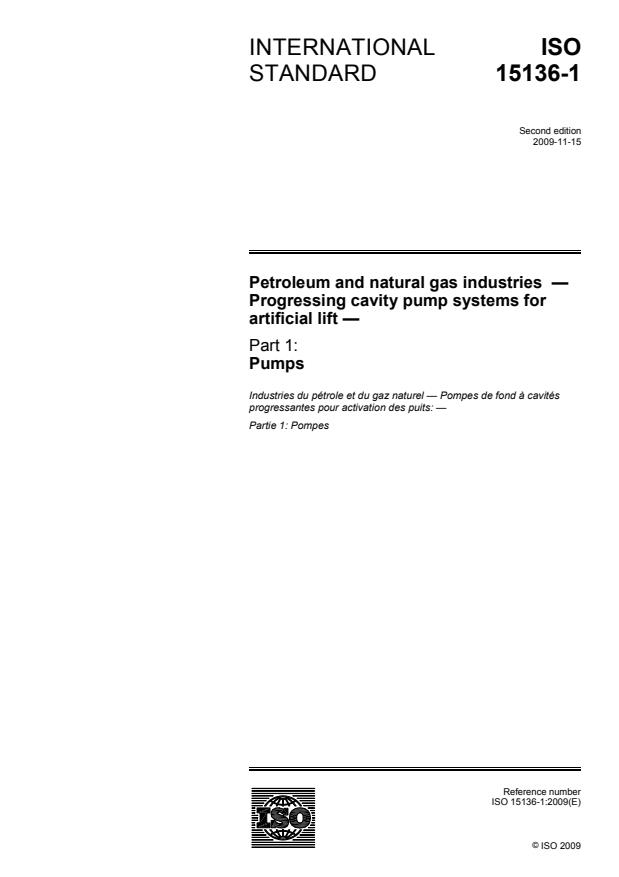
INTERNATIONAL ISO
STANDARD 15136-1
Second edition
2009-11-15
Petroleum and natural gas industries —
Progressing cavity pump systems for
artificial lift —
Part 1:
Pumps
Industries du pétrole et du gaz naturel — Pompes de fond à cavités
progressantes pour activation des puits: —
Partie 1: Pompes
Reference number
©
ISO 2009
PDF disclaimer
PDF files may contain embedded typefaces. In accordance with Adobe's licensing policy, such files may be printed or viewed but shall
not be edited unless the typefaces which are embedded are licensed to and installed on the computer performing the editing. In
downloading a PDF file, parties accept therein the responsibility of not infringing Adobe's licensing policy. The ISO Central Secretariat
accepts no liability in this area.
Adobe is a trademark of Adobe Systems Incorporated.
Details of the software products used to create the PDF file(s) constituting this document can be found in the General Info relative to
the file(s); the PDF-creation parameters were optimized for printing. Every care has been taken to ensure that the files are suitable for
use by ISO member bodies. In the unlikely event that a problem relating to them is found, please inform the Central Secretariat at the
address given below.
This CD-ROM contains
1) the publication ISO 15136-1:2009 (including inserts) in portable document format (PDF), which can be
viewed using Adobe® Acrobat® Reader;
2) a separate folder for the following electronic inserts:
a) troubleshooting guide (Table F.2);
b) speciation of functional requirements (Figure H.1);
c) rotor condition and stator condition inspection results (Tables I.1 and I.2).
Adobe and Acrobat are trademarks of Adobe Systems Incorporated.
This second edition cancels and replaces the first edition (ISO 15136-1:2001), which has been technically
revised.
IMPORTANT — The electronic file of this document contains colours which are considered to be
useful for the correct understanding of the document. Users should therefore consider printing this
document using a colour printer.
© ISO 2009
All rights reserved. Unless other
...