

ISO 10101-1:2022
(Main)Natural gas — Determination of water by the Karl Fischer method — Part 1: General requirements
General Information
- Abstract
This document specifies general requirements for the determination of water in natural gas using the Karl Fischer method (see Reference [1]). ISO 10101-2 and ISO 10101-3 specify two individual methods of determination, a titration procedure and a coulometric procedure, respectively.
- Status
- Published
- Publication Date
- 23-Aug-2022
- Technical Committee
- ISO/TC 193/SC 1 - Analysis of natural gas
- Drafting Committee
- ISO/TC 193/SC 1/WG 21 - Revision of ISO 10101
- Current Stage
- 6060 - International Standard published
- Start Date
- 24-Aug-2022
- Due Date
- 03-Dec-2022
- Completion Date
- 24-Aug-2022

Overview
ISO 10101-1:2022 establishes the general requirements for determining water content in natural gas using the Karl Fischer method. This internationally recognized standard enhances measurement accuracy by specifying fundamental principles, sampling procedures, and uncertainty evaluation for water determination. It serves as Part 1 of a series, complemented by ISO 10101-2 and ISO 10101-3 that detail volumetric and coulometric procedures, respectively.
The Karl Fischer method offers a selective, rapid, and precise technique for moisture analysis in natural gas - essential for ensuring gas quality, safety, and efficiency in processing, transport, and end-use applications.
Key Topics
Scope and Application: Defines the purpose of determining water concentration in natural gas via Karl Fischer titration, applicable to both volumetric and coulometric techniques.
Principle of Method:
- Based on the stoichiometric reaction of water with iodine and sulfur dioxide in a methanol solution.
- Water quantity is derived from iodine consumption, measured either by titration (volumetric) or electrochemical generation of iodine (coulometric).
- Volumetric titration suits water amounts from 1 mg to 100 mg; coulometric titration targets smaller amounts from 10 µg to 10 mg.
Chemical Reactions and Interferences:
- Detailed key reaction mechanisms and the impact of interfering gases like hydrogen sulfide and mercaptans, with correction formulas for interference mitigation.
- Guidance on identifying and quantifying interfering sulfur compounds to ensure precise water measurement.
Sampling Requirements:
- Highlights the necessity of maintaining sample integrity by keeping gas temperature above dew point and using inert materials.
- Recommends sampling procedures aligned with ISO 10715 to prevent moisture loss or contamination.
Measurement Uncertainty:
- Emphasizes estimating measurement uncertainty using interlaboratory comparisons (ISO 5725-2) and evaluation guidelines (ISO 21748).
- Suggests reporting expanded uncertainty with a coverage factor k=2 for reliable results.
- Incorporates the importance of including sampling uncertainty in the total uncertainty budget.
Applications
Natural Gas Industry: Monitoring and controlling moisture levels to prevent pipeline corrosion, hydrate formation, and equipment damage.
Gas Quality Assurance: Ensuring compliance with gas specifications for both transmission companies and end users.
Laboratory Analysis: Development of standardized procedures for routine moisture testing in natural gas samples.
Environmental and Safety Compliance: Moisture determination to assess gas safety parameters and reduce risks associated with impurities.
Process Optimization: Utilizing accurate water content data to improve gas processing operations and efficiency.
Related Standards
ISO 10101-2: Specifies the volumetric titration procedure for water determination in natural gas.
ISO 10101-3: Details the coulometric titration method adapted for low water content measurements.
ISO 10715: Provides general guidelines for natural gas sampling essential for water analysis.
ISO 14532: Natural gas vocabulary ensuring consistent terminology in moisture analysis and related testing.
ISO 5725-2: Establishes protocols for evaluating repeatability and reproducibility of measurement methods.
ISO 21748: Offers guidance on using repeatability and reproducibility data to estimate measurement uncertainty.
ISO 19739: Covers determination of sulfur compounds in natural gas, relevant for interference correction.
Keywords: ISO 10101-1, natural gas, water determination, Karl Fischer method, moisture analysis, volumetric titration, coulometric titration, sampling, measurement uncertainty, gas quality, sulfur compound interference.
Relations
- Effective Date
- 25-Aug-2026
- Effective Date
- 25-Aug-2026
- Effective Date
- 12-Feb-2026
- Consolidated By
ISO 2440:2019 - Flexible and rigid cellular polymeric materials — Accelerated ageing tests - Effective Date
- 06-Jun-2022
- Effective Date
- 04-Nov-2015
Get Certified
Connect with accredited certification bodies for this standard

Element Materials Technology
Materials testing and product certification.

ABS Group Brazil
ABS Group certification services in Brazil.

ABS Quality Evaluations Inc.
American Bureau of Shipping quality certification.
Sponsored listings
Frequently Asked Questions
ISO 10101-1:2022 is a standard published by the International Organization for Standardization (ISO). Its full title is "Natural gas — Determination of water by the Karl Fischer method — Part 1: General requirements". This standard covers: This document specifies general requirements for the determination of water in natural gas using the Karl Fischer method (see Reference [1]). ISO 10101-2 and ISO 10101-3 specify two individual methods of determination, a titration procedure and a coulometric procedure, respectively.
This document specifies general requirements for the determination of water in natural gas using the Karl Fischer method (see Reference [1]). ISO 10101-2 and ISO 10101-3 specify two individual methods of determination, a titration procedure and a coulometric procedure, respectively.
ISO 10101-1:2022 is classified under the following ICS (International Classification for Standards) categories: 75.060 - Natural gas. The ICS classification helps identify the subject area and facilitates finding related standards.
ISO 10101-1:2022 has the following relationships with other standards: It is inter standard links to EN ISO 10101-3:2022, EN ISO 10101-2:2022, EN ISO 10101-1:2022, ISO 2440:2019, ISO 10101-1:1993. Understanding these relationships helps ensure you are using the most current and applicable version of the standard.
ISO 10101-1:2022 is available in PDF format for immediate download after purchase. The document can be added to your cart and obtained through the secure checkout process. Digital delivery ensures instant access to the complete standard document.
Standards Content (Sample)
INTERNATIONAL ISO
STANDARD 10101-1
Second edition
2022-08
Natural gas — Determination of water
by the Karl Fischer method —
Part 1:
General requirements
Gaz naturel — Dosage de l'eau par la méthode de Karl Fischer —
Partie 1: Exigences générales
Reference number
© ISO 2022
All rights reserved. Unless otherwise specified, or required in the context of its implementation, no part of this publication may
be reproduced or utilized otherwise in any form or by any means, electronic or mechanical, including photocopying, or posting on
the internet or an intranet, without prior written permission. Permission can be requested from either ISO at the address below
or ISO’s member body in the country of the requester.
ISO copyright office
CP 401 • Ch. de Blandonnet 8
CH-1214 Vernier, Geneva
Phone: +41 22 749 01 11
Email: copyright@iso.org
Website: www.iso.org
Published in Switzerland
ii
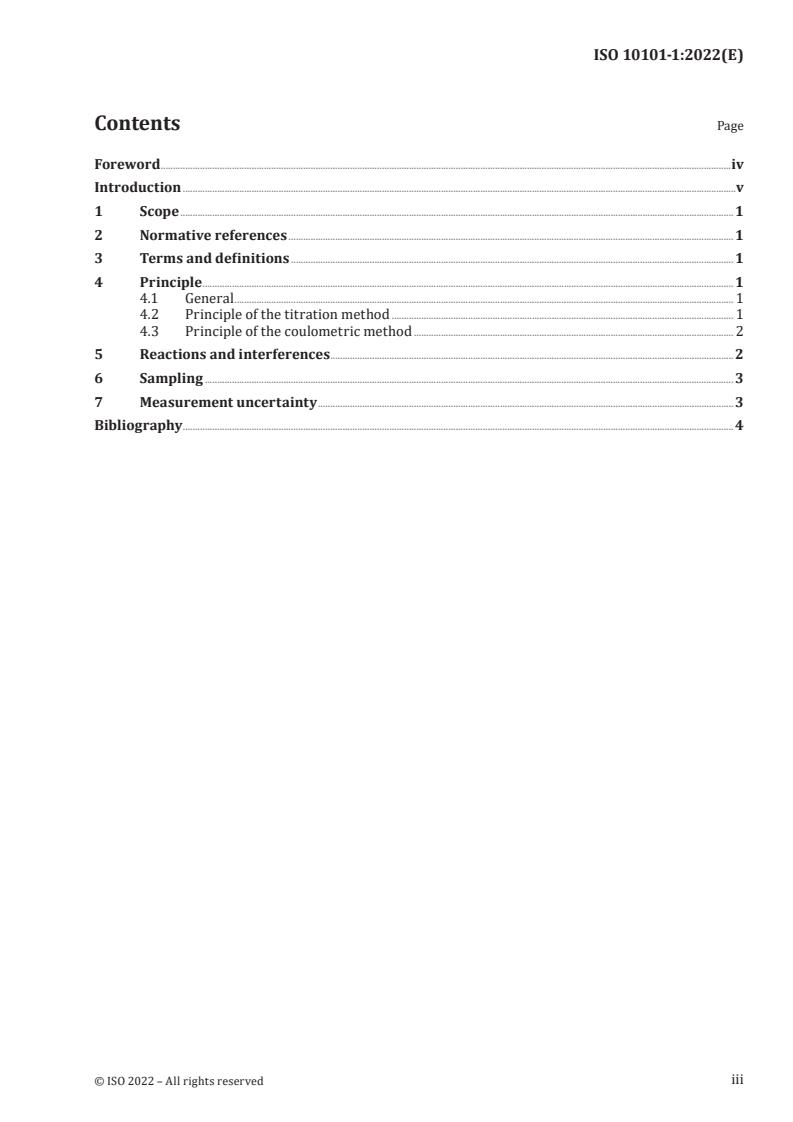
Contents Page
Foreword .iv
Introduction .v
1 Scope . 1
2 Normative references . 1
3 Terms and definitions . 1
4 Principle . 1
4.1 General . 1
4.2 Principle of the titration method . 1
4.3 Principle of the coulometric method . 2
5 Reactions and interferences .2
6 Sampling . 3
7 Measurement uncertainty .3
Bibliography . 4
iii
Foreword
ISO (the International Organization for Standardization) is a worldwide federation of national standards
bodies (ISO member bodies). The work of preparing International Standards is normally carried out
through ISO technical committees. Each member body interested in a subject for which a technical
committee has been established has the right to be represented on that committee. International
organizations, governmental and non-governmental, in liaison with ISO, also take part in the work.
ISO collaborates closely with the International Electrotechnical Commission (IEC) on all matters of
electrotechnical standardization.
The procedures used to develop this document and those intended for its further maintenance are
described in the ISO/IEC Directives, Part 1. In particular the different approval criteria needed for the
different types of ISO documents should be noted. This document was drafted in accordance with the
editorial rules of the ISO/IEC Directives, Part 2 (see www.iso.org/directives).
Attention is drawn to the possibility that some of the elements of this document may be the subject of
patent rights. ISO shall not be held responsible for identifying any or all such patent rights. Details of
any patent rights identified during the development of the document will be in the Introduction and/or
on the ISO list of patent declarations received (see www.iso.org/patents).
Any trade name used in this document is information given for the convenience of users and does not
constitute an endorsement.
For an explanation on the voluntary nature of standards, the meaning of ISO specific terms and
expressions related to conformity assessment, as well as information about ISO's adherence to the
World Trade Organization (WTO) principles in the Technical Barriers to Trade (TBT) see the following
URL: www.iso.org/iso/foreword.html.
This document was prepared by Technical Committee ISO/TC 193, Natural Gas, Subcommittee SC 1,
Analysis of natural gas, in collaboration with the European Committee for Standardization (CEN)
Technical Committee CEN/TC 238, Test gases, test pressures, appliance categories and gas appliance types,
in accordance with the Agreement on technical cooperation between ISO and CEN (Vienna Agreement).
This second edition cancels and replaces the first edition (ISO 10101-1:1993), which has been technically
revised.
The main changes are as follows:
— Clause 2 and Bibliography were revised;
— New fixed structure numbering inserted.
A list of all parts in the ISO 10101 series can be found on the ISO website.
iv
Introduction
Water vapour may be present in natural gas due to, for example, natural occurrence in the well
production stream, the storage of gas in underground reservoirs, transmission or distribution through
mains containing moisture or other reasons.
The Karl Fischer method for the determination of moisture has several practical advantages compared
to other methods for moisture determination, such as accuracy, speed and selectivity.
The Karl Fischer method is selective for water, because the titration reaction itself consumes water.
The Karl Fischer (KF) titration can be divided into two basic techniques depending on the application
range – volumetric and coulometric KF titration. The two analysis techniques differ in the mode of
iodine addition or generation.
KF titration is essentially based on the Bunsen reaction used for the determination of sulphur dioxide
in aqueous solution:
22HO++SO IH→+SO HI
22 22 4
If an excess of sulphur dioxide with simultaneous neutralization of the sulphuric acid formed shift the
reaction equilibrium to the right, the Bunsen reaction can also be used for the determination of water.
Karl Fischer used pyridine as (neutralization) base, thus developing the classical KF reagent. This was
[9]
a solution of iodine and sulphur dioxide in a solvent mixture of pyridine and methanol . The fact that
the pyridine contained in the reagent has a strong unpleasant odour and toxicity and the reaction
[9]
runs stoichiometrically only within a certain pH range led to the revision of the KF reagents . Scholz
formulated the following KF reaction based on imidazole:
CH OH+SO+RN→[]RNHSOCH
32 33
where RN = Base.
HO+I +R[]NH SO CH +2RN→[]RNHSOCH+2R[]NH I
22 33 43
Volumetric KF titration is preferably used for the determination of large amounts of water in the range
[10]
of 1 mg to 100 mg
...