


ISO 14317:2015
(Main)Sintered metal materials excluding hardmetals - Determination of compressive yield strength
Sintered metal materials excluding hardmetals - Determination of compressive yield strength
ISO 14317:2015 specifies a method for the determination of the compressive yield strength of sintered metal materials, excluding hardmetals. This method is applicable to sintered materials (excluding hardmetals) that might or might not have been subjected to heat treatment after sintering and also to materials that have been sized or coined after sintering.
Matériaux métalliques frittés, à l'exclusion des métaux-durs — Détermination de la limite d'élasticité en compression
General Information
Relations
Overview
ISO 14317:2015 is an international standard developed by the International Organization for Standardization (ISO) that specifies a precise method for determining the compressive yield strength of sintered metal materials, excluding hardmetals. This standard is essential for assessing the mechanical properties of sintered metals, whether or not they have undergone post-sintering heat treatment, sizing, or coining processes.
The compressive yield strength is a critical property that defines the stress level at which a material begins to deform plastically under compressive load. Accurate measurement of this property ensures quality control, material characterization, and reliable engineering design in powder metallurgy and related industries.
Key Topics
Scope and Applicability
ISO 14317:2015 applies specifically to sintered metal materials, excluding hardmetals, regardless of heat treatment or post-sintering processing such as sizing or coining. This flexibility makes it widely applicable within the sintered metal manufacturing sector.Test Methodology
The standard outlines a rigorous compression test procedure using calibrated testing machines compliant with ISO 7500-1. Test specimens are compressed axially, and strain is measured with high-precision extensometers ensuring errors remain below strict limits, guaranteeing reliable and repeatable results.Test Specimens
Test pieces are cylindrical with a diameter of 9.0 mm and length of 27.0 mm (L/D ratio 3:1), machined to exact tolerances from compacted specimens. This standardization ensures consistency in testing and accuracy in determining the compressive yield strength.Procedure
The specimen is placed between polished, parallel anvil faces and subjected to compression at a controlled loading rate not exceeding 0.05 mm/min. The stress-strain curve is analyzed to identify the yield point at 0.1% strain using the offset method.Results Expression
The compressive yield strength is calculated by dividing the yield load by the cross-sectional area of the specimen and reported in megapascals (MPa). The method ensures consistent interpretation of results according to internationally recognized guidelines.Reporting Requirements
The standard mandates comprehensive documentation in the test report including sample identification, processing conditions, test results, optional procedures followed, and any factors influencing the test outcomes.
Applications
Quality Control for Sintered Metals
Manufacturers of sintered metal components rely on ISO 14317:2015 to verify compressive yield strength, ensuring products meet design and performance criteria in automotive, aerospace, and industrial machinery sectors.Material Development and Research
Researchers and material scientists use this standard to compare the mechanical properties of novel sintered materials, optimizing processing parameters such as compaction and heat treatment.Engineering Design and Component Specification
Engineers apply compressive yield strength data obtained via ISO 14317 testing to select appropriate materials for load-bearing parts and structural components fabricated from sintered metal powders.Standardization in Powder Metallurgy
The method facilitates harmonization in the global powder metallurgy community by providing a common test framework, enhancing reliability and comparison across international suppliers and markets.
Related Standards
ISO 7500-1: Metallic materials - Verification of static uniaxial testing machines
This standard is referenced within ISO 14317:2015 for calibration and verification of compression testing machines, ensuring accuracy in force measurement.ISO 5754: Sintered metal materials, excluding hardmetals - Unnotched impact test piece
Provides the basis for dimensional specifications of test specimens used in ISO 14317, promoting consistency in sample preparation.Additional ISO Standards on Powder Metallurgy
Standards within ISO Technical Committee ISO/TC 119, particularly Subcommittee SC 3, cover a broad range of sampling and testing methods applicable to sintered metal materials.
Keywords: ISO 14317, compressive yield strength, sintered metal materials, powder metallurgy standards, mechanical testing ISO, sintered metals compression test, metal material standards, quality control sintered metals, sintered metal strength measurement.
Frequently Asked Questions
ISO 14317:2015 is a standard published by the International Organization for Standardization (ISO). Its full title is "Sintered metal materials excluding hardmetals - Determination of compressive yield strength". This standard covers: ISO 14317:2015 specifies a method for the determination of the compressive yield strength of sintered metal materials, excluding hardmetals. This method is applicable to sintered materials (excluding hardmetals) that might or might not have been subjected to heat treatment after sintering and also to materials that have been sized or coined after sintering.
ISO 14317:2015 specifies a method for the determination of the compressive yield strength of sintered metal materials, excluding hardmetals. This method is applicable to sintered materials (excluding hardmetals) that might or might not have been subjected to heat treatment after sintering and also to materials that have been sized or coined after sintering.
ISO 14317:2015 is classified under the following ICS (International Classification for Standards) categories: 77.040.10 - Mechanical testing of metals; 77.160 - Powder metallurgy. The ICS classification helps identify the subject area and facilitates finding related standards.
ISO 14317:2015 has the following relationships with other standards: It is inter standard links to ISO 14317:2006. Understanding these relationships helps ensure you are using the most current and applicable version of the standard.
You can purchase ISO 14317:2015 directly from iTeh Standards. The document is available in PDF format and is delivered instantly after payment. Add the standard to your cart and complete the secure checkout process. iTeh Standards is an authorized distributor of ISO standards.
Standards Content (Sample)
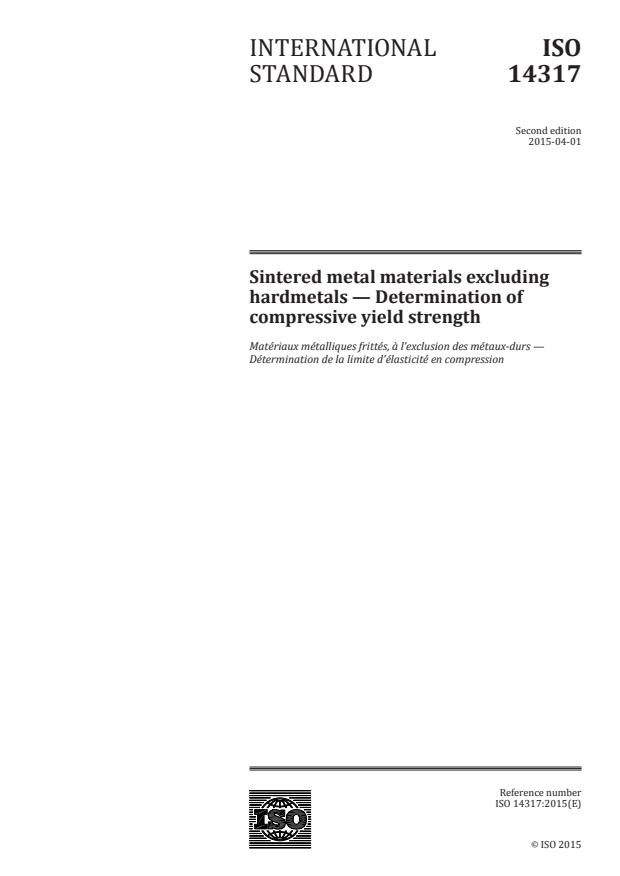
INTERNATIONAL ISO
STANDARD 14317
Second edition
2015-04-01
Sintered metal materials excluding
hardmetals — Determination of
compressive yield strength
Matériaux métalliques frittés, à l’exclusion des métaux-durs —
Détermination de la limite d’élasticité en compression
Reference number
©
ISO 2015
© ISO 2015
All rights reserved. Unless otherwise specified, no part of this publication may be reproduced or utilized otherwise in any form
or by any means, electronic or mechanical, including photocopying, or posting on the internet or an intranet, without prior
written permission. Permission can be requested from either ISO at the address below or ISO’s member body in the country of
the requester.
ISO copyright office
Case postale 56 • CH-1211 Geneva 20
Tel. + 41 22 749 01 11
Fax + 41 22 749 09 47
E-mail copyright@iso.org
Web www.iso.org
Published in Switzerland
ii © ISO 2015 – All rights reserved
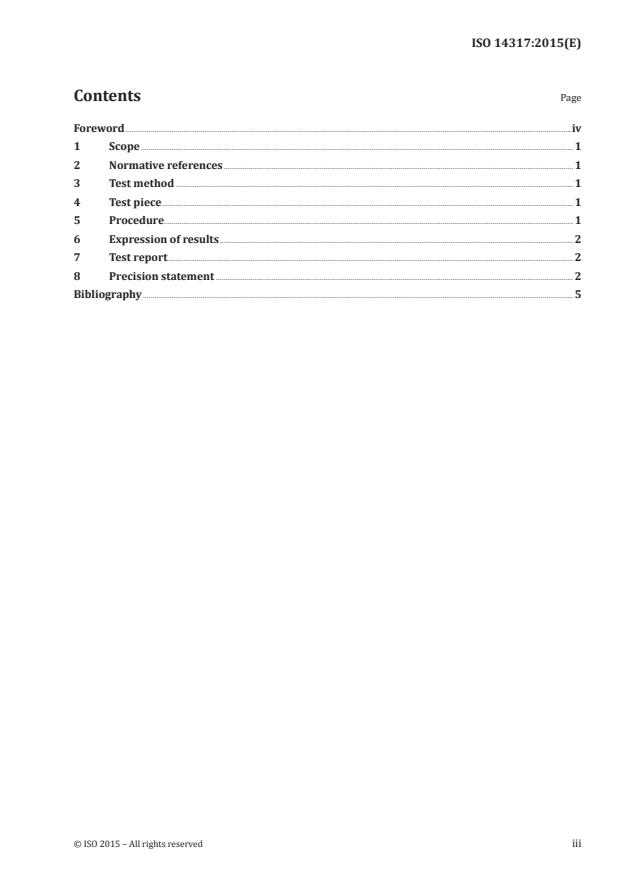
Contents Page
Foreword .iv
1 Scope . 1
2 Normative references . 1
3 Test method . 1
4 Test piece . 1
5 Procedure. 1
6 Expression of results . 2
7 Test report . 2
8 Precision statement . 2
Bibliography . 5
Foreword
ISO (the International Organization for Standardization) is a worldwide federation of national standards
bodies (ISO member bodies). The work of preparing International Standards is normally carried out
through ISO technical committees. Each member body interested in a subject for which a technical
committee has been established has the right to be represented on that committee. International
organizations, governmental and non-governmental, in liaison with ISO, also take part in the work.
ISO collaborates closely with the International Electrotechnical Commission (IEC) on all matters of
electrotechnical standardization.
The procedures used to develop this document and those intended for its further maintenance are
described in the ISO/IEC Directives, Part 1. In particular the different approval criteria needed for the
different types of ISO documents should be noted. This document was drafted in accordance with the
editorial rules of the ISO/IEC Directives, Part 2 (see www.iso.org/directives).
Attention is drawn to the possibility that some of the elements of this document may be the subject of
patent rights. ISO shall not be held responsible for identifying any or all such patent rights. Details of any
patent rights identified during the development of the document will be in the Introduction and/or on
the ISO list of patent declarations received (see www.iso.org/patents).
Any trade name used in this document is information given for the convenience of users and does not
constitute an endorsement.
For an explanation on the meaning of ISO specific terms and expressions related to conformity
assessment, as well as information about ISO’s adherence to the WTO principles in the Technical Barriers
to Trade (TBT), see the following URL: Foreword — Supplementary information.
The committee responsible for this document is ISO/TC 119, Powder metallurgy, Subcommittee SC 3,
Sampling and testing methods for sintered metal materials (excluding hardmetals).
This second edition cancels and replaces the first edition (ISO 14317:2006), which has been
technically revised.
iv © ISO 2015 – Al
...
Questions, Comments and Discussion
Ask us and Technical Secretary will try to provide an answer. You can facilitate discussion about the standard in here.
Loading comments...