

ISO 18209-1:2024
(Main)Biotechnology — Biobanking of parasites — Part 1: Helminths
General Information
- Abstract
This document provides requirements for the biobanking of helminths as parasitic resources including the collection, safeguarding, classification, proliferation, preservation, storage and distribution of helminths. This document sets requirements for the quality of helminths and their associated data, the data collection, and safety management when handling the helminths as a source of human disease infection. This document is applicable to all organizations performing biobanking with helminths used for research and development. NOTE International, national or regional regulations or requirements, or multiple of them, can also apply to specific topics covered in this document.
- Status
- Published
- Publication Date
- 22-Apr-2024
- Technical Committee
- ISO/TC 276 - Biotechnology
- Drafting Committee
- ISO/TC 276 - Biotechnology
- Current Stage
- 9092 - International Standard to be revised
- Start Date
- 16-Jun-2026
- Completion Date
- 29-Aug-2026
Overview
ISO 18209-1:2024 sets internationally recognized requirements for the biobanking of helminths-parasitic worms important in biotechnology research and healthcare. Developed by ISO’s Technical Committee 276 (Biotechnology), this standard supports organizations that collect, safeguard, classify, proliferate, preserve, store, and distribute helminth resources for research and development. It addresses the quality, data management, and safety controls necessary to handle helminths, which are relevant as both research tools and potential sources of human infection.
Helminth biobanking is critical for developing therapies for autoimmune diseases, anthelmintic drugs, diagnostic tools, and furthering scientific understanding of parasitic infections. This standard applies globally, ensuring consistency and safety across diverse research and industry settings.
Key Topics
- Biobank Operations: Guidance for establishing and managing helminth biobanks, including legal and ethical compliance, risk assessment, and scope of activities.
- Collection and Classification: Procedures for collecting helminths in varied life stages (adults, larvae, eggs) from hosts, with documentation requirements for source and metadata.
- Preservation and Storage: Requirements for sample handling, including use of appropriate chemicals (such as formalin or ethanol), temperature controls (refrigeration, ultra-low freezers, liquid nitrogen), and dedicated sample rooms with controlled humidity, lighting, and ventilation.
- Health, Safety, and Biosafety: Detailed safety protocols are included for chemical, biological, and physical hazards-such as mandatory use of personal protective equipment (PPE), waste management, and compliance with biosafety levels.
- Data and Information Management: Minimum dataset (MDS) and recommended dataset (RDS) requirements for sample tracking, data collection, cataloging, and inventory control, aligned with other ISO data management standards.
- Quality and Validation: Procedures for sample verification, contamination inspection, traceability, and complaints management.
- Distribution and Transport: Protocols for moving helminth samples between organizations, ensuring data security and safety during transportation.
Applications
ISO 18209-1:2024 provides practical value for:
- Biobanks and Research Organizations: Standardizes practices for storing and supplying uncontaminated helminths to the biological and pharmaceutical industries, ensuring reliable research materials.
- Pharmaceutical Companies: Facilitates the development of new anthelmintic drugs and immunotherapies by providing access to high-quality, characterized parasite samples.
- Clinical and Diagnostic Laboratories: Supports the development and validation of diagnostic tests for parasitic infections.
- Regulatory Bodies and Ethics Committees: Helps ensure compliance with national and international regulations for the ethical collection and handling of biological resources.
- Academic Research: Enables reproducibility and data sharing in parasitology, genomics, and animal model studies focused on helminth biology and disease.
Related Standards
Implementing ISO 18209-1:2024 may involve additional guidance from complementary international standards, such as:
- ISO 20387:2018 – Biotechnology - Biobanking - General requirements for biobanking
- ISO 15190:2020 – Medical laboratories - Requirements for safety
- ISO 21710:2020 – Specification on data management in microbial resource centers
- ISO 24088-1 – Biotechnology - Biobanking of microorganisms - Part 1: Bacteria and archaea
- ISO 35001 – Biorisk management for laboratories
- ISO 45001:2018 – Occupational health and safety management systems
- IEC 61010-1 – Safety for laboratory equipment
Organizations involved in biotechnology, parasitology research, and biobanking should integrate ISO 18209-1:2024 into their practices to promote reproducibility, safety, and responsible resource stewardship in the collection and management of helminth resources.
For further information or to acquire the standard, visit the ISO website.
Frequently Asked Questions
ISO 18209-1:2024 is a standard published by the International Organization for Standardization (ISO). Its full title is "Biotechnology — Biobanking of parasites — Part 1: Helminths". This standard covers: This document provides requirements for the biobanking of helminths as parasitic resources including the collection, safeguarding, classification, proliferation, preservation, storage and distribution of helminths. This document sets requirements for the quality of helminths and their associated data, the data collection, and safety management when handling the helminths as a source of human disease infection. This document is applicable to all organizations performing biobanking with helminths used for research and development. NOTE International, national or regional regulations or requirements, or multiple of them, can also apply to specific topics covered in this document.
This document provides requirements for the biobanking of helminths as parasitic resources including the collection, safeguarding, classification, proliferation, preservation, storage and distribution of helminths. This document sets requirements for the quality of helminths and their associated data, the data collection, and safety management when handling the helminths as a source of human disease infection. This document is applicable to all organizations performing biobanking with helminths used for research and development. NOTE International, national or regional regulations or requirements, or multiple of them, can also apply to specific topics covered in this document.
ISO 18209-1:2024 is classified under the following ICS (International Classification for Standards) categories: 07.080 - Biology. Botany. Zoology. The ICS classification helps identify the subject area and facilitates finding related standards.
ISO 18209-1:2024 is available in PDF format for immediate download after purchase. The document can be added to your cart and obtained through the secure checkout process. Digital delivery ensures instant access to the complete standard document.
Standards Content (Sample)
International
Standard
ISO 18209-1
First edition
Biotechnology — Biobanking of
2024-04
parasites —
Part 1:
Helminths
Reference number
© ISO 2024
All rights reserved. Unless otherwise specified, or required in the context of its implementation, no part of this publication may
be reproduced or utilized otherwise in any form or by any means, electronic or mechanical, including photocopying, or posting on
the internet or an intranet, without prior written permission. Permission can be requested from either ISO at the address below
or ISO’s member body in the country of the requester.
ISO copyright office
CP 401 • Ch. de Blandonnet 8
CH-1214 Vernier, Geneva
Phone: +41 22 749 01 11
Email: copyright@iso.org
Website: www.iso.org
Published in Switzerland
ii
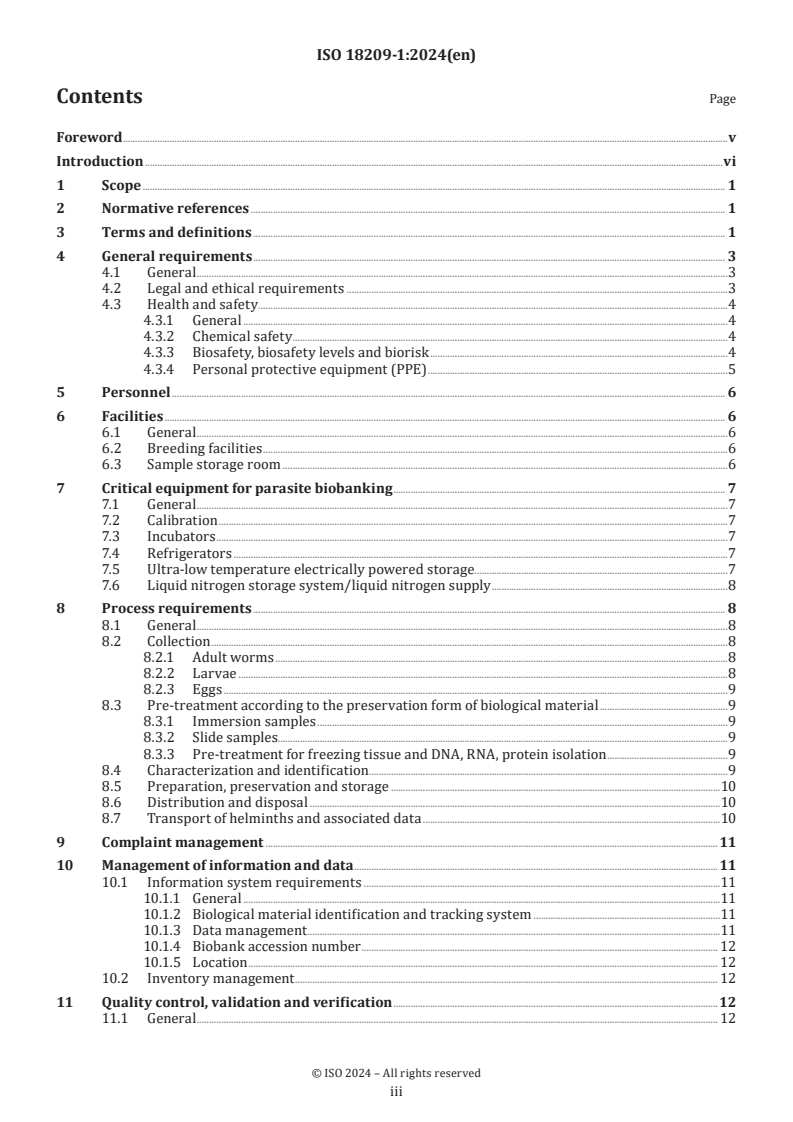
Contents Page
Foreword .v
Introduction .vi
1 Scope . 1
2 Normative references . 1
3 Terms and definitions . 1
4 General requirements . 3
4.1 General .3
4.2 Legal and ethical requirements .3
4.3 Health and safety . .4
4.3.1 General .4
4.3.2 Chemical safety . .4
4.3.3 Biosafety, biosafety levels and biorisk .4
4.3.4 Personal protective equipment (PPE) .5
5 Personnel . 6
6 Facilities . 6
6.1 General .6
6.2 Breeding facilities .6
6.3 Sample storage room .6
7 Critical equipment for parasite biobanking . 7
7.1 General .7
7.2 Calibration .7
7.3 Incubators .7
7.4 Refrigerators .7
7.5 Ultra-low temperature electrically powered storage .7
7.6 Liquid nitrogen storage system/liquid nitrogen supply .8
8 Process requirements . 8
8.1 General .8
8.2 Collection .8
8.2.1 Adult worms .8
8.2.2 Larvae .8
8.2.3 Eggs .9
8.3 Pre-treatment according to the preservation form of biological material .9
8.3.1 Immersion samples .9
8.3.2 Slide samples.9
8.3.3 Pre-treatment for freezing tissue and DNA, RNA, protein isolation .9
8.4 Characterization and identification.9
8.5 Preparation, preservation and storage .10
8.6 Distribution and disposal .10
8.7 Transport of helminths and associated data .10
9 Complaint management .11
10 Management of information and data .11
10.1 Information system requirements .11
10.1.1 General .11
10.1.2 Biological material identification and tracking system .11
10.1.3 Data management .11
10.1.4 Biobank accession number . 12
10.1.5 Location . 12
10.2 Inventory management . 12
11 Quality control, validation and verification .12
11.1 General . 12
iii
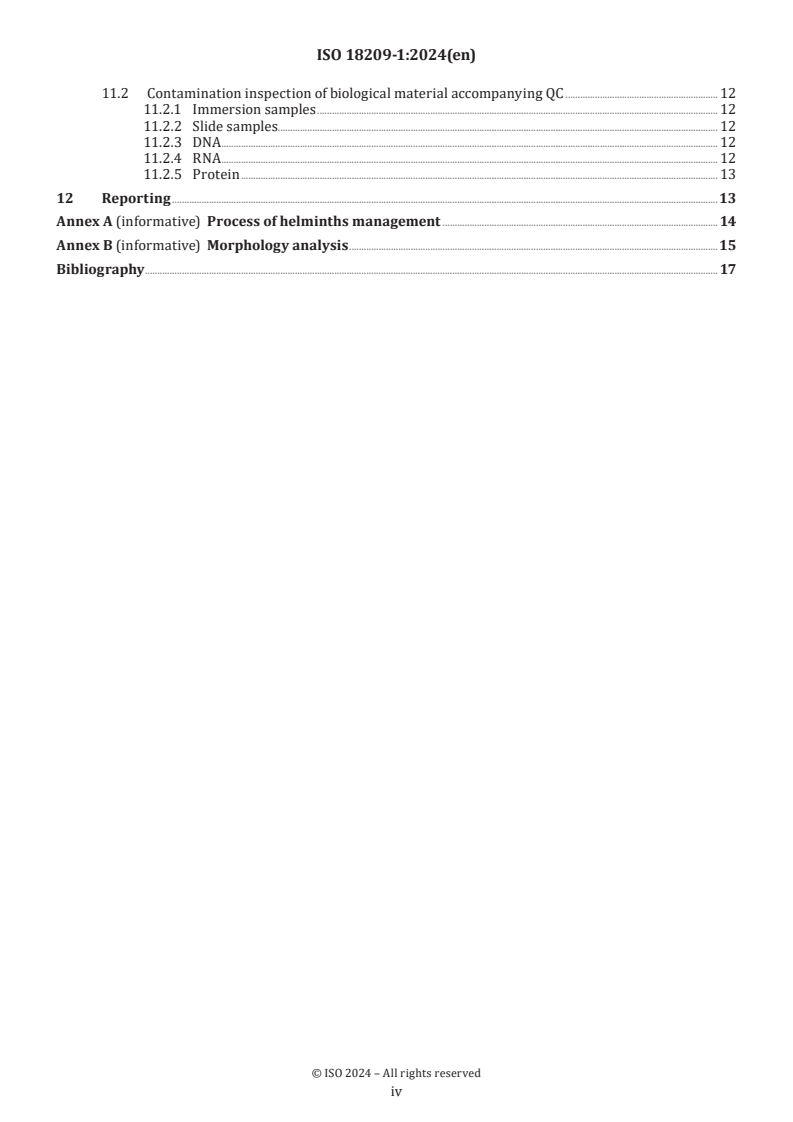
11.2 Contamination inspection of biological material accompanying QC . 12
11.2.1 Immersion samples . 12
11.2.2 Slide samples. 12
11.2.3 DNA . . 12
11.2.4 RNA . . 12
11.2.5 Protein . 13
12 Reporting .13
Annex A (informative) Process of helminths management . 14
Annex B (informative) Morphology analysis .15
Bibliography . 17
iv
Foreword
ISO (the International Organization for Standardization) is a worldwide federation of national standards
bodies (ISO member bodies). The work of preparing International Standards is normally carried out through
ISO technical committees. Each member body interested in a subject for which a technical committee
has been established has the right to be represented on that committee. International organizations,
governmental and non-governmental, in liaison with ISO, also take part in the work. ISO collaborates closely
with the International Electrotechnical Commission (IEC) on all matters of electrotechnical standardization.
The procedures used to develop this document and those intended for its further maintenance are described
in the ISO/IEC Directives, Part 1. In particular, the different approval criteria needed for the different types
of ISO document should be noted. This document was drafted in accordance with the editorial rules of the
ISO/IEC Directives, Part 2 (see www.iso.org/directives).
ISO draws attention to the possibility that the implementation of this document may involve the use of (a)
patent(s). ISO takes no position concerning the evidence, validity or applicability of any claimed patent
rights in respect thereof. As of the date of publication of this document, ISO had not received notice of (a)
patent(s) which may be required to implement this document. However, implementers are cautioned that
this may not represent the latest information, which may be obtained from the patent database available at
www.iso.org/patents. ISO shall not be held responsible for identifying any or all such patent rights.
Any trade name used in this document is information given for the convenience of users and does not
constitute an endorsement.
For an explanation of the voluntary nature of standards, the meaning of ISO specific terms and expressions
related to conformity assessment, as well as information about ISO's adherence to the World Trade
Organization (WTO) principles in the Technical Barriers to Trade (TBT), see www.iso.org/iso/foreword.html.
This document was prepared by Technical Committee ISO/TC 276, Biotechnology.
A list of all parts in the ISO 18209 series can be found on the ISO website.
Any feedback or questions on this document should be directed to the user’s national standards body. A
complete listing of these bodies can be found at www.iso.org/members.html.
v
Introduction
The biological industry has been using helminths to treat diseases such as Crohn’s disease, ulcerative colitis,
auto-immune disease like allergic asthma, and even incurable disease like cancer. The industry is also
developing anthelmintic drugs and rapid infection diagnosis methods.
A biobank that can fulfil the role as a platform for collecting, storing and distributing parasitic resources is
of urgent need.
This document supports processes that maintain animal welfare, as it is anchored in the principle of the
[20]
three Rs: to “Replace, Reduce and Refine the use of animals” .
This document deals with the management and operation of the biobank: Helminth, which can safely
manage and supply uncontaminated parasitic resources for the biological industry to develop treatment of
autoimmune diseases, parasite infection diagnostic tests, and anthelmintics.
In this document, the following verbal forms are used:
— “shall” indicates a requirement;
— “should” indicates a recommendation;
— “may” indicates a permission;
— “can” indicates a possibility or a capability.
vi
International Standard ISO 18209-1:2024(en)
Biotechnology — Biobanking of parasites —
Part 1:
Helminths
1 Scope
This document provides requirements for the biobanking of helminths as parasitic resources including the
collection, safeguarding, classification, proliferation, preservation, storage and distribution of helminths.
This document sets requirements for the quality of helminths and their associated data, the data collection,
and safety management when handling the helminths as a source of human disease infection.
This document is applicable to all organizations performing biobanking with helminths used for research
and development.
NOTE International, national or regional regulations or requirements, or multiple of them, can also apply to
specific topics covered in this document.
2 Normative references
The following documents are referred to in the text in such a way that some or all of their content constitutes
requirements of this document. For dated references, only the edition cited applies. For undated references,
the latest edition of the referenced document (including any amendments) applies.
ISO 15190:2020, Medical laboratories — Requirements for safety
ISO 20387:2018, Biotechnology — Biobanking — General requirements for biobanking
ISO 21710:2020, Biotechnology — Specification on data management and publication in microbial resource centers
ISO 24088-1, Biotechnology — Biobanking of microorganisms — Part 1: Bacteria and archaea
ISO 35001, Biorisk management for laboratories and other related organisations
ISO 45001:2018, Occupational health and safety management systems — Requirements with guidance for use
IEC 61010-1, Safety requirements for electrical equipment for measurement, control, and laboratory use —
Part 1: General requirements
3 Terms and definitions
For the purposes of this document, the terms and definitions given in ISO 20387 and ISO 24088-1 and the
following apply.
ISO and IEC maintain terminology databases for use in standardization at the following addresses:
— ISO Online browsing platform: available at https:// www .iso .org/ obp
— IEC Electropedia: available at https:// www .electropedia .org/
3.1
biobank
parasite resource bank
legal entity or part of a legal entity that performs biobanking of parasites (3.8)
[SOURCE: ISO 20387:2018, 3.5, modified ― The accepted term “parasite resource bank” was added and the
words “of parasites” were added to the definition.]
3.2
cyst
form in which parasites (3.8) are surrounded by resistant covers or membranes
3.3
final host
organism that nourishes a parasite (3.8), which undergoes a stage of reproduction from the final adult stage
3.4
helminth
relatively large multicellular invertebrate parasites (3.8)
Note 1 to entry: Helminth can be found in the gastrointestinal tract and other parts of the stomach as well as in other
organs and parts of the body.
Note 2 to entry: Typical helminth include acanthocephalan, nematode and platyhelminth (monogenean, trematode,
cestode).
3.5
host
organism that nourishes a parasite (3.8) and is either an intermediate host (3.6) or a final host (3.3)
3.6
intermediate host
organism that nourishes a parasite (3.8) during the larva stage
3.7
minimum dataset
MDS
collection of technical and scientific data digitized in specific fields of a database, which is necessary to
distinguish unambiguously a particular biological material and provides a minimum amount of information
available for each accession in a biobank (3.1)
[SOURCE: ISO 21710:2020, 3.15, modified — Note 1 to entry was deleted; in the definition, “microbial
material” was replaced by “biological material” and “an MRC” was replaced by “a biobank”.]
3.8
parasite
organism that temporarily or permanently resides in the body of another organism and receives the
necessary nutrients therefrom
3.9
parasite life cycle
life history stage of the parasite
chain of consecutive life stages, in which the growth of parasites (3.8) is divided into eggs, larvae and adults
3.10
recommended data set
RDS
collection of data that includes useful information for an improved description of the functions and
properties of a biological material
Note 1 to entry: This includes optional data fields for use by the biobank (3.1) in the catalogue, when available.
[SOURCE: ISO 24088-1:2022, 3.17, modified — In the definition, “microbial material” was replaced by
“biological material”; in the note, “microbial biobank” was changed to “biobank”.]
3.11
room temperature
temperature in the range of 18 °C to 25 °C
Note 1 to entry: The definition is given for the purposes of this document. Local or national regulations can have
different definitions.
[SOURCE: ISO 20186-1:2019, 3.23]
4 General requirements
4.1 General
The biobank shall meet the requirements described in ISO 20387, in addition to those in this document.
ISO/TR 22758 can be used as additional reference for the implementation of ISO 20387.
Properly trained personnel shall carry out the sampling and identification of samples.
The biobank for helminths shall prepare, implement and document procedures for the preservation,
identification, information provision, distribution, etc. of parasitic resources.
NOTE Annex A includes a visualization of the helminths management process within a biobank.
The biobank shall determine the optimal storage environment for its use, and ensure that sufficient
equipment, facilities and funds should be secured to store parasitic samples until they are necessary.
The biobank shall establish an effective utilization plan for parasitic resources by defining the collection, pre-
treatment, identification, preservation, storage and distribution of parasite resources and associated data.
The biobank shall define and document the scope of activities in accordance with this document. The
biobank should insist on the suitability of this document only to the defined extent of banking activities.
4.2 Legal and ethical requirements
The collection of biological material from live animals shall comply with applicable animal welfare
practice. The biobank shall be aware of and able to demonstrate compliance with applicable animal welfare
requirements.
NOTE Additional guidance can be found in References [2] and [3].
National and international legislation can require the biobank to retain documented information. This can
include:
— evidence of compliance with applicable health and safety requirements;
— parasite risk classification;
— quarantine requirements;
— intellectual property rights;
— international treaties;
— access and benefit-sharing including biological material and associated data access, exchange and
transfer.
4.3 Health and safety
4.3.1 General
The biobank or the legal entity of which it is a part shall ensure that health and safety procedures are in
accordance with ISO 20387:2018, 6.2.1.5. All procedures shall be performed according to the appropriate
[26]
biosafety classification (see ISO 35001 and WHO 4th guideline ).
The helminth egg concentration index of irrigation water is closely related to human health protection, such
as the risk of direct contact and the risk related to crop types. Since helminth eggs can adversely affect the
human body through crops, irrigation water applied to crops is regulated by many countries. In this regard,
sewage and wastewater from the laboratory handling parasites or biological material derived from them
shall be treated appropriately for the water quality of irrigation water.
Since helminth eggs are different in shape and size, they can only be identified by properly trained personnel.
The personnel shall be familiar with the work of the laboratory handling parasites or biological material
derived from them.
Procedures for separating adults and larvae from the host’s organs or separating them from the host’s feces
or sputum shall be established, implemented and documented. These procedures shall take all necessary
safety procedures into account (e.g. ISO 15190).
When conducting an experiment to separate adults and larvae from the host’s organs or to separate them
from the host’s feces or sputum, personnel shall wear appropriate personal protective equipment (gloves,
gowns, eye protection, etc.) to prevent infection or transmission of infective forms and conduct personal
hygiene.
The biobank shall prepare procedures to respond to incidents, exposures and accidents in accordance with
the relevant parts of ISO 15190 and ISO 35001.
4.3.2 Chemical safety
The biobank shall be in accordance with ISO 15190 when handling chemicals.
The biobank shall establish, document and implement policies and procedures concerning the storage,
handling, use and disposal of chemicals, taking into account the applicable regulations of each country or
region in which the biobank operates.
Handling chemicals related to biobank activities can include but is not limited to extraction, synthesis,
industrial production, transportation, use and disposal.
The safety data sheet (SDS) for all chemicals used by the biobank shall be prominently displayed or readily
available.
The biobank’s laboratory, culture room, and sample room dealing with chemicals shall indicate physical and
chemical hazards such as explosiveness, flammability, oxidation, etc. and health hazards shall be marked at
the entrance.
4.3.3 Biosafety, biosafety levels and biorisk
[26]
The biobank should follow ISO 35001 or WHO 4th guideline when handling biological material
contaminated with pathogens.
The biobank shall ensure that risks to health are managed effectively, including consideration for preventive
and protective measures. Personnel shall be medically examined periodically according to exposure and risk.
The requirements of the personnel health programme, including requirements for record management and
confidentiality, shall be determined by a biosafety risk assessment.
The biobank shall:
a) establish and implement a vaccination policy as part of the personnel health surveillance;
b) ensure that the required and/or recommended vaccines and their information are made available to
the personnel. In the cases where no vaccines are available, periodical tests should be performed and
treatment of infected personnel should be provided.
Personnel at risk of exposure to vaccine-preventable infectious diseases shall have appropriate
immunizations made available to them, where possible.
Biosafety in the biobank shall be in accordance with ISO 45001:2018, Clause 7.
The biobank shall have material SDSs for at least internationally recognized hazardous parasites and/or
hazardous derivatives handled in the biobank and should ensure that they are prominently displayed or
readily available.
Waste management procedures for biological material shall be documented including waste storage,
packaging, transportation and decontamination.
[25]
NOTE More information about biosafety can be found in the CDC 6th guideline .
The safety rating of pathogens is classified as follows:
a) Class 1: Parasites that are non-pathogenic and have been used for a long time, which may cause
opportunistic infection, or require caution in excessive or long-term contact.
b) Class 2: Parasites that are likely to infect but can be prevented from infecting, and there are treatment
measures when they infect humans.
c) Class 3: Direct handling of parasites at the hospital requires considerable care. Parasites can be
prevented from infecting humans, and there are treatment measures when they infect humans.
d) Class 4: Parasites that cannot be prevented from infecting, and there is no treatment when they
infect humans
4.3.4 Personal protective equipment (PPE)
4.3.4.1 General
The biobank shall provide appropriate PPE according to the biosafety level of the helminth being handled
and those of the equipment and materials being used.
The biobank shall ensure that all PPE is working properly, free of contamination before use and available in
a place that is easily accessible.
4.3.4.2 Physical safety
Facilities for compressed gas shall be provided in accordance with ISO 15190:2020, 9.1. In addition, access to
emergency equipment including fire extinguishers, safety showers and eye washers, and first aid kits shall
be maintained.
4.3.4.3 Liquid nitrogen safety
In order to safely handle, store and use liquid nitrogen, appropriate facilities and securing devices in
accordance with ISO 15190:2020, 9.1, shall be provided, taking into account the applicable requirements of
each country or region.
Oxygen monitoring devices and alarm system
...