

ISO/DTS 19684
(Main)Characterization of liquid dispersion homogeneity
- Abstract
This document describes a framework for evaluating homogeneity and heterogeneity in dispersed solid/liquid, liquid/liquid, and gas/liquid particle systems. The antonyms homogeneity and heterogeneity are defined in terms of the degree to which a property or dispersed phase is uniformly distributed throughout a quantity of material over a stated (and typically macroscopic) length scale. This document defines indices for measurement of homogeneity and heterogeneity, presents methods for off-line and online measurement, and includes application examples. The measurement of dispersion stability requires multiple measurements of homogeneity over time and is not considered here. Although this document does not directly address powders or other multiphase dispersions, the concepts can be readily carried over to those areas.
- Status
- Not Published
- Technical Committee
- ISO/TC 24/SC 4 - Particle characterization
- Current Stage
- 5020 - Proof sent to secretariat or FDIS ballot initiated: 8 weeks - 50 Approval
- Start Date
- 11-Nov-2026
- Due Date
- 11-Nov-2026
- Completion Date
- 11-Nov-2026
Buy Documents
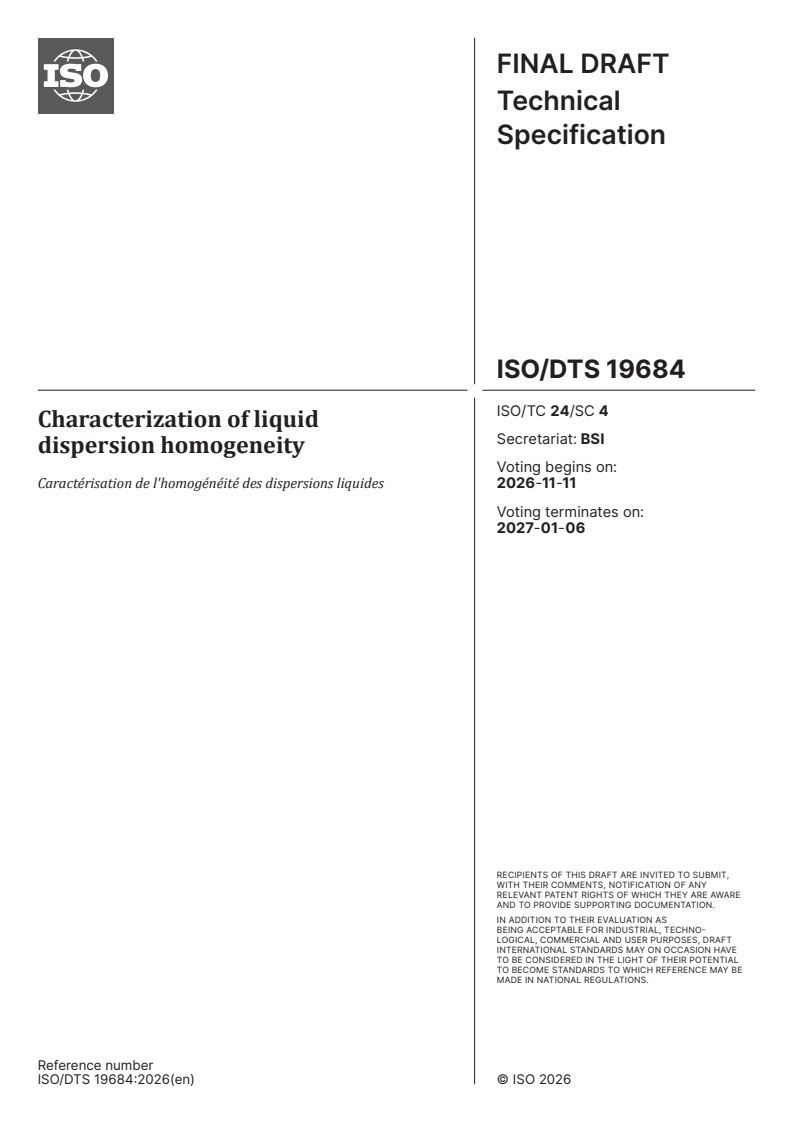


ISO/DTS 19684 - Characterization of liquid dispersion homogeneity
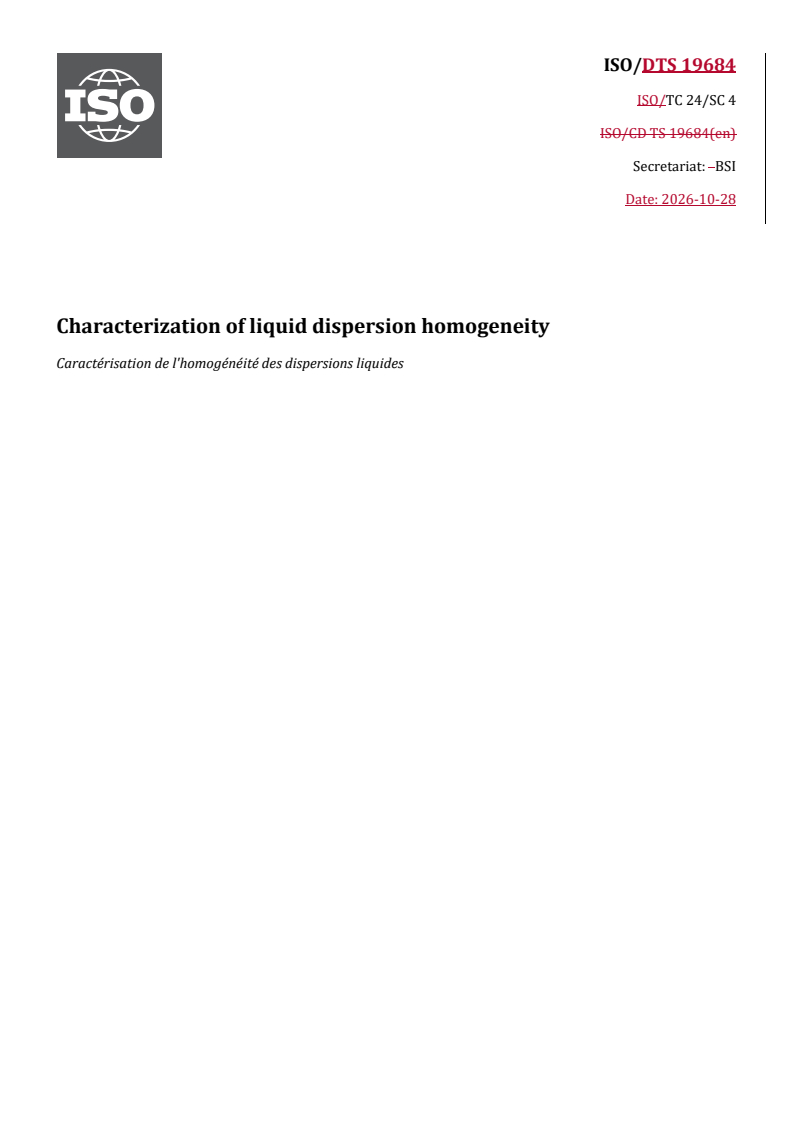
REDLINE ISO/DTS 19684 - Characterization of liquid dispersion homogeneity
ISO/DTS 19684 is an ISO technical specification for characterizing liquid dispersion homogeneity. It provides a framework for quantifying homogeneity and heterogeneity in dispersed solid/liquid, liquid/liquid, and gas/liquid particle systems. The document is written for people who need comparable measurements in laboratories, process monitoring, mixing, and quality control.
What does ISO/DTS 19684 specify?
ISO/DTS 19684 specifies how to describe, measure, calculate, and report homogeneity and heterogeneity in liquid dispersions. It treats homogeneity as spatial uniformity over a stated length scale, and it focuses on off-line and online evaluation.
The document is organized into:
- Clause 1, Scope
- Clause 2, Normative references
- Clause 3, Terms and definitions
- Clause 4, Symbols and abbreviated terms
- Clause 5, Characterization of homogeneity and heterogeneity
- Clause 6, Reporting requirements
- Annex A, Informative examples of measurement techniques and applications
- Annex B, Informative example calculation of indices
| Annex | What it covers |
|---|---|
| Annex A | Measurement techniques and applications for probes, sample scanning, and process imaging |
| Annex B | Example calculations of heterogeneity and homogeneity indices using simulated data |
What are the key requirements of ISO/DTS 19684?
What is being measured
ISO/DTS 19684 requires the user to identify the property or dispersed phase to be analysed, the characterization method, the sensor arrangement, and the spatial resolution and detection level. In practice, that means the measurement setup has to match the size of the heterogeneity you want to detect.
The standard frames homogeneity as a spatial property, not a time-based stability measure. That matters because a sample can look uniform at one moment even if it changes later.
How heterogeneity is quantified
ISO/DTS 19684 uses heterogeneity indices to describe variation in a property or dispersed phase, and the index must be dimensionless and decrease as the dispersion becomes more uniform. Clause 5.2 presents a coefficient of variation (CV)-based index and also a bounded alternative that depends on the maximum standard deviation for the system.
This gives users two practical choices: a simple, widely used measure, or a bounded measure that is easier to interpret on a 0 to 1 or 0 % to 100 % scale.
How homogeneity is quantified
ISO/DTS 19684 defines homogeneity as the complement of heterogeneity. Clause 5.3 gives a basic homogeneity index and an alternate form that accounts for measurement noise, which is useful when sensor variability would otherwise prevent the index from reaching 100 %.
In practice, this helps readers decide whether they need a straightforward comparison metric or a value that is corrected for instrument noise.
Multiphase and multi-property systems
ISO/DTS 19684 extends the approach to multiphase liquid dispersions and multiple measured properties. Clause 5.4 combines separate indices using weighting factors that sum to one.
This matters when different phases, or different properties of the same dispersion, do not contribute equally to the final assessment.
Mandatory selection steps
ISO/DTS 19684 lists the steps needed to determine an index: choose the property or phases, select the method and sensors, estimate spatial resolution and detection level, choose the index form, determine the parameters used by that form, and set the threshold for calling the material homogeneous. That threshold is the practical decision point for acceptance or classification.
Reporting
ISO/DTS 19684 requires reports to state the property measured, the characterization method, the detection level, the material quantity, the spacing or spatial resolution, the index definition, the index value, and the homogeneity threshold. This makes results traceable and comparable between laboratories or production sites.
What terms does ISO/DTS 19684 define?
- Heterogeneity - the degree to which a property or dispersed phase is not uniformly distributed throughout a quantity of material.
- Heterogeneity index - a measure of variation in a property or dispersed phase using a stated method, spatial resolution, and detection level.
- Homogeneity - the degree to which a property or dispersed phase is uniformly distributed throughout a quantity of material.
- Homogeneity index - the complement of the heterogeneity index.
- Homogeneous - uniform in property and composition, with no detected variation above the stated detection level.
- Coefficient of variation (CV) - the standard deviation divided by the mean, used here as a common basis for heterogeneity indexing.
Who uses ISO/DTS 19684?
ISO/DTS 19684 is used by engineers, researchers, laboratory staff, and quality managers who need to assess whether a liquid dispersion is uniform. It is relevant to mixing, process control, and quality control work, especially when comparing results across labs or operating conditions.
The measurement approaches in Annex A also make it useful for users of probes, scanners, and process imaging systems in industrial settings.
Which standards are used with ISO/DTS 19684?
ISO/DTS 19684 cites ISO 3534-1:2006 for statistical vocabulary and symbols. That reference supports the use of mean value and standard deviation in the index calculations.
What does the ISO/DTS 19684 document contain?
ISO/DTS 19684 contains the framework for defining and calculating homogeneity and heterogeneity indices, including formulae for basic, bounded, and noise-aware forms. Clause 5 also includes the rules for combining indices across multiple phases or properties and a comparison table of the main index types.
Annex A gives examples of measurement techniques and applications, including probes, sample scanning, and process imaging. It discusses methods such as electrical conductivity and capacitance probes, fibre-optic reflectance, Raman spectroscopy, ultrasonic attenuation, NIR scanning, radiography, X-ray tomography, and electrical tomographic imaging.
Annex B provides a worked simulation of a stirred tank with sensor placement, synthetic images, and example calculations over time. It shows how heterogeneity decreases and homogeneity increases as the system becomes more uniform.
Buy Documents
ISO/DTS 19684 - Characterization of liquid dispersion homogeneity
REDLINE ISO/DTS 19684 - Characterization of liquid dispersion homogeneity
Get Certified
Connect with accredited certification bodies for this standard

IMP NDT d.o.o.
Non-destructive testing services. Radiography, ultrasonic, magnetic particle, penetrant, visual inspection.

Inštitut za kovinske materiale in tehnologije
Institute of Metals and Technology. Materials testing, metallurgical analysis, NDT.

Q Techna d.o.o.
NDT and quality assurance specialist. 30+ years experience. NDT personnel certification per ISO 9712, nuclear and thermal power plant inspections, QA/
Sponsored listings
Frequently Asked Questions
ISO/DTS 19684 is a draft published by the International Organization for Standardization (ISO). Its full title is "Characterization of liquid dispersion homogeneity". This standard covers: This document describes a framework for evaluating homogeneity and heterogeneity in dispersed solid/liquid, liquid/liquid, and gas/liquid particle systems. The antonyms homogeneity and heterogeneity are defined in terms of the degree to which a property or dispersed phase is uniformly distributed throughout a quantity of material over a stated (and typically macroscopic) length scale. This document defines indices for measurement of homogeneity and heterogeneity, presents methods for off-line and online measurement, and includes application examples. The measurement of dispersion stability requires multiple measurements of homogeneity over time and is not considered here. Although this document does not directly address powders or other multiphase dispersions, the concepts can be readily carried over to those areas.
This document describes a framework for evaluating homogeneity and heterogeneity in dispersed solid/liquid, liquid/liquid, and gas/liquid particle systems. The antonyms homogeneity and heterogeneity are defined in terms of the degree to which a property or dispersed phase is uniformly distributed throughout a quantity of material over a stated (and typically macroscopic) length scale. This document defines indices for measurement of homogeneity and heterogeneity, presents methods for off-line and online measurement, and includes application examples. The measurement of dispersion stability requires multiple measurements of homogeneity over time and is not considered here. Although this document does not directly address powders or other multiphase dispersions, the concepts can be readily carried over to those areas.
ISO/DTS 19684 is classified under the following ICS (International Classification for Standards) categories: 19.120 - Particle size analysis. Sieving. The ICS classification helps identify the subject area and facilitates finding related standards.
ISO/DTS 19684 is available in PDF format for immediate download after purchase. The document can be added to your cart and obtained through the secure checkout process. Digital delivery ensures instant access to the complete standard document.
Standards Content (Sample)
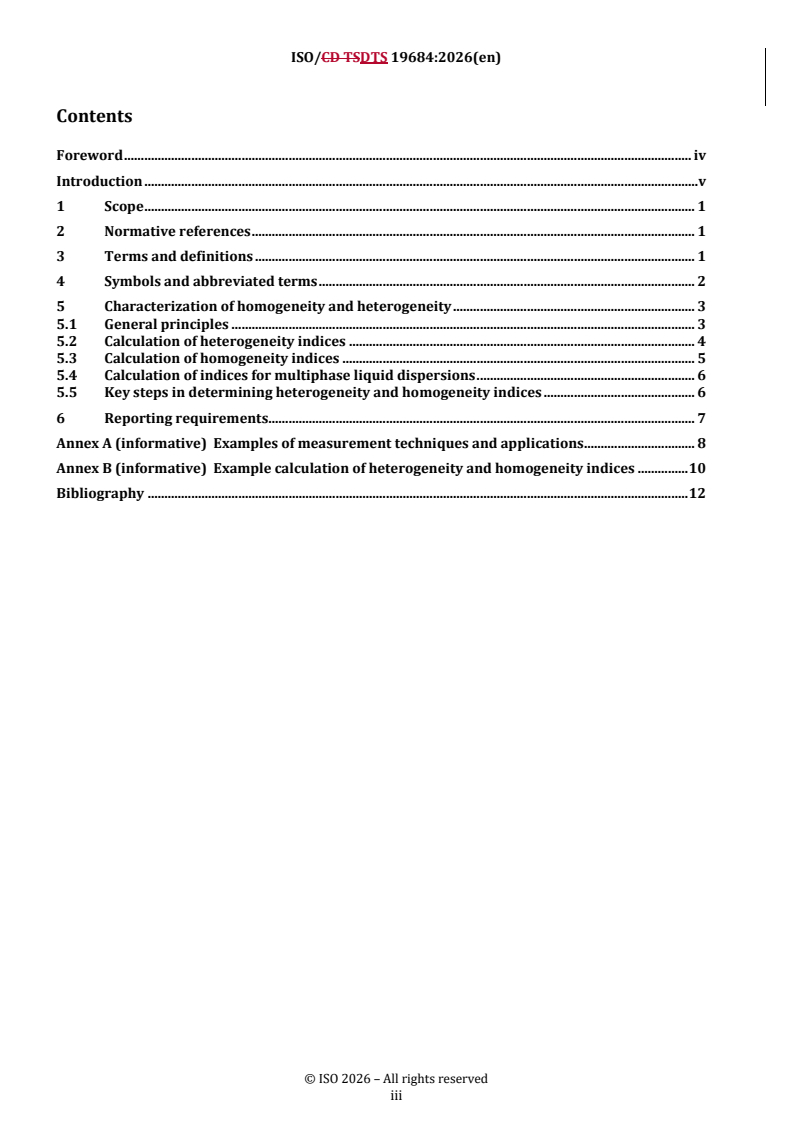
Contents
- Introduction
- 1 Scope
- 2 Normative references
- 3 Terms and definitions
- 3.1 heterogeneity
- 3.2 heterogeneity index
- 3.3 homogeneity
- 3.4 homogeneity index
- 3.5 homogeneous
- 4 Symbols and abbreviated terms
- 5 Characterization of homogeneity and heterogeneity
- 5.1 General principles
- 5.2 Calculation of heterogeneity indices
- 5.3 Calculation of homogeneity indices
- 5.4 Calculation of indices for multiphase liquid dispersions
- 5.5 Key steps in determining heterogeneity and homogeneity indices
- 6 Reporting requirements
- Annex A
- Annex B
- Bibliography
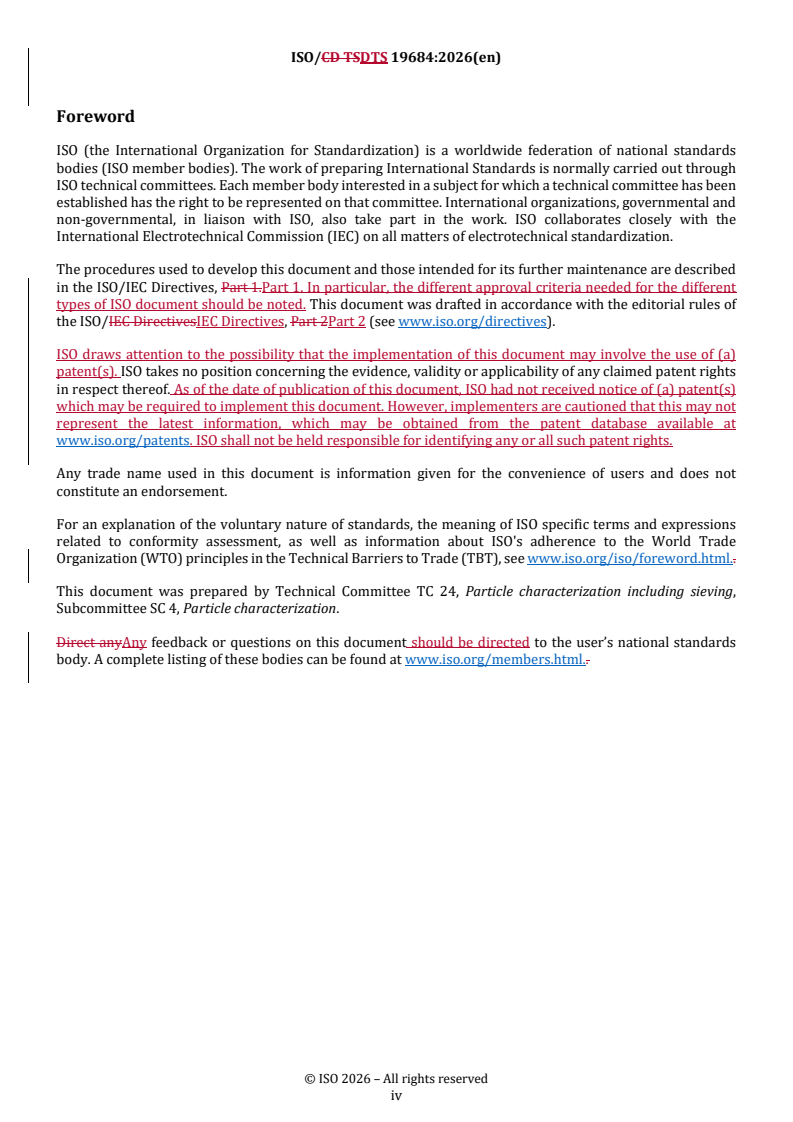
Introduction
The term “homogeneity” is broadly used throughout industry (e.g. in mixing, process control applications, and quality control documents) to describe degree of uniformity within a substance, and it is frequently mentioned in research papers. In many instances “homogeneity” and “homogeneous” are used as qualitative terms. Scientific and technical publications that quantify the level of homogeneity or, more accurately, the absence of heterogeneity rely on ad hoc definitions of a “homogeneity index” or “heterogeneity index”. In the context of liquid dispersions (e.g., solid particles dispersed in liquid phases), standard metrics of homogeneity and heterogeneity allow results obtained in different labs or under different conditions to be compared directly. These metrics should be applicable to systems with multiple dispersed phases. The purpose of this technical specification is to provide formal definitions of homogeneity index and heterogeneity index that are suitable for quantifying the homogeneity of liquid dispersions, including liquids that contain two or more dispersed phases. These definitions adapt a widely-used approach based on the coefficient of variation, and they are sufficiently broad to be useful for many other applications. Since this document defines the homogeneity index as the complement of the heterogeneity index, both quantities contain equivalent information, and the choice of index depends on whether the focus is on uniformity or non-uniformity. The antonyms homogeneity and heterogeneity are defined in terms of the degree to which a property or dispersed phase is uniformly distributed throughout a quantity of material over a stated (and typically macroscopic) length scale.
Assessment of dispersion stability involves multiple measurements of homogeneity or heterogeneity index over time and is not considered in this document. The homogeneity indices defined in this document are not suitable for measurement of contamination. This document does not directly address powders or solid/solid dispersions, but the concepts can be readily carried over to those applications.
FINAL DRAFT Technical Specification ISO/DTS 19684:2026(en) Characterization of liquid dispersion homogeneity
1 Scope
This document describes a framework for evaluating homogeneity and heterogeneity in liquid dispersions. This document also defines indices for quantifying homogeneity and heterogeneity that are suitable for off-line (e.g. batch) and online (real-time) evaluation and includes application examples. Multiphase liquid dispersions are within the scope of this document, which is also applicable to measurement of multiple properties.
2 Normative references
The following documents are referred to in the text in such a way that some or all of their content constitutes requirements of this document. For dated references, only the edition cited applies. For undated references, the latest edition of the referenced document (including any amendments) applies. ISO 3534-1:2006, Statistics — Vocabulary and symbols — Part 1: General statistical terms and terms used in probability
3 Terms and definitions
For the purposes of this document, the terms and definitions given in ISO 3534-1:2006 and the following apply.
ISO and IEC maintain terminology databases for use in standardization at the following addresses: — ISO Online browsing platform: available at https:// www .iso .org/ obp - IEC Electropedia: available at https:// www .electropedia .org/
3.1 heterogeneity
inhomogeneity degree to which a property or dispersed phase is not uniformly distributed throughout a quantity of material Note 1 to entry: Heterogeneity is revealed by variations in the property or dispersed phase that exceed the stated detection level for one or more stated characterization methods. [1] [SOURCE: ISO 21637:2020 , 3.36, modified – “type of particle of a solid recovered fuel (3.75)” is replaced with “dispersed phase”; Note 1 to entry has been added.]
3.2 heterogeneity index
measure of variation in a property or dispersed phase throughout a defined quantity of material using a stated characterization method with a stated spatial resolution and detection level Note 1 to entry: A heterogeneity index is relatively large for an undispersed solid/liquid mixture and approaches zero (i.e. below the detection level of the characterization method) for homogeneous dispersions. Note 2 to entry: More than one heterogeneity index may be defined, depending on the application. Note 3 to entry: If multiple characterization methods are used to form more than one heterogeneity index, or if separate heterogeneity indices are defined to analyse multiple phases, those values can be combined to form a total heterogeneity index.
ISO/DTS 19684:2026(en)
3.3 homogeneity
degree to which a property or dispersed phase is uniformly distributed throughout a quantity of material Note 1 to entry: A uniform dispersion is one in which no variations in the property or dispersed phase(s) are detected, i.e. exceed the stated detection level, for one or more stated characterization methods. [2] [SOURCE: ISO/TS 22107:2021 , 3.11, modified – “a constituent” is replaced with “dispersed phase”; Note 1 to entry has been added.]
3.4 homogeneity index
complement of the heterogeneity index Note 1 to entry: If the homogeneity index is expressed as a percentage (%), then the heterogeneity index (also expressed as a percentage) is equal to 100 % minus the homogeneity index. Note 2 to entry: More than one homogeneity index may be defined, depending on the application. Note 3 to entry: If multiple characterization methods are used to form more than one homogeneity index, or if separate homogeneity indices are defined to analyse multiple phases, those values can be combined to form a total homogeneity index.
3.5 homogeneous
uniform in property and composition Note 1 to entry: Uniformity indicates that no variation in property or composition is observed by one or more stated characterization methods to exceed the stated detection level. Note 2 to entry: A homogeneous dispersion may actually contain a small amount of heterogeneity if variations in property and composition exist that are below the stated detection limit for the stated characterization methods. [3] [SOURCE: ISO 20166-1:2018 , 3.31, modified – Notes 1 and 2 to entry have been added.]
4 Symbols and abbreviated terms
CV coefficient of variation, equal to the standard deviation divided by the mean H homogeneity index defined in Formula (3) that ignores stochastic variability of the B measurements H total homogeneity index defined in Formula (8) that considers multiple properties or dispersed T phases H homogeneity index defined in Formula (5) that considers stochastic variability of the V measurements H homogeneity index of one property or one dispersed phase in a multiphase system
I bounded heterogeneity index defined in Formula (2) that ignores stochastic variability of the B measurements I total heterogeneity index defined in Formula (6) that considers multiple properties or dispersed T phases I unbounded heterogeneity index U bounded heterogeneity index defined in Formula (4) that considers stochastic variability of the measurements
ISO/DTS 19684:2026(en) heterogeneity index of one property or one dispersed phase in a multiphase system N number of indices used to calculate a total index s (population) standard deviation of the measurement in the absence of "measurement noise" het s standard deviation of the observed measurements m s maximum standard deviation that can be attained in a sample a given particle system max s standard deviation of stochastic variation in the measurements (i.e. “measurement noise”) n x measured value of a specified property of a dispersion or dispersed phase, taken at a given position and time mean value of measurements of a specified property
5 Characterization of homogeneity and heterogeneity
5.1 General principles
In general, homogeneity is indicated by the degree to which specified physical properties (e.g. particle size, concentration, shape or colour, optical reflectance, or X-ray absorption) or dispersed phases (e.g. chemical composition) are uniformly distributed throughout the volume of a liquid dispersion at one moment in time. Therefore, homogeneity is primarily related to spatial, rather than temporal, uniformity. In contrast, variation of properties or dispersed phase(s) over time is determined by the stability of the particle [4] system, which is not considered in this document; see ISO/TR 13097:2013 . Practical measurements of heterogeneity may include data collected at more than one point in time, provided that the time span of data collection is short compared to the time scale of changes (e.g. creaming or sedimentation) induced by instability.
Assessment of homogeneity depends on the detection and quantification of heterogeneity, i.e. variation in the properties or dispersed phases. Therefore, the observed quantity is usually heterogeneity, rather than homogeneity.
Measurement of heterogeneity requires - Selection of one or more physical properties or dispersed phases to be measured and the sensitivity (precision) level required for each.
- Specification of the minimum spatial resolution or spacing between measurement points required to detect heterogeneity.
- Specification of the measurement method(s) to be used, subject to the required sensitivity and spatial resolution.
- Measurement of a sufficient volume (or number of samples) to be statistically representative of the entire sample (or product batch).
- Quantification of the measurement results, which may be accomplished by defining a heterogeneity index, e.g. the coefficient of variation in the measurand(s).
A heterogeneity index may be measured for a material at rest or in manufacturing processes, for which it can serve as a state variable. Its value is expected to change over time in a dynamic process but to stabilize if a process attains steady-state operation. The heterogeneity index shall be dimensionless, and its value shall decrease as the property or distributed phase (or phases) becomes more uniformly distributed in the dispersion.
ISO/DTS 19684:2026(en) A homogeneity index shall be defined in terms of one or more heterogeneity indices, and its value shall increase as the property or distributed phase (or phases) becomes more uniformly distributed in the dispersion.
NOTE 1 Heterogeneity and homogeneity indices are often expressed using the symbol % (percent), which represents the number 0.01. Formulae in this document calculate these indices as decimal numbers ranging approximately from 0 to 1. Multiplication by 100 % yields the equivalent percent values, which range approximately from 0 % to 100 %. In order to be considered homogeneous, a sample’s measured heterogeneity shall be less than a specified detection level that is based on the capability of the measurement method(s) and the application requirements.
...
Contents
- Introduction
- 1 Scope
- 1 Scope
- 2 Normative references
- 3 Terms and definitions
- 3.1 heterogeneity
- 3.2 heterogeneity index
- 3.3 homogeneity
- 3.4 homogeneity index
- 3.5 homogeneous
- 4 Symbols and abbreviated terms
- 5 Characterization of homogeneity and heterogeneity
- 5.1 General principles
- 5.2 Calculation of heterogeneity indices
- 5.3 Calculation of homogeneity indices
- 5.4 Calculation of indices for multiphase liquid dispersions
- 5.5 Key steps in determining heterogeneity and homogeneity indices
- 6 Reporting requirements
- Annex A
- Annex B
- Bibliography
Introduction
The term “homogeneity” is broadly used throughout industry (e.g. in mixing, process control applications, and quality control documents) to describe degree of uniformity within a substance, and it is frequently mentioned in research papers. In many instances “homogeneity” and “homogeneous” are used as qualitative terms. Scientific and technical publications that quantify the level of homogeneity or, more accurately, the absence of heterogeneity rely on ad hoc definitions of a “homogeneity index” or “heterogeneity index”. In the context of liquid dispersions (e.g., solid particles dispersed in liquid phases), standard metrics of homogeneity and heterogeneity allow results obtained in different labs or under different conditions to be compared directly. These metrics should be applicable to systems with multiple dispersed phases. The purpose of this technical specification is to provide formal definitions of homogeneity index and heterogeneity index that are suitable for quantifying the homogeneity of liquid dispersions, including liquids that contain two or more dispersed phases. These definitions adapt a widely-used approach based on the coefficient of variation, and they are sufficiently broad to be useful for many other applications. Since this document defines the homogeneity index as the complement of the heterogeneity index, both quantities contain equivalent information, and the choice of index depends on whether the focus is on uniformity or nonuniformity.
ISO/DTS 19684:2026(en) Characterization of liquid dispersion homogeneity
1 Scope
This document describes a framework for evaluating homogeneity and heterogeneity in liquid dispersions. The antonyms homogeneity and heterogeneity are defined in terms of the degree to which a property or dispersed phase is uniformly distributed throughout a quantity of material over a stated (and typically macroscopic) length scale. This document defines indices for quantifying homogeneity and heterogeneity that are suitable for off-line (e.g. batch) and online (real-time) evaluation and includes application examples. Multiphase liquid dispersions are within the scope of this technical specification, which is also applicable to measurement of multiple properties.
Assessment of dispersion stability involves multiple measurements of homogeneity or heterogeneity index over time and is not considered here.
in this document. The homogeneity indices defined herein this document are probably not suitable for measurement of contamination.
This document does not directly address powders or solid/solid dispersions, but the concepts can be readily carried over to those applications.
ISO/CD TSDTS 19684:2026(en) Characterization of liquid dispersion homogeneity
1 Scope
This document describes a framework for evaluating homogeneity and heterogeneity in liquid dispersions. This document also defines indices for quantifying homogeneity and heterogeneity that are suitable for offline (e.g. batch) and online (real-time) evaluation and includes application examples. Multiphase liquid dispersions are within the scope of this document, which is also applicable to measurement of multiple properties.
2 Normative references
The following documents are referred to in the text in such a way that some or all of their content constitutes requirements of this document. For dated references, only the edition cited applies. For undated references, the latest edition of the referenced document (including any amendments) applies. ISO 3534-1:2006, Statistics — Vocabulary and symbols — Part 1: General statistical terms and terms used in probability
3 Terms and definitions
The Terms and definitions clause is a mandatory element of the text. For rules on the drafting of the Terms and definitions, refer to the . To insert a new terminological entry, go to the Structure tab and click on Insert Term entry.
For the purposes of this document, the following terms and definitions, as well as terms and definitions given in ISO 3534-1:2006 and the following apply.
ISO and IEC maintain terminologicalterminology databases for use in standardization at the following addresses:
- IEC Electropedia: available at
- ISO Online browsing platform: available at https://www.iso.org/obp
- IEC Electropedia: available at https://www.electropedia.org/
3.1 heterogeneity
inhomogeneity, noun degree to which a property or dispersed phase is not uniformly distributed throughout a quantity of material Note 1 to entry: Heterogeneity is revealed by variations in the property or dispersed phase that exceed the stated detection level for one or more stated characterization methods. [1] [SOURCE: ISO 21637:2020 ISO 21637:2020,, 3.36, modified – “type of particle of a solid recovered fuel (3.75)” is replaced with “dispersed phase”; Note 1 to entry has been added.]
ISO/CD TSDTS 19684:2026(en)
3.2 heterogeneity index
measure of variation in a property or dispersed phase throughout a defined quantity of material using a stated characterization method with a stated spatial resolution and detection level Note 1 to entry: A heterogeneity index is relatively large for an undispersed solid/liquid mixture and approaches zero (i.e. below the detection level of the characterization method) for homogeneous dispersions. Note 2 to entry: More than one heterogeneity index may be defined, depending on the application. Note 3 to entry: If multiple characterization methods are used to form more than one heterogeneity index, or if separate heterogeneity indices are defined to analyse multiple phases, those values can be combined to form a total heterogeneity index.
3.3 homogeneity
degree to which a property or dispersed phase is uniformly distributed throughout a quantity of material Note 1 to entry: A uniform dispersion is one in which no variations in the property or dispersed phase(s) are detected, i.e. exceed the stated detection level, for one or more stated characterization methods. [2] [SOURCE: ISO/TS 22107:2021 ISO TS 22107:2021,, 3.11, modified – “a constituent” is replaced with “dispersed phase”; Note 1 to entry has been added.]
3.4 homogeneity index
complement of the heterogeneity index Note 1 to entry: If the homogeneity index is expressed as a percentage (%), then the heterogeneity index (also expressed as a percentage) is equal to 100 % minus the homogeneity index. Note 2 to entry: More than one homogeneity index may be defined, depending on the application. Note 3 to entry: If multiple characterization methods are used to form more than one homogeneity index, or if separate homogeneity indices are defined to analyse multiple phases, those values can be combined to form a total homogeneity index.
3.5 homogeneous
uniform in property and composition Note 1 to entry: Uniformity indicates that no variation in property or composition is observed by one or more stated characterization methods to exceed the stated detection level. Note 2 to entry: A homogeneous dispersion may actually contain a small amount of heterogeneity if variations in property and composition exist that are below the stated detection limit for the stated characterization methods. [3] [SOURCE: ISO 20166-1:2018 ISO 20166-1:2018,, 3.31, modified – Notes 1 and 2 to entry have been added.]
4 Symbols and abbreviated terms
CV coefficient of variation, equal to the standard deviation divided by the mean
ISO/CD TSDTS 19684:2026(en) H homogeneity index defined in Formula (3) that ignores stochastic variability of the B measurements H total homogeneity index defined in Formula (8) that considers multiple properties or T dispersed phases H homogeneity index defined in Formula (5) that considers stochastic variability of the V measurements H homogeneity index of one property or one dispersed phase in a multiphase system
I bounded heterogeneity index defined in Formula (2) that ignores stochastic variability of B the measurements I total heterogeneity index defined in Formula (6) that considers multiple properties or T dispersed phases I unbounded heterogeneity index U 𝐼𝐼 bounded heterogeneity index defined in Formula (4) that considers stochastic variability of V the measurements 𝐼𝐼 heterogeneity index of one property or one dispersed phase in a multiphase system
N number of indices used to calculate a total index s (population) standard deviation of the measurement in the absence of "measurement noise" het s standard deviation of the observed measurements m s maximum standard deviation that can be attained in a sample a given particle system max s standard deviation of stochastic variation in the measurements (i.e. “measurement noise”) n x measured value of a specified property of a dispersion or dispersed phase, taken at a given position and time 𝑥𝑥 mean value of measurements of a specified property
5 Characterization of homogeneity and heterogeneity
5.1 General principles
In general, homogeneity is indicated by the degree to which specified physical properties (e.g. particle size, concentration, shape or colour, optical reflectance, or X-ray absorption) or dispersed phases (e.g. chemical composition) are uniformly distributed throughout the volume of a liquid dispersion at one moment in time. Therefore, homogeneity is primarily related to spatial, rather than temporal, uniformity. In contrast, variation of properties or dispersed phase(s) over time is determined by the stability of the particle system, which is [4] not considered in this document; see ISO/TR 13097:2013 .. Practical measurements of heterogeneity may include data collected at more than one point in time, provided that the time span of data collection is short compared to the time scale of changes (e.g. creaming or sedimentation) induced by instability.
ISO/CD TSDTS 19684:2026(en) Assessment of homogeneity depends on the detection and quantification of heterogeneity, i.e. variation in the properties or dispersed phases. Therefore, the observed quantity is usually heterogeneity, rather than homogeneity.
Measurement of heterogeneity requires - Selection of one or more physical properties or dispersed phases to be measured and the sensitivity (precision) level required for each.
- Specification of the minimum spatial resolution or spacing between measurement points required to detect heterogeneity.
- Specification of the measurement method(s) to be used, subject to the required sensitivity and spatial resolution.
- Measurement of a sufficient volume (or number of samples) to be statistically representative of the entire sample (or product batch)).
- Quantification of the measurement results, which may be accomplished by defining a heterogeneity index, e.g. the coefficient of variation in the measurand(s)).
A heterogeneity index may be measured for a material at rest or in manufacturing processes, for which it can serve as a state variable. Its value is expected to change over time in a dynamic process but to stabilize if a process attains steady-state operation. The heterogeneity index shall be dimensionless, and its value shall decrease as the property or distributed phase (or phases) becomes more uniformly distributed in the dispersion.
A homogeneity index shall be defined in terms of one or more heterogeneity indices, and its value shall increase as the property or distributed phase (or phases) becomes more uniformly distributed in the dispersion.
...