

ISO/FDIS 25585
(Main)Traditional Chinese medicine — Notopterygium incisum and Notopterygium franchetii rhizome and root
General Information
- Abstract
This document specifies the quality and safety requirements of Notopterygium incisum and Notopterygium franchetii rhizome and root(abbreviated as Notopterygium rhizome and root). This document applies to Notopterygium rhizome and root that is sold and used as natural medicine in international trade, including Chinese materia medica (whole medicinal materials) and decoction pieces derived from this herb, excluding wild source herbs.
- Status
- Not Published
- Technical Committee
- ISO/TC 249 - Traditional Chinese medicine
- Current Stage
- 5000 - FDIS registered for formal approval
- Start Date
- 06-Jul-2026
- Completion Date
- 06-Jul-2026
Buy Documents
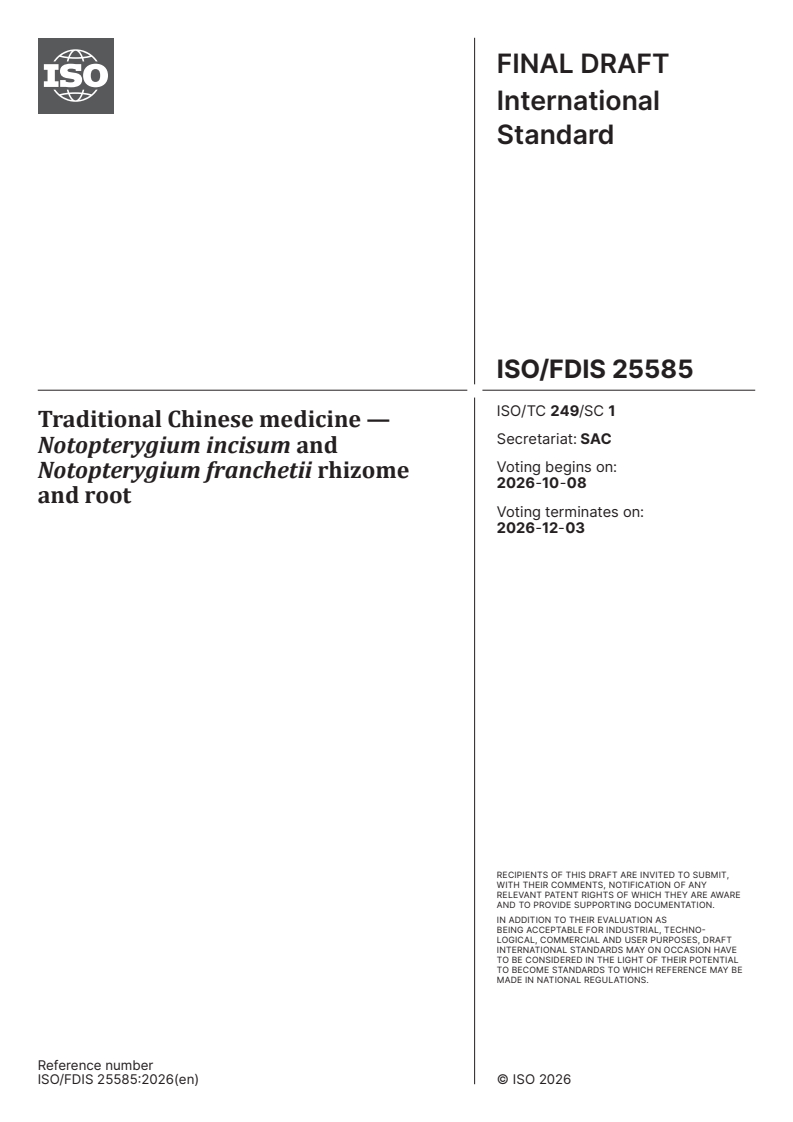
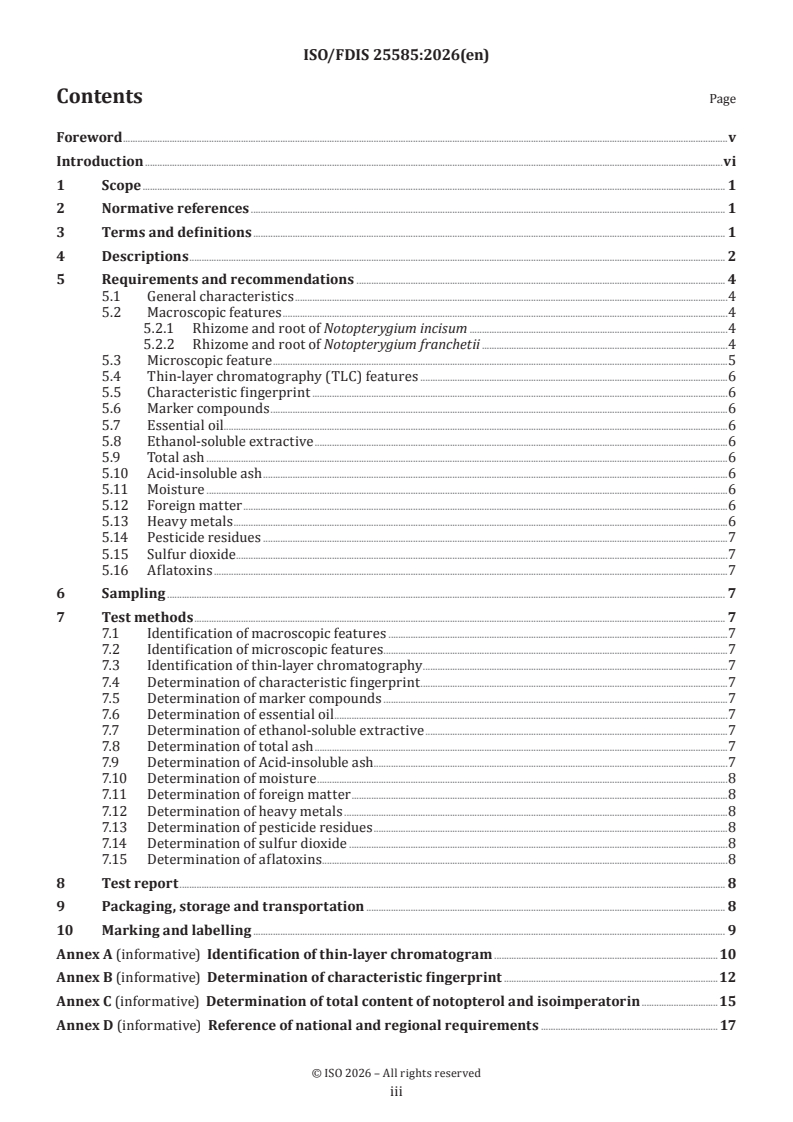
ISO/FDIS 25585 - Traditional Chinese medicine — Notopterygium incisum and Notopterygium franchetii rhizome and root
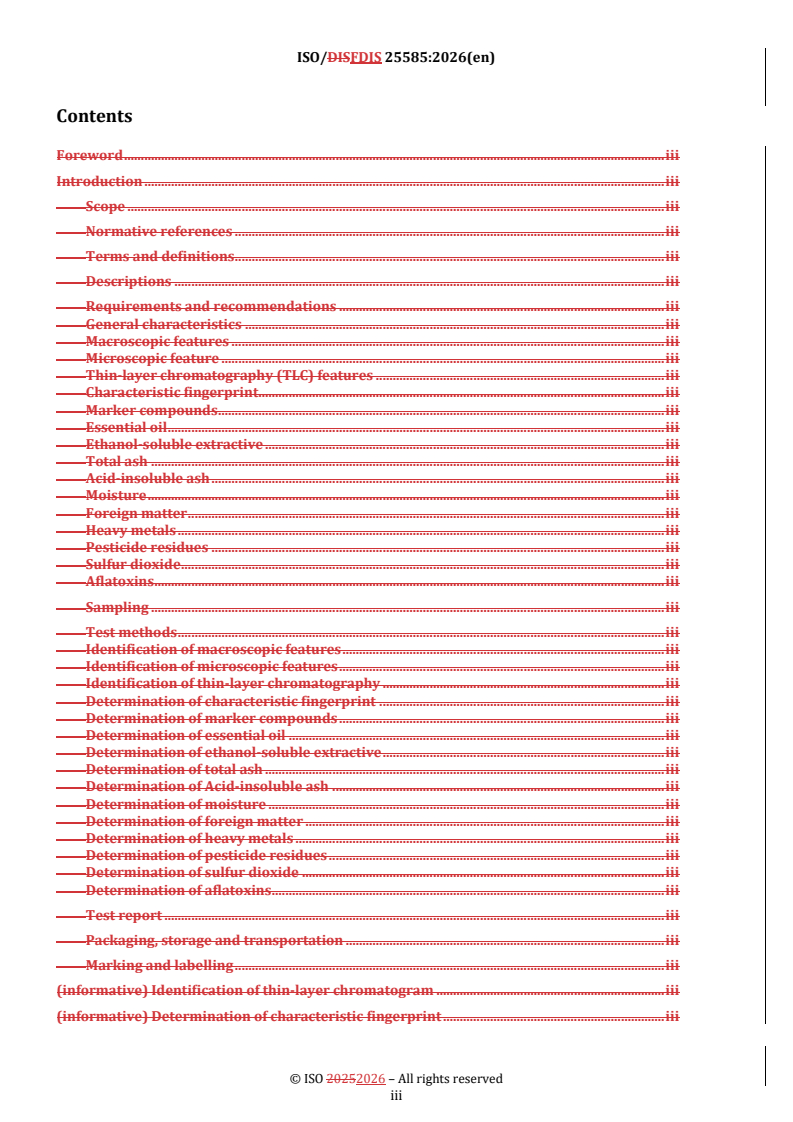
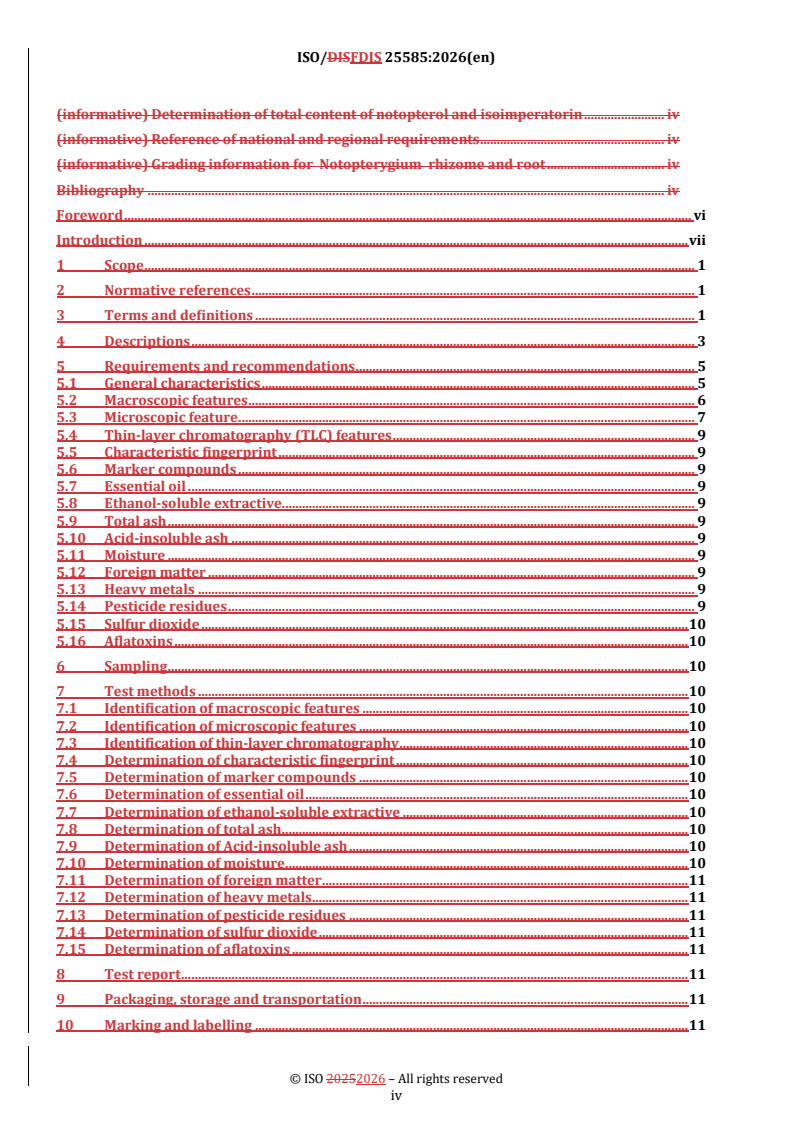
REDLINE ISO/FDIS 25585 - Traditional Chinese medicine — Notopterygium incisum and Notopterygium franchetii rhizome and root
Overview
ISO/FDIS 25585 is an ISO standard for Traditional Chinese medicine that addresses Notopterygium incisum and Notopterygium franchetii rhizome and root, also referred to as Notopterygium rhizome and root or Qiang Huo. It specifies quality and safety requirements for these natural medicinal materials in international trade.
The standard applies to:
- Chinese materia medica in whole-material form
- Decoction pieces derived from the herb
It does not apply to wild source herbs, making it especially relevant for controlled commercial supply chains. For manufacturers, traders, laboratories, and regulators, ISO/FDIS 25585 supports product consistency, market access, and traceability in the global herbal medicine sector.
Key Topics
This standard focuses on practical controls that help verify identity and safety throughout the supply chain. Key areas include:
- Botanical identification of the rhizome and root of Notopterygium incisum and Notopterygium franchetii
- Macroscopic and microscopic features for material recognition
- Thin-layer chromatography (TLC) for identity confirmation
- Characteristic fingerprinting using high-performance liquid chromatography (HPLC)
- Marker compounds, including notopterol and isoimperatorin
- Quality indicators such as:
- Essential oil
- Ethanol-soluble extractive
- Total ash
- Acid-insoluble ash
- Moisture
- Foreign matter
- Safety requirements covering:
- Heavy metals
- Pesticide residues
- Sulfur dioxide
- Aflatoxins
ISO/FDIS 25585 also includes guidance on sampling, test methods, test reports, packaging, storage, transportation, marking, and labelling, helping users apply a complete quality control framework.
Applications
ISO/FDIS 25585 is valuable in any setting where herbal medicine quality assurance is essential. Common applications include:
- International trade of traditional Chinese medicinal materials
- Quality control laboratories testing herbal raw materials and decoction pieces
- Manufacturers and processors preparing medicinal products for export
- Regulators and inspectors checking compliance in herbal supply chains
- Purchasing and procurement teams verifying product identity and safety
The standard is especially useful for organizations seeking to reduce variability and support controllable, repeatable, and safe herbal sourcing. Its informative annexes provide additional support for TLC identification, fingerprinting, marker content determination, and grading information.
Related Standards
ISO/FDIS 25585 references several related ISO documents that support implementation:
- ISO 23723 - General requirements for herbal raw material and materia medica
- ISO/TS 21310 - Microscopic examination of medicinal herbs
- ISO 18664 - Determination of heavy metals in herbal medicines used in Traditional Chinese Medicine
- ISO 22258 - Determination of pesticide residues in natural products by gas chromatography
- ISO 22283 - Determination of aflatoxins in natural products by LC-FLD
- ISO 22590 - Determination of sulfur dioxide in natural products by titration
- ISO 22217 - Storage requirements for raw materials and decoction pieces
- ISO 21371 - Labelling requirements of products intended for oral or topical use
- ISO 16791 - Machine-readable coding of medicinal product package identifiers
Together, these standards strengthen herbal medicine standardization, product safety, and international conformity assessment.
Buy Documents
ISO/FDIS 25585 - Traditional Chinese medicine — Notopterygium incisum and Notopterygium franchetii rhizome and root
REDLINE ISO/FDIS 25585 - Traditional Chinese medicine — Notopterygium incisum and Notopterygium franchetii rhizome and root
Get Certified
Connect with accredited certification bodies for this standard

BSI Group
BSI (British Standards Institution) is the business standards company that helps organizations make excellence a habit.

TÜV Rheinland
TÜV Rheinland is a leading international provider of technical services.

TÜV SÜD
TÜV SÜD is a trusted partner of choice for safety, security and sustainability solutions.
Sponsored listings
Frequently Asked Questions
ISO/FDIS 25585 is a draft published by the International Organization for Standardization (ISO). Its full title is "Traditional Chinese medicine — Notopterygium incisum and Notopterygium franchetii rhizome and root". This standard covers: This document specifies the quality and safety requirements of Notopterygium incisum and Notopterygium franchetii rhizome and root(abbreviated as Notopterygium rhizome and root). This document applies to Notopterygium rhizome and root that is sold and used as natural medicine in international trade, including Chinese materia medica (whole medicinal materials) and decoction pieces derived from this herb, excluding wild source herbs.
This document specifies the quality and safety requirements of Notopterygium incisum and Notopterygium franchetii rhizome and root(abbreviated as Notopterygium rhizome and root). This document applies to Notopterygium rhizome and root that is sold and used as natural medicine in international trade, including Chinese materia medica (whole medicinal materials) and decoction pieces derived from this herb, excluding wild source herbs.
ISO/FDIS 25585 is classified under the following ICS (International Classification for Standards) categories: 11.120.10 - Medicaments. The ICS classification helps identify the subject area and facilitates finding related standards.
ISO/FDIS 25585 is available in PDF format for immediate download after purchase. The document can be added to your cart and obtained through the secure checkout process. Digital delivery ensures instant access to the complete standard document.
Standards Content (Sample)
FINAL DRAFT
International
Standard
ISO/TC 249/SC 1
Traditional Chinese medicine —
Secretariat: SAC
Notopterygium incisum and
Voting begins on:
Notopterygium franchetii rhizome
2026-10-08
and root
Voting terminates on:
2026-12-03
RECIPIENTS OF THIS DRAFT ARE INVITED TO SUBMIT,
WITH THEIR COMMENTS, NOTIFICATION OF ANY
RELEVANT PATENT RIGHTS OF WHICH THEY ARE AWARE
AND TO PROVIDE SUPPOR TING DOCUMENTATION.
IN ADDITION TO THEIR EVALUATION AS
BEING ACCEPTABLE FOR INDUSTRIAL, TECHNO
LOGICAL, COMMERCIAL AND USER PURPOSES, DRAFT
INTERNATIONAL STANDARDS MAY ON OCCASION HAVE
TO BE CONSIDERED IN THE LIGHT OF THEIR POTENTIAL
TO BECOME STAN DARDS TO WHICH REFERENCE MAY BE
MADE IN NATIONAL REGULATIONS.
Reference number
FINAL DRAFT
International
Standard
ISO/TC 249/SC 1
Traditional Chinese medicine —
Secretariat: SAC
Notopterygium incisum and
Voting begins on:
Notopterygium franchetii rhizome
and root
Voting terminates on:
© ISO 2026
All rights reserved.
RECIPIENTS OF THIS DRAFT ARE INVITED TO SUBMIT,
WITH THEIR COMMENTS, NOTIFICATION OF ANY
This ISO publication is protected by copyright and is owned by ISO and/or its licensors.
RELEVANT PATENT RIGHTS OF WHICH THEY ARE AWARE
The content of this ISO publication is provided under licence, not sold. Use is subject to the applicable licence terms issued by ISO,
AND TO PROVIDE SUPPOR TING DOCUMENTATION.
an ISO member body, or an authorized third-party distributor.
IN ADDITION TO THEIR EVALUATION AS
BEING ACCEPTABLE FOR INDUSTRIAL, TECHNO
Except as required for implementation or expressly permitted by a separate licence, no part of this ISO publication may be
LOGICAL, COMMERCIAL AND USER PURPOSES, DRAFT
reproduced, distributed, modified, used, or made available in any form or by any means – electronic or mechanical, including
INTERNATIONAL STANDARDS MAY ON OCCASION HAVE
photocopying, scanning, recording, or posting on internal or external digital platforms. TO BE CONSIDERED IN THE LIGHT OF THEIR POTENTIAL
TO BECOME STAN DARDS TO WHICH REFERENCE MAY BE
Any use beyond the scope of the granted rights is prohibited and may result in legal action.
MADE IN NATIONAL REGULATIONS.
ISO copyright office
CP 401 • CH-1214 Vernier, Geneva
Phone: +41 22 749 01 11
Email: copyright@iso.org
Website: www.iso.org
Published in Switzerland
Reference number
ii
Contents Page
Foreword .v
Introduction .vi
1 Scope . 1
2 Normative references . 1
3 Terms and definitions . 1
4 Descriptions . 2
5 Requirements and recommendations . 4
5.1 General characteristics .4
5.2 Macroscopic features .4
5.2.1 Rhizome and root of Notopterygium incisum .4
5.2.2 Rhizome and root of Notopterygium franchetii .4
5.3 Microscopic feature .5
5.4 Thin-layer chromatography (TLC) features .6
5.5 Characteristic fingerprint .6
5.6 Marker compounds .6
5.7 Essential oil.6
5.8 Ethanol-soluble extractive .6
5.9 Total ash .6
5.10 Acid-insoluble ash .6
5.11 Moisture .6
5.12 Foreign matter .6
5.13 Heavy metals .6
5.14 Pesticide residues .7
5.15 Sulfur dioxide . .7
5.16 Aflatoxins .7
6 Sampling . 7
7 Test methods . 7
7.1 Identification of macroscopic features .7
7.2 Identification of microscopic features .7
7.3 Identification of thin-layer chromatography .7
7.4 Determination of characteristic fingerprint .7
7.5 Determination of marker compounds .7
7.6 Determination of essential oil . .7
7.7 Determination of ethanol-soluble extractive .7
7.8 Determination of total ash .7
7.9 Determination of Acid-insoluble ash . .7
7.10 Determination of moisture .8
7.11 Determination of foreign matter .8
7.12 Determination of heavy metals .8
7.13 Determination of pesticide residues .8
7.14 Determination of sulfur dioxide .8
7.15 Determination of aflatoxins . .8
8 Test report . 8
9 Packaging, storage and transportation . 8
10 Marking and labelling . 9
Annex A (informative) Identification of thin-layer chromatogram .10
Annex B (informative) Determination of characteristic fingerprint .12
Annex C (informative) Determination of total content of notopterol and isoimperatorin .15
Annex D (informative) Reference of national and regional requirements . 17
iii
Annex E (informative) Grading information for Notopterygium rhizome and root . 19
Bibliography .20
iv
Foreword
ISO (the International Organization for Standardization) is a worldwide federation of national standards
bodies (ISO member bodies). The work of preparing International Standards is normally carried out through
ISO technical committees. Each member body interested in a subject for which a technical committee
has been established has the right to be represented on that committee. International organizations,
governmental and non-governmental, in liaison with ISO, also take part in the work. ISO collaborates closely
with the International Electrotechnical Commission (IEC) on all matters of electrotechnical standardization.
The procedures used to develop this document and those intended for its further maintenance are described
in the ISO/IEC Directives, Part 1. In particular, the different approval criteria needed for the different types
of ISO document should be noted. This document was drafted in accordance with the editorial rules of the
ISO/IEC Directives, Part 2 (see www.iso.org/directives).
ISO draws attention to the possibility that the implementation of this document may involve the use of (a)
patent(s). ISO takes no position concerning the evidence, validity or applicability of any claimed patent
rights in respect thereof. As of the date of publication of this document, ISO had not received notice of (a)
patent(s) which may be required to implement this document. However, implementers are cautioned that
this may not represent the latest information, which may be obtained from the patent database available at
www.iso.org/patents. ISO shall not be held responsible for identifying any or all such patent rights.
Any trade name used in this document is information given for the convenience of users and does not
constitute an endorsement.
For an explanation of the voluntary nature of standards, the meaning of ISO specific terms and expressions
related to conformity assessment, as well as information about ISO's adherence to the World Trade
Organization (WTO) principles in the Technical Barriers to Trade (TBT), see www.iso.org/iso/foreword.html.
This document was prepared by ISO/TC 249, Traditional medicine, Subcommittee SC 1, Traditional Chinese
medicine.
Any feedback or questions on this document should be directed to the user’s national standards body. A
complete listing of these bodies can be found at www.iso.org/members.html.
v
Introduction
The medicinal history of Notopterygium incisum and Notopterygium franchetii rhizome and root (abbreviated
as Notopterygium rhizome and root, Chinese Pinyin name Qiang Huo) dates back to over 2 000 years.
Notopterygium rhizome and root is used as a traditional herbal medicine in China, Japan, South Korea, the
United States, Netherlands, and other countries. It has played a role in various therapeutic effects, such as
an anti-inflammation, analgesic, antipyretic, antibacterial, antiviral, anti-arrhythmia, and anti-thrombotic,
intended for the treatment of common cold, headache, rheumatic pain, and rheumatoid arthritis, etc.
Origin plants of Notopterygium rhizome and root are Notopterygium incisum K. C. Ting ex H. T. Chang and N.
franchetii H. de Boiss. (Fam. Apiaceae) as recorded in several pharmacopeias, such as Chinese Pharmacopoeia,
Japanese Pharmacopoeia, Korean Pharmacopoeia, and European Pharmacopoeia. In addition, the Korean
Pharmacopoeia contains Ostericum koreanum rhizome and root for local use.
The establishment of an international standard for Notopterygium rhizome and root is necessary to
guarantee the clinical effectiveness, patient safety, and controllability in global commerce and trade.
As national implementation may differ, national standards bodies are invited to modify the values given in
5.6, 5.7, 5.9, 5.10 and 5.11 in their national standards. Examples of national and regional values are given in
Annex D. In addition, grading information of Notopterygium rhizome and root are given in Annex E.
vi
FINAL DRAFT International Standard ISO/FDIS 25585:2026(en)
Traditional Chinese medicine — Notopterygium incisum and
Notopterygium franchetii rhizome and root
1 Scope
This document specifies the quality and safety requirements of Notopterygium incisum and Notopterygium
franchetii rhizome and root (abbreviated as Notopterygium rhizome and root).
This document applies to Notopterygium rhizome and root that is sold and used as natural medicine in
international trade, including Chinese materia medica (whole medicinal materials) and decoction pieces
derived from this herb, excluding wild source herbs.
2 Normative references
The following documents are referred to in the text in such a way that some or all of their content constitutes
requirements of this document. For dated references, only the edition cited applies. For undated references,
the latest edition of the referenced document (including any amendments) applies.
ISO 16791, Health informatics — Requirements for international machine-readable coding of medicinal product
package identifiers
ISO 18664, Traditional Chinese Medicine — Determination of heavy metals in herbal medicines used in
Traditional Chinese Medicine
ISO/TS 21310, Traditional Chinese medicine — Microscopic examination of medicinal herbs
ISO 21371, Traditional Chinese medicine — Labelling requirements of products intended for oral or topical use
ISO 22217, Traditional Chinese medicine —Storage requirements for raw materials and decoction pieces
ISO 22258, Traditional Chinese medicine — Determination of pesticide residues in natural products by gas
chromatography
ISO 22283, Traditional Chinese medicine — Determination of aflatoxins in natural products by LC-FLD
ISO 22590, Traditional Chinese medicine — Determination of sulfur dioxide in natural products by titration
ISO 23723, Traditional Chinese medicine — General requirements for herbal raw material and materia medica
3 Terms and definitions
For the purposes of this document, the following terms and definitions apply.
ISO and IEC maintain terminological databases for use in standardization at the following addresses:
— IEC Electropedia: available at http:// www .electropedia .org/
— ISO Online browsing platform: available at http:// www .iso .org/ obp
3.1
Notopterygium rhizome and root, noun
dried rhizome and root of Notopterygium incisum K. C. Ting ex H. T. Chang and/or Notopterygium franchetii H.
de Boissieu (family Apiaceae) subject to primary processing (3.2), harvested in autumn or early spring when
the aerial part of the plant wither
Note 1 to entry: An admitted term for Notopterygium rhizome and root (3.1) is Notopterygium incisum and Notopterygium
franchetii rhizome and root.
Note 2 to entry: The Chinese Pinyin name for Notopterygium rhizome and root (3.1) is Qiang Huo.
Note 3 to entry: Notopterygium (3.1) rhizome and root crude drug is classified into multiple commercial specifications
by macroscopic characteristics, namely silkworm-form (3.3)Notopterygium rhizome (Canqiang), bamboo-form (3.5)
Notopterygium rhizome (Zhujieqiang), nodular-form (3.4)Notopterygium rhizome (Datouqiang), and strip-form (3.6)
Notopterygium rhizome and root (Tiaoqiang). Materials with irregular morphology are designated as mixed goods.
3.2
primary processing
stage of the pre-treatment of natural materials during the collecting and harvesting process by which the
raw materials are transformed into medicinal materials
Note 1 to entry: The primary processing includes removing rootlet and clay and drying in the sun or in the oven
(usually below 60 °C).
[1]
[SOURCE: ISO 21300:2019 , 3.4, modified — Note 1 to entry has been added.]
3.3
silkworm-form Notopterygium rhizome, noun
rhizome of Notopterygium incisum (Apiaceae), a morphological subtype of Notopterygium rhizome and root
(3.1), characterized by a stout cylindrical shape, dense protruding nodes, rounded stem bases retained at
the apex, and an overall morphology resembling a silkworm
Note 1 to entry: The Chinese Pinyin name for silkworm-form Notopterygium rhizome (3.3) is Can Qiang.
3.4
nodular-form Notopterygium rhizome, noun
rhizome of Notopterygium incisum or Notopterygium franchetii (Apicaceae), a morphological subtype of
Notopterygium rhizome and root (3.1), characterized by irregular nodular swellings at junctions, multiple
stem scars at apex, and numerous thin roots trailing distally
Note 1 to entry: The Chinese Pinyin name for nodular-form Notopterygium rhizome (3.4) is Da Tou Qiang.
3.5
bamboo-form Notopterygium rhizome, noun
rhizome of Notopterygium incisum or Notopterygium franchetii (Apicaceae), a morphological subtype of
Notopterygium rhizome and root (3.1), characterized by elongated internodes, sparse nodes, and an overall
morphology resembling bamboo joints
Note 1 to entry: The Chinese Pinyin name for bamboo-form Notopterygium rhizome (3.5) is Zhu Jie Qiang.
3.6
strip-form Notopterygium rhizome and root, noun
root and rhizome of Notopterygium incisum or Notopterygium franchetii (Apiaceae), a morphological subtype
of Notopterygium rhizome and root (3.1), characterized by an elongated strip-like morphology with conical
ox-tail-shaped root (tapering to a tail-like tip) and bamboo-form Notopterygium rhizome (3.5)
Note 1 to entry: The Chinese Pinyin name for strip-form Notopterygium rhizome and root (3.6) is Tiao Qiang.
4 Descriptions
Notopterygium rhizome and root is t
...
ISO/DISFDIS 25585
ISO/TC 249/SC 1
Secretariat: SAC
Date: 2026-07-0609-24
Traditional Chinese medicine — Notopterygium incisum and
Notopterygium franchetii rhizome and root
DISFDIS stage
VVVVVoooootttttiiiiing bng bng bng bng beeeeegigigigiginsnsnsnsns o o o o on:n:n:n:n: 202 202 202 202 20255555-----1212121212-----2222222222
VoVoVoVoVotintintintintinggggg t t t t terererererminminminminminatatatatateseseseses o o o o onnnnn::::: 22222000002222266666-----0000033333-----1616161616
ISO/DISFDIS 25585:2026(en)
© ISO 2026
All rights reserved. Unless otherwise specified,
This ISO publication is protected by copyright and is owned by ISO and/or its licensors.
The content of this ISO publication is provided under licence, not sold. Use is subject to the applicable licence terms issued
by ISO, an ISO member body, or an authorized third-party distributor.
Except as required in the context of its for implementation or expressly permitted by a separate licence, no part of this
ISO publication may be reproduced or utilized otherwise, distributed, modified, used, or made available in any form or
by any means, – electronic or mechanical, including photocopying, scanning, recording, or posting on internal or external
digital platforms.
Any use beyond the internet or an intranet, without prior written permission. Permission can be requested from either
ISO at the address below or ISO’s member body in the countryscope of the requestergranted rights is prohibited and may
result in legal action.
ISO copyright office
CP 401 • Ch. de Blandonnet 8
CH-1214 Vernier, Geneva
Phone: + 41 22 749 01 11
E-mailEmail: copyright@iso.org
Website: www.iso.org
Published in Switzerland
ii
ISO/DISFDIS 25585:2026(en)
Contents
Foreword . iii
Introduction . iii
Scope . iii
Normative references . iii
Terms and definitions . iii
Descriptions . iii
Requirements and recommendations . iii
General characteristics . iii
Macroscopic features . iii
Microscopic feature . iii
Thin-layer chromatography (TLC) features . iii
Characteristic fingerprint. iii
Marker compounds . iii
Essential oil . iii
Ethanol-soluble extractive . iii
Total ash . iii
Acid-insoluble ash . iii
Moisture . iii
Foreign matter . iii
Heavy metals . iii
Pesticide residues . iii
Sulfur dioxide . iii
Aflatoxins . iii
Sampling . iii
Test methods . iii
Identification of macroscopic features . iii
Identification of microscopic features . iii
Identification of thin-layer chromatography . iii
Determination of characteristic fingerprint . iii
Determination of marker compounds . iii
Determination of essential oil . iii
Determination of ethanol-soluble extractive . iii
Determination of total ash . iii
Determination of Acid-insoluble ash . iii
Determination of moisture . iii
Determination of foreign matter . iii
Determination of heavy metals . iii
Determination of pesticide residues . iii
Determination of sulfur dioxide . iii
Determination of aflatoxins . iii
Test report . iii
Packaging, storage and transportation . iii
Marking and labelling . iii
(informative) Identification of thin-layer chromatogram . iii
(informative) Determination of characteristic fingerprint . iii
iii
ISO/DISFDIS 25585:2026(en)
(informative) Determination of total content of notopterol and isoimperatorin . iv
(informative) Reference of national and regional requirements . iv
(informative) Grading information for Notopterygium rhizome and root . iv
Bibliography . iv
Foreword . vi
Introduction . vii
1 Scope . 1
2 Normative references . 1
3 Terms and definitions . 1
4 Descriptions . 3
5 Requirements and recommendations . 5
5.1 General characteristics . 5
5.2 Macroscopic features . 6
5.3 Microscopic feature . 7
5.4 Thin-layer chromatography (TLC) features . 9
5.5 Characteristic fingerprint . 9
5.6 Marker compounds . 9
5.7 Essential oil . 9
5.8 Ethanol-soluble extractive. 9
5.9 Total ash . 9
5.10 Acid-insoluble ash . 9
5.11 Moisture . 9
5.12 Foreign matter . 9
5.13 Heavy metals . 9
5.14 Pesticide residues . 9
5.15 Sulfur dioxide . 10
5.16 Aflatoxins . 10
6 Sampling . 10
7 Test methods . 10
7.1 Identification of macroscopic features . 10
7.2 Identification of microscopic features . 10
7.3 Identification of thin-layer chromatography . 10
7.4 Determination of characteristic fingerprint . 10
7.5 Determination of marker compounds . 10
7.6 Determination of essential oil . 10
7.7 Determination of ethanol-soluble extractive . 10
7.8 Determination of total ash . 10
7.9 Determination of Acid-insoluble ash . 10
7.10 Determination of moisture . 10
7.11 Determination of foreign matter . 11
7.12 Determination of heavy metals . 11
7.13 Determination of pesticide residues . 11
7.14 Determination of sulfur dioxide . 11
7.15 Determination of aflatoxins . 11
8 Test report . 11
9 Packaging, storage and transportation . 11
10 Marking and labelling . 11
iv
ISO/DISFDIS 25585:2026(en)
Annex A (informative) Identification of thin-layer chromatogram . 13
Annex B (informative) Determination of characteristic fingerprint . 15
Annex C (informative) Determination of total content of notopterol and isoimperatorin . 19
Annex D (informative) Reference of national and regional requirements . 21
Annex E (informative) Grading information for Notopterygium rhizome and root . 23
Bibliography . 24
v
ISO/DISFDIS 25585:2026(en)
Foreword
ISO (the International Organization for Standardization) is a worldwide federation of national standards
bodies (ISO member bodies). The work of preparing International Standards is normally carried out through
ISO technical committees. Each member body interested in a subject for which a technical committee has been
established has the right to be represented on that committee. International organizations, governmental and
non-governmental, in liaison with ISO, also take part in the work. ISO collaborates closely with the
International Electrotechnical Commission (IEC) on all matters of electrotechnical standardization.
The procedures used to develop this document and those intended for its further maintenance are described
in the ISO/IEC Directives, Part 1. In particular, the different approval criteria needed for the different types of
ISO document should be noted. This document was drafted in accordance with the editorial rules of the
ISO/IEC Directives, Part 2 (see www.iso.org/directives).
ISO draws attention to the possibility that the implementation of this document may involve the use of (a)
patent(s). ISO takes no position concerning the evidence, validity or applicability of any claimed patent rights
in respect thereof. As of the date of publication of this document, ISO had not received notice of (a) patent(s)
which may be required to implement this document. However, implementers are cautioned that this may not
represent the latest information, which may be obtained from the patent database available at
www.iso.org/patents. ISO shall not be held responsible for identifying any or all such patent rights.
Any trade name used in this document is information given for the convenience of users and does not
constitute an endorsement.
For an explanation of the voluntary nature of standards, the meaning of ISO specific terms and expressions
related to conformity assessment, as well as information about ISO's adherence to the World Trade
Organization (WTO) principles in the Technical Barriers to Trade (TBT), see www.iso.org/iso/foreword.html.
This document was prepared by ISO/TC 249, Traditional medicine, Subcommittee SC 1, Traditional Chinese
medicine.
Any feedback or questions on this document should be directed to the user’s national standards body. A
complete listing of these bodies can be found at www.iso.org/members.html.
vi
ISO/DISFDIS 25585:2026(en)
Introduction
The medicinal history of Notopterygium incisum and Notopterygium franchetii rhizome and root (abbreviated
as Notopterygium rhizome and root, Chinese Pinyin name Qiang Huo) dates back to over 2 000 years.
Notopterygium rhizome and root is used as a traditional herbal medicine in China, Japan, South Korea, the
United States, Netherlands, and other countries. It has played a role in various therapeutic effects, such as an
anti-inflammation, analgesic, antipyretic, antibacterial, antiviral, anti-arrhythmia, and anti-thrombotic,
intended for the treatment of common cold, headache, rheumatic pain, and rheumatoid arthritis, etc. Origin
plants of Notopterygium rhizome and root are Notopterygium incisum K. C. Ting ex H. T. Chang and N. franchetii
H. de Boiss. (Fam. Apiaceae) as recorded in several pharmacopeias, such as Chinese Pharmacopoeia, Japanese
Pharmacopoeia, Korean Pharmacopoeia, and European Pharmacopoeia. In addition, the Korean
Pharmacopoeia contains Ostericum koreanum rhizome and root for local use.
The establishment of an international standard for Notopterygium rhizome and root is necessary to guarantee
the clinical effectiveness, patient safety, and controllability in global commerce and trade.
As national implementation may differ, national standards bodies are invited to modify the values given in 5.6,
5.7, 5.9, 5.10 and 5.11 in their national standards. Examples of national and regional values are given in Annex
D. In addition, grading information of Notopterygium rhizome and root are given in Annex E.
vii
ISO/DISFDIS 25585:2026(en)
Traditional Chinese medicine — Notopterygium incisum and
Notopterygium franchetii rhizome and root
1 Scope
This document specifies the quality and safety requirements of Notopterygium incisum and Notopterygium
franchetii rhizome and root (abbreviated as Notopterygium rhizome and root).
This document applies to Notopterygium rhizome and root that is sold and used as natural medicine in
international trade, including Chinese materia medica (whole medicinal materials) and decoction pieces
derived from this herb, excluding wild source herbs.
2 Normative references
The following documents are referred to in the text in such a way that some or all of their content constitutes
requirements of this document. For dated references, only the edition cited applies. For undated references,
the latest edition of the referenced document (including any amendments) applies.
ISO 16791, Health informatics — Requirements for international machine-readable coding of medicinal product
package identifiers
ISO 18664, Traditional Chinese Medicine — Determination of heavy metals in herbal medicines used in
Traditional Chinese Medicine
ISO 21300:2019, Traditional Chinese medicine — Guidelines and specification for Chinese materia medica
ISO/TS 21310, Traditional Chinese medicine — Microscopic examination of medicinal herbs
ISO 21371, Traditional Chinese medicine — Labelling requirements of products intended for oral or topical use
ISO 22217, Traditional Chinese medicine —Storage requirements for raw materials and decoction pieces
ISO 22258, Traditional Chinese medicine — Determination of pesticide residues in natural products by gas
chromatography
ISO 22283, Traditional Chinese medicine — Determination of aflatoxins in natural products by LC-FLD
ISO 22590, Traditional Chinese medicine — Determination of sulfur dioxide in natural products by titration
ISO 23723, Traditional Chinese medicine — General requirements for herbal raw material and materia medica
3 Terms and definitions
For the purposes of this document, the following terms and definitions apply.
ISO and IEC maintain terminological databases for use in standardization at the following addresses:
— IEC Electropedia: available at http://www.electropedia.org/
— ISO Online browsing platform: available at http://www.iso.org/obp
ISO/DISFDIS 25585:2026(en)
3.1
Notopterygium rhizome and root, noun
dried rhizome and root of Notopterygium incisum K. C. Ting ex H. T. Chang and/or Notopterygium franchetii H.
de Boissieu (family Apiaceae) subject to primary processing (3.2), harvested in autumn or early spring when
the aerial part of the plant wither
Note 1 to entry: An admitted term for Notopterygium rhizome and root (3.1) is Notopterygium incisum and Notopterygium
franchetii rhizome and root.
Note 2 to entry: The Chinese Pinyin name for Notopterygium rhizome and root (3.1) is Qiang Huo.
Note 3 to entry: Notopterygium (3.1) rhizome and root crude drug is classified into multiple commercial specifications by
macroscopic characteristics, namely silkworm-form (3.3)Notopterygium rhizome (Canqiang), bamboo-form
(3.5)Notopterygium rhizome (Zhujieqiang), nodular-form (3.4)Notopterygium rhizome (Datouqiang), and strip-
form (3.6)Notopterygium rhizome and root (Tiaoqiang). Materials with irregular morphology are designated as mixed
goods.
3.2
primary processing
stage of the pre-treatment of natural materials during the collecting and harvesting process by which the raw
materials are transformed into medicinal materials
Note 1 to entry: The primary processing includes removing rootlet and clay and drying in the sun or in the oven (usually
below 60 ℃).°C).
[1]
[SOURCE: ISO 21300:2019ISO 21300:2019 , 3.4, modified — Note 1 to entry ha
...