

ISO 20435:2026
(Main)Framework for representing physical assets using tokens
- Abstract
This document establishes a digital ledger technology (DLT) agnostic, decentralized identifier (DID) framework for representing physical assets using tokens. This includes: A DID generation method: An algorithmic data method for generating DIDs from assets with immutable unique identifiers, e.g. serial numbers. A cryptographic method to tie asset data objects to the DID: An algorithmic hash tree data method for transferring a set of asset data objects that are cryptographically tied together, agnostic to any specific DLT or blockchain system. A DID method scheme: A DID method scheme to enable DID registry interoperability, so the digital representation can be stored, resolved or transferred to any compliant DID registry. Real world trust anchor processes: Processes for utilizing off-chain trust anchors to establish proof of real-world human and machine generated events and information that tie a real-world asset to its digital representation.
- Status
- Published
- Publication Date
- 13-Oct-2026
- Technical Committee
- ISO/TC 307 - Blockchain and distributed ledger technologies
- Drafting Committee
- ISO/TC 307 - Blockchain and distributed ledger technologies
- Current Stage
- 6060 - International Standard published
- Start Date
- 14-Oct-2026
- Completion Date
- 14-Oct-2026
ISO 20435:2026 is an ISO standard from ISO/TC 307 for representing physical assets using tokens. It defines a DLT (digital ledger technology)-agnostic DID (decentralized identifier) framework that links a physical asset, its data objects, and its lifecycle events into a verifiable digital representation.
The standard is aimed at assets with immutable unique identifiers such as serial numbers, and it supports use cases such as DPP (digital product passport) implementations. In practice, it helps organizations identify assets, prove their history, move their digital representation across registries, and connect real-world events to the tokenized record.
What does ISO 20435:2026 specify?
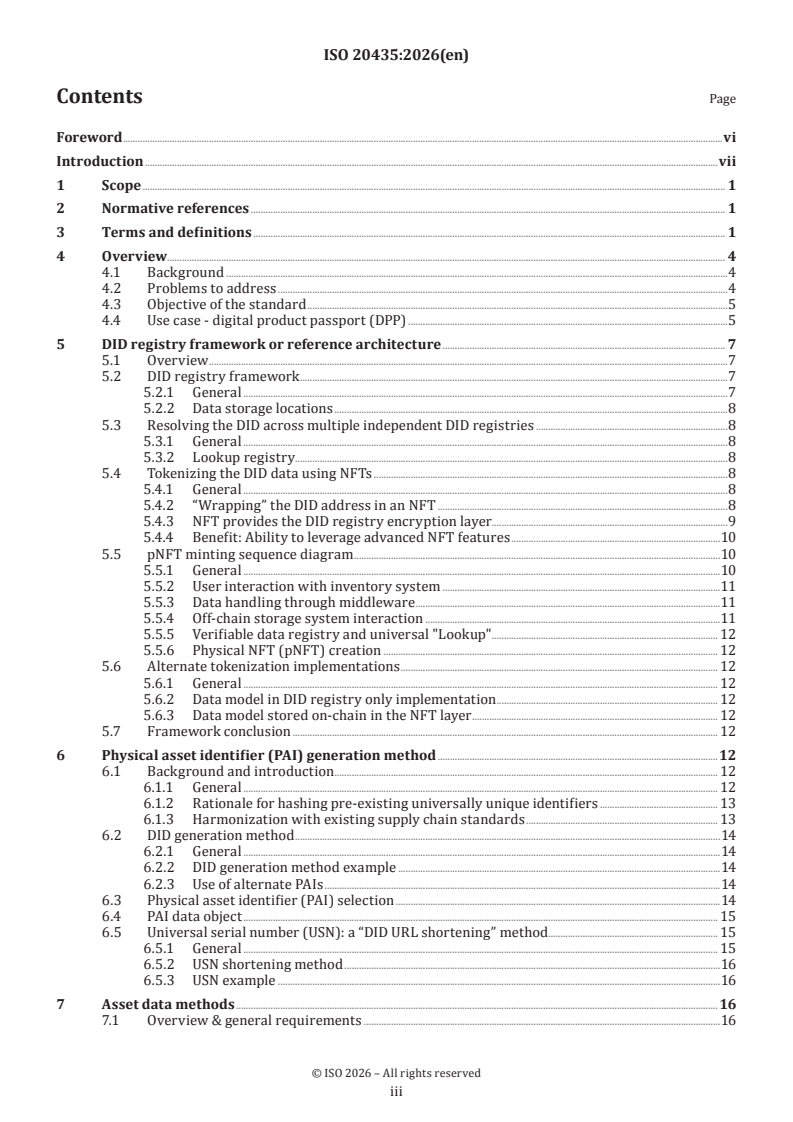
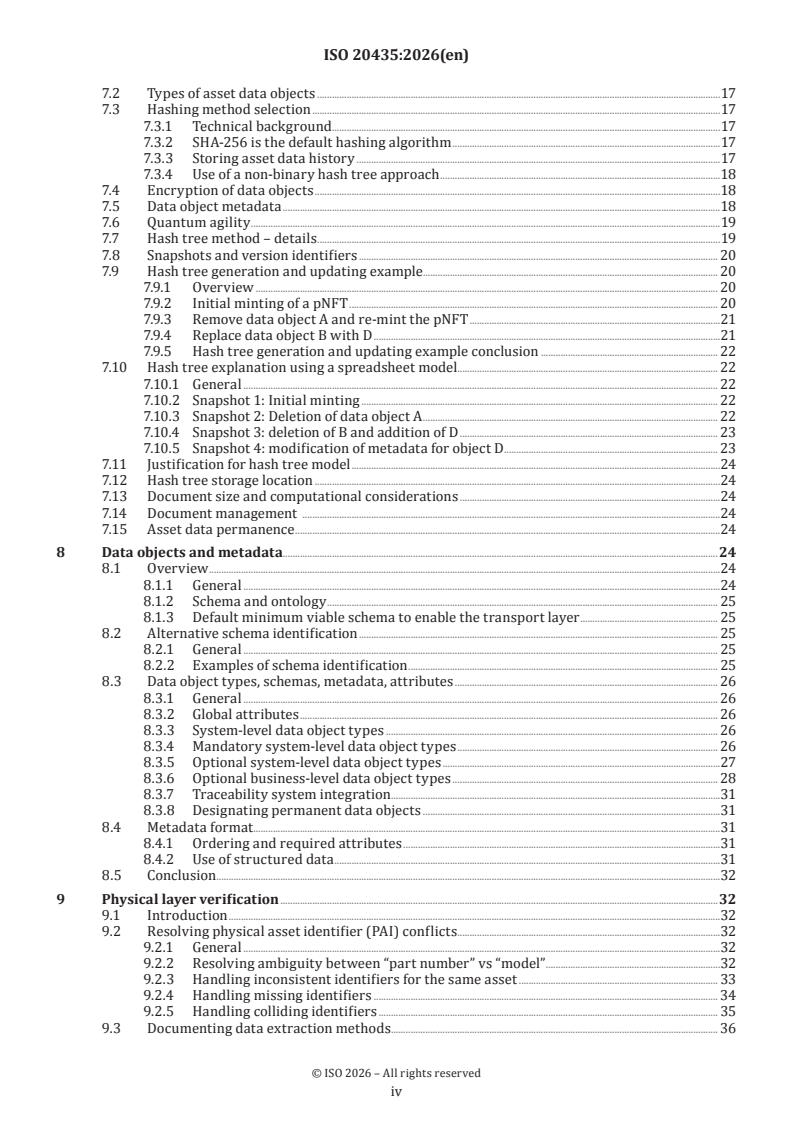
ISO 20435:2026 specifies a framework for representing physical assets using tokens, with emphasis on non-fungible tangible assets and their digital counterparts. It is organized into clauses 1 to 13, followed by Annex A and a bibliography.
The main technical path runs from identification, to data binding, to registry interoperability, to verification and security:
- Clause 4 gives the overview and a DPP use case.
- Clause 5 describes the DID registry framework or reference architecture.
- Clause 6 defines the physical asset identifier (PAI) generation method.
- Clause 7 covers asset data methods and hash trees.
- Clause 8 defines data objects and metadata.
- Clause 9 covers physical layer verification.
- Clause 10 defines the DID method scheme and API operations.
- Clause 11 addresses trust anchors and legalities.
- Clause 12 covers encryption, privacy and cybersecurity.
The framework stays neutral on specific blockchain or DLT implementations. It is designed so that the digital representation can be stored, resolved, or transferred across compliant DID registries, while the physical asset remains the anchor for identification.
What are the key requirements of ISO 20435:2026?
ISO 20435:2026 centers on five practical requirements: derive a reproducible identifier from the physical asset, bind the asset data cryptographically, keep metadata minimal but interoperable, verify the physical source of the data, and support registry operations for the tokenized record.
DID registry framework and tokenization
Clause 5 defines a DID registry framework that can work across multiple independent DID registries. The registry can act as a lookup layer and can be wrapped in an NFT (non-fungible token) so the DID address becomes part of the tokenized representation. In practice, this lets different systems resolve the same asset without using one central platform.
Clause 5 also states that the NFT's cryptographic keys provide authentication and access control for creation, access, updates, and transfers. When ownership changes, the DID registry is updated so control follows the new owner. That matters because the digital record must stay aligned with the real-world control of the asset.
PAI and USN generation
Clause 6 defines the PAI (physical asset identifier) generation method. The PAI is derived algorithmically from identifiers affixed to the asset, such as manufacturer, part number, and serial number. The document also introduces the USN (universal serial number), a shortened version of the identifier created with cryptographic hashing.
This matters in practice because the same physical asset can be re-identified by different actors using the same inherent identifiers. The document also explains how alternate identifiers can be stored, and it addresses collisions by using a lookup registry and, where needed, adding a random component to create a unique version.
Asset data objects and hash trees
Clause 7 describes how asset data objects are tied together with a hash tree. The standard uses hash trees to create a cryptographic proof for a set of asset data objects, and the root hash supports version tracking. SHA-256 is given as the default hashing algorithm.
The practical effect is that if one data object changes, the asset data set becomes a new version. Clause 7 also explains snapshots, version identifiers, and updates through examples, so implementers can trace the history of a data set instead of overwriting it.
Metadata and minimal ontology
Clause 8 defines the data object and metadata model. ISO 20435:2026 keeps the ontology at a minimum upper level so different sectors can exchange data without forcing one industry schema on everyone. The document also names system-level and business-level data object types.
This matters because transport-layer interoperability depends on knowing what a data object is for, not just storing its bytes. Clause 8 also marks some data objects as permanent with the isPermanent attribute, so records that must not be altered or deleted can be protected in later snapshots.
Physical layer verification and identifier conflicts
Clause 9 connects the digital record back to the real asset. It gives a priority order for resolving conflicting identifiers, starting with firmware data, then visual inspection, then supporting documentation, and then external standards. Clause 9 also describes documenting how data was extracted.
That is important for recyclers, repairers, and other downstream users who may no longer see original labels. The clause helps them decide which identifier to trust and how to document the decision.
DID operations and security
Clause 10 defines standardized DID and API operations: resolve, register, update, and deactivate. The DID document contains verification methods, service endpoints, proof, and metadata.
Clause 12 adds encryption, privacy, and cybersecurity guidance. It discusses transfer options for encrypted pNFTs, including off-chain re-encryption and keystore transfer. In practice, implementers choose the method that fits their security needs, performance limits, and regulatory context.
What terms does ISO 20435:2026 define?
- decentralized identifier (DID) - An identifier managed in a decentralized system and intended to be unique within its context.
- DID registry - A verifiable data registry that stores, resolves, and manages DIDs so they can be accessed across systems.
- physical asset identifier (PAI) - A unique identifier for a physical asset, derived algorithmically from identifiers on the asset.
- universal serial number (USN) - A shortened identifier generated from the PAI using cryptographic hashing.
- non-fungible token (NFT) - A token that is not mutually substitutable with another individual token.
- physical asset token (PAT) - A digital token that represents a physical asset in a blockchain or distributed ledger system.
- verifiable credential (VC) - A cryptographically secure digital document issued by a trusted authority that contains claims about an entity or object.
Who uses ISO 20435:2026?
ISO 20435:2026 is for organizations that need to identify, verify, transfer, or audit physical assets across their lifecycle. Typical users include manufacturers, warehouse and inventory system operators, supply chain teams, repair and reuse providers, recyclers, materials recovery organizations, verifiers, and trust anchors.
It is especially relevant where a DPP is used to follow an asset from manufacturing through repair, reuse, and end-of-life processing. Buyers and compliance teams can also use it when they need a verifiable record of provenance, ownership, condition, sanitization, or disposal.
Which standards are used with ISO 20435:2026?
| Standard | How it contributes |
|---|---|
| W3C Verifiable Credentials Data Model v2.0 | Normative reference for verifiable credentials used in trust anchor and verification processes. |
| W3C Decentralized Identifiers (DIDs) v1.0 | Provides the DID core architecture, data model, and representations referenced by the document. |
| ISO/TR 23644:2023 | Gives guidance on trust anchors for DLT-based identity management. |
| GS1 EPCIS 2.0 | Supplies supply chain event types that can be stored as data objects. |
| NIST IR 8536 | Provides the supply chain traceability meta-framework referenced for traceability integration. |
| ISO/TR 24332:2025 | Supports the document's use of blockchain and DLT in relation to authoritative records and records management. |
| ISO 22739:2024 | Supplies the DLT vocabulary used for terms such as DID, NFT, and verifiable data registry. |
What does the ISO 20435:2026 document contain?
ISO 20435:2026 contains a use case diagram for DPP tracking, a DID registry reference architecture, and a sequence diagram for pNFT minting and re-minting. It also includes hash tree generation and updating examples, including a spreadsheet model that shows how versions change over time.
The document defines metadata patterns, sample data object types, and the structure of a DID document. It also gives API-style operations for registering, resolving, updating, and deactivating a DID, plus security guidance for encrypted data transfer and trust anchors.
Get Certified
Connect with accredited certification bodies for this standard

BSI Group
BSI (British Standards Institution) is the business standards company that helps organizations make excellence a habit.

NYCE
Mexican standards and certification body.
Sponsored listings
Frequently Asked Questions
ISO 20435:2026 is a standard published by the International Organization for Standardization (ISO). Its full title is "Framework for representing physical assets using tokens". This standard covers: This document establishes a digital ledger technology (DLT) agnostic, decentralized identifier (DID) framework for representing physical assets using tokens. This includes: A DID generation method: An algorithmic data method for generating DIDs from assets with immutable unique identifiers, e.g. serial numbers. A cryptographic method to tie asset data objects to the DID: An algorithmic hash tree data method for transferring a set of asset data objects that are cryptographically tied together, agnostic to any specific DLT or blockchain system. A DID method scheme: A DID method scheme to enable DID registry interoperability, so the digital representation can be stored, resolved or transferred to any compliant DID registry. Real world trust anchor processes: Processes for utilizing off-chain trust anchors to establish proof of real-world human and machine generated events and information that tie a real-world asset to its digital representation.
This document establishes a digital ledger technology (DLT) agnostic, decentralized identifier (DID) framework for representing physical assets using tokens. This includes: A DID generation method: An algorithmic data method for generating DIDs from assets with immutable unique identifiers, e.g. serial numbers. A cryptographic method to tie asset data objects to the DID: An algorithmic hash tree data method for transferring a set of asset data objects that are cryptographically tied together, agnostic to any specific DLT or blockchain system. A DID method scheme: A DID method scheme to enable DID registry interoperability, so the digital representation can be stored, resolved or transferred to any compliant DID registry. Real world trust anchor processes: Processes for utilizing off-chain trust anchors to establish proof of real-world human and machine generated events and information that tie a real-world asset to its digital representation.
ISO 20435:2026 is classified under the following ICS (International Classification for Standards) categories: 35.240.99 - IT applications in other fields. The ICS classification helps identify the subject area and facilitates finding related standards.
ISO 20435:2026 is available in PDF format for immediate download after purchase. The document can be added to your cart and obtained through the secure checkout process. Digital delivery ensures instant access to the complete standard document.
Standards Content (Sample)
International
Standard
ISO 20435
First edition
Framework for representing
2026-10
physical assets using tokens
Cadre pour la représentation des actifs physiques à l'aide de
jetons
Reference number
© ISO 2026
All rights reserved.
This ISO publication is protected by copyright and is owned by ISO and/or its licensors.
The content of this ISO publication is provided under licence, not sold. Use is subject to the applicable licence terms issued by ISO,
an ISO member body, or an authorized third-party distributor.
Except as required for implementation or expressly permitted by a separate licence, no part of this ISO publication may be
reproduced, distributed, modified, used, or made available in any form or by any means – electronic or mechanical, including
photocopying, scanning, recording, or posting on internal or external digital platforms.
Any use beyond the scope of the granted rights is prohibited and may result in legal action.
ISO copyright office
CP 401 • CH-1214 Vernier, Geneva
Phone: +41 22 749 01 11
Email: copyright@iso.org
Website: www.iso.org
Published in Switzerland
ii
Contents Page
Foreword .vi
Introduction .vii
1 Scope . 1
2 Normative references . 1
3 Terms and definitions . 1
4 Overview . 4
4.1 Background .4
4.2 Problems to address .4
4.3 Objective of the standard .5
4.4 Use case - digital product passport (DPP) .5
5 DID registry framework or reference architecture . 7
5.1 Overview .7
5.2 DID registry framework .7
5.2.1 General .7
5.2.2 Data storage locations .8
5.3 Resolving the DID across multiple independent DID registries .8
5.3.1 General .8
5.3.2 Lookup registry.8
5.4 Tokenizing the DID data using NFTs .8
5.4.1 General .8
5.4.2 “Wrapping” the DID address in an NFT .8
5.4.3 NFT provides the DID registry encryption layer . .9
5.4.4 Benefit: Ability to leverage advanced NFT features .10
5.5 pNFT minting sequence diagram .10
5.5.1 General .10
5.5.2 User interaction with inventory system .11
5.5.3 Data handling through middleware .11
5.5.4 Off-chain storage system interaction .11
5.5.5 Verifiable data registry and universal "Lookup" . 12
5.5.6 Physical NFT (pNFT) creation . 12
5.6 Alternate tokenization implementations . 12
5.6.1 General . 12
5.6.2 Data model in DID registry only implementation . 12
5.6.3 Data model stored on-chain in the NFT layer . 12
5.7 Framework conclusion . 12
6 Physical asset identifier (PAI) generation method .12
6.1 Background and introduction . 12
6.1.1 General . 12
6.1.2 Rationale for hashing pre-existing universally unique identifiers . 13
6.1.3 Harmonization with existing supply chain standards . 13
6.2 DID generation method .14
6.2.1 General .14
6.2.2 DID generation method example .14
6.2.3 Use of alternate PAIs .14
6.3 Physical asset identifier (PAI) selection .14
6.4 PAI data object . 15
6.5 Universal serial number (USN): a “DID URL shortening” method . . 15
6.5.1 General . 15
6.5.2 USN shortening method .16
6.5.3 USN example .16
7 Asset data methods . 16
7.1 Overview & general requirements .16
iii
7.2 Types of asset data objects .17
7.3 Hashing method selection .17
7.3.1 Technical background . .17
7.3.2 SHA-256 is the default hashing algorithm .17
7.3.3 Storing asset data history .17
7.3.4 Use of a non-binary hash tree approach .18
7.4 Encryption of data objects .18
7.5 Data object metadata .18
7.6 Quantum agility .19
7.7 Hash tree method – details . .19
7.8 Snapshots and version identifiers . 20
7.9 Hash tree generation and updating example . . 20
7.9.1 Overview . 20
7.9.2 Initial minting of a pNFT . 20
7.9.3 Remove data object A and re-mint the pNFT .21
7.9.4 Replace data object B with D .21
7.9.5 Hash tree generation and updating example conclusion . 22
7.10 Hash tree explanation using a spreadsheet model . 22
7.10.1 General . 22
7.10.2 Snapshot 1: Initial minting . 22
7.10.3 Snapshot 2: Deletion of data object A . 22
7.10.4 Snapshot 3: deletion of B and addition of D . 23
7.10.5 Snapshot 4: modification of metadata for object D . 23
7.11 Justification for hash tree model .24
7.12 Hash tree storage location .24
7.13 Document size and computational considerations .24
7.14 Document management .24
7.15 Asset data permanence .24
8 Data objects and metadata.24
8.1 Overview .24
8.1.1 General .24
8.1.2 Schema and ontology . 25
8.1.3 Default minimum viable schema to enable the transport layer . 25
8.2 Alternative schema identification . 25
8.2.1 General . 25
8.2.2 Examples of schema identification . 25
8.3 Data object types, schemas, metadata, attributes . 26
8.3.1 General . 26
8.3.2 Global attributes . 26
8.3.3 System-level data object types . 26
8.3.4 Mandatory system-level data object types . 26
8.3.5 Optional system-level data object types .27
8.3.6 Optional business-level data object types . 28
8.3.7 Traceability system integration . .31
8.3.8 Designating permanent data objects .31
8.4 Metadata format .31
8.4.1 Ordering and required attributes .31
8.4.2 Use of structured data .31
8.5 Conclusion .32
9 Physical layer verification .32
9.1 Introduction .32
9.2 Resolving physical asset identifier (PAI) conflicts.32
9.2.1 General .32
9.2.2 Resolving ambiguity between “part number” vs “model” .32
9.2.3 Handling inconsistent identifiers for the same asset . 33
9.2.4 Handling missing identifiers . 34
9.2.5 Handling colliding identifiers . 35
9.3 Documenting data extraction methods. 36
iv
9.3.1 General . 36
9.3.2 Retrieval methods . 36
9.3.3 Manual data entry .37
10 DID method scheme .37
10.1 General .37
10.2 Overview of DID roles and components .37
10.3 DID document and metadata . 38
10.4 DID generation method requirements . 39
10.5 DID format and syntax . 39
10.6 Standardized DID and API operations . 39
10.6.1 General . 39
10.6.2 Resolve DID . 40
10.6.3 Register DID . . 40
10.6.4 Update DID .41
10.6.5 Deactivate DID .41
11 Trust anchors and legalities . 41
11.1 General .41
11.2 Natural person identification .42
11.2.1 Digital credential requirements .42
11.2.2 Trust anchor requirements .42
11.3 Machine/software identification requirements .42
11.3.1 Software interaction signing .42
11.3.2 Trust anchor validation .42
11.4 Issues and considerations . .42
11.4.1 Maturity of SSI/decentralized identity standards .42
11.4.2 Maturity of trust anchor standards .42
11.4.3 Legal ownership framework . . .42
11.5 Current domain-specific implementation .42
11.5.1 Role of trade and membership associations .42
11.5.2 Authority requests for device ownership .43
11.6 References to ISO/TR 23644 .43
12 Encryption, privacy and cybersecurity .43
12.1 Overview .43
12.2 DID authentication and encryption options .43
12.3 Data transfer methods for encrypted pNFTs . 44
12.3.1 General . 44
12.3.2 Off-chain re-encryption method . 44
12.3.3 Keystore transfer method . 44
12.3.4 Implementation considerations . 44
12.4 Encryption methods . 44
12.4.1 Data object encryption. 44
12.4.2 Optional individual encryption . 44
12.5 DID and USN generation security considerations . 44
12.6 Privacy considerations .45
12.6.1 Hashing and privacy .45
12.6.2 User responsibility .45
12.6.3 GDPR and privacy regulations .45
12.7 Cybersecurity best practices .45
12.8 Limitations and user responsibilities .45
12.8.1 Limitations of the standard .45
12.8.2 User responsibilities .45
12.9 References to DID method specification .45
12.10 Security conclusion .45
13 Conclusion .45
Bibliography . 47
v
Foreword
ISO (the International Organization for Standardization) is a worldwide federation of national standards
bodies (ISO member bodies). The work of preparing International Standards is normally carried out through
ISO technical committees. Each member body interested in a subject for which a technical committee
has been established has the right to be represented on that committee. International organizations,
governmental and non-governmental, in liaison with ISO, also take part in the work. ISO collaborates closely
with the International Electrotechnical Commission (IEC) on all matters of electrotechnical standardization.
The procedures used to develop this document and those intended for its further maintenance are described
in the ISO/IEC Directives, Part 1. In particular, the different approval criteria needed for the different types
of ISO documents should be noted. This document was drafted in accordance with the editorial rules of the
ISO/IEC Directives, Part 2 (see www.iso.org/directives).
ISO draws attention to the possibility that the implementation of this document may involve the use of (a)
patent(s). ISO takes no position concerning the evidence, validity or applicability of any claimed patent
rights in respect thereof. As of the date of publication of this document, ISO had not received notice of (a)
patent(s) which may be required to implement this document. However, implementers are cautioned that
this may not represent the latest information, which may be obtained from the patent database available at
www.iso.org/patents. ISO shall not be held responsible for identifying any or all such patent rights.
Any trade name used in this document is information given for the convenience of users and does not
constitute an endorsement.
For an explanation of the voluntary nature of standards, the meaning of ISO specific terms and expressions
related to conformity assessment, as well as information about ISO's adherence to the World Trade
Organization (WTO) principles in the Technical Barriers to Trade (TBT), see www.iso.org/iso/foreword.html.
This document was prepared by Technical Committee ISO/TC 307, Blockchain and distributed ledger
technologies.
Any feedback or questions on this document should be directed to the user’s national standards body. A
complete listing of these bodies can be found at www.iso.org/members.html.
vi
Introduction
This document outlines a framework for representing physical assets by means of tokens. The standard is
neutral on the choice of distributed ledger technology (DLT). This document introduces the universal serial
number (USN), which is a standardized identifier derived algorithmically from existing asset identifiers.
It also outlines methods for securely encoding physical asset data using decentralized identifiers (DIDs),
creating a standardized and verifiable framework that enables seamless transfers across different systems.
The framework enables comprehensive tracking of physical assets throughout their lifecycle, offering
significant environmental advantages. Additionally, this framework enables tokenization in initiatives such
as digital product passports (DPP).
The framework includes the following key components:
— A DID generation method: How to transform the existing identifiers of any physical asset that has a serial
number into a standard reproducible DID format called a USN.
— Physical asset data model: How to combine data objects about a physical asset into a standard provable
structure, using a hash tree format.
— DID method scheme with standardized application programming interface (API) endpoints: To allow
the digital representation to be transportable across independent DID registries.
— Business document classification: The minimum viable semantics that allow disparate systems to rec-
ognize the purpose (and legal requirements) of data objects.
— Physical layer verification: How to use trust anchors to verify and tie information about the real-world
object to its digital representation as per ISO/TR 23644.
vii
International Standard ISO 20435:2026(en)
Framework for representing physical assets using tokens
1 Scope
This document establishes a digital ledger technology (DLT) agnostic, decentralized identifier (DID)
framework for representing physical assets using tokens. This includes:
— A DID generation method: An algorithmic data method for generating DIDs from assets with immutable
unique identifiers, e.g. serial numbers.
— A cryptographic method to tie asset data objects to the DID: An algorithmic hash tree data method for
transferring a set of asset data objects that are cryptographically tied together, agnostic to any specific
DLT or blockchain system.
— A DID method scheme: A DID method scheme to enable DID registry interoperability, so the digital
representation can be stored, resolved or transferred to any compliant DID registry.
— Real world trust anchor processes: Processes for utilizing off-chain trust anchors to establish proof of
real-world human and machine generated events and information that tie a real-world asset to its digital
representation.
2 Normative references
The following documents are referred to in the text in such a way that some or all of their content constitutes
requirements of this document. For dated references, only the edition cited applies. For undated references,
the latest edition of the referenced document (including any amendments) applies.
W3C, Verifiable Credentials Data Model v2.0, W3C Recommendation 15 May 2025 https:// www .w3 .org/ TR/
vc -data -model/
3 Terms and definitions
For the purposes of this document, the following terms and definitions apply.
ISO and IEC maintain terminology databases for use in standardization at the following addresses:
— ISO Online browsing platform: available at https:// www .iso .org/ obp
— IEC Electropedia: available at https:// www .electropedia .org/
3.1
asset
anything that has value to a stakeholder
[SOURCE: ISO 22739:2024, 3.1]
3.2
asset data object
data object (3.4) containing specific information about a physical asset
Note 1 to entry: Information may include documents, structured data, verified credentials or other information
representing attributes, events or states of the asset within a distributed ledger system.
3.3
asset data set
collection of data objects (3.4) that comprehensively represent the information pertinent to a physical or
digital asset (3.1)
Note 1 to entry: This may include historical, operational and identification data.
3.4
data object
individual unit of data related to a physical asset (3.1) or its digital representation
Note 1 to entry: This data can be structured or unstructured and can include documents, images, structured data or
other digital content.
3.5
decentralized identifier
DID
identifier that is issued or managed in a decentralized system and designed to be unique within a context
Note 1 to entry: Decentralized identifiers are used in systems that do not rely on central registration authorities.
[SOURCE: ISO 22739:2024, 3.18]
3.6
DID registry
verifiable data registry (3.24) that provides the storage, resolution and management of decentralized
identifiers (DIDs) (3.5), ensuring that DIDs are accessible and verifiable across different systems and
platforms
3.7
digital asset
asset (3.1) that exists only in digital form or that is the digital representation of another asset
[SOURCE: ISO 22739:2024, 3.21]
3.8
digital product passport
DPP
digital document containing the lifecycle data of a product from manufacturing to end of life, to support
transparency, conformity and sustainability practices
3.9
digital representation of a physical asset
digital format encapsulating all essential data and attributes of a physical asset, enabling it to be uniquely
identified, managed and tracked within a digital ecosystem
3.10
distributed ledger technology oracle
DLT oracle
service that updates a distributed ledger using data from outside of a DLT system
Note 1 to entry: DLT oracles can be used by smart contracts to access data from sources external to the DLT system.
[SOURCE: ISO 22739:2024, 3.32]
3.11
lookup registry
decentralized system or service that stores and manages the resolution of digital identifiers across multiple
registries, ensuring the correct linking and retrieval of asset data and digital representations
3.12
non-fungible
not capable of mutual substitution among individual units
Note 1 to entry: The individual units can be digital assets (3.7), e.g. tokens (3.20).
3.13
non-fungible token
NFT
token (3.20) that is non-fungible
[SOURCE: ISO 22739:2024, 3.64]
3.14
physical asset identifier
PAI
unique identifier for a physical asset, derived algorithmically, using identifiers affixed to the asset such as
serial numbers, model or manufacturer data
3.15
physical asset token
PAT
digital token that represents a physical asset within a blockchain or distributed ledger system
Note 1 to entry: PATs are designed to track ownership, authenticity and provenance of the physical asset throughout
its lifecycle. Depending on the implementation, a PAT is often realized as an NFT but can also be fungible or semi-
fungible based on the asset's characteristics and requirements.
3.16
physical NFT
pNFT
physical asset token (3.15) implemented as a non-fungible token (3.13), representing a unique physical asset
within a blockchain or distributed ledger system
Note 1 to entry: The pNFT purports to bind the digital representation of the asset to its physical counterpart, ensuring
traceability and authenticity.
3.17
root hash
single hash value at the top of the hash tree that results from consecutively hashing pairs of child node
hashes until a single hash remains
Note 1 to entry: This hash represents the entirety of the data stored in the tree. Any change in the data blocks at the
leaves of the tree causes a change in the root hash, thus providing a quick way to verify whether any data has been
altered.
3.18
semantic layer interoperability
ability of systems to use shared schema and ontologies to ensure that the content of exchanged data is
consistently understood and processed across different platforms in a verifiable manner
3.19
snapshot
unique historical version of an asset data set (3.3), minted into a physical non-fungible token (pNFT) (3.16) at
a point in time
Note 1 to entry: A snapshot serves as a single source of truth for the state of the asset at a point in time. Due to the gas
and storage costs of re-minting an NFT, off-chain systems typically make intermediate data changes to an off-chain
copy of the snapshot, only re-minting the pNFT as necessary for communication with external systems.
3.20
token
asset (3.1) that represents a collection of entitlements
3.21
transport layer interoperability
capacity of systems to exchange data seamlessly and verifiably across a network, without interpreting or
modifying the content, regardless of differing underlying technologies or protocols
3.22
universal serial number
USN
shortened, universally unique identifier generated from the physical asset identifier (3.14) using
cryptographic hashing
Note 1 to entry: The USN is intended to simplify identification while maintaining uniqueness across systems.
3.23
verifiable credential
digital document issued by a trusted authority that contains claims about an individual, organization, or
object
Note 1 to entry: Verifiable credentials (VC) are cryptographically secure, tamper-evident and can be verified
electronically. VCs enable the holder to prove information to a verifier without revealing unnecessary p
...