


ISO 23317
(Main)Implants for surgery — Materials — Simulated body fluid (SBF) preparation procedure and test method to detect apatite formation in SBF for initial screening of bone-contacting implant materials
Implants for surgery — Materials — Simulated body fluid (SBF) preparation procedure and test method to detect apatite formation in SBF for initial screening of bone-contacting implant materials
This document specifies a procedure for preparing the simulated body fluid (SBF) and a test method for use as an initial screening tool in the evaluation of apatite formation on the surfaces of bone-contacting implant materials. The results of this SBF test (see Clause 7) alone do not establish bone-bonding ability. The test can be used along with other in vitro and in vivo confirmatory tests to establish an implant material’s ability to bond with bone tissue in vivo. This document is limited to an assessment of the in vitro apatite-forming ability of bulky solid materials used for bone-contacting implants and is not intended to be used to evaluate this ability of porous materials, particulate materials or solute molecules or ions. Porous materials are excluded from test specimens because they require a large volume of SBF due to high surface area, and often have difficulty in penetration of SBF into their porous bodies. Furthermore, analysis of the inner surfaces of porous materials is difficult by the method described in this document.
Implants chirurgicaux — Matériaux — Mode opératoire de préparation de fluide corporel simulé (FCS) et méthode d’essai pour détecter la formation d’apatite dans le FCS pour l’étude préliminaire de matériaux d’implant en contact avec l’os
General Information
Relations
Buy Standard
Standards Content (Sample)
International
Standard
Fourth edition
Implants for surgery — Materials
— Simulated body fluid (SBF)
preparation procedure and test
method to detect apatite formation
in SBF for initial screening of bone-
contacting implant materials
Implants chirurgicaux — Matériaux — Mode opératoire de
préparation de fluide corporel simulé (FCS) et méthode d’essai
pour détecter la formation d’apatite dans le FCS pour l’étude
préliminaire de matériaux d’implant en contact avec l’os
PROOF/ÉPREUVE
Reference number
© ISO 2025
All rights reserved. Unless otherwise specified, or required in the context of its implementation, no part of this publication may
be reproduced or utilized otherwise in any form or by any means, electronic or mechanical, including photocopying, or posting on
the internet or an intranet, without prior written permission. Permission can be requested from either ISO at the address below
or ISO’s member body in the country of the requester.
ISO copyright office
CP 401 • Ch. de Blandonnet 8
CH-1214 Vernier, Geneva
Phone: +41 22 749 01 11
Email: copyright@iso.org
Website: www.iso.org
Published in Switzerland
PROOF/ÉPREUVE
ii
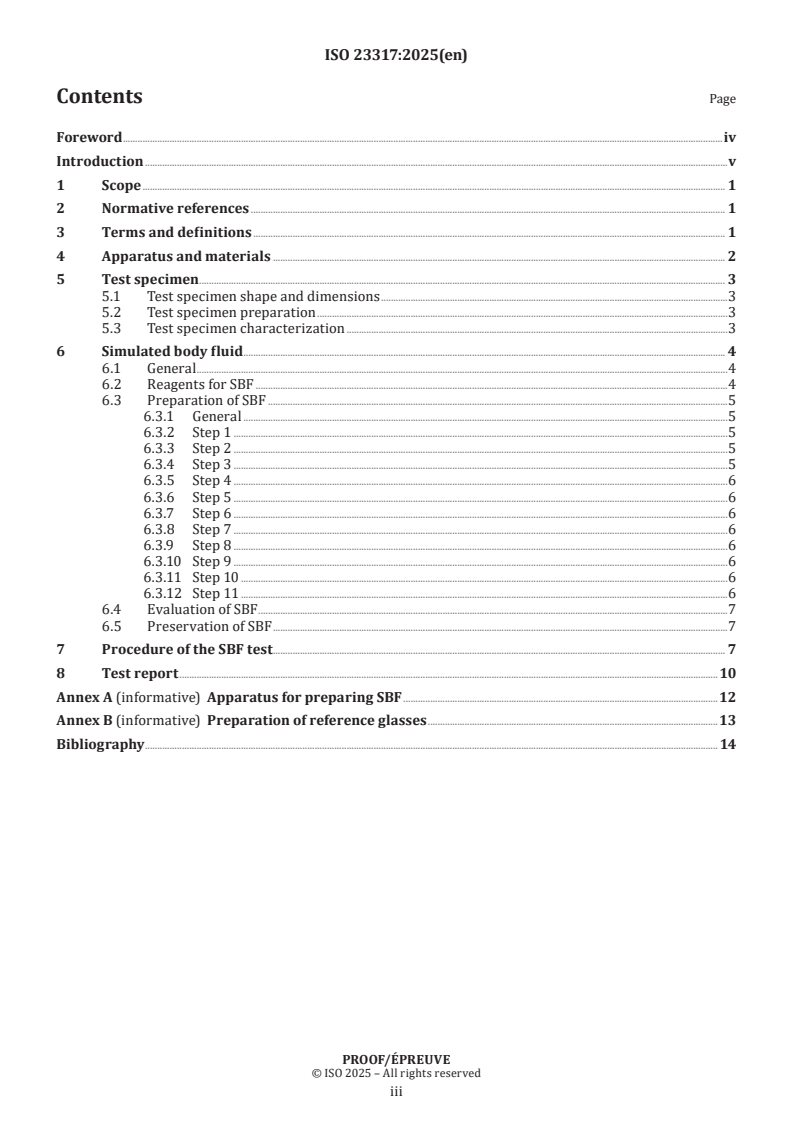
Contents Page
Foreword .iv
Introduction .v
1 Scope . 1
2 Normative references . 1
3 Terms and definitions . 1
4 Apparatus and materials . 2
5 Test specimen . 3
5.1 Test specimen shape and dimensions .3
5.2 Test specimen preparation .3
5.3 Test specimen characterization .3
6 Simulated body fluid . 4
6.1 General .4
6.2 Reagents for SBF .4
6.3 Preparation of SBF .5
6.3.1 General .5
6.3.2 Step 1 .5
6.3.3 Step 2 .5
6.3.4 Step 3 .5
6.3.5 Step 4 .6
6.3.6 Step 5 .6
6.3.7 Step 6 .6
6.3.8 Step 7 .6
6.3.9 Step 8 .6
6.3.10 Step 9 .6
6.3.11 Step 10 .6
6.3.12 Step 11 .6
6.4 Evaluation of SBF .7
6.5 Preservation of SBF .7
7 Procedure of the SBF test . . 7
8 Test report .10
Annex A (informative) Apparatus for preparing SBF .12
Annex B (informative) Preparation of reference glasses .13
Bibliography . 14
PROOF/ÉPREUVE
iii
Foreword
ISO (the International Organization for Standardization) is a worldwide federation of national standards
bodies (ISO member bodies). The work of preparing International Standards is normally carried out through
ISO technical committees. Each member body interested in a subject for which a technical committee
has been established has the right to be represented on that committee. International organizations,
governmental and non-governmental, in liaison with ISO, also take part in the work. ISO collaborates closely
with the International Electrotechnical Commission (IEC) on all matters of electrotechnical standardization.
The procedures used to develop this document and those intended for its further maintenance are described
in the ISO/IEC Directives, Part 1. In particular, the different approval criteria needed for the different types
of ISO document should be noted. This document was drafted in accordance with the editorial rules of the
ISO/IEC Directives, Part 2 (see www.iso.org/directives).
ISO draws attention to the possibility that the implementation of this document may involve the use of (a)
patent(s). ISO takes no position concerning the evidence, validity or applicability of any claimed patent
rights in respect thereof. As of the date of publication of this document, ISO had not received notice of (a)
patent(s) which may be required to implement this document. However, implementers are cautioned that
this may not represent the latest information, which may be obtained from the patent database available at
www.iso.org/patents. ISO shall not be held responsible for identifying any or all such patent rights.
Any trade name used in this document is information given for the convenience of users and does not
constitute an endorsement.
For an explanation of the voluntary nature of standards, the meaning of ISO specific terms and expressions
related to conformity assessment, as well as information about ISO's adherence to the World Trade
Organization (WTO) principles in the Technical Barriers to Trade (TBT), see www.iso.org/iso/foreword.html.
This document was prepared by Technical Committee ISO/TC 150, Implants or surgery, Subcommittee SC 1,
Materials.
This fourth edition cancels and replaces the third edition (ISO 23317:2014), which has been editorially
revised. The main changes are:
— the title, Introduction and scope have been revised to clarify the significance and limitations of the SBF test;
— the terms and definitions clause has been rearranged and revised for better understanding;
— the list of apparatus and materials has been enriched and detailed;
— the test specimen preparation has been revised, and test specimen characterization has been added;
— the preparation of SBF has been revised and described in more detail;
— a description of test specimens with lower density than SBF has been added;
— the arrangement of the test specimen in the SBF test has been revised and explained depending on the
specimen’s shape and density;
— the necessity of visual inspection of SBF has been added;
— the soaking period of seven days in the SBF test has been specified;
— the criteria for judging the specimen’s apatite-forming ability in the SBF test have been clarified;
— the test report has been detailed according to the revised SBF test procedure;
— the bibliography has been revised and each bibliographical entry has been cited at the relevant point in
this document.
Any feedback or questions on this document should be directed to the user’s national standards body. A
complete listing of these bodies can be found at www.iso.org/members.html.
PROOF/ÉPREUVE
iv
Introduction
The mechanism of action of bone-contacting implant materials is based upon a complex series of reactions
in the body that can be influenced by the surface properties of the implant material in contact with bone. In
some cases on synthetic bone-contacting implant materials such as Bioglass, Cerabone® A-W, Ceravital®-
1)
type glass-ceramic and sintered hydroxyapatite (Ca (PO ) (OH) ), a layer of an avascular, non-cellular
10 4 6 2
apatite-like mineral phase is found on the implant surface, at the bone-implant interface, and is said to
promote the bone-bonding behaviour. It has been shown that in vivo apatite formation can be initially
modelled in vitro using a number of different aqueous solutions, including an acellular simulated body fluid
[1]-[3]
(SBF) with inorganic ion concentrations nearly equal to those found in human blood plasma .
The apatite formed in an SBF test can indicate if an implant material's physicochemical surface features
warrant further evaluation and testing, including cell culture studies and animal studies, to demonstrate
[4],[5]
safety and efficacy of the implant material .
SBF described in this document is highly supersaturated with respect to apatite and several other calcium
phosphates and is similar in pH and inorganic ion concentrations to human blood plasma. SBF can retain
its metastable state without inducing calcium phosphate precipitation for four weeks under certain, well-
controlled conditions described in this document. SBF has been shown to produce a crystalline calcium
phosphate (apatite-like) layer that is chemically and crystallographically similar to bone mineral. Thus, SBF
can be used as a test solution for initial screening of the formation of calcium phosphate and apatite-like
mineral at the surface of a synthetic bone-contacting implant material.
Since SBF can be prepared easily from ultrapure water and ordinary chemical reagents (inorganic salts and
a buffer), and the proposed SBF test is a simple and low-cost method available in almost every laboratory,
SBF has been used worldwide over the past few decades to evaluate inorganic chemical reactions at the
implant surface exposed to the solution. These worldwide tests using SBF have been used to understand
biomineralization processes in humans and to be used as a screening tool to predict the potential for in vivo
apatite formation on an implant surface. However, SBF is an acellular, biomolecule-free pseudo-physiological
solution for mimicking in
...
ISO/PRF 23317:2025(en)
ISO/TC 150/SC1/WG 3SC 1
Secretariat: DIN
Date: 2025-04-22
Implants for surgery — Materials — Simulated body fluid (SBF)
preparation procedure and test method to detect apatite
formation in SBF for initial screening of bone-contacting implant
materials
Fourth edition
Date: 2024-05-13
ISO #####-#:####(X)
Implants chirurgicaux — Matériaux — Mode opératoire de préparation de fluide corporel simulé (FCS) et
méthode d’essai pour détecter la formation d’apatite dans le FCS pour l’étude préliminaire de matériaux
d’implant en contact avec l’os
PROOF
2 © ISO #### – All rights reserved
ISO/PRF 23317:2025(en)
All rights reserved. Unless otherwise specified, or required in the context of its implementation, no part of this publication
may be reproduced or utilized otherwise in any form or by any means, electronic or mechanical, including photocopying,
or posting on the internet or an intranet, without prior written permission. Permission can be requested from either ISO
at the address below or ISO’s member body in the country of the requester.
ISO copyright office
CP 401 • Ch. de Blandonnet 8
CH-1214 Vernier, Geneva
Phone: + 41 22 749 01 11
EmailE-mail: copyright@iso.org
Website: www.iso.org
Published in Switzerland
iii
ISO/PRF 23317:2025(en)
Contents
Foreword . v
Introduction . vii
1 Scope . 1
2 Normative references . 1
3 Terms and definitions . 1
4 Apparatus and materials . 2
5 Test specimen . 3
5.1 Test specimen shape and dimensions . 3
5.2 Test specimen preparation . 4
5.3 Test specimen characterization . 4
6 Simulated body fluid . 4
6.1 General. 4
6.2 Reagents for SBF . 5
6.3 Preparation of SBF . 5
6.4 Evaluation of SBF . 7
6.5 Preservation of SBF . 7
7 Procedure of the SBF test . 8
8 Test report . 11
Annex A (informative) Apparatus for preparing SBF . 13
Annex B (informative) Preparation of reference glasses . 14
Bibliography . 15
iv
ISO/PRF 23317:2025(en)
Foreword
ISO (the International Organization for Standardization) is a worldwide federation of national standards
bodies (ISO member bodies). The work of preparing International Standards is normally carried out through
ISO technical committees. Each member body interested in a subject for which a technical committee has been
established has the right to be represented on that committee. International organizations, governmental and
non-governmental, in liaison with ISO, also take part in the work. ISO collaborates closely with the
International Electrotechnical Commission (IEC) on all matters of electrotechnical standardization.
The procedures used to develop this document and those intended for its further maintenance are described
in the ISO/IEC Directives, Part 1. In particular, the different approval criteria needed for the different types of
ISO document should be noted. This document was drafted in accordance with the editorial rules of the
ISO/IEC Directives, Part 2 (see www.iso.org/directives).
ISO draws attention to the possibility that the implementation of this document may involve the use of (a)
patent(s). ISO takes no position concerning the evidence, validity or applicability of any claimed patent rights
in respect thereof. As of the date of publication of this document, ISO had not received notice of (a) patent(s)
which may be required to implement this document. However, implementers are cautioned that this may not
represent the latest information, which may be obtained from the patent database available at
www.iso.org/patents. ISO shall not be held responsible for identifying any or all such patent rights.
Any trade name used in this document is information given for the convenience of users and does not
constitute an endorsement.
For an explanation of the voluntary nature of standards, the meaning of ISO specific terms and expressions
related to conformity assessment, as well as information about ISO's adherence to the World Trade
Organization (WTO) principles in the Technical Barriers to Trade (TBT), see www.iso.org/iso/foreword.html.
This document was prepared by Technical Committee ISO/TC 150, Implants or surgery, Subcommittee SC 1,
Materials.
This fourth edition cancels and replaces the third edition (ISO 23317:2014), which has been editorially
revised. The main changes are:
— — the title, Introduction, and scope have been revised to clarify the significance and limitations of the
SBF test;
— — the terms and definitions haveclause has been rearranged and revised for better understanding;
— — the list of apparatus and materials has been enriched and detailed;
— — the test specimen preparation has been revised, and test specimen characterization has been added;
— — the preparation of SBF has been revised and described in more detail;
— — a description of test specimens with lower density than SBF has been added;
— — the arrangement of the test specimen in the SBF test has been revised and explained depending on the
specimen’s shape and density;
— — the necessity of visual inspection of SBF has been added;
— — the soaking period of seven days in the SBF test has been specified;
— — the criteria for judging the specimen’s apatite-forming ability in the SBF test have been clarified;
v
ISO/PRF 23317:2025(en)
— — the test report has been detailed according to the revised SBF test procedure;
— — the bibliography has been revised and each bibliographical entry has been cited at the relevant point
in thethis document.
Any feedback or questions on this document should be directed to the user’s national standards body. A
complete listing of these bodies can be found at www.iso.org/members.html.
vi
ISO/PRF 23317:2025(en)
Introduction
The mechanism of action of bone-contacting implant materials is based upon a complex series of reactions in
the body that can be influenced by the surface properties of the implant material in contact with bone. In some
cases on synthetic bone-contacting implant materials such as Bioglass, Cerabone® A-W, Ceravital®-type
1)
glass-ceramic and sintered hydroxyapatite (Ca (PO ) (OH) ), a layer of an avascular, non-cellular apatite-
10 4 6 2
like mineral phase is found on the implant surface, at the bone-implant interface, and is said to promote the
bone-bonding behaviour. It has been shown that in vivo apatite formation can be initially modelled in vitro
using a number of different aqueous solutions, including an acellular simulated body fluid (SBF) with inorganic
[ ]-[ [1-3] ]
ion concentrations nearly equal to those found in human blood plasma 0 0 . .
The apatite formed in an SBF test can indicate if an implant material´smaterial's physicochemical surface
features warrant further evaluation and testing, including cell culture studies and animal studies, to
[ ],[ [4,5] ]
demonstrate safety and efficacy of the implant material 0 0 . .
SBF described in this document is highly supersaturated with respect to apatite and several other calcium
phosphates and is similar in pH and inorganic ion concentrations to human blood plasma. SBF can retain its
metastable state without inducing calcium phosphate precipitation for four weeks under certain, well-
controlled conditions described in this document. SBF has been shown to produce a crystalline calcium
phosphate (apatite-like) layer that is chemically and crystallographically similar to bone mineral. Thus, SBF
can be used as a test solution for initial screening of the formation of calcium phosphate and apatite-like
mineral at the surface of a synthetic bone-contacting implant material.
Since SBF can be prepared easily from ultrapure water and ordinary chemical reagents (inorganic salts and a
buffer), and the proposed SBF test is a simple and low-cost method available in almost every laboratory, SBF
has been used worldwide over the past few decades to evaluate inorganic chemical reactions at the implant
surface exposed to the solution. These worldwide tests using SBF have been used to understand
biomineralization processes in humans and to be used as a screening tool to predict the potential for in vivo
apatite formation on an implant surface. However, SBF is an acellular, biomolecule-free pseudo-physiological
solution for mimicking in vivo inorganic chemical reactions only and is used under artificially controlled static
conditions. Hence, the SBF test, like other in vitro tests, cannot reproduce in vivo biologically based reactions
completely. Some of these limitations are given in the NOTES 1, 2, 3 and 4.
The apatite layer formed in this SBF test can, generally, be detected by conventional surface analytical
techniques such as X-ray diffraction (XRD) analysis, scanning electron microscopy (SEM), energy dispersive
X-ray spectroscopy (EDX),) and Fourier transform infrared spectroscopy (FT-IR). The apatite formed in this
SBF test has some similarities to bone mineral (apatite), it is a Ca-deficient type low crystalline apatite which
2+ + – 2–
contains the ionic species Mg , Na , Cl , CO , etc.
NOTE 1 Conditions of the SBF test are different from in vivo conditions in several factors, e.g. lack of biological
substances (cells, proteins, etc.), that play a significant role in the ultimate formation of the bone–-implant interface, lack
of body fluid circulation, lower carbonate and higher chloride concentrations and the presence of tris-hydroxymethyl
[ ],[ [6,7] ]
aminomethane (TRIS) buffer. Note that all these factors affect apatite formation in an SBF test, 0 0 , and can account
for the discrepancy between the SBF test results and in vivo results.
NOTE 2 Biological responses (biomolecular events, cellular responses, immunological responses, toxicity, etc.) cannot
be evaluated by the SBF test.
NOTE 3 The glass compositions used as reference glasses in this document (in the Na2O–CaO–SiO2 glass forming
system) have shown a positive correlation between bone-forming ability in a bone defect of a rabbit and apatite-forming
[ [8] ]
ability in this SBF test 0 . .
1)
Bioglass, Cerabone® A-W, Ceravital®-type glass-ceramic and sintered hydroxyapatite are examples of suitable
products available commercially. This information is given for the convenience of users of this document and does not
constitute an endorsement by ISO of these products.
vii
ISO/PRF 23317:2025(en)
NOTE 4 The relationship between the in vitro formation of an apatite-like mineral layer as proposed in this document
and the ultimate in vivo response of the implant material is not direct and is subject to many variables. Bioglass (45S5
[ ]-[ ],[ [1-3],[8] ] [ [9] ] [ [10] ]
and other glasses in this series), 0 0 0) , CaO-SiO2 glasses, 0 , Cerabone® A-W, 0 , Ceravital®-type glass-
[ [10] ] [ [10] ] [ [11] ]
ceramic, 0 , sintered hydroxyapatite, 0 , and alkali and heat treated titanium metal, 0 , all have shown to bond to
bone most likely through an apatite layer developed at the bone–implant interface in vivo and all form an apatite-like
[ ]-[ [12-20] ]
mineral layer on their surfaces in an SBF test. 0 0 . However, there are materials with relatively high solubility such
[ [21]] [ [22]]
as beta-tricalcium phosphate (Ca3(PO4)2) 0) and calcium carbonate 0 that can bond to bone without forming an
apatite layer on their surfaces, either in vitro (in an SBF test) or in vivo. Apatite formation in this test is a result of
chemically driven calcium phosphate precipitation, crystallization and growth. Some material formulations resorb too
quickly to form a direct bond to living bone, such as calcium sulfate hemihydrate, calcium sulfate dihydrate a
...
Questions, Comments and Discussion
Ask us and Technical Secretary will try to provide an answer. You can facilitate discussion about the standard in here.