

ISO 8399-2:1998
(Main)Aerospace — Accessory drives and mounting flanges (Metric series) — Part 2: Dimensions
General Information
- Abstract
This part of ISO 8399 specifies the dimensions of couplings for accessory drives and mounting flanges with quick attach/detach provisions primarily intended for use in aircraft gearboxes and engine accessories.
- Status
- Published
- Publication Date
- 02-Dec-1998
- Technical Committee
- ISO/TC 20 - Aircraft and space vehicles
- Drafting Committee
- ISO/TC 20 - Aircraft and space vehicles
- Current Stage
- 9093 - International Standard confirmed
- Start Date
- 31-Jan-2023
- Completion Date
- 29-Aug-2026
Buy Documents
ISO 8399-2:1998 - Aerospace — Accessory drives and mounting flanges (Metric series) — Part 2: Dimensions Released:12/3/1998
ISO 8399-2:1998 - Aéronautique et espace — Fixation et entraînement des équipements (Série métrique) — Partie 2: Dimensions Released:12/3/1998
Overview - ISO 8399-2:1998 (Aerospace accessory drives & mounting flanges - Dimensions)
ISO 8399-2:1998 defines the metric-series dimensions for couplings, spigots and mounting flanges used with quick attach/detach provisions in aircraft gearboxes and engine accessories. As Part 2 of ISO 8399, it complements Part 1 (design criteria) by providing the detailed dimensional, fit and surface requirements that support interchangeability, manufacture and inspection of accessory drives and mounting flanges.
Key topics and technical requirements
- Scope and configuration: Dimensioned layouts, figures and tables specify the geometry for accessory flanges and mating engine/gearbox flanges (spigots, collars, sockets).
- Spigot and sealing: Detailed spigot dimensions and sealing groove guidance. Radial compression and assembly stretch assumptions are based on nitrile, fluorocarbon and silicone elastomers with ~80% stretch capability and 70–80 IRHD hardness. Groove modifications are recommended if other elastomers are used.
- Locating features: Locating pin and socket dimensions are provided for accurate flange alignment, including transfer tube and transfer-tube seal arrangements for larger spigot sizes.
- O-ring specification: Transfer-tube O-rings specified with nominal inside diameter 6.9 −0.14 mm and cross-section 1.8 −0.08 mm (aligned with ISO 3601 series).
- Involute splines: Internal and external spline characteristics follow ISO 4156 - number of teeth and module listed in tables; pressure angle 30°; fillet root; tolerance class 5; fit class H/d; side fit. Separate dimensions are given for lubricated and unlubricated splines.
- Surface finish & tolerances: Surface roughness per ISO 4287 and ISO 1302 (values in figures), with permission to double roughness for aluminium sealing surfaces after treatment. Limit deviations and fits reference ISO 286-2; general tolerances default to ISO 2768-m where not otherwise specified.
- Documentation: Figures and tables supply the specific numeric dimensions, control diameters and inspection notes required for manufacturing and quality control.
Applications and who uses it
ISO 8399-2 is applied across the aerospace supply chain where standardized accessory drive interfaces are critical:
- Aircraft and engine OEMs specifying accessory drive/mounting flanges
- Accessory manufacturers (pumps, generators, starters) for mechanical interface design
- Gearbox and accessory mounting designers ensuring interchangeability
- Manufacturing, inspection and quality teams using the dimensional tables and surface/tolerance requirements
- MRO and certification engineers verifying compliant replacement parts
Related standards
- ISO 8399-1:1998 (Design criteria)
- ISO 4156 (Involute splines)
- ISO 286-2 (Limits and fits)
- ISO 3601-1 (O-rings)
- ISO 4287 / ISO 1302 (Surface texture)
- ISO 2768-1, ISO 13715
Keywords: ISO 8399-2, accessory drives, mounting flanges, aerospace couplings, spigot dimensions, quick attach/detach, involute splines, O-ring, surface roughness, metric series.
Relations
- Consolidated By
ISO 8224-1:2003 - Traveller irrigation machines — Part 1: Operational characteristics and laboratory and field test methods - Effective Date
- 06-Jun-2022
Buy Documents
ISO 8399-2:1998 - Aerospace — Accessory drives and mounting flanges (Metric series) — Part 2: Dimensions Released:12/3/1998
ISO 8399-2:1998 - Aéronautique et espace — Fixation et entraînement des équipements (Série métrique) — Partie 2: Dimensions Released:12/3/1998
Get Certified
Connect with accredited certification bodies for this standard

BUREAU VERITAS Certification Germany
Bureau Veritas certification in Germany.

Element Materials Technology
Materials testing and product certification.

AQMS Ltd.
AQMS provides ISO certification to SMEs across the UK.
Sponsored listings
Frequently Asked Questions
ISO 8399-2:1998 is a standard published by the International Organization for Standardization (ISO). Its full title is "Aerospace — Accessory drives and mounting flanges (Metric series) — Part 2: Dimensions". This standard covers: This part of ISO 8399 specifies the dimensions of couplings for accessory drives and mounting flanges with quick attach/detach provisions primarily intended for use in aircraft gearboxes and engine accessories.
This part of ISO 8399 specifies the dimensions of couplings for accessory drives and mounting flanges with quick attach/detach provisions primarily intended for use in aircraft gearboxes and engine accessories.
ISO 8399-2:1998 is classified under the following ICS (International Classification for Standards) categories: 49.035 - Components for aerospace construction. The ICS classification helps identify the subject area and facilitates finding related standards.
ISO 8399-2:1998 has the following relationships with other standards: It is inter standard links to ISO 8224-1:2003. Understanding these relationships helps ensure you are using the most current and applicable version of the standard.
ISO 8399-2:1998 is available in PDF format for immediate download after purchase. The document can be added to your cart and obtained through the secure checkout process. Digital delivery ensures instant access to the complete standard document.
Standards Content (Sample)
INTERNATIONAL ISO
STANDARD 8399-2
First edition
1998-12-01
Aerospace — Accessory drives and
mounting flanges (Metric series) —
Part 2:
Dimensions
Aéronautique et espace — Fixation et entraînement des équipements
(série métrique) —
Partie 2: Dimensions
A
Reference number
Foreword
ISO (the International Organization for Standardization) is a worldwide federation of national standards bodies (ISO
member bodies). The work of preparing International Standards is normally carried out through ISO technical
committees. Each member body interested in a subject for which a technical committee has been established has
the right to be represented on that committee. International organizations, governmental and non-governmental, in
liaison with ISO, also take part in the work. ISO collaborates closely with the International Electrotechnical
Commission (IEC) on all matters of electrotechnical standardization.
Draft International Standards adopted by the technical committees are circulated to the member bodies for voting.
Publication as an International Standard requires approval by at least 75 % of the member bodies casting a vote.
International Standard ISO 8399-2 was prepared by Technical Committee ISO/TC 20, Aerospace, Subcommittee
SC 12, Mechanical system parts.
ISO 8399 consists of the following parts, under the general title Aerospace — Accessory drives and mounting
flanges (Metric series):
— Part 1: Design criteria
— Part 2: Dimensions
© ISO 1998
All rights reserved. Unless otherwise specified, no part of this publication may be reproduced or utilized in any form or by any means, electronic
or mechanical, including photocopying and microfilm, without permission in writing from the publisher.
International Organization for Standardization
Case postale 56 • CH-1211 Genève 20 • Switzerland
Internet iso@iso.ch
Printed in Switzerland
ii
©
INTERNATIONAL STANDARD ISO ISO 8399-2:1998(E)
Aerospace — Accessory drives and mounting flanges
(Metric series) —
Part 2:
Dimensions
1 Scope
This part of ISO 8399 specifies the dimensions of couplings for accessory drives and mounting flanges with quick
attach/detach provisions primarily intended for use in aircraft gearboxes and engine accessories.
2 Normative references
The following standards contain provisions which, through reference in this text, constitute provisions of this part of
ISO 8399. At the time of publication, the editions indicated were valid. All standards are subject to revision, and
parties to agreements based on this part of ISO 8399 are encouraged to investigate the possibility of applying the
most recent editions of the standards indicated below. Members of IEC and ISO maintain registers of currently valid
International Standards.
ISO 286-2:1988, ISO system of limits and fits — Part 2: Tables of standard tolerance grades and limit deviations for
holes and shafts.
ISO 1302:1992, Technical drawings — Method of indicating surface texture.
ISO 2768-1:1989, General tolerances — Part 1: Tolerances for linear and angular dimensions without individual
tolerance indications.
ISO 3601-1:1988, Fluid systems — Sealing devices — O-rings — Part 1: Inside diameters, cross-sections,
tolerances and size identification code.
ISO 4156:1981, Straight cylindrical involute splines — Metric module, side fit — Generalities, dimensions and
inspection.
ISO 4287:1997, Geometrical Product Specifications (GPS) — Surface texture: Profile method — Terms, definitions
and surface texture parameters.
ISO 8399-1:1998, Aerospace — Accessory drives and mounting flanges (Metric series) — Part 1: Design criteria.
ISO 13715:1994, Technical drawings — Corners — Vocabulary and indication on drawings.
© ISO
3 Dimensions
3.1 Configuration and dimensions
The configuration of the accessory and engine or gearbox flanges is shown in figure 1. The dimensions shall be as
specified in figure 1 and table 1; other dimensions indicated in the details in figure 1 shall be as specified in figures 2
to 5 and tables 2 to 4.
Corners are indicated in the figures in accordance with ISO 13715.
3.2 Misalignment
See ISO 8399-1:1998, subclause 6.3.
3.3 Surface roughness
The surface roughness values according to ISO 4287, specified in the figures in accordance with ISO 1302, apply
after surface treatment. However, it is permitted to double the value of the surface roughness specified in the figures
for the sealing surfaces for aluminium alloy parts.
3.4 Limit deviations and fits
Limit deviations and fits are in accordance with ISO 286-2. For values without indication of limit deviations, class
ISO 2768-m applies.
4 Spigot
4.1 Dimensions
The dimensions for the spigot (accessory flange and engine or gearbox flanges) shall be as shown in figure 1 and
as specified in table 1.
4.2 Sealing of spigot seal groove
The radial compression on the cross-section and the stretch during assembly allowed for in this part of ISO 8399
are based on nitrile, fluorocarbon and silicon elastomers having a stretch capability of 80 % and a hardness value
between 70 IRHD and 80 IRHD. It may be necessary to modify the groove and land dimensions if another material
is used.
5 Locating of flanges
5.1 Locating pin
The dimensions for locating pins for flanges shall be as specified in table 2 and as shown in figures
1 and 2 a) for accessory flanges, and
3 and 2 b) for engine or gearbox flanges.
5.2 Transfer tube and transfer tube seal
The dimensions for transfer tubes and transfer tibe seals for spigot size code greater than or equal to 075, shall be
as shown in figures
1 and 3 a) for accessory flanges
1 and 3 b) for engine or gearbox flanges
...
NORME ISO
INTERNATIONALE 8399-2
Première édition
1998-12-01
Aéronautique et espace — Fixation et
entraînement des équipements
(série métrique) —
Partie 2:
Dimensions
Aerospace — Accessory drives and mounting flanges (Metric series) —
Part 2: Dimensions
A
Numéro de référence
Avant-propos
L'ISO (Organisation internationale de normalisation) est une fédération mondiale d'organismes nationaux de
normalisation (comités membres de l'ISO). L'élaboration des Normes internationales est en général confiée aux
comités techniques de l'ISO. Chaque comité membre intéressé par une étude a le droit de faire partie du comité
technique créé à cet effet. Les organisations internationales, gouvernementales et non gouvernementales, en
liaison avec l'ISO participent également aux travaux. L'ISO collabore étroitement avec la Commission
électrotechnique internationale (CEI) en ce qui concerne la normalisation électrotechnique.
Les projets de Normes internationales adoptés par les comités techniques sont soumis aux comités membres pour
vote. Leur publication comme Normes internationales requiert l'approbation de 75 % au moins des comités
membres votants.
La Norme internationale ISO 8399-2 a été élaborée par le comité technique ISO/TC 20, Aéronautique et espace,
sous-comité SC 12, Éléments de systèmes mécaniques.
L'ISO 8399 comprend les parties suivantes, présentées sous le titre général Aéronautique et espace — Fixation et
entraînement des équipements (série métrique):
Partie 1: Critères de conception
Partie 2: Dimensions
© ISO 1998
Droits de reproduction réservés. Sauf prescription différente, aucune partie de cette publication ne peut être reproduite ni utilisée sous quelque
forme que ce soit et par aucun procédé, électronique ou mécanique, y compris la photocopie et les microfilms, sans l'accord écrit de l'éditeur.
Organisation internationale de normalisation
Case postale 56 • CH-1211 Genève 20 • Suisse
Internet iso@iso.ch
Imprimé en Suisse
ii
NORME INTERNATIONALE © ISO ISO 8399-2:1998(F)
Aéronautique et espace — Fixation et entraînement
des équipements (série métrique) —
Partie 2:
Dimensions
1 Domaine d'application
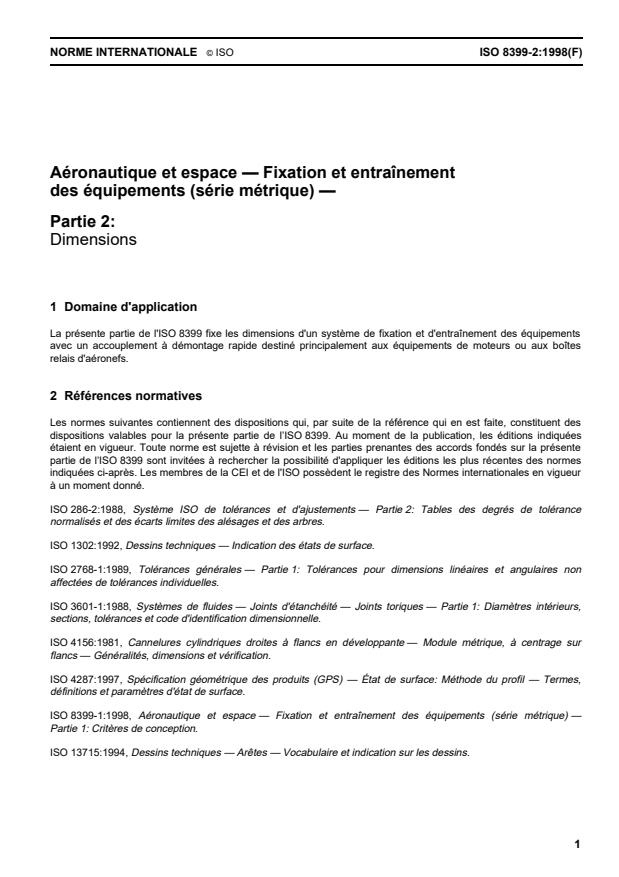
La présente partie de l'ISO 8399 fixe les dimensions d'un système de fixation et d'entraînement des équipements
avec un accouplement à démontage rapide destiné principalement aux équipements de moteurs ou aux boîtes
relais d'aéronefs.
2 Références normatives
Les normes suivantes contiennent des dispositions qui, par suite de la référence qui en est faite, constituent des
dispositions valables pour la présente partie de l’ISO 8399. Au moment de la publication, les éditions indiquées
étaient en vigueur. Toute norme est sujette à révision et les parties prenantes des accords fondés sur la présente
partie de l’ISO 8399 sont invitées à rechercher la possibilité d'appliquer les éditions les plus récentes des normes
indiquées ci-après. Les membres de la CEI et de l'ISO possèdent le registre des Normes internationales en vigueur
à un moment donné.
ISO 286-2:1988, Système ISO de tolérances et d'ajustements — Partie 2: Tables des degrés de tolérance
normalisés et des écarts limites des alésages et des arbres.
ISO 1302:1992, Dessins techniques — Indication des états de surface.
ISO 2768-1:1989, Tolérances générales — Partie 1: Tolérances pour dimensions linéaires et angulaires non
affectées de tolérances individuelles.
ISO 3601-1:1988, Systèmes de fluides — Joints d'étanchéité — Joints toriques — Partie 1: Diamètres intérieurs,
sections, tolérances et code d'identification dimensionnelle.
ISO 4156:1981, Cannelures cylindriques droites à flancs en développante — Module métrique, à centrage sur
flancs — Généralités, dimensions et vérification.
ISO 4287:1997, Spécification géométrique des produits (GPS) — État de surface: Méthode du profil — Termes,
définitions et paramètres d'état de surface.
ISO 8399-1:1998, Aéronautique et espace — Fixation et entraînement des équipements (série métrique) —
Partie 1: Critères de conception.
ISO 13715:1994, Dessins techniques — Arêtes — Vocabulaire et indication sur les dessins.
© ISO
3 Dimensionnement
3.1 Configuration et dimensions
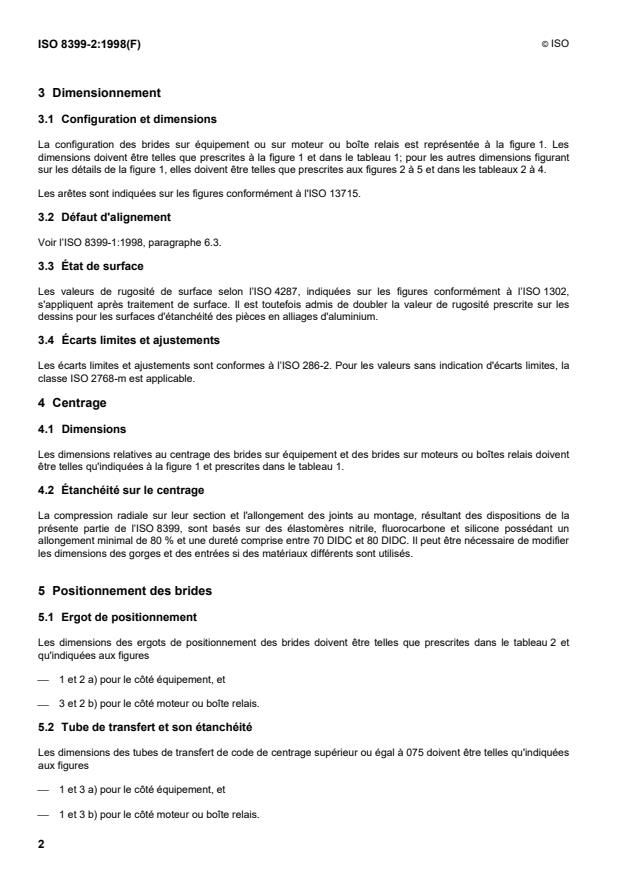
La configuration des brides sur équipement ou sur moteur ou boîte relais est représentée à la figure 1. Les
dimensions doivent être telles que prescrites à la figure 1 et dans le tableau 1; pour les autres dimensions figurant
sur les détails de la figure 1, elles doivent être telles que prescrites aux figures 2 à 5 et dans les tableaux 2 à 4.
Les arêtes sont indiquées sur les figures conformément à l'ISO 13715.
3.2 Défaut d'alignement
Voir l’ISO 8399-1:1998, paragraphe 6.3.
3.3 État de surface
Les valeurs de rugosité de surface selon l’ISO 4287, indiquées sur les figures conformément à l’ISO 1302,
s'appliquent après traitement de surface. Il est toutefois admis de doubler la valeur de rugosité prescrite sur les
dessins pour les surfaces d'étanchéité des pièces en alliages d'aluminium.
3.4 Écarts limites et ajustements
Les écarts limites et ajustements sont conformes à l’ISO 286-2. Pour les valeurs sans indication d'écarts limites, la
classe ISO 2768-m est applicable.
4 Centrage
4.1 Dimensions
Les dimensions relatives au centrage des brides sur équipement et des brides sur moteurs ou boîtes relais doivent
être telles qu'indiquées à la figure 1 et prescrites dans le tableau 1.
4.2 Étanchéité sur le centrage
La compression radiale sur leur section et l'allongement des joints au montage, résultant des dispositions de la
présente partie de l’ISO 8399, sont basés sur des élastomères nitrile, fluorocarbone et silicone possédant un
allongement minimal de 80 % et une dureté comprise entre 70 DIDC et 80 DIDC. Il peut être nécessaire de modifier
les dimensions des gorges et des entrées si des matériaux différents sont utilisés.
5 Positionnement des brides
5.1 Ergot de positionnement
Les dimensions des ergots de positionnement des brides doivent être telles que prescrites dans le tableau 2 et
qu'indiquées aux figures
1 et 2 a) pour le côté équipement, et
3 et 2 b) pour le côté moteur ou boîte relais.
5.2 Tube de transfert et son étanchéité
Les dimensions des tubes de transfert de code de centrage supéri
...