


ISO 20894:2018
(Main)Aircraft - LED based taxiing lightsystem - General requirements
Aircraft - LED based taxiing lightsystem - General requirements
This document specifies characteristics and interface requirements for the LED taxiing light system.
Aéronefs — Système de lumière de roulage à base de LED — Exigences générales
General Information
Overview
ISO 20894:2018 - Aircraft - LED based taxiing lightsystem - General requirements defines functional, photometric and interface requirements for LED-based taxi and runway turnoff (RTO) lighting systems on aircraft. The standard addresses the transition from sealed-beam lamps to LEDs, capturing expectations for luminous intensity, chromaticity, illuminance distribution, electromagnetic compatibility and environmental durability over the unit’s operating life.
Key Topics and Requirements
- Scope and purpose: Specifies characteristics and interface requirements for the LED taxiing light system (taxi and RTO lights), and can apply to other future light sources that replace LEDs.
- Operating life: Defines effective operating life as the time until photometric minimums (luminous intensity and chromaticity locus) are no longer met. Degradation of LEDs, lenses and control electronics must be considered.
- Photometric performance
- Initial luminous intensity and chromaticity locus must be established and monitored for degradation.
- Illuminance distribution: horizontal distribution must meet a cosine-based requirement across −74° to +74° and a minimum reference illuminance (example value E_C = 54 lux). An enhanced level example is E = 70 lux.
- Combined taxi + RTO illuminance may be evaluated together; minimum three measurement points required.
- Colour: Light shall be white and permit sufficient perception of airport markings; chromaticity limits must be maintained throughout life.
- Thermal and mechanical: LED junction temperature must never exceed each LED’s maximum junction temperature; plastic lenses must resist UV and environmental conditions for the required life.
- Electromagnetic interference (EMI): Conducted emissions testing per ISO 7137 (Table 1, Section 16, Category B limits) unless specified otherwise.
- Quality assurance and testing
- Component testing on specimens mounted in simulated real conditions.
- Photometric measurements after warm-up: minimum 30 minutes for LED sources or until thermal stabilization (light output change ≤3% over 15 minutes).
Applications and Users
ISO 20894:2018 is intended for:
- Aircraft manufacturers and systems engineers designing taxi and RTO lighting
- Avionics and lighting suppliers developing LED luminaires and control units
- Certification and compliance teams preparing test evidence
- Maintenance planners and MRO organizations evaluating lifecycle and replacement schedules
Keywords: ISO 20894:2018, LED taxiing light system, aircraft taxi lights, RTO lights, illuminance distribution, luminous intensity, chromaticity, LED junction temperature, electromagnetic interference.
Related Standards
- ISO 7137:1995 - Aircraft environmental conditions and test procedures for airborne equipment (referenced for EMI, environmental and power-source tests)
- SAE/ARP 693 - referenced locations for illuminance comparison
- FAR 25.1397 - referenced for aviation white chromaticity domain (CIE1931)
Frequently Asked Questions
ISO 20894:2018 is a standard published by the International Organization for Standardization (ISO). Its full title is "Aircraft - LED based taxiing lightsystem - General requirements". This standard covers: This document specifies characteristics and interface requirements for the LED taxiing light system.
This document specifies characteristics and interface requirements for the LED taxiing light system.
ISO 20894:2018 is classified under the following ICS (International Classification for Standards) categories: 49.060 - Aerospace electric equipment and systems. The ICS classification helps identify the subject area and facilitates finding related standards.
You can purchase ISO 20894:2018 directly from iTeh Standards. The document is available in PDF format and is delivered instantly after payment. Add the standard to your cart and complete the secure checkout process. iTeh Standards is an authorized distributor of ISO standards.
Standards Content (Sample)
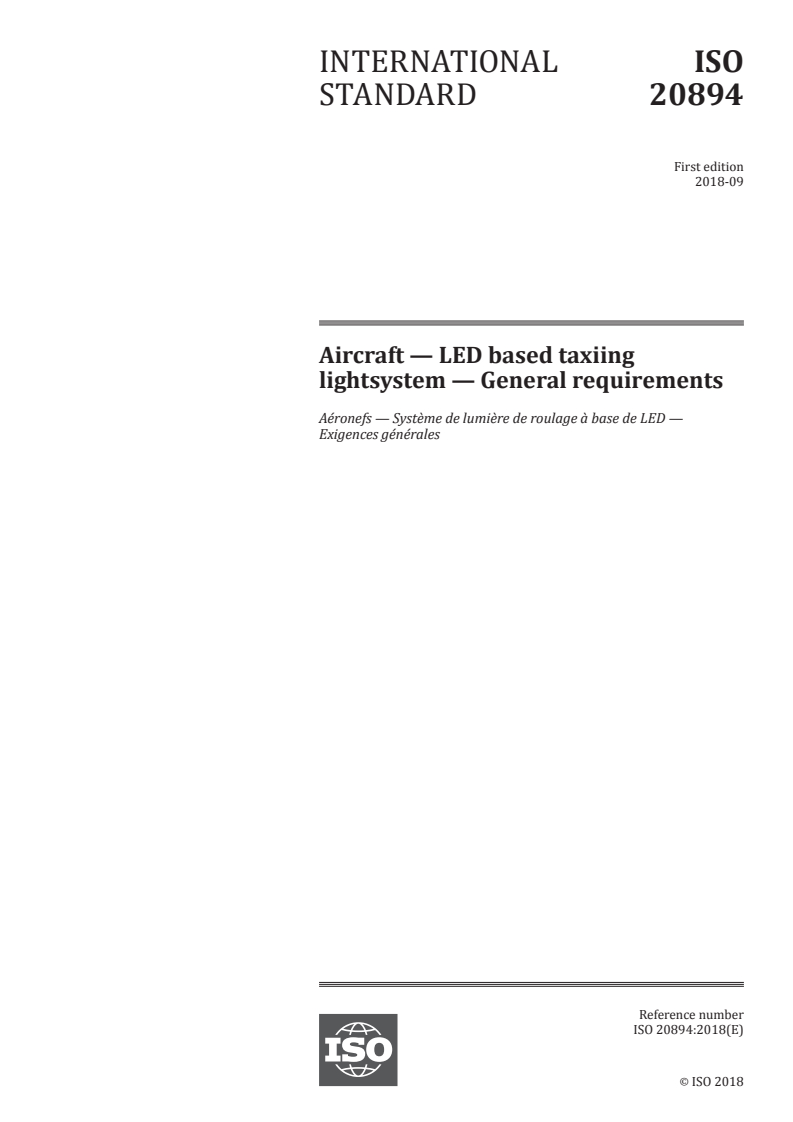
INTERNATIONAL ISO
STANDARD 20894
First edition
2018-09
Aircraft — LED based taxiing
lightsystem — General requirements
Aéronefs — Système de lumière de roulage à base de LED —
Exigences générales
Reference number
©
ISO 2018
© ISO 2018
All rights reserved. Unless otherwise specified, or required in the context of its implementation, no part of this publication may
be reproduced or utilized otherwise in any form or by any means, electronic or mechanical, including photocopying, or posting
on the internet or an intranet, without prior written permission. Permission can be requested from either ISO at the address
below or ISO’s member body in the country of the requester.
ISO copyright office
CP 401 • Ch. de Blandonnet 8
CH-1214 Vernier, Geneva
Phone: +41 22 749 01 11
Fax: +41 22 749 09 47
Email: copyright@iso.org
Website: www.iso.org
Published in Switzerland
ii © ISO 2018 – All rights reserved
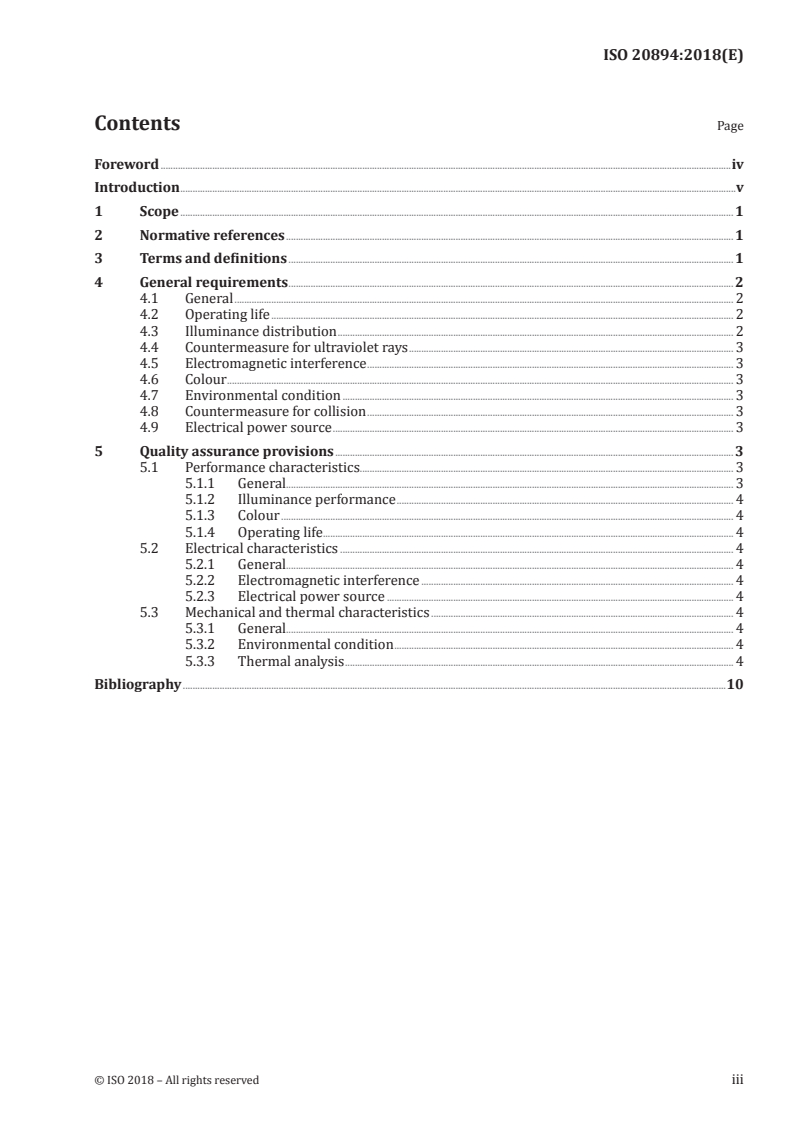
Contents Page
Foreword .iv
Introduction .v
1 Scope . 1
2 Normative references . 1
3 Terms and definitions . 1
4 General requirements . 2
4.1 General . 2
4.2 Operating life . 2
4.3 Illuminance distribution . 2
4.4 Countermeasure for ultraviolet rays . 3
4.5 Electromagnetic interference . 3
4.6 Colour . 3
4.7 Environmental condition . 3
4.8 Countermeasure for collision . 3
4.9 Electrical power source . 3
5 Quality assurance provisions . 3
5.1 Performance characteristics. 3
5.1.1 General. 3
5.1.2 Illuminance performance . 4
5.1.3 Colour . 4
5.1.4 Operating life . 4
5.2 Electrical characteristics . 4
5.2.1 General. 4
5.2.2 Electromagnetic interference . 4
5.2.3 Electrical power source . 4
5.3 Mechanical and thermal characteristics . 4
5.3.1 General. 4
5.3.2 Environmental condition . 4
5.3.3 Thermal analysis . 4
Bibliography .10
Foreword
ISO (the International Organization for Standardization) is a worldwide federation of national standards
bodies (ISO member bodies). The work of preparing International Standards is normally carried out
through ISO technical committees. Each member body interested in a subject for which a technical
committee has been established has the right to be represented on that committee. International
organizations, governmental and non-governmental, in liaison with ISO, also take part in the work.
ISO collaborates closely with the International Electrotechnical Commission (IEC) on all matters of
electrotechnical standardization.
The procedures used to develop this document and those intended for its further maintenance are
described in the ISO/IEC Directives, Part 1. In particular, the different approval criteria needed for the
different types of ISO documents should be noted. This document was drafted in accordance with the
editorial rules of the ISO/IEC Directives, Part 2 (see www .iso .org/directives).
Attention is drawn to the possibility that some of the elements of this document may be the subject of
patent rights. ISO shall not be held responsible for identifying any or all such patent rights. Details of
any patent rights identified during the development of the document will be in the Introduction and/or
on the ISO list of patent declarations received (see www .iso .org/patents).
Any trade name used in this document is information given for the convenience of users and does not
constitute an endorsement.
For an explanation of the voluntary nature of standards, the meaning of ISO specific terms and
expressions related to conformity assessment, as well as information about ISO's adherence to the
World Trade Organization (WTO) principles in the Technical Barriers to Trade (TBT) see www .iso
.org/iso/foreword .html.
This document was prepared by Technical Committee ISO/TC 20, Aircraft and space vehicles,
Subcommittee SC 1, Aerospace electrical requirements.
Any feedback or questions on this document should be directed to the user’s national standards body. A
complete listing of these bodies can be found at www .iso .org/members .html.
iv © ISO 2018 – All rights reserved
Introduction
This document is the standard of the LED (Light Emitting Diode) Taxi and RTO lights (Runway Turnoff
Lights) for aerospace.
LEDs are attractive to users because of their lower power consumption and reduced maintenance
efforts as well as their long operating life. However, Taxi and RTO lights require their light source to
provide not only a large amount of luminous flux, but also high luminous intensity. Since recent LEDs
achieve high luminous intensity, LEDs have come to be adopted as light sources of Taxi and RTO lights.
This document intends to establish a functional requirement set for modern Taxi and RTO lights which
adopt LEDs as the light source.
In addition, this document is applied not only to the LED light source, but it can be applied also to other
new light sources appearing in the future.
...
기사 제목: ISO 20894:2018 - 항공기 - LED 기반 세타이어 조명 시스템 - 일반 요구 사항 기사 내용: 이 문서는 LED 세타이어 조명 시스템의 특성과 인터페이스 요구 사항을 명시합니다.
The article discusses ISO 20894:2018, which outlines the general requirements for an LED-based taxiing light system in aircraft. It specifies the characteristics and interface requirements for such a system.
記事タイトル:ISO 20894:2018 - 航空機-LEDベースのタクシングライトシステム-一般要件 記事内容:この文書は、LEDに基づくタクシングライトシステムの特性とインタフェース要件を指定しています。
Questions, Comments and Discussion
Ask us and Technical Secretary will try to provide an answer. You can facilitate discussion about the standard in here.
Loading comments...