

ISO 20087:2016
(Main)Photography — Digital still cameras — Battery life measurement
General Information
- Abstract
ISO 20087:2016 specifies measurement method of battery life for consumer-use digital still cameras (hereinafter referred to as "DSC").
- Status
- Published
- Publication Date
- 02-May-2016
- Technical Committee
- ISO/TC 42 - Photography
- Drafting Committee
- ISO/TC 42/WG 18 - Electronic still picture imaging
- Current Stage
- 9093 - International Standard confirmed
- Start Date
- 06-Jun-2026
- Completion Date
- 29-Aug-2026
Buy Documents

ISO 20087:2016 - Photography -- Digital still cameras -- Battery life measurement

ISO 20087:2016 - Photography — Digital still cameras — Battery life measurement/3/2016
Overview
ISO 20087:2016 - Photography - Digital still cameras - Battery life measurement - specifies a standardized measurement method for determining battery life (number of shots) of consumer digital still cameras (DSC). Based on the CIPA measurement procedure, ISO 20087:2016 gives laboratories, manufacturers and reviewers a repeatable test sequence and reporting rules so battery life results are comparable and reproducible across devices and test sites.
Key Topics and Requirements
- Scope: Applies to consumer-use digital still cameras (DSC).
- Reported result: Only the number of shots (possible number of recordable pictures) shall be reported as battery life.
- Battery handling:
- Primary (non‑rechargeable): use a new battery.
- Secondary (rechargeable): battery must be fully charged; battery model/type must be reported.
- Environmental conditions: Tests conducted at (23 ± 2) °C and relative humidity (50 ± 20) %.
- Camera settings: Use factory shipping modes for image quality and pixel count unless otherwise stated; non-specified parameters should be set to typical user settings and reported.
- Shooting sequence:
- First shot 30 seconds after power-on; thereafter one picture every 30 seconds (or when camera is ready).
- Flash: full flash used on one of every two shots (alternate full/off).
- Motor-driven optical zoom: move between TELE and WIDE before every picture.
- Picture monitor: kept on as the electronic viewfinder during the test; if the monitor has illumination/backlight, it remains lit.
- Power cycling: power is turned off after every 10th picture and allowed sufficient off time that does not affect battery life.
- End-of-test criteria: Test ends at the first low-battery shutdown or when a still-photography function stops working (with reactivation rules defined).
- Reporting: Include battery identification, recording media identification, and any function settings that differ from factory defaults.
Applications and Users
- Camera manufacturers use ISO 20087:2016 for product validation and to publish comparable battery life claims.
- Independent test labs and certification bodies adopt the standard to provide consistent, repeatable measurements.
- Reviewers and retailers use results to compare models and inform consumers.
- Regulators and standards committees reference the method for harmonized performance metrics. Practical benefits: consistent benchmarking, validated product specifications, and improved consumer confidence in battery-life claims.
Related Standards
- CIPA “Procedure for Measuring Digital Still Camera Battery Consumption” - the CIPA procedure underpins ISO 20087.
- ISO/TC 42 (Photography) publications and referenced bibliography for related measurement practices.
Keywords: ISO 20087:2016, battery life measurement, digital still cameras, DSC, camera battery testing, CIPA.
Buy Documents
ISO 20087:2016 - Photography -- Digital still cameras -- Battery life measurement
ISO 20087:2016 - Photography — Digital still cameras — Battery life measurement/3/2016
Frequently Asked Questions
ISO 20087:2016 is a standard published by the International Organization for Standardization (ISO). Its full title is "Photography — Digital still cameras — Battery life measurement". This standard covers: ISO 20087:2016 specifies measurement method of battery life for consumer-use digital still cameras (hereinafter referred to as "DSC").
ISO 20087:2016 specifies measurement method of battery life for consumer-use digital still cameras (hereinafter referred to as "DSC").
ISO 20087:2016 is classified under the following ICS (International Classification for Standards) categories: 37.040.99 - Other standards related to photography. The ICS classification helps identify the subject area and facilitates finding related standards.
ISO 20087:2016 is available in PDF format for immediate download after purchase. The document can be added to your cart and obtained through the secure checkout process. Digital delivery ensures instant access to the complete standard document.
Standards Content (Sample)
INTERNATIONAL ISO
STANDARD 20087
First edition
2016-05-01
Photography — Digital still cameras —
Battery life measurement
Photographie — Caméras numériques — Mesurage de la durée de vie
de la batterie
Reference number
©
ISO 2016
© ISO 2016, Published in Switzerland
All rights reserved. Unless otherwise specified, no part of this publication may be reproduced or utilized otherwise in any form
or by any means, electronic or mechanical, including photocopying, or posting on the internet or an intranet, without prior
written permission. Permission can be requested from either ISO at the address below or ISO’s member body in the country of
the requester.
ISO copyright office
Ch. de Blandonnet 8 • CP 401
CH-1214 Vernier, Geneva, Switzerland
Tel. +41 22 749 01 11
Fax +41 22 749 09 47
copyright@iso.org
www.iso.org
ii © ISO 2016 – All rights reserved
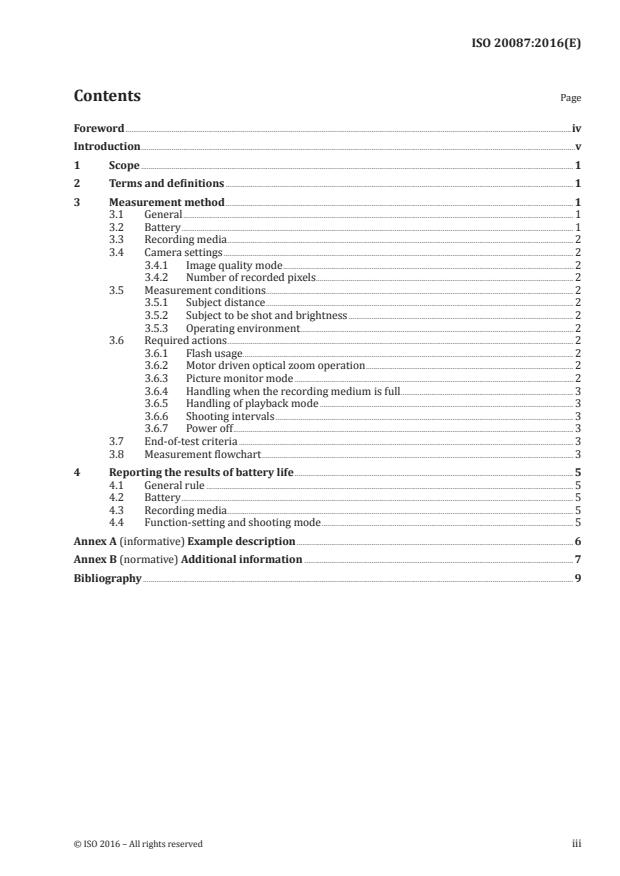
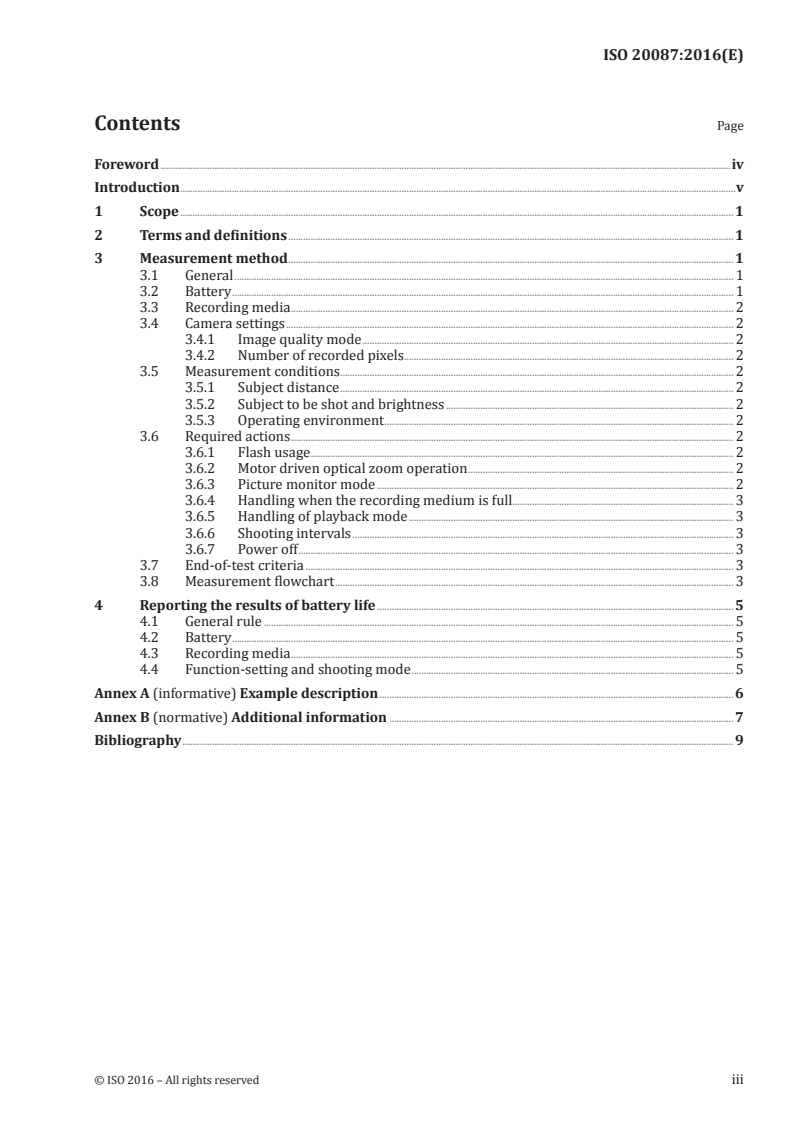
Contents Page
Foreword .iv
Introduction .v
1 Scope . 1
2 Terms and definitions . 1
3 Measurement method . 1
3.1 General . 1
3.2 Battery . 1
3.3 Recording media . 2
3.4 Camera settings . 2
3.4.1 Image quality mode . 2
3.4.2 Number of recorded pixels . 2
3.5 Measurement conditions . . 2
3.5.1 Subject distance . 2
3.5.2 Subject to be shot and brightness . 2
3.5.3 Operating environment . 2
3.6 Required actions . 2
3.6.1 Flash usage . 2
3.6.2 Motor driven optical zoom operation . 2
3.6.3 Picture monitor mode . 2
3.6.4 Handling when the recording medium is full. 3
3.6.5 Handling of playback mode . 3
3.6.6 Shooting intervals . 3
3.6.7 Power off . 3
3.7 End-of-test criteria . 3
3.8 Measurement flowchart . 3
4 Reporting the results of battery life . 5
4.1 General rule . 5
4.2 Battery . 5
4.3 Recording media . 5
4.4 Function-setting and shooting mode . 5
Annex A (informative) Example description . 6
Annex B (normative) Additional information . 7
Bibliography . 9
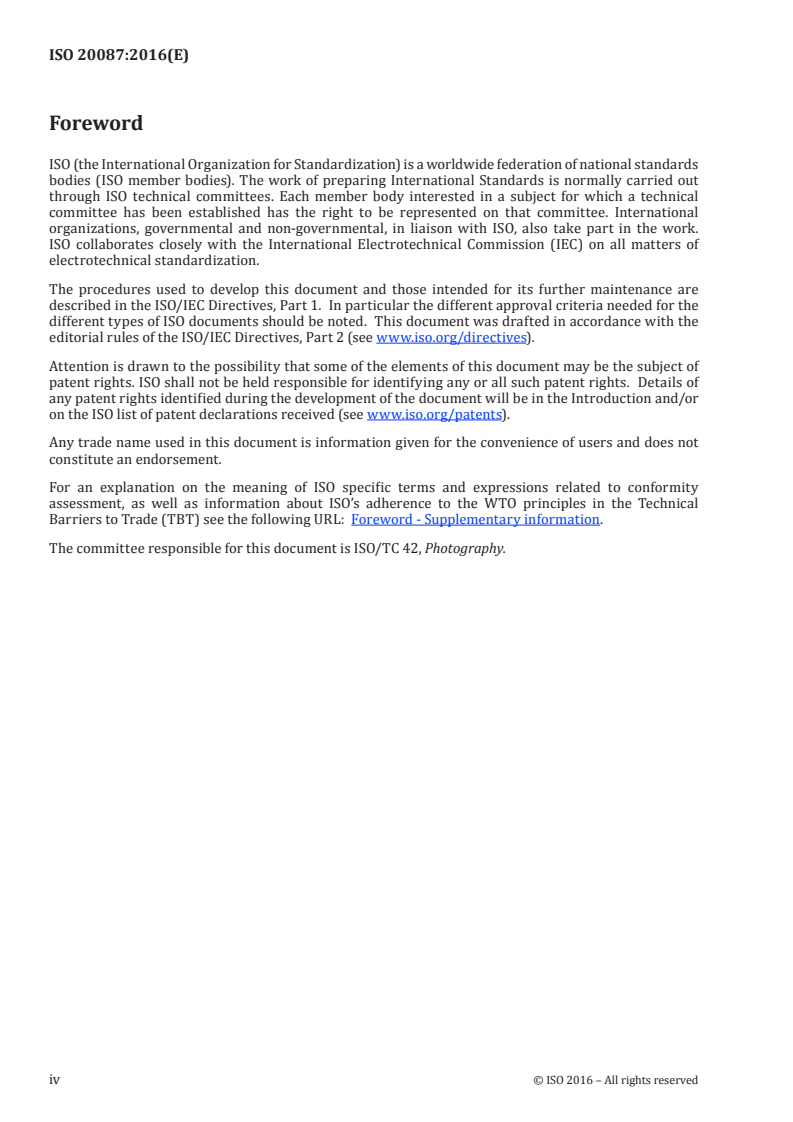
Foreword
ISO (the International Organization for Standardization) is a worldwide federation of national standards
bodies (ISO member bodies). The work of preparing International Standards is normally carried out
through ISO technical committees. Each member body interested in a subject for which a technical
committee has been established has the right to be represented on that committee. International
organizations, governmental and non-governmental, in liaison with ISO, also take part in the work.
ISO collaborates closely with the International Electrotechnical Commission (IEC) on all matters of
electrotechnical standardization.
The procedures used to develop this document and those intended for its further maintenance are
described in the ISO/IEC Directives, Part 1. In particular the different approval criteria needed for the
different types of ISO documents should be noted. This document was drafted in accordance with the
editorial rules of the ISO/IEC Directives, Part 2 (see www.iso.org/directives).
Attention is drawn to the possibility that some of the elements of this document may be the subject of
patent rights. ISO shall not be held responsible for identifying any or all such patent rights. Details of
any patent rights identified during the development of the document will be in the Introduction and/or
on the ISO list of patent declarations received (see www.iso.org/patents).
Any trade name used in this document is information given for the convenience of users and does not
constitute an endorsement.
For an explanation on the meaning of ISO specific terms and expressions related to conformity
assessment, as well as information about ISO’s adherence to the WTO principles in the Technical
Barriers to Trade (TBT) see the following URL: Foreword - Supplementary information.
The committee responsible for this document is ISO/TC 42, Photography.
iv © ISO 2016 – All rights reserved
Introduction
For digital cameras, long battery life is one of the important features. The Camera and Imaging
Products Association (CIPA) defined a CIPA standard “Procedure for Measuring Digital Still Camera
Battery Consumption” for specifying a standard measurement procedure. The procedure gives useful
information on battery life to end-users for making a selection from a variety of digital cameras.
This International Standard is based on the CIPA standard mentioned above and it is referenced in the
Bibliography. The standardized measurement procedure primarily includes high power-consuming
functions such as image display on picture monitor, use of flash, and zoom and retractable lens
movement.
INTERNATIONAL STANDARD ISO 20087:2016(E)
Photography — Digital still cameras — Battery life
measurement
1 Scope
This International Standard specifies measurement method of battery life for consumer-use digital still
cameras (hereinafter referred to as “DSC”).
2 Terms and definitions
For the purposes of this document, the following terms and definitions apply.
2.1
number of shots
number of pictures shot by a digital camera under the conditions stipulated in the measurement
procedure in this International Standard
3 Measurement method
3.1 General
a) All the still-photography functions shall be utilized to their full extent when the measurement
is conducted. The functions which have nothing to do with taking still photography (e.g. audio-
recording and movie-recording functions) need not be activated during the measurement.
b) The camera’s function-setting parameters, except those defined in this International Standard,
shall be identical to factory shipping settings. If the measurement is conducted with parameters
that are different from the factory shipping settings, such settings parameters shall be reported
along with the measurement results. If certain setting parameters are not defined by the factory
shipping settings (see Annex B), the measurement shall be conducted using the settings which are
most likely employed by the users of the applicable cameras, and information which can identify
such setting parameters shall be reported along with the measurement data.
c) Some of the functions whose test conditions are defined in this International Standard may be
ignored if a camera to be measured is not equipped with those functions.
d) If the power level is not fully determined by the factory shipping setting, the measurement shall be
made with the operation that result in the highest power demand level for the camera.
Summarized priorities for the above a), b) and c) are as follows.
— The measurement conditions of the standard procedure which are listed in 3.2 to 3.8.
— Function-setting parameters which are not listed in 3.2 to 3.8 shall be identical to the factory
shipping settings.
— If any parameters cannot be defined by the factory shipping settings, such parameters shall be set
to ones which are assumed to be most likely employed by the users of the applicable cameras.
3.2 Battery
a) Battery type is not specified for the measurement, but information that can identify the battery
shall be reported along with the measurement results.
b) When using a primary battery, a new battery shall be used. When using a secondary battery
(rechargeable battery), the battery shall be fully charged (see Annex B).
3.3 Recording media
Not specified, but information that can identify the recording media shall be reported along with the
measurement results.
3.4 Camera settings
3.4.1 Image quality mode
The factory shipping mode shall be used.
3.4.2 Number of recorded pixels
The factory shipping mode shall be used.
3.5 Measurement conditions
3.5.1 Subject distance
Not specified.
3.5.2 Subject to be shot and brightness
Subject to be shot is not specified. The subject brightness shall be within the range of the camera’s AE
system, if automatic exposure (AE) is used.
3.5.3 Operating environment
Measurements shall be made at (23 ± 2) °C and relative humidity (50 ± 20) %.
3.6 Required actions
3.6.1 Flash usage
Full flash shall be used for one of every two shots. For the other shot, the flash shall not be used. Any
given shooting condition for the full illumination flash may be used.
3.6.2 Motor driven optical zoom operation
The motor driven optical zoom lens shall be moved either from the TELE end to the WIDE end or from
the WIDE end to the TELE end before eve
...
INTERNATIONAL ISO
STANDARD 20087
First edition
2016-05-01
Photography — Digital still cameras —
Battery life measurement
Photographie — Caméras numériques — Mesurage de la durée de vie
de la batterie
Reference number
©
ISO 2016
© ISO 2016, Published in Switzerland
All rights reserved. Unless otherwise specified, no part of this publication may be reproduced or utilized otherwise in any form
or by any means, electronic or mechanical, including photocopying, or posting on the internet or an intranet, without prior
written permission. Permission can be requested from either ISO at the address below or ISO’s member body in the country of
the requester.
ISO copyright office
Ch. de Blandonnet 8 • CP 401
CH-1214 Vernier, Geneva, Switzerland
Tel. +41 22 749 01 11
Fax +41 22 749 09 47
copyright@iso.org
www.iso.org
ii © ISO 2016 – All rights reserved
Contents Page
Foreword .iv
Introduction .v
1 Scope . 1
2 Terms and definitions . 1
3 Measurement method . 1
3.1 General . 1
3.2 Battery . 1
3.3 Recording media . 2
3.4 Camera settings . 2
3.4.1 Image quality mode . 2
3.4.2 Number of recorded pixels . 2
3.5 Measurement conditions . . 2
3.5.1 Subject distance . 2
3.5.2 Subject to be shot and brightness . 2
3.5.3 Operating environment . 2
3.6 Required actions . 2
3.6.1 Flash usage . 2
3.6.2 Motor driven optical zoom operation . 2
3.6.3 Picture monitor mode . 2
3.6.4 Handling when the recording medium is full. 3
3.6.5 Handling of playback mode . 3
3.6.6 Shooting intervals . 3
3.6.7 Power off . 3
3.7 End-of-test criteria . 3
3.8 Measurement flowchart . 3
4 Reporting the results of battery life . 5
4.1 General rule . 5
4.2 Battery . 5
4.3 Recording media . 5
4.4 Function-setting and shooting mode . 5
Annex A (informative) Example description . 6
Annex B (normative) Additional information . 7
Bibliography . 9
Foreword
ISO (the International Organization for Standardization) is a worldwide federation of national standards
bodies (ISO member bodies). The work of preparing International Standards is normally carried out
through ISO technical committees. Each member body interested in a subject for which a technical
committee has been established has the right to be represented on that committee. International
organizations, governmental and non-governmental, in liaison with ISO, also take part in the work.
ISO collaborates closely with the International Electrotechnical Commission (IEC) on all matters of
electrotechnical standardization.
The procedures used to develop this document and those intended for its further maintenance are
described in the ISO/IEC Directives, Part 1. In particular the different approval criteria needed for the
different types of ISO documents should be noted. This document was drafted in accordance with the
editorial rules of the ISO/IEC Directives, Part 2 (see www.iso.org/directives).
Attention is drawn to the possibility that some of the elements of this document may be the subject of
patent rights. ISO shall not be held responsible for identifying any or all such patent rights. Details of
any patent rights identified during the development of the document will be in the Introduction and/or
on the ISO list of patent declarations received (see www.iso.org/patents).
Any trade name used in this document is information given for the convenience of users and does not
constitute an endorsement.
For an explanation on the meaning of ISO specific terms and expressions related to conformity
assessment, as well as information about ISO’s adherence to the WTO principles in the Technical
Barriers to Trade (TBT) see the following URL: Foreword - Supplementary information.
The committee responsible for this document is ISO/TC 42, Photography.
iv © ISO 2016 – All rights reserved
Introduction
For digital cameras, long battery life is one of the important features. The Camera and Imaging
Products Association (CIPA) defined a CIPA standard “Procedure for Measuring Digital Still Camera
Battery Consumption” for specifying a standard measurement procedure. The procedure gives useful
information on battery life to end-users for making a selection from a variety of digital cameras.
This International Standard is based on the CIPA standard mentioned above and it is referenced in the
Bibliography. The standardized measurement procedure primarily includes high power-consuming
functions such as image display on picture monitor, use of flash, and zoom and retractable lens
movement.
INTERNATIONAL STANDARD ISO 20087:2016(E)
Photography — Digital still cameras — Battery life
measurement
1 Scope
This International Standard specifies measurement method of battery life for consumer-use digital still
cameras (hereinafter referred to as “DSC”).
2 Terms and definitions
For the purposes of this document, the following terms and definitions apply.
2.1
number of shots
number of pictures shot by a digital camera under the conditions stipulated in the measurement
procedure in this International Standard
3 Measurement method
3.1 General
a) All the still-photography functions shall be utilized to their full extent when the measurement
is conducted. The functions which have nothing to do with taking still photography (e.g. audio-
recording and movie-recording functions) need not be activated during the measurement.
b) The camera’s function-setting parameters, except those defined in this International Standard,
shall be identical to factory shipping settings. If the measurement is conducted with parameters
that are different from the factory shipping settings, such settings parameters shall be reported
along with the measurement results. If certain setting parameters are not defined by the factory
shipping settings (see Annex B), the measurement shall be conducted using the settings which are
most likely employed by the users of the applicable cameras, and information which can identify
such setting parameters shall be reported along with the measurement data.
c) Some of the functions whose test conditions are defined in this International Standard may be
ignored if a camera to be measured is not equipped with those functions.
d) If the power level is not fully determined by the factory shipping setting, the measurement shall be
made with the operation that result in the highest power demand level for the camera.
Summarized priorities for the above a), b) and c) are as follows.
— The measurement conditions of the standard procedure which are listed in 3.2 to 3.8.
— Function-setting parameters which are not listed in 3.2 to 3.8 shall be identical to the factory
shipping settings.
— If any parameters cannot be defined by the factory shipping settings, such parameters shall be set
to ones which are assumed to be most likely employed by the users of the applicable cameras.
3.2 Battery
a) Battery type is not specified for the measurement, but information that can identify the battery
shall be reported along with the measurement results.
b) When using a primary battery, a new battery shall be used. When using a secondary battery
(rechargeable battery), the battery shall be fully charged (see Annex B).
3.3 Recording media
Not specified, but information that can identify the recording media shall be reported along with the
measurement results.
3.4 Camera settings
3.4.1 Image quality mode
The factory shipping mode shall be used.
3.4.2 Number of recorded pixels
The factory shipping mode shall be used.
3.5 Measurement conditions
3.5.1 Subject distance
Not specified.
3.5.2 Subject to be shot and brightness
Subject to be shot is not specified. The subject brightness shall be within the range of the camera’s AE
system, if automatic exposure (AE) is used.
3.5.3 Operating environment
Measurements shall be made at (23 ± 2) °C and relative humidity (50 ± 20) %.
3.6 Required actions
3.6.1 Flash usage
Full flash shall be used for one of every two shots. For the other shot, the flash shall not be used. Any
given shooting condition for the full illumination flash may be used.
3.6.2 Motor driven optical zoom operation
The motor driven optical zoom lens shall be moved either from the TELE end to the WIDE end or from
the WIDE end to the TELE end before eve
...