

ISO 25490
(Main)Traditional Chinese medicine — Citrus reticulata pericarp
General Information
- Abstract
This document specifies the minimum requirements and test methods for C. reticulata pericarp, which is the dried pericarp of the ripe fruit of C. reticulata Blanco or its cultivars(Fam. Rutaceae), C. unshiu Marcowicz, C. unshiu Markovich, C. reticulata 'Chachi', C. reticulata 'Dahongpao', C. reticulata 'Unshiu', C. reticulata 'Tangerina'. It is applicable to C. reticulata pericarp that is sold and used as herbal raw materials in the international trade, including Chinese materia medica (whole medicinal materials) and decoction pieces derived from this plant.
- Status
- Not Published
- Technical Committee
- ISO/TC 249 - Traditional Chinese medicine
- Current Stage
- 6000 - International Standard under publication
- Start Date
- 25-Sep-2026
- Completion Date
- 26-Sep-2026
Buy Documents
ISO/FDIS 25490 - Traditional Chinese medicine — Citrus reticulata pericarp
REDLINE ISO/FDIS 25490 - Traditional Chinese medicine — Citrus reticulata pericarp
Overview
ISO 25490 is an international standard for Traditional Chinese medicine - Citrus reticulata pericarp. It specifies the minimum requirements and test methods for the dried pericarp of ripe Citrus reticulata fruit and related cultivars used in herbal trade.
This standard is designed for Chinese materia medica and decoction pieces derived from Citrus reticulata pericarp. It supports consistent quality control for a widely traded herbal raw material used in traditional Chinese medicine, food-related products, and international supply chains.
Key benefits of ISO 25490 include:
- Clear identification requirements for Citrus reticulata pericarp
- Practical test methods for quality and safety evaluation
- Support for harmonized international trade
- Better consistency in packaging, storage, labeling, and transport
Key Topics
ISO 25490 covers the main quality and authenticity checks needed for reliable handling of Citrus reticulata pericarp. The standard addresses both appearance-based examination and analytical testing.
Important topics include:
- General characteristics - cleanliness, absence of living insects, mould, foreign matter, rancid odour, and abnormal taste
- Morphological features - surface color, texture, thickness, and structure
- Microscopic characteristics - diagnostic features used for herbal identification
- TLC identification - thin-layer chromatogram comparison with a hesperidin reference
- Foreign matter - determination of unwanted material
- Moisture content - limited to not more than 13%
- Hesperidin content - determination of a key chemical marker
- Heavy metals, pesticide residues, aflatoxins, and sulfur dioxide - safety-related testing
The document also includes guidance on sampling, test reporting, packaging, storage, transportation, and labeling.
Applications
ISO 25490 is especially useful for organizations involved in the herbal medicine supply chain and traditional Chinese medicine quality assurance. It can support:
- Manufacturers of herbal raw materials and decoction pieces
- Laboratories performing authentication and safety testing
- Importers and exporters of TCM ingredients
- Regulatory and inspection bodies
- Traders seeking standardized product documentation
Because Citrus reticulata pericarp is used across multiple regions and pharmacopoeial systems, ISO 25490 helps improve trade confidence, product consistency, and conformity assessment. It is also valuable for businesses managing packaging, storage, and labeling requirements for herbal products intended for oral use.
Related Standards
ISO 25490 is linked to several ISO documents that support broader testing and handling of traditional Chinese medicine materials:
- ISO 23723:2021 - general requirements for herbal raw material and materia medica
- ISO/TS 21310 - microscopic examination of medicinal herbs
- ISO 18664 - determination of heavy metals in herbal medicines
- ISO 22258 - determination of pesticide residues by gas chromatography
- ISO 22283 - determination of aflatoxins by LC-FLD
- ISO 22590 - determination of sulfur dioxide in natural products
- ISO 22217 - storage requirements for raw materials and decoction pieces
- ISO 21371 - labeling requirements for products intended for oral or topical use
Together, these standards help build a stronger framework for traditional Chinese medicine quality standards and international herbal trade compliance.
Buy Documents
ISO/FDIS 25490 - Traditional Chinese medicine — Citrus reticulata pericarp
REDLINE ISO/FDIS 25490 - Traditional Chinese medicine — Citrus reticulata pericarp
Get Certified
Connect with accredited certification bodies for this standard

BSI Group
BSI (British Standards Institution) is the business standards company that helps organizations make excellence a habit.

TÜV Rheinland
TÜV Rheinland is a leading international provider of technical services.

TÜV SÜD
TÜV SÜD is a trusted partner of choice for safety, security and sustainability solutions.
Sponsored listings
Frequently Asked Questions
ISO 25490 is a draft published by the International Organization for Standardization (ISO). Its full title is "Traditional Chinese medicine — Citrus reticulata pericarp". This standard covers: This document specifies the minimum requirements and test methods for C. reticulata pericarp, which is the dried pericarp of the ripe fruit of C. reticulata Blanco or its cultivars(Fam. Rutaceae), C. unshiu Marcowicz, C. unshiu Markovich, C. reticulata 'Chachi', C. reticulata 'Dahongpao', C. reticulata 'Unshiu', C. reticulata 'Tangerina'. It is applicable to C. reticulata pericarp that is sold and used as herbal raw materials in the international trade, including Chinese materia medica (whole medicinal materials) and decoction pieces derived from this plant.
This document specifies the minimum requirements and test methods for C. reticulata pericarp, which is the dried pericarp of the ripe fruit of C. reticulata Blanco or its cultivars(Fam. Rutaceae), C. unshiu Marcowicz, C. unshiu Markovich, C. reticulata 'Chachi', C. reticulata 'Dahongpao', C. reticulata 'Unshiu', C. reticulata 'Tangerina'. It is applicable to C. reticulata pericarp that is sold and used as herbal raw materials in the international trade, including Chinese materia medica (whole medicinal materials) and decoction pieces derived from this plant.
ISO 25490 is classified under the following ICS (International Classification for Standards) categories: 11.120.10 - Medicaments. The ICS classification helps identify the subject area and facilitates finding related standards.
ISO 25490 is available in PDF format for immediate download after purchase. The document can be added to your cart and obtained through the secure checkout process. Digital delivery ensures instant access to the complete standard document.
Standards Content (Sample)
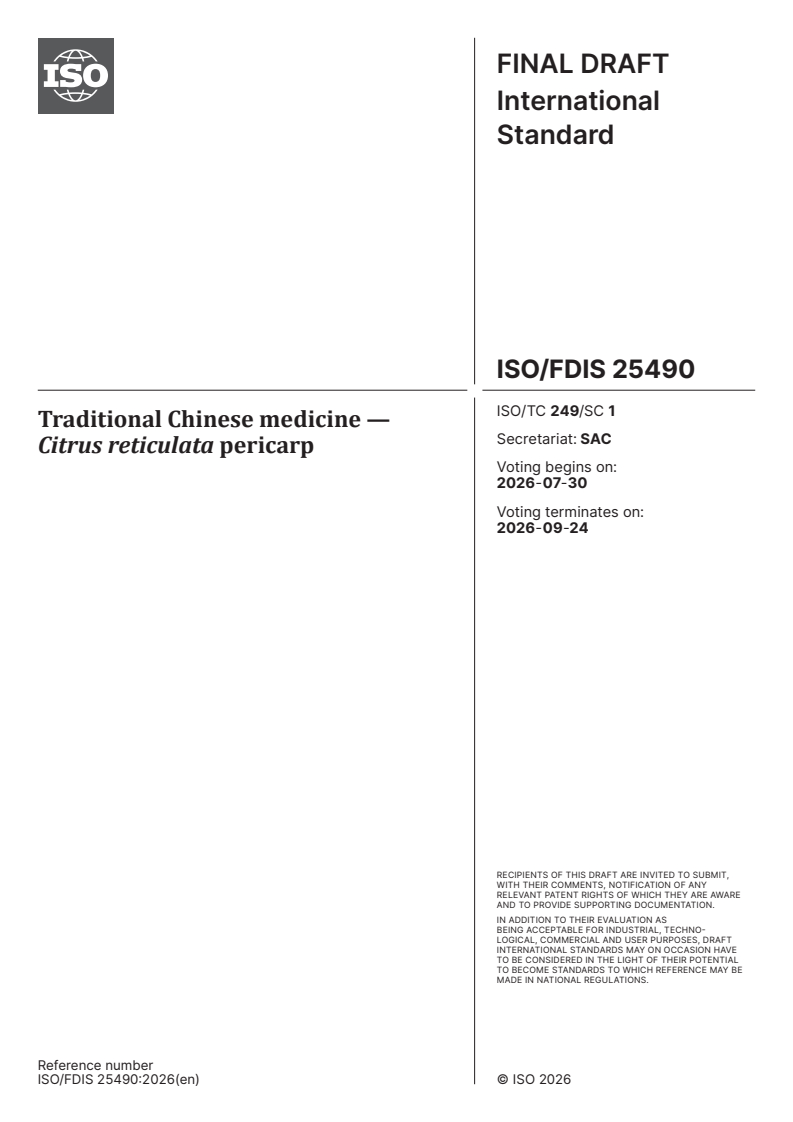
FINAL DRAFT
International
Standard
ISO/FDIS 25490
ISO/TC 249/SC 1
Traditional Chinese medicine —
Secretariat: SAC
Citrus reticulata pericarp
Voting begins on:
2026-07-30
Voting terminates on:
2026-09-24
RECIPIENTS OF THIS DRAFT ARE INVITED TO SUBMIT,
WITH THEIR COMMENTS, NOTIFICATION OF ANY
RELEVANT PATENT RIGHTS OF WHICH THEY ARE AWARE
AND TO PROVIDE SUPPOR TING DOCUMENTATION.
IN ADDITION TO THEIR EVALUATION AS
BEING ACCEPTABLE FOR INDUSTRIAL, TECHNO
LOGICAL, COMMERCIAL AND USER PURPOSES, DRAFT
INTERNATIONAL STANDARDS MAY ON OCCASION HAVE
TO BE CONSIDERED IN THE LIGHT OF THEIR POTENTIAL
TO BECOME STAN DARDS TO WHICH REFERENCE MAY BE
MADE IN NATIONAL REGULATIONS.
Reference number
ISO/FDIS 25490:2026(en) © ISO 2026
FINAL DRAFT
ISO/FDIS 25490:2026(en)
International
Standard
ISO/FDIS 25490
ISO/TC 249/SC 1
Traditional Chinese medicine —
Secretariat: SAC
Citrus reticulata pericarp
Voting begins on:
Voting terminates on:
RECIPIENTS OF THIS DRAFT ARE INVITED TO SUBMIT,
WITH THEIR COMMENTS, NOTIFICATION OF ANY
RELEVANT PATENT RIGHTS OF WHICH THEY ARE AWARE
AND TO PROVIDE SUPPOR TING DOCUMENTATION.
© ISO 2026
IN ADDITION TO THEIR EVALUATION AS
All rights reserved. Unless otherwise specified, or required in the context of its implementation, no part of this publication may
BEING ACCEPTABLE FOR INDUSTRIAL, TECHNO
LOGICAL, COMMERCIAL AND USER PURPOSES, DRAFT
be reproduced or utilized otherwise in any form or by any means, electronic or mechanical, including photocopying, or posting on
INTERNATIONAL STANDARDS MAY ON OCCASION HAVE
the internet or an intranet, without prior written permission. Permission can be requested from either ISO at the address below
TO BE CONSIDERED IN THE LIGHT OF THEIR POTENTIAL
or ISO’s member body in the country of the requester.
TO BECOME STAN DARDS TO WHICH REFERENCE MAY BE
MADE IN NATIONAL REGULATIONS.
ISO copyright office
CP 401 • Ch. de Blandonnet 8
CH-1214 Vernier, Geneva
Phone: +41 22 749 01 11
Email: copyright@iso.org
Website: www.iso.org
Published in Switzerland Reference number
ISO/FDIS 25490:2026(en) © ISO 2026
ii
ISO/FDIS 25490:2026(en)
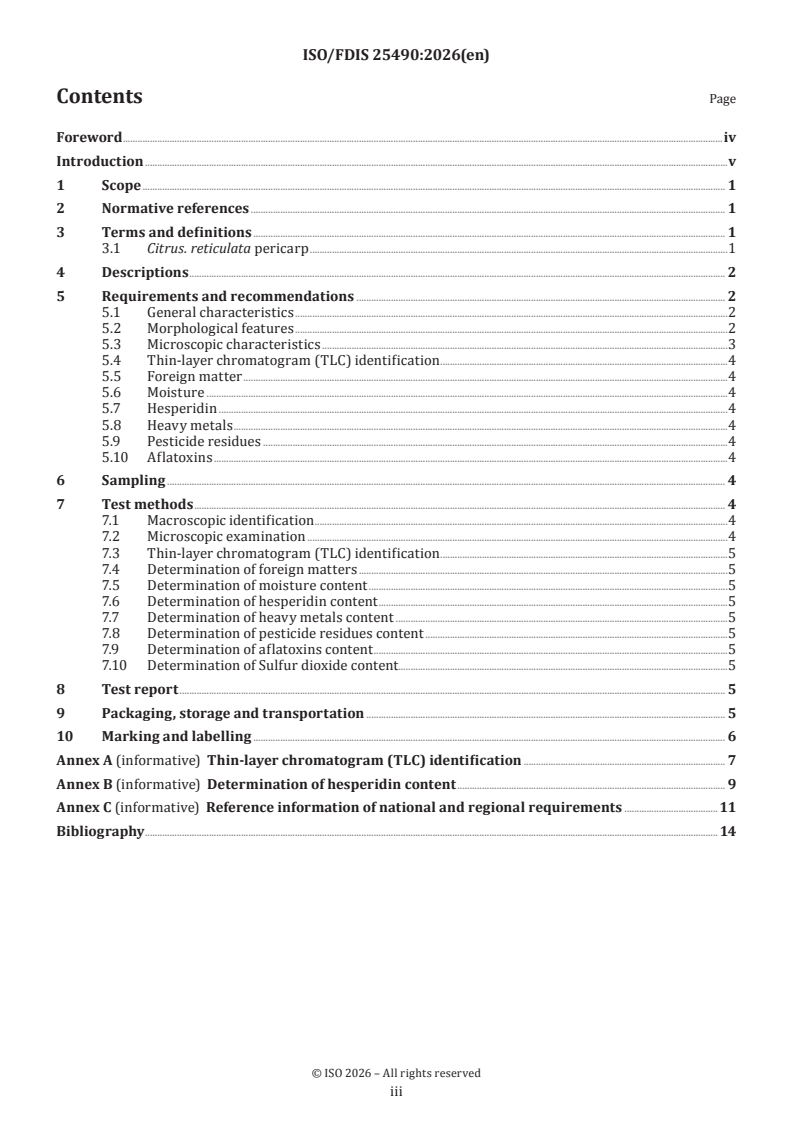
Contents Page
Foreword .iv
Introduction .v
1 Scope . 1
2 Normative references . 1
3 Terms and definitions . 1
3.1 Citrus. reticulata pericarp .1
4 Descriptions . 2
5 Requirements and recommendations . 2
5.1 General characteristics .2
5.2 Morphological features .2
5.3 Microscopic characteristics .3
5.4 Thin-layer chromatogram (TLC) identification .4
5.5 Foreign matter .4
5.6 Moisture .4
5.7 Hesperidin .4
5.8 Heavy metals .4
5.9 Pesticide residues .4
5.10 Aflatoxins .4
6 Sampling . 4
7 Test methods . 4
7.1 Macroscopic identification .4
7.2 Microscopic examination .4
7.3 Thin-layer chromatogram (TLC) identification .5
7.4 Determination of foreign matters .5
7.5 Determination of moisture content .5
7.6 Determination of hesperidin content .5
7.7 Determination of heavy metals content .5
7.8 Determination of pesticide residues content .5
7.9 Determination of aflatoxins content .5
7.10 Determination of Sulfur dioxide content.5
8 Test report . 5
9 Packaging, storage and transportation . 5
10 Marking and labelling . 6
Annex A (informative) Thin-layer chromatogram (TLC) identification . 7
Annex B (informative) Determination of hesperidin content . 9
Annex C (informative) Reference information of national and regional requirements .11
Bibliography . 14
iii
ISO/FDIS 25490:2026(en)
Foreword
ISO (the International Organization for Standardization) is a worldwide federation of national standards
bodies (ISO member bodies). The work of preparing International Standards is normally carried out through
ISO technical committees. Each member body interested in a subject for which a technical committee
has been established has the right to be represented on that committee. International organizations,
governmental and non-governmental, in liaison with ISO, also take part in the work. ISO collaborates closely
with the International Electrotechnical Commission (IEC) on all matters of electrotechnical standardization.
The procedures used to develop this document and those intended for its further maintenance are described
in the ISO/IEC Directives, Part 1. In particular, the different approval criteria needed for the different types
of ISO document should be noted. This document was drafted in accordance with the editorial rules of the
ISO/IEC Directives, Part 2 (see www.iso.org/directives).
ISO draws attention to the possibility that the implementation of this document may involve the use of (a)
patent(s). ISO takes no position concerning the evidence, validity or applicability of any claimed patent
rights in respect thereof. As of the date of publication of this document, ISO had not received notice of (a)
patent(s) which may be required to implement this document. However, implementers are cautioned that
this may not represent the latest information, which may be obtained from the patent database available at
www.iso.org/patents. ISO shall not be held responsible for identifying any or all such patent rights.
Any trade name used in this document is information given for the convenience of users and does not
constitute an endorsement.
For an explanation of the voluntary nature of standards, the meaning of ISO specific terms and expressions
related to conformity assessment, as well as information about ISO's adherence to the World Trade
Organization (WTO) principles in the Technical Barriers to Trade (TBT), see www.iso.org/iso/foreword.html.
This document was prepared by Technical Committee ISO/TC 249, Traditional medicine, Subcommittee SC 1,
Traditional Chinese medicine.
Any feedback or questions on this document should be directed to the user’s national standards body. A
complete listing of these bodies can be found at www.iso.org/members.html.
iv
ISO/FDIS 25490:2026(en)
Introduction
Citrus reticulata pericarp is also called Citri Reticulatae pericarpium, dried Tangerine Peel, Chen Pi in
Mandarin, or 陈皮 or 陳皮 (aged dried tangerine peel) in Han characters, which is the dried pericarp of the
ripe fruit of C. reticulata Blanco or its cultivars (Fam. Rutaceae), C. unshiu Markovich, C. reticulata 'Chachi', C.
reticulata 'Dahongpao', C. reticulata 'Unshiu', C. reticulata 'Tangerina'.
C. reticulata pericarp has been commonly consumed as a health food supplement and in traditional Chinese
medicine (TCM) for thousands of years due to its high nutritional and medicinal value. According to Shennong
Bencao Jing, written between 300 BC and 200 AD, one of the earliest books of Chinese medicine, C. reticulata
pericarp was regarded as one of the top-grade medicinal herbs that could extend one's life expectancy to
treat the symptoms of chest tightness and shortness of breath caused by reversed flow of internal heat in
the chest, and help with digestion and excretion. It can also remove bad breath, regulate qi function, and
make people feel energetic. Along with a growing number of studies on C. reticulata pericarp, it has been
utilized as a versatile medicinal herb with wide benefits in treating nausea, vomiting, indigestion, diarrhea,
cough, expectoration, preventing cardiovascular diseases, etc. Modern pharmacological studies indicate
that C. reticulata pericarp possesses wide therapeutical effects such as antioxidant, anti-inflammatory, anti-
cancer, and protective effects on the liver and nerves. Approximately 140 chemical compounds have been
isolated and identified in C. reticulata pericarp, including vitamins, minerals, polysaccharides, flavonoids,
volatile oil, alkaloids, phenolic acids, and limonoids.
[1]
Among 1607 formulations in the 2020 edition of the Chinese Pharmacopoeia , there are 180 formulations
containing C. reticulata pericarp (occupying 11,20%); among 294 formulations in the approval Standards
for OTC Kampo products from the ministry of health, labor, and welfare (MHLW) of Japan, there are 49
formulations containing C. reticulata pericarp (occupying 16,67%); among 2825 herbal preparations in
South Korea, there are 346 herbal preparations containing C. reticulata pericarp (occupying 12,25%).
Moreover, in the United States and Europe, C. reticulata pericarp is also a dietary supplement ingredient.
In China, Korea, and Japan, C. reticulata pericarp is also often used in food and beverages such as processed
into dried tangerine pericarp, preserved tangerine pericarp, tangerine pericarp tea, tangerine pericarp
wine, tangerine pericarp cakes, tangerine pericarp essential oils, tangerine pericarp condiments, etc.
Based on the statistics of the general administration of customs of the People’s Republic of China, the import
and export trade volume of C. reticulata pericarp ranged from 2 405 tons to 3 463 tons globally from 2018
to 2022, respectively, which was worth a total of 41 million USD. There are more than 30 trading countries
and regions of C. reticulata pericarp in the world, and the number is still increasing. From 2018 to 2022, the
top 5 countries with the largest import trade volume of C. reticulata pericarp were Vietnam, Spain, Japan,
Argentina, and Thailand.
Although C. reticulata pericarp is widely utilized and cultivated in a lot of countries and regions, especially
in China, Korea, and Japan, however, the quality standards of C. reticulata pericarp provided from different
areas or by different cultivators are quite different. In fact, C. reticulata pericarp has been recorded in the
[1] th [2]
2020 edition of the Chinese Pharmacopoeia , the Japanese Pharmacopoeia (18 edition) , the Korean
th [3] [4]
Pharmacopoeia (12 edition) , the United States Pharmacopeia (NF2023 edition) , and the European
th [5]
Pharmacopoeia (11 edition) , but these standards are not harmonized, limiting the international trade
of C. reticulata pericarp. Thus, there is a clear and urgent need to develop an international standard for
harmonizing the existing standards and ensuring the safety and quality of C. reticulata pericarp in the
international market.
As national implementation may differ, National Standards Bodies are invited to modify their national
standards' values in 5.6. Examples of national and regional values are given in Annex C.
v
FINAL DRAFT International Standard ISO/FDIS 25490:2026(en)
Traditional Chinese medicine — Citrus reticulata pericarp
1 Scope
This document specifies the minimum requirements and test methods for Citrus. reticulata pericarp,
which is derived from the plant of Citrus. reticulata Blanco or its cultivars (Fam. Rutaceae), Citrus. unshiu
Markovich, Citrus. reticulata 'Chachi', Citrus. reticulata 'Dahongpao', Citrus. reticulata 'Unshiu', Citrus.
reticulata 'Tangerina'.
This document applies to C. reticulata pericarp, sold and used as raw herbal materials in international trade,
including Chinese materia medica (whole medicinal materials) and decoction pieces derived from this plant.
2 Normative references
The following documents are referred to in the text in such a way that some or all of their content constitutes
requirements of this document. For dated references, only the edition cited applies. For undated references,
the la
...
ISO/DISFDIS 25490
ISO/TC 249/SC 1
Secretariat: SAC
Date: 2026-05-0407-16
Traditional Chinese medicine — Citrus reticulata pericarp
DISFDIS stage
VVVoootttiiing bng bng beeegigiginsnsns o o on:n:n: 202 202 202666---010101---131313
VoVoVotintintinggg t t terererminminminatatateseses o o onnn::: 222000222666---000444---070707
ISO/DISFDIS 25490:2026(en)
All rights reserved. Unless otherwise specified, or required in the context of its implementation, no part of this publication
may be reproduced or utilized otherwise in any form or by any means, electronic or mechanical, including photocopying,
or posting on the internet or an intranet, without prior written permission. Permission can be requested from either ISO
at the address below or ISO’s member body in the country of the requester.
ISO copyright office
CP 401 • Ch. de Blandonnet 8
CH-1214 Vernier, Geneva
Phone: + 41 22 749 01 11
E-mail: copyright@iso.org
Website: www.iso.org
Published in Switzerland
ii
ISO/DISFDIS 25490:2026(en)
Contents
Foreword . iii
Introduction . iii
Scope . iii
Normative references . iii
Terms and definitions . iii
Citrus. reticulata pericarp . iii
Descriptions . iii
Requirements and recommendations . iii
General characteristics . iii
Morphological features . iii
Microscopic characteristics . iii
Thin-layer chromatogram (TLC) identification . iii
Foreign matter . iii
Moisture . iii
Hesperidin . iii
Heavy metals . iii
Pesticide residues . iii
Aflatoxins . iii
Sampling . iii
Test methods . iii
Macroscopic identification . iii
Microscopic examination . iii
Thin-layer chromatogram (TLC) identification . iii
Determination of foreign matters . iii
Determination of moisture content . iii
Determination of hesperidin content . iii
Determination of heavy metals content . iii
Determination of pesticide residues content . iii
Determination of aflatoxins content . iii
Determination of Sulfur dioxide content . iii
Test report . iii
Packaging, storage and transportation . iii
Marking and labelling . iii
(informative) Thin-layer chromatogram (TLC) identification . iii
(informative) Determination of hesperidin content . iii
(informative) Reference information of national and regional requirements . iii
Bibliography . iii
Foreword . v
Introduction . vi
1 Scope . 1
2 Normative references . 1
3 Terms and definitions . 1
3.1 Citrus. reticulata pericarp . 1
iii
ISO/DISFDIS 25490:2026(en)
4 Descriptions . 2
5 Requirements and recommendations . 3
5.1 General characteristics . 3
5.2 Morphological features . 3
5.3 Microscopic characteristics. 3
5.4 Thin-layer chromatogram (TLC) identification . 6
5.5 Foreign matter . 6
5.6 Moisture . 6
5.7 Hesperidin . 6
5.8 Heavy metals . 6
5.9 Pesticide residues . 6
5.10 Aflatoxins . 6
6 Sampling . 6
7 Test methods . 6
7.1 Macroscopic identification . 6
7.2 Microscopic examination . 6
7.3 Thin-layer chromatogram (TLC) identification . 6
7.4 Determination of foreign matters . 6
7.5 Determination of moisture content . 6
7.6 Determination of hesperidin content . 7
7.7 Determination of heavy metals content . 7
7.8 Determination of pesticide residues content . 7
7.9 Determination of aflatoxins content . 7
7.10 Determination of Sulfur dioxide content . 7
8 Test report . 7
9 Packaging, storage and transportation . 7
10 Marking and labelling . 7
Annex A (informative) Thin-layer chromatogram (TLC) identification . 9
Annex B (informative) Determination of hesperidin content . 12
Annex C (informative) Reference information of national and regional requirements . 14
Bibliography . 17
iv
ISO/DISFDIS 25490:2026(en)
Foreword
ISO (the International Organization for Standardization) is a worldwide federation of national standards
bodies (ISO member bodies). The work of preparing International Standards is normally carried out through
ISO technical committees. Each member body interested in a subject for which a technical committee has been
established has the right to be represented on that committee. International organizations, governmental and
non-governmental, in liaison with ISO, also take part in the work. ISO collaborates closely with the
International Electrotechnical Commission (IEC) on all matters of electrotechnical standardization.
The procedures used to develop this document and those intended for its further maintenance are described
in the ISO/IEC Directives, Part 1. In particular, the different approval criteria needed for the different types of
ISO documentsdocument should be noted. This document was drafted in accordance with the editorial rules
of the ISO/IEC Directives, Part 2 (see www.iso.org/directives).
Attention is drawnISO draws attention to the possibility that some of the elementsimplementation of this
document may beinvolve the subjectuse of (a) patent(s). ISO takes no position concerning the evidence,
validity or applicability of any claimed patent rights. in respect thereof. As of the date of publication of this
document, ISO had not received notice of (a) patent(s) which may be required to implement this document.
However, implementers are cautioned that this may not represent the latest information, which may be
obtained from the patent database available at www.iso.org/patents. ISO shall not be held responsible for
identifying any or all such patent rights. Details of any patent rights identified during the development of the
document will be in the Introduction and/or on the ISO list of patent declarations received (see
www.iso.org/patents).
Any trade name used in this document is information given for the convenience of users and does not
constitute an endorsement.
For an explanation of the voluntary nature of standards, the meaning of ISO specific terms and expressions
related to conformity assessment, as well as information about ISO's adherence to the World Trade
Organization (WTO) principles in the Technical Barriers to Trade (TBT), see www.iso.org/iso/foreword.html.
This document was prepared by Technical Committee ISO/TC 249, Traditional medicine, Subcommittee SC 1,
Formatted: Font: Not Italic
Traditional Chinese medicine.
Formatted: Font: Not Italic
Any feedback or questions on this document should be directed to the user’s national standards body. A
complete listing of these bodies can be found at www.iso.org/members.html.
v
ISO/DISFDIS 25490:2026(en)
Introduction
Citrus reticulata pericarp is also called Citri Reticulatae pericarpium, dried Tangerine Peel, Chen Pi in
Mandarin, or 陈皮 or 陳皮 (aged dried tangerine peel) in Han characters, which is the dried pericarp of the
ripe fruit of C. reticulata Blanco or its cultivars (Fam. Rutaceae), C. unshiu Markovich, C. reticulata 'Chachi', C.
reticulata 'Dahongpao', C. reticulata 'Unshiu', C. reticulata 'Tangerina'.
C. reticulata pericarp has been commonly consumed as a health food supplement and in traditional Chinese
medicine (TCM) for thousands of years due to its high nutritional and medicinal value. According to Shennong
Bencao Jing, written between 300 BC and 200 AD, one of the earliest books of Chinese medicine, C. reticulata
pericarp was regarded as one of the top-grade medicinal herbs that could extend one's life expectancy to treat
the symptoms of chest tightness and shortness of breath caused by reversed flow of internal heat in the chest,
and help with digestion and excretion. It can also remove bad breath, regulate qi function, and make people
feel energetic. Along with a growing number of studies on C. reticulata pericarp, it has been utilized as a
versatile medicinal herb with wide benefits in treating nausea, vomiting, indigestion, diarrhea, cough,
expectoration, preventing cardiovascular diseases , etc. Modern pharmacological studies indicate that C.
reticulata pericarp possesses wide therapeutical effects such as antioxidant, anti-inflammatory, anti-cancer,
and protective effects on the liver and nerves. Approximately 140 chemical compounds have been isolated
and identified in C. reticulata pericarp, including vitamins, minerals, polysaccharides, flavonoids, volatile oil,
alkaloids, phenolic acids, and limonoids.
[1]
Among 1607 formulations in the 2020 edition of the Chinese Pharmacopoeia ,, there are 180 formulations
containing C. reticulata pericarp (occupying 11,20%); among 294 formulations in the approval Standards for
OTC Kampo products from the ministry of health, labor, and welfare (MHLW) of Japan , there are 49
formulations containing C. reticulata pericarp (occupying 16,67%); among 2825 herbal preparations in South
Korea, there are 346 herbal preparations containing C. reticulata pericarp (occupying 12,25%). Moreover, in
the United States and Europe, C. reticulata pericarp is also a dietary supplement ingredient. In China, Korea,
and Japan, C. reticulata pericarp is also often used in food and beverages such as processed into dried tangerine
pericarp, preserved tangerine pericarp, tangerine pericarp tea, tangerine pericarp wine, tangerine pericarp
cakes, tangerine pericarp essential oils, tangerine pericarp condiments, etc.
Based on the statistics of the general administration of customs of the People’s Republic of China, the import
and export trade volume of C. reticulata pericarp ranged from 2 405 tons to 3 463 tons globally from 2018 to
2022, respectively, which was worth a total of 41 million USD. There are more than 30 trading countries and
regions of C. reticulata pericarp in the world, and the number is still increasing. From 2018 to 2022, the top 5
countries with the largest import trade volume of C. reticulata pericarp were Vietnam, Spain, Japan, Argentina,
and Thailand.
Although C. reticulata pericarp is widely utilized and cultivated in a lot of countries and regions, especially in
China, Korea, and Japan, however, the quality standards of C. reticulata pericarp provided from different areas
or by different cultivators are quite different. In fact, C. reticulata pericarp has been recorded in the 2020
[1] th [2]
edition of the Chinese Pharmacopoeia ,, the Japanese Pharmacopoeia (18 edition) , the Korean
th [3] [4]
Pharmacopoeia (12 edition) ,, the United States Pharmacopeia (NF2023 edition) ,, and the European
th [5]
Pharmacopoeia (11 edition) ,, but these standards are not harmonized, limiting the international trade of
C. reticulata pericarp. Thus, there is a clear and urgent need to develop an international standard for
harmonizing the existing standards and ensuring the safety and quality of C. reticulata pericarp in the
international market.
As national implementation may differ, National Standards Bodies are invited to modify their national
standards' values in 5.6.5.6. Examples of national and regional values are given in Annex C.Annex C.
vi
ISO/DISFDIS 25490:2026(en)
Traditional Chinese medicine — Citrus reticulata pericarp
1 Scope
This document specifies the minimum requirements and test methods for Citrus . reticulata pericarp, which is
derived from the plant of Citrus . reticulata Blanco or its cultivars (Fam. Rutaceae), Citrus . unshiu Markovich,
Citrus . reticulata 'Chachi', Citrus . reticulata 'Dahongpao', Citrus . reticulata 'Unshiu', Citrus . reticulata
'Tangerina'.
This document applies to C. reticulata pericarp, sold and used as raw herbal materials in international trade,
including Chinese materia medica (whole medicinal materials) and decoction pieces derived from this plant.
2 Normative references
The following documents are referred to in the text in such a way that some or all of their content constitutes
requirements of this document. For dated references, only the edition cited applies. For undated references,
the latest edition of the referenced document (including any amendments) applies.
ISO 18664, Traditional Chinese Medicine — Determination of heavy metals in herbal medicines used in
Traditional Chinese Medicine
ISO/TS 21310, Traditional Chinese medicine — Microscopic examination of medicinal herbs
ISO 21371, Traditional Chinese medicine — Labelling requirements of products intended for oral or topical use
ISO 22217, Traditional Chinese medicine —Storage requirements for raw materials and decoction pieces
ISO 22258,
...