


ISO 29463-1
(Main)High efficiency filters and filter media for removing particles in air — Part 1: Classification, performance, testing and marking
High efficiency filters and filter media for removing particles in air — Part 1: Classification, performance, testing and marking
ISO 29463-1 establishes a classification of filters based on their performance, as determined in accordance with ISO 29463‑3, ISO 29463‑4 and ISO 29463‑5. It also provides an overview of the test procedures, and specifies general requirements for assessing and marking the filters, as well as for documenting the test results. It is intended to be used in conjunction with ISO 29463‑2, ISO 29463‑3, ISO 29463‑4 and ISO 29463‑5.
Filtres à haut rendement et filtres pour l'élimination des particules dans l'air — Partie 1: Classification, essais de performance et marquage
General Information
Relations
Buy Standard
Standards Content (Sample)
FINAL DRAFT
International
Standard
ISO/FDIS 29463-1
ISO/TC 142
High efficiency filters and filter
Secretariat: UNI
media for removing particles in
Voting begins on:
air —
2024-05-13
Part 1:
Voting terminates on:
2024-07-08
Classification, performance, testing
and marking
Filtres à haut rendement et filtres pour l'élimination des
particules dans l'air —
Partie 1: Classification, essais de performance et marquage
RECIPIENTS OF THIS DRAFT ARE INVITED TO SUBMIT,
WITH THEIR COMMENTS, NOTIFICATION OF ANY
RELEVANT PATENT RIGHTS OF WHICH THEY ARE AWARE
AND TO PROVIDE SUPPOR TING DOCUMENTATION.
IN ADDITION TO THEIR EVALUATION AS
BEING ACCEPTABLE FOR INDUSTRIAL, TECHNO-
LOGICAL, COMMERCIAL AND USER PURPOSES, DRAFT
INTERNATIONAL STANDARDS MAY ON OCCASION HAVE
TO BE CONSIDERED IN THE LIGHT OF THEIR POTENTIAL
TO BECOME STAN DARDS TO WHICH REFERENCE MAY BE
MADE IN NATIONAL REGULATIONS.
Reference number
ISO/FDIS 29463-1:2024(en) © ISO 2024
FINAL DRAFT
ISO/FDIS 29463-1:2024(en)
International
Standard
ISO/FDIS 29463-1
ISO/TC 142
High efficiency filters and filter
Secretariat: UNI
media for removing particles in air —
Voting begins on:
Part 1:
Classification, performance, testing
Voting terminates on:
and marking
Filtres à haut rendement et filtres pour l'élimination des
particules dans l'air —
Partie 1: Classification, essais de performance et marquage
RECIPIENTS OF THIS DRAFT ARE INVITED TO SUBMIT,
WITH THEIR COMMENTS, NOTIFICATION OF ANY
RELEVANT PATENT RIGHTS OF WHICH THEY ARE AWARE
AND TO PROVIDE SUPPOR TING DOCUMENTATION.
© ISO 2024
IN ADDITION TO THEIR EVALUATION AS
All rights reserved. Unless otherwise specified, or required in the context of its implementation, no part of this publication may
BEING ACCEPTABLE FOR INDUSTRIAL, TECHNO-
LOGICAL, COMMERCIAL AND USER PURPOSES, DRAFT
be reproduced or utilized otherwise in any form or by any means, electronic or mechanical, including photocopying, or posting on
INTERNATIONAL STANDARDS MAY ON OCCASION HAVE
the internet or an intranet, without prior written permission. Permission can be requested from either ISO at the address below
TO BE CONSIDERED IN THE LIGHT OF THEIR POTENTIAL
or ISO’s member body in the country of the requester.
TO BECOME STAN DARDS TO WHICH REFERENCE MAY BE
MADE IN NATIONAL REGULATIONS.
ISO copyright office
CP 401 • Ch. de Blandonnet 8
CH-1214 Vernier, Geneva
Phone: +41 22 749 01 11
Email: copyright@iso.org
Website: www.iso.org
Published in Switzerland Reference number
ISO/FDIS 29463-1:2024(en) © ISO 2024
ii
ISO/FDIS 29463-1:2024(en)
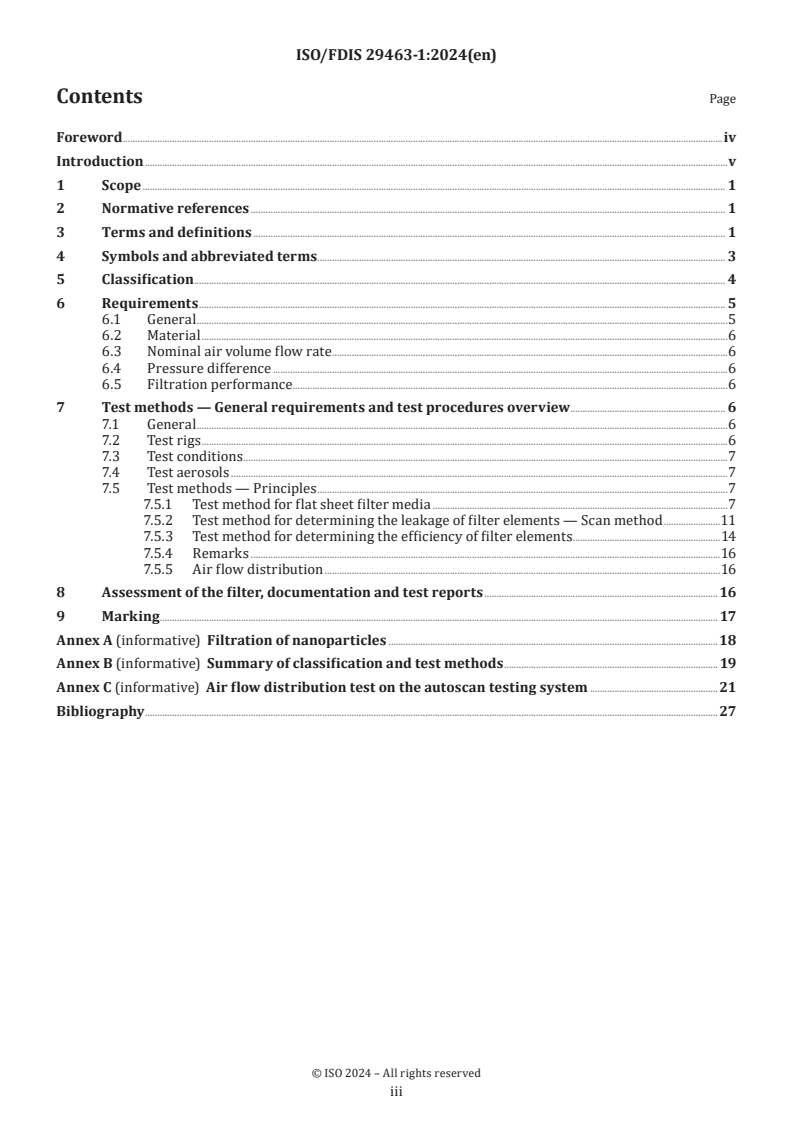
Contents Page
Foreword .iv
Introduction .v
1 Scope . 1
2 Normative references . 1
3 Terms and definitions . 1
4 Symbols and abbreviated terms. 3
5 Classification . 4
6 Requirements . 5
6.1 General .5
6.2 Material .6
6.3 Nominal air volume flow rate .6
6.4 Pressure difference .6
6.5 Filtration performance . .6
7 Test methods — General requirements and test procedures overview . 6
7.1 General .6
7.2 Test rigs .6
7.3 Test conditions .7
7.4 Test aerosols .7
7.5 Test methods — Principles .7
7.5.1 Test method for flat sheet filter media .7
7.5.2 Test method for determining the leakage of filter elements — Scan method .11
7.5.3 Test method for determining the efficiency of filter elements .14
7.5.4 Remarks .16
7.5.5 Air flow distribution .16
8 Assessment of the filter, documentation and test reports .16
9 Marking . . 17
Annex A (informative) Filtration of nanoparticles .18
Annex B (informative) Summary of classification and test methods . 19
Annex C (informative) Air flow distribution test on the autoscan testing system .21
Bibliography .27
iii
ISO/FDIS 29463-1:2024(en)
Foreword
ISO (the International Organization for Standardization) is a worldwide federation of national standards
bodies (ISO member bodies). The work of preparing International Standards is normally carried out through
ISO technical committees. Each member body interested in a subject for which a technical committee
has been established has the right to be represented on that committee. International organizations,
governmental and non-governmental, in liaison with ISO, also take part in the work. ISO collaborates closely
with the International Electrotechnical Commission (IEC) on all matters of electrotechnical standardization.
The procedures used to develop this document and those intended for its further maintenance are described
in the ISO/IEC Directives, Part 1. In particular, the different approval criteria needed for the different types
of ISO documents should be noted. This document was drafted in accordance with the editorial rules of the
ISO/IEC Directives, Part 2 (see www.iso.org/directives).
ISO draws attention to the possibility that the implementation of this document may involve the use of (a)
patent(s). ISO takes no position concerning the evidence, validity or applicability of any claimed patent
rights in respect thereof. As of the date of publication of this document, ISO had not received notice of (a)
patent(s) which may be required to implement this document. However, implementers are cautioned that
this may not represent the latest information, which may be obtained from the patent database available at
www.iso.org/patents. ISO shall not be held responsible for identifying any or all such patent rights.
Any trade name used in this document is information given for the convenience of users and does not
constitute an endorsement.
For an explanation of the voluntary nature of standards, the meaning of ISO specific terms and expressions
related to conformity assessment, as well as information about ISO's adherence to the World Trade
Organization (WTO) principles in the Technical Barriers to Trade (TBT), see www.iso.org/iso/foreword.html.
This document was prepared by Technical Committee ISO/TC 142, Cleaning equipment for air and other gases.
This third edition cancels and replaces the second edition (ISO 29463-1:2017), which has been technically
revised.
The main changes are as follows:
— two E classes have been included in Tables 1 and 2;
— informative Annex C for measuring air velocity uniformity has been added.
A list of all parts in the ISO 29463 series can be found on the ISO website.
Any feedback or questions on this document should be directed to the user’s national standards body. A
complete listing of these bodies can be found at www.iso.org/member.html.
iv
ISO/FDIS 29463-1:2024(en)
Introduction
The ISO 29463 series is derived from the EN 1822 series. It contains requirements, fundamental principles
of testing and the marking for high-efficiency particulate air filters with efficiencies from 85 % to
99,999 995 % that can be used for classifying filters in general or for specific use by agreement between
users and suppliers.
The ISO 29463 series establishes a procedure for the determination of the efficiency of all filters on the basis
of a particle counting method using a liquid (or alternatively a solid) test aerosol and allows a standardized
classification of these filters in terms of their efficiency, both local and overall efficiency, which covers most
needs of different applications. The difference between this document and other national standards lies
in the technique used for the determination of the overall efficiency. Instead of mass relationships or total
concentrations, this technique is based on particle counting at the most penetrating particle size (MPPS),
which for micro fibre-glass filter media is usually in the range of 0,12 μm to 0,25 μm. This method also
allows testing ultra-low penetration air filters, which was not possible with the previous test methods
because of their inadequate sensitivity. For membrane filter media, separate rules apply, and are described
in ISO 29463-5:2022, Annex B. Although no equivalent test procedures for testing filters with charged media
is prescribed, a method for dealing with these types of filters is described in ISO 29463-5:2022, Annex C.
Specific requirements for testing method, frequency, and reporting requirements may be modified by
agreement between supplier and customer. For lower efficiency filters (Group H, as described in Clause 5),
alternate leak test methods noted in ISO 29463-4:2011, Annex A may be used by specific agreement between
users and suppliers, but only if the use of these other methods is clearly designated in the filter markings, as
noted in the annex. Although the methods prescribed in this document can be generally used to determine
filter performance for nano-size particles, testing or classification of filters for nano-size particles are
beyond the scope of this document (see Annex A for additional information).
There are differences between the ISO 29463 series and other normative practices common in several
countries. For example, many of these rely on total aerosol concentrations rather than individual particles.
A brief summary of these methods and their reference standards is provided in ISO 29463-5:2022, Annex A.
v
FINAL DRAFT International Standard ISO/FDIS 29463-1:2024(en)
High efficiency filters and filter media for removing particles
in air —
Part 1:
Classification, performance, testing and marking
1 Scope
This document establishes a classification of filters based on their performance, as determined in accordance
with ISO 29463-3, ISO 29463-4 and ISO 29463-5. It also provides an overview of the test procedures and
specifies general requirements for a
...
ISO/FDIS 29463-1:2024(E)
ISO/TC 142
Secretariat: UNI
Date: 2024-02-2804-29
High Efficiency Filtersefficiency filters and Filter Mediafilter media
for Removing Particles from Air — removing particles in air —
Part 1:
Classification, performance, testing and marking
Filtres à haut rendement et filtres pour l'élimination des particules dans l'air —
Partie 1: Classification, essais de performance et marquage
FDIS stage
ISO/FDIS 29463-1:2024(Een)
All rights reserved. Unless otherwise specified, or required in the context of its implementation, no part of this publication
may be reproduced or utilized otherwise in any form or by any means, electronic or mechanical, including photocopying,
or posting on the internet or an intranet, without prior written permission. Permission can be requested from either ISO
at the address below or ISO’s member body in the country of the requester.
ISO copyright office
CP 401 • Ch. de Blandonnet 8
CH-1214 Vernier, Geneva
Phone: + 41 22 749 01 11
EmailE-mail: copyright@iso.org
Website: www.iso.org
Published in Switzerland
ii © ISO 2024 – All rights reserved
ii
ISO/FDIS 29463-1:2024(Een)
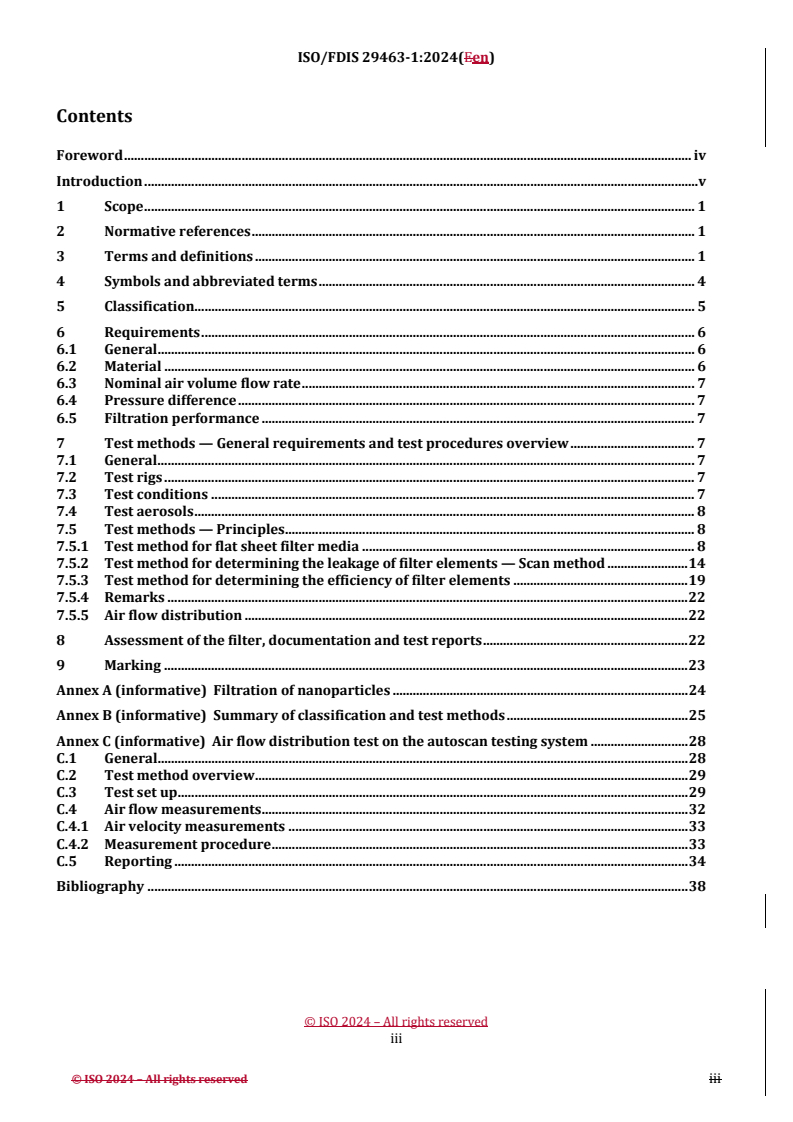
Contents
Foreword . iv
Introduction . v
1 Scope . 1
2 Normative references . 1
3 Terms and definitions . 1
4 Symbols and abbreviated terms . 4
5 Classification. 5
6 Requirements . 6
6.1 General . 6
6.2 Material . 6
6.3 Nominal air volume flow rate . 7
6.4 Pressure difference . 7
6.5 Filtration performance . 7
7 Test methods — General requirements and test procedures overview . 7
7.1 General . 7
7.2 Test rigs . 7
7.3 Test conditions . 7
7.4 Test aerosols . 8
7.5 Test methods — Principles. 8
7.5.1 Test method for flat sheet filter media . 8
7.5.2 Test method for determining the leakage of filter elements — Scan method . 14
7.5.3 Test method for determining the efficiency of filter elements . 19
7.5.4 Remarks . 22
7.5.5 Air flow distribution . 22
8 Assessment of the filter, documentation and test reports . 22
9 Marking . 23
Annex A (informative) Filtration of nanoparticles . 24
Annex B (informative) Summary of classification and test methods . 25
Annex C (informative) Air flow distribution test on the autoscan testing system . 28
C.1 General . 28
C.2 Test method overview . 29
C.3 Test set up . 29
C.4 Air flow measurements . 32
C.4.1 Air velocity measurements . 33
C.4.2 Measurement procedure . 33
C.5 Reporting . 34
Bibliography . 38
iii
ISO/FDIS 29463-1:2024(Een)
Foreword
ISO (the International Organization for Standardization) is a worldwide federation of national standards
bodies (ISO member bodies). The work of preparing International Standards is normally carried out through
ISO technical committees. Each member body interested in a subject for which a technical committee has been
established has the right to be represented on that committee. International organizations, governmental and
non-governmental, in liaison with ISO, also take part in the work. ISO collaborates closely with the
International Electrotechnical Commission (IEC) on all matters of electrotechnical standardization.
The procedures used to develop this document and those intended for its further maintenance are described
in the ISO/IEC Directives, Part 1. In particular, the different approval criteria needed for the different types of
ISO documentdocuments should be noted. This document was drafted in accordance with the editorial rules
of the ISO/IEC Directives, Part 2 (see www.iso.org/directives).
ISO draws attention to the possibility that the implementation of this document may involve the use of (a)
patent(s). ISO takes no position concerning the evidence, validity or applicability of any claimed patent rights
in respect thereof. As of the date of publication of this document, ISO had not received notice of (a) patent(s)
which may be required to implement this document. However, implementers are cautioned that this may not
represent the latest information, which may be obtained from the patent database available at
www.iso.org/patents. ISO shall not be held responsible for identifying any or all such patent rights.
Any trade name used in this document is information given for the convenience of users and does not
constitute an endorsement.
For an explanation of the voluntary nature of standards, the meaning of ISO specific terms and expressions
related to conformity assessment, as well as information about ISO's adherence to the World Trade
Organization (WTO) principles in the Technical Barriers to Trade (TBT), see www.iso.org/iso/foreword.html.
This document was prepared by Technical Committee ISO/TC 142, Cleaning equipment for air and other gases.
This third edition cancels and replaces the second edition (ISO 29463-1:2017), which has been technically
revised.
The main changes are as follows:
— — two E classes have been included in Tables 1Tables 1 and 22;;
— — informative Annex CAnnex C for measuring air velocity uniformity has been added.
A list of all parts in the ISO 29463 series can be found on the ISO website.
Any feedback or questions on this document should be directed to the user’s national standards body. A
complete listing of these bodies can be found at www.iso.org/member.html.
iv © ISO 2024 – All rights reserved
iv
ISO/FDIS 29463-1:2024(Een)
Introduction
The ISO 29463 series is derived from the EN 1822 series. It contains requirements, fundamental principles of
testing and the marking for high-efficiency particulate air filters with efficiencies from 85 % to 99,999 995 %
that can be used for classifying filters in general or for specific use by agreement between users and suppliers.
The ISO 29463 series establishes a procedure for the determination of the efficiency of all filters on the basis
of a particle counting method using a liquid (or alternatively a solid) test aerosol and allows a standardized
classification of these filters in terms of their efficiency, both local and overall efficiency, which actually covers
most needs of different applications. The difference between this document and other national standards lies
in the technique used for the determination of the overall efficiency. Instead of mass relationships or total
concentrations, this technique is based on particle counting at the most penetrating particle size (MPPS),
which for micro fiberfibre-glass filter media is usually in the range of 0,12 μm to 0,25 μm. This method also
allows testing ultra-low penetration air filters, which was not possible with the previous test methods because
of their inadequate sensitivity. For membrane filter media, separate rules apply, and are described in
ISO 29463-5:2022, Annex B. Although no equivalent test procedures for testing filters with charged media is
prescribed, a method for dealing with these types of filters is described in ISO 29463-5:2022, Annex C. Specific
requirements for testing method, frequency, and reporting requirements may be modified by agreement
between supplier and customer. For lower efficiency filters (Group H, as described in Clause 5Clause 5),),
alternate leak test methods noted in ISO 29463-4:2011, Annex A may be used by specific agreement between
users and suppliers, but only if the use of these other methods is clearly designated in the filter markings, as
noted in the annex. Although the methods prescribed in this document can be generally used to determine
filter performance for nano-size particles, testing or classification of filters for nano-size particles are beyond
the scope of this document (see Annex AAnnex A for additional information).
There are differences between the ISO 29463 series and other normative practices common in several
countries. For example, many of these rely on total aerosol concentrations rather than individual particles. A
brief summary of these methods and their reference standards is provided in ISO 29463-5:2022, Annex A.
v
FINAL DRAFT INTERNATIONAL STANDARD ISO/FDIS 29463-1:2024(E)
High Efficiency Filtersefficiency filters and Filter Mediafilter media for
Removing Particles from Air — removing particles in air —
Part 1:
Classification, performance, testing and marking
1 Scope
This document establishes a classification of filters based on their performance, as determined in accordance
with ISO 29463-3, ISO 29463-4 and ISO 29463-5. It also provides an overview of the test procedures and
specifies general requirements for assessing and marking the filters, as well as for documenting the test
results. It is intended to be used in conjunction with ISO 29463-2, ISO 29463-3, ISO 29463-4 and ISO 29463-
5.
2 Normative references
The following documents are referred to in the text in such a way that some or all of their content constitutes
requirements of this document. For dated references, only the edition cited applies. For undated references,
the latest edition of the referenced document (including any amendments) applies.
ISO 29463--2:2011, High-efficiency filters and filter media for removing particles in air — Part 2: Aerosol
production, measuring equipment and particle-counting statistics
ISO 29463--3:2011, High-efficiency filters and filter media for removing particles in air — Part 3: Testing flat
sheet filter media
ISO 29463--4:2011, High-efficiency filters and filter media for removing particles in air — Part 4: Test method
for determining leakage of filter elements-Scan method
ISO 29463--5:2022, High-efficiency filters and filter media for removing particles in air — Part 5: Test method
for filter elements
3 Terms and definitions
For the purposes of this document, the following terms and definitions apply.
ISO and IEC maintain terminology databases for use in standardization at the following addresses:
— — ISO Online browsing platform: available at https://www.iso.org/obp
— — IEC Electropedia: available at
...
Questions, Comments and Discussion
Ask us and Technical Secretary will try to provide an answer. You can facilitate discussion about the standard in here.