

ISO/IEC 11694-6:2014
(Main)Identification cards — Optical memory cards — Linear recording method — Part 6: Use of biometrics on an optical memory card
General Information
- Abstract
ISO/IEC 11694-6:2014 describes the use of biometric data on optical memory cards using the logical data structure described in ISO/IEC 11694-5.
- Status
- Published
- Publication Date
- 23-Jun-2014
- Technical Committee
- ISO/IEC JTC 1/SC 17 - Cards and security devices for personal identification
- Current Stage
- 9093 - International Standard confirmed
- Start Date
- 11-Oct-2019
- Completion Date
- 29-Aug-2026
Buy Documents

ISO/IEC 11694-6:2014 - Identification cards -- Optical memory cards -- Linear recording method
ISO/IEC 11694-6:2014 - Identification cards — Optical memory cards — Linear recording method — Part 6: Use of biometrics on an optical memory card/24/2014
Overview
ISO/IEC 11694-6:2014 is an international standard specifying the use of biometric data on optical memory cards employing the linear recording method. As part six of the ISO/IEC 11694 series, it defines how biometric information is organized and accessed on optical memory cards according to the logical data structure outlined in ISO/IEC 11694-5. This standard ensures reliable storage and interoperability of biometric data for enhanced identification and personal verification systems using optical memory cards.
Key Topics
Biometric Data on Optical Cards
The standard describes a structured approach for storing biometric data such as fingerprints, facial images, iris scans, and signatures on optical memory cards. Biometric data can be encoded or raw, and the standard facilitates their interchange using predefined tags.Logical Data Structure
ISO/IEC 11694-6 relies on the logical data format introduced in ISO/IEC 11694-5, enabling applications to read biometric data as discrete items identified by standardized tags.Biometric Tag Ranges
To categorize biometric data, the standard defines specific ranges of tags for different biometric types:- 2000–2999: Encoded facial or head biometrics (face, ear)
- 3000–3999: Encoded finger biometrics (fingerprints, finger attributes)
- 4000–4999: Encoded eye biometrics (iris, retina)
- 5000–5999: Encoded hand or foot biometrics (hand geometry, palm prints)
- 6000–6999: Raw images (e.g., facial portraits)
- 7000–7999: Raw images of fingerprints
- 8000–8999: Pen-based signature data
- 12200–12299: Molecular or cellular data (DNA, body odor)
- 12300–12399: Behavioral biometrics (gait, voice, keystroke)
- 12400–12799 and 12800–12899: Other biometric data, conforming or not to the Common Biometric Exchange Formats Framework (CBEFF)
Support for CBEFF Formats
The standard endorses the use of biometric data formatted according to the Common Biometric Exchange Formats Framework (ISO/IEC 19785-1). It includes assigned tags for CBEFF-conforming biometrics such as finger minutiae, face images, iris data, and signature/time series data.Interoperability and Data Discovery
To facilitate reading applications in discovering relevant biometric data, ISO/IEC 11694-6 supports the use of a reserved tag (12900) containing headers referencing CBEFF files stored on the card. This allows software to identify and parse biometric content efficiently, even when unknown or new tags are present.
Applications
Secure Identification Cards
Governments and organizations can issue optical memory cards with embedded biometric data for identity verification in passports, driver licenses, and access control cards.Biometric Authentication Systems
The standard supports interoperability among biometric readers and systems that utilize optical memory cards to store and retrieve templates such as fingerprint or facial data for authentication.Multi-Modal Biometric Storage
Cards can contain multiple types of biometric data, enabling flexible and robust multi-modal identity verification.Law Enforcement and Border Control
Optical memory cards compliant with ISO/IEC 11694-6 can be employed by authorities requiring reliable biometric identification methods that conform to international standards.
Related Standards
ISO/IEC 11694 Series
- Part 1: Physical characteristics of optical memory cards
- Part 2: Dimensions and accessible optical area
- Part 3: Optical properties and characteristics
- Part 4: Logical data structures
- Part 5: Data formats for information interchange on optical memory cards
Common Biometric Exchange Formats Framework (CBEFF)
- ISO/IEC 19785-1: Data element specification for biometric data interchange
Biometric Data Interchange Formats (ISO/IEC 19794 series)
- Part 2: Finger minutiae data
- Part 3: Finger pattern spectral data
- Part 4: Finger image data
- Part 5: Face image data
- Part 6: Iris image data
- Part 7: Signature/sign time series data
- Part 8: Finger pattern skeletal data
Conclusion
ISO/IEC 11694-6:2014 standardizes the secure and efficient storage and interchange of biometric data on optical memory cards using the linear recording method. By leveraging logical data structures and an established tagging system aligned with recognized biometric standards such as CBEFF, it enhances interoperability and adoption of biometric technology in identification applications worldwide. This standard is essential for developers and organizations implementing biometric-enabled optical memory cards for secure personal identification and authentication systems.
Relations
- Consolidated By
ISO 4042:2018 - Fasteners — Electroplated coating systems - Effective Date
- 06-Jun-2022
- Effective Date
- 04-Feb-2012
Buy Documents
ISO/IEC 11694-6:2014 - Identification cards -- Optical memory cards -- Linear recording method
ISO/IEC 11694-6:2014 - Identification cards — Optical memory cards — Linear recording method — Part 6: Use of biometrics on an optical memory card/24/2014
Get Certified
Connect with accredited certification bodies for this standard

BSI Group
BSI (British Standards Institution) is the business standards company that helps organizations make excellence a habit.

NYCE
Mexican standards and certification body.
Sponsored listings
Frequently Asked Questions
ISO/IEC 11694-6:2014 is a standard published by the International Organization for Standardization (ISO). Its full title is "Identification cards — Optical memory cards — Linear recording method — Part 6: Use of biometrics on an optical memory card". This standard covers: ISO/IEC 11694-6:2014 describes the use of biometric data on optical memory cards using the logical data structure described in ISO/IEC 11694-5.
ISO/IEC 11694-6:2014 describes the use of biometric data on optical memory cards using the logical data structure described in ISO/IEC 11694-5.
ISO/IEC 11694-6:2014 is classified under the following ICS (International Classification for Standards) categories: 35.240.15 - Identification cards. Chip cards. Biometrics. The ICS classification helps identify the subject area and facilitates finding related standards.
ISO/IEC 11694-6:2014 has the following relationships with other standards: It is inter standard links to ISO 4042:2018, ISO/IEC 11694-6:2006. Understanding these relationships helps ensure you are using the most current and applicable version of the standard.
ISO/IEC 11694-6:2014 is available in PDF format for immediate download after purchase. The document can be added to your cart and obtained through the secure checkout process. Digital delivery ensures instant access to the complete standard document.
Standards Content (Sample)
INTERNATIONAL ISO/IEC
STANDARD 11694-6
Second edition
2014-07-01
Identification cards — Optical
memory cards — Linear recording
method —
Part 6:
Use of biometrics on an optical
memory card
Cartes d’identification — Cartes à mémoire optique — Méthode
d’enregistrement linéaire —
Partie 6: Emploi de la biométrie sur une carte à mémoire optique
Reference number
©
ISO/IEC 2014
© ISO/IEC 2014
All rights reserved. Unless otherwise specified, no part of this publication may be reproduced or utilized otherwise in any form
or by any means, electronic or mechanical, including photocopying, or posting on the internet or an intranet, without prior
written permission. Permission can be requested from either ISO at the address below or ISO’s member body in the country of
the requester.
ISO copyright office
Case postale 56 • CH-1211 Geneva 20
Tel. + 41 22 749 01 11
Fax + 41 22 749 09 47
E-mail copyright@iso.org
Web www.iso.org
Published in Switzerland
ii © ISO/IEC 2014 – All rights reserved
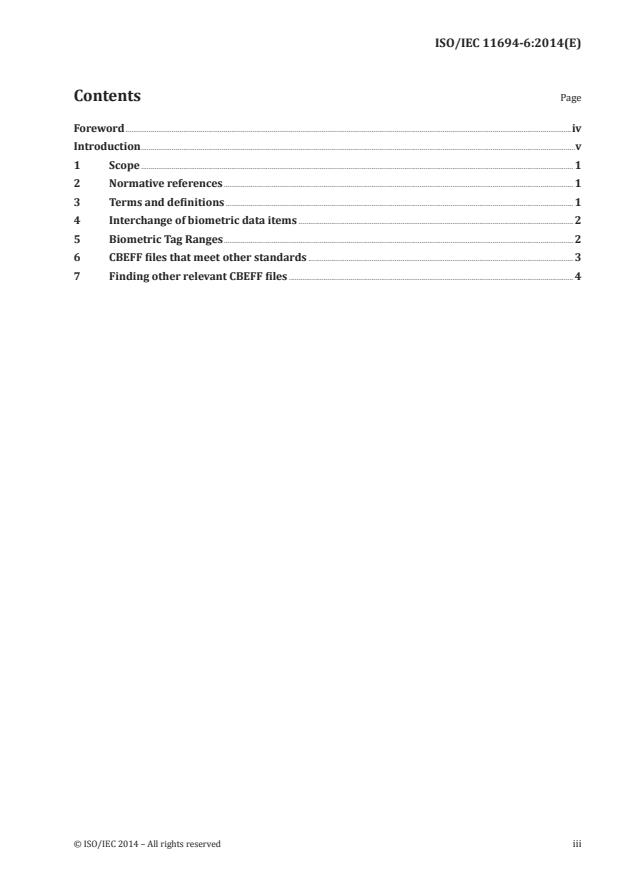
Contents Page
Foreword .iv
Introduction .v
1 Scope .1
2 Normative references .1
3 Terms and definitions .1
4 Interchange of biometric data items . 2
5 Biometric Tag Ranges . 2
6 CBEFF files that meet other standards .3
7 Finding other relevant CBEFF files .4
© ISO/IEC 2014 – All rights reserved iii
Foreword
ISO (the International Organization for Standardization) is a worldwide federation of national standards
bodies (ISO member bodies). The work of preparing International Standards is normally carried out
through ISO technical committees. Each member body interested in a subject for which a technical
committee has been established has the right to be represented on that committee. International
organizations, governmental and non-governmental, in liaison with ISO, also take part in the work.
ISO collaborates closely with the International Electrotechnical Commission (IEC) on all matters of
electrotechnical standardization.
The procedures used to develop this document and those intended for its further maintenance are
described in the ISO/IEC Directives, Part 1. In particular the different approval criteria needed for the
different types of ISO documents should be noted. This document was drafted in accordance with the
editorial rules of the ISO/IEC Directives, Part 2 (see www.iso.org/directives).
Attention is drawn to the possibility that some of the elements of this document may be the subject of
patent rights. ISO shall not be held responsible for identifying any or all such patent rights. Details of
any patent rights identified during the development of the document will be in the Introduction and/or
on the ISO list of patent declarations received (see www.iso.org/patents).
Any trade name used in this document is information given for the convenience of users and does not
constitute an endorsement.
For an explanation on the meaning of ISO specific terms and expressions related to conformity
assessment, as well as information about ISO’s adherence to the WTO principles in the Technical Barriers
to Trade (TBT) see the following URL: Foreword - Supplementary information
The committee responsible for this document is ISO/IEC JTC1, Information technology, Subcommittee
SC 17, Cards and personal identification.
This second edition cancels and replaces the first edition (ISO/IEC 11694-6:2006), which has been
technically revised.
ISO/IEC 11694 consists of the following parts, under the general title Identification cards — Optical
memory cards — Linear recording method:
— Part 1: Physical characteristics
— Part 2: Dimensions and location of the accessible optical area
— Part 3: Optical properties and characteristics
— Part 4: Logical data structures
— Part 5: Data format for information interchange for applications using ISO/IEC 11694‑4
— Part 6: Use of biometrics on an optical memory card
iv © ISO/IEC 2014 – All rights reserved
Introduction
This part of ISO/IEC 11694 is one of a series of International Standards defining the parameters for
optical memory cards and the use of such cards for the storage and interchange of digital data.
This part of ISO/IEC 11694 is specific to optical memory cards using the linear recording method.
Characteristics which apply to other specific recording methods shall be found in separate International
Standards.
This part of ISO/IEC 11694 describes the use of biometric data on an optical memory card. It uses the
logical structure defined in ISO/IEC 11694-5 to facilitate the interchange of biometric data written to
optical memory cards using the linear recording method.
All numbers in this document are written in decimal notation unless otherwise specified.
© ISO/IEC 2014 – All rights reserved v
INTERNATIONAL STANDARD ISO/IEC 11694-6:2014(E)
Identification cards — Optical memory cards — Linear
recording method —
Part 6:
Use of biometrics on an optical memory card
1 Scope
This part of ISO/IEC 11694 describes the use of biometric data on optical memory cards using the logical
data structure described in ISO/IEC 11694-5.
2 Normative references
The following documents, in whole or in part, are normatively referenced in this document and are
indispensable for its application. For dated references, only the edition cited applies. For undated
references, the latest edition of the referenced document (including any amendments) applies.
ISO/IEC 11694-4, Identification cards — Optical memory cards — Linear recording method — Part 4:
Logical data structures.
ISO/IEC 11694-5, Identification cards — Optical memory cards — Linear recording method — Part 5: Data
format for information interchange for applications using ISO/IEC 11694‑4
ISO/IEC 19785-1, Information technology — Common Biometric Exchange Formats Framework — Part 1:
Data element specification
ISO/IEC 19794-2, Information technology — Biometric data interchange formats — Part 2: Finger minutiae
data
ISO/IEC 19794-3, Information technology — Biometric data interchange formats — Part 3: Finger pattern
spectral data
ISO/IEC 19794-4, Information technology — Biometric data interchange formats — Part 4: Finger image
data
ISO/IEC 19794-5, Information technology — Biometric data interchange formats — Part 5: Face image
data
ISO/IEC 19794-6, Information technology — Biometric data interchange formats — Part 6: Iris image data
ISO/IEC 19794-7, Information technology — Biometric data interchange formats — Part 7: Signature/sign
time series data
ISO/IEC 19794-8, Information technology — Biometric data interchange formats — Part 8: Finger pattern
skeletal data
3 Terms and definitions
For the purposes of this document, the terms and definitions given in ISO/IEC 11694-4, ISO/IEC 11694-
5, ISO/IEC 19785-1, and the following, apply.
© ISO/IEC 2014 – All rights reserved 1
3.1
biometric data
set of bytes that describes the physical properties of one or more parts of a living body
EXAMPLE The encoded template which mathematically describes a person’s fingerprint. This template can
be compared against the fingerprint of the person who is presenting the card.
3.2
CBEFF file
biometric data file (a set of bytes) that conforms to ISO/IEC 19875-1
3.3
encoded biometric data
biometric data that has been interpreted and encoded
3.4
raw biometric data
biometric data obtained directly from a biometric device
4 Interchange of biometric data items
ISO/IEC 11694-5 allows for the interchange of all types of data on optical cards by specifying both the
directory structure on the card and the method of identifying individual data items that are written to
the card. Using the data format described in ISO/IEC 11694-5, biometric data are accessed in much the
same manner as any other type of data on an optical memory card.
This being the case, this part of the standard specifies tags and structures which facilitate and which
are specific to accessing biometric data items on a card.
Typically, an application that reads a given card looks on that card for tags that correspond to data items
that the application knows how to use, based on the published tag document. ISO/IEC 11694-5 includes a
set of defined tag ranges that assist a reading application in accessing useful biometric data on the card
in the absence of the application’s knowledge of a particular tag.
EXAMPLE The reader requires from the card, images of one or more of the cardholder’s fingerprints. It
queries the card for any data with tags in the range from 7000 through 7999. Tags in this range correspond to
data items containing raw fingerprint images. If the card co
...
INTERNATIONAL ISO/IEC
STANDARD 11694-6
Second edition
2014-07-01
Identification cards — Optical
memory cards — Linear recording
method —
Part 6:
Use of biometrics on an optical
memory card
Cartes d’identification — Cartes à mémoire optique — Méthode
d’enregistrement linéaire —
Partie 6: Emploi de la biométrie sur une carte à mémoire optique
Reference number
©
ISO/IEC 2014
© ISO/IEC 2014
All rights reserved. Unless otherwise specified, no part of this publication may be reproduced or utilized otherwise in any form
or by any means, electronic or mechanical, including photocopying, or posting on the internet or an intranet, without prior
written permission. Permission can be requested from either ISO at the address below or ISO’s member body in the country of
the requester.
ISO copyright office
Case postale 56 • CH-1211 Geneva 20
Tel. + 41 22 749 01 11
Fax + 41 22 749 09 47
E-mail copyright@iso.org
Web www.iso.org
Published in Switzerland
ii © ISO/IEC 2014 – All rights reserved
Contents Page
Foreword .iv
Introduction .v
1 Scope .1
2 Normative references .1
3 Terms and definitions .1
4 Interchange of biometric data items . 2
5 Biometric Tag Ranges . 2
6 CBEFF files that meet other standards .3
7 Finding other relevant CBEFF files .4
© ISO/IEC 2014 – All rights reserved iii
Foreword
ISO (the International Organization for Standardization) is a worldwide federation of national standards
bodies (ISO member bodies). The work of preparing International Standards is normally carried out
through ISO technical committees. Each member body interested in a subject for which a technical
committee has been established has the right to be represented on that committee. International
organizations, governmental and non-governmental, in liaison with ISO, also take part in the work.
ISO collaborates closely with the International Electrotechnical Commission (IEC) on all matters of
electrotechnical standardization.
The procedures used to develop this document and those intended for its further maintenance are
described in the ISO/IEC Directives, Part 1. In particular the different approval criteria needed for the
different types of ISO documents should be noted. This document was drafted in accordance with the
editorial rules of the ISO/IEC Directives, Part 2 (see www.iso.org/directives).
Attention is drawn to the possibility that some of the elements of this document may be the subject of
patent rights. ISO shall not be held responsible for identifying any or all such patent rights. Details of
any patent rights identified during the development of the document will be in the Introduction and/or
on the ISO list of patent declarations received (see www.iso.org/patents).
Any trade name used in this document is information given for the convenience of users and does not
constitute an endorsement.
For an explanation on the meaning of ISO specific terms and expressions related to conformity
assessment, as well as information about ISO’s adherence to the WTO principles in the Technical Barriers
to Trade (TBT) see the following URL: Foreword - Supplementary information
The committee responsible for this document is ISO/IEC JTC1, Information technology, Subcommittee
SC 17, Cards and personal identification.
This second edition cancels and replaces the first edition (ISO/IEC 11694-6:2006), which has been
technically revised.
ISO/IEC 11694 consists of the following parts, under the general title Identification cards — Optical
memory cards — Linear recording method:
— Part 1: Physical characteristics
— Part 2: Dimensions and location of the accessible optical area
— Part 3: Optical properties and characteristics
— Part 4: Logical data structures
— Part 5: Data format for information interchange for applications using ISO/IEC 11694‑4
— Part 6: Use of biometrics on an optical memory card
iv © ISO/IEC 2014 – All rights reserved
Introduction
This part of ISO/IEC 11694 is one of a series of International Standards defining the parameters for
optical memory cards and the use of such cards for the storage and interchange of digital data.
This part of ISO/IEC 11694 is specific to optical memory cards using the linear recording method.
Characteristics which apply to other specific recording methods shall be found in separate International
Standards.
This part of ISO/IEC 11694 describes the use of biometric data on an optical memory card. It uses the
logical structure defined in ISO/IEC 11694-5 to facilitate the interchange of biometric data written to
optical memory cards using the linear recording method.
All numbers in this document are written in decimal notation unless otherwise specified.
© ISO/IEC 2014 – All rights reserved v
INTERNATIONAL STANDARD ISO/IEC 11694-6:2014(E)
Identification cards — Optical memory cards — Linear
recording method —
Part 6:
Use of biometrics on an optical memory card
1 Scope
This part of ISO/IEC 11694 describes the use of biometric data on optical memory cards using the logical
data structure described in ISO/IEC 11694-5.
2 Normative references
The following documents, in whole or in part, are normatively referenced in this document and are
indispensable for its application. For dated references, only the edition cited applies. For undated
references, the latest edition of the referenced document (including any amendments) applies.
ISO/IEC 11694-4, Identification cards — Optical memory cards — Linear recording method — Part 4:
Logical data structures.
ISO/IEC 11694-5, Identification cards — Optical memory cards — Linear recording method — Part 5: Data
format for information interchange for applications using ISO/IEC 11694‑4
ISO/IEC 19785-1, Information technology — Common Biometric Exchange Formats Framework — Part 1:
Data element specification
ISO/IEC 19794-2, Information technology — Biometric data interchange formats — Part 2: Finger minutiae
data
ISO/IEC 19794-3, Information technology — Biometric data interchange formats — Part 3: Finger pattern
spectral data
ISO/IEC 19794-4, Information technology — Biometric data interchange formats — Part 4: Finger image
data
ISO/IEC 19794-5, Information technology — Biometric data interchange formats — Part 5: Face image
data
ISO/IEC 19794-6, Information technology — Biometric data interchange formats — Part 6: Iris image data
ISO/IEC 19794-7, Information technology — Biometric data interchange formats — Part 7: Signature/sign
time series data
ISO/IEC 19794-8, Information technology — Biometric data interchange formats — Part 8: Finger pattern
skeletal data
3 Terms and definitions
For the purposes of this document, the terms and definitions given in ISO/IEC 11694-4, ISO/IEC 11694-
5, ISO/IEC 19785-1, and the following, apply.
© ISO/IEC 2014 – All rights reserved 1
3.1
biometric data
set of bytes that describes the physical properties of one or more parts of a living body
EXAMPLE The encoded template which mathematically describes a person’s fingerprint. This template can
be compared against the fingerprint of the person who is presenting the card.
3.2
CBEFF file
biometric data file (a set of bytes) that conforms to ISO/IEC 19875-1
3.3
encoded biometric data
biometric data that has been interpreted and encoded
3.4
raw biometric data
biometric data obtained directly from a biometric device
4 Interchange of biometric data items
ISO/IEC 11694-5 allows for the interchange of all types of data on optical cards by specifying both the
directory structure on the card and the method of identifying individual data items that are written to
the card. Using the data format described in ISO/IEC 11694-5, biometric data are accessed in much the
same manner as any other type of data on an optical memory card.
This being the case, this part of the standard specifies tags and structures which facilitate and which
are specific to accessing biometric data items on a card.
Typically, an application that reads a given card looks on that card for tags that correspond to data items
that the application knows how to use, based on the published tag document. ISO/IEC 11694-5 includes a
set of defined tag ranges that assist a reading application in accessing useful biometric data on the card
in the absence of the application’s knowledge of a particular tag.
EXAMPLE The reader requires from the card, images of one or more of the cardholder’s fingerprints. It
queries the card for any data with tags in the range from 7000 through 7999. Tags in this range correspond to
data items containing raw fingerprint images. If the card co
...