

SIST EN 2858-2:2001
(Main)Aerospace series - Titanium and titanium alloys - Forging stock and forgings - Technical specification - Part 2: Forging stock
- Abstract
This standard specifies the particular requirements for forging stock of grades 1 and 2 intended to be used for the manufacture of titanium and titanium alloy forgings. Unless otherwise specified, the requirements for grande 2 shall apply.
- Status
- Published
- Publication Date
- 31-Dec-2000
- Technical Committee
- SS SPL - Technical Board for the general field
- Current Stage
- 6060 - National Implementation/Publication (Adopted Project)
- Start Date
- 01-Jan-2001
- Due Date
- 01-Jan-2001
- Completion Date
- 01-Jan-2001

SIST EN 2858-2:2001 is a SIST standard in the aerospace series for titanium and titanium alloys. It specifies particular requirements for forging stock of grades 1 and 2 used to make titanium and titanium alloy forgings. In practice, it helps suppliers, forge shops, and purchasers agree on the material to be delivered before forging begins.
What does SIST EN 2858-2:2001 specify?
SIST EN 2858-2:2001 covers forging stock of grades 1 and 2 intended for the manufacture of titanium and titanium alloy forgings. The scope makes clear that the standard is about the starting material, not the finished forged part.
SIST EN 2858-2:2001 is Part 2 of a technical specification for the aerospace series. The scope also states a default rule: unless another requirement is stated, the requirements for grade 2 apply.
In practice, that means a buyer or quality team should use this standard when they need a controlled basis for ordering or receiving titanium-based forging stock for later aerospace forging operations.
What are the key requirements of SIST EN 2858-2:2001?
SIST EN 2858-2:2001 sets the particular requirements for two material grades, grade 1 and grade 2. This matters because the grade identifies which stock is being supplied and which requirements apply to it.
The standard is limited to forging stock used for titanium and titanium alloy forgings. That keeps the specification focused on input material for subsequent forging rather than on the finished component.
A central rule in the scope is that grade 2 requirements apply unless otherwise specified. In practice, that means users should treat grade 2 as the default reference point when no separate instruction is given.
The document belongs to the aerospace series. For users, that signals that the material control is intended for aerospace supply chains, where traceability and clear material definition are typically important.
The title and scope together show a split between forging stock and forgings. That distinction matters because acceptance of stock happens before the part is forged, so material ordering and incoming inspection need to match the stock specification rather than the final part specification.
The standard is a technical specification for a defined product form. For a supplier, that means the deliverable is not just titanium material in general, but forging stock meeting the stated grade requirements for later processing.
What terms does SIST EN 2858-2:2001 define?
Aerospace series - The family designation used in the title for standards applied to aerospace materials and products.
Titanium - The base metal named in the standard’s scope for the forging stock covered by the document.
Titanium alloy - An alloy based on titanium, included because the standard applies to both pure titanium and titanium-alloy forgings.
Forging stock - The material supplied for later forging operations, before it becomes the finished forged shape.
Forgings - The parts produced by forging that are made from the stock covered by this standard.
Grade 1 - One of the two grades named in the scope for which the standard gives particular requirements.
Grade 2 - The other named grade, and the default grade whose requirements apply unless another requirement is stated.
Who uses SIST EN 2858-2:2001?
Suppliers of titanium and titanium alloy forging stock use SIST EN 2858-2:2001 to offer material in a defined grade and product form. That helps them state exactly what they are delivering.
Forge shops and aerospace manufacturers use it when they buy or receive stock for making forgings. It gives them a common basis for deciding whether the incoming material is suitable for the intended forging process.
Quality managers and inspectors use it for material specification control and acceptance checks. It helps them verify that the stock ordered for forging matches the required grade and application.
Purchasers and specification writers use it when they prepare purchase descriptions for aerospace material supply. That reduces ambiguity about what kind of forging stock is being requested.
What changed in SIST EN 2858-2:2001 from the previous edition?
SIST EN 2858-2:2001 corresponds to EN 2858-2:1994.
What does the SIST EN 2858-2:2001 document contain?
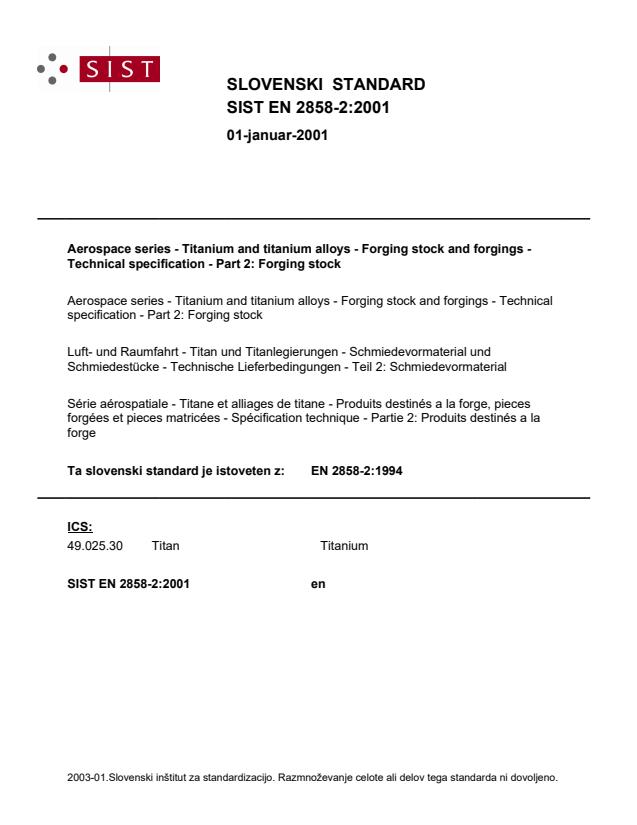
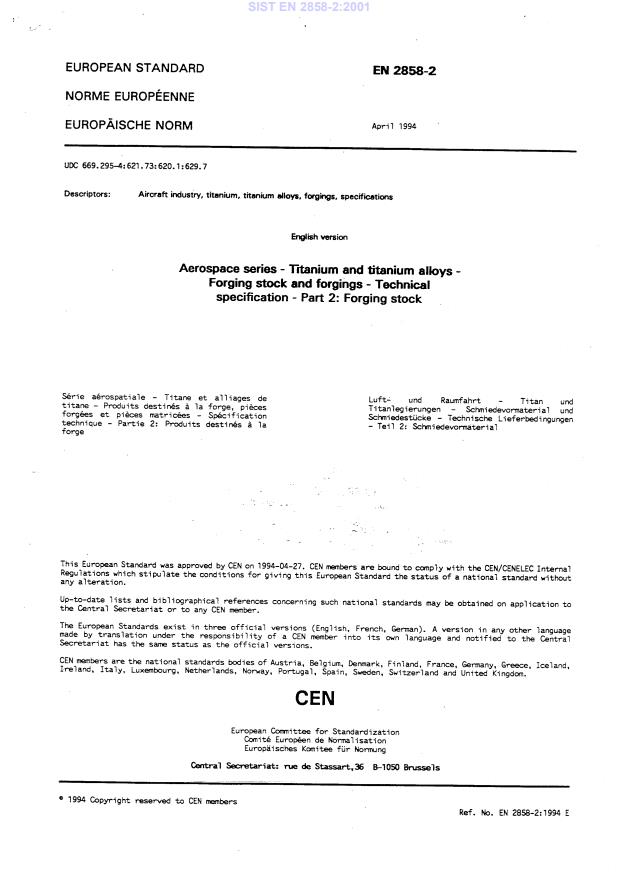
The document front matter identifies the standard in Slovene, German, French, and English, and gives the classification ICS 49.025.30. It also identifies the standard as being identical with EN 2858-2:1994.
The technical content signalled by the scope is a material specification for aerospace forging stock. It focuses on the product form, the named grades, and the rule that grade 2 applies by default unless otherwise stated.
For a buyer or quality team, the document serves as the reference for ordering, supplying, and checking titanium and titanium alloy forging stock before it is forged into finished parts.
Relations
- Effective Date
- 28-Jan-2026
- Effective Date
- 28-Jan-2026
- Effective Date
- 28-Jan-2026
- Effective Date
- 28-Jan-2026
Get Certified
Connect with accredited certification bodies for this standard

BUREAU VERITAS Certification Germany
Bureau Veritas certification in Germany.

Element Materials Technology
Materials testing and product certification.

AQMS Ltd.
AQMS provides ISO certification to SMEs across the UK.
Sponsored listings
Frequently Asked Questions
SIST EN 2858-2:2001 is a standard published by the Slovenian Institute for Standardization (SIST). Its full title is "Aerospace series - Titanium and titanium alloys - Forging stock and forgings - Technical specification - Part 2: Forging stock". This standard covers: This standard specifies the particular requirements for forging stock of grades 1 and 2 intended to be used for the manufacture of titanium and titanium alloy forgings. Unless otherwise specified, the requirements for grande 2 shall apply.
This standard specifies the particular requirements for forging stock of grades 1 and 2 intended to be used for the manufacture of titanium and titanium alloy forgings. Unless otherwise specified, the requirements for grande 2 shall apply.
SIST EN 2858-2:2001 is classified under the following ICS (International Classification for Standards) categories: 49.025.30 - Titanium. The ICS classification helps identify the subject area and facilitates finding related standards.
SIST EN 2858-2:2001 has the following relationships with other standards: It is inter standard links to SIST EN 2858-1:2001, SIST EN 2955:2025, SIST EN 3451:2017, SIST EN 2858-3:2001. Understanding these relationships helps ensure you are using the most current and applicable version of the standard.
SIST EN 2858-2:2001 is available in PDF format for immediate download after purchase. The document can be added to your cart and obtained through the secure checkout process. Digital delivery ensures instant access to the complete standard document.
Standards Content (Sample)
2003-01.Slovenski inštitut za standardizacijo. Razmnoževanje celote ali delov tega standarda ni dovoljeno.Aerospace series - Titanium and titanium alloys - Forging stock and forgings - Technical specification - Part 2: Forging stockLuft- und Raumfahrt - Titan und Titanlegierungen - Schmiedevormaterial und Schmiedestücke - Technische Lieferbedingungen - Teil 2: SchmiedevormaterialSérie aérospatiale - Titane et alliages de titane - Produits destinés a la forge, pieces forgées et pieces matricées - Spécification technique - Partie 2: Produits destinés a
...